Iran Turns Hormuz Into a Toll Booth. America Sends Paratroopers.
Tehran is formalizing its grip on the world's most critical oil chokepoint, charging ships in Chinese yuan to pass and barring anything with US or Israeli ties. Washington's response: paratroopers from the 82nd Airborne, more Marines, and a 15-point peace proposal that Iran publicly rejected before the ink dried.

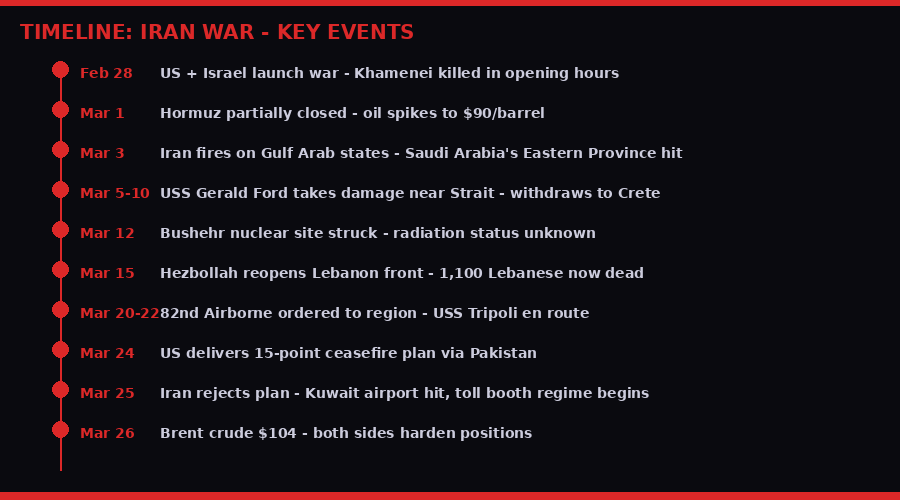
On Day 26 of a war neither side officially planned for - but both sides walked into anyway - the Iran conflict has reached a pivot point with no clear off-ramp. The Strait of Hormuz, once just a theory of leverage, is now a live control mechanism. Iran's paramilitary Revolutionary Guard is screening cargo, vetting crews, and demanding payment in yuan. At least two ships have already paid. And that number will grow.
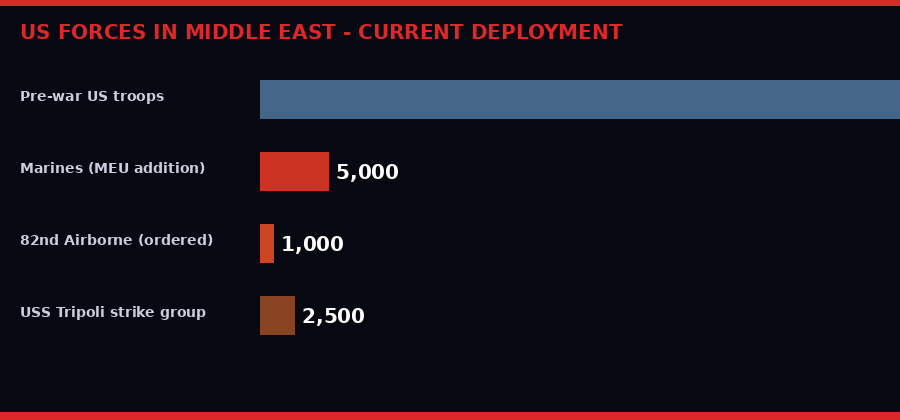
While Tehran formalizes its stranglehold on 20% of the world's traded oil, US Central Command is accelerating the largest Middle East force buildup in years. The 82nd Airborne - America's designated emergency response unit, the force built to parachute into contested territory and hold airfields - has been ordered to the region. At least 1,000 paratroopers, plus Major General Brandon Tegtmeier and division staff. That is not a rotation. That is a deployment with a purpose.
Brent crude sits at $104 a barrel, up more than 40% since the war began February 28. German Defense Minister Boris Pistorius, visiting Australia, put it plainly: "To make it crystal clear, this war is a catastrophe for world's economies." Nobody in Washington or Tehran seems to be listening.
The Strait Becomes a Cash Register

Lloyd's List Intelligence, the shipping data firm, is calling it a "de facto toll booth regime." The language is precise and damning. Iran is not just blocking ships - it is building a parallel customs infrastructure in one of the world's most legally contested waterways, and it is doing it at speed.
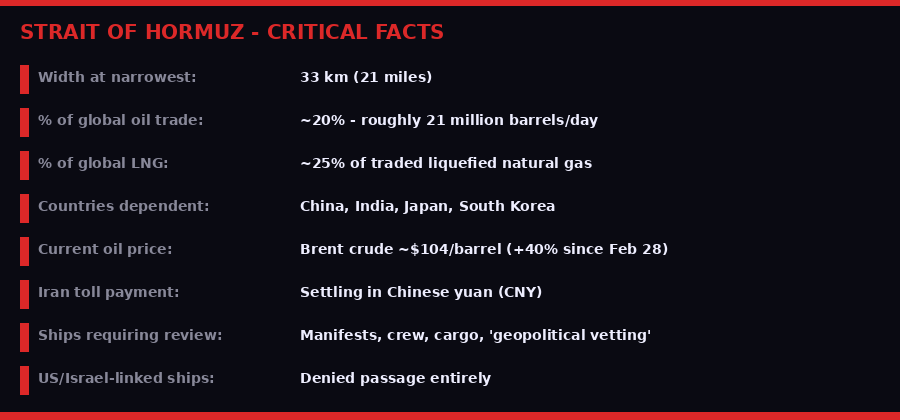
Here is how the system works, according to Lloyd's List and the Fars and Tasnim news agencies - both close to Iran's Revolutionary Guard. Ships seeking passage must submit manifests, crew lists, cargo details, and destination information to the Guard for screening. The vetting has three filters: sanctions alignment, cargo type (oil gets priority over everything else), and what is described internally as "geopolitical vetting" - meaning the Guard decides whether your national flag is acceptable.
"We provide its security, and it is natural that ships and oil tankers should pay such fees." - Mohammadreza Rezaei Kouchi, Iranian parliamentarian, quoted by Tasnim News Agency
At least two vessels have already paid in Chinese yuan. Iran's only remaining major trading partner is China, and the yuan payment system sidesteps US dollar clearing entirely - meaning Washington cannot use its standard financial pressure tools to track or block those transactions. It is an elegant piece of financial warfare woven into the physical blockade.
Any vessel perceived as linked to the United States or Israel is denied passage entirely. The Strait of Hormuz is 33 kilometers wide at its narrowest point. The internationally recognized shipping lanes - where the legal status of "international waters" applies - sit within that narrow band. Iran and Oman share territorial waters along the strait, but the lanes themselves have been treated as open to all shipping since the modern era of tanker traffic began.
Iran is now contesting that legal reality by force. Its parliament is working to formalize the fee structure in legislation. That would transform a wartime emergency measure into a permanent claim of sovereignty over the passage - a claim no US administration, current or future, will accept. (Source: AP News, March 26, 2026)
10,000 Targets Hit. More Troops Coming. What Is the Endgame?

US Navy Admiral Brad Cooper, who commands US military forces in the region as head of Central Command, released a video message Thursday that reads like a damage assessment and a warning rolled into one.
"We're not done yet. We are on a path to completely eliminate Iran's wider military apparatus." - Admiral Brad Cooper, Commander, US Central Command, March 26, 2026
Cooper's numbers are staggering. Since the US and Israel began the war on February 28, US forces have struck more than 10,000 targets in Iran. Ninety-two percent of Iran's largest naval ships have been destroyed. More than two-thirds of the country's missile, drone, and naval production facilities have been hit. That is not surgical precision - that is systematic dismantlement of a military industrial base.
And yet Iran is still fighting. Its remaining forces are operating, in the words of Foreign Minister Abbas Araghchi himself, as independent units acting on pre-issued general instructions rather than real-time command. The command structure is shattered. The forces are not. (Source: AP News analysis, March 2026)
Into this environment, Washington is sending its emergency force. The 82nd Airborne Division, based at Fort Bragg in North Carolina, is the US Army's rapid-deployment unit. It exists to do one specific thing: parachute into hostile or contested territory, secure airfields, and hold ground until heavier forces arrive. Its deployment to a theater where no US ground combat is officially occurring is either serious contingency planning or preparation for something imminent. The Pentagon did not specify which.
White House spokeswoman Anna Kelly, when asked about the deployment, deferred to the Pentagon and added: "President Trump always has all military options at his disposal." That is a non-answer designed to leave every option visible to Tehran. (Source: AP News, March 25, 2026)
Alongside the 82nd Airborne, the amphibious assault ship USS Tripoli is closing on the region with a 2,500-strong Marine strike group. A second Marine Expeditionary Unit is en route from San Diego. When all forces arrive, the US will have added approximately 8,500 combat-ready personnel to a theater where 50,000 American troops were already positioned. The focus, according to US officials, is a possible operation against Iran's Kharg Island oil terminal or other sites controlling access to the strait.
The Diplomacy That Isn't

The gap between what Washington says is happening and what Tehran says is happening may be the most dangerous feature of this conflict. It is not just spin - it is a structural communication failure that makes miscalculation more likely with every passing day.
Trump, speaking at a Washington fundraiser Wednesday night, insisted negotiations are underway. His team, he said, includes special envoy Steve Witkoff, son-in-law Jared Kushner, Secretary of State Marco Rubio, and Vice President JD Vance. "They are negotiating, by the way," Trump told donors, "and they want to make a deal so badly, but they're afraid to say it because they figure they'll be killed by their own people."
Iran's response to that characterization was swift and categorical. Foreign Minister Araghchi went on state television and stated that his government "has not engaged in talks to end the war, and we do not plan on any negotiations." He added a technical qualifier: the US had tried to send messages through third countries, "but that is not a conversation nor a negotiation."
Mohammad Bagher Qalibaf, speaker of Iran's parliament, denied Trump's claims of direct talks entirely. An Iranian military spokesman issued a statement vowing to fight "until complete victory." These are not the signals of a government preparing to accept a 15-point ceasefire proposal. (Source: AP News, March 25, 2026)
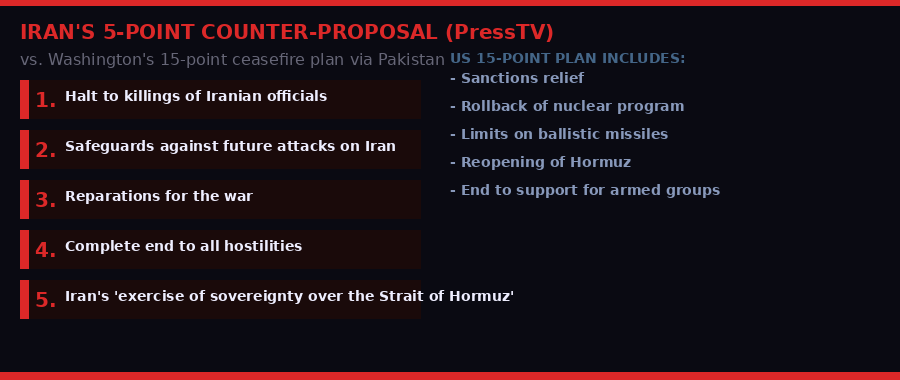
The 15-point proposal itself, transmitted through Pakistan as intermediary, reportedly covers: sanctions relief for Iran, a rollback of its nuclear program, limits on ballistic missiles, restrictions on support for regional armed groups, and - crucially - the reopening of the Strait of Hormuz. Egyptian and Pakistani officials who described the proposal to AP did so anonymously. Washington has not publicly confirmed the details.
Iran's counter-proposal, published by state TV's Press TV, runs to five points and reads as the mirror image of Washington's demands: a halt to killing Iranian officials, guarantees against future attacks on Iran, war reparations, a complete end to hostilities, and - in language designed to be unacceptable to any US president - Iran's "exercise of sovereignty over the Strait of Hormuz." Not access rights. Sovereignty.
Mediators were pushing for in-person talks in Pakistan as early as Friday. Iran's position as of Thursday morning suggests those talks, if they happen at all, will not be substantive. (Source: AP News, March 26, 2026)
Iran's Power Vacuum and the Revolutionary Guard's Unchecked War

A critical factor shaping Iran's refusal to negotiate is the question of who, exactly, is negotiating for whom. The answer is genuinely unclear - and that uncertainty is itself a source of danger.
Supreme Leader Ayatollah Ali Khamenei was killed in the opening hours of the war on February 28. His son Mojtaba, aged 56, was quickly named as successor. Mojtaba has not been seen in public since the airstrike that killed his father also killed his wife, Zahra Haddad Adel. US and Israeli officials have suggested he may have been wounded in the same attack. Israeli Prime Minister Netanyahu said publicly: "I'm not sure who's running Iran right now. Mojtaba, the replacement ayatollah, has not shown his face."
Ali Vaez, Iran project director at the International Crisis Group, describes the power structure bluntly: "The Revolutionary Guard is the state now." Before the war, civilian leadership was fully subordinate to the supreme leader, with the Guard as the second power center. With the elder Khamenei dead and his replacement invisible, "it is really the Revolutionary Guards who are running the country."
The Guards are not a negotiating authority. They are a fighting force with a revolutionary ideology and an institutional interest in continued conflict. Their expeditionary Quds Force built Iran's "Axis of Resistance" - Hezbollah, Hamas, Iraqi militias, the Houthis. They are not optimizing for a deal with Washington. They are optimizing for survival and, if possible, a negotiated outcome that preserves their institutional power.
Araghchi's own statement from March 1 - that military units were "now in fact independent and somehow isolated" and "acting based on instructions given to them in advance" - describes a military operating on autopilot. Strikes on Gulf Arab states like Oman, which had been acting as a nuclear talks intermediary, were described by Araghchi as "not our choice." That is either a lie or evidence of genuine command-and-control collapse. Neither interpretation is reassuring. (Source: AP News, March 2026)
Burcu Ozcelik of the Royal United Services Institute (RUSI) frames the long-term impact carefully: "Leadership matters, and the loss of key decision-makers spanning politics, intelligence, internal security and the army will have transformative consequences. The fixation on the terminology of 'regime collapse' is obscuring the fact that the regime is already changing."
The question for Washington is whether it can reach a ceasefire agreement with an entity whose command structure has been deliberately shattered by the war the US helped start.
The Human Cost Nobody Is Counting Properly

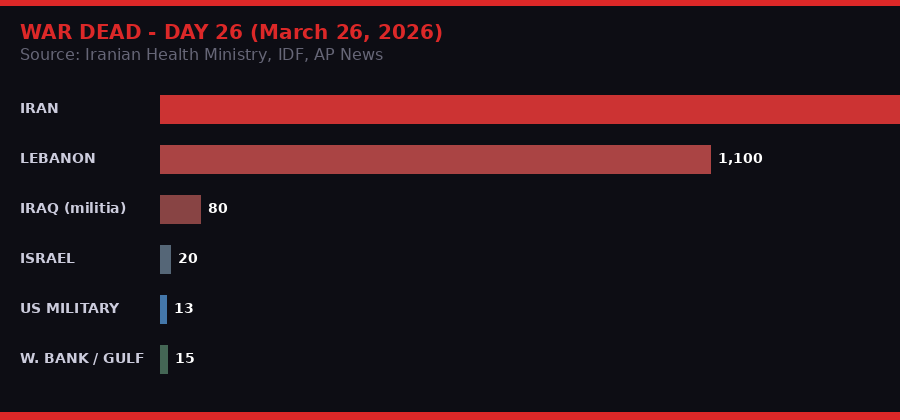
The confirmed death toll across the conflict sits at roughly 2,800 people as of Day 26. That number is almost certainly an undercount on the Iranian side, where the Health Ministry's figure of more than 1,500 dead covers only what can be officially acknowledged - not the destruction of military-adjacent civilian infrastructure in Isfahan, Tehran, and along the coast.
In Lebanon, nearly 1,100 people have been killed as Hezbollah has reopened its northern front against Israel, firing rockets into Israeli territory around the clock. Israel has killed two soldiers in Lebanon. Twenty civilians have been killed inside Israel itself. Two Israeli soldiers are confirmed dead.
Thirteen US military members have been killed since the war began. That figure, for a conflict that officially involves no US ground troops in Iran, is striking. They are dying in strikes on US facilities across the region - bases in the Gulf, naval vessels, forward positions in Iraq, where Iranian-backed militias have now entered the fight and killed 80 members of Iraqi security forces. (Source: AP News cumulative reporting, March 2026)
Confirmed Dead - Day 26 Summary
- Iran: 1,500+ (Iranian Health Ministry figures - likely understated)
- Lebanon: ~1,100 (Hezbollah front, Israeli strikes)
- Iraq: 80 security forces (Iranian-backed militia fighting)
- Israel: 20 civilians killed; 2 soldiers killed in Lebanon
- US Military: 13 killed across regional positions
- West Bank + Gulf states (civilians): 15+
In Kuwait, one drone penetrated air defenses and hit a fuel tank at Kuwait International Airport. The airport is still operational, but the strike was the most dramatic hit on a Gulf state civilian facility since the war began. Six people allegedly linked to Hezbollah were arrested in Kuwait for planning assassination attempts against Gulf leaders. Fourteen of their associates fled before the arrests. (Source: Kuwait Ministry of Interior via AP, March 25, 2026)
Saudi Arabia's Eastern Province - home to the majority of the country's oil production infrastructure - continues to absorb drone and missile attacks. The Saudi Defense Ministry reported intercepting at least eight drones Wednesday. The UAE's air defenses are also working continuously. Bahrain, home to the US Navy's 5th Fleet headquarters, reported extinguishing a blaze near its international airport.
These are not precision strikes against military targets. They are an attempt to make the economic cost of supporting the US war effort unbearable for Gulf Arab governments that officially maintain non-belligerent status while hosting US forces.
The Oil Markets and the Cost of an Unresolved War

Brent crude, the international oil benchmark, was trading at roughly $104 per barrel on Thursday morning - down slightly from last week's peak near $120 on news of potential negotiations, but still up more than 40% from the day the war started. For context, oil was around $72 in January 2026. The jump represents the largest sustained energy price shock since the 1970s Arab oil embargo.
A new AP-NORC poll conducted March 19-23 found that 45% of Americans are "extremely" or "very" concerned about being able to afford gasoline in the coming months - up from 30% in December 2024. That is the fastest acceleration in consumer energy anxiety in polling history. About 59% of Americans say US military action against Iran has gone "too far." (Source: AP-NORC poll, March 19-23, 2026)
Trump's overall approval rating has held steady at roughly 40%, but his foreign policy approval sits slightly lower at 34%, and his specific Iran handling is at 35%. The political window for escalation is not closed, but it is narrowing. About 60% of Americans oppose deploying ground troops. Only about 30% are in favor of continuing airstrikes against military targets in Iran.
For the Gulf Arab economies, the threat is more immediate. Their sovereign wealth funds, budget projections, and long-term development plans were built on oil prices and uninterrupted export flows. If Iran's toll-booth regime becomes permanent, every barrel shipped through the Strait of Hormuz becomes a payment to the Revolutionary Guard. That is not a viable long-term arrangement for Riyadh, Abu Dhabi, or Doha.
China, for its part, is watching carefully. China is Iran's only remaining oil customer of scale and the currency in which Iran's toll is being collected. Beijing has not taken a public position on the war. The yuan payment system quietly extends Chinese economic influence into the strait without requiring a single Chinese warship. That is the kind of strategic gain Beijing does not announce.
What Happens Next: Four Scenarios

Four trajectories now compete for the coming days:
Scenario One: Diplomatic breakthrough. Pakistan-mediated in-person talks happen in Islamabad, possibly as early as Friday. Both sides make enough face-saving concessions to agree to a temporary humanitarian ceasefire. Oil prices drop sharply. This scenario requires Iran's Revolutionary Guard-dominated government to accept terms that include Hormuz restrictions and nuclear limitations - neither of which it has shown any willingness to accept. Probability: low.
Scenario Two: Kharg Island operation. The 82nd Airborne and Marine expeditionary forces are not for show. The US has been examining the possibility of seizing Iran's Kharg Island oil terminal or other facilities controlling strait access. A ground or amphibious operation to take and hold the terminal would open the strait by force, force oil prices down, and present Iran with a fait accompli. The risks - Iranian missile retaliation against US forces, Gulf Arab oil infrastructure, and potentially Israel - are severe. But Trump has demonstrated a tolerance for tactical boldness. Probability: medium.
Scenario Three: Prolonged stalemate. Neither side can land the decisive blow. Iran continues degraded but functional operations. The US continues airstrikes but avoids ground engagement. Oil stays elevated. Domestic US political pressure builds. The war grinds through the spring and into summer with no resolution. This is the current trajectory. Probability: high.
Scenario Four: Iranian escalatory gambit. Tehran, sensing US domestic political pressure and the narrowing window for ground operations, escalates dramatically - targeting a major Gulf state oil facility, attempting to close the strait completely, or launching a large-scale missile barrage at Israel or US bases. The gamble being that this breaks Washington's coalition and forces a negotiated outcome. The risk being that it instead triggers the Kharg Island operation. Probability: medium, and rising with each failed diplomatic round.
What is not on the table, despite Washington's 15-point proposal, is a negotiated settlement that leaves Iran's nuclear program intact and the Hormuz toll-booth regime in place. That is the gap between the two sides that no mediator, Pakistani or Egyptian, has yet found a way to bridge.
Get BLACKWIRE reports first.
Breaking news, investigations, and analysis - straight to your phone.
Join @blackwirenews on TelegramSources: AP News (March 25-26, 2026 - multiple articles on Iran war, 82nd Airborne deployment, ceasefire talks, Strait of Hormuz operations, AP-NORC polling); Lloyd's List Intelligence (Hormuz toll-booth regime reporting); Royal United Services Institute - Burcu Ozcelik analysis; International Crisis Group - Ali Vaez commentary; Kuwait Ministry of Interior; Saudi Arabian Defense Ministry; US Central Command (Admiral Cooper statement); Iranian Health Ministry; Iranian Foreign Ministry (Araghchi statements).