Iran's Toll Booth: The IRGC Seizes Control of the World's Most Critical Oil Chokepoint
Iran's Islamic Revolutionary Guards Corps has transformed the Strait of Hormuz from an international waterway into a guarded checkpoint. Ships submit crew lists, cargo manifests, and geopolitical vetting forms. Approved vessels pay tolls in Chinese yuan. Gunboats provide "escorts." Traffic is down 90 percent. The world's most critical oil artery is no longer open. It is occupied.

Oil tankers transiting international waters. The Strait of Hormuz, which normally handles 20 percent of global oil supply, has seen traffic collapse by 90 percent since Iran began enforcing its new toll system. (Photo: Pexels)
The Architecture of Control

Military patrol vessels now escort commercial shipping through the northern route past Larak Island - inside Iranian territorial waters. (Photo: Pexels)
This is not improvised blockade. What Iran's Islamic Revolutionary Guards Corps has constructed at the Strait of Hormuz over the past four weeks is a systematic gatekeeping apparatus - documented, formalized, and now apparently heading toward codification in Iranian law. According to shipping intelligence firm Lloyd's List Intelligence, ships wishing to transit must now route themselves into Iranian territorial waters, submitting detailed documentation to what Lloyd's describes as "approved intermediaries" of the Revolutionary Guard.
The documentation requirement is comprehensive. Vessels must submit the full cargo manifest, the names and nationalities of all crew members, the vessel's ownership structure, and the intended destination. What Lloyd's calls "geopolitical vetting" then determines whether a ship gets through. If approved, the vessel receives an identification code and is joined by an IRGC gunboat for the transit. The escort is not optional.
The physical route change is deliberate. Normally, vessels use a two-lane shipping channel running through the center of the strait. Vessels approved for transit under the new IRGC system instead take a northern route around Larak Island, placing them inside Iranian territorial waters throughout the passage. That positioning puts them under continuous Iranian naval surveillance and keeps them away from any U.S. or allied naval presence that might otherwise be watching from international waters.
The tolls are paid in yuan - China's currency. Lloyd's List confirmed that at least two vessels have made cash payments for passage, settled in the Chinese renminbi. The use of yuan is not incidental. It bypasses the dollar-denominated global financial system, sidesteps U.S. sanctions, and reinforces the economic architecture Iran and China have been building for years. Every toll collected in yuan is a transaction that Washington cannot see, cannot freeze, and cannot sanction.
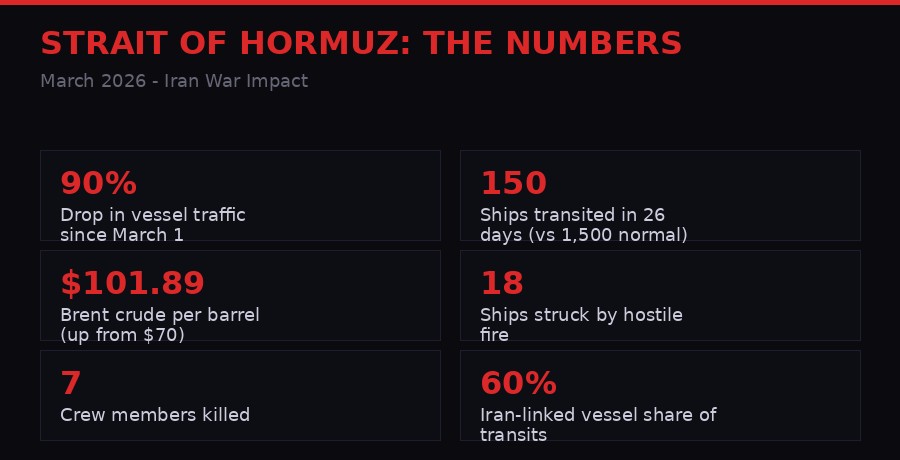
By the numbers: the Strait of Hormuz traffic collapse and oil price surge since the start of the Iran war on February 28, 2026. (BLACKWIRE/Data: Lloyd's List, Kpler, UN IMO)
Iran's parliament is not waiting to see how the IRGC experiment plays out. Local media reports that lawmakers are actively drafting legislation to formally codify fees for ships transiting the strait. Lawmaker Mohammadreza Rezaei Kouchi, quoted by Fars and Tasnim news agencies - both outlets with close ties to the Revolutionary Guard - said parliament is "pursuing a plan to formally codify Iran's sovereignty, control and oversight over the Strait of Hormuz, while also creating a source of revenue through the collection of fees." (Source: AP News, March 26, 2026)
The bill, if passed, would transform what is currently an extra-legal wartime seizure into a permanent fixture of Iranian policy. That distinction matters enormously - not just legally, but geopolitically. A wartime blockade can be reversed by a ceasefire. A sovereign toll system enshrined in Iranian domestic law cannot.
The Numbers Behind the Collapse

Container ships and tankers typically move in dense convoys through the Strait. Normal daily traffic has been reduced to a trickle, with most vessels re-routing around southern Africa. (Photo: Pexels)
The scale of the disruption is hard to overstate. Lloyd's List Intelligence reports that approximately 150 vessels - combining tankers, container ships, and bulk carriers - have transited the Strait of Hormuz since March 1. Under normal conditions, that is roughly one day's traffic. Before the war, approximately 21 million barrels of oil moved through the strait daily, representing about 20 percent of global supply. That flow has effectively stopped.
Of the ships that have gotten through, the ownership distribution tells its own story. Iran-affiliated vessels accounted for 24 percent of transits when measured by ownership or flag registration, Greece 18 percent, and China 10 percent. But that aggregate figure obscures a sharper trend: in the first days of the war, Iran-connected ships made up roughly 60 percent of transits. In the most recent days, that share has climbed to approximately 90 percent. The strait is increasingly a private lane for Iran and its clients.
The behavior of vessels that do attempt transit reveals the level of fear. According to Lloyd's List, roughly half of the ships turn off their Automatic Identification System transponders - the radio-based positioning beacons that allow maritime authorities to track ship locations in real time - before entering the passage. They reappear on the far side in the Gulf of Oman. Switching off AIS is a significant act. It erases a vessel from the international maritime tracking grid, violates IMO regulations in ordinary times, and signals that captains consider the legal consequences of going dark less dangerous than the physical consequences of being visible.
The human cost is already being counted. At least 18 ships have been struck by hostile fire since hostilities began, and at least seven crew members have been killed, according to the UN's International Maritime Organization. The IMO did not identify which nation was responsible for the attacks.
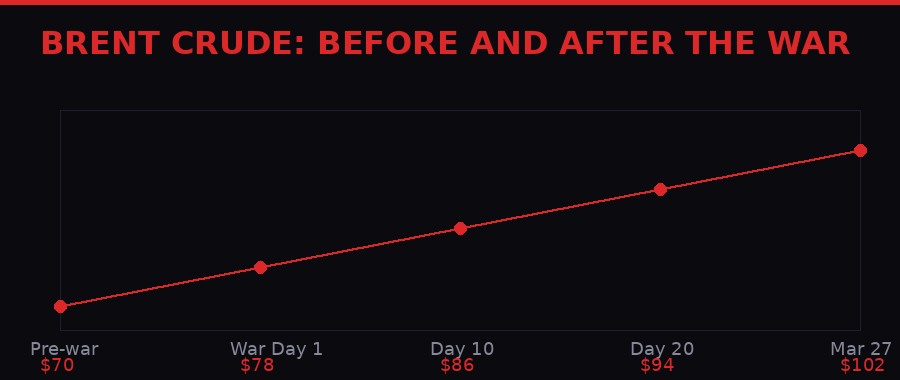
Brent crude oil prices have climbed from approximately $70 per barrel before the war to over $101 by March 27 - a 45 percent increase in under four weeks. (BLACKWIRE infographic / Data: AP, market reports)
Iran's Oil Flows Through While the World's Cannot

Iran's Kharg Island export terminal, the country's main oil export hub, has continued loading at near pre-war rates throughout the conflict - while other producers are locked out. (Photo: Pexels)
The toll booth is not disrupting Iran's own oil exports. That is the point. Iran's Kharg Island terminal - the country's primary crude export facility - loaded 1.6 million barrels in March, according to data and analytics firm Kpler. That figure is largely unchanged from pre-war monthly loading totals. While the rest of the Persian Gulf's oil exporters - Saudi Arabia, the UAE, Kuwait, Iraq - struggle to move their product through the now-contested strait, Iran's supply chain remains intact.
The customers receiving Iran's oil are described by Kpler as predominantly small, private refineries in China that are indifferent to U.S. sanctions. This is a customer base that has been carefully cultivated over years of sanctions pressure. The war has, in a perverse way, consolidated Iran's competitive advantage: it can export while its rivals cannot, it collects tolls from the ships that do get through, and it does so in a currency its primary buyer uses.
The practical effect for countries that depend on Persian Gulf oil flowing east through the strait is severe. Asian nations - Japan, South Korea, India, and others - have been the primary victims of the traffic collapse. India managed to negotiate the passage of two vessels carrying liquid petroleum gas through diplomatic channels, according to Lloyd's List. But that exception underscores the new reality: getting your energy supply through requires bilateral negotiation with Tehran.
For global shipping companies, the calculus is stark. The alternative to the Hormuz route is diverting around the Cape of Good Hope at the southern tip of Africa - adding 10 to 15 days to transit times and roughly $1.5 to $2 million in additional fuel costs per voyage. Insurance premiums for vessels attempting the Hormuz route have reportedly increased by factors of five to ten since hostilities began. Many shipping companies have simply suspended operations entirely rather than expose their vessels and crews to the risk.
The Legal Fiction and the Real Seizure

The economic consequences of the Hormuz blockade extend far beyond oil - petrochemical feedstocks, LNG, and industrial gases critical to global supply chains are all affected. (Photo: Pexels)
Tehran is not shy about the legal cover it is reaching for. On Tuesday, the Iranian government sent a formal communication to the International Maritime Organization in London, stating that it "had implemented a set of precautionary measures aimed at preserving maritime safety and security" and claiming these measures were consistent with "the principles of international law." (Source: AP News, March 26, 2026)
International law scholars and maritime experts are dismissive of that framing. Article 19 of the UN Convention on the Law of the Sea establishes the principle of innocent passage - the right of ships from any nation to pass through the territorial waters of another nation without interference, provided they are peaceful and law-abiding. No provision in UNCLOS or any other instrument of international maritime law permits a coastal state to impose tolls on foreign vessels transiting in innocent passage.
"There's no provision in international law anywhere to set up a toll booth and shake down shipping. This is Iran using the element that they have right now, which is control of the Strait of Hormuz." - Sal Mercogliano, maritime historian, Campbell University, North Carolina (AP News)
The secretary general of the Gulf Cooperation Council - the regional bloc comprising Saudi Arabia, the UAE, Kuwait, Qatar, Bahrain, and Oman - was direct. Jasem Mohamed al-Budaiwi described Iran's toll collection as "an aggression and a violation of the United Nations agreement on the law of the sea."
Sultan al-Jaber, who leads Abu Dhabi National Oil Company, the massive state-run Emirati energy giant, used starker language. Speaking at a Middle East Institute event in Washington, al-Jaber called the move "economic terrorism."
"Weaponizing the Strait of Hormuz is not an act of aggression against one nation. It is economic terrorism against every consumer, every family that depends on affordable energy and food. When Iran holds Hormuz hostage, every nation pays the ransom - at the gas pump, at the grocery store and at the pharmacy." - Sultan al-Jaber, CEO, Abu Dhabi National Oil Company (AP News)
The IMO has condemned the attacks on vessels and called for "an internationally coordinated approach" to secure freedom of navigation. The GCC has made formal protests. The legal consensus is clear: what Iran is doing violates international law. The practical reality is equally clear: no one has stopped it. Enforcement of freedom of navigation in the Strait of Hormuz would require direct military confrontation with Iranian naval forces - a step the United States, despite having carrier strike groups in the region, has not taken.
Washington's reluctance to force the strait open is itself a strategic signal that Tehran has absorbed. It tells Iran that the international community's commitment to freedom of navigation has a ceiling, and that ceiling is somewhere below the level of escalation required to physically displace IRGC gunboats from a waterway they now effectively control.
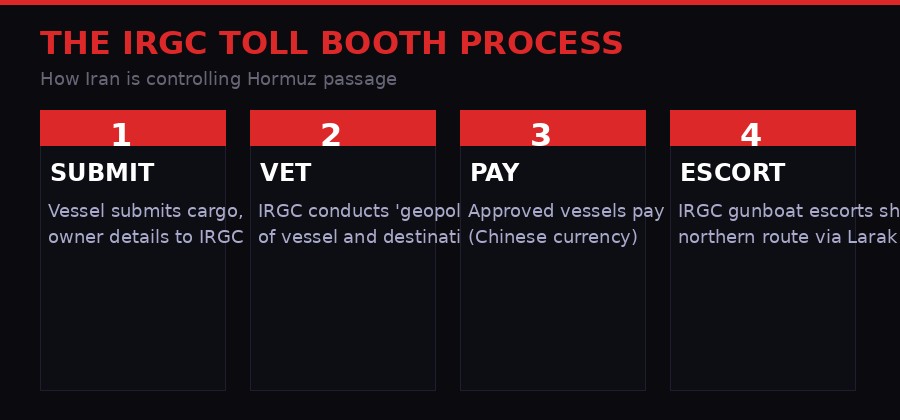
The four-step IRGC vetting and escort process documented by Lloyd's List Intelligence. Vessels that do not comply risk hostile engagement from Iranian naval forces. (BLACKWIRE infographic)
Trump Blinks, Then Threatens, Then Blinks Again

The diplomatic track remains in flux as Trump administration officials oscillate between threats of escalation and signals of openness to a deal. (Photo: Pexels)
The Trump administration entered this week with momentum. The president announced on Monday that "productive talks" had taken place about ending the war - a statement that briefly propelled equity markets higher and trimmed oil prices. By Tuesday, Iran had flatly denied that direct negotiations were underway. By Wednesday, Tehran had rejected a U.S. ceasefire proposal that had been delivered via Pakistan as an intermediary. By Thursday, the S&P 500 posted its worst single-day loss since the war began.
On Thursday morning, Trump posted on his social media platform: "They better get serious soon, before it is too late, because once that happens, there is NO TURNING BACK, and it won't be pretty!" The message was aimed at Iran's negotiators and directed at an April 6 deadline Trump had set for Iran to accept U.S. terms or face escalated strikes on its power generation infrastructure.
Then, just minutes after Wall Street closed, Trump moved the goalposts again. He announced he was delaying the threat to strike Iranian power plants, extending the diplomatic window. Oil prices trimmed their gains on the news. Treasury yields pulled back from session highs. Markets interpreted the move as familiar: Trump threatening, then retreating when markets signal pain.
The pattern has generated a specific Wall Street nickname - "TACO," standing for "Trump Always Chickens Out" - a reference to an almost identical sequence that played out with tariffs in early 2025, when Trump reversed course on global tariff threats after the bond market showed strain. Critics say the acronym captures something strategically important: when Trump's escalatory language meets financial market resistance, the escalation gets delayed or diluted.
Brent crude fell from an intraday high of $101.89 per barrel back toward $100 following Trump's announcement of the delay. Bond markets partially unwound sharp yield increases. The 10-year Treasury yield had climbed to 4.43 percent Thursday, up from 3.97 percent before the war began - a significant jump that has already translated into higher mortgage rates and increased borrowing costs for American businesses and households. (Source: AP News, March 26, 2026)
U.S. military posture tells a different story from Trump's diplomatic oscillations. Thousands more U.S. troops were approaching the region as of Thursday, according to AP reporting. The buildup suggests the Pentagon is hedging, preparing for escalation even as the White House delays it. The divergence between military and diplomatic signaling creates its own risks - Tehran may rationally read U.S. troop movements as the more reliable signal of American intent.
Lebanon Under the Grinder

Lebanon's south is being systematically emptied. Israeli forces have issued evacuation orders covering more than 14 percent of Lebanese territory, and ground troops are pushing the occupation line further north. (Photo: Pexels)
While the Hormuz crisis dominates global attention, Israel has been methodically escalating its ground operation in southern Lebanon. On Thursday, the Israeli military announced that Division 162 would be deployed to southern Lebanon "with the aim of expanding" what it calls a "buffer zone." Division 162 joins two other IDF divisions already operating in Lebanese territory - a significant concentration of ground combat power. (Source: Al Jazeera, March 26, 2026)
Israeli Prime Minister Benjamin Netanyahu confirmed the ambition a day earlier, stating the military planned to create "a larger buffer zone" in the south to push back Hezbollah's missile threat. The zone's expansion has been accompanied by systematic bridge destruction. Israeli forces have struck six key crossings over the Litani River: the Qasmiyeh Bridge, the Coastal Highway Bridge, the al-Qantara Bridge, the Khardali Bridge, the al-Dalafa Bridge, and the Zaraiya-Tirseflay Bridge. The goal, Lebanese President Joseph Aoun has stated, appears to be severing the south from the rest of the country - making any future Hezbollah resupply impossible and creating the physical conditions for permanent occupation.
The human cost is accumulating at pace. Israel's attacks have killed at least 1,116 people in Lebanon and wounded 3,229 others since the beginning of March, according to Lebanon's Ministry of Health. More than 1.2 million people have been internally displaced, according to UN figures. The International Organization for Migration puts the total number of registered displaced at 1,049,328 - with 132,742 people residing in collective shelters. Shelter capacity has been overwhelmed. Families are spending nights in streets, in vehicles, and in public spaces. More than 250,000 people have left Lebanon entirely over the past two weeks - a 40 percent increase compared to the two weeks prior, with the majority heading toward Syria.
Hezbollah has not capitulated. The group's secretary-general Naim Qassem has pledged the organization would fight "without limits." On Thursday alone, Hezbollah announced more than 45 distinct military operations against Israeli forces, including rocket and drone strikes and the use of guided anti-tank missiles against Merkava tanks in the border town of Deir Siryan. A Hezbollah rocket strike on the coastal Israeli city of Nahariya killed one person and wounded eleven. One Israeli soldier was killed in what the IDF described as an "incident" in southern Lebanon.
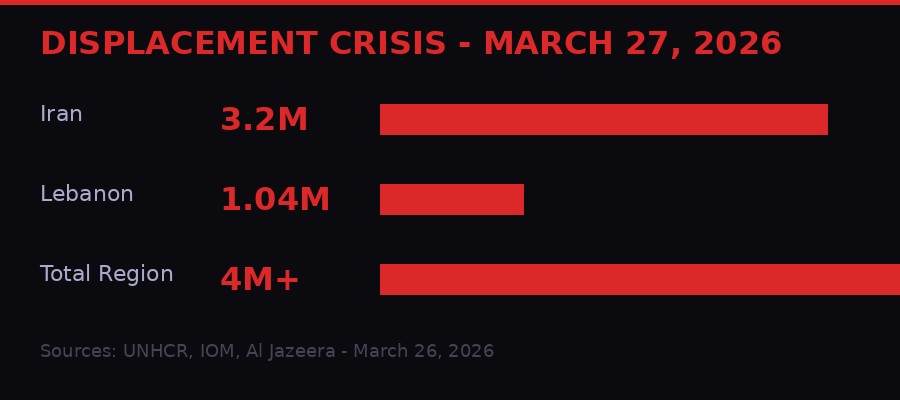
Combined displacement across Iran and Lebanon has surpassed four million people - one of the fastest-developing refugee crises the region has seen. (BLACKWIRE infographic / Sources: UNHCR, IOM, Al Jazeera)
France, the UK, Germany, Italy, and Canada issued a joint warning last week that an expanded Israeli ground offensive "would have devastating humanitarian consequences" and "must be averted." Israeli Defence Minister Israel Katz's response was that Lebanese civilians would not be allowed to return to homes in the south until northern Israel's security was fully secured - an undefined threshold that critics argue could mean an indefinite occupation.
Lebanese Prime Minister Nawaf Salam told UN Secretary-General Antonio Guterres on Thursday that Israel's actions "constitute a matter of utmost gravity that threatens Lebanon's sovereignty" and announced Lebanon would file a formal complaint to the UN Security Council. The Security Council - where the United States holds veto power - has historically been unable to impose binding resolutions on Israeli military operations that Washington opposes.
What Four Million Displaced People Looks Like

Aid agencies describe shelter capacity in Lebanon as critically overwhelmed. Many displaced families have exhausted savings and cannot access their damaged homes. (Photo: Pexels)
The UN's refugee agency UNHCR estimates that 3.2 million people - more than three percent of Iran's total population - have been internally displaced within the country since U.S.-Israeli strikes began on February 28. Cross-border refugee flows remain limited; Afghanistan has seen some returns of Afghan nationals previously resident in Iran, while Iraq has recorded 325 Iranian nationals crossing the border. Neighboring states Turkey, Turkmenistan, and Azerbaijan report only authorized crossings and no significant refugee inflow. But the pressure is building.
Inside Iran, the scope of infrastructure damage is staggering. Aid agencies report more than 85,176 civilian sites damaged since the war began, including 282 healthcare facilities, 600 schools, and 64,583 homes. In Tehran alone, the city administration has reported approximately 14,000 damaged residential units, with at least 6,000 people housed in municipal hotels. Strikes on nuclear facilities, oil refineries, and desalination plants have created cascading shortages of water, fuel, and electricity that are pushing more civilians to flee urban centers.
The combined displacement figure across the war theater - Iran's 3.2 million internally displaced plus Lebanon's 1.04 million displaced - exceeds four million people. That number does not count the 1,500 killed in Iran alone, the 1,116 killed in Lebanon, or the displaced populations still inside Gaza from the war that began in October 2023. The region is generating refugees faster than the international humanitarian system can track them, let alone house and feed them.
The speed of displacement in Lebanon has been particularly alarming. Nearly one in five Lebanese citizens - 18 percent of the population - has been displaced within two weeks. The Norwegian Refugee Council notes that Israel's forced evacuation orders now cover more than 1,470 square kilometers, or roughly 14 percent of Lebanon's entire territory. Those orders are backed by military force: areas where residents have ignored evacuation orders have been struck from the air and subsequently targeted by ground forces.
Timeline: The Strait of Hormuz Crisis
The Permanent Seizure: What Happens If the War Ends

Major Persian Gulf export terminals in Saudi Arabia, the UAE, and Kuwait have been effectively landlocked by the Hormuz closure. Diversion routes add weeks and millions in costs per shipment. (Photo: Pexels)
The question that no ceasefire negotiator has fully answered is what happens to the Strait of Hormuz regime if fighting stops. The IRGC toll system is not simply a wartime measure that will dissolve when a ceasefire agreement is signed. Iran's parliament is actively working to codify it as permanent sovereign policy. The IRGC has invested significant resources in constructing the vetting and escort infrastructure. The yuan-denominated payment system has created a revenue stream that will have institutional constituencies within the Iranian state. None of those incentives evaporate with a ceasefire.
Negotiators who believe that a return to the status quo ante - with the strait freely open under international law - is simply the default outcome of ending the shooting have not been paying attention to how Iran is building this system. The smart money in maritime insurance and commodity trading circles now treats some level of continued Iranian control over Hormuz passage as the base case, not the exception, for the next several years.
The implications for global energy infrastructure are profound. Fourteen years of post-2011 investment in alternative pipeline routes - the UAE's Abu Dhabi Crude Oil Pipeline, which can bypass Hormuz, and various planned Saudi routes - are suddenly looking like prescient decisions. Countries that never bothered building bypass capacity, including several of the world's largest oil consumers, are now paying that price at the pump.
For China, the calculus is particular. Beijing's private refineries are buying Iranian oil at a significant discount to international benchmarks - exactly the kind of deal that makes sense when your supplier has a captive market. China has simultaneously maintained a surface-level neutrality in the war while its companies and currency have become central to Iran's survival mechanism. The strait's Chinese-yuan toll payments are a minor but symbolically significant piece of a larger Chinese positioning strategy that has been years in the making.
The IMO's call for "an internationally coordinated approach" to secure strait passage represents the institutional response of the world's maritime governance framework - earnest, procedurally correct, and practically toothless. Coordinated international approaches to Iranian challenges have a limited track record of success in the absence of American willingness to apply hard power. And the current American administration's record in this conflict - threatening April 6 deadlines and then delaying them, announcing productive talks that Iran denies, building troop strength while pushing the strike window further out - does not suggest the kind of sustained pressure that would compel Tehran to dismantle a system it is simultaneously legislating into permanence.
The IRGC toll booth is not a crisis that peaked and is now stabilizing. It is a new institutional reality being locked in while the world argues about it.
Get BLACKWIRE reports first.
Breaking news, investigations, and analysis - straight to your phone.
Join @blackwirenews on Telegram