The Toll Booth at the End of the World
Iran's Revolutionary Guard has installed a toll regime in the Strait of Hormuz. Ships pay in yuan. Traffic is down 90%. Pakistan runs the ceasefire channel. And Yemen's Houthis have not yet played their card.
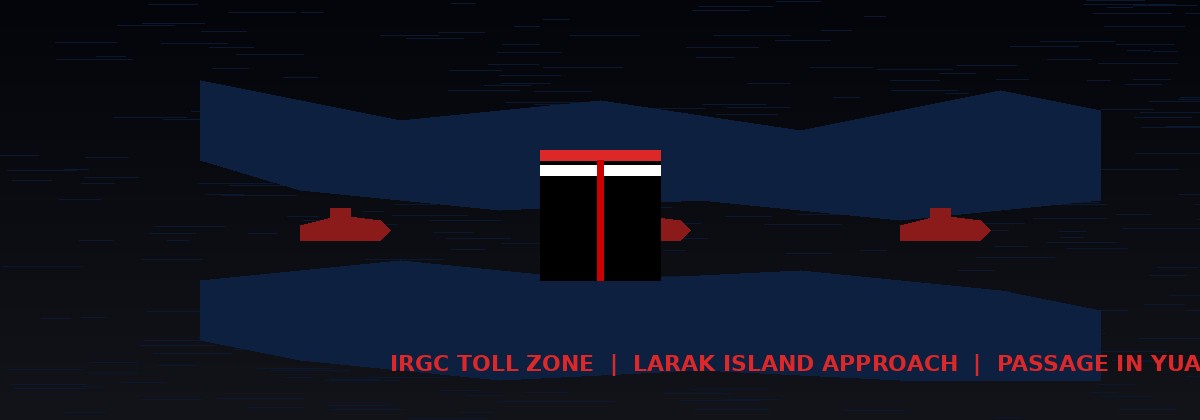
On March 25, the International Maritime Organization received a letter from the Iranian government. It was careful and bureaucratic in its language. Iran said it "had implemented a set of precautionary measures aimed at preserving maritime safety and security" in the Strait of Hormuz. It claimed these measures were consistent with international law.
What the letter described, without using these words, is a toll booth.
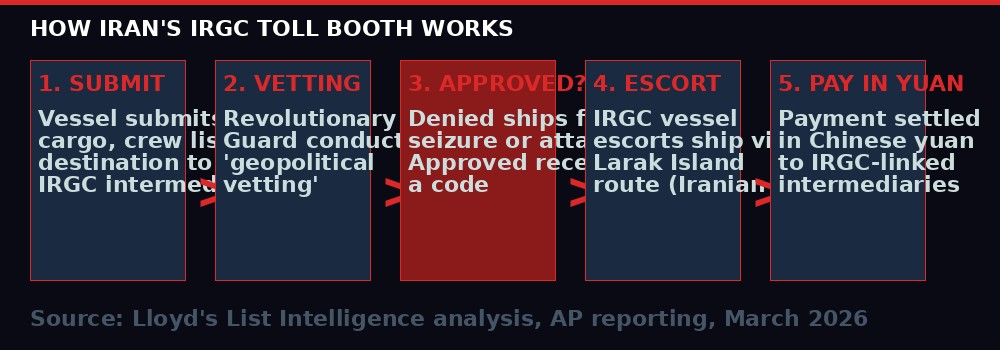
Ships that want to pass through the world's most important oil chokepoint must now submit their full cargo manifests, crew lists, ownership details, and destination information to what the London-based shipping intelligence firm Lloyd's List calls "approved intermediaries" of Iran's Islamic Revolutionary Guard Corps. If vetting is approved - and it is explicitly described as "geopolitical vetting" - the vessel receives a code. An IRGC gunboat appears alongside to escort it through. If not approved, the ship turns back, or it doesn't.
At least two ships have paid a direct toll. The payment is settled in Chinese yuan, according to Lloyd's List Intelligence, cited by AP News.
This is what day 28 of the US-Israel war against Iran looks like. Not a hot-phase tank battle. Not a nuclear strike. A slow, structural seizure of the global oil supply chain, conducted by men in speedboats with satellite phones, in a narrow stretch of water twenty-one miles wide at its tightest point.
How the Chokepoint Became a Cash Register
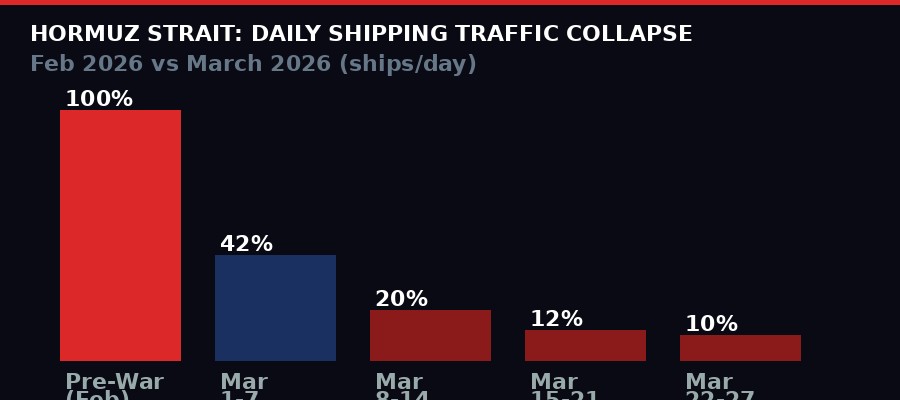
Before the war, the Strait of Hormuz was the artery through which roughly 20% of the world's oil supply flowed every day. Saudi Arabia, Iraq, Kuwait, the UAE - all of their petroleum exports moved through this narrow gap between the Iranian coastline and the tip of the Musandam Peninsula. About 150 vessels made the transit daily under the standard two-lane shipping channel system.
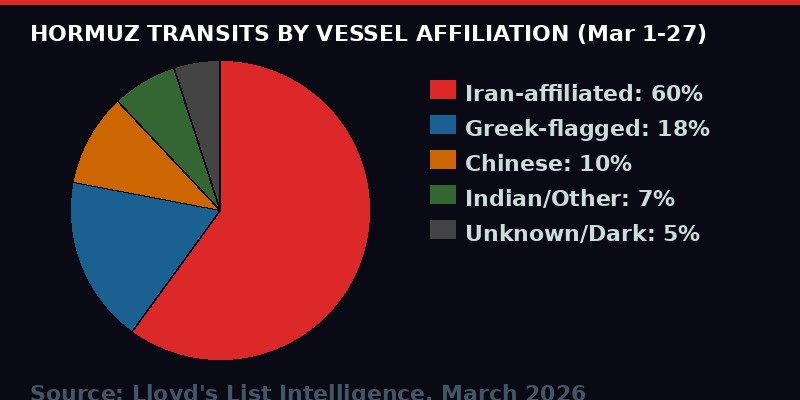
Since late February, when Operation Epic Fury - the US-Israeli air campaign that opened by killing Supreme Leader Ali Khamenei within days - began reshaping the regional order, that traffic has collapsed. According to Lloyd's List Intelligence, only about 150 vessels have made the full transit in the entire month of March. That is roughly one and a half days of normal traffic spread across four weeks.
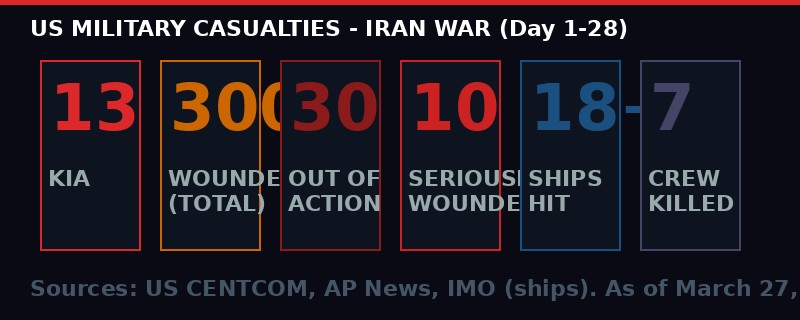
Iran accomplished this partly through direct military action. The IMO has confirmed at least 18 ships have been hit in or near the strait. Seven crew members are confirmed dead. The agency did not specify which country attacked which vessels. It did not need to. The traffic data speaks clearly: the strait has become a danger zone, and most commercial operators have rerouted or halted entirely.
What remained was not random chaos. Iran moved systematically. Ships that still attempted the passage began routing north, away from the standard lanes, hugging the Iranian coastline around Larak Island. This placed them squarely inside Iranian territorial waters - and squarely under IRGC jurisdiction.
"Iran's IRGC has imposed a de facto 'toll booth' regime in the Strait of Hormuz." - Lloyd's List Intelligence, March 2026
The payment mechanism is deliberate. Yuan, not dollars. This is not incidental. Iran remains under extensive US sanctions. Dollar transactions are theoretically traceable and blockable through the SWIFT system and US correspondent banking. Yuan transactions are not - especially when they flow through small private Chinese refineries that have been buying Iranian oil throughout the sanctions era. Iran's Kharg Island terminal loaded 1.6 million barrels in March, according to data firm Kpler, essentially unchanged from pre-war levels. The oil keeps moving. It just moves on Iran's terms, to buyers who don't care about American rules.
Iran's parliament is now working to formalize this system in law. Fars and Tasnim news agencies - both close to the Revolutionary Guard - quoted lawmaker Mohammadreza Rezaei Kouchi saying parliament is pursuing "a plan to formally codify Iran's sovereignty, control and oversight over the Strait of Hormuz, while also creating a source of revenue through the collection of fees."
That sentence is worth reading twice. Iran is not framing this as a wartime measure. It is framing it as permanent national infrastructure.
The Legal Argument Iran Is Making - and Why It Doesn't Hold
Iran's letter to the IMO claimed its measures were consistent with international law. This claim faces serious obstacles.
Article 19 of the United Nations Convention on the Law of the Sea - the primary international legal framework governing maritime passage - requires coastal states to allow "innocent passage" of peaceful, law-abiding vessels through their territorial waters. The standard shipping channel in the strait runs through international waters, outside any nation's territorial jurisdiction. The IRGC is now forcing ships into Iranian territorial waters specifically to impose jurisdiction over them.
"There's no provision in international law anywhere to set up a toll booth and shake down shipping. This is Iran using the element that they have right now, which is control of the Strait of Hormuz." - Sal Mercogliano, maritime historian, Campbell University, North Carolina
The Gulf Cooperation Council's secretary general, Jasem Mohamed al-Budaiwi, was direct: Iran's fee collection is "an aggression and a violation of the United Nations agreement on the law of the sea."
Sultan al-Jaber, the head of Abu Dhabi National Oil Co. and one of the most powerful executives in the Gulf energy sector, used the phrase "economic terrorism" in a speech at the Middle East Institute in Washington. The language was striking from a figure who normally trades in euphemism.
"Weaponizing the Strait of Hormuz is not an act of aggression against one nation. It is economic terrorism against every consumer, every family that depends on affordable energy and food. When Iran holds Hormuz hostage, every nation pays the ransom - at the gas pump, at the grocery store and at the pharmacy." - Sultan al-Jaber, CEO, Abu Dhabi National Oil Co., March 27, 2026
The US sanctions angle compounds the problem. Any payment made to IRGC-linked intermediaries likely violates American and European sanctions against the Revolutionary Guard, which was designated a foreign terrorist organization by the Trump administration in 2019. Shipping companies, insurers, and vessel operators who pay face potential secondary sanctions exposure. The legal environment for complying with Iran's regime may be worse than the physical environment for refusing it.
Some vessels have found unofficial workarounds. Two Indian ships carrying liquid petroleum gas were allowed through, Lloyd's List reported, apparently following diplomatic pressure at the government level. India, which maintains working relationships with both Tehran and Washington, appears to have negotiated ad hoc passage. The Indian deal was not in yuan. The terms were not disclosed.
The Casualties Pile Up While Trump Claims Victory
On Thursday, March 26, President Donald Trump announced that Iran had been "obliterated." Defense Secretary Pete Hegseth declared that "never in recorded history has a nation's military been so quickly and so effectively neutralized."
The next day, Iranian missiles and drones struck Prince Sultan Air Base in Saudi Arabia, wounding at least ten US service members and damaging several American refueling aircraft, according to two US officials who spoke to AP News on condition of anonymity. Two of the wounded were described as seriously injured. Satellite imagery of the damaged aircraft circulated online within hours.
It was not the first time Prince Sultan Air Base had been targeted. Army Sergeant Benjamin N. Pennington, 26, was wounded there in a March 1 attack and died days later. He is among 13 US service members killed in the monthlong conflict.
US Central Command said earlier Friday that more than 300 service members have been wounded across the conflict. The majority have recovered and returned to duty. Thirty remained out of action as of March 27. Ten were classified as seriously wounded.
This is the arithmetic of a war that official statements from Washington have repeatedly described as nearly won. The gap between the narrative and the kill-and-wound numbers is not a rounding error. It is a pattern. And the Iranian ability to strike a major US air base in Saudi Arabia - with aircraft on the ramp, in a country that hosts American forces under bilateral defense arrangements - suggests that whatever "obliteration" means to the administration, it does not yet mean the IRGC has lost the ability to project force beyond Iran's borders.
The Pentagon is responding. At least 1,000 troops from the 82nd Airborne Division - the unit trained to parachute into contested territory and secure airfields - are being deployed to the Middle East in coming days, AP reported. Two Marine units are also in transit, adding roughly 5,000 Marines and thousands of sailors to the regional force posture. These are not garrison troops. These are assault-capable formations.
Pakistan Runs the Back Channel - It Has Done This Before
On March 25, Pakistani Foreign Minister Ishaq Dar confirmed publicly what had been quietly understood for days: Islamabad is serving as the conduit for a 15-point US ceasefire proposal from Washington to Tehran. Turkey and Egypt are also providing diplomatic support, but Pakistan is the primary channel.
On Thursday, chief US negotiator Steve Witkoff confirmed Pakistan's role. Hours later, Trump announced a ten-day pause on threatened strikes against Iranian power plants, citing a request from the Iranian government. Iran has denied that direct negotiations are taking place. The ten-day pause is the second time Trump has deferred the power plant strike threat after initially announcing it over the preceding weekend.
None of this surprised anyone who has studied Pakistan's diplomatic history. The role is structurally familiar.
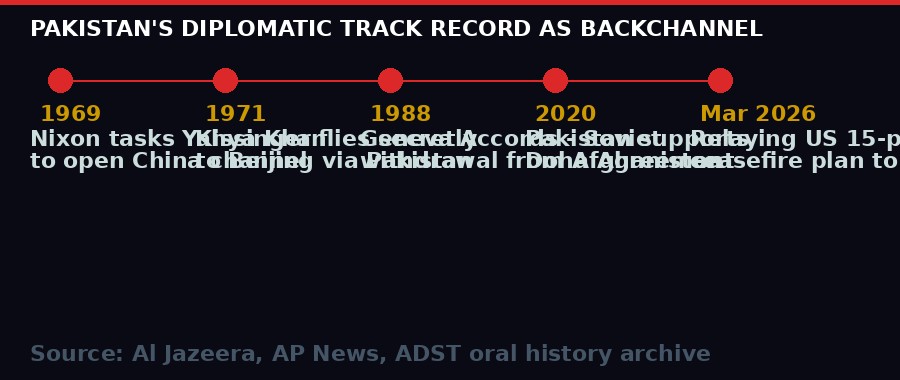
In August 1969, US President Richard Nixon visited Pakistan and privately tasked military ruler Yahya Khan with passing a message to Beijing: Washington wanted to open communication with the People's Republic of China. Pakistan was chosen because it maintained functional relations with both Washington and Beijing at a time when the two powers had no direct contact.
In July 1971, Henry Kissinger arrived in Islamabad on a public tour. He appeared to fall ill at a welcome dinner. In the early hours of July 9, Yahya Khan's driver took Kissinger and three aides to a military airfield. A Pakistani government plane was waiting with four Chinese representatives aboard. The aircraft flew to Beijing overnight. Kissinger spent 48 hours in meetings with Zhou Enlai. The trip paved the way for Nixon's 1972 Beijing visit and the restructuring of Cold War geopolitics.
"In 1971, Pakistan was the only country that could be trusted simultaneously in Washington and Beijing with a very sensitive mission, which was kept secret even from the State Department." - Masood Khan, former Pakistani Ambassador to the United States and United Nations
Pakistan played similar roles in the Soviet withdrawal from Afghanistan through the Geneva Accords of 1988, and in supporting the 2020 Doha Agreement. It has also attempted to mediate between Saudi Arabia and Iran across multiple governments.
The current situation has structural similarities to 1971 - and structural differences. In 1971, Pakistan was a neutral facilitator with no direct stake in the US-China relationship. Today, Pakistan signed a mutual defense agreement with Saudi Arabia in September 2025. Saudi Arabia hosts US forces. Those forces have been struck from Iranian soil. Pakistan's Army Chief, Field Marshal Asim Munir, has had at least one direct call with Trump. Prime Minister Shehbaz Sharif has spoken repeatedly with Iranian President Masoud Pezeshkian.
Pakistan is threading a needle: military alliance with one party to the conflict, functional diplomatic access to the other, and economic vulnerability to both. Its oil comes through a region Iran can disrupt. Its security architecture depends on Gulf Arab states who are under Iranian fire.
Muhammad Faisal, a Sydney-based foreign policy analyst, called the 1971 Kissinger channel Pakistan's most consequential diplomatic act - but noted its limits. "Pakistan couldn't turn that support from both powers to its advantage in the 1971 civil conflict and the subsequent war with India," he told Al Jazeera. The implication for 2026 is similar: Pakistan can carry the message. Whether it can influence the outcome is a different question.
Lebanon: 1.2 Million Displaced, UN Warns of Catastrophe
The Strait of Hormuz is not the only theater where the math of this war is accumulating costs.
In Lebanon, more than 1.2 million people have been forced from their homes since Israel intensified attacks following Hezbollah's rocket salvos after Khamenei's assassination in late February. The UN Refugee Agency's Lebanon representative, Karolina Lindholm Billing, told reporters in Geneva on Friday that the situation presents "a real risk of humanitarian catastrophe."
"The families are living in constant fear, and the psychological toll, particularly on children, will last far beyond this current escalation." - Karolina Lindholm Billing, UNHCR Lebanon Representative, March 27, 2026
Israel's military issued new forced displacement orders for several Beirut suburbs on Friday afternoon, including Haret Hreik and Burj al-Barajneh, followed by a fresh wave of airstrikes on the capital. Israeli Prime Minister Benjamin Netanyahu announced plans to expand the ground invasion in southern Lebanon and create what he described as "a larger buffer zone" in Lebanese territory.
The infrastructure dimension of Israel's campaign is becoming harder to ignore. Israeli strikes have destroyed key bridges over the Litani River in southern Lebanon. The UNHCR's Billing noted this has "cut off entire districts, isolating over 150,000 people and severely limiting humanitarian access." Human Rights Watch stated that "Israel's tactics of mass expulsion in Lebanon raise serious risks of forced displacement" and that "forced displacement and collective punishment are war crimes."
Hezbollah has continued firing rockets into northern Israel and engaging Israeli troops in the south. Its leader, Naim Qassem, said this week the group had no plans to stop fighting "an enemy that occupies land and continues daily aggression." Three Israeli divisions are now committed to the Lebanon ground war, according to previous BLACKWIRE reporting.
Yemen: The Card Not Yet Played
There is one card in the deck that has not yet been played.
Yemen's Houthi rebels - who spent two years attacking commercial shipping in the Red Sea following the October 2023 start of Israel's war on Gaza - have so far sat out the US-Iran conflict. Their chief, Abdel-Malik al-Houthi, said publicly that the group's "hands are on the trigger," promising action at the right time. An Iranian military official told Tasnim News on March 21 that any US aggression against Kharg Island oil facilities "would pave the way for Tehran to destabilise the Red Sea and the Bab al-Mandeb Strait."
Bab al-Mandeb is the chokepoint at the southern end of the Red Sea, between Yemen and Djibouti. Roughly 12% of global trade passes through it. If the Houthis activate their Red Sea campaign simultaneously with Iran's Hormuz toll regime, two of the world's four most critical maritime chokepoints are under hostile control at the same time. The other two - the Suez Canal and the Strait of Malacca - would be indirectly impacted by the rerouting and insurance shocks.
Analysts cited by Al Jazeera believe the consequences for Yemen itself would be severe. Mustafa Nasr, head of the Studies and Economic Media Center in Yemen, said activation would deal a "tremendous blow" to the Yemeni economy. "Yemen depends on imports for petrol, diesel and food commodities," he said. "The chaos in the waterway will disrupt shipping, which can result in immediate price hikes. With no substitutes, Yemeni civilians will bear the brunt."
International shipping companies have already imposed a $3,000 "war risk" fee on containers bound for Yemen - before any Houthi involvement. If Bab al-Mandeb becomes active, that number climbs. Yemen, one of the world's poorest nations following seven years of civil war, has almost no margin left to absorb further price shocks.
The geopolitical calculation for the Houthis is not simple. The US-Houthi ceasefire of May 2025, which paused Red Sea attacks in exchange for an end to American airstrikes, would collapse immediately. The Yemeni government - backed by Saudi Arabia and stabilized after regaining control of Aden earlier in 2026 - might seize the opportunity to reignite the ground war against Houthi-held territory in the north. US and Saudi support for a renewed Yemeni government offensive would be available.
The Houthi leadership understands this arithmetic. Which is why the card remains unplayed - held in reserve as deterrence, as leverage, as a potential final escalation tool if the war in Iran reaches a phase where Tehran feels it has nothing left to lose.
Timeline: 28 Days of the Hormuz War
Ukraine's Second Front: Weapons Diverted, Guarantees Disputed
The Iran conflict's gravitational pull is distorting theaters far from the Gulf.
Ukrainian President Volodymyr Zelenskyy told Reuters this week that the United States is conditioning its offer of security guarantees on Kyiv's agreement to cede the Donbas region to Russia. The claim landed hard. Donbas is the industrial east of Ukraine - long coveted by Moscow, partially occupied since 2014, and currently the site of heavily fortified front lines where Russian and Ukrainian forces have been grinding for four years.
US Secretary of State Marco Rubio, speaking to reporters after a G7 meeting in France, called the characterization "a lie." He insisted the US had merely conveyed what Russia is demanding - not advocated for it. "We've never told them they have to take it or leave it," Rubio said. "The role we have played is to try to figure out what both sides want, and see if we can bridge the middle ground."
The Ukrainian presidential office declined to comment on the discrepancy. The gap between Zelenskyy's account and Rubio's is not a small one. Either the US conveyed Russia's demand in a manner Kyiv interpreted as American backing, or Zelenskyy is misrepresenting the conversation to rally domestic and European resistance to any land concession. Both possibilities have serious implications.
What is not disputed: American Patriot air-defense missiles have been moved from Europe toward the Middle East, AP has reported. Zelenskyy has warned that Ukraine will "definitely" face Patriot shortages as a result. Rubio acknowledged Friday that while no weapons have yet been pulled from sales bound for Ukraine, the calculus could change. "If we need something for America and it's American, we're going to keep it for America first," he said.
For Ukraine, fighting a grinding war of attrition against a larger adversary with drone-heavy tactics, Patriot is not optional equipment. It is the primary defense against Russian ballistic missile strikes on Ukrainian cities and energy infrastructure. Every launcher repositioned to cover American forces in Saudi Arabia or the Gulf is one fewer launcher available to defend Kharkiv or Kyiv.
What Comes Next
Key Variables to Watch
The 10-day pause: Trump deferred Iranian power plant strikes twice. The pause expires around April 5. Whether Iran offers a substantive ceasefire response before then determines if the pause holds or collapses into direct escalation.
Houthi activation: If Hormuz talks fail and Iran signals Houthi support is needed, Bab al-Mandeb becomes a second chokepoint under threat simultaneously.
Pakistan's credibility: Islamabad's value as a backchannel depends on Tehran trusting it to accurately represent both sides. Any perception that Pakistan is simply carrying US demands - rather than genuinely mediating - ends the channel.
Lebanon's military inflection: Three Israeli divisions in Lebanon, bridges destroyed, 1.2 million displaced. International pressure for a ceasefire is rising. Whether Hezbollah or Israel blinks first in the north could reshape the broader conflict.
Ukraine's window: Russia may read the US distraction as opportunity. Any Russian offensive surge while Patriot systems are repositioned and American attention is in the Gulf changes the European security landscape.
The Strait of Hormuz toll booth is not simply an act of war. It is a statement of intent about the postwar order Iran is trying to secure. If the IRGC can maintain and formalize control of the strait - collecting yuan from Chinese buyers, denying passage to adversaries, codifying it in Iranian national law - then whatever ceasefire eventually emerges will not restore the pre-war status quo. Iran will have converted military pressure into permanent economic leverage.
The United States and its partners can contest this. Rubio signaled Washington is looking at "other countries" to help secure Hormuz passage. That implies either a multinational naval escort operation - enormously complex and costly - or negotiated arrangements that implicitly recognize Iran's new position.
Neither option is comfortable. Both represent a world in which a 21-mile-wide strait, controlled by men in speedboats and settled in Chinese currency, has more geopolitical weight than any of the aircraft carriers currently stationed in the Gulf.
The toll booth is open. The world is paying.
Get BLACKWIRE reports first.
Breaking news, investigations, and analysis - straight to your phone.
Join @blackwirenews on TelegramSources: AP News (Iran war coverage, Saudi base strike, Ukraine/Rubio), Al Jazeera (Pakistan backchannel, Lebanon UNHCR, Yemen Houthi analysis), Lloyd's List Intelligence (Hormuz toll regime), IMO (maritime safety letter, ship attacks), Kpler (oil loading data), Campbell University maritime law analysis, Gulf Cooperation Council statement, Abu Dhabi National Oil Co. / Sultan al-Jaber remarks. All sourced reporting as of March 27-28, 2026.