Ghost Command: Iran's Invisible Supreme Leader and the IRGC's Silent Coup
Twenty-six days into a war that has killed more than 1,500 Iranians, the man named to run the country hasn't been seen in public once. Mojtaba Khamenei - Iran's new supreme leader - is a ghost. And while Washington hunts for someone to negotiate with, the Islamic Revolutionary Guard Corps has quietly absorbed the power vacuum. A state is running a war without a visible head.

Smoke columns over Tehran following successive Israeli airstrikes. Iran's capital has sustained repeated waves of bombardment since Feb. 28. (File/Unsplash)
The ceasefire talks are theater. Both sides know it. Tehran's Foreign Minister Abbas Araghchi told Al Jazeera on March 1 that Iran's military units "are now in fact independent and somehow isolated and they are acting based on instructions - you know, general instructions - given to them in advance." Translation: nobody is steering this. The rockets keep flying because the orders were written before the war started, and no one has issued new ones.
That admission - remarkable even by the standards of wartime doublespeak - crystallizes the fundamental crisis at the heart of the Iran war: the United States is trying to negotiate a ceasefire with a government that cannot speak for its own military. And the man who should be making the decisions hasn't been photographed, quoted, or confirmed alive since February 28. [AP News, March 25, 2026]
The Man Who Wasn't There

The seat of power in Tehran sits effectively leaderless at the supreme leader level. Mojtaba Khamenei has not appeared publicly since his father was killed. (Illustrative/Unsplash)
On February 28, Israel and the United States launched the opening strikes of what would become the most destructive attack on Iranian soil since the Iran-Iraq War. In those first hours, Ayatollah Ali Khamenei - 86 years old, the unquestioned supreme leader of the Islamic Republic for 34 years - was killed in an airstrike on his compound in downtown Tehran. [AP News]
His son, 56-year-old Mojtaba Khamenei, was quickly named to replace him. The clerical establishment moved fast - too fast, perhaps, to think through what it meant to install a figurehead during an active war when enemy aircraft might take a similar interest in the new leader's location.
Mojtaba has not been seen in public since.
Israeli Prime Minister Benjamin Netanyahu flagged the absence bluntly during a press conference. "I'm not sure who's running Iran right now," Netanyahu said. "Mojtaba, the replacement ayatollah, has not shown his face. Have you seen him? We haven't, and we can't vouch for what exactly is happening there." [AP News, March 25]
American and Israeli officials have suggested Mojtaba may have been wounded in the same strike that killed his father. His wife, Zahra Haddad Adel, was also killed in that attack. The younger Khamenei - who before the war had never held a government position, having operated as a behind-the-scenes power broker tied to the IRGC - is either incapacitated, in hiding, or dead. No one outside Iran's inner circle knows which.
"Iran's command and control structure is in utter chaos." - Israeli Prime Minister Benjamin Netanyahu, press conference, late March 2026
What is known is that Mojtaba Khamenei officially controls Iran's armed forces and holds final authority over the nuclear program. If he cannot or will not exercise that authority, the question of who can give orders - and have those orders obeyed - becomes existential. Not just for Iran, but for anyone trying to end this war. [AP News analysis]
The IRGC Fills the Vacuum

The Islamic Revolutionary Guard Corps - Iran's most powerful military and political force - has effectively absorbed the leadership vacuum left by the killing of senior officials. (File/Unsplash)
Long before the first American bomb fell on Tehran, the IRGC was the most powerful force in Iran. The Islamic Revolutionary Guard Corps was born out of the 1979 revolution as a force to protect the clerical order - and over four decades, it became the clerical order. It runs businesses, controls media, funds proxy militias from Beirut to Baghdad to Sanaa, and maintains a parallel chain of command that has always operated alongside - and frequently overridden - Iran's civilian government. [AP News, RUSI analysis]
"The Revolutionary Guard is the state now," said Ali Vaez, Iran project director at the International Crisis Group. Before the war, Iran's civilian leadership was "subservient entirely" to the supreme leader, he explained. The Guard was the second-most powerful force. Now, with the elder Khamenei gone and his son not enjoying the same legitimacy or visibility, "it is really the Revolutionary Guards who are running the country." [AP News, March 25]
The IRGC's top commander, Maj. Gen. Mohammad Pakpour, took over after Israel killed his predecessor during the 12-day war last June. He is alive, active, and in command of the only coherent military force still functioning in Iran. His vow on Tuesday that the fighting "will continue until complete victory" - issued as Trump was claiming Iran desperately wanted a deal - was as much a message to Iran's own leadership as it was to Washington. [AP News]
The message: don't sign anything without us. We are the war.
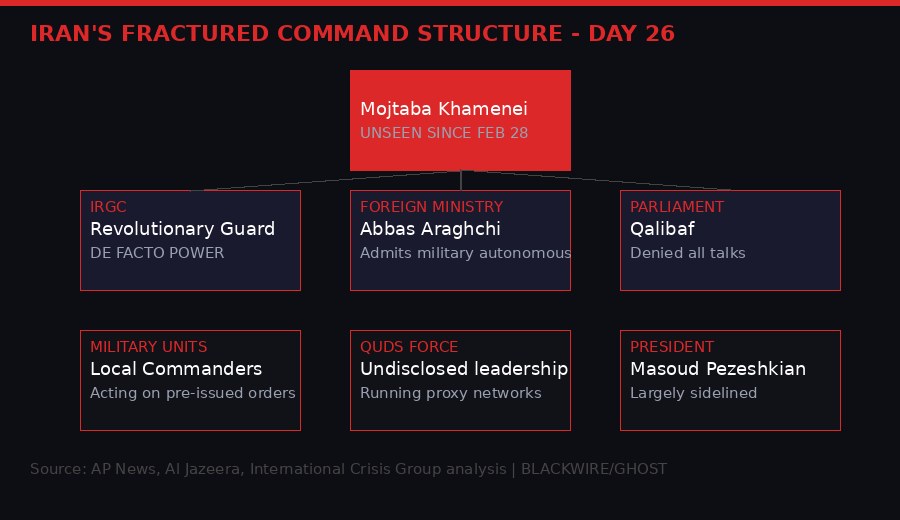
Iran's fractured command structure as of Day 26 of the war. Multiple power centers operate semi-independently with no confirmed supreme authority. (BLACKWIRE/GHOST)
Military Units Running on Dead Man's Orders

Iran's ballistic missile and drone strikes have continued at pace throughout the war - even as civilian leaders admit the military is acting on pre-war operational orders. (Illustrative/Unsplash)
Araghchi's admission about military autonomy on Al Jazeera was technically damage control. He was trying to explain why Iranian units had struck Oman - a country that had been acting as a diplomatic intermediary on Iran's behalf. His framing was apologetic: "What happened in Oman was not our choice. We have already told our armed forces to be careful about the targets that they choose."
But the implications go far beyond one mistaken strike. If Iran's military units are "acting based on instructions given to them in advance" - meaning pre-war operational plans - then they are not receiving real-time orders from any civilian or military command authority. They are executing a script written before the war started. The script says: hit these target categories, use these systems, at this rate. No one needs to be home to send the orders. [Al Jazeera, March 2026]
This is not unique to Iran. Modern militaries build dead-man protocols precisely because command-and-control can be disrupted in war. What makes Iran's situation unusual is that the disruption appears to have reached the very top of the hierarchy - and no one has restored meaningful top-down command.
The result is a war machine that can sustain - and escalate - but cannot negotiate. The strikes on Israel and Gulf Arab states continued Wednesday even as Araghchi was telling state TV that Iran "has not engaged in talks to end the war, and we do not plan on any negotiations." The rockets and drones are indifferent to what the foreign minister says. They follow a logic that was programmed before he gave that interview. [AP News, March 25]
"Our military units are now in fact independent and somehow isolated and they are acting based on instructions - general instructions - given to them in advance." - Iranian Foreign Minister Abbas Araghchi, Al Jazeera, March 1, 2026
Forty-Eight Hours of Parallel Realities

Diplomatic efforts to broker a ceasefire have involved Pakistan, Egypt, and Gulf Arab intermediaries - but Iran's actual decision-makers remain elusive. (Illustrative/Unsplash)
The collision between diplomatic theater and military reality was on full display Tuesday and Wednesday. Trump told reporters the U.S. is "in negotiations right now" - naming envoy Steve Witkoff, son-in-law Jared Kushner, Secretary of State Marco Rubio, and Vice President JD Vance as participants. He claimed an Iranian leader met with Witkoff and Kushner on Sunday. He did not say who. [AP News]
Reports focused on Parliament Speaker Mohammad Bagher Qalibaf as the possible interlocutor. Qalibaf got on X and denied it. An Iranian military spokesman, Maj. Gen. Ali Abdollahi Aliabadi, issued a statement vowing to fight "until complete victory." Iran's state TV broadcaster, Press TV, quoted an anonymous official saying "Iran will end the war when it decides to do so and when its own conditions are met."
Meanwhile, White House press secretary Karoline Leavitt insisted talks are "productive." Mediators from Pakistan, Egypt, and Gulf Arab states are trying to arrange in-person talks, possibly as soon as Friday in Islamabad. [AP News, March 25]
The gap between these positions is not a negotiating gap. It is a reality gap. Trump is describing talks with a government that, by its own foreign minister's admission, may not control its military. Any deal signed by Araghchi or Qalibaf would be worthless unless the IRGC and local commanders accept it. There is no public sign that they would.
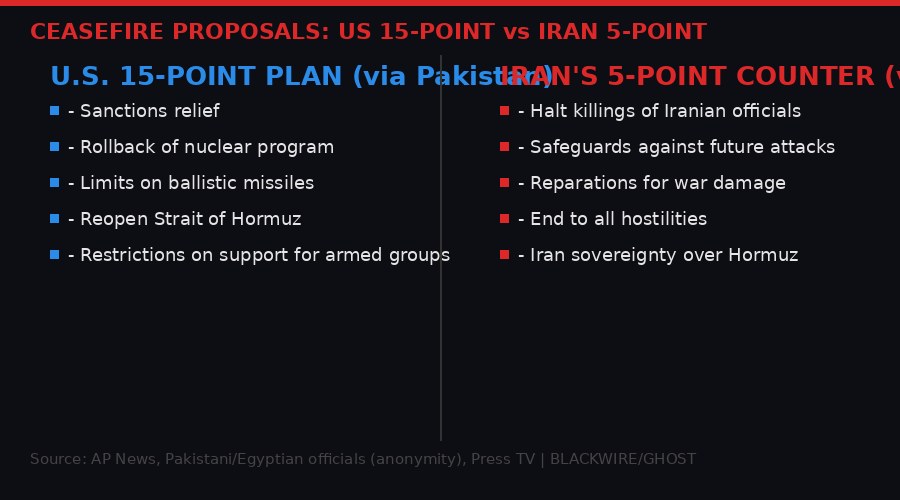
The U.S. 15-point ceasefire plan versus Iran's 5-point counter-demands. The gap on Hormuz sovereignty and missile limitations alone is close to unbridgeable. (BLACKWIRE/GHOST)
The 15-Point Plan Iran Won't Touch

The Strait of Hormuz - through which roughly a fifth of the world's oil moved before the war - remains at the heart of both the conflict and the ceasefire negotiations. (Unsplash)
The 15-point proposal was transmitted to Tehran by Pakistani intermediaries late Tuesday. According to Pakistani and Egyptian officials who spoke on condition of anonymity, it addresses: sanctions relief for Iran; a rollback of the nuclear program; limits on ballistic missiles; a reopening of the Strait of Hormuz; and restrictions on Iran's support for armed groups like Hezbollah and the Houthis. [AP News, March 24-25]
Every single one of those demands runs into a wall with Iranian red lines that predate this war by years.
Iran's ballistic missile program is not a bargaining chip. Tehran views it as the last layer of deterrence against exactly the kind of attack it just experienced. The IRGC views it as an existential asset. Asking Iran to limit its missiles in the middle of an active war, after its supreme leader was just killed by the country it's supposed to give up missile deterrence against, is not a negotiating position. It is a demand for surrender.
Iran's support for proxy forces - Hezbollah in Lebanon, the Houthis in Yemen, Shia militias in Iraq - is the other cornerstone of its deterrence architecture. Since the war began, Hezbollah has fired rockets into northern Israel "around the clock," according to AP. Iraqi militias have killed 80 members of Iraqi security forces. The IRGC describes this network as its "Axis of Resistance." Dismantling it would remove Iran's ability to threaten Israel from multiple directions simultaneously - which is exactly what the IRGC believes keeps Israel from going further. [AP News]
And then there is the Strait of Hormuz.
Iran's five-point counter-proposal, as reported by Press TV, includes "Iran's exercise of sovereignty over the Strait of Hormuz." That is not compatible with international maritime law, which treats the narrow shipping channels as international waters open to all vessels. It is certainly not compatible with the United States restoring $100-a-barrel oil back to pre-war levels. But it is precisely the kind of leverage - control over 20% of global oil flow - that the IRGC is least willing to surrender at the table. [AP News, Press TV via AP]
The 82nd Airborne and What It Signals

The 82nd Airborne Division - the U.S. Army's designated emergency response force - is deploying to the Middle East alongside thousands of Marines. The unit is trained to seize contested airfields. (Illustrative/Unsplash)
While diplomats talk, soldiers move. The U.S. military is deploying at least 1,000 troops from the 82nd Airborne Division to the Middle East in the coming days, according to three people with knowledge of the plans who spoke to AP. The force includes a battalion of the 1st Brigade Combat Team and the division commander, Maj. Gen. Brandon Tegtmeier. [AP News, March 25]
The 82nd Airborne is not a peacekeeping unit. Based at Fort Bragg, North Carolina, its entire doctrine is built around parachuting into hostile or contested territory to seize airfields and secure key terrain. It is the Army's emergency response force - deployable within 18 hours. Its presence in the region means the U.S. military has pre-positioned rapid-seizure capability within striking range of Iran.
The paratroopers are arriving alongside approximately 5,000 additional Marines trained in amphibious assaults and thousands of sailors aboard several Navy ships. The Japan-based USS Tripoli and 31st Marine Expeditionary Unit have been redirected from exercises near Taiwan. Two Marine Expeditionary Units from San Diego are also heading to the Gulf. [AP News]
This gives the U.S. roughly 55,000 to 60,000 troops in the region, with the combat power to conduct not just airstrikes, but potential ground operations. Whether that is leverage for negotiations or preparation for escalation - or both - is unclear even to those inside the administration.
When the White House was asked about the 82nd Airborne deployment, spokeswoman Anna Kelly offered: "President Trump always has all military options at his disposal." That is technically true of any president at all times. Its use as an answer suggests the administration is deliberately keeping Iran guessing. [AP News]
The Proxy War's Widening Radius

Kuwait International Airport sustained a direct hit on a fuel tank after Iranian drone strikes on March 25. Kuwaiti authorities also announced the arrest of six people linked to Hezbollah plotting to assassinate Gulf leaders. (Illustrative/Unsplash)
The war is no longer confined to Iran and Israel. The radius has been expanding for weeks, and Wednesday added new fronts.
An Iranian drone breached Kuwaiti defenses on Wednesday and struck a fuel tank at Kuwait International Airport, starting a fire. Kuwait said it shot down multiple other drones. Saudi Arabia's Defense Ministry confirmed it had destroyed at least eight drones over its oil-rich Eastern Province. Missile sirens sounded in Bahrain. [AP News, March 25]
Kuwait's Ministry of Interior then dropped a separate and potentially more significant announcement: six people allegedly linked to Hezbollah had been arrested in Kuwait for planning to assassinate Gulf leaders. Fourteen associates had fled the country. The IRGC's proxy network - the same network the U.S. wants Iran to dismantle as part of the ceasefire deal - was running an assassination plot inside a Gulf state while the ceasefire negotiations were supposedly underway. [AP News, Kuwait Ministry of Interior]
In Lebanon, Hezbollah has continued rocket fire into northern Israel "around the clock" since the war began. The Israeli military has responded with airstrikes on Lebanon throughout. The Lebanese death toll has reached approximately 1,100. [AP News]
In Iraq, where Iranian-supported militant groups entered the conflict in the war's early days, 80 members of the Iraqi security forces have been killed. The Iraqi government - which depends on both Iran and the U.S. for support - is caught between two patrons at war with each other.
The widening conflict is the clearest evidence that Iran's pre-war operational orders activated the entire proxy network simultaneously. Hezbollah, Iraqi militias, and drone units targeting Gulf infrastructure are not receiving real-time orders from Tehran. They are executing standing plans. The IRGC's decades of investment in a decentralized regional network means the war expands even if no one gives a command to expand it. [AP News, Al Jazeera]
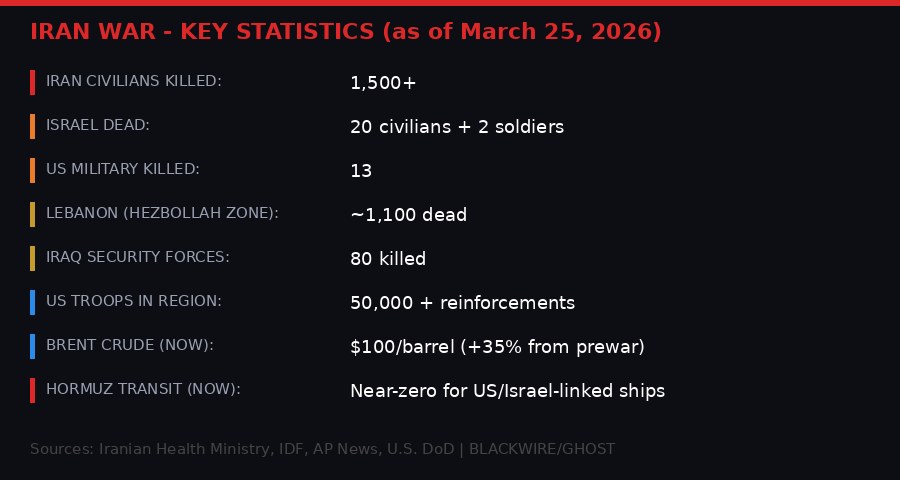
War statistics as of Day 26. The death toll in Iran alone exceeds 1,500, while Lebanon has seen roughly 1,100 killed and Iraqi security forces have lost 80 personnel. (BLACKWIRE/GHOST)
The Architecture of Defiance

Iran's nuclear facilities were targeted in the opening strikes of the war. The fate of the nuclear program - and who controls it - remains one of the central questions of any ceasefire. (Illustrative/Unsplash)
The question of who has authority to negotiate is not just procedural. It goes to the heart of whether a ceasefire is achievable at all.
Iran's constitution places final authority over armed forces and the nuclear program with the supreme leader. Mojtaba Khamenei holds that position. But he has not been seen or heard from. The government formed a council to govern until a new supreme leader is chosen - but that council's authority over the IRGC and the military remains unproven under fire. [AP News]
Within Iran's government, multiple centers of power have operated with increasing independence since the war began. President Masoud Pezeshkian - a moderate who won election in 2024 on promises of nuclear de-escalation - has been largely sidelined. Foreign Minister Araghchi handles public diplomacy but by his own admission cannot speak for the military. Parliament Speaker Qalibaf has denied any talks with the U.S. The IRGC's Pakpour has promised to fight until victory.
Ali Vaez of the International Crisis Group warned against the assumption that killing leaders breaks states. "The mistake in the U.S. and in Israel is that they ended up believing their own rhetoric that Iran is akin to a terrorist organization, that decapitating the regime or removing one or two layers of political elite would result in paralysis and collapse," he said. "Whereas this is a state. It has multiple layers of leadership." [AP News]
Even if all top generals were eliminated, others lower down the ranks can pick up where their superiors left off. The IRGC has 150,000 active-duty personnel and a vast reserve structure. Killing its leaders accelerates succession, it does not stop operations.
"The expectation that this regime will implode by removing a few dozen senior leaders, I think is nothing but an illusion," Vaez said.
That assessment points to the fundamental problem with the current war strategy. The U.S. and Israel have killed the supreme leader, multiple IRGC commanders, and numerous political figures. Iran has not collapsed. Its military has not stopped fighting. Its proxy network is still expanding operations into Gulf states. The regime has changed - but it is still functioning, still shooting, still denying that any negotiations are taking place while its envoys sit across from Pakistani intermediaries in Islamabad. [AP News, International Crisis Group]
Conflict Timeline: Key Events
What Happens If No One Blinks
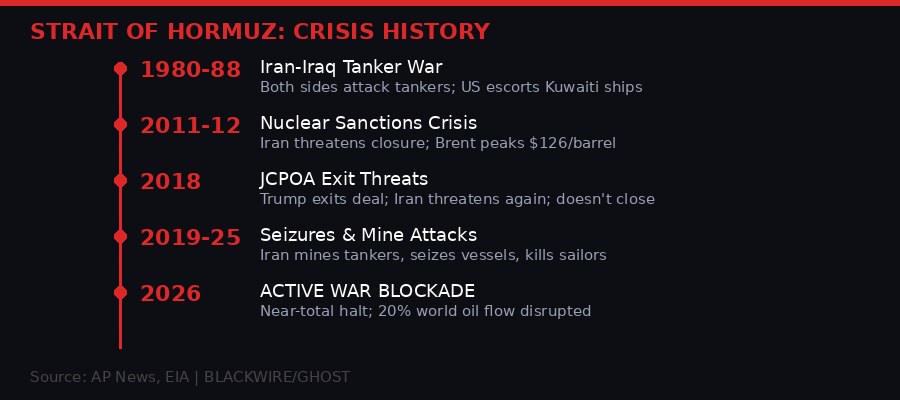
The Strait of Hormuz has been weaponized before - but never to this degree. This is the first time traffic has been near-completely halted. (BLACKWIRE/GHOST)
The economic math is becoming undeniable. Brent crude was trading around $100 per barrel on Wednesday - down from a peak near $120 earlier in the war, but still up roughly 35% from pre-war levels. [AP News] Economists have warned that sustained triple-digit oil prices will flow through to food prices, mortgage rates, and auto loans. The Philippines has already declared a national energy emergency. Asian economies dependent on Gulf oil are in triage mode.
Iran allowing only selective traffic through Hormuz - no ships from the U.S., Israel, or countries deemed linked to them - means the blockade is political as well as military. It is leverage the IRGC has spent decades building. The 2011-12 nuclear standoff, the 2018 JCPOA collapse, and multiple seizure operations were all previews. The Guard has always believed control of Hormuz was their ultimate deterrent. They are now using it.
The escalation risk is real and quantifiable. If Trump's extended deadline expires without progress and he orders the threatened strikes on Iranian power plants, Iran has pledged retaliation against power, water, and oil infrastructure across the Gulf. That means Saudi Arabia's oil terminals, UAE desalination plants, Bahrain's infrastructure. A conflict that has so far been largely contained to Iran, Israel, and Lebanon would explode into a Gulf-wide catastrophe affecting the energy supply chains of Europe, Asia, and beyond.
Burcu Ozcelik of the Royal United Services Institute offered the most clear-eyed assessment: "Leadership matters, and the loss of key decision-makers spanning politics, intelligence, internal security and the army will have transformative consequences." But the transformation will take years, not weeks. The regime is "already changing" - but it is not collapsing. [AP News]
The paratroopers from Fort Bragg are trained to seize airfields. The Marines are trained in amphibious assault. The Air Force and Navy are already running strike operations. The military options are on the table. What is not on the table - because no one who controls Iran's military has stepped into the light - is a deal.
Mojtaba Khamenei is either hiding, wounded, or dead. The IRGC is running the war on pre-written orders. The ceasefire proposals are being rejected by a government that cannot deliver on what it signs. And 1,000 American paratroopers are wheels-up toward a region where the next move belongs to a man who hasn't been seen in 26 days.
The ghost in Tehran is not a metaphor. It is a problem with no current solution.
Get BLACKWIRE reports first.
Breaking news, investigations, and analysis - straight to your phone.
Join @blackwirenews on TelegramSources: AP News (multiple dispatches, March 25-26, 2026); Al Jazeera "The Take" (March 25, 2026); International Crisis Group - Ali Vaez; Royal United Services Institute - Burcu Ozcelik; AP-NORC Center for Public Affairs Research poll (March 19-23, 2026); Press TV (via AP); Kuwait Ministry of Interior; U.S. DoD (via AP); Iranian Health Ministry (via AP).