BREAKINGBomb the Universities: Iran's IRGC Issues Midnight Ultimatum as Houthis Enter the War
The Islamic Revolutionary Guard Corps threatened Sunday to strike Israeli universities and American university branches across the Middle East unless Washington condemns the bombing of Iranian academic institutions by noon Monday, March 30. At the same moment, Houthi rebels in Yemen fired their first missiles of the war at Israel - opening a new front that could seal the last open shipping lane left in the region.

Day 30 of the US-Israel-Iran war brought simultaneous escalations that security analysts say could determine the conflict's trajectory. (Illustrative)
Iran's war just escalated from a regional military conflict into something else - a threat aimed at campuses, at students, at the soft infrastructure of higher education in a region that has already lost thousands of lives in 30 days of direct US-Israeli strikes.
The IRGC statement, distributed through Iranian state media on Sunday morning, demands that the United States issue an official condemnation of strikes on Iranian universities and research centers by Monday at noon. If that condemnation does not arrive, Iran will consider Israeli universities and branches of American universities operating in the Middle East - schools like branches of American institutions in the UAE, Qatar, and Lebanon - as "legitimate targets," the statement said, according to the Associated Press.
Simultaneously, Houthi rebels in Yemen fired their first missiles of the entire conflict at Israeli territory - missiles that Israeli air defenses intercepted but whose launch signals the potential sealing of the Bab al-Mandeb strait, the last major shipping lane that has been keeping Saudi crude moving to global markets since the Strait of Hormuz was effectively closed on day one of this war.
Thirty days in, the US-Israel war with Iran has killed more than 3,000 people, wounded more than 300 American service members, sent oil prices to $105 a barrel, wiped out 17% of the world's LNG export capacity, and now threatens to make universities into military targets.
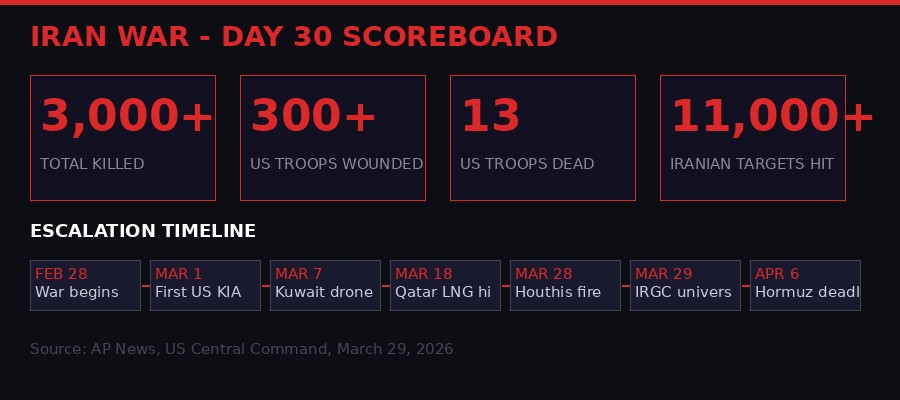
Day 30 scoreboard: the scale of the conflict in numbers. (BLACKWIRE/PIL)
The IRGC's University Ultimatum - What It Says and What It Means
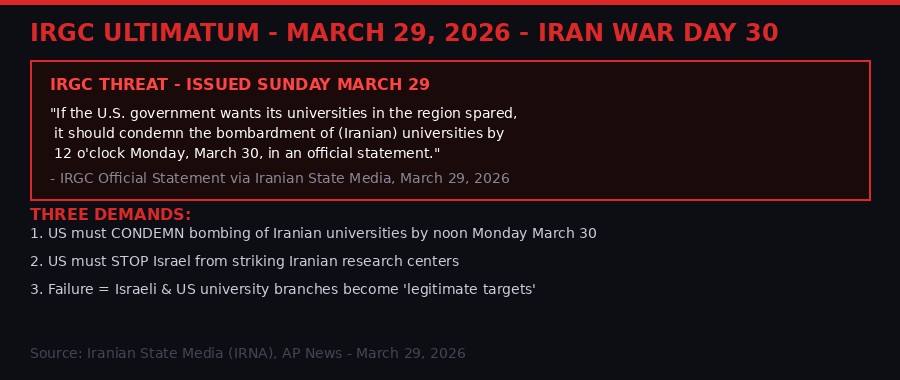
The IRGC's three demands as issued Sunday, March 29 - with a Monday noon deadline. (BLACKWIRE/PIL)
The Revolutionary Guard's statement was issued Sunday after Israeli airstrikes this past week targeted what Israel's military described as "essential weapons production sites" inside Iran. Some of those strikes, Israeli officials acknowledged, hit Iranian university facilities and research centers - institutions that Iran says are civilian academic infrastructure but that Israel argues are dual-use facilities connected to the weapons program.
"If the U.S. government wants its universities in the region spared, it should condemn the bombardment of (Iranian) universities by 12 o'clock Monday, March 30, in an official statement." - IRGC, via Iranian State Media, March 29, 2026
The statement goes further than a warning. It is a structured ultimatum with a countdown. The Guard demanded the US government both condemn the strikes and actively halt Israeli targeting of Iranian universities and research facilities. Two demands with a single deadline: noon Monday.
What makes this development more than a rhetorical escalation is the target category. Throughout this war, Iran has struck military bases, port facilities, oil infrastructure, and civilian-adjacent targets in Gulf states. Threatening universities - institutions with international student bodies, American faculty, and legal protections under international humanitarian law - moves the threat into territory that Western governments cannot easily absorb as routine wartime rhetoric.
American university branches in the region include NYU Abu Dhabi, Carnegie Mellon Qatar, Georgetown Qatar, Northwestern University in Qatar, Texas A&M Qatar, and the American University of Beirut, among others. Combined, these institutions enroll tens of thousands of students, including large numbers of American, European, and regional nationals.
The American University of Beirut - already operating under stress since Hezbollah's re-engagement in southern Lebanon earlier this month - declined to comment. The US State Department did not immediately respond to requests for a statement on the IRGC ultimatum.
Legal experts reached Sunday noted that targeting universities with no direct military function would constitute a war crime under Additional Protocol I of the Geneva Conventions. But Iran, like several states in the region, has a complicated relationship with that legal framework - and the IRGC has historically treated legal exposure as secondary to strategic leverage.
How We Got Here - Iran's University War Began With Israel's Targeting

Israel has targeted what it describes as dual-use research facilities - Iran calls them universities. The line has defined this week's escalation. (Illustrative)
Israel's military announced earlier this week that it was hitting what it called Iran's "essential weapons production sites," with the campaign expected to conclude "within a few days." Among the facilities targeted, Israeli and Western military analysts have confirmed, are installations at or adjacent to Iranian universities - including sites connected to Tehran's Sharif University of Technology and facilities linked to the Malek Ashtar University of Technology, both of which have long-established ties to Iran's defense and aerospace programs.
Iran's position is categorical: these are civilian academic institutions, and strikes on them constitute deliberate attacks on education and culture. Israel's position is equally firm: research centers embedded within universities that produce ballistic missile components, drone guidance systems, and advanced propellant chemistry are military targets regardless of their institutional affiliation.
The argument is not new. Both sides made similar claims throughout the 2006 Lebanon war, during previous Gaza campaigns, and during Iran's nuclear negotiations. What is new is that Iran has now formalized the dispute into a public ultimatum against American institutions, dragging the US directly into a bilateral education-sector confrontation it did not choose.
Secretary of State Marco Rubio, speaking Friday before the ultimatum was issued, said the US can achieve its war objectives "without any ground troops" - a statement that has already aged poorly given that over 300 American service members have been wounded and 13 killed. The State Department will now face a harder question: does Washington issue any statement on Iranian universities, and if so, what does that statement say without implicitly endorsing Iranian framing about the illegitimacy of the strikes?
Trump himself has given Iran until April 6 to reopen the Strait of Hormuz. Iran says it has not engaged in any negotiations about the strait. The university ultimatum, with its Monday noon deadline, sits inside that April 6 window - a compressed test of Washington's signaling discipline before the bigger deadline arrives.
The Houthis Fire - The Last Open Lane Is Now in Play

Saudi Arabia has been routing millions of barrels of crude through Bab al-Mandeb since Hormuz closed. The Houthi entry into the war threatens that final corridor. (Illustrative)
For 30 days, the Houthis watched. They issued statements, they put their "fingers on the trigger," as Brig. Gen. Yahya Saree said Friday, but they had not fired a shot in this new war. That changed Saturday.
Houthi Brig. Gen. Yahya Saree announced that the rebels launched missiles toward what he described as "sensitive Israeli military sites" in the south of Israel. The Israeli military confirmed it intercepted a missile fired from Yemen. It was one missile, intercepted, with no reported casualties. But the significance is not the missile itself - it is what the missile represents as a signal.
"We are preparing for a multifront war." - Israeli military spokesperson Brig. Gen. Effie Defrin, responding to questions about the Houthi entry
The Bab al-Mandeb strait, a 32-kilometer-wide passage at the southern tip of the Arabian Peninsula, has become the single most critical artery keeping the global energy system from complete collapse. Since Iran closed the Strait of Hormuz by threatening tankers on day one of the war, Saudi Arabia has been routing millions of barrels of crude per day through Bab al-Mandeb and up through the Red Sea toward the Suez Canal. A quarter of global container trade normally moves this way.
The Houthis shut down that route before - from late 2023 through early 2025, their drone and missile campaign against commercial shipping in the Red Sea forced vessels to reroute around the Cape of Good Hope at enormous cost. Trump had halted US strikes on Houthi positions after a deal that saw the rebels stand down their shipping attacks. That deal's durability is now in serious question.
Ahmed Nagi, a senior Yemen analyst at the International Crisis Group, told AP: "If we see more pressure on the Iranians, or there's any escalation, the Houthis will jump in harshly." That was a pre-launch statement. The launch has now happened. The question is whether one missile is a warning shot or the start of a sustained campaign.
European energy officials are watching Bab al-Mandeb with particular dread. The EU relies heavily on LNG tankers that pass through the Red Sea - Iran's March 18 strike on Qatar's Ras Laffan terminal already destroyed 17% of global LNG export capacity, with QatarEnergy estimating repairs could take up to five years. If the Red Sea now closes alongside Hormuz, European natural gas supplies face a compounding shortage with no obvious near-term remedy.
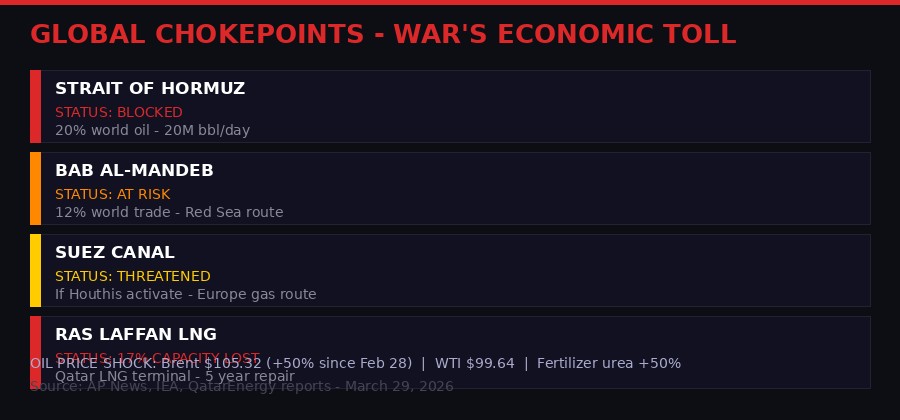
Two chokepoints blocked, two threatened - the global energy map after 30 days of war. (BLACKWIRE/PIL)
300 Americans Wounded, 13 Dead - The Saudi Base Under Fire

Prince Sultan Air Base, 96 kilometers from Riyadh, has been struck repeatedly. More than 300 US troops have been wounded in the war. (Illustrative)
The human cost inside the US military is accumulating in ways that the nightly news cycle has failed to fully convey. US Central Command confirmed Friday that more than 300 service members have been wounded in the war - most have returned to duty, 30 remain out of action, and 10 are considered seriously wounded. Thirteen Americans have been killed.
The week's most intensive attack came Friday, when Iran fired six ballistic missiles and 29 drones at Saudi Arabia's Prince Sultan Air Base, a joint US-Saudi installation 96 kilometers from Riyadh. At least 15 troops were injured in that strike, including five seriously. Earlier in the week, a separate attack injured 14 US troops. In a third incident, no personnel were hurt but a US aircraft was damaged.
The dead include Army Sgt. Benjamin N. Pennington, 26, who was wounded in a March 1 attack on the base and died days later. The worst single incident killed six Army Reserve members when an Iranian drone struck an operations center at a civilian port in Kuwait - logistics soldiers who kept troops supplied with food, water, fuel, and ammunition. Six others died when a refueling tanker aircraft crashed in Iraq following an incident with another aircraft, in circumstances the US military says were "not due to hostile or friendly fire."
James Jeffrey, a former deputy national security adviser and US ambassador to Iraq, told AP the low casualty count relative to the volume of Iranian fire "says great things about our operational and tactical-level use of the military." But Jeffrey was direct about what the US has failed to achieve: "We have not stopped Iran from its campaign against the Gulf. We have not eliminated all of their missiles. And of course, they still have the 400-plus kilograms of highly enriched uranium. It's buried, but still it's there."
That 400-kilogram enriched uranium figure looms over every diplomatic conversation. The IAEA has been unable to access Natanz and other enrichment facilities since the war began. The question of what Iran might do with that material if it believes its survival as a state is genuinely threatened has not been answered - and the university ultimatum is one more signal that Tehran is operating in a register of maximum pressure.
Reinforcements continue to flow into the region. The USS Tripoli, an amphibious assault ship carrying approximately 2,500 Marines from the 31st Marine Expeditionary Unit, arrived in the Middle East on Saturday. The ship was conducting exercises near Taiwan when orders came to deploy nearly two weeks ago. The USS Boxer and two additional ships with another Marine Expeditionary Unit are en route from San Diego. Combined with two aircraft carriers and roughly 50,000 troops already in place, the US now has its largest regional military presence in more than 20 years.
Trump's War of Mixed Messages Meets Its Hardest Test

Trump's "it's going very well" framing on Iran talks has collided with Iran's flat denial of any negotiations. The university ultimatum sharpens that contradiction. (Illustrative)
In the days before the IRGC issued its university ultimatum, Trump said talks to end the war were going "very well." Iran immediately and publicly denied that any talks were underway. The gap between those two statements - one from the US president, one from the Revolutionary Guard - defines the communication environment in which Monday morning's deadline will land.
Trump has now twice delayed deadlines for Iran to reopen the Strait of Hormuz. The current deadline is April 6. He has threatened to "obliterate" Iran's energy plants if the strait remains closed, then said separately that the US was "not affected" by the closure - a claim difficult to sustain as gasoline prices and airline ticket costs rise for American consumers. He has pilloried European allies for not joining the war effort, then said he does not need their help.
Leon Panetta, who served as defense secretary and CIA director under Democratic administrations, did not spare the assessment: "It's not the first administration that has not told the truth about war. But the president has made it kind of a very standard approach to almost any question to in one way or another kind of lie about what's really happening and basically describe everything as fine and that we're winning the war."
Rep. Gregory Meeks of New York, ranking Democrat on the House Foreign Affairs Committee, said the administration is "winging it" - pointing to Trump's repeated contradictions on deadlines, negotiations, and military objectives. Even Republican senators, heading into a two-week congressional recess, expressed private frustration at what several called an absence of a coherent exit strategy.
The university ultimatum now forces a specific, public response calculation that vague war-is-going-well messaging cannot absorb. If Washington says nothing, the IRGC may interpret silence as license. If Washington issues any statement that touches on Iranian universities, it could be read domestically as capitulating to Iranian pressure and internationally as implying criticism of Israeli targeting decisions. There is no obvious clean lane through Monday noon.
Pakistan, the Diplomats, and the Sunday Meeting

Regional powers are convening Sunday in Pakistan to discuss paths to de-escalation, even as Iran issues new ultimatums. (Illustrative)
Not every signal from the region Sunday was escalatory. Pakistan's government announced that foreign ministers from regional powers would convene Sunday to discuss paths toward ending the conflict. Egyptian Foreign Minister Badr Abdelatty and Pakistani counterpart Ishaq Dar were already meeting in Islamabad Saturday, with Sunday's broader gathering intended to coordinate a regional diplomatic position.
Pakistan has emerged as one of the few governments with credible contacts on multiple sides. It maintains working relationships with Iran, with Gulf Arab states, with China which has significant economic stakes in Iranian infrastructure, and with the United States. Pakistani Foreign Minister Dar has said the country can serve as a "bridge" between parties - language that every regional power mediator uses, with varying degrees of success.
Iran, for its part, agreed Friday to allow humanitarian aid and agricultural shipments through the Strait of Hormuz following a United Nations request - a concession that the UN presented as a partial breakthrough but that leaves the fundamental commercial closure of the strait intact. Oil tankers are not moving. LNG carriers are not moving. The price of crude is $105 a barrel and the price of ammonia fertilizer is up 20% from pre-war levels, with urea up 50%.
The Sunday diplomatic meetings will take place against the backdrop of the university ultimatum's Monday noon deadline, the Houthi missile launch, and the broader April 6 Hormuz deadline Trump has set. Three clocks running simultaneously, none of them synchronized with the diplomatic process that might slow any of them.
Israel's military, operating in what spokesperson Brig. Gen. Effie Defrin called preparations for "a multifront war," said early Sunday that an American-Israeli dual-national soldier from New Haven, Connecticut, had been killed in combat in southern Lebanon - the fifth Israeli military death in Lebanon since the conflict with Hezbollah reignited on March 2. Three Israelis were wounded in the same engagement.
The Economic Damage After 30 Days - A War the World Is Paying For

US stocks closed out their worst week since the war began. The economic fallout extends from oil prices to fertilizer shortages to food inflation in the developing world. (Illustrative)
The war that began as a US-Israeli military operation has become, at its 30-day mark, a global economic crisis with no agreed endpoint. The statistics are stark.
Brent crude settled Friday at $105.32 per barrel, up 3.4% on the day and roughly 50% above its level before the war started. Benchmark US crude (WTI) rose 5.5% to $99.64. The International Energy Agency has called the supply disruption "the largest in the history of the global oil market," with 20 million barrels per day effectively removed from the market by the Hormuz closure.
The Ras Laffan strike on March 18 destroyed 17% of Qatar's LNG export capacity. Helium, a byproduct of natural gas production at Ras Laffan that supplies about a third of the world's requirement for chipmaking, rocket guidance, and medical imaging, is now critically short. The fertilizer market has collapsed in terms of availability - urea prices up 50%, ammonia up 20% - with downstream effects on food production expected to hit developing-world markets by mid-year.
Christopher Knittel, an energy economist at MIT, told AP: "A week ago or certainly two weeks ago, I would have said: If the war stopped that day, the long-term implications would be pretty small. But what we're seeing is infrastructure actually being destroyed, which means the ramifications of this war are going to be long-lived."
The IEA's head Fatih Birol warned on March 23: "No country will be immune to the effects of this crisis if it continues to go in this direction." That statement came before the Houthi entry into the war, before the university ultimatum, and before the Iranian threats on Sunday to strike educational institutions. The compounding of crises within a single weekend suggests the war is entering a new, more complex phase.
US stocks finished their worst week of the war. Carmen Reinhart, a former World Bank chief economist now at Harvard Kennedy School, has warned of stagflation - higher inflation and lower growth simultaneously - in language that echoes the 1970s oil shocks that preceded recession in the US and Europe. IMF former chief economist Gita Gopinath calculated that global growth, expected at 3.3% before the war, will be 0.3 to 0.4 percentage points lower even in a scenario where oil averages $85 a barrel for 2026 - a scenario now well below current prices.
Poorer nations are being outbid for remaining energy supplies. Asia, which imports more than 80% of the oil and LNG that passes through the closed or threatened straits, faces the steepest exposure. Brazil, which imports 85% of its fertilizer, is watching its coming harvest season approach with inventory shortfalls that could push food prices sharply higher by late 2026.
What Happens Monday - The Countdown and Its Consequences

Monday noon Tehran time - the IRGC's deadline for a US condemnation statement. What happens next shapes the war's second month. (Illustrative)
By Monday at noon Middle East time, Washington will face a specific, public test of its crisis management under fire. The choices are limited and all of them carry costs.
Option one: say nothing. Let the deadline pass without a response. The IRGC will interpret this as permission or provocation - it is unlikely to interpret it as diplomatic maturity. Any subsequent strike on a university campus would drag the US into a hostage-crisis-style response with no good options and enormous international visibility.
Option two: issue a general statement about international humanitarian law and the protection of civilian institutions, without specifically naming Iranian universities. This would allow the State Department to frame the statement as principle rather than capitulation. Iran would likely reject this as inadequate and use it as cover for proceeding with threats. Domestic critics would call it appeasement regardless of its careful wording.
Option three: address the Iranian universities directly, expressing concern about the targeting of academic institutions while reaffirming support for Israel's right to target weapons production infrastructure. This threading of the needle has historically been the State Department's preferred mode - nuanced enough to claim it isn't a concession, specific enough to give Iran something to point to. Whether the current administration has the institutional bandwidth to execute that kind of precision statement under the current communications chaos is a genuine question.
The IRGC has not historically issued ultimatums it then lets expire without follow-through. That pattern - set a deadline, enforce it - has defined Iranian escalation management throughout this war and in previous conflicts. The announcement that Iranian air defenses intercepted missiles and drones "across Gulf countries" early Sunday suggests military operations are continuing at scale even as the political ultimatum plays out.
Tehran's threat to strike Israeli universities also contains a second-order message for Israel's domestic population. The Weizmann Institute, Tel Aviv University, the Technion - these are institutions with international faculty, joint programs with American and European universities, Nobel laureates on their rosters. Any strike on them would produce an immediate, massive international response that would make the current diplomatic isolation of the US-Israeli campaign look mild by comparison. Iran almost certainly knows this. The threat may be more about pressure than execution - but "almost certainly" is not the same as "certainly" when 13 Americans are already dead and 300 are wounded.
The war began one month ago on February 28. In those 30 days, the world's largest oil supply disruption reshaped global energy markets, 3,000 people were killed, the Houthis were drawn into a direct confrontation they had spent a month delaying, and the IRGC issued a threat to bomb universities with a 24-hour deadline. The second month begins Monday. The trajectory is not pointing toward de-escalation.
Sources: Associated Press (Samy Magdy, Cairo; Konstantin Toropin, Washington; multiple AP correspondents), US Central Command official statements, International Crisis Group Yemen analysis, Iranian state media (IRNA), IEA March 23 statement, QatarEnergy reports, MIT energy economics analysis. All quotes and data verified through AP News reporting as of 07:06 UTC March 29, 2026.
Get BLACKWIRE reports first.
Breaking news, investigations, and analysis - straight to your phone.
Join @blackwirenews on Telegram