Iron Rain: Iran Strikes Gulf Factories, Airports and Ports in Broadest Industrial Assault Yet

Iran opened a new chapter in the month-old war on Saturday and Sunday by launching coordinated strikes against civilian industrial infrastructure across four Gulf states simultaneously. Aluminium smelters in Abu Dhabi and Bahrain. Kuwait's international airport radar system. A commercial port in southern Oman. In the space of 24 hours, the Islamic Revolutionary Guard Corps turned the Persian Gulf's economic arteries into a shooting gallery - and sent a message that no neutral country hosting American military assets is safe.
The attacks mark a dramatic escalation from Iran's earlier pattern of targeting US military bases and Israeli territory directly. By hitting factories that produce aluminium for global supply chains, airport systems that keep civilian aviation running, and ports that handle cargo for entire economies, Tehran has declared that the distinction between military and economic targets no longer applies. The message to Gulf Arab capitals is blunt: there is a price for hosting American forces, and Iran intends to collect it.
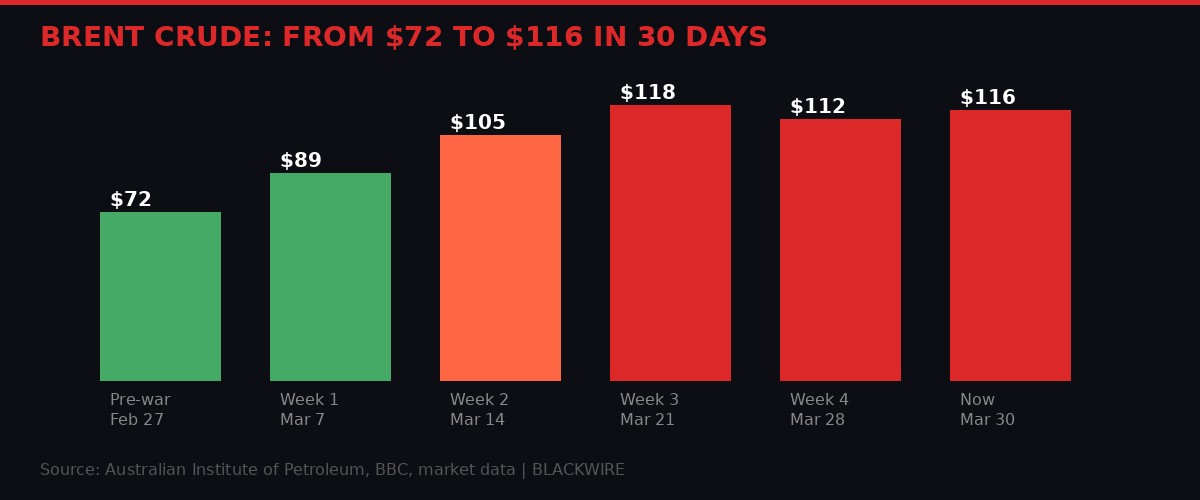
As of early Monday morning, Brent crude had climbed to $115.84 per barrel, up 2.9% from Friday's close, continuing a relentless march that has seen oil prices surge more than 60% since the war began on February 28. The aluminium strikes alone could tighten global supply for a metal critical to aerospace, automotive and construction industries worldwide. Aluminium Bahrain (ALBA) operates one of the world's largest smelting facilities. Emirates Global Aluminium (EGA) in Abu Dhabi is the largest industrial company in the UAE outside the oil and gas sector. Both reported significant damage.
Abu Dhabi: The Crown Jewel Gets Hit

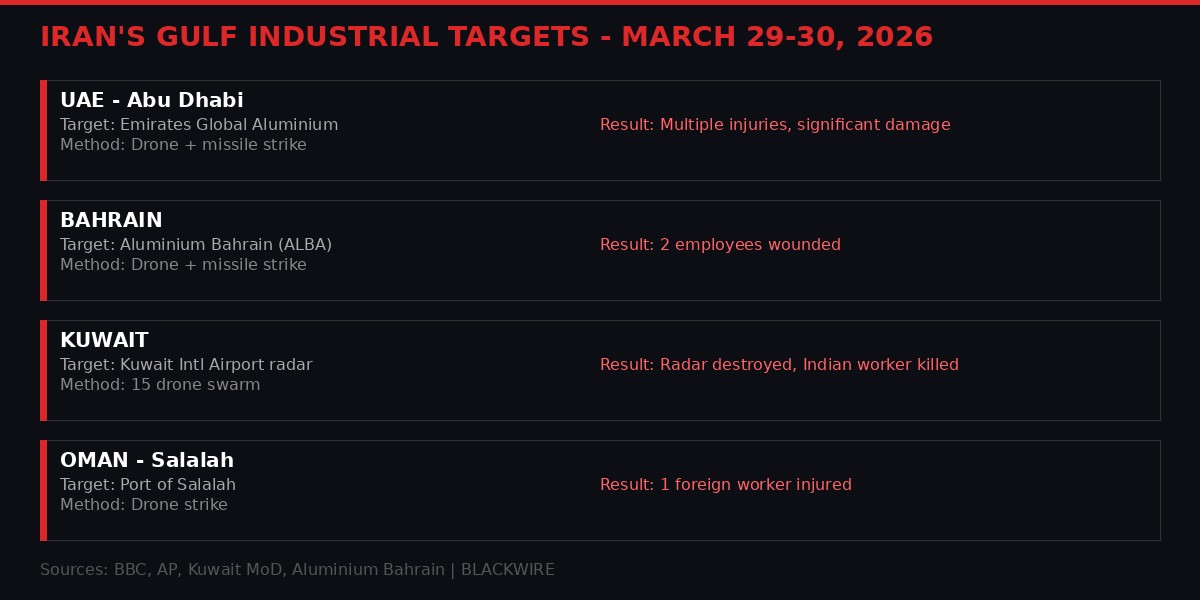
Emirates Global Aluminium confirmed that its sprawling facility in the Khalifa Industrial Zone of Abu Dhabi sustained a direct strike from Iranian drones and missiles on Saturday. The company reported "significant damage" to smelting infrastructure and confirmed multiple employees were injured, though it declined to specify exact numbers. The UAE government said the injured were receiving treatment at hospitals in Abu Dhabi, but released no further details about the extent of casualties or damage to production capacity.
EGA is not a small player. The company produces 2.5 million tonnes of aluminium annually, roughly 4% of the world's total output. It supplies raw material to manufacturers across more than 60 countries. Its products end up in everything from Airbus fuselages to Coca-Cola cans. A sustained disruption to EGA's operations would ripple through global supply chains already stretched thin by the Strait of Hormuz blockade and pandemic-era bottlenecks that never fully resolved.
The Khalifa Industrial Zone sits approximately 250 kilometers from Iranian territory across the Persian Gulf. That proximity has always been the unspoken vulnerability of the UAE's economic model - build massive industrial capacity in a region where a determined adversary with medium-range missiles and cheap drones can reach your factories in minutes. Saturday's attack turned that theoretical risk into operational reality.
The IRGC's statement, carried by Iran's semi-official Mehr news agency, claimed the aluminium facilities were "linked to the American military." The assertion is a stretch - EGA is jointly owned by Mubadala Investment Company and Investment Corporation of Dubai, both sovereign wealth vehicles. But the IRGC's logic follows a consistent pattern: any economic asset in a country that hosts US forces is a legitimate target. The USS Tripoli's arrival in the Gulf hours later only reinforced that calculus.
For Abu Dhabi, the strike hits at something deeper than aluminium production. The emirate has spent decades building a reputation as a stable, globally connected business hub - a place where sovereign wealth funds and multinational corporations park capital precisely because it sits above the chaos. The Houthis struck Abu Dhabi airport and an oil facility in January 2022, but the UAE had largely avoided direct Iranian fire in the current war until now. That era of relative immunity is over.
Bahrain: The Smelter and the Fifth Fleet

Aluminium Bahrain - universally known as ALBA - confirmed that two employees were wounded when Iranian drones and missiles struck its facility on Saturday. The company, which operates one of the world's largest aluminium smelting complexes capable of producing over 1.5 million tonnes per year, reported damage to sections of its plant but said it was assessing whether production could continue at reduced capacity.
Bahrain occupies a unique and vulnerable position in this conflict. The tiny island kingdom - just 780 square kilometers, smaller than New York City - hosts the headquarters of the US Navy's Fifth Fleet in the Juffair district of its capital, Manama. Iranian missiles have targeted that naval complex multiple times since the war began. On March 2, debris from an intercepted missile killed an Asian worker on a foreign vessel undergoing maintenance in Bahrain's waters. Three people have now died in Bahrain from war-related attacks, according to Al Jazeera's live tracker.
The decision to strike ALBA specifically carries economic weight far beyond Bahrain's small domestic market. ALBA's aluminium feeds into manufacturing chains across the Middle East, Europe and Asia. The company is the largest non-oil industrial enterprise in Bahrain and one of the largest employers in the kingdom. Any prolonged shutdown would devastate the local economy and strain Bahrain's attempts to diversify away from oil dependence - the very strategy that was supposed to insulate Gulf economies from exactly this kind of geopolitical shock.
The IRGC's claim that these aluminium facilities are "linked" to the American military serves a dual purpose. It provides legal cover under Iran's declared rules of engagement, and it forces Gulf states into an uncomfortable spotlight: the more they are seen as extensions of the US military presence, the more they become targets. Bahrain, with its Fifth Fleet headquarters, has the least room to maneuver. The country's entire defense posture depends on the American security umbrella. That umbrella is now attracting missiles instead of deflecting them.
Kuwait: Fifteen Drones, One Airport

Kuwait's defense ministry confirmed that the radar system at Kuwait International Airport was "significantly damaged" after being attacked by a swarm of 15 Iranian drones. The strike effectively blinded one of the Gulf's busiest civilian airports - a facility that handled over 15 million passengers in 2024 and serves as a critical hub for flights connecting Asia, Europe and Africa.
In a separate incident, Kuwait's Ministry of Electricity and Water confirmed that an Indian worker was killed in an Iranian attack on a power and desalination plant. The ministry said technical teams were working "to ensure the continuity of vital services" after reporting "significant damage" to the facility. The death of a civilian worker from a third country - India, whose diaspora numbers roughly 1 million people in Kuwait alone - adds an international dimension that complicates the conflict further.
India's response will be closely watched. The country has approximately 9 million citizens working across the Gulf states, making it one of the largest diaspora populations in the region. Indian workers staff everything from construction sites to hospitals to IT departments. When one of them dies in a strike by a country India has historically maintained cordial relations with, diplomatic calculations shift. New Delhi has so far avoided taking sides in the US-Iran conflict, but the death of an Indian national in a direct Iranian attack may force its hand.
The drone swarm tactic used against Kuwait's airport radar is militarily significant. Fifteen drones coordinated against a single target suggests a level of operational planning designed to overwhelm point-defense systems. The radar itself - necessary for tracking aircraft in the airport's control zone - is not easily replaced. Spare parts for advanced airport radar systems typically take weeks to procure under normal conditions. In wartime, with global supply chains disrupted and the Strait of Hormuz effectively closed, the timeline could stretch much longer.
Kuwait has tried harder than most Gulf states to maintain a neutral posture. The country declined to join the Abraham Accords, maintained working diplomatic relations with Iran and avoided the more aggressive anti-Iran rhetoric of its neighbors. None of that prevented its airport from getting hit. The lesson for other neutral-leaning Gulf states is clear: neutrality is not a shield when the country hosting you also hosts American military infrastructure. Kuwait has been home to a major US military presence since the 1991 Gulf War, including Camp Arifjan, one of the largest US army installations in the Middle East.
Oman: The Quiet Neighbor Takes Fire

Oman announced it was investigating what it called "cowardly attacks" on its southern port of Salalah, where a foreign worker was reportedly injured in a drone strike. No group claimed responsibility for the attack, but the timing - simultaneous with IRGC operations against targets in the UAE, Bahrain and Kuwait - strongly suggests Iranian involvement.
Oman's inclusion in the target list is the most diplomatically explosive element of Saturday's offensive. The sultanate has for decades maintained a unique position as the Gulf's honest broker - the country that talks to everyone, takes no sides and facilitates back-channel diplomacy between adversaries. Oman helped broker the preliminary talks that led to the 2015 Iran nuclear deal. It has consistently maintained warm relations with Tehran even as other Gulf states adopted confrontational stances.
If Iran struck Salalah, it represents a break with decades of mutual respect between Tehran and Muscat. Salalah is not just any port - it is Oman's primary container terminal on the Arabian Sea, handling roughly 4 million TEU (twenty-foot equivalent units) of cargo annually. It sits outside the Strait of Hormuz entirely, on the Indian Ocean side, making it one of the few Gulf-adjacent ports that can theoretically operate even when the strait is closed. Hitting it suggests Iran views the disruption of all Gulf commercial activity as a legitimate war objective, regardless of the target country's diplomatic stance.
The lack of a claim of responsibility is itself telling. Iran may be testing the boundaries - striking a historically friendly country to demonstrate reach while maintaining plausible deniability. If Oman attributes the attack to Iran, it would rupture one of Tehran's last remaining diplomatic relationships in the Gulf. If Oman stays quiet, Iran learns that even its friends will absorb punishment without public complaint.
The Houthi Variable: A Second Front at Sea

The Gulf industrial strikes arrived against the backdrop of another dramatic escalation: Yemen's Iran-backed Houthi movement officially entered the conflict on Saturday, firing its first barrage of missiles at Israel. The Israeli military confirmed intercepting two drones launched from Yemen early Monday morning and said it had shot down two missiles from Yemen the previous day.
The Houthi entrance changes the war's economic calculus fundamentally. Iran already controls - or has disrupted - the Strait of Hormuz, through which roughly 20% of the world's oil and natural gas transits. The Houthis now threaten the Bab al-Mandeb strait connecting the Red Sea to the Gulf of Aden, the other major chokepoint for global shipping. Between November 2023 and early 2025, Houthi attacks on shipping in the Red Sea forced the world's largest container lines to reroute around the Cape of Good Hope, adding 10-14 days and thousands of dollars in fuel costs to every voyage.
Major shipping companies had only recently begun experimenting with returning to the Red Sea route when the Iran war erupted. Now they have abandoned it again. Maersk CEO Vincent Clerc put it plainly in a recent BBC interview: "It's very hard for us to put our colleagues and our ships in harm's way and risk having an attack be successful and create damage or loss of life." Hapag-Lloyd, MSC and CMA CGM have all followed suit.
The economic impact of a dual chokepoint disruption is difficult to overstate. The Strait of Hormuz handles roughly 21 million barrels of oil per day. The Bab al-Mandeb handles approximately 6 million. Together, they account for nearly 30% of all seaborne oil trade. If both waterways become active conflict zones simultaneously, the price shock would dwarf anything seen since the 1973 oil embargo.
Australian states are already responding. Victoria, home to Melbourne, announced free public transport for all of April. Tasmania will offer free buses, coaches and ferries through June. Fuel prices in Australia have jumped to A$2.38 per liter from A$2.09 before the war. Egypt has ordered shops, restaurants and cafes to close early. The Philippines declared a national emergency and implemented a four-day work week for civil servants. Sri Lanka, Ethiopia and dozens of other countries are implementing their own fuel conservation measures. The global economy is entering rationing mode, and the war is barely a month old.
Pakistan's Diplomatic Gambit: Talks Without Talking

As bombs fell on Gulf factories, diplomats gathered in Islamabad for a peace effort that looks increasingly detached from the reality on the ground. Pakistan's Foreign Minister Ishaq Dar announced Sunday that his country would "be honored to host and facilitate meaningful talks between the two sides in the coming days," following meetings with foreign ministers from Saudi Arabia, Turkey and Egypt.
There is one critical problem: neither the US nor Iran has publicly confirmed they will attend. Iran's parliament speaker, Mohammad Bagher Ghalibaf, dismissed the Pakistan talks as diplomatic cover for what he described as a planned American ground invasion. "The enemy signals negotiation in public, while in secret it plots a ground attack," Ghalibaf said through state media, adding that Iranian forces were "waiting for the arrival of American troops on the ground to set them on fire."
The rhetorical escalation from Tehran is not merely performative. The Washington Post reported that the Pentagon was preparing for weeks of ground operations in Iran. Axios followed with reports that military planners were developing options for a "final blow" involving a combination of Special Operations raids and conventional bombing campaigns. President Trump told reporters he was not sending ground troops but added, "If I were, I certainly wouldn't tell you." Secretary of State Marco Rubio said the US "could meet its war objectives without ground troops" while acknowledging Trump needed to "be prepared for multiple contingencies."
The gap between American and Iranian negotiating positions remains vast. The US reportedly passed a 15-point "action list" to Iran via Pakistan, which included longstanding demands like abandoning Iran's nuclear program. Iran rejected it flatly. Tehran's counter-proposal calls for recognition of Iranian sovereignty over the Strait of Hormuz, reparations for war damage, a halt to the killing of Iranian officials, guarantees against future attacks, and the removal of American military bases from the Middle East.
Neither side's demands are remotely achievable through negotiation alone. The US wants Iran to surrender its nuclear program and its most potent strategic asset - the Strait of Hormuz. Iran wants the US to leave the Middle East entirely and pay for the damage inflicted over the past month. These are not starting positions for compromise. They are end-state visions of total victory.
Trump, Kharg Island and the Oil Gambit

In a Financial Times interview published Sunday evening, President Trump stated bluntly that his "favourite thing is to take the oil in Iran" and suggested the US could seize Kharg Island, the hub through which roughly 90% of Iranian oil exports flow. "Maybe we take Kharg Island, maybe we don't. We have a lot of options," Trump told the newspaper. When asked about Iranian defenses on the island, he responded: "I don't think they have any defense. We could take it very easily."
Kharg Island sits roughly 25 kilometers off Iran's southern coast in the Persian Gulf. It has been one of the world's most important oil export terminals since the 1960s. During the Iran-Iraq war of the 1980s, both sides attacked each other's oil tankers and terminals in the "Tanker War" phase of that conflict, and Kharg Island was bombed repeatedly by Iraqi aircraft. Iran repaired the damage and kept exporting. The island's facilities have been upgraded significantly since then.
Trump's comments, whether genuine strategic intention or rhetorical improvisation, immediately moved oil prices. Brent crude opened at $115.84 on Asian markets Monday morning, up nearly 3%. The possibility of an American occupation of Iran's primary oil export terminal raises scenarios that would reshape global energy markets for years. If the US seized Kharg and held it, it would control roughly 1.5 million barrels per day of export capacity - oil that currently flows primarily to China, India and other Asian buyers.
The operational challenges of a Kharg Island seizure would be substantial. The island is within range of Iranian anti-ship missiles, coastal artillery and drone swarms launched from the mainland. It sits inside the Persian Gulf, meaning any occupying force would need to maintain supply lines through waters that Iran has already demonstrated it can contest. The 2,500 Marines aboard the USS Tripoli who arrived in the region over the weekend are trained in amphibious operations - exactly the capability needed for an island seizure. Their presence may not be coincidental.
Iran's IRGC has specifically warned that it would target the homes of US and Israeli "commanders and political officials" in the region in response to continued attacks on Iranian civilian infrastructure. The spokesperson for Iran's Khatam al-Anbiya Central Headquarters - the country's highest operational command unit - cited the "targeting of residential homes of the Iranian people in various cities" as justification. Iran also warned that Israeli universities and branches of US universities in the region would be considered "legitimate targets" unless assurances were provided for the safety of Iranian universities that have been struck by Israeli airstrikes.
Thirty Days of Fire: The Numbers

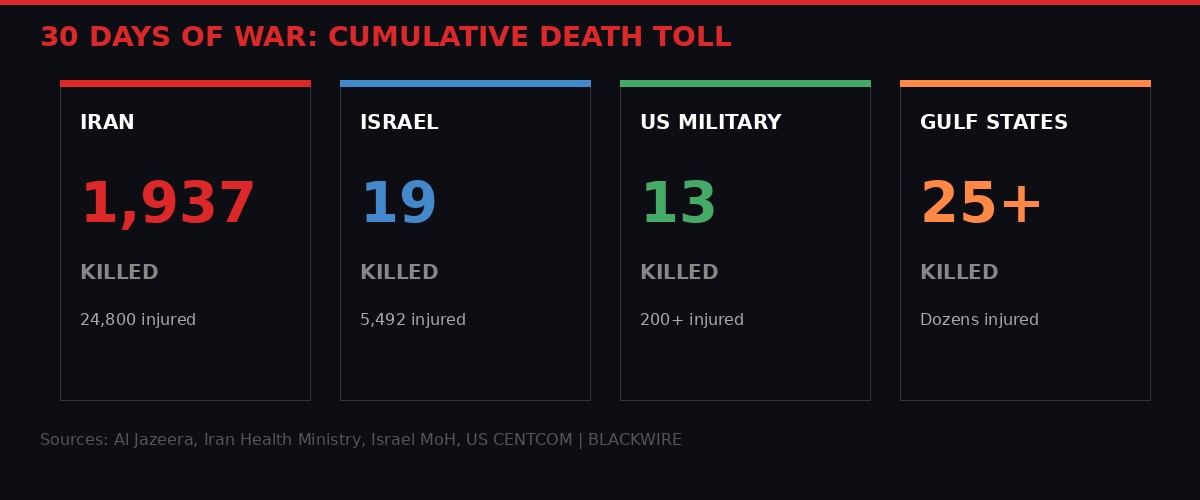
The war that began with US and Israeli strikes on February 28 has now passed the 30-day mark with no ceasefire in sight, no functional peace process and an expanding list of belligerents. The numbers tell a story of accelerating devastation.
In Iran, at least 1,937 people have been killed and over 24,800 injured, according to figures from Iran's Health Ministry cited by HRANA, a US-based human rights monitoring organization. The dead include 240 women and 212 children. Victims range in age from eight months to 88 years old. Over the past 24 hours, Israeli fighter jets dropped more than 120 munitions on Tehran alone, targeting sites Israel claims were used for weapons research and development. Iranian state television reported power outages across sections of Tehran following strikes on electricity infrastructure.
In Israel, 19 people have been killed and more than 5,492 wounded in Iranian retaliatory attacks. The Israeli city of Dimona - home to Israel's primary nuclear facility - and nearby Arad have suffered some of the heaviest damage, with at least 180 people wounded in a single Iranian missile barrage that targeted the nuclear complex. Israel's Health Ministry has urged citizens to rush to bomb shelters "with caution," noting that injuries sustained while running to shelters are contributing to the casualty count.
The US military has confirmed 13 fatalities from Iranian attacks on bases across the region, with over 200 service members injured. An additional service member died of a "health-related incident" in Kuwait. Six crew members were killed on March 13 when a KC-135 refueling aircraft crashed in western Iraq during combat operations. The total American death toll is lower than Iran's, but the political impact at home is mounting. A recent poll found 59% of Americans oppose the war.
Across the Gulf states, at least 25 people have been killed with dozens more injured in Iranian strikes on Bahrain, Kuwait, Saudi Arabia, the UAE, Qatar, Oman, Iraq and Jordan. An Iranian drone also struck a runway at a UK military base in Cyprus. The geographic scope of Iranian retaliation now spans nine countries.
Netanyahu announced on Sunday that Israel would expand its "existing security strip" in southern Lebanon, where more than one million Lebanese have been displaced. The expansion puts roughly a tenth of Lebanon's territory under effective Israeli military control, drawing comparisons to the Israeli occupation of southern Lebanon from 1985 to 2000. Five Israeli soldiers have died since the latest incursion began. The World Health Organization reported that nine paramedics were killed in southern Lebanon within 24 hours, bringing the March total to 51 health workers killed.
What Comes Next: Convergence and Contagion

Three dynamics are now converging to push this war toward a more dangerous phase than anything seen in the past 30 days.
First, Iran's industrial targeting of Gulf states represents a strategic shift from symbolic retaliation to economic warfare. The earlier pattern - missiles at US bases, drones at Israeli military sites - was calibrated to demonstrate capability without triggering a total break with Gulf neighbors. Saturday's attacks shattered that restraint. By hitting aluminium smelters, airport radar and ports, Iran is telling Gulf states that their entire economic model is hostage to the conflict. The IRGC explicitly framed the strikes as retaliation for Israeli attacks on Iranian industrial facilities, establishing a tit-for-tat framework that could spiral indefinitely.
Second, the Houthi entrance opens a second maritime front. The Red Sea was already the world's most dangerous shipping lane before the Houthis declared their involvement in the current war. Their track record from 2023-2024 shows they are willing and capable of sustaining attacks on commercial shipping for months or years. If Houthi operations resume at the intensity of that earlier campaign, the combination of Hormuz and Bab al-Mandeb disruptions could create the most severe global shipping crisis since World War II.
Third, the ground invasion question looms. The arrival of 3,500 Marines aboard the USS Tripoli, Trump's public musing about seizing Kharg Island, Washington Post and Axios reports about Pentagon planning for ground operations, and Rubio's careful language about "multiple contingencies" all point in the same direction. Whether a ground incursion happens or not, the mere possibility is shaping Iranian military posture. Ghalibaf's promise to "set American troops on fire" is not idle rhetoric - Iran has spent years preparing asymmetric defenses designed to make any ground operation prohibitively costly.
The UAE adviser Anwar Gargash captured the Gulf perspective in a statement calling for any peace settlement to include "clear guarantees" that Iranian attacks on neighbors will not be repeated. He described Iran's government as "the main threat" to Gulf security and demanded compensation for attacks on civilian infrastructure. The remark reflects a region that has already given up on neutrality and is now calculating the cost of picking a side.
On the cyber front, the war continues to intensify. An AP investigation found that Iranian operatives are coordinating cyber attacks with physical strikes - sending Israelis malicious links disguised as bomb shelter information during active missile barrages. Cybersecurity firm DigiCert has tracked nearly 5,800 attacks by approximately 50 Iranian-linked groups targeting US, Israeli and Gulf networks. A pro-Iranian hacking group claimed to have infiltrated FBI Director Kash Patel's personal accounts. Iran has also begun targeting data centers and healthcare systems, showing how digital warfare is becoming inseparable from the kinetic conflict.
Meanwhile, North Korea is watching and learning. Pyongyang announced a successful test of an upgraded solid-fuel engine with 2,500 kilonewtons of thrust - enough for an ICBM capable of reaching the US mainland. Kim Jong Un called it a "significant development." The test, reported by state media on Sunday, is a reminder that every conflict reshapes the global security order. Iran's ability to sustain a month-long war against the United States, absorb massive strikes and continue retaliating across nine countries is rewriting the calculus for every nation that considers nuclear weapons its ultimate insurance policy.
Thirty days in, the war has no ceiling, no off-ramp and no shortage of participants eager to widen it further. The factories burning in Abu Dhabi and Bahrain are not collateral damage. They are the new front line.
Get BLACKWIRE reports first.
Breaking news, investigations, and analysis - straight to your phone.
Join @blackwirenews on Telegram