Israel Kills Iran's Navy Chief. The Strait of Hormuz Has No Commander.
On Day 27 of the US-Israel war on Iran, an Israeli strike killed the admiral overseeing the Hormuz blockade. Brent crude touched $104. The GCC convened an emergency summit in Riyadh. And peace talks, already tenuous, flatlined.

Naval operations in contested waters. The killing of Iran's Hormuz commander removes the officer who designed the blockade that has choked 21% of global oil supply for nearly four weeks. (Pexels)
The message was not subtle. Israel killed the officer commanding Iran's naval blockade of the Strait of Hormuz - the single most consequential chokepoint in the global economy - hours after the Gulf Cooperation Council declared Iran had "crossed all red lines" at an emergency summit in Riyadh. Brent crude, already elevated by four weeks of war, jumped again to touch $104 per barrel, according to market data reported by Al Jazeera. Every airline ticket, every heating bill, every container shipped across the Pacific is getting more expensive because of what is happening in a 39-kilometer strip of water between Iran and Oman.
The killed officer - Iran's top naval commander overseeing the Hormuz blockade - had been the architect of Tehran's most effective weapon in this conflict. Not a missile. Not a drone. A geographical straitjacket. By controlling traffic through Hormuz, Iran weaponized geography itself, forcing the entire global economy to pay attention to a war that Washington told its allies would be over in days. It has now been 27 days.
Israel announced the strike. Iran has not confirmed the death but has not denied it either. Iranian state television went quiet for 40 minutes after the news broke, according to monitoring sources. By mid-morning in Tehran, the IRGC Navy had issued no public statements. That silence, in a war where both sides fight as much with information as with weapons, is itself a statement.
The Strike: What Happened and How

Israeli precision strikes have systematically targeted Iran's military command structure throughout the 27-day campaign. Today's hit is the most strategically significant. (Pexels)
Israel's announcement came in a statement released by the Israel Defense Forces early Thursday morning. The IDF confirmed that its air force had conducted a precision strike targeting the Iranian naval commander responsible for coordinating the Strait of Hormuz blockade. The statement did not name the officer, a deliberate practice Israel has maintained throughout the campaign to avoid providing Iran's propaganda apparatus with martyr material.
The location of the strike has not been independently confirmed. Israeli officials have conducted strikes across southern Iran, including Hormozgan province, which borders the strait directly. Earlier in the campaign, Israel struck naval command infrastructure at Bandar Abbas, Iran's primary port on the Strait. Today's strike is consistent with that pattern - taking out the chain of command rather than simply the hardware.
The tactic follows a logic laid out clearly in the first week of the war: decapitate the decision-making apparatus before it can adapt. Israel killed Khamenei on February 28 in the opening hours of Operation Epic Fury. Since then, a succession of Iranian military commanders, intelligence chiefs, and program directors have been eliminated in strikes that suggest deep penetration of Iranian communications by Israeli intelligence. Each kill has come at a moment when Iran was shifting tactics - as if Israel is reading the orders before they are carried out.
Whether the death of the Hormuz blockade commander will actually disrupt the blockade is a separate question. Military institutions survive individual commanders. The IRGC Navy has a deep bench of officers. But losing the man who designed and is currently operating the blockade - who knows where every mine is, every patrol boat's schedule, every contingency plan - creates a gap that cannot be filled in 24 hours. In a war where every hour costs the global economy hundreds of millions of dollars in disrupted shipping, a 24-hour gap is significant.
The GCC Breaks: "All Red Lines Crossed"

Gulf Cooperation Council leaders convened in Riyadh on March 26 as the war's economic fallout overwhelmed regional tolerance thresholds. (Pexels)
The Gulf Cooperation Council's emergency summit in Riyadh on Thursday produced language that has not been heard from that body in years. The GCC secretary-general stated that Iran's actions had "crossed all red lines," according to Al Jazeera's live coverage. The statement referenced Iranian attacks on Gulf ports, civilian infrastructure, and shipping lanes that have killed hundreds of workers - the majority of them South Asian migrants who make up the backbone of Gulf labor forces.
The GCC - Saudi Arabia, UAE, Qatar, Bahrain, Kuwait, and Oman - occupies an impossible position in this conflict. Saudi Arabia and the UAE are American partners but have watched missiles land on their territory. Oman has historically served as a back-channel for Iran-US communications and has watched that role collapse as bombs fall on Iranian soil. Qatar hosts the largest US air base in the Middle East and has tried to maintain economic ties with Iran simultaneously. The GCC's unified condemnation of Iran marks a rhetorical shift, though what follows that shift in policy terms remains unclear.
"What Iran has done crosses all red lines. The Gulf states cannot remain silent as our infrastructure burns and our workers die in Iranian attacks." - GCC Secretary-General, emergency summit, Riyadh, March 26, 2026 (Al Jazeera)
The GCC has not committed troops. It has not formally joined the US-Israel coalition. But the public condemnation matters because it removes what little diplomatic cover Iran had left in its own neighborhood. Tehran has framed this war as a fight against American-Israeli imperialism in the Muslim world. The GCC statement punctures that narrative. The Arab monarchies of the Gulf are telling their populations: we do not stand with Iran.
Pakistan separately confirmed Thursday that it has been facilitating US-Iran mediation channels, with Turkey and Egypt also involved. Pakistan's foreign ministry statement, reported by Al Jazeera, said the mediation effort was active. Iran's government pushed back within hours, insisting it was not engaged in direct talks with the United States. The two positions are not mutually exclusive - indirect talks through intermediaries do not require Tehran to acknowledge direct contact with Washington. But Iran's public denial makes any deal harder to sell domestically.
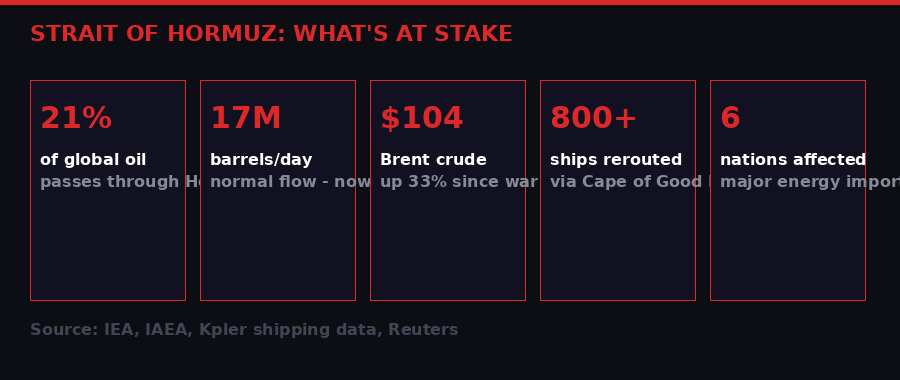
What the Strait of Hormuz blockade means in numbers: 21% of global oil, 17 million barrels per day, 800+ ships rerouted. Every day the blockade holds, the global economy bleeds. (BLACKWIRE data)
Oil at $104: The Economic War Behind the Military War

Global energy markets have been in sustained disruption since the war began February 28. Brent crude at $104 represents a 33% increase from pre-war levels. (Pexels)
Brent crude topped $104 a barrel on Thursday as hopes for de-escalation faded, according to Al Jazeera market data. The price is up roughly 33% from the $78 per barrel Brent was trading at on February 25, three days before Operation Epic Fury began. The AP-NORC poll released Wednesday found that 59% of Americans now say US military action against Iran has gone too far - a number that tracks closely with gas prices at the pump, which the same reporting context places at $3.88 nationally.
The connection is direct and uncomfortable for the White House. Every dollar per barrel added to Brent crude eventually shows up as cents per gallon at US gas stations. The cumulative increase since the war began represents a substantial informal tax on American households. The political math is stark: Americans supported the war when it looked fast. It does not look fast anymore. It looks like Day 27 with no end in sight.
War's Economic Footprint - March 26, 2026
The BBC's analysis published Thursday noted that the UK faces the "biggest hit to growth from the Iran war out of major economies," citing OECD data that downgraded growth forecasts across the board. The Gulf's hub airports - Dubai, Abu Dhabi, Doha, Riyadh - which made long-haul travel cheaper by serving as midpoints on Europe-Asia routes, now face an uncertain future as those hubs become targets or transit risks. Airlines are rerouting. The economics of global aviation are reshaping themselves in real time around a 27-day war.
The helium shortage is another indicator that few people are talking about. Al Jazeera reported Thursday that the war has produced a significant disruption in helium supply chains, with direct consequences for MRI machines in hospitals globally. Iran is a significant helium producer. The blockade and bombing of its industrial infrastructure - including energy facilities - has cascaded into medical equipment shortages in countries that have no stake in this war whatsoever. That is the nature of a conflict fought at a global economic chokepoint.
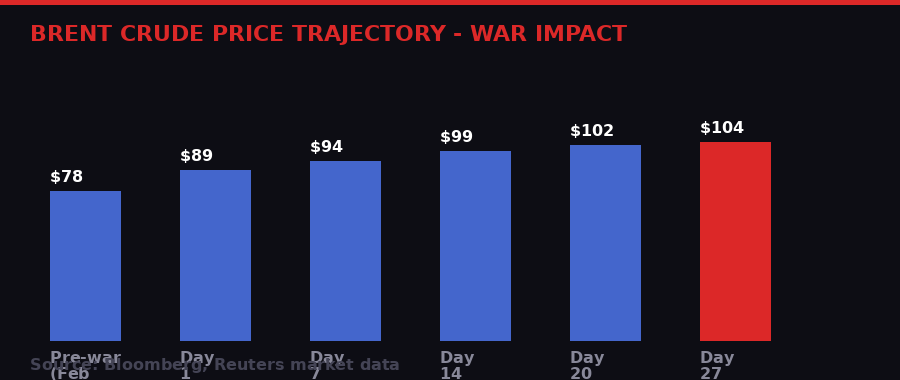
Brent crude trajectory from pre-war levels to Day 27. The 33% price surge since Operation Epic Fury began February 28 translates directly to consumer costs in every importing nation. (BLACKWIRE data)
The Systematic Elimination of Iran's Command Structure

Israel's campaign has followed a doctrine of systematic decapitation - eliminating commanders before their institutions can adapt. Today's kill is the most operationally significant since Khamenei. (Pexels)
Today's killing is not an isolated event. It is the latest in a pattern of targeted eliminations that has systematically stripped Iran of its most experienced military leadership over 27 days. The pattern began at the very top: Supreme Leader Ali Khamenei was killed in the opening hours of Operation Epic Fury on February 28, an act that crossed a threshold no previous Middle Eastern conflict had approached. Since then, the targeting has moved down the chain of command with methodical precision.
Iran's succession structures have been tested at every level. Mojtaba Khamenei, the supreme leader's son, issued his first public statement in the conflict's second week, but his authority over the IRGC and regular military has been contested by multiple competing power centers. The IRGC - which runs its own parallel command structure independent of the regular Iranian military - has lost at least two senior commanders. The intelligence apparatus has been penetrated so thoroughly that Iran's operatives appear to be unable to trust their own communications.
The killing of the Hormuz blockade commander follows this logic to its operational conclusion. Taking out Khamenei was the political strike. Taking out the navy commander is the strategic strike - targeting the mechanism by which Iran translates its geographic position into economic leverage. If Iran cannot coordinate the blockade, it cannot maintain the blockade. And if the blockade collapses, Iran loses its most powerful bargaining chip.
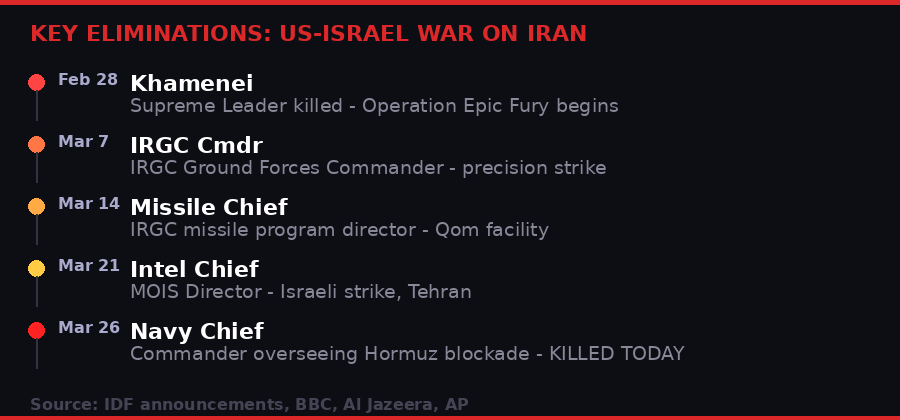
The systematic elimination of Iran's military leadership over 27 days, from Supreme Leader Khamenei to today's naval commander. Each strike has targeted decision-makers at key operational junctures. (BLACKWIRE data)
Iran's parliament speaker issued a warning Thursday - reported by Al Jazeera - threatening a regional neighbor if Iran's islands in the Persian Gulf were occupied. The specificity of the threat suggests the Iranian leadership is aware that US military planning now includes scenarios beyond air operations. Multiple outlets have reported a growing US military presence in the Gulf that "suggests a shift from air campaign to potential ground operations," in the words of Al Jazeera's military analysts. The 82nd Airborne's deployment, previously covered by BLACKWIRE, has been joined by additional force elements whose composition and positioning point toward something beyond sustained bombing.
Day 27: What the Situation Looks Like on the Ground

Four killed in Iran and Abu Dhabi Thursday as the war's geographic footprint continues to expand beyond its initial targets. Isfahan struck again. (Pexels)
Al Jazeera reported Thursday that four people were killed in separate incidents in Iran and Abu Dhabi. Israel announced strikes on Isfahan, Iran's third-largest city and home to significant nuclear-adjacent infrastructure and military installations. Isfahan has been struck multiple times during the campaign, each strike drawing international condemnation and each time failing to shift the war's trajectory.
The transport workers of the Philippines went on strike Thursday, partially in protest of fuel cost increases driven by the Hormuz blockade. The BBC reported that a Russian crude oil tanker had arrived in the Philippines earlier this week - one of the alternative supply chains that countries dependent on Gulf oil have been scrambling to establish. The scene in Manila captures the war's radius: dockers and drivers in Southeast Asia walking off the job because of a conflict 4,000 miles away at a strait they will never see.
Hungary announced it would cut natural gas supplies to Ukraine until Russian oil deliveries resume - a separate but connected thread, according to AP, in which the disruption of Middle Eastern energy markets is reshaping European energy politics. Countries that had begun reducing dependence on Russian energy are now navigating a world where Middle Eastern alternatives are also compromised. There is no clean supply chain left in global energy. Every option carries a geopolitical surcharge.
Trump claimed Thursday that Iranian leaders want to "make a deal," according to AP and BBC coverage. Tehran's government contradicted him directly, with Iranian officials stating no such negotiations are underway. Pakistan's confirmation that indirect mediation channels exist through Islamabad, Ankara, and Cairo suggests both things can be simultaneously true: there is indirect contact, and Tehran is not ready to admit it publicly. Iran's five conditions for peace, outlined on state television Thursday, include demands that US officials have described as non-starters.
The Peace Talks That Aren't: What Both Sides Want

Indirect mediation channels through Pakistan, Turkey, and Egypt are active but Iran publicly denies direct talks. The gap between what both sides want makes a quick deal structurally difficult. (Pexels)
The BBC's analysis published Thursday outlined what both sides say they want - and the gap is substantial. The US-Israel coalition, at minimum, wants a verifiable end to Iran's nuclear program and the Hormuz blockade. The Trump administration's 15-point plan, characterized by an Iranian official this week as "maximalist," reportedly includes demands for Iranian military restructuring and limitations on IRGC activities that Tehran views as demands for regime change by other means.
Iran's publicly stated conditions include cessation of all strikes, withdrawal of US forces from the Gulf region, sanctions relief, and security guarantees backed by neutral parties. It also wants the killing of Khamenei acknowledged as a violation of international law - a demand that no US administration could accept without undermining the entire legal framework of the operation.
"The termination of the US-Israeli war on Iran would require solid guarantees and a credible guarantor. Neither currently exists." - Sultan Al-Khulaifi, opinion analysis, Al Jazeera, March 25, 2026
Pakistan's role as a mediator is notable given Islamabad's complex relationships with both Washington and Tehran, its proximity to the conflict zone, and its own energy vulnerability. Pakistan imports significant volumes of gas from Iran and has watched the war disrupt both the supply and the political relationships that underpin it. Islamabad has every incentive to see a ceasefire - it is losing money and diplomatic stability simultaneously.
Turkey's involvement tracks with Ankara's consistent positioning throughout the war as a party willing to deal with both sides. President Erdogan has condemned the military campaign while maintaining economic channels with Israel. Turkey's ability to talk to everyone makes it useful as a messenger, even if its credibility with Washington has been eroded by its purchases of Russian military equipment and its equivocal NATO posture.
Egypt's inclusion in the mediation framework reflects Cairo's traditional role as a communication channel in the Arab world and its specific leverage as the operator of the Suez Canal - one of the alternative routes that shipping companies are using to avoid Hormuz. Egypt has a direct economic stake in the war's duration: longer conflict, more ships through Suez, more canal fees. Cairo is being paid by the war. That gives it financial incentive to mediate slowly.
What Happens Next: The Fork in the Road

Day 27 presents a genuine strategic fork: can the killing of Iran's Hormuz commander accelerate a deal, or does it eliminate the person Tehran would need to operationalize any ceasefire at sea? (Pexels)
The killing of Iran's Hormuz blockade commander creates a specific fork that neither side anticipated publicly. On one branch: the operational disruption of the blockade accelerates Iran's willingness to negotiate, because Tehran loses the leverage it has been maintaining through the chokepoint. The pain becomes untenable and the country comes to the table. This is the optimistic reading from Washington and Tel Aviv.
On the other branch: the killing eliminates the one officer who had the command authority and operational knowledge to actually pull Iranian naval forces out of the strait in a verifiable, organized way. Any ceasefire at sea requires someone to give the order and have it obeyed across multiple IRGC Navy units that have been fighting for four weeks and have no obvious reason to trust Washington's word. You killed the guy who could have managed that transition. Now what?
Iranian public sentiment is not monolithic. The BBC reported Thursday that Iranians marked Nowruz - their new year - with "anger, fear, and defiance." One resident cleaning her home for the festival told reporters: "Perhaps this dark night will finally give way to dawn." That ambivalence captures something real: Iranians are exhausted, economically hammered, and terrified, but they are also proud and suspicious of American intentions. The leadership can exploit that pride even as the bombs fall. It has done so for 45 years.
The US domestic situation is its own pressure point. The AP-NORC poll showing 59% opposition to the scale of military action is a midterm warning. AP reported Thursday that Trump is promising "bigger GOP majorities" despite midterm warning signs. In 2003, the initial popularity of the Iraq invasion masked political dynamics that eventually produced a Democratic wave election. The White House is aware of the historical precedent. Whether that awareness changes behavior is the question.
The OECD's downgraded growth forecasts, published this week, represent the international community's formal acknowledgment that this war is not a regional problem. It is a global economic event. The UK, according to the OECD, faces the largest growth hit of any major economy - a reflection of London's exposure to Gulf energy markets and its role as a global financial hub sensitive to commodity price shocks. The BBC noted Thursday that the Gulf hub airports, whose low-cost connections reshaped long-haul aviation economics, now face fundamental uncertainty. Gulf airlines are not just transport companies. They are arteries of the global economy, and those arteries are under stress.
Timeline: 27 Days of War
Operation Epic Fury launches. Khamenei killed in opening strikes. Iran seals Hormuz within hours.
Dubai port infrastructure struck. Oil spikes above $90. Coalition solidarity begins fracturing.
Hormuz formally sealed. 82nd Airborne deployed. Tanker war intensifies. Brent crosses $95.
Isfahan strikes. Power plant ultimatum. UK opens bases. Gerald Ford withdraws to Crete. Brent at $102.
US 15-point plan leaked. Iran rejects it as "maximalist." GCC emergency summit called for next day.
Israel kills Iran's Hormuz blockade commander. GCC: "all red lines crossed." Brent at $104. Pakistan confirms mediation. Peace talks in public limbo.
The Strait of Hormuz has a new problem. The man who was running Iran's blockade is dead. His replacement is unknown. The blockade's coordination capacity is degraded. Whether oil prices reflect a genuine loosening of the chokepoint, or whether IRGC Navy units operate on standing orders that require no central command, will become clear in the next 48 to 72 hours. Markets are watching. So are the 20 nations whose economies run on oil that used to flow through 39 kilometers of contested water.
Day 27 ends with the war's most senior naval casualty on the Iranian side. Day 28 will tell us whether that changes anything.
Get BLACKWIRE reports first.
Breaking news, investigations, and analysis - straight to your phone.
Join @blackwirenews on Telegram