Nuclear Sites Hit on Both Sides. Trump Issues 48-Hour Hormuz Ultimatum.
Within a 24-hour window, US-Israeli jets struck Iran's main uranium enrichment facility at Natanz for the second time in three weeks, Iran's ballistic missiles breached Israeli air defenses to hit cities flanking the Negev Nuclear Research Center at Dimona, and President Trump threatened to obliterate Iran's power plants if the Strait of Hormuz is not fully reopened in 48 hours. The Iran war has reached its most dangerous inflection point yet.
The 48-Hour Clock
At 23:44 GMT on Saturday, March 21, President Trump posted a message to Truth Social that no American president has ever written. In all-capital letters, he threatened to destroy Iran's power plants - starting with the largest - unless the Strait of Hormuz was fully reopened to all shipping within two days.
"If Iran doesn't FULLY OPEN, WITHOUT THREAT, the Strait of Hormuz, within 48 HOURS from this exact point in time, the United States of America will hit and obliterate their various POWER PLANTS, STARTING WITH THE BIGGEST ONE FIRST." - President Donald Trump, Truth Social, March 21, 2026 (via AP)
The statement was not coordinated with the Joint Chiefs. Admiral Brad Cooper, head of US Central Command, had posted a video just hours earlier asserting that Iran's ability to threaten vessels in the strait had already been "degraded" - with US F/A-18s having dropped 5,000-pound bombs on an underground coastal facility storing antiship cruise missiles and radar relay stations. Al Jazeera's correspondent in Washington noted a stark "gap between what the White House appears to want... and what the US military says they have already accomplished."
The White House did not specify which plant Trump was referring to as the "biggest." The Bushehr nuclear power plant on the Persian Gulf coast, already struck last week, is Iran's largest. Damavand, a major gas-fired plant 70km northeast of Tehran, is another possibility. Either strike would constitute a threshold-crossing act in the history of the conflict.
Iran's military responded before dawn on March 22. In a statement carried by state media and semiofficial outlets, Iranian forces warned that any strike on Iran's energy facilities would trigger attacks on all US and Israeli energy infrastructure in the region - specifically naming IT systems and desalination facilities as targets. The threat, if carried out, would put the water supply of multiple Gulf states at direct risk.
The framing from Tehran was deliberate. Hitting desalination plants in Saudi Arabia, the UAE, Kuwait or Qatar would not kill combatants - it would cut off drinking water to millions of civilians. That is the message Iran is sending: every escalation has a civilian cost on the other side.
Meanwhile, Iran's foreign minister Abbas Araghchi maintained that the Strait of Hormuz remains open to "everyone except enemies." Tehran has approved passage for vessels from China and other Asian countries. The practical effect is a partial blockade that still shuts out most Western tanker traffic - exactly the condition Trump is demanding end.
Natanz Struck for the Second Time
Saturday morning began with Iran's Atomic Energy Organisation announcing that the Shahid Ahmadi Roshan enrichment complex at Natanz had been "targeted" by the US and Israel. The underground facility, located roughly 220km southeast of Tehran in central Iran, is one of the country's most significant uranium enrichment sites.
The strike was the second in 22 days. IAEA confirmed partial damage to Natanz in early March following the first week of the war. Satellite images at the time showed destroyed above-ground infrastructure. This second strike's exact scope was not immediately confirmed by outside investigators.
Iran reported no leakage of radioactive materials and no danger to surrounding populations. Al Jazeera's Ali Hashem, reporting from Tehran, described the attack as "expected," given that destroying Iran's nuclear capability has been one of Trump's stated war objectives. He added context that Western governments have been watching closely: Tehran currently holds approximately 400kg of highly enriched uranium, much of it now believed to be buried beneath rubble at the Isfahan facility.
"According to reports, there is no radiation and there are no leaks. But this strike could signal the possibility of further attacks." - Al Jazeera's Ali Hashem, reporting from Tehran, March 21, 2026
The IAEA's Rafael Grossi repeated his call for "military restraint to avoid any risk of a nuclear accident." Russia condemned the strike as "a blatant violation of international law." An unnamed Israeli official quoted by AP denied Israeli responsibility for the Natanz strike specifically - the Pentagon declined to comment entirely.
Also on Saturday, the Israeli military separately announced it had struck the Malek Ashtar University research and development facility in Tehran, which it said had been used to develop components for nuclear weapons and ballistic missiles. The dual targeting - Natanz enrichment plus a weapons development facility - suggested a systematic decapitation of Iran's nuclear program, not a surgical deterrence strike.
Natanz: Key Facts
- Full name: Shahid Ahmadi Roshan Enrichment Complex
- Location: Natanz, Isfahan Province, ~220km SE of Tehran
- Capacity: Houses thousands of IR-1 and advanced centrifuges across underground halls
- Previous strikes: Stuxnet worm (2010), multiple Israeli covert ops, June 2025 war (12-day conflict), and now twice in March 2026
- Current status: No radiation reported, enrichment status unclear
- Iran's stockpile: ~400kg highly enriched uranium, much now at Isfahan beneath rubble (IAEA)
Iran Hits Dimona. Israel's Air Defenses Fail.
The response came within hours. Iranian missiles struck the southern Israeli cities of Dimona and Arad on Saturday - the first time Iran's ballistic missiles had successfully penetrated Israeli air defense systems in the area flanking the Negev Nuclear Research Center.
The Israeli Ministry of Health reported at least 180 people wounded. In Arad, 116 were injured including seven seriously, with extensive damage to the city center. In Dimona, 64 were wounded with one in serious condition, after several residential buildings were destroyed. The wounded included a 10-year-old boy.
An Israeli military spokesman offered a striking admission: "In both Dimona and Arad, interceptors were launched that failed to hit the threats, resulting in two direct hits by ballistic missiles with warheads weighing hundreds of kilograms."
"If the Israeli regime is unable to intercept missiles in the heavily protected Dimona area, it is, operationally, a sign of entering a new phase of the battle." - Mohammad Bagher Ghalibaf, Speaker of Iran's Parliament, on X, March 21, 2026
The IAEA moved immediately to address the obvious question: had the Negev Nuclear Research Center been hit? The agency said it had "received no indication of damage" to the Shimon Peres center and that "no abnormal radiation levels" had been detected. Director General Grossi urged "maximum military restraint... in particular in the vicinity of nuclear facilities."
Dimona sits roughly 20km west of the nuclear research complex. Arad is approximately 35km north. These are not accidental near-misses. The pattern of Iranian targeting - Natanz and the Dimona region struck within a single 12-hour period - constitutes a deliberate nuclear symmetry message. Tehran is saying: whatever you do to our nuclear program, we will attempt to do to yours.
Iran's Parliament Speaker Ghalibaf's statement on X made the logic explicit. Israel had enjoyed a form of air defense invulnerability in the Dimona zone throughout the war. That shield cracked on March 21. Whether Iran intended to hit the research center itself - or to demonstrate it could, with plausible deniability - remains an open question.
Netanyahu toured Arad and called the absence of fatalities a "miracle." He blamed casualties on residents who failed to reach shelters in time and promised to continue attacks on Iran. Hard-line national security minister Itamar Ben-Gvir visited the same day and called it a "historic battle" that must continue "until victory."
The Gulf Under Siege
The nuclear strikes and the ultimatum dominated the headlines, but underneath them, the wider Gulf is being methodically ground down. The scale of Iran's parallel campaign against regional states hosting US military assets is a story being swallowed by the larger one.
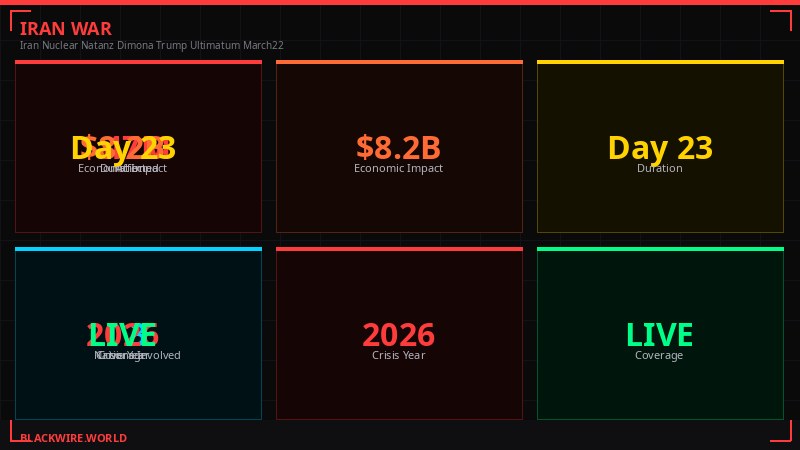
Bahrain has now intercepted and destroyed 143 missiles and 242 drones since the war began on February 28. Saudi Arabia's Ministry of Defense reported shooting down at least 47 drones in a single day - including a concentrated barrage of 38 drones within just three hours. Kuwait's Mina al-Ahmadi refinery, capable of processing approximately 730,000 barrels of oil per day, was hit by two waves of Iranian drones Friday night, sparking fires at one of the Middle East's largest facilities.
The Yanbu Red Sea port - Saudi Arabia's only functioning oil export outlet after Iran effectively shut Hormuz to enemy tankers - was disrupted Thursday when a drone hit the nearby Aramco-ExxonMobil refinery, SAMREF. That single strike landed on the last viable exit for Saudi crude.
Iran also threatened Ras al-Khaimah directly. Its military warned of "crushing blows" to the UAE port city if any "further aggression" was launched from UAE territory against the disputed Gulf islands of Abu Musa and Greater Tunb. Kuwait's Ministry of Defence announced it was actively "dealing with hostile missile and drone attacks" around the same time.
The diplomatic fallout reached Saudi Arabia's breaking point on Saturday. Riyadh declared Iran's military attache and four additional embassy staff persona non grata, giving them 24 hours to leave. The Saudi Ministry of Foreign Affairs cited "repeated Iranian attacks" on its territory. Qatar had taken the same step against Iranian military and security attaches in Doha on Wednesday.
The significance is historical. Saudi Arabia and Iran completed a Beijing-brokered diplomatic rapprochement just three years ago, a landmark deal that was held up globally as proof that regional rivals could find common ground. That deal is now effectively dead. The war launched by the US and Israel on Iran has fractured the Arab-Iranian normalization process entirely.
"Trust in Iran has been shattered... Saudi Arabia and other Gulf states have very significant capacities and capabilities that they could bring to bear should they choose to do so." - Saudi Foreign Minister Prince Faisal bin Farhan Al Saud, earlier this week (Al Jazeera)
The US approved a $16.5 billion arms deal to Gulf states amid rising tensions, AP reported Friday. Washington is also reported to be considering plans to blockade or even occupy Kharg Island - Iran's main oil export hub in the Persian Gulf - a move that Axios reported could cripple Iran's economy but risked triggering major new escalation.
Energy Markets and the Global Economy
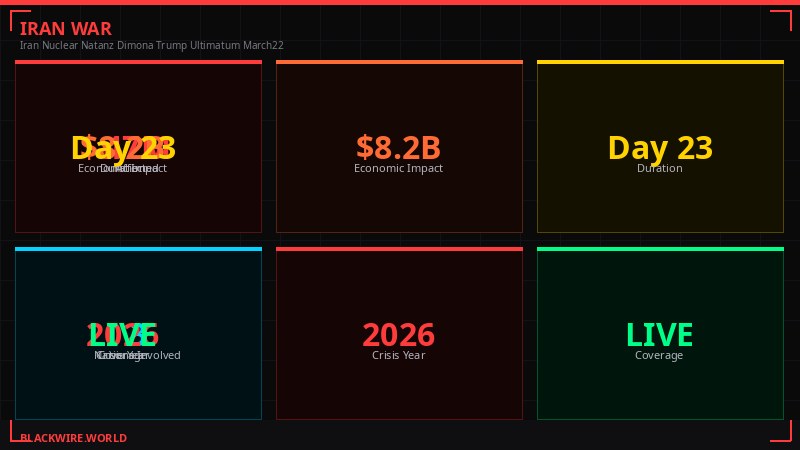
Brent crude hit $112.19 per barrel this week, a 44% jump from pre-war levels. The figure is climbing toward the kinds of prices last seen during the 2022 Russian invasion shock, but with a fundamental difference: the disruption mechanism is the Strait of Hormuz, and there is no obvious bypass route for the Persian Gulf's trapped oil.
During peacetime, roughly one-fifth of all global oil and gas transits through the strait. That flow has virtually halted. Iran has been selective about which vessels are cleared for passage - China and Asian nations have received some assurances, but Western-linked tankers are operating in a kill zone. The practical effect has been a partial embargo on Gulf crude for Europe and the United States.
The Panama Canal is operating at maximum capacity, processing 36 to 38 vessels daily. The canal's chief credited the surge to demand for LNG tankers rerouting around the Persian Gulf crisis. That rerouting adds thousands of miles per journey, inflating shipping costs across every supply chain that depends on Gulf energy.
The EU urged member states to begin storing winter gas urgently, acknowledging that the "high, volatile" price environment threatened storage projections that had been built on peacetime assumptions. Gas infrastructure in Qatar was attacked in March, directly hitting one of Europe's primary LNG suppliers. The Qatar-to-Germany pipeline math no longer works the same way it did before February 28.
Iran's counter-threat - targeting desalination infrastructure - adds a second economic weapon. Saudi Arabia, the UAE, Kuwait, and Qatar all depend on desalination for the bulk of their fresh water supply. A sustained campaign against those facilities would create a humanitarian crisis entirely independent of the military one.
Sudan: 64 Dead in Hospital Drone Strike
While the Middle East absorbed global attention, a hospital was burning in Sudan. On the night of March 21, a drone struck al-Daein Teaching Hospital in al-Daein, the capital of East Darfur state. WHO Director-General Tedros Adhanom Ghebreyesus announced Saturday that at least 64 people were killed, including 13 children, two female nurses, and one male doctor. Another 89 were wounded, including eight healthcare staff.
The attack destroyed the hospital's paediatric ward, maternity unit, and emergency department. The facility is now nonfunctional. For al-Daein's population, there is simply no hospital anymore.
"As a result of this tragedy, the total number of fatalities linked to attacks on health facilities during Sudan's war has now surpassed 2,000." - Tedros Adhanom Ghebreyesus, Director-General, World Health Organization, March 22, 2026
Sudan's Emergency Lawyers rights group attributed the strike to a Sudanese Armed Forces (SAF) drone. The WHO, which runs the Surveillance System for Attacks on Health Care, does not assign blame - it records and counts.
The numbers it is recording are extraordinary. In 2023, 64 attacks on healthcare in Sudan killed 38 people. In 2024, 72 attacks killed 200 people. In 2025 alone, 65 attacks killed 1,620 people - 82% of all deaths from attacks on healthcare facilities recorded worldwide that year. The trajectory is not stabilizing. It is accelerating.
East Darfur is nominally under Rapid Support Forces (RSF) control. Sudan's army - which is fighting the RSF across the country in a war that has ground on since April 2023 - has been targeting RSF-held cities with increasing frequency and power. Al-Daein has been struck before: an army strike on its market earlier this month set fire to oil barrels that burned for hours. The hospital strike follows the same pattern of targeting civilian infrastructure in RSF-controlled territory.
The context is an almost incomprehensible humanitarian collapse. Since April 2023, Sudan's war has displaced more than 12 million people, created what the UN calls one of the world's fastest-growing man-made crises, and left more than 33 million people dependent on humanitarian aid. UN rights chief Volker Turk said this month he was "appalled" after more than 200 civilians were killed by drone attacks within a single eight-day period.
"Parties to the conflict in Sudan continue to use increasingly powerful drones to deploy explosive weapons with wide-area impacts in populated areas." - Volker Turk, UN High Commissioner for Human Rights, March 2026 (Al Jazeera)
Sudan's war receives a fraction of the diplomatic energy and media coverage given to the Middle East. It is a strategic failure of international attention. The math is brutal: 2,036 people killed in attacks on healthcare alone. The hospital that held together communities under fire is gone. That number will keep rising.
The Hezbollah Front and Iraq Rockets
The main war in Iran is not the only front. Hezbollah has been conducting strikes into northern Israel since the US-Israeli assault on Iran began on February 28, citing the killing of Iran's Supreme Leader as motivation. On Sunday morning, a Hezbollah rocket killed a man in the northern Israeli town of Misgav Am. Israeli medics found him dead in his car. Two vehicles burned at the scene.
At least 1,001 people have been killed in Lebanon since Israel renewed widespread attacks following the start of the Iran war, including at least 118 children, according to Lebanon's Ministry of Public Health. Israel issued fresh evacuation orders for southern Beirut suburbs including Haret Hreik, Ghobeiry, and Hadath ahead of new strikes on Hezbollah infrastructure.
In Iraq, a US logistics support camp near Baghdad International Airport was hit by rockets on Saturday, with explosions reported in the area. The Iraqi front had seen intermittent US aircraft losses in earlier weeks. An additional 2,200 to 2,500 US Marines are currently being deployed to the Middle East, while military analysts note the latest movements could lead to "potential US boots on the ground in Iran" to secure the strait - a scenario Trump has neither confirmed nor denied.
Israel also struck military infrastructure in southern Syria in response to alleged attacks on Druze civilians in Suwayda. Qatar, Jordan, and Egypt all condemned the Syria strike as a "flagrant violation of sovereignty and international law." The diplomatic condemnations are accumulating faster than anyone can track them. They are having no measurable effect on the operational tempo.
Israeli Defense Minister Israel Katz announced Saturday that the intensity of strikes on Iran would "rise significantly" in the week beginning Sunday. US CENTCOM's Admiral Cooper stated that 8,000 military targets in Iran have been struck so far, and that Iran's "combat capability is on the steady decline." The public message from both US and Israeli officials is one of escalating pressure toward a forced Iranian capitulation. Trump's 48-hour ultimatum fits that narrative. The alternative - that the ultimatum is a bluff - would signal weakness in a war where both sides have been raising the stakes every 72 hours.
What Happens in 48 Hours
The Trump ultimatum expires at approximately 23:44 GMT on March 23 - roughly 36 hours from the time of this report. Three scenarios are in play.
The first: Iran partially complies, allowing neutral shipping to resume without formally capitulating. Tehran has already said it is open to non-enemy vessels. A face-saving formula that lets tankers move while Iran claims it never closed the strait to begin with could give Trump a political win without requiring Tehran to formally surrender. Iran's foreign minister has signaled he has had "approaches from a number of countries" seeking safe passage - the diplomatic machinery exists.
The second: Iran does nothing, and Trump either strikes the power plants or backs down. An American president who posts an ultimatum in capital letters and then does nothing is not just politically damaged - he is handing Tehran a deterrence victory that will reverberate across every future confrontation. Striking the power plants, however, means taking down the Bushehr nuclear facility, contamination risk or not, or attacking Iranian civilian electricity infrastructure on a massive scale. That is a choice with no clean exit.
The third: the situation escalates past both sides' stated red lines before the deadline arrives. Saturday's Dimona strike was not a stray round. Iran's Parliament Speaker called it a signal that "a new phase of the battle" had begun. Israeli Defense Minister Katz confirmed strikes would intensify. If a US or Israeli strike kills Iranian civilians at scale in the next 24 hours - or if Iran's missiles kill Israelis - the ultimatum clock becomes irrelevant. The war writes its own schedule.
The IAEA's Grossi has now made the same call twice in 24 hours: "maximum military restraint... in the vicinity of nuclear facilities." Both sides struck nuclear-adjacent targets on March 21 anyway. The international institutional machinery designed to prevent exactly this scenario is running out of leverage.
One figure stood out in the day's dispatch. The Bushehr nuclear power plant was already hit last week. Trump may threaten it again. Iran has 400kg of highly enriched uranium sitting beneath rubble at Isfahan. Both sides have demonstrated they will strike nuclear sites, find no radiation leak, and continue fighting. The question is whether the next strike produces a different result - and whether anyone in a position to stop it will act before the clock runs out.
Trump's 48-hour ultimatum expires approximately 23:44 GMT on March 23, 2026. Iran's response was received before dawn March 22. BLACKWIRE will update as the deadline approaches. Sources: Al Jazeera, AP, IAEA, WHO, Saudi MFA, Tasnim News Agency.
Get BLACKWIRE reports first.
Breaking news, investigations, and analysis - straight to your phone.
Join @blackwirenews on Telegram