Iran's Nuclear Sites Struck: The Hormuz War Reaches Its Pivot Point
US-Israeli forces struck two Iranian nuclear facilities Friday - a heavy water complex in Arak and a yellowcake plant in Yazd - as Secretary of State Marco Rubio declared the operation would end in "weeks, not months." Iran's counter-proposal to a US peace plan is expected within hours. The clock is ticking toward an April 6 deadline that could trigger attacks on Iran's power grid.

The strikes, confirmed by Iranian state media Friday afternoon, hit the Khondab heavy water complex in Arak and the Ardakan yellowcake production facility in Yazd Province. Iranian authorities reported no casualties at Khondab and no radioactive release beyond the perimeter at Ardakan, according to IRGC-affiliated news agency Fars News and the official Islamic Republic News Agency (IRNA).
The timing is loaded. Within hours of the strikes being confirmed, Rubio was standing before cameras following a G7 foreign ministers meeting in France, delivering one of the most confident US assessments of the conflict to date. Iran's diplomatic counter-move - a response to the US 15-point peace proposal delivered via Pakistani intermediaries - was also expected to land on Washington's desk by Friday evening, according to CBS News, citing sources briefed on the negotiations.
This is the war arriving at its hinge. Either a deal closes in the next ten days, or Trump follows through on his threat to destroy Iran's power infrastructure - and the Strait of Hormuz stays shut, oil stays above $100 a barrel, and the global economy keeps bleeding.
What Was Struck - and Why It Matters
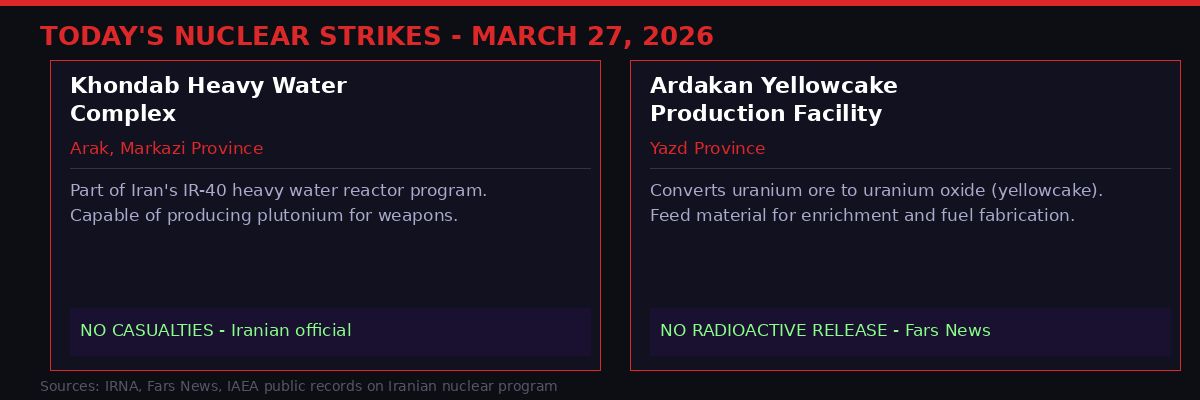
The Khondab Heavy Water Research Reactor - also known as the IR-40 - sits outside Arak in Markazi Province, roughly 250 kilometers southwest of Tehran. For years it sat at the center of Western fears about Iran's nuclear ambitions. Heavy water reactors are capable of producing plutonium as a byproduct - plutonium that, if separated, can be used in nuclear weapons. Under the 2015 Joint Comprehensive Plan of Action (JCPOA), Iran agreed to redesign the reactor's core to neutralize its weapons-grade plutonium potential. After Trump withdrew from the deal in 2018, those commitments frayed and eventually collapsed.
The Ardakan facility in Yazd Province is a different kind of target. It processes uranium ore concentrate - what the industry calls "yellowcake" - which serves as the entry-point raw material for Iran's enrichment program. Without a functioning yellowcake facility, the pipeline of uranium into Iran's centrifuge halls becomes constrained over time. It is not a dramatic target in the way a centrifuge hall at Natanz or Fordow would be, but it is a chokepoint in the nuclear fuel cycle.
Iranian authorities were quick to issue assurances about radiological safety. An official from Markazi Province told IRNA there were no casualties at Khondab. Fars News reported no radioactive material was released beyond the Ardakan perimeter. Neither claim was independently verifiable in the immediate aftermath.
Nuclear safety experts have consistently warned that attacks on facilities containing enriched uranium or heavy water carry radiological risk even when they don't trigger the catastrophic scenarios associated with power reactor meltdowns. The IAEA has not yet commented publicly on Friday's strikes.
"Iran's nuclear facilities - even those not at the most sensitive stages of the fuel cycle - represent complex targets. Strikes produce debris fields, dust, and in some cases structural failures that can spread contaminated material beyond the immediate site perimeter." - Nuclear security analyst, paraphrasing standard IAEA risk guidance
What the US and Israel appear to be doing is methodical: they are not attempting a single decisive blow on Iran's deepest buried facilities like Fordow, which sits inside a mountain and was designed to be impervious to conventional airstrikes. Instead, they are working through the layers - degrading the industrial and logistical infrastructure that supports Iran's nuclear ambitions, facility by facility.
Rubio at the G7: "Weeks, Not Months"

Marco Rubio's language at the post-G7 press conference was precise and deliberate. Asked how long the US military operation in Iran would last, he said: "We are talking weeks, not months." He added that the US has "clear objectives" and is "very confident we are on the verge of achieving them very soon."
He was careful to avoid committing to specifics. When asked about ground troops, he said the US can achieve its goals "without any ground troops" - a significant statement given that the Pentagon has moved thousands of paratroopers and Marines into the region in recent weeks. What Rubio was projecting, fundamentally, was confidence that air power and economic pressure alone can compel Iran to back down.
That confidence is not universally shared. AP analysis published Thursday describes Iran as fighting like "an insurgency rather than a nation" - using shoot-and-scoot missile tactics, mobile launch platforms disguised as commercial trucks, and underground bases to survive daily bombardment from two of the world's most advanced air forces. Iran has lost roughly 91% of its missile arsenal by Trump's own estimate - though that figure cannot be independently verified - and yet it continues to hold the Strait of Hormuz, the narrow channel through which 20% of the world's oil normally passes.
Rubio also addressed the Hormuz toll booth regime that Lloyd's List Intelligence has now formally documented - ships paying in yuan for IRGC-approved passage. He called it "unacceptable" and said countries most affected by the chokehold "should do something." The message to Gulf states, Asian oil importers, and European allies: the US is not going to resolve Hormuz alone, and the international community has skin in this game.
"Weaponizing the Strait of Hormuz is not an act of aggression against one nation. It is economic terrorism against every consumer, every family that depends on affordable energy and food." - Sultan al-Jaber, CEO of Abu Dhabi National Oil Company, speaking at the Middle East Institute in Washington
The G7 foreign ministers meeting in France produced a joint communique calling for attacks on civilians to stop and committing to "securing the Strait of Hormuz." UK Foreign Secretary Yvette Cooper called for "a swift resolution" and said Iran "cannot be able to just hold the global economy hostage." More than 30 countries participated in discussions about opening the strait and protecting international shipping, she said.
The 15-Point Deal and Iran's Counter-Proposal

The diplomatic track running in parallel to the bombs is complex, indirect, and contested. Pakistan's government has acknowledged serving as a conduit for the US 15-point peace proposal delivered to Iran in the past week - a role it says follows weeks of quiet diplomacy. Turkey and Egypt are also described as working behind the scenes, according to Pakistani Foreign Minister Ishaq Dar.
The US proposal, details of which were published by Israel's Channel 12 network, is sweeping in scope. It calls for an end to Iran's nuclear program, dismantlement of its ballistic missile capabilities, and a complete severance of Tehran's ties with proxy militias - Hezbollah in Lebanon, the Houthis in Yemen, Shia militias in Iraq. In essence, the 15 points ask Iran to surrender the entire strategic infrastructure it has spent forty years constructing.
Iran initially dismissed the proposal as "excessive." Then Foreign Minister Abbas Araghchi told state television that "some ideas" had been proposed to senior leaders. Iran's own stated conditions for ending the war include payment of war reparations, international recognition of Iran's "sovereign right to exercise authority over the Strait of Hormuz," and a guarantee of no further attacks. The gap between the two positions is enormous.
CBS News reported Friday, citing sources, that Iran's formal counter-proposal was expected to land with Washington before the end of the day. US officials were said to have been informed. Rubio, asked directly whether he expected the response Friday, said: "We haven't gotten it yet. It could happen at any moment."
Pakistan's role is unusual. Islamabad has historically been a less prominent diplomatic player than Oman or Qatar, which traditionally served as back-channels in US-Iran negotiations. But with those Gulf states now under Iranian missile threat, Pakistan's combination of proximity to Iran, strategic ties with the Gulf states, close relations with the US, and its army chief's personal relationship with Trump ("my favorite Field Marshal," Trump said publicly) makes it uniquely positioned.
Still, Pakistani analysts are cautious. Abdullah Khan of the Pakistan Institute for Conflict and Security Studies noted that US threats on Iran's energy infrastructure have been delayed - twice now - citing diplomatic progress. Iran's measured responses toward US Gulf interests may reflect an attempt to preserve space for those same negotiations. But measured is not ceasefire, and time is running out.
The April 6 Deadline - and What Happens If It Breaks

Trump set his latest deadline Thursday evening: Iran has until 8 PM Eastern time on April 6 to fully reopen the Strait of Hormuz. If it doesn't, he has threatened to "obliterate" Iran's energy plants. This is the third iteration of this particular threat. The first came Saturday with a 48-hour window. The second came Monday with a five-day extension after Asian markets convulsed. The third came Thursday after the S&P 500 recorded its worst single-day drop since the war began - down 1.7%, the Dow falling 469 points, the Nasdaq sinking 2.4%.
The pattern is visible: Trump sets a deadline, markets react badly, Trump retreats and cites diplomatic progress. Iran has studied this pattern closely. By hardening the IRGC's toll booth regime on Hormuz - documented by Lloyd's List Intelligence as requiring ships to submit crew lists, cargo manifests, and pass IRGC vetting before receiving an escort code - Tehran is demonstrating it can maintain economic leverage even as it absorbs military punishment.
The risk calculus on April 6 is different from the previous two deadlines. Iran's counter-proposal is expected today. If it is substantive - if it offers real movement on Hormuz reopening in exchange for a ceasefire - Trump has political cover to extend again. If it is hollow, or if Iran publicly rejects further talks, the administration faces a credibility crisis that markets and allies are watching closely.
What happens if Trump follows through? Iran has warned it will retaliate against the region's critical infrastructure - specifically naming desalination facilities that provide drinking water to Gulf states. The UAE's Sultan al-Jaber escalated rhetoric sharply Thursday with the "economic terrorism" framing, a sign that Gulf states are beginning to publicly pressure Iran and implicitly signal their own red lines.
Macquarie's strategists have modeled the scenario: if the war runs to end of June with Hormuz still restricted, oil could reach $200 per barrel. The record is just above $147, set in 2008. At $200 oil, the global inflation shock would be severe, recession risks would spike across every import-dependent economy, and the political costs for Trump heading into November midterms would be substantial.
"Any further statements by Trump about a deal are white noise to the markets. Only if the IRANIANS say the talks are going well will it impact markets." - Jim Bianco, president of Bianco Research, writing Friday
The Hormuz Numbers - One Month of Economic Carnage
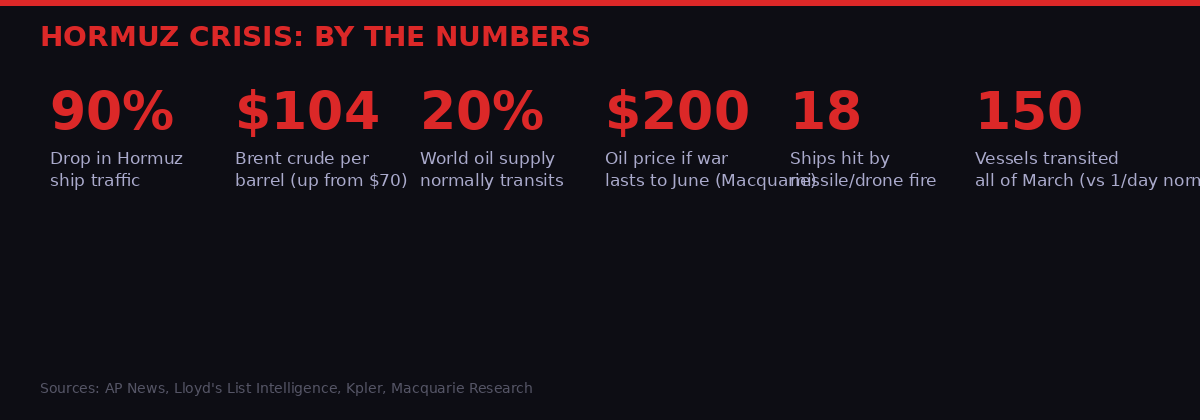
The statistics from the first month of war are stark. According to Lloyd's List Intelligence, only around 150 vessels - tankers and container ships combined - transited the Strait of Hormuz throughout the entire month of March. Before the war, that was a single day's normal traffic. Strait traffic has fallen by roughly 90%.
Brent crude oil was trading at roughly $70 per barrel before the war began February 28. As of Friday, it stood at $104.39, a gain of nearly 50% in one month. US benchmark crude was at $98.59, up 4.3% on the day alone. Oil prices eased briefly Thursday night after Trump's deadline extension, then resumed climbing when it became clear Iran was not backing down.
The ships that are transiting the strait are doing so under extraordinary conditions. About half of vessels turn off their Automatic Identification System - the radio transponder that broadcasts location - before entering and reappear in the Gulf of Oman on the other side. Some have been allowed through following diplomatic pressure from their home countries; two Indian vessels loaded with liquefied petroleum gas passed after New Delhi engaged directly, according to Lloyd's List.
Of those that have transited in recent weeks, Iran-affiliated ships accounted for as much as 90% of transits in the latest tracking period, compared to 24% in the early weeks of the war. The strait is, for practical purposes, an Iranian toll road. Iran's Kharg Island terminal loaded 1.6 million barrels in March - essentially unchanged from pre-war totals - with most going to small, private Chinese refineries indifferent to US sanctions.
At least 18 ships have been hit since the war began. At least seven crew members have been killed, according to the UN International Maritime Organization, which tracks maritime security. The UN's Law of the Sea Treaty prohibits states from imposing tolls on innocent passage through territorial waters. The IMO has condemned the attacks. Iran's parliament, meanwhile, is reportedly working on legislation to formally codify fees for strait passage - turning a de facto chokehold into a legal framework.
"Iran's IRGC has imposed a de facto 'toll booth' regime in the Strait of Hormuz. While not all ships are paying a direct toll, at least two vessels have and the payment is settled in yuan." - Lloyd's List Intelligence, March 27, 2026
Iran's Military Strategy - Survive to Win

One month in, the US and Israel are fighting a nation that has adapted its military doctrine to look more like a guerrilla force than a state army. Iran lost the top layer of its conventional capabilities fast: its air force is largely destroyed, its navy has been decimated, Khamenei was killed by Israel in early March, and IRGC Navy chief Alireza Tangsiri - the architect of the Hormuz blockade - was eliminated by an Israeli strike confirmed Thursday. The head of the IRGC Navy's intelligence directorate, Behnam Rezaei, was also killed in the same operation.
And yet Iran fights on. The reason is structural. Iran spent decades building a military posture designed to survive decapitation strikes. Its remaining missile arsenal is hidden in underground facilities and loaded onto mobile launchers disguised as commercial trucks. Its "shoot and scoot" tactics - fire and immediately relocate before the launch site can be targeted - are the same techniques Hezbollah perfected in Lebanon and the Houthis used in Yemen. Both groups were trained and funded by the IRGC. Iran has been running this playbook by proxy for years; now it is running it directly.
Trump claimed Thursday that about 9% of Iran's missile arsenal remains. If accurate - and the figure cannot be independently verified - that still represents a substantial threat capability for a country the size of Alaska with complex mountain terrain and decades of hidden infrastructure investment. Iran maintains bases that can conceal launchers until minutes before a strike, then disappear back into civilian-adjacent facilities.
The Eurasia Group, a risk advisory firm, described the US approach as "escalate to de-escalate" - moving more ships and paratroopers into the region to credibly threaten overwhelming force, while holding off on the final escalatory step in hopes Iran blinks first. The 82nd Airborne and additional Marine units have been deployed to the region in recent weeks, according to AP News.
Iran's calculation is simpler and, in some ways, more durable. As Mideast security analyst Shukriya Bradost wrote: "The Islamic Republic understands that it cannot defeat the United States militarily. Instead, its objective is both simpler and more strategic: Survive the war long enough to claim victory." Every month of Hormuz blockade is a month of $100+ oil. Every month of $100+ oil is a month of political pressure on Trump. Iran doesn't need to win the war. It needs to not lose faster than Trump needs the war to end.
The Full War Timeline: How We Got Here
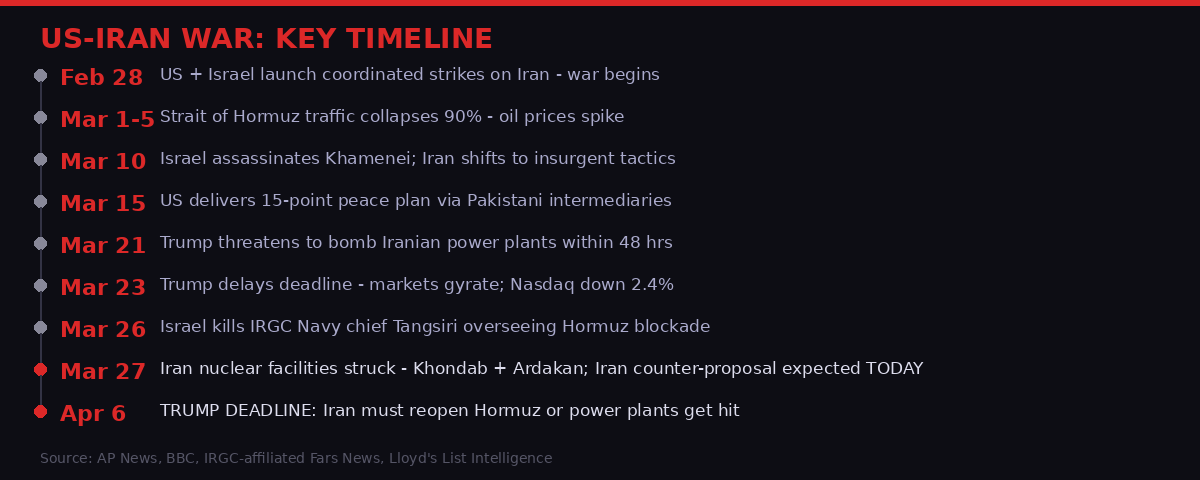
The war began February 28, when the United States and Israel launched coordinated strikes on Iran. The trigger, in the formal sense, was Iran's nuclear program and its support for regional proxies. The deeper context: years of escalating confrontation following the US withdrawal from the JCPOA, Iran's subsequent uranium enrichment acceleration past 60% purity, and the collapse of multiple diplomatic tracks after the Gaza conflict intensified.
Within days of the first strikes, the Strait of Hormuz became Iran's primary weapon. IRGC naval forces - acting on decades of strategic planning that always envisioned Hormuz as the ultimate leverage point - began systematically blocking shipping. Traffic collapsed within a week. Oil prices began their climb toward $100.
Israel accelerated its decapitation campaign in parallel. Supreme Leader Ali Khamenei was killed by an Israeli strike in early March, along with security chief Ali Larijani. The killing of Tangsiri on Thursday was the latest in a series of leadership eliminations intended to degrade Iran's command-and-control capability. Iran's response has been to disperse decision-making - another insurgent adaptation that makes the organization harder to kill from above.
Diplomatic channels opened almost immediately through Pakistan, Turkey, Egypt, and Oman - though Oman and Qatar came under direct Iranian missile fire, limiting their traditional role as intermediaries. Pakistan's emergence as the primary conduit reflects a reordering of regional relationships driven by the war itself. The US 15-point proposal landed in Tehran via Islamabad last week. Iran's counter-proposal is expected today.
The G7 meeting in France on Friday produced formal alignment among the world's seven largest economies on reopening the strait - a political signal, but not a military one. No G7 member has deployed naval forces to force-open the strait. The US, per Rubio, is not asking anyone else to do so. The military burden remains entirely on Washington and Jerusalem.
Israel, meanwhile, continued operations in Lebanon Friday, launching fresh strikes on southern Beirut and targeting what it called "Hezbollah terrorist infrastructure." The IDF said simultaneously it was attacking infrastructure in three different regions of Iran. The multi-front pace of operations, one month in, shows no sign of slowing.
What Happens Next - The Scenarios

Three scenarios are now in play, and the next 72 hours will likely determine which one dominates.
Scenario One - Diplomatic breakthrough: Iran's counter-proposal, expected Friday, contains enough substance to justify an extension of the April 6 deadline. Indirect talks via Pakistan intensify over the weekend. A framework for Hormuz reopening is sketched out - perhaps a phased process in which Iran agrees to allow un-vetted passage for non-sanctioned vessels while broader negotiations continue. Markets rally, oil eases, Trump declares victory on Fox News. The war enters a de-escalation phase. This is the scenario the White House is publicly pricing in.
Scenario Two - Stalemate and escalation: Iran's counter-proposal is either absent or maximalist - demanding reparations and sovereignty over Hormuz, neither of which the US can accept. Trump faces a credibility crisis on April 6. He either attacks Iranian power plants - triggering Iranian retaliation against Gulf desalination and energy infrastructure, a significant escalation with unpredictable cascade effects - or he blinks for a third time, watching his "deadline" strategy collapse entirely. Markets price in extended conflict. Brent crude pushes toward $120.
Scenario Three - Partial deal, extended conflict: Enough common ground is found to produce a fragile understanding - not a formal ceasefire but a temporary Hormuz accommodation - while the nuclear, missile, and proxy questions remain unresolved. The war continues at lower intensity. Iran's IRGC maintains partial control of the strait, collects yuan-denominated transit fees, and waits for Trump's political clock to run out. The Middle East enters a prolonged cold-war-like freeze with occasional hot flashes. This is Iran's preferred scenario.
The nuclear strikes on Khondab and Ardakan, timed to land on the same day as Iran's expected peace response, are themselves a message: the US-Israeli coalition is not waiting. It will continue degrading Iran's capabilities even during diplomacy. It is a negotiating posture expressed in bomb craters rather than position papers.
Whether Iran reads that posture as determination or desperation will shape everything that comes next.
KEY FACTS - MARCH 27, 2026
- Nuclear sites struck today: Khondab Heavy Water Complex (Arak) and Ardakan Yellowcake Facility (Yazd)
- Casualties/radioactive release: None reported by Iranian authorities
- Rubio G7 statement: War ends in "weeks, not months"; no ground troops needed
- Iran counter-proposal: Expected Friday per CBS News sources; Rubio says "could happen at any moment"
- April 6 deadline: Trump threatens Iranian power plant strikes if Hormuz not reopened by 8 PM ET
- Oil prices: Brent $104.39/barrel (+2.5% on day); US crude $98.59 (+4.3%)
- Stock markets: S&P 500 -1%, Dow -481 pts, Nasdaq -1.4% Friday; fifth straight losing week
- Strait traffic: Down 90% - 150 vessels all month vs. ~150 per day pre-war
- IRGC Navy chief killed: Alireza Tangsiri eliminated by Israel Thursday; intelligence chief also killed
Background: The Nuclear Program That Started This War

The strikes on Khondab and Ardakan are the latest chapter in a decades-long confrontation over Iran's nuclear ambitions. The Khondab reactor was revealed publicly in 2002, when an Iranian opposition group exposed the existence of multiple undisclosed nuclear facilities. The IR-40 reactor, designed to produce heavy water and use natural uranium as fuel, was capable of generating enough spent fuel to extract weapons-grade plutonium. For years, it was considered one of the most proliferation-sensitive components of Iran's nuclear program.
The 2015 JCPOA - the nuclear deal negotiated under Obama with Iran, the P5+1 nations, and the European Union - required Iran to pour concrete into the IR-40 reactor core, permanently preventing it from producing weapons-grade plutonium. Iran did so under IAEA verification. But after Trump unilaterally withdrew from the JCPOA in May 2018, Iran began systematically walking back its commitments. By 2020, Iran was enriching uranium to 20% purity. By 2022, it had crossed to 60%. By the time the war began in February 2026, Iran's enrichment levels and stockpiles had put it within weeks of weapons-grade material if it chose to proceed.
The Ardakan yellowcake facility, operated by the Uranium Production and Nuclear Fuel Production Company (NFPC), converts uranium ore from mines in Yazd Province into uranium oxide concentrate - the yellowcake that feeds Iran's enrichment chain. Disrupting this facility doesn't immediately halt enrichment, since Iran holds existing uranium stockpiles. But over time, it degrades the pipeline of new material into the centrifuge halls.
Taken together, Friday's strikes are consistent with a methodical US-Israeli campaign to dismantle Iran's nuclear infrastructure piece by piece. Fordow, the underground enrichment facility near Qom buried deep in a mountain, remains a harder target - one that may require bunker-buster munitions of the kind the US has been supplying to Israel in large quantities. Whether and when that step comes is the question that IAEA officials, nuclear security analysts, and regional governments are now watching most carefully.
The UN human rights chief Volker Turk, speaking Friday, called on the US to conclude a probe into an Iranian school strike earlier in the month that killed at least 168 people, mostly children. He said the strike "evoked a visceral horror" and called it a potential violation of international humanitarian law. The mounting civilian toll - on both sides - is adding a moral urgency to the diplomatic push that neither Washington nor Tehran has fully reckoned with publicly.
This war, now one month old, has already transformed the Middle East, reshaped global energy markets, and put the world's shipping arteries under the control of a single country's Revolutionary Guard. Friday's nuclear strikes and Rubio's "weeks not months" declaration represent either the beginning of an endgame - or a dangerous escalation on the path to a much longer conflict. The answer is expected to arrive from Tehran, any moment now.
Get BLACKWIRE reports first.
Breaking news, investigations, and analysis - straight to your phone.
Join @blackwirenews on Telegram