GHOST BUREAU - WAR & CONFLICT
The Atom Splits: Israel Strikes Iran's Nuclear Sites, US Sends the 82nd Airborne, and April 6 Looms as the Point of No Return
Israel has struck Iran's uranium processing facility in Yazd and the Khondab Heavy Water Complex. A projectile landed near Bushehr's nuclear reactor. The Houthis fired their first missile at Israel. The 82nd Airborne is deploying. And Donald Trump has set April 6 as the deadline before the power grid goes dark. This is not an escalation. This is a war changing shape.
When Israel's Air Force confirmed it had struck a uranium processing plant in Yazd on Friday, it crossed a threshold that none of the previous 27 days of this war had reached. Hitting steel mills is industrial sabotage. Hitting a facility that extracts the raw material for uranium enrichment is a direct strike at the infrastructure of the bomb.
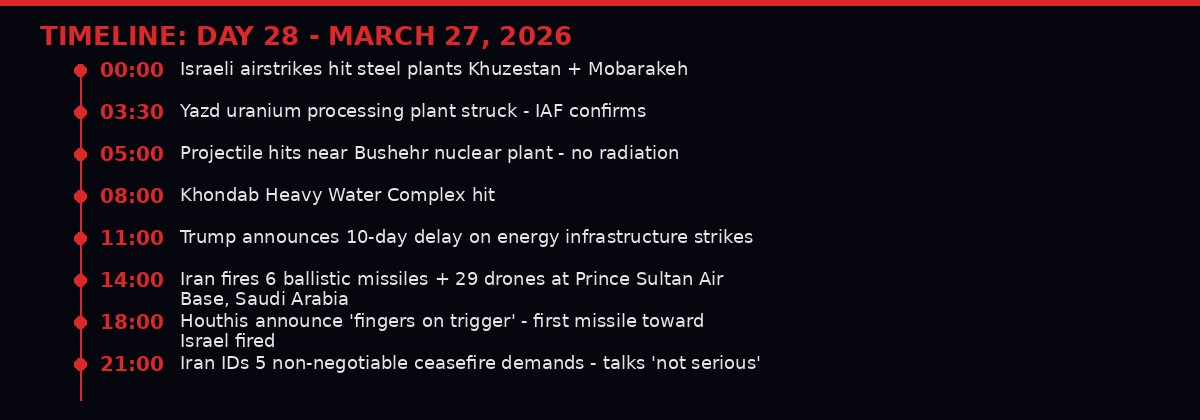
Iran's Atomic Energy Organization confirmed the Yazd hit - and added that a projectile struck near the Bushehr Nuclear Power Plant. "No casualties, financial, or technical damage," the AEOI said, in a statement that no independent observer was in any position to verify. Al Jazeera / AEOI
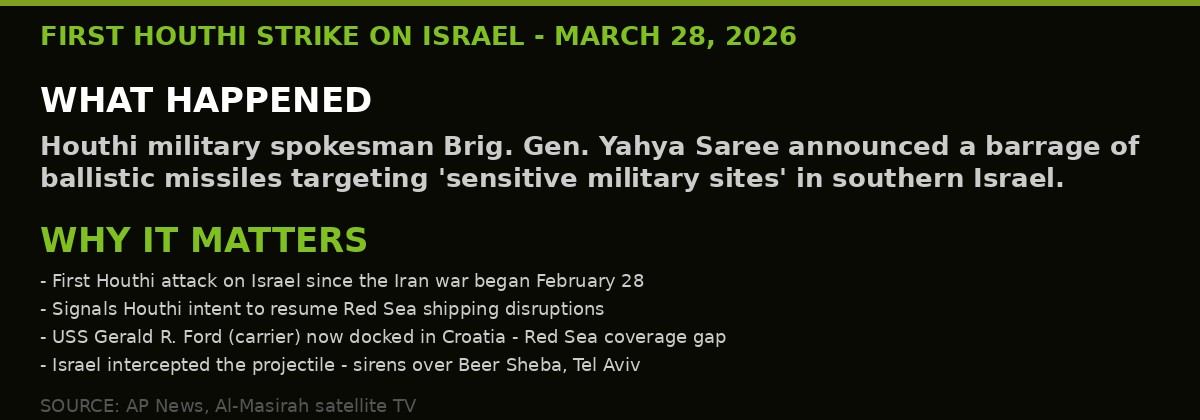
On the same day, Iran fired six ballistic missiles and 29 drones at Prince Sultan Air Base in Saudi Arabia. More than two dozen U.S. troops were wounded over the course of the week in attacks on that base alone. In Yemen, Houthi spokesman Brigadier General Yahya Saree announced the group had fired a barrage of ballistic missiles at "sensitive Israeli military sites" in southern Israel - the first Houthi strike against Israel since this war started February 28. Israel intercepted the projectile. Sirens went off over Beer Sheba and Tel Aviv. AP News, Al-Masirah TV
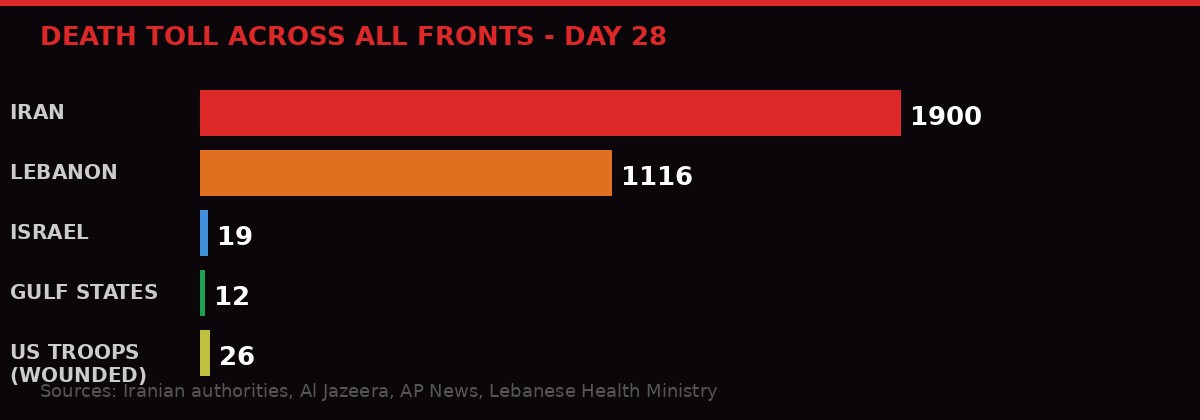
Twenty-eight days. 1,900 Iranians killed. 1,116 Lebanese dead. 19 Israeli fatalities. Twenty-six U.S. troops wounded in a week. And the paratroopers are still packing their chutes.
What Israel Actually Hit - and What It Means
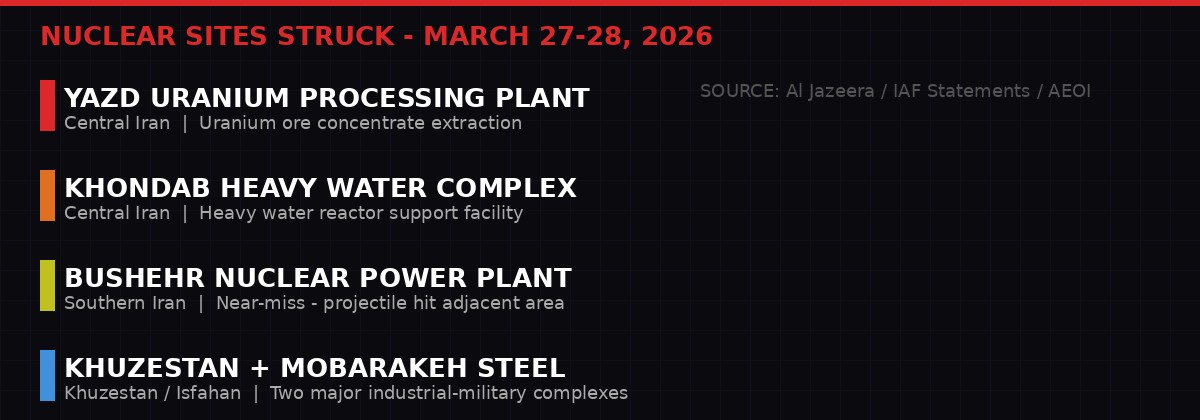
The Israeli Air Force described the Yazd uranium plant as a "unique facility" in Iran's nuclear infrastructure. That language is precise. Yazd processes uranium ore concentrate - the yellow-cake feedstock that feeds the enrichment cycle. It is the entry point of Iran's nuclear fuel chain, not the exit. Hitting it is not the same as hitting an enrichment centrifuge hall at Natanz or Fordow. It is an attack on the beginning of the process.
But the symbolism is not subtle. The message Israel is sending: we can reach every node in your nuclear program. The Khondab Heavy Water Complex - also struck on Friday - is associated with Iran's IR-40 reactor project, which was mothballed under the 2015 JCPOA deal but whose fate has been contested ever since Washington unilaterally withdrew in 2018. Heavy water reactors produce plutonium as a byproduct. That makes Khondab the other path to the bomb. Al Jazeera
Iran's Foreign Minister Abbas Araghchi did not mince language. "Israel has hit two of Iran's largest steel factories, a power plant and civilian nuclear sites among other infrastructure," he wrote on X. "Iran will exact a heavy price." He did not specify what price, or when. X / AFP
Israel's Defence Minister Israel Katz said Israel would "intensify" the campaign and "expand" its target list, accusing Tehran of deliberately directing missiles at Israeli civilians. IRGC Aerospace Commander Seyed Majid Moosavi offered the most ominous statement of the day: "The equation will no longer be an eye for an eye." He urged workers at US and Israeli-linked industrial companies across the region to "immediately vacate their workplaces." Al Jazeera
Al Jazeera's correspondent in Tehran noted the obvious implication: with two major nuclear sites now hit, Iran's pressure to retaliate against Dimona - Israel's Negev nuclear research center, which Iran struck near last week - has intensified sharply.
"The strikes on two major Iranian nuclear facilities could prompt the IRGC to target Dimona again, as it did last week." - Al Jazeera's Ali Hashem, reporting from Tehran, March 27, 2026
The 82nd Airborne Is on the Move
The 82nd Airborne Division does not deploy to do disaster relief. It deploys to seize airfields and key terrain in hostile territory, fast. When the Pentagon sends Fort Bragg's emergency response force to a theater, it means someone is thinking about things ground troops do that airstrikes cannot: hold ground, protect facilities, or open corridors for follow-on forces.
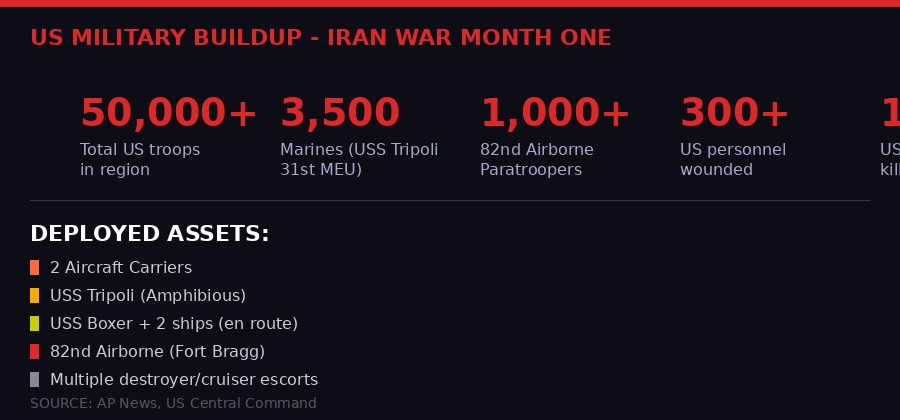
At least 1,000 paratroopers from the 1st Brigade Combat Team, along with Major General Brandon Tegtmeier and division staff, are now ordered to the Middle East. This is on top of roughly 5,000 Marines already heading to the region aboard multiple expeditionary units - the USS Tripoli with the 31st MEU redeployed from Taiwan exercises, and a second rapid-reaction Marine force dispatched from San Diego. Combined with the 50,000 U.S. troops already in the region, Washington now has over 55,000 military personnel either in or en route to the Middle East theater. AP News
White House spokeswoman Anna Kelly's response to questions about the 82nd deployment was telling in its brevity: "President Trump always has all military options at his disposal." That is not a statement designed to de-escalate.
Secretary of State Marco Rubio, speaking after G7 meetings in France, continued to insist the United States "can achieve all of our objectives without ground troops." But the composition of the force being assembled tells a different story. You do not deploy paratroopers trained for hostile airfield seizure into a theater where you have no ground objectives. AP News
"Trump's preference remains 'escalate to de-escalate.' The U.S. is moving more ships and ground troops into the region and will be better prepared to escalate in mid-April." - Eurasia Group risk advisory, March 27, 2026
The Senate Armed Services Committee received a classified briefing from Pentagon officials this week. The contents were not disclosed. The timing - coinciding with the 82nd deployment orders - was not coincidental.
The Houthis Enter the War
This is the development that changes the geometry of the war. For 28 days, the Houthis watched. They held an uneasy ceasefire with Saudi Arabia that had been in place for years. They made signals - "fingers on the trigger," said Saree on Friday, before the launch. And then, in the early hours of Saturday morning, they followed through.
The barrage targeted what Saree described as "sensitive Israeli military sites" in southern Israel. The Israeli military intercepted the projectile and confirmed the interception. Sirens activated around Beer Sheba and the area near Israel's Dimona nuclear research center. Eleven impact sites were confirmed across the Tel Aviv metro area from other overnight strikes. AP News, Al-Masirah TV
The Houthi entry into the war is not just a military event. It is a strategic and logistical crisis for the United States. The USS Gerald R. Ford - one of America's two carrier strike groups in or near the theater - is currently sitting in Split, Croatia, undergoing repairs after being rotated out. The carrier that bore the brunt of anti-shipping operations in 2024 and 2025, the USS Harry S. Truman, previously ran a sustained campaign against the Houthis in the Red Sea. That campaign degraded but did not destroy Houthi missile capabilities.
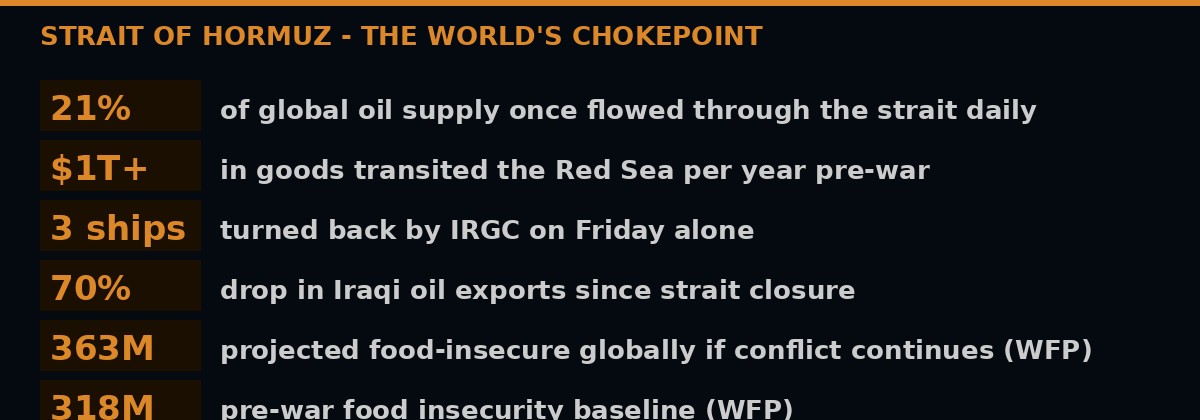
Now the Houthis appear ready to re-engage the Red Sea corridor. Before the Iran war, roughly $1 trillion worth of goods transited the Red Sea annually. That flow had barely recovered from the 2024-2025 Houthi campaign. Re-opening that front means re-imposing insurance surcharges, route diversions around the Cape of Good Hope, and shipping cost spikes on top of oil price spikes already driven by the Strait of Hormuz closure. AP News
The Strait of Hormuz and the War's Economic Weapon
Iran does not need to win on the battlefield. It needs to survive long enough on the economic battlefield to make the war politically untenable for Washington. That strategy is working - for now.
The Strait of Hormuz, through which 21 percent of global oil once passed daily, is effectively a toll booth controlled by the IRGC. On Friday, Iran's Revolutionary Guard Corps turned back three ships attempting to transit the strait, declaring it closed to vessels heading to or from ports linked to its "enemies." Iran's navy is largely destroyed. But its arsenal of land-based anti-ship missiles and drone swarms means no commercial operator will risk a transit without either Iranian approval or a multinational naval escort. Neither is currently available at scale. AP News, Al Jazeera
The economic cascades are now documented. Iraq's oil exports have fallen by more than 70 percent since the strait's closure - devastating for a government that derives 90 percent of its revenues from oil. Gulf states that were once clients of the global oil market are now scrambling for alternatives. A ship carrying over 700,000 barrels of Russian crude oil arrived in the Philippines - which has declared a national energy emergency. Russia, notably, is one of the few parties benefiting from the war: its oil, priced below market rates even before the conflict, is now a lifeline for Asian importers cut off from Gulf supplies. AFP, Al Jazeera
The World Food Programme on Friday warned the conflict could push the number of food-insecure people globally to 363 million, up from a pre-war baseline of 318 million. The mechanism is straightforward: oil prices drive transport and fertilizer costs, which drive food prices, which hit the poorest populations hardest. The war in the Gulf is not staying in the Gulf. WFP statement, March 27, 2026
Rubio called Iran's Hormuz toll regime "illegal, unacceptable and dangerous to the world," and said he had found broad G7 support for confronting it. But confronting it militarily - attempting to force the strait open - carries its own escalation ladder. Even with most of Iran's navy gone, IRGC shore-based missiles can reach and sink vessels inside a 34-kilometer-wide waterway. The U.S. Navy has run the numbers. The numbers are not comfortable.
Iran's ambassador to the United Nations did offer one partial concession: Tehran would "facilitate and expedite humanitarian aid shipments through the Strait of Hormuz." The UN announced a task force to establish a new mechanism for fertilizer and raw materials movement. France said a tanker escort system would be needed once the worst fighting subsides - an implicit acknowledgment that the worst fighting has not subsided yet.
The April 6 Ultimatum and Iran's Five-Point Counter
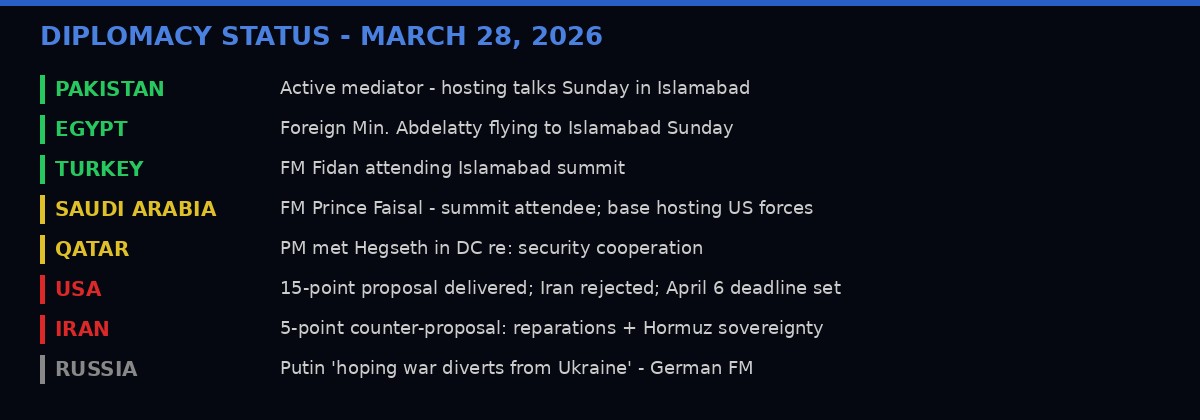
Trump on Thursday delayed his planned strikes on Iran's energy infrastructure - power plants, electrical grid - by 10 days to April 6. His stated reason: negotiations are "going very well." Iran said no negotiations were taking place. This is not a new pattern in this war. AP News
The gap between the two positions is structural, not just rhetorical. Washington delivered a 15-point "action list" through envoy Steve Witkoff: restrict Iran's nuclear program, reopen the Strait of Hormuz, and accept curbs on its regional proxy network. Tehran rejected the proposal as "one-sided and unfair" and presented its own five-point counter: war reparations, recognition of Iranian control of the Strait of Hormuz, cessation of all attacks, lifting of all sanctions, and guarantees of non-aggression. AP News
These are not negotiating positions designed to reach a deal. They are negotiating positions designed to document the other side's intransigence. Iran's sovereign claim over the Strait of Hormuz is not something Washington will recognize - doing so would legitimize IRGC control of 21 percent of global oil supply as a permanent feature of international law. Tehran knows this. The five points are a statement of war aims, not a ceasefire framework.
What April 6 means in practice: if Iran has not reopened the strait to international shipping by 8pm Eastern Time - midnight GMT - Trump has said the U.S. will begin bombing Iranian power plants. That would be a significant escalation from the current target set. Taking out a country's electrical grid at scale is the kind of infrastructure attack that produces cascading civilian casualties not from blast effects but from hospital failures, water treatment shutdowns, and winter heating collapse. International humanitarian law has complex things to say about that. Washington's lawyers will have prepared arguments. They always do.
Iranian officials described the continuing strikes while simultaneously claiming "talks are progressing" as "intolerable." Mohamed Vall, reporting for Al Jazeera from Tehran, noted that ordinary Iranians are not watching the diplomatic channels - they are watching the airstrikes. The bombs falling on Yazd and Qom and Isfahan are the message they receive. The negotiations in Islamabad are abstract. The funerals are not.
"The Islamic Republic understands that it cannot defeat the United States militarily. Instead, its objective is both simpler and more strategic: survive the war long enough to claim victory." - Shukriya Bradost, Mideast security analyst, via AP News
Iran as Insurgency: The Strategic Logic of Survival
One month into this war, the analytical framework that makes most sense of Iran's behavior is not conventional interstate conflict. It is insurgency doctrine applied at the nation-state level.
Iran has lost most of its conventional navy. Its air force is largely destroyed. Its air defense network has been systematically degraded over 28 days of sustained US-Israeli strikes. And yet: it still controls the Strait of Hormuz, it is still firing ballistic missiles at Gulf states, and it just wounded over two dozen American troops in a single week at a base 96 kilometers from Riyadh. By any conventional measure, this is a state that should have been compelled toward a ceasefire weeks ago. It has not been.
The reason is structural. Iran's economy, hobbled by decades of sanctions, is broadly insulated from the international financial system. Rising oil prices hurt the global economy. They do not hurt Iran proportionally - Tehran was never plugged into the system that is now breaking. The pain is asymmetric and it flows outward, not toward the party that controls the chokepoint.
Meanwhile, Iran's "shoot and scoot" tactics - mobile missile launchers disguised as commercial trucks, underground bases dug into mountainous terrain across a landmass the size of Alaska - mirror the insurgent playbook its own proxies have used for decades. The Houthis survived years of Saudi airstrikes using these tactics. Hezbollah survived repeated Israeli campaigns. The IRGC taught them this. Now it is running the same playbook. AP News analysis
Trump said Thursday that approximately 9 percent of Iran's missile arsenal remains. There is no way to independently verify that figure. But even accepting it: 9 percent of a missile arsenal built over decades, combined with hundreds of drone assets and shore-based anti-ship batteries, is still enough to close a 34-kilometer strait, wound American troops, and set Gulf oil infrastructure on fire. The math of attrition has not produced the political surrender Washington anticipated.
Iran's home front is also more complicated than US officials projected. Both Washington and Jerusalem have said they hope the Iranian people - who challenged their government in nationwide protests in January before a bloody IRGC crackdown - would rise up and topple the theocracy. That uprising has not materialized. Instead, something more ambiguous has emerged. Negar Mortazavi, a senior non-resident fellow at the Center for International Policy, told Al Jazeera that even Iranians who were critical of their own government increasingly view the war as an attack on the Iranian people - not just on its leaders. Targeting water, electricity, gas, cultural heritage, schools, and hospitals has a unifying effect that no government could purchase through propaganda. Al Jazeera
Lebanon and the Second Front
Israel's southern Lebanon operation has killed more than 1,100 people. Over 1.2 million Lebanese - one in every five residents of the country - have been displaced. The UN has warned Lebanon risks a "humanitarian catastrophe." Lebanese Prime Minister Nawaf Salam has told the United Nations there is a "risk of annexation" of Lebanese territory south of the Litani River. Two Israeli soldiers were killed in the south this week as the IDF attempted to establish a "buffer zone" in villages and towns near the border. Al Jazeera, AP News
Israel's opposition leader Yair Lapid accused the government of leading Israel into a "security disaster" - conducting a multi-front war without a strategy or sufficient troops. The Israeli military has publicly said it needs more soldiers in southern Lebanon. The IDF is stretched: it is conducting sustained airstrikes on Iran, operating in Lebanon, dealing with intermittent Hezbollah fire from the north, managing the Houthi threat from the south, and now facing a revived threat from its own nuclear periphery.
In Iraq, US airstrikes hit Habbaniyah base in Anbar province, killing between five and seven Iraqi soldiers and wounding 23. Iraq's oil exports, which collapsed by more than 70 percent with the strait closure, are now being threatened by its own political instability - a government that cannot afford not to condemn US strikes on its territory, but cannot afford to break with Washington entirely.
In Beirut, Israeli airstrikes hit the city's southern suburbs in the early hours of Friday. Lebanese media confirmed the strikes. No casualty figures were immediately available.
The pattern across the entire theater is the same: each escalation produces a retaliatory escalation, each of which produces the conditions for the next escalation. There is no deconfliction mechanism functioning. There is no hotline that is being used. There are mediators - Pakistan, Egypt, Turkey - but they are mediating between parties who, as of Friday, do not agree on whether talks are even taking place.
TIMELINE - MONTH ONE OF THE IRAN WAR
What Comes After April 6
The April 6 deadline is the most significant variable in the near-term trajectory of this war. Three scenarios are in play.
The first: Iran agrees to some partial concession on Hormuz - not full reopening, but a humanitarian corridor and a halt to active enforcement actions - that gives Trump enough political cover to claim a win and delay the grid strikes again. This is the Pakistani and Egyptian mediators' preferred outcome. It is narrow and unstable, but it is a path.
The second: Trump strikes the Iranian power grid on April 6 or April 7. This would be the largest escalation yet. Destroying electrical infrastructure at scale will produce civilian casualties not from the strikes themselves but from hospital failures, dialysis machines going dark, and water pumping stations shutting down in summer heat. Iran has already warned of "unacceptable" civilian consequences. The international response - including from nominal US allies - would be severe. Russia's President Putin is, per Germany's Foreign Minister Johann Wadephul, "hoping the war shifts focus from his crimes in Ukraine." Grid strikes on Iran would hand him that gift at the G7 level. Al Jazeera
The third: some party miscalculates and the war escalates laterally. A Houthi missile strikes a US naval vessel. An Iranian drone hits a Saudi oil facility at a scale that breaks the Kingdom's tacit tolerance of US base usage. An IRGC unit fires on Iraqi-based US forces and kills a dozen soldiers, not wounds them. Any of these events could produce a political demand in Washington for a response that the current strike package is not designed to deliver without ground forces. And the 82nd Airborne will be in position by then.
What is clear: the four-week war that was supposed to produce a quick Iranian capitulation has produced neither capitulation nor a clear American victory condition. Trump campaigned on keeping the US out of new wars. He is now running a sustained air campaign against a nation of 87 million people, with two carrier groups, 55,000 troops, paratroopers ordered to seize hostile airfields, and a 10-day countdown to power grid strikes. The distance between where this started and where it is now is not measured in miles. It is measured in decisions that cannot be taken back.
Eighteen people were killed in Qom on Friday. The city is one of Shia Islam's holiest sites. The IRGC buried their dead under the domes the airstrikes could not reach. And in Islamabad, diplomats landed to talk about peace, under a deadline that ticks like a metronome toward a war nobody has named yet.
Get BLACKWIRE reports first.
Breaking news, investigations, and analysis - straight to your phone.
Join @blackwirenews on Telegram