Pakistan's Gambit: Islamabad Offers to Host Iran-US Talks as the Bombs Keep Falling
Day 24 of the Iran-US war. Ten missile waves hit Israel. Brent crude holds above $100. Pakistan's PM posts his peace offer on X. And in Washington, nobody quite agrees whether any talks are actually happening.
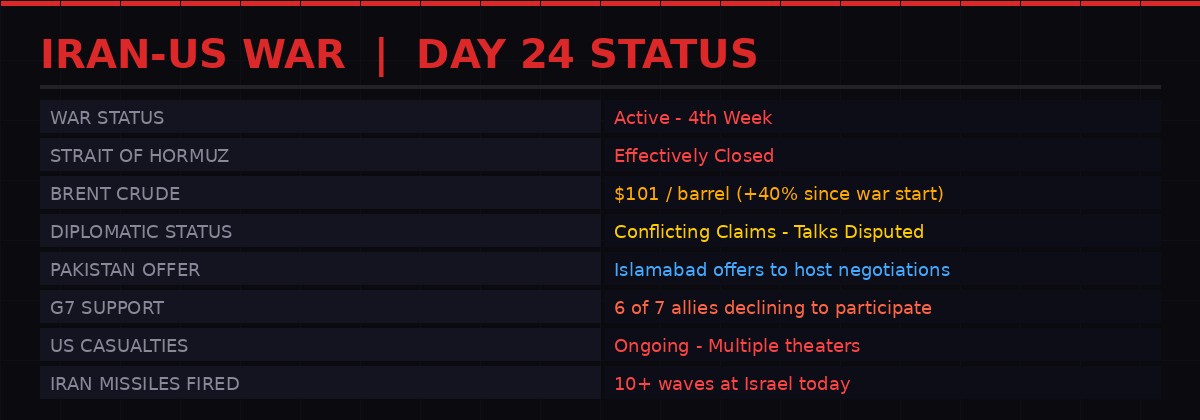
War status as of Tuesday, March 24, 2026 - Day 24 of the Iran-US conflict. Source: BLACKWIRE, AP News data.
The war is in its fourth week and neither side is winning cleanly. The United States and Israel have degraded significant Iranian military and infrastructure targets. Iran has not reopened the Strait of Hormuz. Brent crude is sitting at $101 a barrel - up 40% since the first strikes on February 28. The global economy is bleeding.
On Tuesday, Pakistan's Prime Minister Shehbaz Sharif posted on X that Islamabad was ready to "facilitate meaningful and conclusive talks" to end the conflict. Three Pakistani officials told the Associated Press that the United States had agreed "in principle" to join those talks, while mediators were still working to bring Iran to the table.
Within hours of that announcement, Iran fired at least 10 waves of missiles at Israel. A 100-kilogram warhead slammed into a street in central Tel Aviv, blowing out windows of an apartment building. Israel struck what it described as Iranian "production sites." A massive blast was heard in northern Tehran. Another in the city center.
This is what peace looks like before anyone has agreed to it.
The Diplomacy That May Not Exist
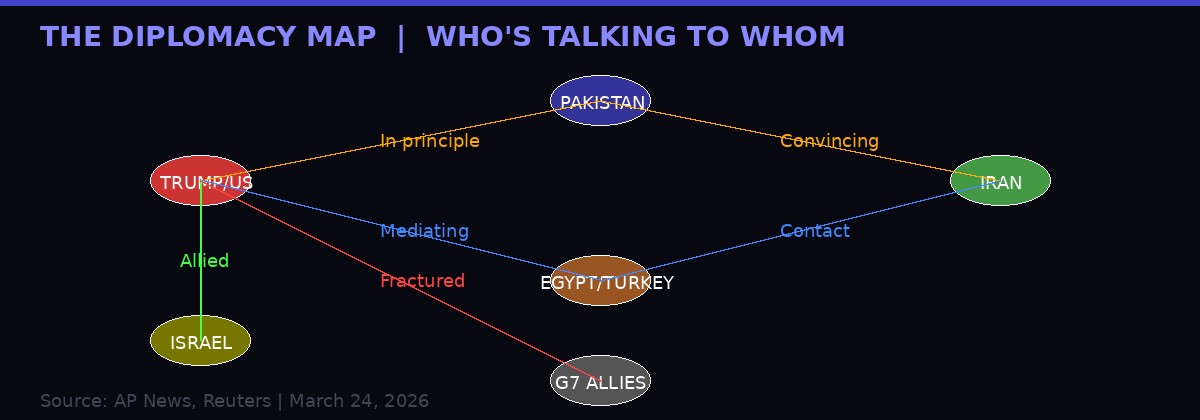
The current diplomatic landscape: who is talking to whom, and what influence pathways exist. BLACKWIRE graphic based on AP News reporting.
On Monday morning, President Trump made an announcement carefully timed to move markets before they opened. He said his envoys - son-in-law Jared Kushner and Steve Witkoff - had held "very good" talks over the weekend with unnamed "respected" Iranian officials. He said Iran was "eager to make a deal." He extended his deadline for Iran to reopen the Strait of Hormuz by five days, pulling back from a weekend threat to bomb Iranian power plants.
"All I'm saying is we are in the throes of a real possibility of making a deal. And I think, if I were a betting man I'd bet for it. But again, I'm not guaranteeing anything." - President Donald Trump, speaking to reporters before boarding Air Force One, March 23, 2026 (AP News)
Before Trump's plane had landed in Tennessee - less than two hours later - Iran had already refuted the entire premise. Mohammad Bagher Qalibaf, speaker of Iran's parliament, posted on X that "no negotiations have been held with the US" and called Trump's claims "fakenews used to manipulate the financial and oil markets." The Iranian Foreign Ministry echoed him within the hour, calling Trump's statement an effort to "reduce energy prices and buy time for implementing his military plans."
Oil briefly fell 9.7% on Trump's optimism, hitting $101.26 a barrel. By Tuesday it was nudging back above $100. The momentary reprieve evaporated as fast as it arrived.
Multiple countries are now involved in the effort to find an exit ramp. Turkey and Egypt say they have spoken to both sides. Pakistan has gone public with its offer. An Egyptian official told AP that efforts were focused on "trust-building" - the diplomatic language for two parties who don't trust each other enough to stop shooting. The goal, the Egyptian official said, was a "mechanism" for Iran to reopen the Strait of Hormuz and a pause in attacks on energy infrastructure.
Israel is not involved in these talks. Israel has vowed to continue targeting Iranian leadership, and has done so - which creates an obvious complication for any ceasefire negotiation brokered between Tehran and Washington.
Pakistan's Calculation
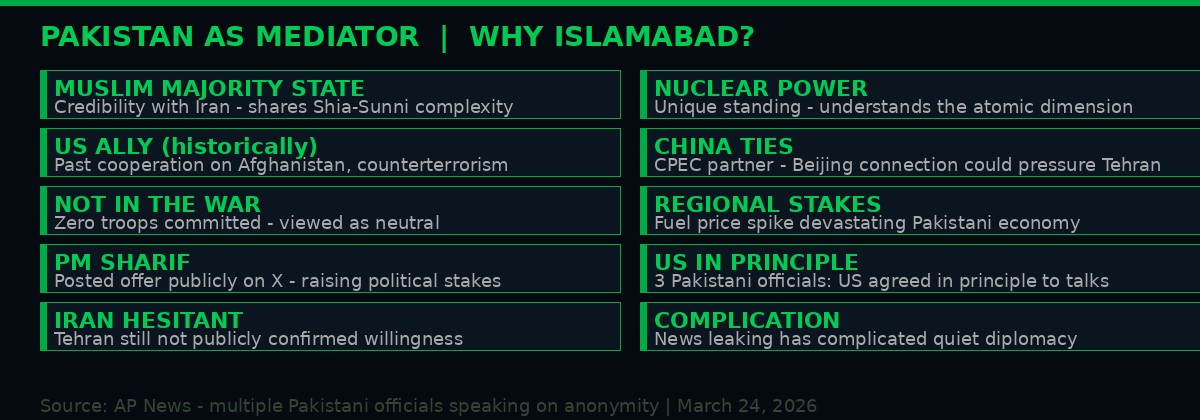
Why Pakistan is uniquely positioned - and why the offer is complicated. BLACKWIRE analysis.
Islamabad's bid to host peace negotiations is not purely altruistic. Pakistan is being hit hard by the oil shock. As a country that imports significant quantities of fuel, the 40% price spike is compounding an already fragile economic situation. Getting the Strait of Hormuz open again is existential for Pakistan's balance of payments.
Pakistan also has credentials other potential mediators lack. It is a Muslim-majority state, which gives it standing with Iran. It has historically maintained ties with the United States, having cooperated on Afghanistan and counterterrorism for decades. It has deep relationships with China through the China-Pakistan Economic Corridor, and Beijing has leverage in Tehran that Washington does not. And critically - Pakistan has not sent a single soldier to this war. It arrives with clean hands.
There is also a nuclear dimension to Pakistan's standing that nobody is saying out loud but everyone understands. Pakistan is the only Muslim country with a functioning nuclear deterrent. If this war spirals toward Iran acquiring or deploying a nuclear weapon, Pakistan's geographic and strategic position makes it an unavoidable actor in what follows.
Three Pakistani officials told AP that the US had agreed in principle to participate. The State Department declined to comment on those reports, referring instead to Trump's own statements about ongoing direct US-Iran communications. The Omani channel - which has historically been used for US-Iran back-channel talks - appears to be active as well, with IAEA Director General Rafael Grossi having attended negotiations between the two sides in Geneva as recently as late February.
But the talks Grossi attended were focused on Iran's nuclear program. These new talks, if they happen in Islamabad, would be about the war itself. It is not clear the two tracks are coordinated - or whether Washington even wants them to be.
"The quiet diplomacy had grown more complicated since news of it leaked." - Pakistani officials speaking on condition of anonymity, as reported by AP News, March 24, 2026
Qalibaf: The Ghost at the Negotiating Table
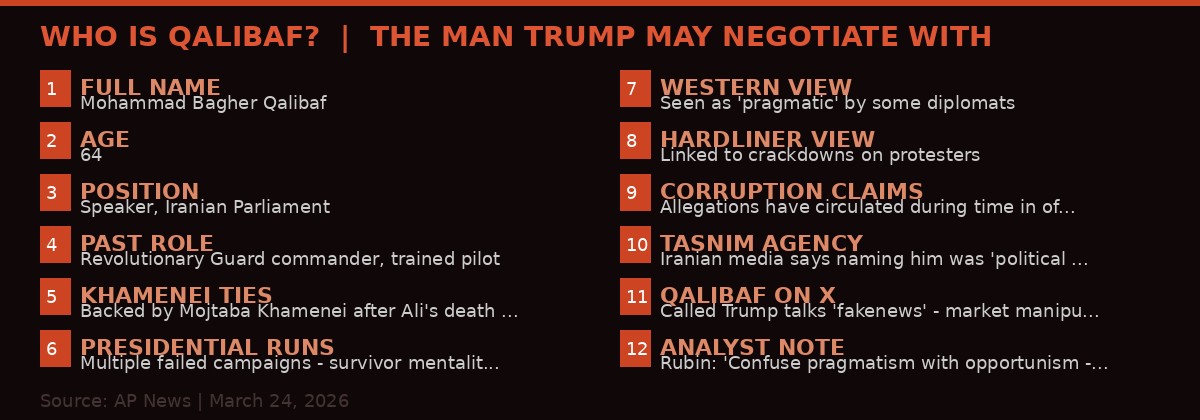
Mohammad Bagher Qalibaf - floated as Iran's potential negotiating partner, now publicly denying any talks exist. BLACKWIRE profile.
The most significant unknown in the diplomatic picture is who, exactly, Iran's interlocutor would be - assuming Iran agrees to talk at all.
Mohammad Bagher Qalibaf, the 64-year-old speaker of Iran's parliament, has been floated as the potential US negotiating partner. His background makes him a credible candidate. He is a former Revolutionary Guard commander and trained pilot who rose through the ranks during the Iran-Iraq war in the 1980s. He spent years positioning himself as someone the West could deal with - telling London's The Times in 2008 that he wanted the West to "trust Iran" and to "advance issues through dialogue."
But Qalibaf is also a political survivor in a system that rewards ideological loyalty and punishes compromise. He has run for president multiple times and lost each time. He has been linked to the crackdown on protesters. Corruption allegations have followed him through his career. And on Tuesday - even as reports swirled that he was the man Kushner and Witkoff had met with - he went on X to call those reports a "political bomb" designed to "create internal divisions within Iran."
Iran's Tasnim news agency, believed close to the Revolutionary Guard, described Western media reports about Qalibaf as a deliberate effort "to present a contradictory and non-unified image of Iran" and to "provoke conflict among political forces."
That framing reveals the fundamental problem with any negotiation. Iran's power structure has been shattered. The Feb. 28 airstrike that killed 86-year-old Supreme Leader Ali Khamenei left a leadership vacuum that has not been cleanly filled. His son Mojtaba was named the new supreme leader, but has reportedly been wounded and has not been seen publicly. Multiple power centers - the Revolutionary Guard, the parliament, the Foreign Ministry - are now vying for authority, and each has different incentives about whether to negotiate or escalate.
"Many Iranians despise Ghalibaf; diplomats see him as pragmatic. Those diplomats confuse pragmatism with opportunism. Ghalibaf is a survivor. He sees in Trump someone who can help him achieve what late Supreme Leader Ali Khamenei denied him: the presidency or some equivalent interim leadership role." - Michael Rubin, analyst, via AP News, March 24, 2026
Trump, for his part, said the US had not spoken to Mojtaba Khamenei. He did not say who they had spoken to. The mystery is not incidental - it is the story.
What the Bombs Are Doing While the Diplomats Talk
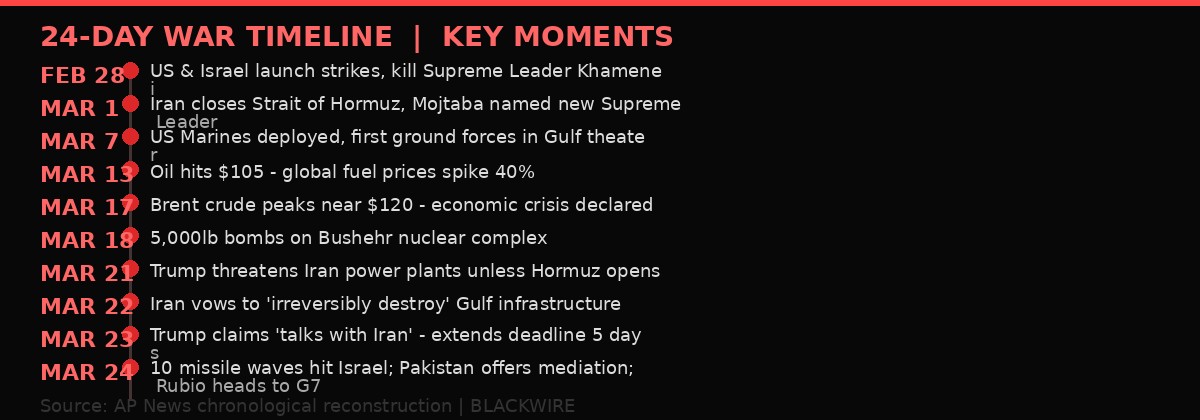
Key events from Day 1 to Day 24 of the Iran-US war. BLACKWIRE timeline reconstruction based on AP News coverage.
Tuesday's battlefield picture undercuts any reading of imminent ceasefire. Iran fired at least 10 separate waves of missiles at Israel throughout the day. In Tel Aviv, the 100-kilogram warhead that hit a city center street left four people with minor wounds - the injuries were minor, but the optics of a missile crater in the middle of Tel Aviv are not minor. A 40-year-old man was in moderate condition elsewhere in southern Israel from a separate strike. A woman and a two-month-old baby suffered minor wounds.
Israel struck back with what it described as extensive attacks on Iranian "production sites." Massive blasts were heard in northern Tehran and in the city center. The exchange reflects the essential paradox of this phase of the war: both sides are hitting hard while simultaneously claiming they are open to dialogue. Iran's military spokesman Maj. Gen. Ali Abdollahi Aliabadi issued a defiant statement on Tuesday declaring Iran's armed forces were "proud, victorious and steadfast" and vowing to fight "until complete victory." He did not define what complete victory would look like.
That vagueness is intentional. Leaving "victory" undefined preserves room to negotiate without appearing to have capitulated. But it also means nobody knows where the off-ramp actually is.
The US military posture is not pulling back. Thousands more Marines are en route to the Gulf. The Strait of Hormuz remains effectively closed to most shipping, with only dozens of vessels managing transit - a fraction of the roughly 20% of global crude oil that passed through the strait before the war began. The closure is not just squeezing fuel prices. It is creating cascading shortages of goods that use the same shipping lanes, and disrupting the food supply chains of countries in South Asia that depend on imports via the Gulf.
The Nuclear Problem Nobody Can Verify
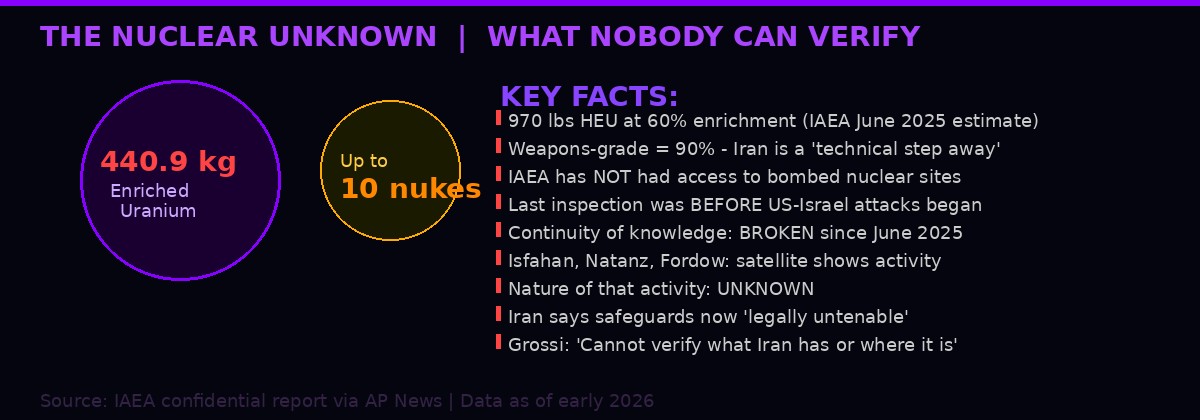
The state of Iran's nuclear program as understood by the IAEA - with critical caveats about what cannot be verified. BLACKWIRE infographic based on IAEA confidential report, AP News.
Underpinning every diplomatic calculation is a question that nobody can currently answer: what does Iran actually have left of its nuclear program?
According to a confidential IAEA report circulated to member states and seen by AP News, Iran has not allowed the UN nuclear watchdog access to its nuclear facilities since they were bombed by Israel and the United States in June 2025 - a 9-month blackout on inspections. The IAEA says it "cannot verify whether Iran has suspended all enrichment-related activities" or the "size of Iran's uranium stockpile at the affected nuclear facilities."
The IAEA's last formal estimate - from June 2025, before the inspection blackout - put Iran's stockpile of uranium enriched up to 60% purity at 440.9 kilograms, roughly 972 pounds. At 60% enrichment, that material is a "short technical step" away from weapons-grade uranium at 90%. IAEA Director General Rafael Grossi has said that stockpile, if weaponized, could fuel as many as 10 nuclear bombs. He added that this does not mean Iran has such weapons - the difference between fissile material and a deployable weapon is substantial - but the uncertainty is precisely the problem.
Robert Goldston, a Princeton University professor researching arms control and fusion energy, told AP that Iran has already performed 99% of the centrifuge work required to produce weapons-grade uranium for nine nuclear weapons. The remaining 1% is technically straightforward. What is not straightforward is whether Iran still has the facilities to do that work, or whether those facilities are beneath rubble.
Satellite imagery observed by the IAEA shows "regular vehicular activity" around the entrance to a tunnel complex at Isfahan - a site struck by both Israel and the US in June. The IAEA also observed activity at Natanz and Fordow. The nature of that activity remains unknown. Iran has told the IAEA that normal safeguards are now "legally untenable and materially impracticable" due to "acts of aggression." The IAEA called the loss of verification continuity something that "needs to be addressed with the utmost urgency."
Trump has said any deal would require Iran to hand over its enriched uranium. Iran has historically refused this on principle - it insists it has the right to peaceful enrichment under the Non-Proliferation Treaty. Whether a leadership shattered by four weeks of bombardment and 2,000+ dead will accept that demand is the central question of any negotiation.
G7 Fractures and Rubio's Repair Mission
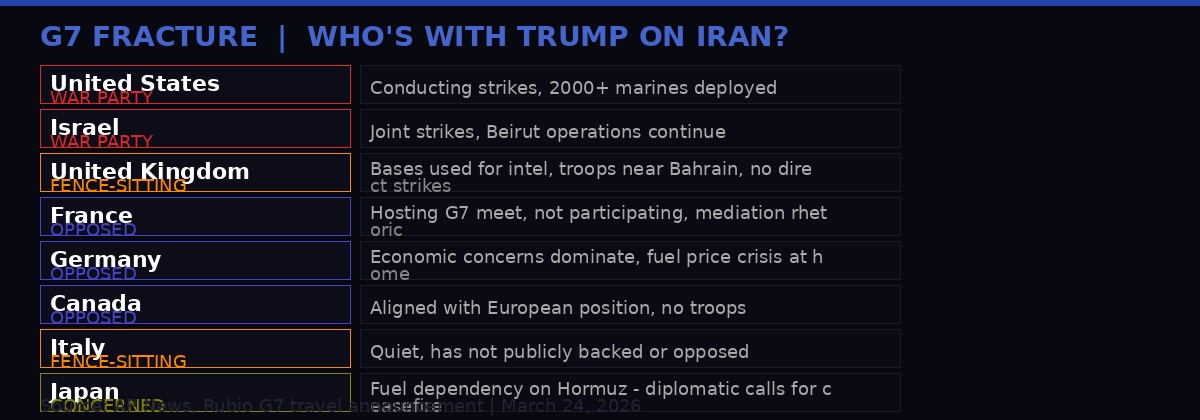
G7 member positions on the Iran war as of March 24, 2026. The fracture between Washington and its traditional allies is unprecedented. BLACKWIRE analysis.
Secretary of State Marco Rubio announced Tuesday he would travel to France this week for a G7 foreign ministers meeting near Versailles. His stated agenda: to "sell" the Iran war strategy to skeptical allies who have largely declined to participate in the conflict.
The selling job is considerable. Six of the seven G7 members have reacted "coolly at best" to the US-Israeli military operation, declining to contribute forces and, in several cases, publicly opposing the campaign. Trump has lashed out at NATO allies repeatedly for their refusal to help reopen the Strait of Hormuz. G7 members have watched fuel prices surge 40% since the war began, and their publics are absorbing the economic pain while having had no voice in the decision to start the war.
Britain occupies an uncomfortable middle ground. HMS Prince of Wales was placed on five-day readiness. UK troops are positioned near Bahrain - reportedly 200 metres from Iranian forces at one point. British intelligence assets and bases have been used in support of operations. But the UK government under Prime Minister Keir Starmer has not committed to direct strikes, and Parliament has not been asked to authorize military action. The political tension in London is acute.
France and Germany have been most vocal in their opposition, or at least their refusal to participate. France is hosting this week's G7 meeting - a deliberate statement about where diplomatic gravity should sit. Germany's economy minister has been openly alarmed about the fuel price impact. Japan's dependence on Gulf oil makes the Hormuz closure an existential economic issue, but Tokyo has stopped well short of military endorsement.
Rubio's Versailles meeting will also address the Russia-Ukraine war, where a ceasefire deal brokered through similar back-channel negotiations earlier in March is being tested by renewed violations. The US is attempting to manage two major war theaters simultaneously, and the diplomatic bandwidth required is extraordinary.
The G7 allies have indicated a growing willingness to back "appropriate action" to restore the Hormuz waterway - but appropriate action does not mean combat. What they appear to mean is diplomatic and economic pressure, possibly coordinated sanctions packages that go beyond what is already in place. Whether that is enough to change Iran's calculus is an open question when US and Israeli aircraft are also bombing Iranian cities.
The Oil Shock and Its Human Arithmetic
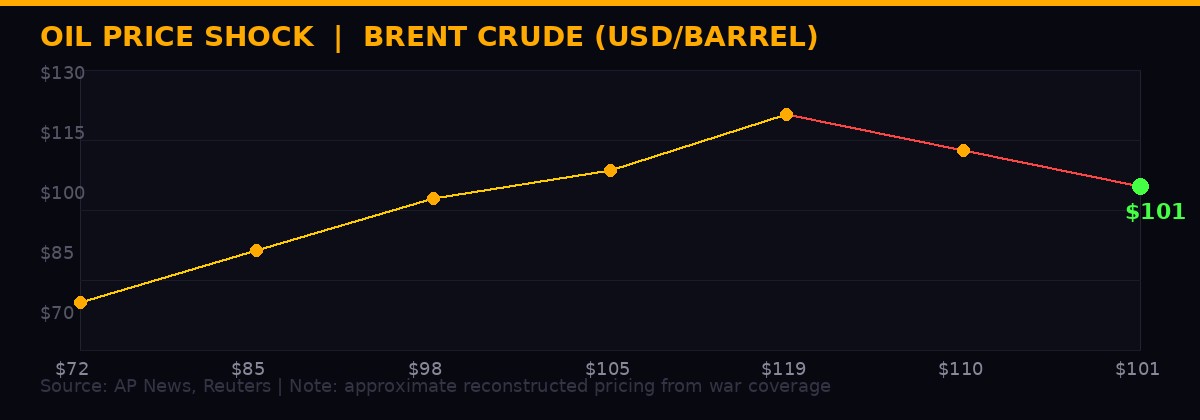
Brent crude trajectory since the war began February 28, 2026. The peace-talk dip on March 23 partially reversed within 24 hours. BLACKWIRE reconstruction from AP News pricing data.
The economic cost of the war is distributing itself with ruthless efficiency along lines of existing inequality. The people with the least margin are absorbing the most pain.
In Buenos Aires, taxi driver Luis Catalano says he is "barely managing to hold on" at a gas station. In Cologne, janitor Kevin Plucken can only afford 20 euros of fuel at a time - his weekends now consist of finding things to do close to home instead of driving his children to activities. In Manila, jeepney driver Johnny Pagnado - a 55-year-old who has driven the iconic vehicles for decades - is cutting every cost he can down to his nightly beer, while worrying about how he will send four children to college. In Lagos, Felicia Iwasa says simply: "Everything is going up. The economy is not easy for us."
Brent crude peaked near $120 a barrel last week before Trump's peace-talk announcement drove it down briefly to $101. That drop is cold comfort for pump prices, which lag global markets by weeks - oil must travel from drill sites through refineries, then via pipelines and tankers to distribution terminals, before it reaches the consumer. The pump prices that are currently squeezing households reflect the $105-$115 range from 10 to 14 days ago. The impact of Monday's temporary dip will not be felt at filling stations for weeks - if it holds.
Before the war, the Strait of Hormuz carried roughly a fifth of the world's crude oil - approximately 21 million barrels per day. The closure has forced producers across the Gulf to cut output because tankers cannot move their crude. Saudi Arabia, the UAE, Kuwait, and Iraq have all been affected. The International Energy Agency called an emergency coordination session in early March. Strategic reserves have been tapped in the US and several European countries, but those reserves are not designed for a multi-week closure - they are designed for short-term disruptions.
If the strait remains closed for another week, energy economists say the full economic impact - including downstream effects on food and goods pricing - will begin to hit consumer prices in Western markets. The political consequence of $8-a-gallon gasoline in the United States before mid-term elections is not lost on either party in Washington.
The Objectives Trump Has Not Yet Achieved
Even as Trump signals openness to a deal, analysts note he would be walking away from a war in which his stated objectives have not been fully met. The president has articulated a specific list of goals: degrading Iran's ballistic missile capability, destroying its defense industrial base, eliminating the Iranian navy, preventing Iran from ever acquiring nuclear weapons, and securing the Strait of Hormuz.
The US-Israeli campaign has made progress on some of these goals. Iranian naval capability has been significantly degraded. Multiple missile production and launch facilities have been struck. The death of Supreme Leader Khamenei removed the central architect of Iran's regional strategy. But none of the objectives have been definitively achieved, and the most important one - permanent verifiable nuclear disarmament - remains the most elusive.
The 970 pounds of highly enriched uranium that the IAEA last verified in June 2025 is still somewhere in Iran - possibly underground, possibly destroyed, possibly relocated. Nobody outside Iran's government can say with confidence. The IAEA cannot say. US intelligence cannot say with certainty. The uncertainty is precisely what makes any "deal" on the nuclear question so difficult to verify and so easy for both sides to claim as a victory or a betrayal.
If Trump ends the war now claiming Iran has agreed to give up enriched uranium, and it later emerges that Iran retained significant stockpiles, the political fallout would be severe. If Trump continues the war until every stated objective is definitively met, the economic damage and military cost could make the political fallout of a bad deal look preferable. This is the dilemma that the Versailles G7 meeting, the Islamabad offer, and the parallel Egyptian-Turkish mediation are all trying to resolve - or at least, trying to help Trump resolve while appearing not to be managing his exit from a war they opposed.
The missiles are still flying. The Hormuz is still closed. The oil is still above $100. And somewhere in Islamabad, a prime minister is waiting by his phone to find out if either side will actually show up.
Get BLACKWIRE reports first.
Breaking news, investigations, and analysis - straight to your phone.
Join @blackwirenews on TelegramKey Facts - Day 24
- War duration: 24 days since Feb 28 US-Israel strikes on Iran
- Confirmed deaths: 2,000+ (AP News estimate, includes Iranian military and civilians)
- Strait of Hormuz: Effectively closed, dozens of vessels still transiting
- Brent crude: $101/barrel - up ~40% since war began (AP News)
- US Marines in theater: 2,500+ deployed, thousands more en route
- Iran nuclear stockpile: 440.9 kg at 60% enrichment - last verified June 2025
- IAEA access: Blocked from bombed facilities for 9 months
- Pakistan mediation: US "in principle" agreed; Iran has not confirmed
- Iran leadership: Mojtaba Khamenei (supreme leader) reportedly wounded, not seen publicly
- G7 support: Only US and Israel actively prosecuting military campaign
Sources
- AP News: "Airstrikes hit Iran as it attacks Israel and Gulf states while diplomatic efforts accelerate" - March 24, 2026
- AP News: "Trump says there are talks with Iran. Tehran says he's buying time" - March 24, 2026
- AP News: "Iran's parliament speaker Qalibaf floated as US contact" - March 24, 2026
- AP News: "Iran has not given IAEA access to nuclear facilities, UN watchdog says" - March 24, 2026
- AP News: "Small comforts fade and big worries grow as fuel prices surge globally" - March 24, 2026
- AP News: "Rubio set to sell Iran war to skeptical G7 allies" - March 24, 2026
- AP News: "What happened the last time shipping was disrupted in the Strait of Hormuz" - March 24, 2026
- AP News: "Trump says Iran is eager for a deal to end the war" - March 23, 2026