Iran Brings the War to Paris: Bomb Device Found at Bank of America, Three Arrested
A man placed a bomb containing five litres of fuel and an ignition system outside the Bank of America headquarters in the heart of Paris early Saturday morning. Three people are now in custody. France's Interior Minister says the attack may be linked to Iranian intelligence services. It is the most visible sign yet that Tehran's war against American power is no longer contained to the Middle East.

A Bomb on the Champs-Elysees

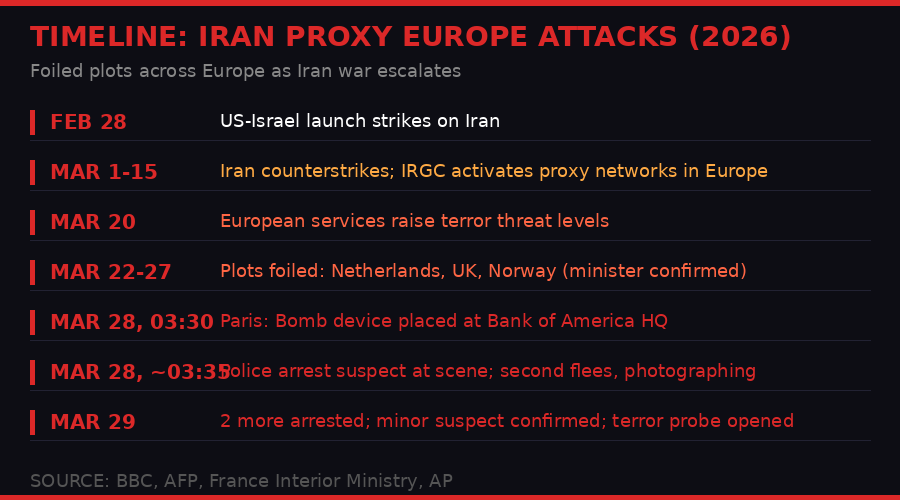
At approximately 03:30 local time on Saturday, March 28, a suspect approached the Bank of America office building in the 8th arrondissement of Paris - a couple of streets from the Champs-Elysees, the symbolic spine of the French capital. He placed a device containing five litres of liquid, believed to be fuel, alongside an ignition system against the building's exterior. Police officers, already deployed at heightened readiness, detained him at the scene.
A second person who had been accompanying the suspect and appeared to be filming the operation with a mobile phone fled before officers could reach him. He has not yet been identified or apprehended.
France's anti-terrorism prosecutor's office opened an investigation immediately, the office confirmed Sunday, looking into "attempted damage by fire or other dangerous means in connection with a terrorist undertaking" and a "terrorist criminal conspiracy." Both Paris judicial police and the General Directorate for Internal Security (DGSI), France's domestic intelligence service, are now involved in the investigation.
By Sunday, two more individuals had been taken into custody. The anti-terrorism prosecutor confirmed the total number of arrests at three. The original suspect, detained at the scene, was identified as a minor. Under French law, terrorism suspects can be held for 96 hours, extendable by court order.
"In this type of conflict, you have a number of Iranian services that are likely to carry out actions such as these through proxies. There is a significant suspicion, but it is for the investigation to determine." - Laurent Nunez, French Interior Minister, March 29, 2026 (via BBC / AFP)
The Iranian embassy in France has not commented on Nunez's remarks.
Fast Facts - Paris Bomb Attempt
- Location: Bank of America HQ, Paris 8th arrondissement (near Champs-Elysees)
- Time: Approximately 03:30 CET, Saturday March 28, 2026
- Device: 5 litres of fuel + ignition system
- Arrests: 3 total (1 minor detained at scene, 2 more Sunday)
- Investigation: France's anti-terrorism prosecutor's office (PNAT)
- Intelligence lead: DGSI (Directorate-General for Internal Security)
- France's assessment: "Significant suspicion" of Iranian proxy involvement
The Pattern France Doesn't Want to Speak Plainly

Interior Minister Nunez did not merely comment on this one incident. He made a broader and more alarming statement: similar attacks have been foiled in other European nations, including France itself, as well as the Netherlands, Britain, and Norway.
That is four countries, four separate incidents, all apparently connected to the same wave of proxy activity. The Paris attempt, which came closest to succeeding, is merely the one that reached the public because a suspect was caught in the act.
Nunez urged security services across the country to be "extra vigilant" and increase their presence at transport hubs and other locations. This is the language of a government that knows the threat is not contained.
The choice of target is deliberate. Bank of America is not just a bank - it is one of the most recognizable symbols of American financial power in Europe. Placing a bomb at its Paris headquarters sends a message designed to be read in Washington. It says: we can reach your institutions anywhere.
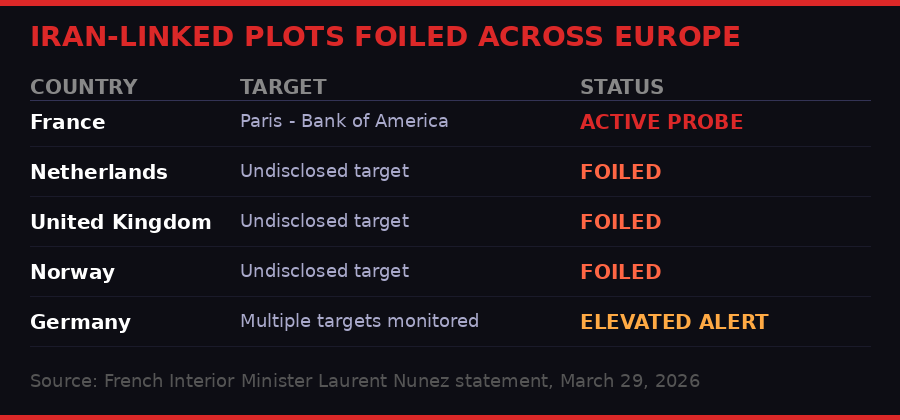
The use of a minor as the primary operative is also textbook deniability architecture. A teenage suspect with no direct IRGC ties cannot easily be used to prove state sponsorship in court. By the time investigators build a chain of custody that leads back to Tehran, months will have passed. In the meantime, the message was delivered.
This is not improvisation. This is a system.
How Iran Built Its European Proxy Network

Iran's Ministry of Intelligence and the IRGC's intelligence directorate have operated clandestine recruitment networks in Western Europe for decades. During peacetime, these networks were used for surveillance of Iranian dissidents abroad - the Mossad-style targeted killings of opposition figures in Paris, Berlin, and Copenhagen in the 1990s and 2000s are well-documented examples.
Since 2022, European services have warned repeatedly that Iran stepped up recruitment efforts in immigrant communities, running operations that looked less like intelligence tradecraft and more like criminal outsourcing: paying individuals modest sums to conduct surveillance or low-level harassment, building layers of deniability through multiple cutouts.
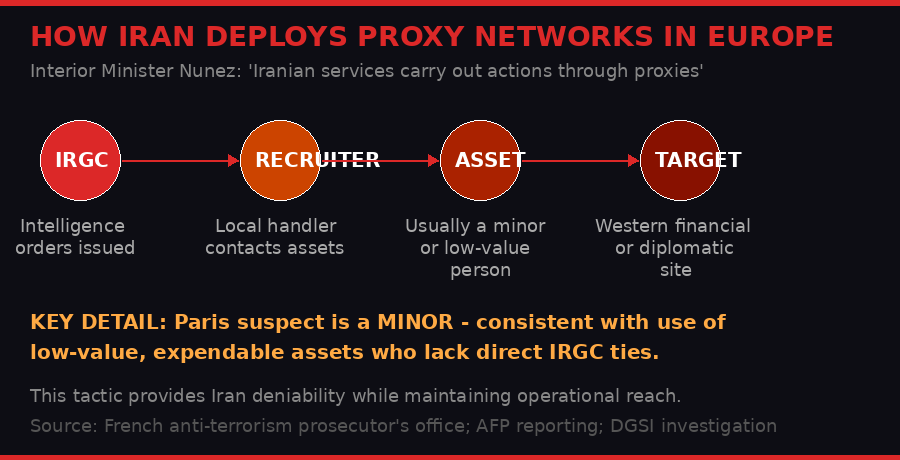
When the US and Israel launched strikes on Iran on February 28, 2026 - the strikes that began the current war - these dormant networks were activated. The objective shifted from surveillance to disruption and intimidation.
The Paris case fits a specific pattern that Western intelligence analysts have been tracking since early March. The primary operative is expendable - young, ideologically motivated or financially desperate, with no direct connection to Iranian government channels. A handler, likely operating via encrypted messaging apps and never meeting the asset in person, provides the device, the target, and the instructions. A second person documents the operation as proof of execution for the handler.
This is not speculation. It is the structure visible in the Paris arrest itself: one man places the device while a second films. The second - the handler's eyes - flees when police arrive, because he is the more important piece of the network. The minor is meant to be caught.
One Month of War: The Expanding Battlefield

Saturday marked exactly one month since the United States and Israel launched strikes on Iran. The Associated Press reports that more than 3,000 people have been killed since the war began. The toll includes at least 13 American service members, over 1,200 in Lebanon, and thousands of Iranian civilians.
More than 300 American troops have been wounded, according to US Central Command. Prince Sultan Air Base in Saudi Arabia alone has been struck multiple times - with Iranian ballistic missiles and Shahed drones destroying at least one E-3 Sentry AWACS aircraft, two KC-135 refuelling tankers, and injuring at least 15 US personnel in Friday's attack alone, according to AP and Air & Space Forces Magazine reporting.
The AWACS destruction is significant by itself. Former USAF Colonel John Venable told the Wall Street Journal the attack "hurts the US ability to see what's happening in the Gulf and maintain situational awareness." Each strike on American command-and-control infrastructure represents a deliberate Iranian calculation that every capability degraded buys time.
Iran has also activated its Houthi allies in Yemen, who are threatening to resume blockades of the Bab el-Mandeb strait. Combined with Iran's chokehold on the Strait of Hormuz - still only partially eased - this would close two of the world's most critical maritime chokepoints simultaneously. The economic implications are catastrophic for global shipping insurance rates, oil prices, and fertilizer supplies.
Iran's power grid is being systematically dismantled by US and Israeli strikes. BBC reporting Sunday confirmed power cuts in Tehran and Alborz provinces after attacks on electricity infrastructure. The Isfahan University of Technology was hit for the second time in a weekend. Iran's IRGC has responded by threatening to treat American and Israeli universities in the region as "legitimate targets" unless the US condemns the strikes by midday Tuesday.
Universities in Qatar and the UAE - including Georgetown, New York University, and Northwestern - have received the warning. American University of Beirut has moved classes online.
Islamabad: The Last Diplomatic Track

Against this backdrop, Pakistan's Foreign Minister Ishaq Dar announced Sunday that Islamabad will host talks between the United States and Iran. The announcement came after a meeting in the Pakistani capital between foreign ministers of Pakistan, Turkey, Egypt, and Saudi Arabia - none of whom represent either of the warring parties.
"Pakistan is very happy that both Iran and the US have expressed their confidence in Pakistan to facilitate the talks. Pakistan will be honored to host and facilitate meaningful talks between the two sides in the coming days." - Ishaq Dar, Pakistani Foreign Minister, March 29, 2026 (AP)
Neither Washington nor Tehran has confirmed participation. The gap between Dar's confident phrasing and the silence from the principal parties is not subtle.
Iran's parliament speaker, Mohammad Bagher Qalibaf, dismissed the Pakistan talks almost simultaneously, calling them a cover operation. He said Iranian forces were "waiting for the arrival of American troops on the ground to set them on fire and punish their regional partners forever," according to Iranian state media.
The US has been signalling a possible limited ground operation targeting Kharg Island and other strategic nodes. Secretary of State Marco Rubio said Friday that the US "can meet its objectives without any ground troops" - but also said Trump "has to be prepared for multiple contingencies." The language of preparation is the language of planning.
Iran, for its part, has released a five-point counter-proposal reportedly calling for: a halt to killing Iranian officials; guarantees against future attacks; reparations; Iran's "exercise of sovereignty over the Strait of Hormuz"; and international recognition of Iran's right to peaceful nuclear development. Washington has not publicly responded. Privately, US officials have described Iran's terms as non-starters.
Pakistan's role as mediator is genuine - Islamabad has relatively functional diplomatic relations with both sides and has already brokered a small practical arrangement, securing Iranian agreement to allow 20 Pakistani-flagged vessels through Hormuz. That incremental trust-building is real. Whether it can scale to a ceasefire while bombs land in Paris and AWACS burn in Saudi Arabia is another matter entirely.
What the Paris Bomb Tells Us About Iran's Strategy

The Paris operation was never expected to succeed in a conventional military sense. Five litres of fuel and an ignition system is not a weapon of mass destruction. It would have started a fire, possibly a serious one, possibly caused injuries. But the operational intent is not destruction - it is cost imposition.
Iran is playing a war of attrition on multiple fronts simultaneously. Militarily, it is eroding US air power in the Gulf - the AWACS loss, the KC-135 damage, the 300+ wounded troops are all real degradations that compound over time. Economically, it is threatening the waterways that move 20 percent of global oil. Politically, it is attempting to fracture the coalition of Western-aligned nations supporting the war by demonstrating that the conflict carries costs at home.
A bomb outside an American bank in Paris does not hurt the US military. But it terrifies French voters, pressures the Elysee Palace, creates domestic political problems for President Macron, and tests the solidarity of European allies who signed up for a Middle East war and are now discovering the war has followed them home.
Four countries in Europe have already seen foiled plots. The Paris attempt broke through. The Interior Minister's public statement was calibrated: acknowledge the threat, name Iran, but hedge with "it is for the investigation to determine." France is not yet prepared to accuse Iran directly in legal terms while also maintaining any residual diplomatic channel.
That calculation may not survive the next attack.
"There are a lot more attacks happening that aren't being reported. This is a way of telling people in other countries that you can still reach out and touch them even though they're on a different continent. That makes them more of an intimidation tactic." - Michael Smith, Field CTO, DigiCert cybersecurity firm (AP)
What Happens Next

The immediate investigative focus is finding the second person who fled the Bank of America scene - the one with the phone. If police identify him, he likely represents a higher tier of the operational network. Whether he can be connected to Iranian intelligence services in a form that survives prosecution is the question that will determine France's official response.
In the short term, expect visible security increases across European capitals at American corporate and governmental targets. The US embassy circuit across Europe - already hardened - will receive additional review. French intelligence is likely sharing information with British MI5, Dutch AIVD, and Norwegian PST on the parallel plots Nunez referenced.
The broader strategic picture is grimmer. Iran has demonstrated that it can activate proxy assets in multiple NATO countries simultaneously. The minor used in the Paris operation represents the bottom of a supply chain that, at its top, has Iranian government direction. Proving that chain legally is enormously difficult. Disrupting it operationally requires sustained intelligence cooperation at a level that European agencies are only beginning to fully mobilize.
Meanwhile, the Pakistan talks remain the only visible diplomatic lifeline. They are meeting again Monday. Both Iran and the US have given signals of engagement that fall well short of commitment. Trump has set April 6 as a deadline for Iran to reopen the Strait of Hormuz - a deadline that, if it passes without result, will produce enormous pressure for escalation.
Iran is placing bets across the board: wear down US airpower in the Gulf, spike energy prices to maximum pain, threaten allies' universities and institutions, plant bombs in European capitals, and simultaneously wave the diplomatic flag in Islamabad. The strategy is to hold out long enough for the economic cost of the war to make continued US military engagement politically untenable in Washington.
Whether that gamble pays off will depend heavily on whether European governments can absorb proxy attacks at home while maintaining unified support for the US campaign - or whether Paris was just the beginning of a pressure campaign that fractures the alliance before a deal is reached.
A bomb near the Champs-Elysees is a message. Tehran wrote it. The world is reading it.
Europe's Security Services: Years of Warning, Now a Reckoning

Europe's counterterrorism agencies have been tracking Iranian proxy activity on the continent with particular urgency since the 2022 nuclear talks collapsed. In 2023, German prosecutors indicted four people on charges of plotting to attack Israeli interests on behalf of Iran. In Denmark, the domestic intelligence service PET warned of Iranian assassination plots targeting dissidents. In the UK, MI5 director-general Ken McCallum stated publicly in 2022 that Iran had been responsible for at least 10 plots on British soil - attempts to kill or kidnap individuals, including journalists and activists.
But these were, until now, operations targeting Iranian opposition figures or Israeli interests. The Paris attack marks a significant shift: a suspected Iranian proxy operation targeting an American financial institution in a major Western capital. The target selection has moved from regime enemies to US economic symbols. That is an escalation in ambition that Europe's security services will have been watching for but hoping not to see.
Nunez's reference to foiled plots in the Netherlands, UK, and Norway suggests a coordinated multi-country activation around the same window of time. Intelligence services do not typically share that kind of cross-border pattern publicly unless they are trying to pressure governments to take collective action - or to prepare public opinion for more information to come.
The DGSI, France's domestic intelligence service, is known to have one of Europe's more aggressive penetration operations against Iranian intelligence networks. If they have any asset visibility into the Paris cell, the investigation will move quickly. If they do not, the minor suspect becomes the sole thread - and minors in terrorism cases present specific legal constraints on interrogation duration and methods under French and European law.
The French government is walking a tightrope. It wants to condemn the attack without formally attributing it to Iran in a way that would require a proportional diplomatic response - which could jeopardize any residual French trade ties and consular arrangements with Tehran, and complicate Paris's status as a potential neutral venue for future negotiations. The phrase "significant suspicion" is carefully chosen. It is not an accusation. It is a warning shot designed to be heard in Tehran without formally closing diplomatic doors.
The Economics of Fear: What Proxy Terror Costs Europe

Beyond the immediate security response, the Paris attack carries a second-order economic cost that Iran understands perfectly. Every American bank, law firm, technology company, and government office in Europe now faces pressure to reassess its physical security posture. That means contracts with security firms, architectural assessments of building access points, revised insurance policies, and heightened personnel costs - all flowing from a device that contained five litres of fuel and reportedly cost almost nothing to construct.
The asymmetry is the point. Iran cannot match American military spending. It can impose costs on American economic presence in Europe through relatively cheap proxy operations that force a massively more expensive defensive response. Security consultants across London, Paris, Berlin, Brussels, and Amsterdam will be busy this week. Their clients will be paying the bill. That bill, in aggregate, is not trivial.
European governments also face the political cost of managing public anxiety. France held elections last year in which security and immigration were dominant issues. An Iranian-linked bombing attempt in the 8th arrondissement - a wealthy, high-profile district - will amplify those anxieties and create pressure on the government to be seen taking action, potentially including expulsion of Iranian diplomatic staff or other measures that would further escalate the bilateral relationship.
Iran may be calculating that this domestic political pressure in France and other European nations eventually transmits into pressure on Washington - European allies asking, privately, whether the benefits of the Iran campaign justify the costs being exported to their capitals. That is a long-odds bet, but it is not an irrational one. Coalition fractures have ended American military campaigns before.
BLACKWIRE Monitor - Key Watches
- Identity of second suspect (fled scene with phone): Critical to establishing the handler tier of the network.
- April 6 Hormuz deadline: Trump's stated red line. Watch for US military movement in the Strait.
- Islamabad talks (Monday): Whether US or Iran sends a senior official will signal seriousness.
- European alliance solidarity: Any France-US diplomatic friction over this incident is an Iranian win.
- IRGC university threat: US must respond by midday Tuesday or face threatened strikes on Georgetown, NYU, Northwestern campuses in Gulf.
Get BLACKWIRE reports first.
Breaking news, investigations, and analysis - straight to your phone.
Join @blackwirenews on TelegramSources: BBC News (March 29, 2026); AFP newswire via BBC; French Interior Ministry statement (Laurent Nunez, March 29); France anti-terrorism prosecutor's office (PNAT) statement; Associated Press - "Pakistan says it will host US-Iran talks" (March 29); AP - "Iranian attack on Saudi base injures American troops" (March 29); Al Jazeera - "Iran 'hits' US AWACS, air tankers" (March 29); Air & Space Forces Magazine - "Key E-3 AWACS aircraft damaged" (March 28); AP - "Iran conflict shows how digital fight is ingrained in warfare" (March 29); BBC Live blog - Iran war March 29, 2026.