Iran Strikes US Troops at Saudi Air Base: The War Crosses a Line
Iran fired a missile at a Saudi air base housing American troops on Day 28 of the US-Israel bombing campaign. Several US service members were wounded. Aircraft were destroyed. This is no longer a war fought only on Iranian soil.
The strike - confirmed by an American defense official speaking to the Associated Press on condition of anonymity - marks the first time Iran has directly targeted US military personnel stationed on a partner nation's territory since the conflict began February 28. The Pentagon is assessing. The White House has not yet commented publicly. But every military planner in Washington, Riyadh, and Tel Aviv is now calculating what comes next.
On the same day, Israel struck two of Iran's nuclear facilities - the Yazd uranium yellowcake plant and the Arak heavy water complex. Tehran responded with what state media called a "calculated response." What the world is watching is not a response. It is an escalation with no visible ceiling.
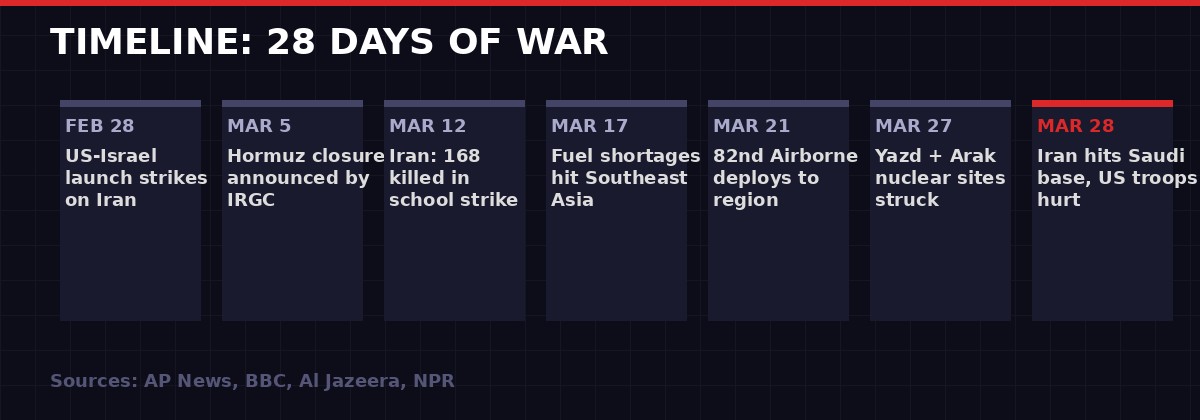
The Strike: What We Know
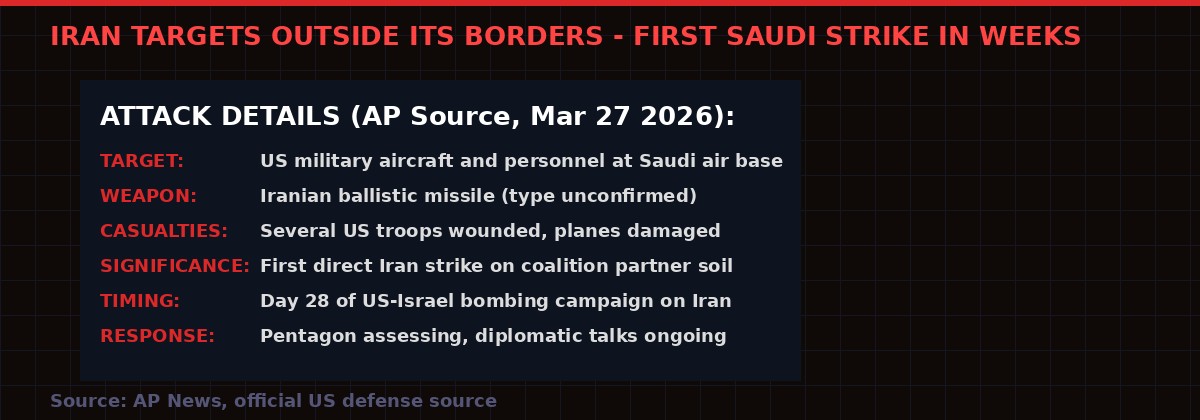
An Iranian missile struck a Saudi air base where American military aircraft and personnel were stationed, according to an AP source with direct knowledge of the situation. Several US troops were wounded. Planes were damaged. The precise Saudi facility has not been named in early reports - a deliberate choice by US officials managing the disclosure.
The attack came hours after what had appeared to be the most intense single day of strikes on Iranian territory since the campaign began. Israel confirmed hitting the Yazd uranium yellowcake processing facility and the Arak heavy water reactor complex on March 27. Iranian state television acknowledged the strikes and vowed Tehran would extract a "heavy price."
What followed - the Saudi base attack - is the price. Whether it is the full price is the question every intelligence analyst is now being asked.
"Iranian strike wounds US troops and damages planes at Saudi air base." - AP News, March 27, 2026
Saudi Arabia has publicly maintained a delicate neutrality throughout this conflict - allowing US forces to operate from its territory, permitting Israeli overflights in some corridors, but avoiding any formal declaration of alliance with the US-Israel campaign. That neutrality was never invisible to Tehran. Iran has now struck through it.
The IRGC - Iran's Revolutionary Guards - have not formally claimed the attack at the time of writing. This pattern matches their behavior in previous ambiguous strikes. When they want deniability, they are silent. When they want to signal, they speak. Silence here may be the most precise signal of all: we hit you, we know you know it was us, and we will decide whether to say so based on what happens next.
CONFIRMED DEVELOPMENTS - MARCH 27-28, 2026
- Iranian missile strikes Saudi air base housing US forces - AP
- Several US troops wounded, aircraft destroyed
- Israel strikes Yazd yellowcake uranium plant - Al Jazeera
- Israel strikes Arak heavy water complex - Al Jazeera
- Iran: "We will extract a heavy price" - Iranian state TV
- Trump extends energy facility strike deadline 10 days
- Rubio: War to end "in weeks, not months" - BBC
- 82nd Airborne + thousands more US troops moving to region - NPR
Nuclear Sites Struck: What Yazd and Arak Mean
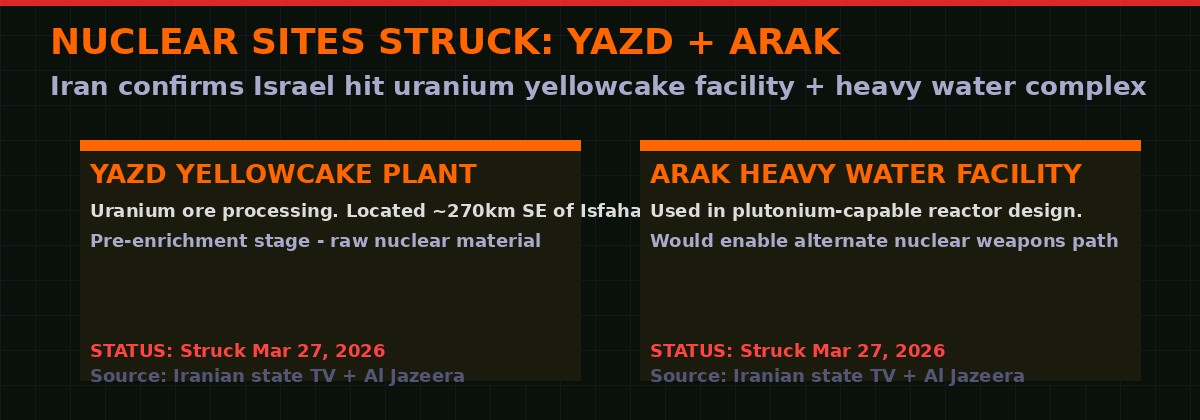
To understand why Iran responded with a direct attack on American personnel, you need to understand what was destroyed on March 27.
The Yazd yellowcake facility is where Iran processes uranium ore into a powder form - uranium oxide - that becomes the feedstock for enrichment. Destroying it does not stop a nuclear program overnight, but it severs a key node in the supply chain. Rebuilding the capability takes years, not months, and requires equipment that is now subject to unprecedented international sanctions and export controls.
The Arak heavy water complex is a more alarming target to Iran's strategic planners. Heavy water reactors can produce plutonium as a byproduct - an alternate path to nuclear weapons distinct from the uranium enrichment route. The site has been subject to previous international inspections and restrictions under the 2015 Joint Comprehensive Plan of Action, which the US withdrew from in 2018. Its destruction is not just a tactical setback. It is the elimination of Iran's alternative nuclear deterrent pathway.
Iranian state media acknowledged both strikes and said the attacks "contradict the US push for diplomacy." The UN human rights chief Volker Turk called for an investigation into the school strike from earlier in the conflict - which killed at least 168 people, mostly children - saying it "evoked visceral horror." The nuclear facility strikes have not yet drawn a formal UN response.
"Iran says Israel attacked Yazd yellowcake, Arak heavy water facilities. Says attacks contradict US push for diplomacy." - Al Jazeera, March 27, 2026
Iran's parliamentary leaders had already been circulating legislation to formalize the "toll booth" regime on the Strait of Hormuz - charging fees to any ship attempting to transit the 33-kilometer chokepoint. The Israeli nuclear strikes appear to have accelerated the internal Iranian decision to hit back outside its own borders, directly at American forces.
The logic from Tehran is transparent: if you destroy our long-term deterrence capacity, we will remind you that we still have the capacity to hurt you right now.
The Strait of Hormuz: Global Chokepoint, Global Crisis
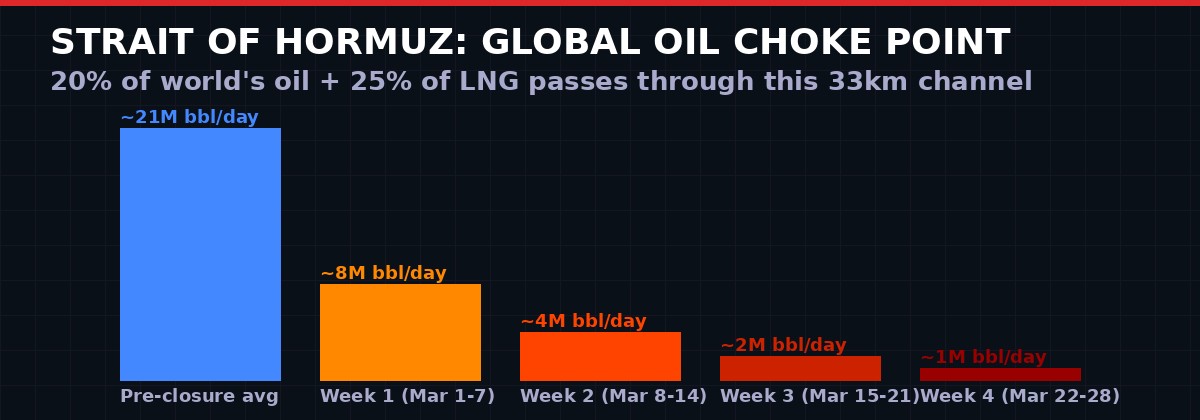
The Strait of Hormuz is 33 kilometers wide at its narrowest point. Through that narrow passage flows roughly 20 percent of the world's traded oil and 25 percent of its liquefied natural gas. Before February 28, approximately 21 million barrels of oil passed through it every day.
Iran formally closed the strait on approximately Day 5 of the conflict. Four weeks later, the effects are cascading across the global economy with increasing severity. Southeast Asia - which is almost entirely dependent on imported fossil fuels - has been hit hardest. Fuel queues in Thailand's Chiang Rai province stretch for blocks. The Philippines held protests outside the presidential palace on March 27, as transport workers demanded the government act on surging diesel prices.
Australia, which imports a significant share of its refined fuel from refineries fed by Gulf crude, has seen panic buying despite official assurances of "secure" supply. Prime Minister Anthony Albanese publicly urged Australians not to hoard fuel on March 26.
Secretary of State Marco Rubio told reporters on March 27 that he had been in contact with US allies about helping escort commercial ships through the strait. The problem is operational: any escort mission requires overpowering the IRGC's coastal defense infrastructure, which includes anti-ship missile batteries, fast attack boats, mines, and drone swarms. The US Navy's Fifth Fleet has the capability. Whether using it escalates the conflict beyond current bounds is the political question keeping National Security Council staff awake.
"Iran starts to formalize its chokehold on the Strait of Hormuz with a 'toll booth' regime." - AP News, March 27, 2026
The Iranian parliament's toll booth legislation - passed in preliminary form according to Iranian state media - would require any commercial vessel transiting the strait to pay a fee to the IRGC. The amount has not been specified. Legal experts note the move violates multiple UN conventions on freedom of navigation. Iran's response to that objection is straightforward: they do not currently recognize the legitimacy of the international legal framework being used to justify the bombing of their country.
The Escalation Ladder: Where the War Stands
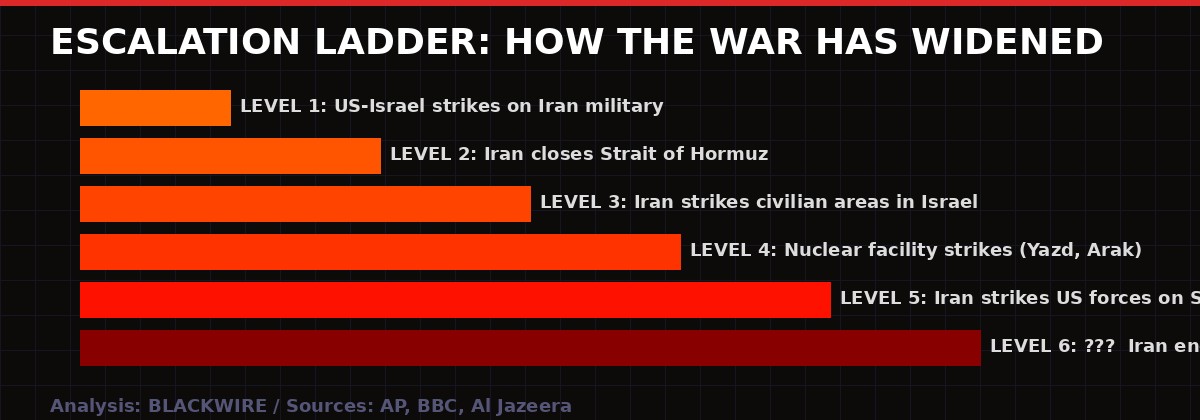
When this conflict began four weeks ago, the stated American objective was to degrade Iran's military capacity to a point where Tehran would agree to permanently abandon its nuclear program and open the Strait of Hormuz to international shipping. The strikes were intended to be swift, targeted, and coercive.
Four weeks in, the Strait remains closed. Iran's nuclear sites are being destroyed piece by piece, but the program has not been formally abandoned. And now Iran has successfully hit American troops on a partner's soil - a strike that carries both military and political significance.
Al Jazeera's analysis team published a 15-point peace proposal framework reportedly circulated by US negotiators. The framework includes: a ceasefire on all aerial strikes, a phased reopening of the Strait, a suspension of Iran's nuclear enrichment program under international monitoring, and a lifting of economic sanctions in stages. Tehran's public response has been to reject it while privately engaging through Oman and Pakistan as back-channel brokers.
The disconnect is familiar to anyone who has followed Middle East diplomacy. Public rejection and private engagement are not mutually exclusive. They are often the same thing. Iran needs to show its domestic audience that it has not capitulated. The US needs to show its domestic audience that diplomacy is working. Both needs can be served by the same ambiguous process.
The risk is that military action on the ground overtakes the diplomatic track. The Saudi base strike is the kind of event that can do that. US service members have been wounded. American aircraft have been destroyed. There will be political pressure on the White House - from Congress, from the Pentagon, from US allies - to respond with force.
"The Pentagon is sending thousands of U.S. troops to the Middle East. Is this an escalation or a warning?" - NPR, March 26, 2026
The Saudi Dimension: A Neutrality Pierced
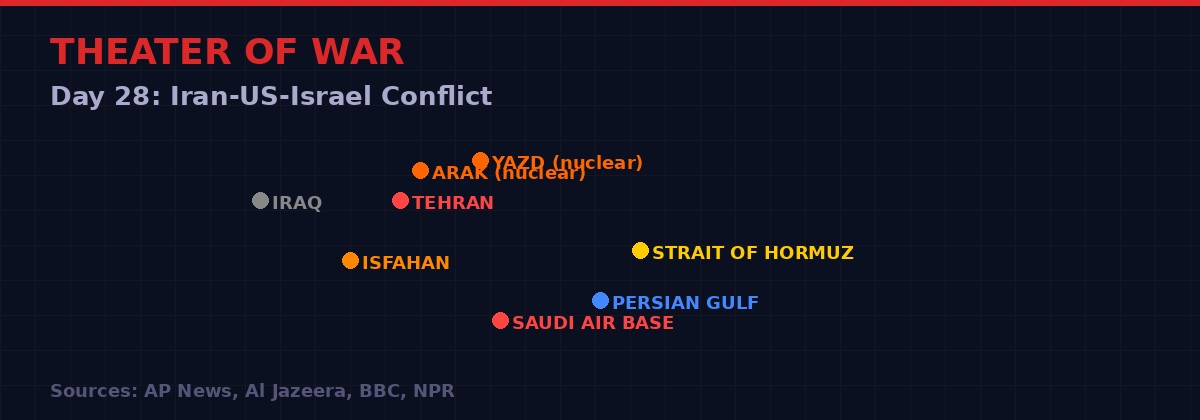
Saudi Arabia's position in this conflict has been the most diplomatically precarious of any Gulf state. It has historic and religious grievances with Iran that run deep - the two countries have functioned as the twin poles of Sunni and Shia regional power for decades. But the Saudi leadership under Mohammed bin Salman has also spent the last several years threading a careful path, including a landmark 2023 normalization agreement with Iran brokered by China.
That normalization was already under severe strain before February 28. It is now, arguably, broken. Iran has struck a Saudi facility hosting American forces. Regardless of Riyadh's public posture, that is an attack on Saudi sovereignty and on the principle that Saudi Arabia can remain neutral when the US operates from its soil.
The Saudis have not commented publicly as of the time of filing. This restraint is itself significant. A year ago, a strike on Saudi territory by Iran would have prompted immediate public outcry from Riyadh. The silence suggests either that the Saudis are processing through back-channels, or that they are genuinely uncertain how to respond without triggering full Saudi involvement in an already complex conflict.
The UAE has also said nothing publicly. Bahrain - which hosts the US Navy's Fifth Fleet - has been watching closely. All three Gulf Cooperation Council states are aware that their hosting of US forces makes them potential targets. The question they are all calculating is whether hosting becomes more or less dangerous as the conflict continues.
Pakistan's role as a back-channel between Washington and Tehran has been reported by multiple outlets. Islamabad has experience with this: it served as an intermediary between the US and China during the Nixon era, and has historically maintained working relationships with both Iran and the US. How much weight Pakistan carries in the current negotiations is unclear. But the fact that it is being used at all suggests neither side has fully foreclosed the diplomatic option.
Diplomacy vs. the Clock: Can Rubio End It?
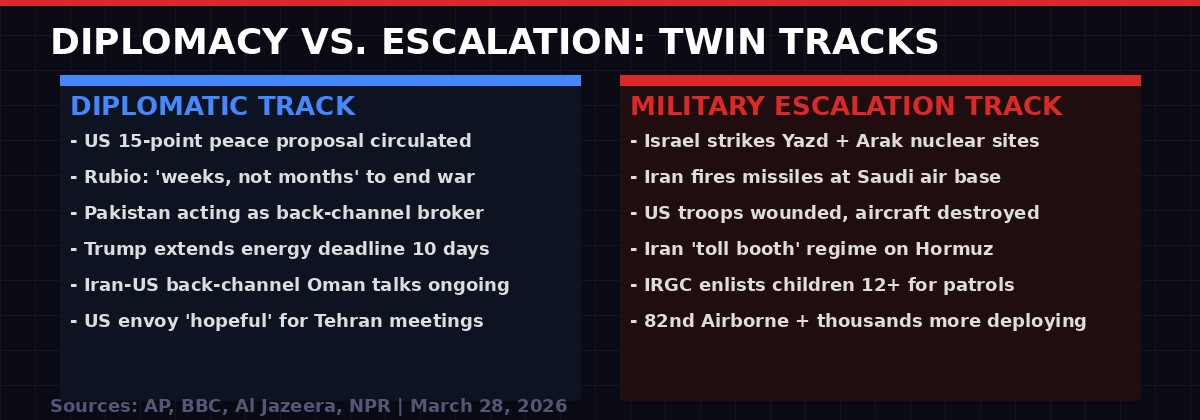
Secretary of State Marco Rubio made a striking claim on March 27: he expects the war to be over "in weeks, not months." The statement was made to reporters traveling with him and was quickly amplified across wire services. It carries real weight - Rubio has been the lead US diplomat in this crisis, and statements this specific about timelines are not made carelessly by Secretaries of State.
The context matters. Trump had extended his deadline for Iran to reopen the Strait of Hormuz by 10 days, citing "progress in talks." Rubio's comment reinforces that framing. The diplomatic strategy appears to be: maintain military pressure, hold the threat of striking Iran's energy infrastructure (oil refineries, natural gas terminals), but give the diplomatic track just enough space to function.
Trump told reporters on March 27 that Iran is "begging for a deal." Iranian officials publicly rejected the characterization. But multiple reporting threads - from the BBC's James Landale, from Al Jazeera's diplomatic correspondents, from NPR's national security desk - suggest the Oman and Pakistan back-channels are active and substantive.
"The US president's commitment to deadlines is fluid but he uses them for a purpose. Is Trump's pause on attacking Iranian energy for diplomacy or an escalation?" - BBC, James Landale, March 27, 2026
The civilian cost inside Iran has been mounting in ways that are beginning to generate significant international attention. A BBC report published March 27 - based on interviews inside Tehran - documents the daily reality of residents living under strikes: the neighborhoods near weapons factories reduced to rubble, families displaced, a civilian toll that the Iranian government describes as deliberate targeting and the US and Israel describe as unavoidable collateral damage in a campaign against military infrastructure.
The UN human rights chief has called for a probe into the school strike. Iran's football team wore black armbands and held school bags in a vigil before their national anthem before a match against Nigeria. These are the images that travel - that shift international opinion, that create political pressure on US allies in Europe to push for faster diplomacy.
Whether that pressure translates into leverage before the next major escalation is the central uncertainty of the next 72 hours.
What Happens Next: The Six Scenarios
Military analysts tracking the conflict have outlined a range of scenarios following the Saudi base strike. They run from rapid de-escalation to a direct regional war involving multiple state actors. Here is where each stands:
Scenario 1 - Back-channel hold: The Oman or Pakistan channel produces a public-facing ceasefire framework within 48-72 hours. Both sides freeze new strikes while talks continue. This requires both Washington and Tehran to absorb the current escalation without retaliating. Probability: possible but requires unusual political restraint from both sides.
Scenario 2 - US retaliatory strike on Iran: The Pentagon identifies the missile battery responsible for the Saudi base attack and conducts a targeted strike. Iran retaliates. The cycle continues but stays contained to specific military assets. This is the most likely near-term path if diplomacy stalls for more than 48 hours.
Scenario 3 - Saudi formal involvement: Riyadh condemns the attack and grants US forces expanded operational authority from Saudi soil. This significantly widens the war's geographic and political scope and may bring other GCC states into formal coalition positions.
Scenario 4 - Iran strikes energy infrastructure: Tehran - having already signaled capability and intent - strikes Saudi, UAE, or Iraqi oil infrastructure. Global oil prices spike past $180/barrel. The economic pressure on the entire global economy becomes acute within days.
Scenario 5 - Iran Hormuz live fire: Iranian forces fire on a US or coalition naval vessel attempting to transit or escort through the strait. A direct US-Iran naval exchange with potential for rapid escalation. The Fifth Fleet's posture makes this scenario one that both sides are actively trying to manage around.
Scenario 6 - Rapid deal: Trump announces a deal, Iran announces a deal. The Strait reopens on a phased schedule. Nuclear inspections resume under a modified framework. Everyone declares some form of victory. This scenario requires Iran to publicly accept terms that its government has rejected for weeks - and requires the US to offer terms that do not constitute total Iranian capitulation. Difficult but not impossible.
The honest assessment, based on 28 days of pattern, is that the war is not ending next week. The diplomatic signals are real but so are the military escalations. The Saudi base strike is a pressure move - Iran signaling that it can impose direct costs on the American military outside Iran's borders. It is also a data point about Iranian capabilities and willingness that the US intelligence community did not have before last night.
REGIONAL RIPPLE EFFECTS - CONFIRMED AS OF MARCH 28
- Philippines: Fuel protests at Malacanang palace, March 27 (AP)
- Australia: Panic buying, PM Albanese urges calm (BBC)
- Southeast Asia: Near total dependence on Hormuz-routed oil (NPR)
- Lebanon: 400,000+ displaced under Israeli bombardment (UNHCR / Al Jazeera)
- Wall Street: 5th straight losing week, worst since conflict began (AP)
- Artemis II: Moon mission crew arrives at Florida launch site (AP)
The Human Cost: Inside the War's Fourth Week
Four weeks of this war have produced casualties that are difficult to fully account for, in part because Iran's government is restricting independent media access to strike sites, and in part because the conflict is happening across multiple theaters simultaneously.
Inside Iran, residents of Tehran and other cities are living under a combination of strikes and a government mobilization that has, according to Al Jazeera's reporting, extended to recruiting children over 12 for armed civilian patrols and checkpoints in some neighborhoods. That detail - confirmed by a senior IRGC official speaking to Iranian state television on March 27 - illustrates how total the mobilization has become. This is not a government managing a limited military setback. This is a government preparing its population for sustained conflict.
NPR's State of the World program aired accounts from four perspectives: an Iranian family in Tehran watching their neighborhood be struck, an Israeli family in Tel Aviv managing the reverse threat of Iranian missile strikes, a family in the Gulf states who had considered Dubai a safe haven and now find themselves proximate to active warfare, and Lebanese citizens in the south who are experiencing the renewed intensity of Israeli airstrikes.
Lebanon has been pulled back into the conflict's orbit. Israel's ground campaign, which had entered a new phase on March 27 according to BLACKWIRE's earlier reporting, continues to generate displacement in the south. The UN Refugee Agency reported that Lebanese families are "living in constant fear." At least 400,000 people remain displaced from their homes.
The fertilizer crisis - a secondary effect of the Hormuz closure reported earlier by BLACKWIRE - is beginning to translate into real-world food security concerns as the planting season arrives in the northern hemisphere. Iran produces approximately 14 percent of the world's urea fertilizer. With its ports closed and export infrastructure struck or threatened, that supply has effectively vanished from global markets. The downstream effects on wheat, corn, and rice production will not be visible until harvest season - but agricultural economists are already sounding the alarm.
Israel's Defense Minister vowed on March 26 to "intensify strikes against Iran." Iran's Ambassador to the UN accused the US and Israel of "deliberately targeting civilians." Both statements were made on the same day. Both are products of the same war, which has now entered a phase where escalation is happening faster than diplomacy can contain it.
The Saudi base strike is not a turning point yet. But it is the clearest signal so far that Iran is willing to widen the theater and accept the risks that come with hitting American forces directly. What the US does in the next 24 to 48 hours will define whether this was a costly Iranian miscalculation - or a successful Iranian pressure campaign that forces new terms at the negotiating table.
The world is watching. The Strait remains closed. And on a Saudi air base, American service members are receiving medical treatment for wounds inflicted by Iranian missiles.
Get BLACKWIRE reports first.
Breaking news, investigations, and analysis - straight to your phone.
Join @blackwirenews on Telegram