Iran Hits Bahrain, Saudi Arabia, UAE, and Tel Aviv in One Day as Lebanon Expels Tehran's Ambassador
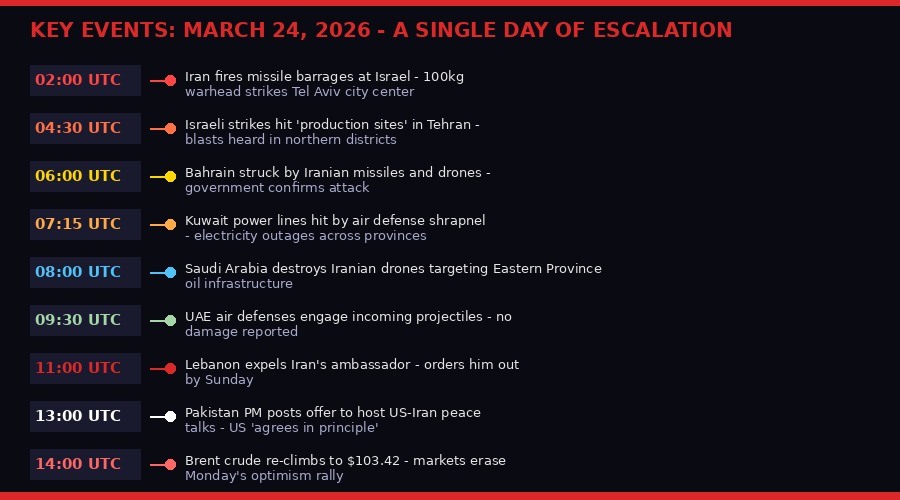
On the 30th day of the US-Iran war, a single Tuesday rewrote the map of the conflict: Iran fired missiles and drones at four countries simultaneously, a 100-kilogram warhead slammed into Tel Aviv's city center, Lebanon kicked out Iran's ambassador, and Brent crude climbed back above $103 a barrel - erasing in hours the "deal optimism" that had briefly moved markets the day before.

The scale of Tuesday's attack was unlike anything the region had seen in a single calendar day. Iran did not pick one target. It picked every target it could reach simultaneously - a coordinated doctrine shift that signals Tehran has moved past deterrence and into sustained multi-front attrition, whether or not anyone is talking about peace.
Pakistan's Prime Minister Shehbaz Sharif offered to host negotiations. Three Pakistani officials and a Gulf diplomat told the Associated Press that Washington had agreed "in principle" to participate. Iran's parliament speaker called the whole idea "fakenews." And the missiles kept flying.
Tel Aviv Takes a Direct Hit

The missile that hit Tel Aviv carried a 100-kilogram warhead - 220 pounds of explosive payload that detonated in a street in the city center, blowing out windows across an apartment building and sending smoke columns visible across the city.
Four people suffered minor wounds, according to rescue worker Yoel Moshe of the Israeli rescue service. The casualty count was low partly by luck and partly because Israeli civil defense infrastructure has had four weeks to drill evacuation procedures.
"It feels like you're a sitting duck, waiting for the missiles to hit you, or someone next to you."
- Amir Hasid, emerging from an air raid shelter in Tel Aviv, quoted by AP News
Iran fired multiple waves of missiles at Israel on Tuesday. Not one barrage. Multiple. The distinction matters: multiple waves suggest Iran is conserving some launches for follow-up salvos when Israeli air defenses are reloading, a tactical evolution from the early days of the war when Iran tended to send large single-wave attacks.
Israel, meanwhile, carried out what it described as "an extensive series of strikes" on Iranian "production sites" - deliberately vague language that the Israeli Defense Forces have used throughout the conflict to avoid triggering disclosure rules. In Tehran, a massive explosion was heard in northern neighborhoods and another in the city center, according to AP News correspondents on the ground. Both detonations were attributed to Israeli strikes.
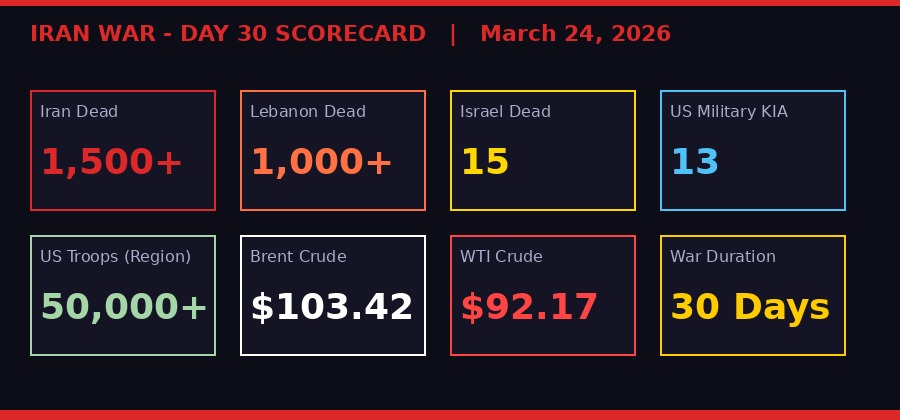
Israel has now killed more than 1,500 Iranians, according to Iran's Health Ministry. In Israel, 15 people have died since the war began on February 28. That casualty asymmetry reflects geography and missile defense capability, not military effort - Israel's Iron Dome and David's Sling systems have been running at maximum operational tempo for thirty consecutive days.
The Gulf-Wide Barrage: Bahrain, Kuwait, UAE, Saudi Arabia

What made March 24 different from previous days of the war was geographic scope. Iran did not target one Gulf neighbor. It targeted all of them - on the same day, in what appears to be a coordinated multi-front saturation strategy designed to overwhelm regional air defense capacity and stretch US Central Command's response envelope.
In Bahrain, the government confirmed it was attacked by missiles and drones. Bahrain hosts the US Navy's 5th Fleet headquarters at Naval Support Activity Bahrain - one of the most significant American military installations in the Persian Gulf. The fact that Iran struck Bahrain again on day 30, after multiple previous attacks, indicates Tehran has made a deliberate decision to target the 5th Fleet's home base as a sustained pressure campaign, not a one-off escalation.
Kuwait suffered a different kind of hit: power lines struck by shrapnel from Kuwait's own air defense systems, which intercepted incoming Iranian projectiles above populated areas. Partial electricity outages spread across several provinces for several hours before being restored. It is a reminder that even successful air defense has costs - debris from interceptor missiles raining down on cities below.
The United Arab Emirates reported that its air defense systems "responded to similar attacks," the official government phrasing for an engagement that stopped incoming missiles or drones before damage occurred. No casualties were reported in the UAE. But the psychological effect of regular missile attacks reaching toward Abu Dhabi and Dubai - among the world's most economically significant cities - is already being priced into regional investment decisions.
Saudi Arabia reported destroying Iranian drones targeting its oil-rich Eastern Province. The Eastern Province is not a random target. It is where Saudi Aramco's Abqaiq processing facility is located - the world's largest crude oil processing plant, handling roughly 7% of global oil supply. A successful strike on Abqaiq would not just hurt Saudi Arabia; it would send oil prices to levels not seen since the 1970s shock. Iran knows this. That is why it keeps trying.
Gulf Strikes Summary - March 24, 2026
- Bahrain: Struck by Iranian missiles and drones. Government confirms attack. US 5th Fleet HQ nearby.
- Kuwait: Power lines hit by air defense shrapnel after intercepts. Partial outages for several hours.
- UAE: Air defense systems "responded" to incoming projectiles. No damage or casualties reported.
- Saudi Arabia: Iranian drones destroyed before reaching Eastern Province oil infrastructure. Abqaiq targeted.
- Israel: Multiple missile waves. 100kg warhead hits Tel Aviv city center. 4 minor injuries.
- Lebanon: Israeli strikes kill 8+ people including 3-year-old girl in Beirut suburb. Pounding continues.
Lebanon Expels Iran's Ambassador - A Seismic Diplomatic Break

The most politically significant development of March 24 was not a missile strike. It was a declaration by Lebanon that Iran's ambassador was persona non grata and must leave the country by Sunday.
For context: Lebanon has been Tehran's most important Arab proxy relationship for decades. Hezbollah, Iran's most powerful non-state military partner, has operated out of Lebanon since the 1980s. Iran has funded, armed, trained, and politically supported Lebanese Hezbollah to the point where the group has functionally co-governed Lebanon alongside - and often above - the Lebanese state. Expelling Iran's ambassador is not a routine diplomatic gesture. It is Lebanon's government signaling, loudly and publicly, that it no longer accepts the terms of that arrangement.
The expulsion came alongside other signals of rupture. Iran has been banned from landing flights in Lebanon since the war began, out of explicit fear that Iranian aircraft are being used to transport weapons or cash to Hezbollah. Lebanese government officials have criticized Tehran directly - accusing it of dragging Lebanon into another war with Israel without Lebanon's consent and against Lebanon's interests.
The numbers explain the anger. Israeli strikes have killed more than 1,000 people in Lebanon and displaced more than one million, according to AP News. Lebanon is a country of approximately 5 million people. One million displaced is a catastrophe at a national scale. And a significant portion of the Lebanese population - particularly in communities outside Hezbollah's core Shia base - blames Iran for creating the conditions that brought this destruction.
The Lebanese state's ability to actually enforce the expulsion order, and to maintain that posture against Hezbollah's opposition, remains an open question. But the declaration itself is remarkable. It would have been unthinkable in any previous Israeli-Lebanese conflict. It reflects a fundamental shift in how Lebanon's government - and much of Lebanon's public - views Iran's role in their country.
Authorities say Israeli strikes have killed more than 1,000 people in Lebanon and displaced more than 1 million.
- Associated Press, March 24, 2026
The Diplomacy That Isn't: Trump's Claims vs. Tehran's Denials

On Monday morning, President Donald Trump posted on social media before markets opened, claiming the United States was in productive talks with Iran and delaying his threat to bomb Iranian power plants by five days. Markets responded immediately: oil dropped, stocks jumped.
Within two hours, Iran's parliament speaker Mohammad Bagher Qalibaf posted on X: "No negotiations have been held with the US. And fakenews is used to manipulate the financial and oil markets and escape the quagmire in which the US and Israel are trapped."
The Iranian Foreign Ministry backed him up, calling Trump's statement an effort "to reduce energy prices and to buy time for implementing his military plans."
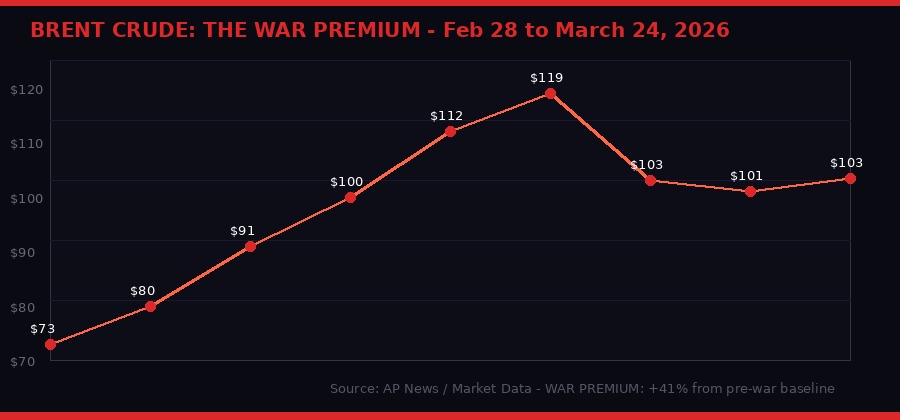
By Tuesday, markets had agreed with Iran. Brent crude climbed back above $103 a barrel, up 3.5% on the day. The S&P 500 fell 0.4%. The Dow was down more than 350 points. Monday's optimism had a shelf life of roughly 18 hours.
Trump's envoys - son-in-law Jared Kushner and special envoy Steve Witkoff - were reported to have spoken with unnamed Iranian officials over the weekend. Trump refused to name who those Iranian officials were. He said the US had not spoken with Supreme Leader Ayatollah Mojtaba Khamenei. Iran denied any such talks happened at a level that counted.
Pakistan's Prime Minister Shehbaz Sharif then posted publicly that his country was "ready to facilitate meaningful and conclusive talks." Three Pakistani officials told AP News the US had agreed "in principle" - but that the quiet diplomacy had been complicated by the news leaking. Iran was still not confirmed as a participant.
The structure of the situation: the US claims talks are happening, Iran denies it, a third country offers to host talks Iran hasn't agreed to, and both sides continue launching airstrikes while the diplomatic language is circulated.
The Marines Are Coming - And That Changes the Math

Whatever is happening diplomatically, the military clock is running independently. The United States has already redirected amphibious assault ships from the Pacific to the Middle East, carrying roughly 2,500 Marines. A second deployment of another 2,500 was announced last week. These forces join more than 50,000 US troops already in the region.
Amphibious Marines are not defensive forces. They are designed to conduct ship-to-shore assaults - to land on beaches under fire and seize territory. Their deployment raises a specific question that military analysts have been discussing since the war began: is the United States preparing to take Kharg Island?
Kharg Island, sitting 33 kilometers off Iran's coast in the Persian Gulf, handles nearly all of Iran's oil exports. The US bombed it on March 21, destroying military assets while, according to satellite imagery reviewed by TankerTrackers, leaving the oil infrastructure intact. Senator Lindsey Graham, a Trump ally, posted that "he who controls Kharg Island controls the destiny of this war."
JPMorgan's global commodity research team warned in a recent note that seizing Kharg Island would "immediately halt the bulk of Iran's crude exports, likely triggering severe retaliation in the Strait of Hormuz or against regional energy infrastructure." That retaliation threat - including Iran mining the Gulf if troops appear to be landing - is the reason the US has not yet moved forces onto the island.
The Soufan Center, a New York-based security think tank, offered two interpretations of Trump's five-day pause in the power plant threat: it could be a genuine search for an exit from the war, or it could be buying time for the Marines to arrive at a position close enough to Kharg to threaten a landing. Both explanations are consistent with the observable facts.
"We are witnessing how a conflict that began over politics and security is moving to be defined by energy and economics. It's hard to ignore the logic inherent in the president's own commentary, which both calms markets but also buys time for Marines to arrive."
- Behnam Ben Taleblu, Senior Director, Foundation for Defense of Democracies, quoted by AP News
Iran has responded with its own warning: it has threatened to mine the Strait of Hormuz if it appears the US is about to land troops. Mining the Strait - the world's most critical oil chokepoint, through which 20% of all traded crude passed before the war - would transform an already severe global supply disruption into a potential economic catastrophe.
The Nuclear Equation: 970 Pounds of Enriched Uranium Underground

Trump's stated war objectives have always included nuclear elimination: preventing Iran from ever acquiring nuclear weapons, degrading its missile capability, destroying its defense industrial base, and reopening the Strait of Hormuz.
Analysts point out that even if Trump declared victory tomorrow, he would be walking away from several of those objectives unfinished. The nuclear question is the hardest to paper over.
Iran has already performed 99% of the centrifuge work required to produce weapons-grade uranium for nine nuclear weapons, according to Princeton University arms control researcher Robert Goldston. As of June 2025, the International Atomic Energy Agency estimated Iran held approximately 440.9 kilograms - 972 pounds - of highly enriched uranium. Much of that material sits buried beneath rubble at three key Iranian nuclear sites badly damaged by a US strike last June during the earlier 12-day Israel-Iran war.
The enriched uranium did not disappear when the buildings above it were destroyed. It is still there. And retrieving or securing it requires either Iranian cooperation - which Iran has refused to offer - or a US ground operation inside Iranian territory to extract it.
Trump said on Monday that if a deal were reached, the US would "take" Iran's enriched uranium. He offered no mechanism. "We'll take it ourselves," he said, without elaborating. No analyst or former diplomat interviewed by AP News could identify a realistic scenario in which the US extracts nearly a ton of enriched uranium from buried Iranian facilities without Iranian cooperation and without a military ground presence inside Iran.
"Trump's war choice has not accomplished his military goals. Iran is still able to attack Gulf allies and effectively control the Strait of Hormuz. No nukes; no enrichment - good luck with that. A singularly incompetent use of America's power."
- Aaron David Miller, former State Department Mideast negotiator, now Senior Fellow at Carnegie Endowment for International Peace, posted on X
The nuclear gap is the central reason a ceasefire at this moment would be diplomatically and politically explosive in Washington. Democrats are already accusing Trump of "needlessly shaking the global economy." If Trump ends the war with Iran's nuclear program intact and its enriched uranium still underground, Republicans who have publicly supported the war - and who have tied their credibility to achieving denuclearization - would face an uncomfortable reckoning.
The Beirut Front: Israel Keeps Hitting Lebanon

Israel did not limit its strikes to Iran on Tuesday. It pounded Beirut's southern suburbs - the area known as the Dahieh, historically Hezbollah's urban stronghold - saying it was targeting Hezbollah infrastructure.
A strike on a residential apartment southeast of the Lebanese capital killed at least three people, including a 3-year-old girl, according to the Lebanese Health Ministry. Another five people were killed in strikes on southern Lebanon. The civilian death toll from Israeli operations in Lebanon throughout the war now exceeds 1,000, with more than one million displaced.
That toll is what drove Lebanon's government to make Tuesday's dramatic move: expelling Iran's ambassador and ordering Iranian commercial flights out of Beirut's airspace. Lebanese officials have privately acknowledged what they are now beginning to say publicly - that Iran's war against Israel, fought partly through Lebanese territory and Lebanese civilians, has cost Lebanon more than the Lebanese people agreed to pay.
The Lebanese state's relationship with Hezbollah remains complicated. The group controls territory, provides social services, and commands military capability that the Lebanese Armed Forces cannot match. But Hezbollah's political dominance has weakened over successive crises - the 2006 war with Israel, the Syrian civil war, the 2019 economic collapse, the 2020 Beirut port explosion, and now a second full-scale Israeli military campaign in under two years. Each crisis has peeled away some of the public support that gave Hezbollah its political cover.
Markets, Oil, and the Global Pain Index
The financial scoreboard on Tuesday told the story of misplaced optimism. Monday's Trump social media post about "talks" had caused Brent crude to drop 9.7% in a single session - from nearly $120 to $101.26. By Tuesday morning, Brent was climbing again, back above $103 a barrel. The S&P 500 gave back more than a third of its Monday gains. The Dow was down 351 points by mid-morning.
The yield on the 10-year US Treasury rose to 4.40%, up from 3.97% before the war began. Higher yields push borrowing costs higher across the entire economy - mortgages, car loans, corporate credit, student debt. The Federal Reserve, which entered 2026 expecting to cut interest rates, is now facing the opposite problem: oil-driven inflation so severe that some market participants are pricing in the possibility of rate hikes before the end of 2026. That scenario was "nearly unthinkable" before February 28, according to AP News.
The pain is not distributed evenly. For wealthy consumers, higher gas prices are an inconvenience. For a 55-year-old jeepney driver in Manila stretching to pay rent, or a German janitor who can only put 20 euros of gas in his car at a time, the war's economic impact is immediate and severe. AP News reporters documented ordinary people across Argentina, Germany, Nigeria, and the Philippines describing the same thing: the feeling that the math of daily life has broken, that one job is no longer enough to survive.
Global food inflation is accelerating alongside energy costs. Iran's chokehold on the Strait of Hormuz has disrupted not just oil tankers but fertilizer shipments - a less-discussed consequence with compounding effects on food prices that will take months to fully materialize in grocery stores. The International Energy Agency, which has been tracking the disruption, has not yet projected a scenario in which this resolves without a Hormuz reopening.
What Happens Next
Four scenarios are credible at this moment, and they are not mutually exclusive.
The first: Pakistan successfully convenes US and Iranian representatives, a ceasefire framework is negotiated around a Hormuz reopening "mechanism," and both sides declare partial victory while leaving the nuclear and missile questions unresolved. The enriched uranium stays underground. Iran keeps some enrichment capacity. The war ends without achieving its stated objectives.
The second: The Marines complete their transit to the Gulf. The US uses their arrival to threaten or conduct a landing on Kharg Island, seizing physical control of Iran's main oil export terminal as maximum-pressure leverage. Iran responds by mining the Strait, triggering a tanker blockade crisis that drives Brent crude toward $150 a barrel. The war expands rather than contracts.
The third: Iran successfully strikes Abqaiq or another major Gulf energy installation, causing severe physical damage. The price and geopolitical shock from a successful Abqaiq strike would be of a different magnitude than anything that has happened so far - potentially triggering direct military intervention by Saudi Arabia and a full reorganization of the conflict.
The fourth: Trump faces enough domestic political and financial market pressure that he finds any available offramp, accepts terms he previously called unacceptable, and declares victory in terms his base will accept regardless of what was actually achieved. This is the scenario the Iranian Foreign Ministry has been pointing toward when it accuses Trump of "buying time" - it suggests Tehran believes Washington will eventually need to exit, and that patience is therefore Iran's most important weapon.
What all four scenarios share: the war has already caused enough damage to the global economy, to Lebanese and Iranian civilians, to the Gulf states' sense of security, and to US military resources that no outcome available now is cost-free. Thirty days in, the war has defined its own logic, and that logic does not bend easily to a social media post claiming deals are near.
The missiles on Tuesday did not wait for the diplomacy to catch up. Neither will Wednesday's.
War Status as of March 24, 2026 - Day 30
- Iran deaths: 1,500+ (Health Ministry)
- Lebanon deaths: 1,000+ | 1+ million displaced
- Israel deaths: 15 civilians and soldiers
- US military KIA: 13
- US troops in region: 50,000+
- US Marines inbound: 5,000 additional (two amphibious groups)
- Brent crude: $103.42/barrel (+41% since Feb 28)
- WTI crude: $92.17/barrel
- Strait of Hormuz: Effectively closed to normal tanker traffic
- Iran enriched uranium (IAEA est.): ~972 lbs highly enriched uranium, buried
- Countries struck by Iran on March 24: Israel, Bahrain, Kuwait, UAE, Saudi Arabia
- Countries struck by US/Israel on March 24: Iran, Lebanon
Get BLACKWIRE reports first.
Breaking news, investigations, and analysis - straight to your phone.
Join @blackwirenews on TelegramSources: AP News (multiple correspondents - Dubai, Cairo, Tel Aviv, Islamabad, Athens, Beirut), Associated Press wire service March 24 2026 - live coverage and analysis articles. Data: Iran Health Ministry, Lebanese Health Ministry, IDF, US CENTCOM public statements, IAEA June 2025 report (cited by AP/Princeton University researcher Robert Goldston), JPMorgan commodity research (cited by AP), Soufan Center analysis, Carnegie Endowment for International Peace (Aaron David Miller), Foundation for Defense of Democracies (Behnam Ben Taleblu), TankerTrackers satellite imagery, CME Group market data.