Trump's 48-Hour Ultimatum: Open Hormuz or the Power Grid Goes Dark
Iranian missiles breached Israel's air defense shield around the Dimona nuclear site for the first time. An intercontinental ballistic missile targeted the U.S. base at Diego Garcia, 4,000 kilometers away. And then, late Saturday night, Donald Trump gave Tehran 48 hours to open the Strait of Hormuz or watch its power infrastructure get obliterated. This is Day 22.
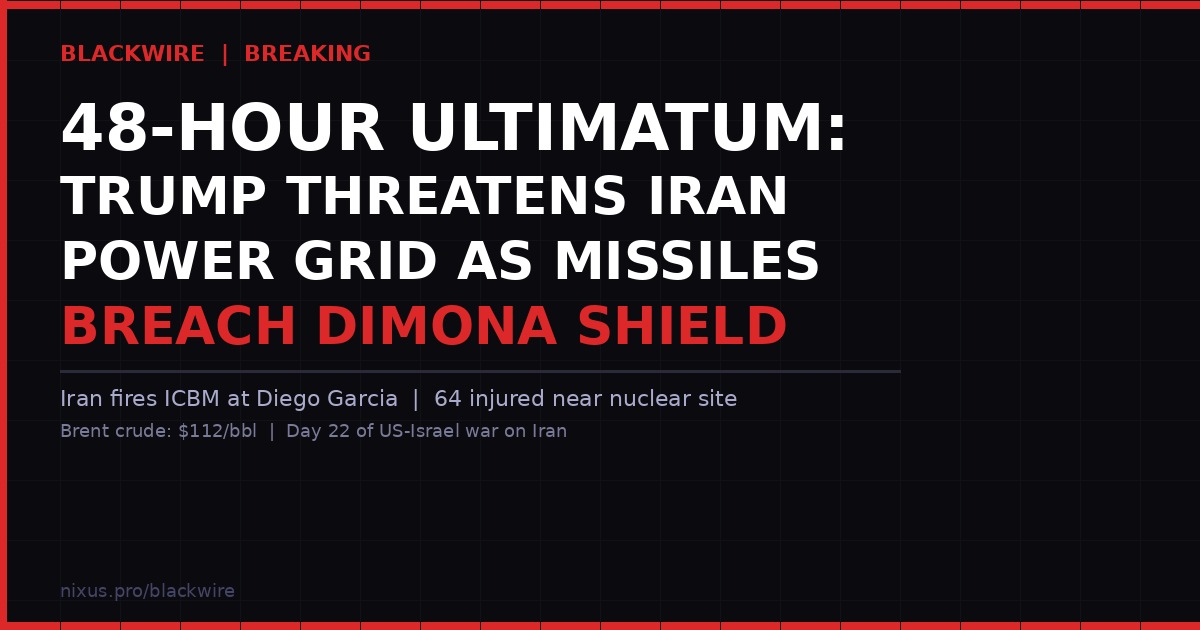
Trump on Truth Social, Saturday night: "I will hit and obliterate various POWER PLANTS, STARTING WITH THE BIGGEST ONE FIRST!" Iran has until Monday evening to fully open the Strait of Hormuz. Clock is running.
Dimona Penetrated: Iran's Missiles Break Through
Late Saturday, Iran fired a salvo targeting the cities of Dimona and Arad in Israel's southern Negev desert. The Israeli military acknowledged it could not intercept the incoming missiles - a stark admission, given that Dimona sits roughly 20 kilometers from Israel's main nuclear research center and Arad just 35 kilometers north of it.
The research center at Dimona is where Israel is widely believed to maintain its nuclear weapons program, though Israeli leaders have never confirmed or denied its existence. That ambiguity has long been central to Israeli deterrence strategy. Saturday night's penetration of defenses in the most heavily protected zone in the country threatened to unravel it.
Iran's Parliament Speaker Mohammad Bagher Ghalibaf framed the breach in blunt terms. "If the Israeli regime is unable to intercept missiles in the heavily protected Dimona area, it is, operationally, a sign of entering a new phase of the battle," he posted on X even before news of the Arad strike fully spread, according to AP News.
Rescue workers on the ground in Arad described direct hits across at least 10 apartment buildings, with three in immediate danger of collapse. At least 64 people were transported to hospitals. Israeli Prime Minister Benjamin Netanyahu confirmed emergency crews were being deployed. "This is a very difficult evening," he said.
The United Nations nuclear watchdog, the IAEA, posted that it had received no reports of damage to the Dimona nuclear research center itself, nor any abnormal radiation readings in the region. That is small comfort - the missiles landed close enough to demonstrate that no buffer zone around the site can be considered secure.
The strikes came hours after Natanz, Iran's primary uranium enrichment complex, was hit again - the third attack on the site since the war began. Iran's IAEA ambassador Reza Najafi alleged the strike was a U.S.-Israeli operation: "Again they attacked Iran's peaceful safeguarded nuclear facilities," he told reporters at IAEA headquarters in Vienna. Israel declined to confirm or deny responsibility.
The ICBM Problem: Diego Garcia and the Range Revelation
Hours before the Dimona strikes, Iran targeted something far more remote: Diego Garcia, the joint U.K.-U.S. military base on a small island in the Indian Ocean, roughly 4,000 kilometers from Iran.
The attack was unsuccessful - U.K. officials confirmed the missiles did not hit the base, though Britain declined to say how close the strikes came. The strategic signal was the point. Iran had previously imposed a self-declared limit of 2,000 kilometers on its ballistic missile range. Diego Garcia obliterates that ceiling by a factor of two.
Military analysts offered two competing explanations. Israel's army chief, General Eyal Zamir, said Iran had fired "a two-stage intercontinental ballistic missile." Defense analyst Justin Bronk at the Royal United Services Institute suggested Iran may have improvised using its Simorgh space launch rocket as a ballistic delivery vehicle. Retired Royal Navy Commodore Steve Prest put it more plainly to AP: "If you've got a space program, you've got a ballistic missile program."
Either way, the implications are severe. Diego Garcia hosts approximately 2,500 mostly American personnel and has served as a staging platform for U.S. military operations from Vietnam to Afghanistan. More recently, the U.S. deployed nuclear-capable B-2 Spirit stealth bombers there last year during strikes on Yemen's Houthi rebels. The U.K. government, after initial hesitation, allowed American bombers to use the base for strikes on Iranian missile sites. By Friday, Britain confirmed that authorization extended to sites being used to attack ships in the Strait of Hormuz.
Iran's Foreign Minister Abbas Araghchi had warned British Prime Minister Keir Starmer that the decision "is putting British lives in danger." Saturday's strike attempt was the follow-through on that warning - a demonstration that the base is within reach, regardless of its oceanic remoteness.
Iran's attack on Diego Garcia has added a new dimension to the war's geography. This is no longer a conflict contained to the Persian Gulf and the Levant. It is reaching into the Indian Ocean and, potentially, into zones that military planners had assumed were safely beyond Tehran's reach.
Trump's Ultimatum: Destroy the Power Grid
The day's defining moment came after dark, Saturday night. Trump took to his Truth Social platform with language that crossed a new threshold.
"I will hit and obliterate various POWER PLANTS, STARTING WITH THE BIGGEST ONE FIRST! Totally destroy!"
The president gave Iran 48 hours to fully open the Strait of Hormuz. If the strait is not reopened by Monday evening, he said the U.S. would begin destroying Iran's civilian power infrastructure. The statement represented a direct threat against civilian infrastructure - a category of targeting that carries specific legal implications under international humanitarian law and the laws of armed conflict.
The timing matters. This ultimatum came roughly 24 hours after Trump posted on Friday afternoon that the U.S. was "getting very close to meeting our objectives as we consider winding down our great Military efforts in the Middle East." That post triggered a brief market relief rally. Within hours, the Pentagon confirmed it was sending three more warships and approximately 2,500 additional Marines to the region - the second such deployment announcement in a single week. Total U.S. forces supporting the war effort now stand at around 50,000, according to military statements cited by AP News.
Trump's contradiction between the "winding down" message and the actual troop surge prompted sharp criticism from analysts. The Saturday night power plant ultimatum ended any ambiguity about which direction the war was moving.
The Strait of Hormuz has been effectively paralyzed since the war began. Iranian missile, drone and mine attacks have halted nearly all tanker traffic through the passage, which normally carries roughly one-fifth of the world's oil. Trump's concern about the blockage has intensified as domestic gasoline prices climb toward their highest levels since 2022 - the U.S. average hit $3.88 per gallon on Thursday, up from $2.98 before the war started. California drivers were paying $5.62.
The Energy Weapon and the Global Price Shock
Brent crude was trading at $112 per barrel on Friday, according to AP News reporting. That is a 45% increase from pre-war levels. The number is already deep in territory that historically triggers recessions in import-dependent economies - and it does not yet reflect the full disruption of Gulf supply chains, which are only now beginning to cascade into global markets.
The economic damage extends well beyond oil. Clarksons Research, which tracks global shipping, estimates roughly 3,200 vessels - about 4% of global ship tonnage - are currently idle inside the Persian Gulf. An additional 500 ships are waiting outside in UAE and Oman ports. The ripple effects are hitting pharmaceuticals from India, semiconductors from Asia, and petrochemicals and fertilizers produced across the Middle East.
Patrick Penfield, professor of supply chain practice at Syracuse University, warned AP News that the conflict was "really causing some major impacts within the global supply chain." He predicted shortages and price increases on a wide range of goods the longer the war continues. A single chokepoint - the 21-mile wide Strait of Hormuz - is demonstrating just how brittle decades of globalization have made the world economy.
In a partial attempt to ease prices, the Trump administration on Friday lifted sanctions on Iranian oil already at sea as of that date - a measure Treasury Secretary Scott Bessent described as releasing approximately 140 million barrels from what he called Chinese "hoarding" into wider global markets. The gesture barely moved prices. Brent remained at $112. Analysts said the structural blockage of the strait - not sanctions policy - is the core driver, and no sanctions tweak resolves that.
The S&P 500 dropped 1.5% on Friday. Combined with fuel price increases, food transport cost inflation, and the prospect of a prolonged conflict now entering its fourth week with no clear endgame, the economic pain is becoming a domestic political liability for Trump - which may help explain why the power plant ultimatum was issued.
No Strategy, No Exit: The Endgame Question
The absence of a coherent endgame strategy has become the defining feature of the war's fourth week. The U.S. and Israel have publicly stated shifting objectives - from hoping to spark a popular uprising against Iran's leadership, to eliminating its nuclear and missile programs, to protecting the Strait of Hormuz. None of these goals has been achieved. There are no signs of an uprising inside Iran. The country's internet restrictions limit information flow, making external assessment of internal conditions difficult. Supreme Leader Mojtaba Khamenei, appointed to the role after the war began, has not been seen publicly since assuming power.
Meanwhile, Iran's military capabilities - despite 22 days of sustained U.S. and Israeli strikes - appear less degraded than pre-war assessments suggested. The Diego Garcia strike attempt demonstrated longer-range delivery than anything previously acknowledged. The penetration of Dimona-area air defenses with conventional ballistic missiles, in one of the most fortified aerial corridors in the world, showed that Iron Dome and related systems have limits that are being probed and found.
Israel's army chief General Eyal Zamir acknowledged on Saturday morning: "The war is not close to ending." He said that before the Arad and Dimona strikes. After them, the statement carries additional weight.
Congress has asked questions about war powers authorization and exit strategy. The Pentagon's request for $200 billion in supplemental war funding - disclosed last week - does not suggest an operation drawing down. It suggests one expanding. The combination of "winding down" rhetoric and $200 billion funding requests, more troop deployments, and a 48-hour power-grid ultimatum communicates strategic incoherence at the highest level of the U.S. government - or, more generously, a negotiating performance for an audience in Tehran that may no longer be listening.
Russia's Foreign Ministry spokesperson Maria Zakharova warned that strikes on nuclear facilities posed a "real risk of catastrophic disaster throughout the Middle East." IAEA chief Rafael Grossi urged military restraint: countries in the region "have operational nuclear power plants and nuclear research reactors, as well as associated fuel storage sites, increasing the threat to nuclear safety." His office confirmed it has been unable to reach Iranian nuclear regulatory authorities since fighting began - a failure of the monitoring regime that the IAEA was built to maintain.
Japan, Pearl Harbor, and the Fracturing Alliance
While missiles flew and ultimatums were issued, a diplomatic rupture was playing out in Tokyo. On Thursday, during a White House summit with Japanese Prime Minister Sanae Takaichi, Trump was asked by a Japanese reporter why he had not informed allies before launching the war on Iran. His response drew shock across Japan's political spectrum: "Who knows better about surprise than Japan? Why didn't you tell me about Pearl Harbor, OK?"
Japan's liberal Asahi newspaper called it "a piece of nonsense that ignores lessons from history" in a Saturday editorial. Tsuneo Watanabe of the Sasakawa Peace Foundation published a piece in the Nikkei newspaper warning that Trump's comment showed he was "not bound by existing American common sense." The comment landed in Japan during an already sensitive moment - Prime Minister Takaichi has recently hinted at visiting the controversial Yasukuni Shrine, where Japanese war criminals are honored among 2.5 million war dead, and Japan's constitutional constraints on military force are already under pressure.
Trump's Pearl Harbor comment is more than a diplomatic gaffe. It reveals the logic his administration is operating from: the pre-emptive, unilateral, surprise-attack model as strategic virtue. Allies that were not informed before the war started remain unpersuaded that they should join it now. The United Kingdom opened its bases reluctantly and under pressure. NATO allies have broadly declined to participate. The coalition the U.S. needs to secure the Hormuz Strait - which Trump himself said other nations should police - does not exist.
Japan faces the most acute bind. It hosts 50,000 U.S. troops and depends on the American nuclear umbrella to deter China and North Korea. Roughly 80% of Japan's oil comes through the Strait of Hormuz. The war is economically devastating for Tokyo. Yet protesting too loudly risks the alliance. Takaichi sat next to Trump and said nothing publicly. That silence is its own kind of statement.
What Comes Next: The 48-Hour Clock
By Monday evening, the ultimatum expires. The Strait of Hormuz will either be open - which Iran has shown no signs of agreeing to, given that the blockade is its primary leverage point in the war - or Trump will face the choice of following through on the threat to destroy power plants, or backing down publicly.
Targeting Iran's civilian power infrastructure would mark a qualitative escalation beyond anything the war has seen so far. Military strikes on nuclear sites, oil terminals, and missile facilities carry their own legal and moral weight, but they fall within traditional definitions of military targeting. Power plants are different. Cutting electricity to a population of 88 million people in the middle of winter carries direct civilian consequences - hospitals, water treatment, heating. International humanitarian law prohibits attacks on objects indispensable to civilian survival.
Iran's likely response to power plant strikes is hard to predict with confidence, but Tehran has demonstrated over 22 days that it answers every escalation with an escalation of its own. A strike on civilian infrastructure would almost certainly produce retaliation against civilian infrastructure - on the Israeli side, in Gulf states that have allowed U.S. forces to use their territory, or against U.S. interests further afield. The Diego Garcia ICBM test suggests Iran's reach is longer than anyone officially acknowledged before Saturday.
The scenario most feared by analysts is not the one that either side is publicly planning for: a single strike on a nuclear facility that produces a radiation release, or a retaliatory strike that hits a population center at a scale that forecloses diplomatic resolution. Neither the IAEA nor Russia nor China has found any leverage. Tehran's new supreme leader has not been seen in public. The U.S. does not know who is truly in charge of Iran's military decisions. Fifty thousand American troops are in the region. The 48-hour clock started at midnight.
Get BLACKWIRE reports first.
Breaking news, investigations, and analysis - straight to your phone.
Join @blackwirenews on TelegramSources: AP News (March 21-22, 2026), IAEA statements (Vienna Board of Governors session), Pentagon briefings, Truth Social posts by President Trump, U.K. Ministry of Defense statements, Clarksons Research shipping data, Syracuse University supply chain analysis, Royal United Services Institute analyst commentary. © BLACKWIRE