Trump's 48-Hour Ultimatum: Bomb Iran's Power Plants or Watch the World Burn
The US-Israel war on Iran just crossed a line that legal scholars, military officers, and even some Republican senators are calling a potential war crime. Trump's 48-hour ultimatum to bomb Iran's civilian power grid - and Iran's counter-threat to "irreversibly destroy" Gulf energy sites - has pushed a three-week-old conflict to the edge of something far worse.
On Saturday night, Donald Trump posted a 51-word message to Truth Social, much of it in capital letters. The gist: Iran had 48 hours to reopen the Strait of Hormuz, or the United States would "obliterate" its power plants, "starting with the biggest one first." (AP, March 22)
Iran responded within hours. Parliament Speaker Mohammad Bagher Ghalibaf went to X with a warning that energy infrastructure "across the entire region" would become "legitimate targets" and would be "irreversibly destroyed" if Iranian power plants are hit. The Islamic Revolutionary Guard Corps went further - threatening complete closure of the strait and strikes on energy facilities in countries hosting US military bases. (Al Jazeera, March 22)
Kuwait and the UAE had already activated air defenses early Monday as missile and drone alerts sounded. Air raid sirens were reported in Bahrain. The Gulf - a region that holds roughly half the world's proven oil reserves and nearly all of its desalination capacity - was suddenly very much inside the blast radius.
The 48-hour clock expires Monday night, Eastern Time.

The Ultimatum That Shocked Military Lawyers
Trump's message did not appear to go through any legal review process, according to Geoffrey Corn, a law professor at Texas Tech University and a retired lieutenant colonel who served as an Army military lawyer. The approach had a "ready, fire, aim" quality, Corn said - and the type of attack Trump described would "probably be a war crime." (AP)
"It certainly has a feeling of ready, fire, aim. He overestimated his ability to control the events once he unleashed this torrent of violence." - Geoffrey Corn, Texas Tech Law / retired Army JAG officer, to AP
Under international humanitarian law, power plants are not automatically protected - but they can only be targeted if the military advantage gained demonstrably outweighs the civilian suffering caused. That is a high bar. Iran has 84 million people. Its power grid runs hospitals, water treatment plants, dialysis centers, and refrigerated medicine storage. Destroying it does not disable an army. It immiserates a population.
For active-duty US military commanders, Corn noted, the order creates a direct dilemma: obey an illegal order and face war crimes liability, or refuse and face criminal sanction for willful disobedience.
Iran's UN Ambassador wrote to the Security Council stating that the deliberate targeting of power plants would be "inherently indiscriminate and clearly disproportionate" - a war crime under international law. (AP)
Democratic senators did not hold back. "Trump has no plan to reopen the Strait of Hormuz, so he is threatening to attack Iran's civil power plants," said Sen. Ed Markey (D-Mass). "This would be a war crime." Sen. Chris Murphy (D-Conn) was more blunt: "He's lost control of the war and he is panicking." (AP)
The Trump administration's defense came from UN Ambassador Mike Waltz, who argued on Fox that Iran's Revolutionary Guard controls much of the country's infrastructure and "uses it to power the war effort." He specified that potential targets would include "gas-fired thermal power plants and other types of plants." The argument is a legal stretch at best - the IRGC controlling a power plant does not automatically make 84 million Iranians' electricity supply a military target.

Natanz Struck - and Iran Hit Back Near Dimona
The ultimatum came 24 hours after the most serious escalation since the war began on February 28. On Saturday, the US and Israel struck Iran's Natanz nuclear enrichment facility - the second major attack on the site since the conflict opened. Iran's Ambassador to the IAEA, Reza Najafi, confirmed it explicitly: "Again they attacked Iran's peaceful safeguarded nuclear facilities yesterday. Their justification that Iran wants to develop nuclear weapons is simply a big lie." (AP, March 22)
The IAEA's Director-General Rafael Grossi said the agency had "no indication" of nuclear facilities being damaged - a position at odds with Iran's own statement. Grossi did warn that countries across the region have "operational nuclear power plants and nuclear research reactors," and that military strikes in the area increase the "threat to nuclear safety." No elevated radiation has been detected in countries bordering Iran.
Iran's response was fast and pointed. Ballistic missiles struck the towns of Arad and Dimona in Israel's Negev Desert - both within proximity of the Negev Nuclear Research Center, Israel's main nuclear weapons development site, though Israel does not acknowledge the facility's weapons purpose. At least 175-180 people were wounded, according to southern Israel's main hospital deputy director Roy Kessous. (Al Jazeera)
Israeli Prime Minister Benjamin Netanyahu said it was a "miracle" no one was killed and called it "a very difficult evening in the battle for our future." The Israeli military said air defenses failed to intercept some Iranian missiles despite being activated - and that investigation was underway. The military described Iran's weapons as not "special or unfamiliar," raising harder questions about why the intercepts failed.
"If you give Iran an inch, they take a mile. The Iranians are indeed retaliating against everything that the Israelis and Americans are hitting. The risk of escalation is extremely high." - Regional security analyst quoted by Al Jazeera, March 22

The Cluster Munition Problem: Why Iron Dome Is Struggling
The failure to intercept Iranian missiles over Arad and Dimona is not a mystery to defense analysts - it is a predictable consequence of Iran's weapon design. Iran has deployed cluster munitions on its ballistic missiles: rather than a single explosive warhead, the missile disperses multiple smaller bomblets before impact. (Al Jazeera)
The intercept window for a ballistic missile equipped with a cluster payload is critically short. A defense system must destroy the incoming missile before the warhead opens and releases its submunitions. Once the payload separates, a single intercept becomes multiple simultaneous threats - impossible to stop with a single interceptor.
"The tip of the missile, instead of containing a big barrel of explosives, contains a mechanism which holds on to a lot of small bombs. And when the missile approaches the target, it opens its skin, it peels off and it spins around and the bomblets are released into space and fall on the ground." - Uzi Rubin, founding director of Israel's missile defense program, Jerusalem Institute for Strategy and Security, to Media Line
Rubin noted that Iranian cluster warheads can contain anywhere from 20-30 to 70-80 bomblets, depending on the missile type. The result is an area-denial effect that a single interceptor missile cannot address. Iran used the same munitions in the 12-day war with Israel in June 2025.
The operational decision is making this worse. The Times of Israel reported Thursday that the Israeli Air Force has started conserving interceptors. Military officials reportedly concluded that Iranian cluster bombs are "unlikely to cause significant harm if people have taken shelter" - and chose not to shoot down all incoming missiles. That calculation looked different by Saturday night, with 180 people wounded in Arad and Dimona.
Defense analysts describe Iran's missile program as the largest and most varied in the Middle East. Developed over decades specifically to compensate for Iran's lack of a modern air force, the arsenal includes short-range Fateh variants, medium-range Shahab-3 and Emad platforms, and the Soumar land-attack cruise missile with a range of 2,000-2,500 km. Former Supreme Leader Khamenei had limited Iranian missile ranges to 2,200 km - that limit was removed after Israel's June attack.
Two Iranian missiles were reportedly fired at Diego Garcia, the US-UK base in the Indian Ocean 4,000 km from Iran - outside the previous range limit. The UK said the attack failed. Iranian officials denied firing the missiles.

Hormuz: The Choke That's Strangling the World
The Strait of Hormuz is 21 miles wide at its narrowest point. About one-fifth of global oil supply and roughly 20% of the world's liquefied natural gas passes through it daily. Since February 28, Iran has effectively closed it to US and allied shipping - and the resulting oil crisis is beginning to look like the worst since 1973. (AP)
Iran insists the strait is "open" - just not to enemies. "The illusion of erasing Iran from the map shows desperation against the will of a history-making nation," said Iranian President Masoud Pezeshkian on X Sunday. Foreign Minister Abbas Araghchi was sharper: "Ships hesitate because insurers fear the war of choice you initiated - not Iran. No insurer - and no Iranian - will be swayed by more threats." (Al Jazeera)
The practical reality is that nearly all tanker traffic has stopped. Attacks on ships carrying US or allied flags have made insurance rates prohibitive. Oil prices have surged roughly 40% since the war began - spiking gas prices in the United States that are now, according to AP, "set to eat up tax refunds touted by Trump."
Trump tried a diplomatic coalition last weekend - asking allies to send warships to help secure the strait. They declined. He then said the US could manage alone. On Friday he suggested other countries "would have to take over." Hours later he implied the waterway would somehow "open itself." By Saturday night he had landed on threatening to bomb power plants - a complete reversal of every position taken in the preceding week. (AP)
Trump's Treasury Department also lifted sanctions on some Iranian oil sales on Friday - the first sanctions relief in decades - in an attempt to push more barrels into global markets and reduce pressure on US pump prices. The contradictions are hard to reconcile: Washington simultaneously threatening to destroy Iran's infrastructure and lifting economic penalties to ease a crisis the war itself created.
Sen. Thom Tillis (R-N.C.) said on ABC's "This Week" that the US cannot simply walk away from a crisis it created: "You can't all of a sudden walk away after you've kind of created the event and expect other people to pick it up."
Lebanon: Bridges Bombed, Ground Invasion Feared
The southern Lebanon front opened a second front of concern on Sunday. Israel expanded its target list to include bridges over the Litani River, with Defense Minister Israel Katz stating that Hezbollah is using the crossings to move fighters and weapons southward. Israeli jets struck the Qasmiyeh Bridge near Tyre with one hour of warning given to civilians. (AP)
Lebanese President Joseph Aoun called the bridge strikes "a prelude to a ground invasion." Israeli army chief said the operation "has only begun" and would be "prolonged." Katz also ordered the military to accelerate destruction of Lebanese homes near the border.
Lebanese authorities report more than 1,000 people killed since the war began and over 1 million displaced. Hezbollah has fired hundreds of rockets into Israel in response. An Israeli civilian - 61-year-old farmer Ofer "Poshko" Moskovitz - was killed near Misgav Am in northern Israel. He had told a radio station two days earlier that living near the Lebanese border was "like Russian roulette." He was right.
Hezbollah entered the conflict shortly after the war began, framing its campaign as retaliation for the killing of Iran's Supreme Leader Ayatollah Ali Khamenei in the opening US-Israeli strikes on February 28. The Lebanese militia has maintained a steady rocket barrage while Israel has expanded both its airstrike campaign and its ground presence in southern Lebanon.
Turkey's foreign ministry confirmed Sunday that Foreign Minister Hakan Fidan held separate calls with Iranian, Egyptian, EU, and US officials to discuss steps toward ending the war - a diplomatic back-channel that the White House has not publicly acknowledged. (Al Jazeera)

Gulf States Caught in the Crossfire
Iran's counter-threat to hit Gulf energy and desalination infrastructure is not abstract. Kuwait and the UAE both activated air defenses in the early hours of Monday morning. Sirens sounded in Bahrain. The IRGC statement was specific: companies with US shareholding will be "completely destroyed" if Washington targets Iranian energy facilities; energy facilities in countries hosting US military bases are "lawful targets." (AP)
This matters more than it sounds. Gulf states - Saudi Arabia, UAE, Kuwait, Bahrain, Qatar - produce a combined 15+ million barrels of oil per day. They also rely on desalination for the majority of their drinking water. If Iran follows through and targets desalination plants, the humanitarian consequences in countries like Kuwait and the UAE - which produce nearly no freshwater naturally - would unfold within weeks.
Iran's parliament speaker Ghalibaf stated flatly that his country's retaliation would "increase the price of oil for a long time." That is not a threat designed to bring a conflict to a close. It is a threat designed to make the economic cost of continuing the war unbearable for everyone involved - the US, its Gulf allies, and global markets.
Asian stock markets fell sharply on Monday morning as Trump's ultimatum registered. Key indexes in Japan, South Korea, and Hong Kong dropped as investors priced in the scenario of a regional energy infrastructure war. (Al Jazeera)
A Qatari military helicopter crash on Saturday, blamed on technical malfunction, killed all seven aboard. Qatar has been one of the key diplomatic intermediaries in the region - the timing of the loss is grim, whatever the cause.

The War Without an Exit: What Comes Next
Three and a half weeks ago, this was a war with a stated set of goals: destroy Iran's nuclear program, degrade its missile capability, eliminate its support networks, and - most implausibly - enable the Iranian people to overthrow their government. None of those objectives have been met. Iran is still firing cluster munitions at Israeli cities. The nuclear program may be damaged but is not destroyed. Hezbollah is still operational. No popular uprising has materialized. And the Strait of Hormuz remains closed to US allies. (AP)
Netanyahu called on world leaders Sunday to join the US-Israel war on Iran - standing at the site of an Iranian strike in Arad, claiming some countries were "already moving in that direction." No country has publicly announced an intent to join. NATO's secretary-general, per AP, has been downplaying Trump's rift with the alliance rather than building a coalition.
The 48-hour deadline expires Monday night. If Trump follows through on the power plant threat and Iran responds by hitting Gulf desalination plants, the war will have moved from a regional military conflict into a global economic catastrophe. The oil price spike would dwarf 1973. Gulf states would face humanitarian crisis within weeks. The global shipping insurance market would freeze.
If Trump backs down from the ultimatum, he hands Iran a public victory at the 24-day mark and further undermines the credibility of US deterrence. The war has already killed more than 2,000 people, wounded thousands more, and displaced over a million Lebanese. There is no version of Monday's deadline that ends cleanly.
"More weeks of fighting against Iran and Hezbollah are expected for us." - Israeli military spokesperson Brig. Gen. Effie Defrin, AP, March 22
Timeline: 24 Days to the Edge
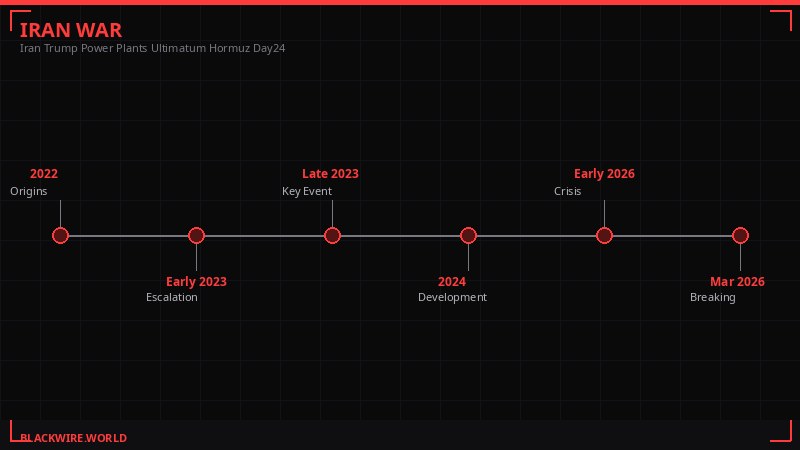
February 28, 2026: The United States and Israel launch simultaneous airstrikes on Iran. Targets include Tehran air defenses, the Natanz nuclear enrichment facility, the Fordow fuel enrichment plant, and the Arak heavy water reactor complex. Iranian Supreme Leader Ali Khamenei is killed in the opening strikes. Iran announces emergency war footing.
March 1-5: Hezbollah begins rocket strikes on northern Israel, citing the killing of Khamenei. Iran announces effective closure of the Strait of Hormuz to US and allied shipping. Global oil prices spike 40% in four days. Iranian proxies begin striking US military facilities in Iraq and Syria.
March 10: A Qatari military helicopter crashes, killing seven. Reports emerge of a US aircraft downed over Iraq. Kuwait activates air defenses for the first time. Israel expands ground operations in southern Lebanon.
March 13: Israeli Prime Minister Netanyahu visits the site of US strikes on Iran's Kharg Island oil export terminal. IDF ground forces advance further into Lebanese territory. Hezbollah deploys anti-armor weapons against Israeli armored columns.
March 15: US strikes Kharg Island a second time. Iran files emergency complaint to the UN Security Council. Trump tells reporters the US "may hit Kharg Island again, just for fun." The statement draws widespread international condemnation. Russian and Chinese vetoes block UNSC action.
March 21: US and Israel conduct joint strikes on the Natanz enrichment facility - the second major attack on Iran's primary uranium enrichment site. Iran's ambassador to the IAEA confirms the strike. IAEA Director-General Grossi calls an emergency Board of Governors session and warns of nuclear safety risks across the region.
March 22: Iran strikes Arad and Dimona in Israel's Negev Desert with cluster munition ballistic missiles. At least 175-180 people wounded. Israel strikes bridges over the Litani River in Lebanon. Trump posts 48-hour ultimatum to Truth Social: open the Strait of Hormuz or US will "obliterate" Iran's power plants. Iran's parliament speaker, IRGC, foreign minister all respond with counter-threats to Gulf energy infrastructure.
March 23 - Now: Kuwait and UAE air defenses activated. Bahrain sirens sounding. Asian markets fall. The 48-hour clock is running.
Get BLACKWIRE reports first.
Breaking news, investigations, and analysis - straight to your phone.
Join @blackwirenews on Telegram