Trump Demands Iran's Uranium. Tehran Says No Talks Happened. The Nuclear Endgame Begins.
Trump says he'll accept a deal. Iran says there is no deal. Between those two statements sits 970 pounds of highly enriched uranium that nobody can find, a watchdog that hasn't been inside Iran's nuclear sites since June, and a five-day clock running down on the threat to bomb every power plant in the country.

The Announcement That Moved $12 Trillion in Markets

The social media post came before U.S. markets opened. That was not an accident. President Donald Trump announced Monday morning that the United States had held "very good" talks with an unnamed "respected" Iranian official over the weekend, and that he was extending his 48-hour ultimatum to bomb Iranian power plants by five more days to allow negotiations to continue.
The effect was immediate and massive. Brent crude, which had been trading near $120 per barrel last week and had opened Asian markets above $112, crashed 10.9% to settle at $99.94 - its biggest single-day drop since the war began in late February. The Dow Jones Industrial Average swung from near flat to up nearly 1,135 points during morning trading before settling around 870 points higher. The S&P 500 posted its best day since the war started, rising 1.7%. European markets, which had opened sharply lower, flipped into positive territory within minutes of Trump's post. (AP News)
Asian markets didn't get the benefit. South Korea's Kospi had already crashed 6.5% by the time Trump posted, having priced in the near-certainty of strikes on Iran's energy grid. Japan's Nikkei 225 fell 3.5%. Hong Kong's Hang Seng dropped 3.5%. Those losses were locked in - the relief rally was a Western-markets-only event for Monday's session.
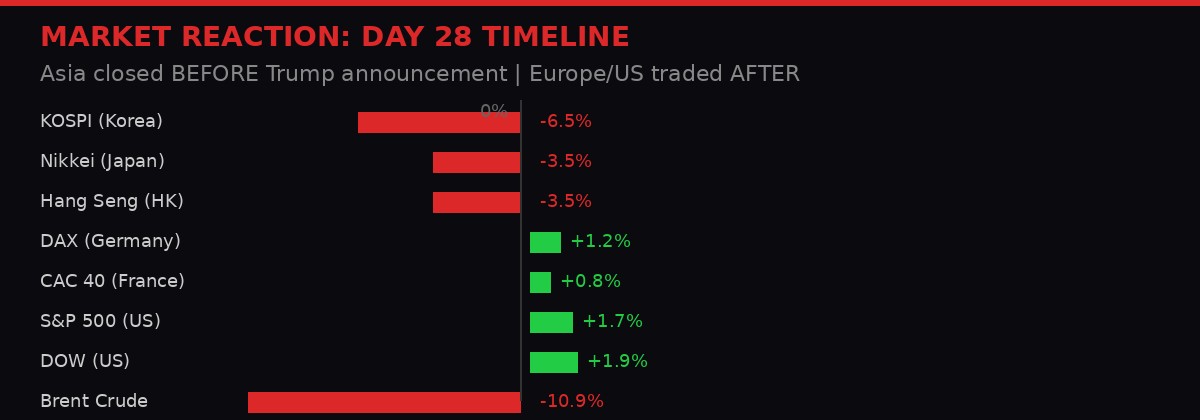
The moves were tentative, though. The Dow went from +1,135 to +540 to +870 in the space of a few hours as Iran's denials began circulating. "Fakenews is used to manipulate the financial and oil markets," Mohammad Bagher Qalibaf, speaker of the Iranian parliament, posted on X. The oil market heard that and immediately recaptured some of its losses - Brent briefly touched $96 before stabilizing near $100.
"The single most important solution to this problem is opening up the Hormuz Strait as things stand now." - Fatih Birol, International Energy Agency Director General, speaking in Canberra, Monday
Iran Says "No Negotiations." Trump Says There Were. Both Can Be Right.

The competing narratives are not necessarily contradictory. Trump said envoy Steve Witkoff and his son-in-law Jared Kushner held talks Sunday with an unnamed Iranian official - one he described as "respected." He did not claim these were direct negotiations with the Supreme Leader or formal government channels. Iran's parliament speaker and the Iranian Foreign Ministry responded that no negotiations had taken place.
The distinction matters. Informal back-channel contacts between American envoys and Iranian officials - mediated through a third country, without acknowledgment from Tehran - are not "negotiations" by Iran's strict public definition. Iran has consistently maintained it will not hold direct talks with Washington while under active military attack. What Trump described could fit within that framework: a message passed through an intermediary, with Iranian officials responding via the same channel, that both sides claim to interpret differently.
An Egyptian official told AP, speaking on condition of anonymity because they were not authorized to speak to media, that the U.S. and Iran had exchanged messages through Egypt, Turkey and Pakistan over the weekend specifically aimed at averting strikes on energy infrastructure. A Gulf diplomat said Egypt and Turkey had led the de-escalation effort. "For now, it appears they managed to avert an energy catastrophe," the diplomat said.
British Prime Minister Keir Starmer added credibility to the back-channel account Monday: "We, the U.K., were aware that was happening," he said, without elaborating.
"They want peace. They've agreed they will not have a nuclear weapon, you know, etc., etc. but we'll see. There's a very good chance a deal will be reached this week." - President Donald Trump, speaking in Memphis, Tennessee, Monday afternoon
Iran's semi-official Fars and Tasnim news agencies - both close to the Revolutionary Guard - portrayed Monday differently. "With this kind of psychological warfare, neither the Strait of Hormuz will return to prewar conditions nor will calm return to energy markets," Tasnim wrote. Iran's Foreign Ministry accused Trump of trying to "reduce energy prices and buy time for implementing his military plans."
The Real Demand: Surrender the Uranium
Buried inside Trump's optimistic framing was the actual demand - one Iran has never once accepted in decades of nuclear negotiations, and one that represents the true test of whether any deal is possible.
Trump said Monday that if a deal is reached, the United States would move to physically take Iran's enriched uranium stockpile. "We would move to take their enriched uranium," he said. This is not a vague aspiration. It is the core demand that previous negotiations - under Obama, Trump's first term, and Biden - all tried and failed to permanently resolve.
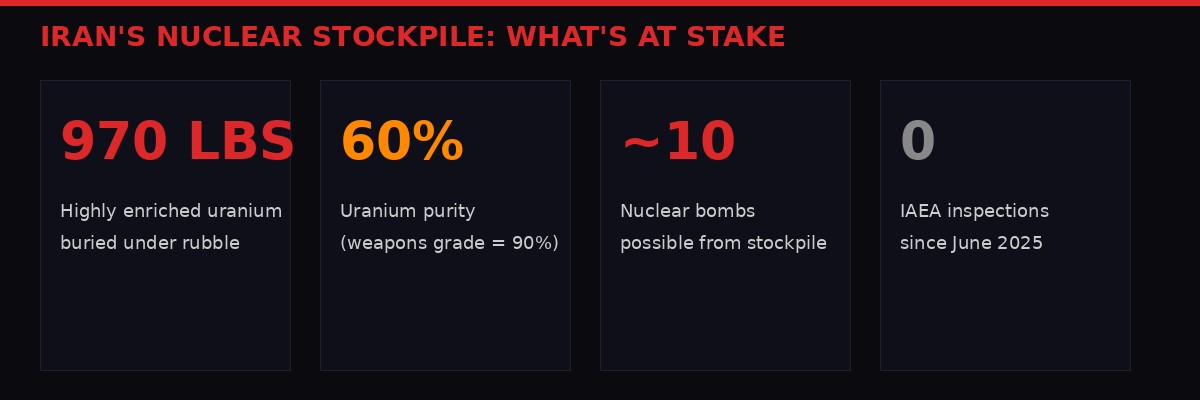
Iran maintains a stockpile of 440.9 kilograms - approximately 972 pounds - of uranium enriched to 60% purity, according to the International Atomic Energy Agency. That is a short technical step from weapons-grade levels of 90%. The IAEA's Director General Rafael Grossi has warned that this stockpile is sufficient for Iran to build as many as 10 nuclear bombs, should it decide to weaponize its program.
The complication is that the IAEA has not been inside Iran's major nuclear facilities since June 2025, when Israel and the United States struck them during a 12-day conflict. Iran informed the IAEA in a February 2 letter that normal safeguards were "legally untenable and materially impracticable" given the attacks. Satellite imagery shows "regular vehicular activity" around the tunnel complex at Isfahan where enriched material is stored - but the agency cannot confirm whether enrichment is continuing, whether the stockpile has been moved, or where it currently sits. (AP News / IAEA confidential report)
Iran has "adamantly refused" demands that it surrender its enriched uranium, insisting it has the right to enrich for peaceful purposes. That position has not changed. What has changed is that 2,000 people are dead, the Strait of Hormuz is sealed, oil is at $100, and Trump has threatened to obliterate the country's power grid. Whether that pressure is enough to shift Tehran's nuclear calculus is the question the next five days will answer.
Turkey, Egypt, Pakistan: The Mediation Machinery Nobody Noticed

While Trump and Iran traded threats publicly, a quieter process was running in parallel. The first confirmed sign of coordinated regional mediation from genuine heavyweight players emerged Sunday and Monday - and it appears to have worked, at least in the short term.
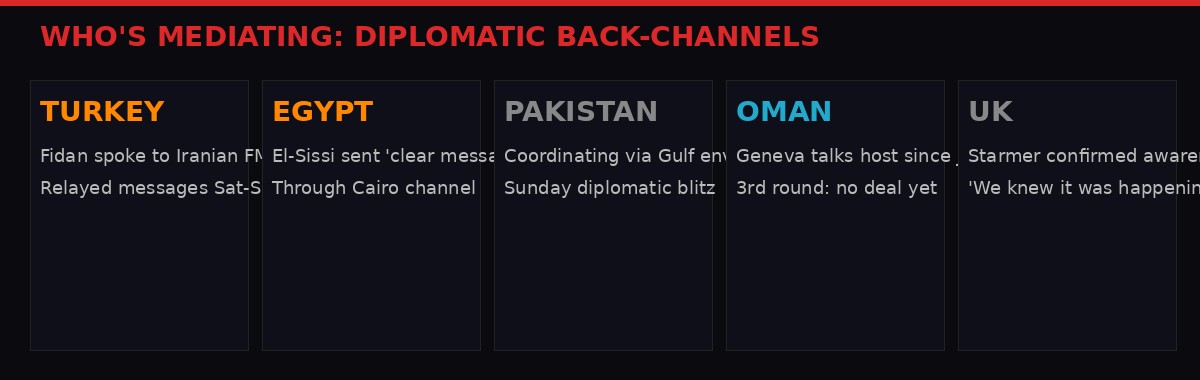
Iranian Foreign Minister Abbas Araghchi spoke by phone with Turkey's Foreign Minister Hakan Fidan Sunday. Turkey has historically served as an intermediary between Tehran and Washington. The Turkish Foreign Ministry declined to confirm it had relayed messages, but a Turkish diplomatic source told AP that Fidan had also spoken to his counterparts from Qatar, Saudi Arabia, Pakistan, Egypt, and the European Union, as well as with U.S. officials, as part of a concerted effort to prevent the power plant strikes.
Egyptian President Abdel-Fattah el-Sissi confirmed Sunday that Cairo had delivered "clear messages" to Iran focused on de-escalating the conflict. The Egyptian Foreign Ministry said it was making "constant efforts and communications" with all parties. An Egyptian official confirmed that Egypt had been part of a three-way message relay system alongside Turkey and Pakistan that shuttled back-channel communications over the weekend.
This matters for a reason beyond preventing Monday's strike. The involvement of Turkey, Egypt, and Pakistan - none of them Western, all of them with existing relationships in Tehran - represents the first genuine multilateral regional pressure that is not simply the U.S. acting through Gulf allies. If a deal is coming, these three countries are more likely to deliver it than Steve Witkoff.
Oman, which has hosted three rounds of indirect nuclear talks this year, is likely to be the formal venue for any deal. The third round, held earlier in March, ended without agreement. But an Omani official said lower-level technical discussions would continue in Vienna - the IAEA's home city - as soon as next week.
Trump's Shifting Strategy: A President Without a Plan

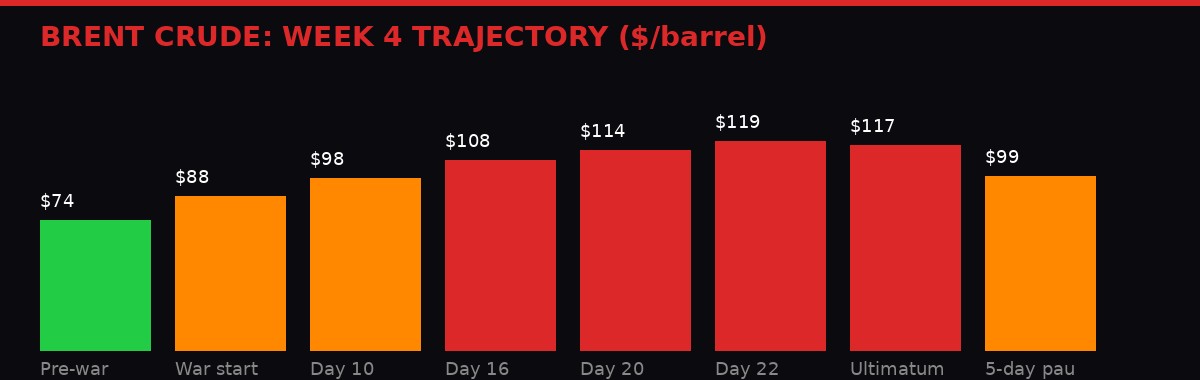
The five-day extension is the latest in a series of pivots that critics across the political spectrum say reveal a president who went to war without a clear exit strategy. The timeline of Trump's Hormuz approach over the past two weeks tells that story plainly.
"Trump has no plan to reopen the Strait of Hormuz, so he is threatening to attack Iran's civil power plants," said Sen. Ed Markey, D-Mass., calling the power plant threat a war crime. Sen. Chris Murphy, D-Conn., was more direct: "He's lost control of the war and he is panicking."
Republican Sen. Thom Tillis of North Carolina offered a more measured but pointed critique: "You can't all of a sudden walk away after you've kind of created the event and expect other people to pick it up."
Trump's defenders argue the power plant threat was strategic pressure that produced results - that Iran blinked, not Trump. Mike Waltz, the U.S. ambassador to the United Nations, said the threat was a legitimate tactic because Iran's Revolutionary Guard controls much of the country's infrastructure and uses it to power its war effort. "The president is not messing around," Waltz said on Fox News Sunday.
Legal experts disagreed with Waltz's framing. Geoffrey Corn, a law professor at Texas Tech and retired Army lieutenant colonel who served as a military lawyer, told AP: "It certainly has a feeling of ready, fire, aim." Widespread attacks on civilian power infrastructure would likely constitute a war crime under international humanitarian law, Corn said, unless a rigorous analysis found military advantages outweighed civilian harm - a bar he said would be extremely difficult to clear for power plants supplying hospitals and homes.
The Energy Crisis Worse Than the 1970s

The International Energy Agency has been trying to paper over the crisis with its strategic reserves. It hasn't been enough. IEA Director General Fatih Birol, speaking at Australia's National Press Club in Canberra Monday morning, laid out the scale of the damage in terms that left no ambiguity.
The combined 1973 and 1979 oil shocks removed 10 million barrels per day from global markets and caused "major economic problems around the world, the recessions," Birol said. The Iran war has now removed 11 million barrels per day - more than both shocks combined. On natural gas: Russia's invasion of Ukraine removed 75 billion cubic meters of gas from markets, primarily in Europe. The Iran war has removed approximately 140 BCM - nearly double that figure.
The IEA has already released 400 million barrels from member countries' strategic reserves - a historically unprecedented drawdown. "We have never released so much oil to the markets," Birol said. He confirmed the agency is consulting with governments across Europe, Asia, North America, and the Middle East about whether to release further stockpiles, but said he would wait to assess market conditions before committing. (AP News)
"40 energy assets in nine countries across the region were severely or very severely damaged," Birol said. He listed the supply chains now broken: "petrochemical, fertilizers, sulfur, helium - their trade is all interrupted, which would have serious consequences for the global economy."
Monday's oil price drop to below $100 per barrel brought some relief, but the Strait remains closed. Treasury yields, which had spiked as markets priced in prolonged inflation from sustained high oil prices, eased after Trump's announcement but remain well above pre-war levels. The Federal Reserve's rate-cutting capacity - which the global economy needs to offset the shock - is constrained as long as oil keeps inflation elevated.
What the Next Five Days Actually Decide

Let's be precise about what the next 120 hours decides - and what it doesn't.
Even if talks succeed and produce a framework by Saturday, the core demands on both sides are structurally difficult to reconcile in five days. Trump's stated objectives for the war - which he has shifted repeatedly - now include degrading Iran's missile capability, destroying its defense industrial base, eliminating the Iranian navy, preventing Iran from ever acquiring nuclear weapons, and securing the Strait of Hormuz. The U.S. and Israeli bombing campaign has made progress on some of these. But analysts told AP that Trump would "strain credulity" claiming he has definitively ended Iran's ability to build a nuclear bomb while the IAEA has zero access to Iran's nuclear sites and 970 pounds of highly enriched uranium are unaccounted for.
Iran's stated minimum is that it retains the right to enrich uranium for peaceful purposes on its own soil. It has never agreed to surrender its stockpile. Every previous nuclear negotiation - Geneva 2013, JCPOA 2015, Trump's first term pullout, Biden-era talks - foundered or partially succeeded on exactly this divide.
The five-day window is best read as a signal rather than a negotiating deadline. Both sides need a face-saving pause. Trump needs to show markets and the American public that he is actively pursuing peace - not because voters support the war (they are divided along partisan lines, according to AP-NORC polling) but because gas prices hitting record highs before midterm elections are politically lethal. Iran needs to demonstrate it has deterred the power plant strikes without formally conceding to U.S. demands - which is exactly how Tehran's state media framed Monday's announcement: "Trump backed down following Iran's firm warning."
The geometry of a real deal, if one is possible, runs through the uranium question. Either Iran agrees to some form of transfer or international custody of its enriched stockpile - a position it has never accepted - or Trump accepts a deal that leaves Iran with enrichment capacity it could reconstitute in months. Neither outcome is clean. Neither is particularly likely in five days.
What is clear is that the current situation - Hormuz sealed, oil near $100, 2,000 dead, Asian markets cratering while Western markets bounce on social media posts, and 970 pounds of uranium sitting somewhere under bombed rubble in Iran with no international inspector anywhere near it - is unstable in every direction.
The five-day clock is running. The next message from Mar-a-Lago will move markets again. Whether it produces a deal or another escalation depends on talks that Iran insists aren't happening and that Trump says are going "very well."
Get BLACKWIRE reports first.
Breaking news, investigations, and analysis - straight to your phone.
Join @blackwirenews on Telegram