The $194 Billion Crater: How One Month of War Bankrupted the Arab World
A UNDP report confirms what the numbers already screamed - one month of conflict has blown a hole through the Arab economy the size of a mid-tier European nation's GDP. And the report assumes this is a short war. It isn't.
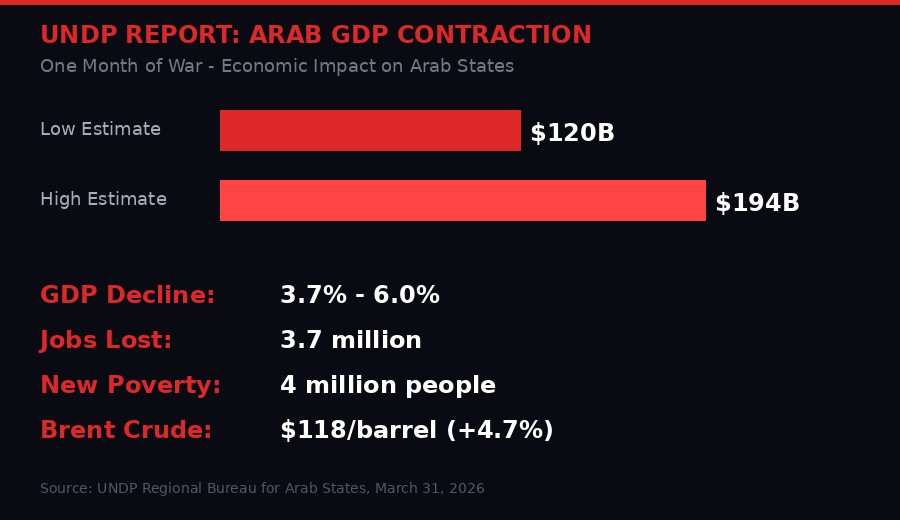
UNDP Regional Bureau for Arab States - GDP contraction estimates after 32 days of conflict | BLACKWIRE infographic
The number landed on Tuesday like a bomb of its own. Up to $194 billion. That is the estimated cost to Arab economies of exactly one month of the US-Israeli war on Iran, according to a United Nations Development Programme report published March 31, 2026. The figure represents a GDP contraction of between 3.7 and 6 percent across the entire Arab region - a collapse so steep it erases years of post-pandemic recovery in a single billing cycle.
Abdallah Al Dardari, the UN assistant secretary-general and director of the UNDP Regional Bureau for Arab States, put the human toll in equally blunt terms: 3.7 million jobs destroyed, four million additional people pushed below the poverty line, and an exposure of what he called the "fragility in the Arab economy" that decades of oil wealth had papered over but never fixed.
Here is the part the report's authors could not say out loud: their projections were modeled on "a short but intense conflict lasting for four weeks." Day 32 is today. There is no ceasefire. There are no active negotiations between the United States and Iran. The IRGC commanders who control Iran's war strategy are publicly promising escalation. And the infrastructure damage - to ports, shipping lanes, airports, energy grids, and financial markets - is compounding daily.
The $194 billion figure is already outdated. The real number is worse.
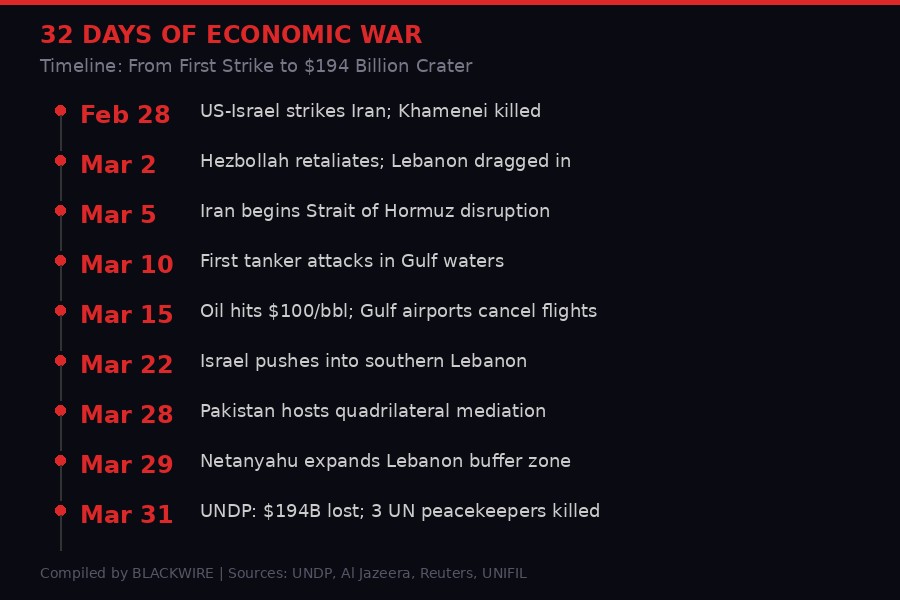
32 days of economic destruction - a war timeline | BLACKWIRE infographic
01 // The UNDP Report: Anatomy of a Regional Collapse
The UNDP report, released while Brent crude futures surged 4.7 percent to surpass $118 per barrel, is the first comprehensive attempt by an international body to quantify the war's economic damage across the Arab world. Previous estimates - including the Pentagon's own $200 billion projection for US military costs alone - focused on the combatants. The UNDP turned its lens on the countries that did not start this war but are paying for it anyway.
The headline range - $120 billion to $194 billion in GDP contraction - reflects two scenarios. The lower estimate assumes the conflict ends quickly and shipping lanes reopen within weeks. The upper estimate accounts for sustained Strait of Hormuz disruption, continued Iranian attacks on Gulf infrastructure, and prolonged investor flight from regional markets. Given what happened on Day 32 alone - a Kuwaiti oil tanker struck by an Iranian drone at Dubai Port, new waves of ballistic missiles intercepted over Saudi Arabia, and three UN peacekeepers killed in Lebanon - the upper estimate looks conservative.
The geographic distribution of the damage is not uniform, and the report is careful to draw distinctions. Oil-exporting Gulf states are experiencing revenue boosts from elevated crude prices even as their physical infrastructure absorbs strikes. Saudi and Omani stock exchanges have actually posted gains since February 28. But the UAE - the region's most diversified economy, most reliant on tourism and services - has taken a disproportionate hit. Non-oil Arab economies, particularly in the Levant and North Africa, face the worst of both worlds: higher energy costs with no oil revenue to offset them.
The poverty projections are concentrated, the report notes, "in the Levant and fragile countries (Sudan and Yemen), where baseline vulnerability is highest and shocks translate more strongly into welfare losses." Translation: the countries that could least afford any economic stress are absorbing the most.
"We hope the fighting will stop tomorrow, as every day of delay has negative repercussions on the global economy."- Abdallah Al Dardari, UN Assistant Secretary-General and Director, UNDP Regional Bureau for Arab States
The statement is notable for its desperation. UN officials typically hedge with diplomatic language. Al Dardari did not. "Every day of delay" is as close to a scream as a UN assistant secretary-general gets.
02 // The Gulf Markets: $120 Billion Evaporated
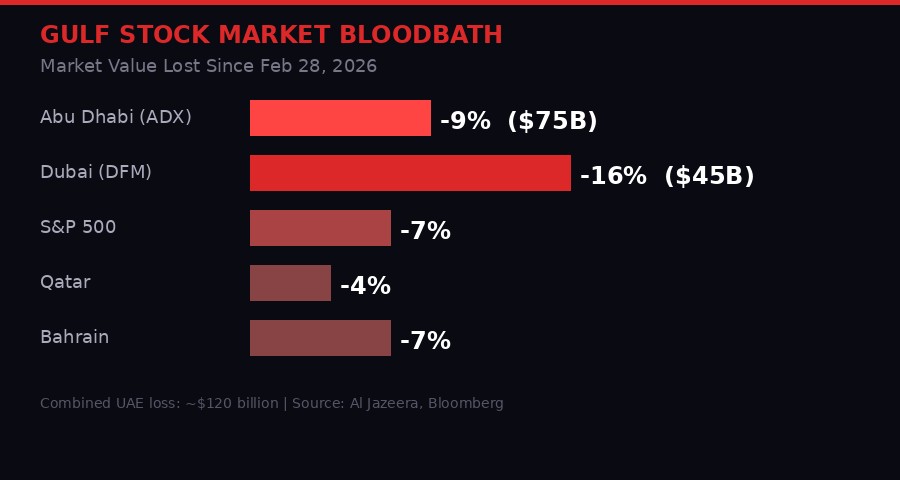
Gulf financial markets since February 28 - a bloodbath | BLACKWIRE infographic
Separate from the UNDP's macro figures, the Gulf's financial markets have been hemorrhaging in real time. The Abu Dhabi Securities Exchange has shed approximately $75 billion in market capitalization since February 28 - a 9 percent decline. Dubai's Financial Market has lost roughly $45 billion, a 16 percent drop. Combined, that is $120 billion wiped from just two exchanges in 32 days.
The damage is not evenly distributed across the Gulf. Qatar's exchange has fallen about 4 percent. Bahrain is down 7 percent. But Saudi Arabia and Oman - further from the direct line of fire and benefiting from elevated oil prices - have seen their indices rise. The divergence tells a story: this war is not just destroying value, it is redistributing it, punishing the countries most exposed to service economies and international connectivity while rewarding those that remain primarily dependent on raw commodities.
For the UAE specifically, the financial losses represent a direct threat to national strategy. Dubai rose to seventh place in the latest Global Financial Centres Index, its highest ever. Under a 10-year economic plan unveiled in 2023, Dubai's leadership envisioned the city becoming one of the world's top four financial hubs by 2033. That ambition is now colliding with the reality that tens of thousands of flights have been cancelled through Dubai International Airport - the world's busiest for international passengers - and that Iranian drones are striking tankers at Dubai Port.
Haytham Aoun, an assistant professor of finance at the American University in Dubai, described the market slide as a "temporary shock" rather than structural damage. "International financial centres are judged not only by market performance during crises but also by the quality of regulation, liquidity management, institutional resilience, and operational continuity," Aoun told Al Jazeera.
That is the optimistic reading. The pessimistic reading is that every additional day of war erodes exactly the investor confidence and institutional trust that Dubai spent two decades building. A $120 billion market loss can be recovered if the war ends tomorrow. But the war is not ending tomorrow.
Burdin Hickok, a professor at New York University's School of Professional Studies who was previously based in the Middle East with the US Department of State, offered a more measured assessment. He expected a "serious rebound" post-war but acknowledged that the fundamental attractiveness of the exchanges depends on the conflict staying contained. "Regulatory or capital restrictions would be a more fundamental change," Hickok told Al Jazeera. The question nobody can answer is whether the war will force exactly those kinds of restrictions.
03 // The Strait of Hormuz: The World's Most Expensive Chokepoint
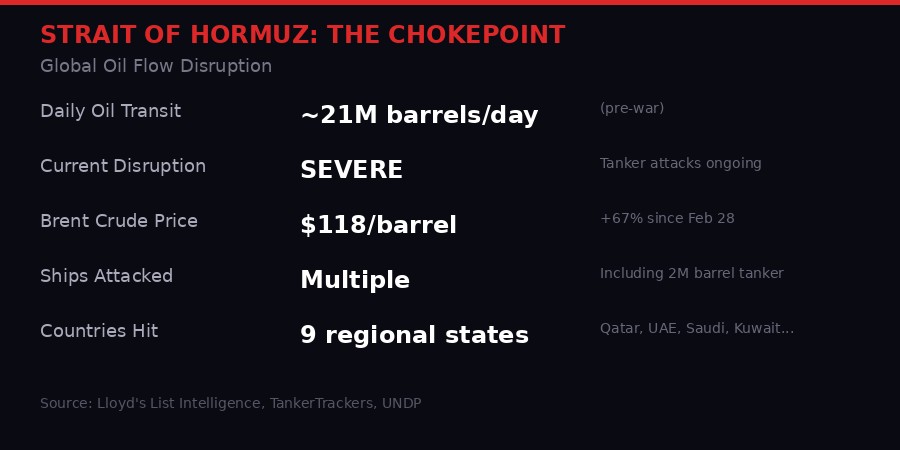
The chokepoint that controls the global economy | BLACKWIRE infographic
Every economic projection in the UNDP report hinges on a single geographic feature: the Strait of Hormuz, a 33-kilometer-wide passage between Iran and Oman through which roughly one-fifth of the world's daily oil and gas supply transits. Since February 28, Iran has effectively weaponized this chokepoint, and the results are visible in every petrol station price board from Houston to Hamburg.
The UNDP report explicitly cited "risks in strategic maritime corridors" as having "knock-on effects on inflation, trade flows, and global supply chains" capable of undermining livelihoods across the Middle East's "interconnected economies." But the damage extends far beyond the region. Brent crude has climbed from approximately $70 per barrel in late February to over $118 - a 67 percent increase that is feeding inflation worldwide and threatening to trigger a global recession.
On Day 32, the chokepoint claimed another casualty. A fully loaded Kuwaiti crude oil tanker, the Al-Salmi, was struck by what authorities described as an Iranian drone attack while anchored at Dubai Port. The Kuwait Petroleum Corporation confirmed the vessel was carrying two million barrels of crude loaded from Kuwait and Saudi Arabia, destined for Qingdao, China, according to Lloyd's List Intelligence and TankerTrackers data. A fire erupted on board before being contained. KPC warned of a possible oil spill in surrounding waters, though Dubai authorities said no leakage was ultimately detected.
The Al-Salmi strike was not an isolated incident. Earlier on Monday, a Greek-owned container ship off the coast of Saudi Arabia's Ras Tanura reported two separate projectile incidents in nearby waters. A Thai cargo ship, the Mayuree Naree, struck near the Strait of Hormuz earlier in the month, remains disabled with three crew members still unaccounted for after a boarding party failed to locate them. The pattern is clear: commercial shipping in the Gulf is under sustained, multi-vector attack.
The economic implications are cascading. Insurance premiums for Gulf shipping have skyrocketed. Some carriers have diverted routes around the Cape of Good Hope, adding weeks and billions in costs to global supply chains. The tourism industry - which contributed approximately $70 billion to the UAE economy last year, accounting for 13 percent of GDP - has been crippled by flight cancellations and security fears. Hotels in Dubai that were running at 85 percent occupancy in February are now reporting rates below 40 percent, according to industry tracking data.
Iran's IRGC spokesmen have been characteristically defiant about the Hormuz strategy. Ebrahim Zolfaghari, spokesman of the Khatam al-Anbiya Central Headquarters, said on Tuesday that the US idea of gaining dominance over the Strait through military attack is a "wish they will take forever to the grave." Senior IRGC commander Ali Fadavi claimed American warships are transmitting "fake signals" from their transponders, positioning themselves far further from Iranian shores than they publicly indicate - a claim that, if true, would suggest even the US Navy views the Strait as more dangerous than it admits.
04 // The Poverty Cascade: Sudan, Yemen, Lebanon Pay the Price
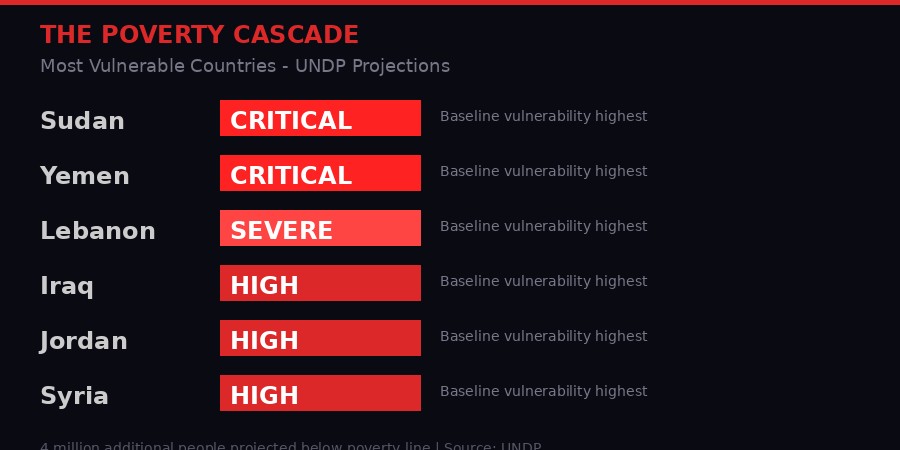
The countries paying the highest human cost | BLACKWIRE infographic
The UNDP's four-million-person poverty estimate is a regional aggregate. Drilling into the country-level data reveals where the suffering concentrates, and it is not in the wealthy Gulf capitals with their sovereign wealth funds and diversified revenue streams. It is in the countries that were already failing before the first bomb fell.
Sudan - which has been consumed by its own civil war since April 2023 - faces the most acute vulnerability. The country's economy was already in freefall before the Hormuz disruption sent fuel and food prices spiraling. With limited foreign reserves, no meaningful export economy, and millions already displaced by internal fighting between the Sudanese Armed Forces and the Rapid Support Forces, the additional shock of regional conflict-driven inflation could push Sudan from crisis to famine.
Yemen - where Houthi forces have opened a second front against US and allied shipping in the Red Sea while simultaneously engaging in proxy operations aligned with Iran - is similarly exposed. Years of Saudi-led bombing, blockade, and civil war have left the country's infrastructure in ruins. The Houthi-controlled north depends on imports for nearly all food and fuel. Global price increases hit Yemen's population with disproportionate force because there are no domestic buffers: no strategic reserves, no domestic production capacity, no functional central bank to manage currency shocks.
Lebanon's inclusion in the UNDP's high-vulnerability category is especially painful because the country's economic destruction is not merely collateral - it is a direct consequence of its geography and political entanglements. Since Hezbollah entered the war on March 2 with retaliatory strikes on Israel following the killing of Iran's former Supreme Leader Ayatollah Ali Khamenei, Israel has intensified its bombardment and ground invasion of southern Lebanon. At least 1,238 people have been killed, more than 3,500 wounded, and over 1.2 million displaced, according to Lebanon's Health Ministry and the United Nations.
The UNDP report noted that Lebanon is experiencing "ongoing air strikes and evacuation orders already causing widespread destruction of residential areas, transport infrastructure, and public services, alongside large-scale displacement." For a country that was already in the grip of a banking collapse, hyperinflation, and political paralysis since 2019, the war is less an economic shock than an economic death sentence.
Iraq and Jordan face elevated but somewhat less acute risks, though both are absorbing refugee flows and economic disruption. Explosions near Erbil's international airport on Tuesday - attributed to Iranian strikes targeting what Tehran claims are US military assets - serve as a reminder that Iraq's fragile stability is one miscalculated strike away from collapse. Jordan, hosting Syrian and Palestinian refugee populations that already strain its resources, faces rising food and fuel costs with limited fiscal space to subsidize them.
Syria, shattered by more than a decade of civil war, barely registers in economic statistics anymore. But the UNDP flags it as high-risk nonetheless - a country where the war's economic shockwaves will be measured not in GDP decline but in calories consumed, medicines available, and children who survive the winter.
05 // The Tanker Attacks: Dubai Port Under Fire
The strike on the Al-Salmi tanker at Dubai Port on Monday night represents something more than another data point in the war's shipping toll. It represents the violation of a space that the global economy assumed was safe. Dubai Port is not the Strait of Hormuz. It is not a contested waterway. It is one of the world's largest commercial ports, the logistical backbone of a city-state that positioned itself as the nexus between Asian manufacturing and European consumption.
Multiple loud explosions echoed across Dubai from approximately 6:00 PM to 2:00 AM local time, according to Al Jazeera's Zein Basravi reporting from the ground. "These attacks seem to be getting closer, they're getting louder, and one of them hit that oil tanker off the coast of the waters of Dubai," Basravi reported. "People certainly seem on high alert here again. You can hear those military jets overhead patrolling the skies."
The Al-Salmi was carrying two million barrels of crude - roughly $236 million worth at current Brent prices - loaded in Kuwait and Saudi Arabia and bound for China. The attack struck at three relationships simultaneously: Kuwait-Iran relations, UAE port security, and China's energy supply chain. Each of those fractures has independent consequences. Together, they represent a systemic threat to the commercial infrastructure that has underwritten Gulf prosperity for decades.
The UAE confirmed that its air forces intercepted eight ballistic missiles, four cruise missiles, and 36 drones launched from Iran on Tuesday alone. Four "Asian nationals" were injured when interception debris fell on homes in southern Dubai. Saudi Arabia separately intercepted and destroyed 10 drones and eight ballistic missiles, with two people injured in al-Kharj province and damage to homes and vehicles.
Iran's foreign minister, Abbas Araghchi, maintained the fiction that Tehran is only targeting US military assets, sharing a photo on social media purportedly showing damage to a US aircraft at Prince Sultan Air Base in Saudi Arabia. "Iran respects the Kingdom of Saudi Arabia and considers it a brotherly nation," Araghchi posted. "Our operations are aimed at enemy aggressors who have no respect for Arabs or Iranians." The four injured Dubai residents, the burning Kuwaiti tanker, and the damaged Saudi homes suggest a different operational reality than the one Iran's foreign ministry is advertising.
06 // Qatar's Rupture: When Mediators Become Targets
Qatar's response to being struck by Iranian attacks while simultaneously trying to mediate the conflict captures the impossible position several Gulf states now occupy. Qatar's Ministry of Foreign Affairs spokesperson, Majed al-Ansari, said on Tuesday that Iran had crossed "many red lines" and that Iranian attacks on Qatar were having a "catastrophic effect on the relationship between the two countries."
The statement is significant because Qatar has historically been the Gulf state most willing to maintain channels with Iran. Doha hosted Hamas's political bureau. It mediated the Gaza ceasefire talks. It maintained diplomatic ties with Tehran when other Gulf states severed theirs during the 2017 blockade. For Qatar to publicly declare its relationship with Iran in catastrophic territory signals a rupture that may outlast the war itself.
Al-Ansari called on all parties to refrain from attacking nuclear and energy infrastructure, warning that "any further escalation will mean more losses for all parties." He confirmed that Gulf states were "unified" in calling for de-escalation - a notable claim given the divergent economic interests at play. Saudi Arabia is benefiting from high oil prices. The UAE is being gutted by them. Qatar sits somewhere in between, wealthy enough to absorb financial losses but politically exposed by its proximity to Iran and its role as a diplomatic bridge.
The spokesperson confirmed that Qatar is not directly involved in Pakistan's mediation efforts but supports them. "We have ongoing communications with all parties, including the mediators as well as other regional players," he said. The careful distancing from Pakistan's initiative while endorsing it suggests Doha may be keeping its own diplomatic channels open for a separate track - or that it recognizes Pakistan's effort as unlikely to succeed and does not want to be associated with the failure.
Iran's attacks on nine countries that are not party to the conflict - Qatar, Iraq, Syria, the UAE, Saudi Arabia, Bahrain, Oman, Jordan, and Kuwait - have transformed the war's political geography. Countries that might have pressured Washington for a ceasefire out of sympathy for Iran are now absorbing Iranian missiles. The goodwill Tehran had in some Arab capitals has been converted into debris craters. The UNDP's $194 billion figure is the economic expression of that political transformation.
07 // The Diplomatic Scramble: Pakistan, China, and the Five-Point Framework
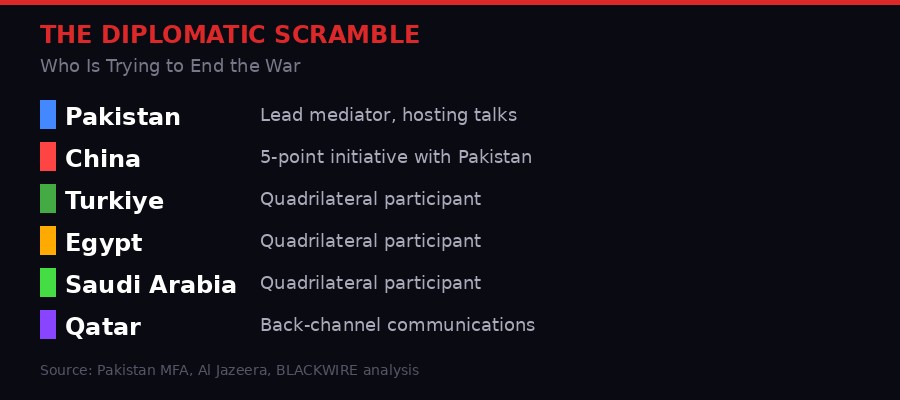
The diplomatic scramble to end the war | BLACKWIRE infographic
Against this economic backdrop, the most consequential diplomatic push to end the war is being led not by the UN Security Council, not by the EU, and not by the United States, but by Pakistan - a country that shares a border with Iran and has been working urgently to prevent the conflict from spilling across it.
On March 29, Pakistan hosted a quadrilateral meeting with the foreign ministers of Turkiye, Egypt, and Saudi Arabia in Islamabad. The four countries discussed frameworks for pushing the US and Iran toward negotiations. Two days later, on March 31, Pakistan's Deputy Prime Minister and Foreign Minister Ishaq Dar traveled to Beijing - despite medical advice to rest after a shoulder fracture sustained while receiving Egypt's foreign minister - to secure China's involvement in a five-point peace initiative.
The Pakistan-China framework, announced Tuesday, calls for: an immediate cessation of hostilities, resumption of talks, protection of civilians, security of shipping including the Strait of Hormuz, and lasting peace based on the United Nations Charter and international law. These are familiar diplomatic principles. The question is whether China will back them with anything beyond words.
Vali Nasr, a former US Department of State official and leading Iran expert, posted on social media that "Iran has asked for guarantees in any deal with the US" and that Dar was traveling to Beijing to secure China as a potential guarantor. "No guarantees of China biting but Beijing is now the front line in the diplomatic effort," Nasr wrote.
Baqir Sajjad Syed, a former Pakistan fellow at the Wilson Center, told Al Jazeera that China is "well-positioned and increasingly willing to act as a credible underwriter of this process" given its economic ties with Iran, broadly stable relations with all parties, and financial weight. "Chinese officials clearly link Beijing's support for Pakistan's mediation to 'restoring Hormuz transit' and 'regional peace and stability,'" he said.
The skeptics are not hard to find. Ishtiaq Ahmad, an emeritus professor at Quaid-e-Azam University in Islamabad, dismissed the idea that China would serve as a guarantor for Iran. "Guarantees are extended by strong, stable actors seeking to preserve order, not by powers aligning themselves with a regime whose position is visibly eroding," he said. Yun Sun of the Stimson Center drew a sharper distinction: "Pakistan can mediate between the US and Iran. China cannot. Most of the calls China has made are with Gulf countries and Iran."
Meanwhile, US Defense Secretary Pete Hegseth said Tuesday that the next few days would be "decisive" while keeping military escalation firmly on the table. On the Iranian side, the IRGC released footage of ballistic missiles fired toward Israel and regional targets, as well as what it claimed were two downed US MQ-9 Reaper drones. The gap between the diplomatic language in Islamabad and Beijing and the operational reality in the Gulf and Strait of Hormuz remains vast.
08 // Lebanon: The Second Front's Economic Catastrophe
The UNDP report's inclusion of Lebanon as a high-vulnerability country understates the scale of what is happening there. Lebanon is not experiencing economic spillover from the Iran war. Lebanon is a battlefield. And on Day 32, that battlefield expanded again.
Israeli Defense Minister Israel Katz announced that Israel plans to occupy parts of southern Lebanon permanently - or at least until a political settlement that may never come. "At the end of the operation, the IDF will establish itself in a security zone inside Lebanon and will maintain security control over the entire area up to the Litani River," Katz said in a video message. This is the "Gaza model" that Netanyahu has been promising: indefinite military occupation presented as defensive necessity.
The UN's Tom Fletcher asked the Security Council a question that nobody could answer: "Given the trajectory that some Israeli ministers have described and given what we have seen in plain sight in Gaza, how will you protect civilians? How should we prepare collectively as the international community for a new addition to the list of occupied territories?"
More than 1.1 million people have been displaced across Lebanon since March 2. The economy - which was already in a banking collapse and hyperinflation crisis since 2019 - is in freefall. The destruction of "residential areas, transport infrastructure, and public services" noted by the UNDP means that even if the war stopped today, Lebanon would need years and billions in reconstruction aid that nobody is offering.
Three UN peacekeepers from Indonesia were killed in southern Lebanon in the 48 hours preceding Tuesday's Security Council emergency session. Two died when an explosion destroyed their vehicle near Bani Haiyyan. One was killed by a projectile at a UNIFIL position near Aadshit al-Qusayr. Jean-Pierre Lacroix, the UN's undersecretary-general for peace operations, said initial findings "point to a roadside explosion striking the convoy." A spokesperson for UN Secretary-General Antonio Guterres warned that attacks on peacekeepers may amount to war crimes.
Israel's expanded buffer zone, the killing of peacekeepers, and the displacement of over a million people represent exactly the kind of "fragile country" shock the UNDP report warned about. Lebanon's contribution to the $194 billion regional economic crater is disproportionate to its size - and is growing every day the ground invasion continues.
09 // Iran's Internal Economics: Executions, Defiance, and a Cabinet Meeting in a Bunker
While the UNDP report focuses on the Arab states, Iran's own economic destruction deserves examination. More than 2,000 people have been killed by US-Israeli strikes since February 28, according to Iranian authorities. Major pharmaceutical plants, steel manufacturers, petrochemical facilities, power infrastructure, and universities have been bombed. Iran produces more than 90 percent of its medicine domestically due to sanctions; the targeting of pharmaceutical companies like Tofigh Darou - a top producer of cancer medication and immunomodulator ingredients - represents an economic attack designed to compound the military one.
Trump has threatened to destroy oil and gas installations, power generation plants, and "possibly" all of Iran's water desalination plants. These are not military targets. They are the infrastructure of civilian survival. If executed, such strikes would create a humanitarian catastrophe that would dwarf the UNDP's Arab-world poverty projections - and would almost certainly trigger refugee flows measured in the millions across every border Iran shares.
The Iranian government's response has been a mixture of military defiance and internal repression. Two more people were executed on Tuesday morning, the judiciary confirmed, described as armed members of the Mojahedin-e-Khalq (MEK) group. New indictments have been issued against 200 "mercenaries" accused of recording footage of air strikes and sending them to foreign outlets. The judiciary reiterated that punishments include full asset confiscation and execution.
President Masoud Pezeshkian held his first cabinet meeting since the war began on Monday night. Images showed a makeshift space at an undisclosed location - the government of a nation of 88 million people meeting under a blue covering like refugees in their own country. Israel's Channel 14 reported that Pezeshkian has been pushing for negotiating authority with the US, but that IRGC chief Ahmad Vahidi declined, unwilling to offer concessions. Iran has not commented on the report.
Pezeshkian's statement from the meeting was carefully calibrated: "Any decision-making about ending the war will be adopted strictly while considering all raised conditions and in the framework of ensuring dignity, security and interests of the great Iranian nation." The language of "dignity" and "guarantees" has been consistent from Iran's civilian leadership. The IRGC's language has been different: defiance, retaliation, escalation. The gap between the two institutions may be the most important fault line in the war.
10 // The Math That Does Not Work
The UNDP's projections were modeled on a four-week war. It has been 32 days. There is no ceasefire. There are no active direct negotiations between the US and Iran. Pakistan and China have issued a five-point framework that neither Washington nor Tehran has endorsed. The UN Security Council convened an emergency session on Tuesday focused primarily on the killing of peacekeepers in Lebanon, not on the broader conflict. Spain has closed its airspace to US warplanes. NATO is fracturing. Gulf states are absorbing missile strikes while their stock markets burn.
Do the math. If $194 billion represents one month of a "short but intense" conflict, what does two months cost? Three? The UNDP's models are not linear - compounding effects mean the second month is worse than the first, as depleted reserves, accumulated infrastructure damage, and eroded investor confidence amplify each additional day's impact. A two-month war does not cost $388 billion. It costs more. Possibly much more.
The 3.7 million jobs already lost do not automatically return when the shooting stops. Destroyed port infrastructure does not rebuild itself. Tourism bookings cancelled for March and April do not reschedule for May. Investor confidence, once shattered, takes years to restore. The UNDP's own director said the report exposed "fragility in the Arab economy" - the recognition that decades of apparent prosperity were built on foundations that 32 days of war have cracked open.
Four million people pushed below the poverty line is not a statistic that reverses when a ceasefire is signed. It is four million people who lost incomes, exhausted savings, pulled children from school, skipped meals, sold assets at distressed prices, and made compromises they cannot unmake. The war's economic damage has a half-life measured in years, possibly decades, in the countries where it concentrates most.
Al Dardari hoped the fighting would stop tomorrow. It will not. The $194 billion crater is not the final bill. It is the first installment.
Key Figures: Day 32 Economic Toll
- $120B - $194B: GDP contraction across Arab states (UNDP estimate, one-month projection)
- $120B: Market capitalization wiped from Dubai and Abu Dhabi exchanges
- $118/barrel: Brent crude (up 67% from pre-war levels)
- 3.7 million: Jobs destroyed across the Arab region
- 4 million: Additional people pushed below poverty line
- 1.2 million: People displaced in Lebanon alone
- 1,238: Killed in Lebanon since March 2
- 2,000+: Killed in Iran since February 28
- 9 countries: Non-combatant nations struck by Iranian attacks
- 3: UN peacekeepers killed in 48 hours
Get BLACKWIRE reports first.
Breaking news, investigations, and analysis - straight to your phone.
Join @blackwirenews on Telegram