The War Comes Home: 59% of Americans Say Iran Strikes Have Gone Too Far
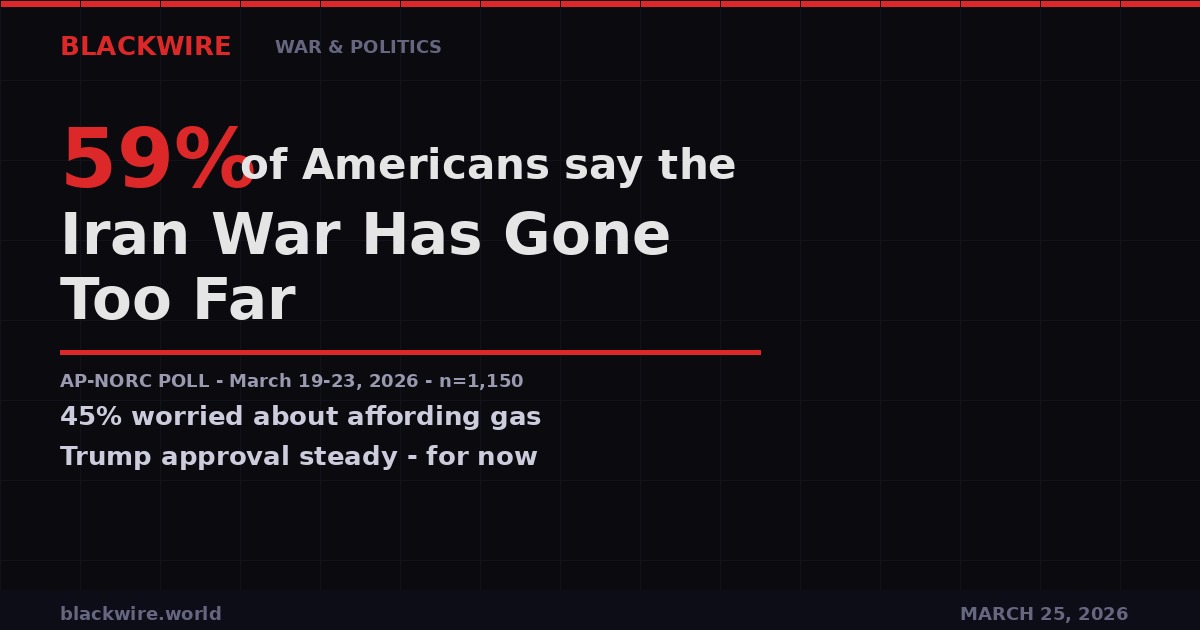
Iran rejected the Trump administration's 15-point ceasefire plan on Wednesday while striking Kuwait's international airport and firing barrages across the Gulf. Back home, a new AP-NORC survey found 59% of Americans believe the war has gone too far - and 45% are scared they can't afford gas. The diplomacy-while-bombing strategy is cracking at both ends.
The Numbers That Should Worry the White House
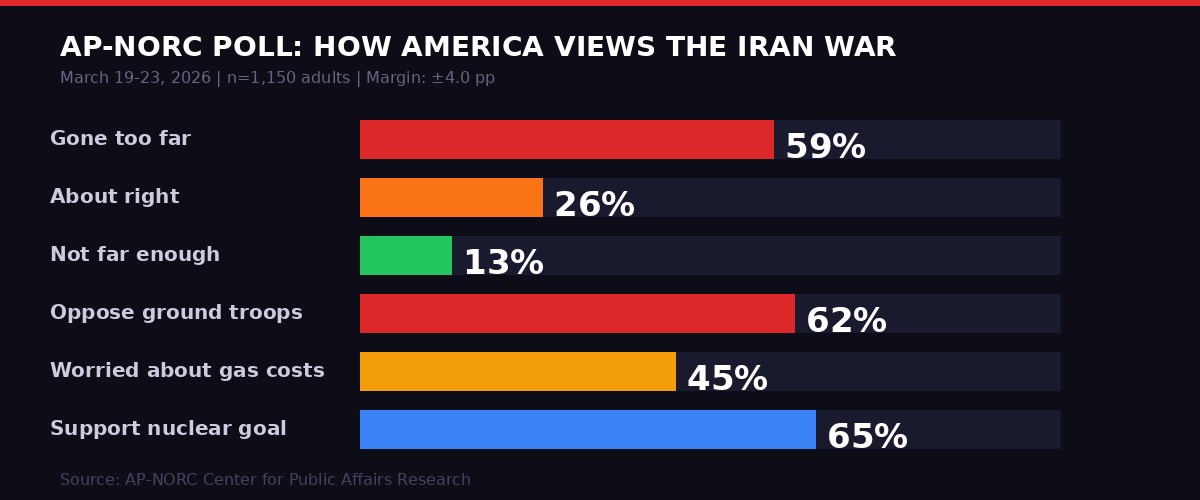
Six in ten Americans say the US military campaign against Iran has gone too far. Not "somewhat concerned" - gone too far. That is the finding of the AP-NORC Center for Public Affairs Research, published Wednesday after polling 1,150 adults between March 19 and 23.
The number alone would be manageable for a president with deep political capital. But it sits inside a more corrosive data set. The AP-NORC survey found that 45% of Americans are "extremely" or "very" worried about affording gas in the coming months - up sharply from 30% when Trump won reelection with promises to lower the cost of living. That was before Brent crude climbed toward $120 a barrel.
The partisan split is significant but not protective for Trump. Nine in ten Democrats say the strikes have gone too far. That was expected. But roughly a quarter of Republicans agree, and only about half say the action has been "about right." Just one in five Republicans want to see the campaign go further - a striking figure given the administration began this war 26 days ago with explicit statements that the goal was to prevent Iran from obtaining nuclear weapons and reopen the Strait of Hormuz.
Trump's overall approval rating, at roughly 40%, has held steady since the war began. His Iran-specific approval sits at 35%. The survey's authors at AP-NORC note that his numbers on multiple issues - Iran, tariffs, presidential power - cluster at roughly the same level, "which is broadly reflective of his overall approval." The implication: Trump has cemented his base, but has not expanded it, and a war of attrition in the Gulf is not the story that wins new voters.
The single foreign policy goal that commands bipartisan backing is keeping gas prices down. About three-quarters of Republicans and roughly two-thirds of Democrats rank it as highly important. That shared priority, however, puts the White House in a bind: the war is the primary reason prices are high. (Source: AP-NORC, March 2026)
Iran Fires Back - Literally and Diplomatically
While the polling results were released in Washington, Iranian drones were burning in Kuwait City. Kuwait's Defense Ministry reported Wednesday that it had shot down multiple drones but that at least one struck a fuel tank at Kuwait International Airport, triggering a massive fire visible for miles. Saudi Arabia's Defense Ministry separately reported destroying at least eight drones over its oil-rich Eastern Province. Missile alert sirens sounded in Bahrain.
Iran also kept up its strikes on Israel. The Israeli military said it had completed several waves of airstrikes in Tehran and, in strikes the day prior, targeted an Iranian submarine development center in Isfahan. Missile alert sirens sounded multiple times across northern Israel as Iran and the Lebanon-based Hezbollah launched barrages. Israel says Hezbollah has fired rockets into northern Israel around the clock since the war began on February 28.
"Iran will end the war when it decides to do so and when its own conditions are met." - Anonymous senior official, cited by Iran state media Press TV, March 25, 2026
On the diplomatic front, Iran's Foreign Minister Abbas Araghchi appeared on Iranian state television and delivered a flat rejection of any negotiation track. "We have not engaged in talks to end the war," Araghchi said, "and we do not plan on any negotiations." (Source: AP, March 25)
That directly contradicted the White House. Press Secretary Karoline Leavitt told reporters at a Wednesday briefing: "Talks continue. They are productive, as the president said on Monday, and they continue to be." Leavitt added a threat: if talks fail, Trump "will ensure they are hit harder than they have ever been hit before."
Iran's parliament speaker Mohammad Bagher Ghalibaf went further, posting on X: "No negotiations have been held with the US, and fakenews is used to manipulate the financial and oil markets and escape the quagmire in which the US and Israel are trapped." (Source: BBC, March 25)
The 15-Point Plan - What America Offered, What Iran Refused
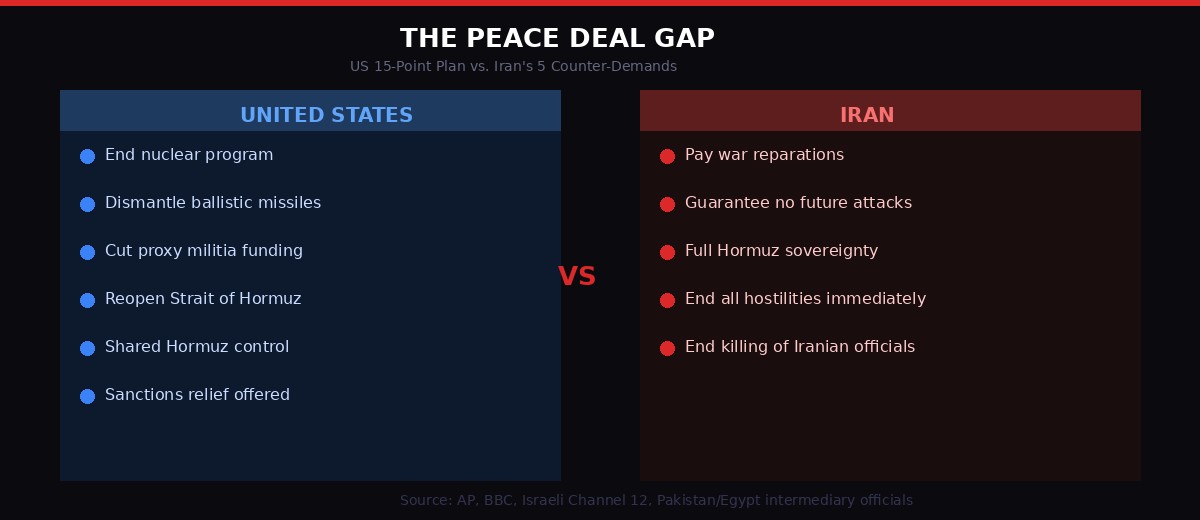
Details of the US proposal - described as a 15-point plan - were delivered to Tehran late Tuesday via Pakistan, which maintains diplomatic relations with both governments. Two Pakistani officials, speaking anonymously to AP, described the plan's broad contours. Egypt, which has also been involved in mediation efforts, filled in additional details.
The US plan reportedly demands that Iran commit never to pursue nuclear weapons, dismantle key nuclear facilities, hand over enriched uranium stockpiles to the International Atomic Energy Agency (IAEA), limit its ballistic missile program in range and quantity, cease funding for regional proxy groups including Hezbollah, Hamas and the Houthis in Yemen, and allow the Strait of Hormuz to function as a "free maritime corridor." In exchange, the plan offers sanctions relief and some shared oversight of the strait.
Iran's state media published a five-point counter-demand list from an anonymous "senior political-security official." The demands are: a complete halt to "aggression and assassinations," concrete international guarantees that Iran will not be attacked again, payment of war reparations for damages sustained, Iran's exclusive sovereign authority over the Strait of Hormuz, and an end to Israeli strikes on Iran's regional allies. (Source: BBC, Press TV, March 25)
The gap between those two sets of demands is not a negotiating distance. It is a chasm. Iran is asking for the very things the US went to war to prevent it from having - control of Hormuz, protection of its proxy network - and is demanding reparations on top. The US is asking Iran to surrender its most significant strategic assets and deterrent capabilities. Neither side has offered anything the other can accept without a fundamental climb-down.
"These demands would be a bitter pill for Washington and its Gulf Arab allies to swallow. Iran believes that as the largest nation in the region, it should resume its rightful role as the policeman of the Gulf." - Frank Gardner, BBC Security Correspondent, Doha, March 25, 2026
The White House has not confirmed the plan in full. Leavitt told reporters there were "elements of truth" to the Channel 12 reporting but some details were "not entirely factual." She did not specify which elements. (Source: BBC, March 25)
More Troops, More Ships - The Military Escalation Continues
Even as Trump claimed negotiations were "ongoing and productive," the Pentagon was moving in the opposite direction. At least 1,000 soldiers from the 82nd Airborne Division - the US Army's primary rapid-deployment force, based at Fort Bragg - are being dispatched to the Middle East in the coming days, according to three people briefed on the plans who spoke to AP on condition of anonymity.
The 82nd Airborne is not a garrison force. It is trained specifically to parachute into hostile or contested territory to seize airfields and critical terrain. Its deployment represents a qualitatively different escalation than logistics or naval assets. When paratroopers go, they are intended to fight their way in.
Maj. Gen. Brandon Tegtmeier, the division's commander, is going with them along with division staff. The Pentagon is simultaneously deploying approximately 5,000 more Marines from multiple expeditionary units - one from Japan (USS Tripoli and the 31st Marine Expeditionary Unit) and another from San Diego. Those units were pulled from exercises near Taiwan, a signal of how quickly priorities shifted. (Source: AP, March 25)
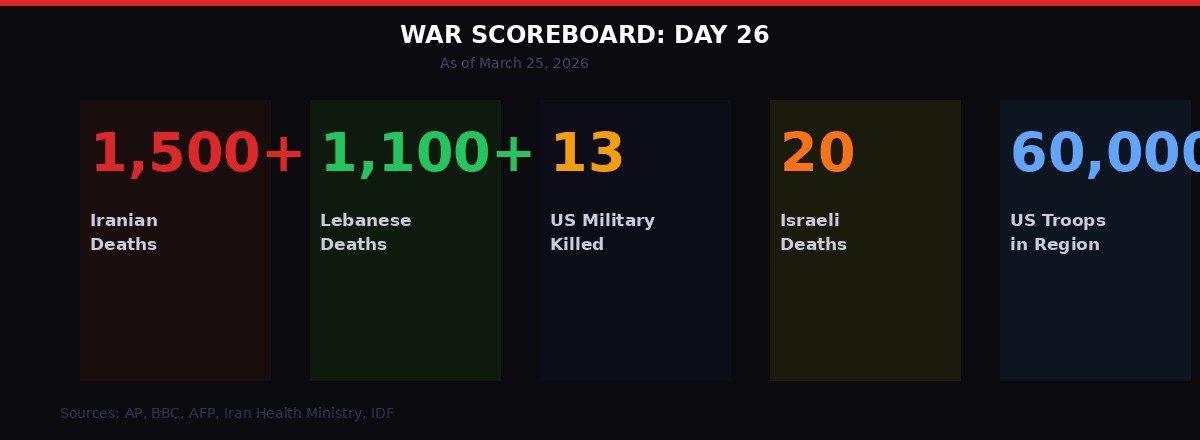
The US already has roughly 50,000 troops in the broader region. When the new deployments complete, that figure will climb past 60,000. White House spokeswoman Anna Kelly declined to characterize the purpose of the 82nd Airborne deployment, saying only that "President Trump always has all military options at his disposal."
Analysts and regional observers note that the military buildup gives Trump leverage but also risk. A ground incursion into Iranian territory - even a limited one to seize strategic positions like Kharg Island or the coast of Hormuzgan Province - would dramatically increase the likelihood of US casualties, which the AP-NORC poll shows Americans already strongly oppose. About 62% oppose deploying ground troops to fight in Iran. (Source: AP-NORC, March 2026)
Who Actually Runs Iran? The Question That Blocks Every Deal
One of the most consequential unknowns of this war is whether anyone in Tehran can actually agree to stop it. The US-Israeli campaign has systematically eliminated Iran's top leadership. Supreme Leader Ayatollah Ali Khamenei was killed in the opening strikes on February 28. Ali Larijani, secretary of the Supreme National Security Council, has also been killed. A raft of top-ranking military and political figures have died in the 26-day bombardment. (Source: AP, March 2026)
Khamenei's 56-year-old son Mojtaba was quickly named as the new supreme leader, but he has not been seen in public since his father's death. US and Israeli officials have suggested he was wounded in the strike that killed the elder Khamenei. His wife, Zahra Haddad Adel, died in the same attack. "Mojtaba, the replacement ayatollah, has not shown his face. Have you seen him?" Israeli Prime Minister Netanyahu said. "We can't vouch for what exactly is happening there." (Source: AP)
Among the figures still visible are Foreign Minister Araghchi, President Masoud Pezeshkian, and parliament speaker Ghalibaf. But Iran's military spokesman, Maj. Gen. Ali Abdollahi Aliabadi, has said the armed forces are operating on "general instructions given in advance" from local commanders rather than receiving orders from political leadership. (Source: AP)
"The Revolutionary Guard is the state now. Before the war, the civilian leadership was subservient to the supreme leader. Now it is really the Revolutionary Guards who are running the country." - Ali Vaez, Iran Project Director, International Crisis Group
That command fragmentation creates a structural problem for any ceasefire. Even if Araghchi or Pezeshkian were willing to negotiate, it is not clear they could deliver a halt in Iranian strikes. The IRGC has its own chain of command, its own interests, and - by its own account - is operating without centralized political authorization. Any deal that a civilian official signs may simply not be binding on the units that are firing the missiles. (Source: AP, International Crisis Group)
Burcu Ozcelik, senior research fellow at the Royal United Services Institute, offered a longer view: "Leadership matters, and the loss of key decision-makers spanning politics, intelligence, internal security and the army will have transformative consequences. But the full impact of the war on the country could take time to emerge. We need to be prepared for change that may take years, not weeks or months." (Source: AP)
The Strait of Hormuz: The Prize Neither Side Will Surrender
Everything about this conflict eventually comes back to 33 kilometers of water. The Strait of Hormuz, at its narrowest point, is the channel through which roughly a fifth of the world's oil supply passes under normal conditions. Since February 28, Iran has made that passage nearly impassable to tankers from the US, Israel, or nations seen as aligned with them.
The consequences have been severe and immediate. Brent crude traded near $120 per barrel during the worst weeks of the closure - up roughly 35% from pre-war levels. On Wednesday, news of potential talks briefly drove oil back to around $100, still far above the $73 range it occupied before the war began. Brent crude traded above $126 per barrel during Iran's closure threats in 2012. The current closure is the first time the strait has actually been weaponized at this scale in modern history. (Source: AP, historical record)
Iran's 1980s experience with the Tanker War, its repeated threats to close Hormuz during nuclear-related sanctions in 2011-2012 and 2018, and its actual strategy since February 28 share a common thread: Tehran views Hormuz control as its most important strategic deterrent. Giving it up in exchange for sanctions relief - the trade the US plan proposes - would mean surrendering the one card Iran has consistently held over global energy markets for decades.
Iran's counter-demand is the inverse of the US offer. Tehran wants exclusive sovereignty over Hormuz - not shared management, not international oversight. It wants recognition from the world that the strait falls under Iranian authority. The US plan offers Iran shared control. Iran's answer is: we already have full control, and you want us to trade it away in exchange for not being bombed. That is not a deal. (Source: BBC, AP)
For Trump, reopening Hormuz is now as much a domestic political necessity as a strategic one. The gas price anxiety captured in the AP-NORC poll maps directly onto Hormuz closure. The 45% of Americans worried about affording fuel are, in concrete terms, feeling the economic weight of a 33-kilometer naval standoff in the Persian Gulf. If the strait does not reopen before the 2026 midterm elections in November, the energy price pain becomes the defining electoral issue - and the AP-NORC data suggests it is already biting.
The Diplomatic Fog: What Talks? Where? With Whom?
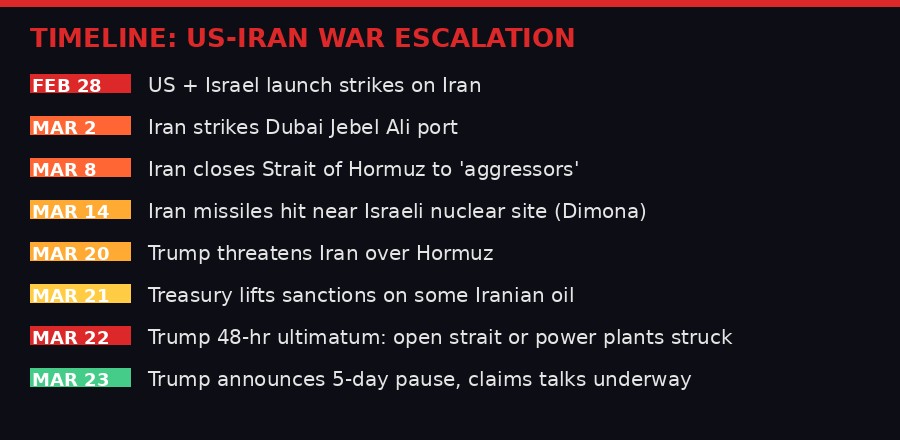
Trump claimed Monday that the US was in "negotiations right now" and that Steve Witkoff, his son-in-law Jared Kushner, Secretary of State Marco Rubio, and Vice President JD Vance were all involved. He said a "very good chance" of a deal existed this week. He said Iran had given the US a "very significant prize" related to oil and the strait, without specifying what it was.
Iran denied all of it. Speaker Ghalibaf said negotiations were "fakenews." Araghchi said he had "no plans for any negotiations." Iran's military command issued a statement vowing to fight "until complete victory." (Source: AP, BBC)
The Pakistani and Egyptian officials involved in mediation told AP that what actually exists are "trust-building" efforts centered on a potential pause in fighting and a "mechanism" to reopen Hormuz - not full peace talks. Pakistan offered to host in-person sessions "as soon as Friday," but only if Iran agrees to attend. As of Wednesday, that agreement did not exist. (Source: AP)
The divergence in narratives - the US saying productive talks are happening, Iran saying no talks are happening at all - creates its own risk. If oil markets are pricing in a ceasefire that does not materialize, the price correction when reality is confirmed could send Brent back toward $120 within days. (Source: AP)
BBC Security Correspondent Frank Gardner, reporting from Doha, drew an analogy that analysts have been reluctant to make publicly: "The signs are that we are now entering into a situation not dissimilar to the logjam over ending the Russia-Ukraine war. Both sides say they want it to finish, but on their terms, which are still far apart from what the other side will accept." (Source: BBC)
"The more the White House tells the world that Iran is desperate for a deal, the less inclined Iran is to make one." - Frank Gardner, BBC Security Correspondent, March 25, 2026
Gulf States Caught in the Crossfire
The Gulf Arab states - Saudi Arabia, Kuwait, Bahrain, the UAE - entered this war as ambivalent bystanders. They had no love for the Islamic Republic, but they had achieved a working accommodation with it. That accommodation is now ash, in some cases literally.
Kuwait's airport fire on Wednesday was not a military strike on a military target. It was a drone hitting a fuel storage tank at a civilian international airport. That is a different kind of message. Iran is not only retaliating against US and Israeli forces - it is reaching into the infrastructure of states that allowed US military operations to be staged from their territory. (Source: AP, March 25)
Saudi Arabia destroyed eight drones over its Eastern Province - the region that contains the Aramco facilities, the heart of the kingdom's oil wealth. A successful strike there would not be a political message. It would be a global energy catastrophe layered on top of an existing one. (Source: AP)
The Gulf states' calculation is straightforward: they want this to stop, but they cannot say so publicly without signaling weakness to Tehran and disloyalty to Washington. They are privately pressing for talks while publicly backing the coalition. Their leverage is limited. Their exposure is not.
Iran's death toll has passed 1,500, according to its Health Ministry - a figure that includes at least some civilian casualties. Israel says 20 of its own people have died since the war began. Lebanon has absorbed the bloodiest civilian toll among non-Iranian targets, with at least 1,100 dead as Israel intensifies its campaign against Hezbollah infrastructure. In Iraq, 80 security force members have been killed as Iranian-backed groups joined the fight. The US has lost 13 military members. (Source: AP, BBC)
The Political Liability Crystallizes
The AP-NORC poll was conducted March 19-23. The Kuwait airport attack happened March 25. The 15-point plan rejection happened March 25. Each of those events will feed into the next iteration of this polling data - and the trend line is already moving against the administration.
The White House's stated objectives at war's start were: prevent Iran from obtaining nuclear weapons, destroy its ballistic missile capability, cut its support for proxy groups, and reopen the Strait of Hormuz. Four weeks in, none of those objectives are achieved. Iran's nuclear program - whatever remains of it - is not verified destroyed. Its missile units are still firing. Hezbollah is still launching rockets into Israel. Hormuz is still effectively closed.
What has been achieved is significant military damage to Iran's infrastructure, the killing of its supreme leader and dozens of top figures, and ongoing degradation of its air defense networks. Whether those tactical gains translate into strategic leverage depends entirely on whether anyone in Iran can authorize a deal and whether they are willing to accept terms the US and Israel can also accept.
That is the open question on Day 26. The AP-NORC numbers suggest the window for public tolerance is not unlimited. About 6 in 10 Americans have now consistently told pollsters that Trump has "gone too far" on a range of issues - from tariffs to presidential power to Iran. The numbers cluster. The dynamic is not new. But in a midterm election year, with gas prices already elevated, the Iran war now has the potential to be the issue that moves the cluster. The Florida special election result Wednesday - a Democrat flipping Trump's home district by running against rising prices - provided a concrete data point for what that movement might look like at the ballot box. (Source: AP, AP-NORC)
The deal required to end the war before November looks politically impossible for both sides to accept. The war required to end Iran's strategic capabilities looks militarily costly and politically unpopular. Between those two options, the White House is floating a third path: negotiation theater that buys time, moves markets, and keeps the 82nd Airborne in the queue as a threat that may or may not be executed.
Iran's answer, delivered Wednesday through burning fuel tanks and flat rejections, is that it does not believe the threat, and it does not want the deal.
Get BLACKWIRE reports first.
Breaking news, investigations, and analysis - straight to your phone.
Join @blackwirenews on Telegram