
The United States does not have an exit strategy. That is not an accusation - it is the stated concern of members of both parties on Capitol Hill, spoken plainly and on record to the Associated Press. What began as an air campaign against Iran's nuclear facilities on February 28 has, in less than four weeks, grown into something far larger, far more expensive, and far less clearly defined than either the White House or the Pentagon has been willing to admit.
On Tuesday, the Army ordered at least 1,000 troops from the 82nd Airborne Division - America's premier rapid-deployment parachute force - to prepare for deployment to the Middle East. That follows confirmation that two Marine Expeditionary Units, totaling around 5,000 Marines and thousands of supporting sailors, are already en route. The Japan-based USS Tripoli, previously conducting exercises near Taiwan, has been redirected to the Gulf. The Navy rushed a rapid-response Marine force from San Diego ahead of schedule. A classified briefing for the Senate Armed Services Committee on the 82nd Airborne deployment took place Wednesday on Capitol Hill.
The math is stark: the US already had approximately 50,000 troops stationed throughout the region when the war began. By the time these new deployments complete, that number climbs toward 65,000 or beyond - and none of the officials briefing Congress have offered a clear explanation for what those troops are supposed to do, or when they will come home.
The 82nd Airborne: What It Means When You Send Paratroopers

The 82nd Airborne Division is trained to parachute into hostile or contested territory to seize airfields and key infrastructure - missions that imply forward combat positions. (Pexels)
The 82nd Airborne Division, based at Fort Bragg, North Carolina, is not a defensive force. It is not a garrison unit. The 82nd is the Army's designated Global Response Force - a formation specifically trained and configured to parachute into contested or hostile territory on short notice, secure airfields, and hold ground until heavier forces can arrive.
When the White House deploys the 82nd, it sends a particular kind of message. It is the signal you send when you want an adversary - and your own military brass - to understand that ground operations are genuinely on the table. As the AP reported Tuesday, the deployment includes Maj. Gen. Brandon Tegtmeier, the division's commander, along with division staff - not just a brigade detachment, but a command-and-control apparatus designed to operate forward.
White House spokeswoman Anna Kelly, when pressed, offered a statement that answered nothing: "President Trump always has all military options at his disposal." The Pentagon deferred questions.
But military doctrine doesn't lie. You do not send the 82nd Airborne to hold a logistics base behind the wire. The unit's core mission - forcible entry into denied territory - is precisely what makes its deployment significant beyond numbers. It means the US military is preparing, at minimum, for contingencies that involve moving troops into contested Iranian airspace or seizing infrastructure under fire.
The 1st Brigade Combat Team's battalion, along with the divisional headquarters element, represents a compact but high-readiness force that can begin operations within 18 hours of an execute order. That timeline is not theoretical. It is what the 82nd is built for.
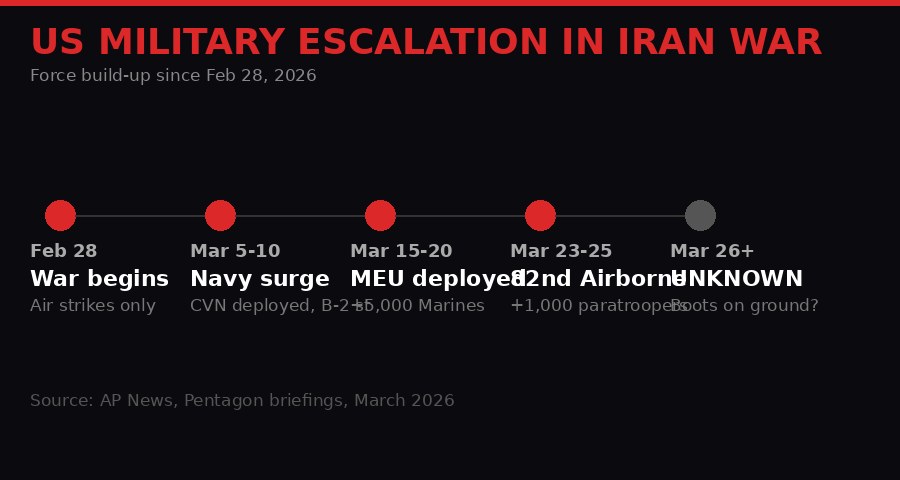
US force build-up in the Iran war, February-March 2026. Source: AP News, Pentagon briefings.
The Marines: Amphibious Assault Capability Deployed to the Gulf

US Navy ships carry Marines trained in amphibious assault operations. The Gulf's shallow waters and coastline geography make Iranian coastal installations potential targets. (Pexels)
The Marine Expeditionary Units now heading to the region bring a distinct capability set. MEUs are designed for amphibious operations - seizure of beachheads, raids on coastal installations, non-combatant evacuations, and the kind of short-notice forcible entry that complements what the 82nd Airborne does from the air. Together, the two force packages represent a pincer: air entry from above, amphibious entry from the sea.
The USS Tripoli's redeployment from Taiwan exercises to the Middle East carries its own diplomatic weight. The US was running those exercises alongside regional partners as a signal to Beijing. Pulling that asset and redirecting it to the Gulf tells China something about American bandwidth - and about where Washington's immediate military priorities lie.
The San Diego-based Marine rapid-response force was accelerated out of its home port ahead of schedule, according to AP reporting from US officials speaking on condition of anonymity. "Rushed" and "ahead of schedule" are not phrases that suggest a leisurely deployment for deterrence. They suggest that commanders believe time matters.
Combined, the two MEUs add roughly 5,000 Marines to the region's American force posture, plus thousands of sailors required to operate the ships that carry them. This is not a show of force. This is pre-positioning for operations.
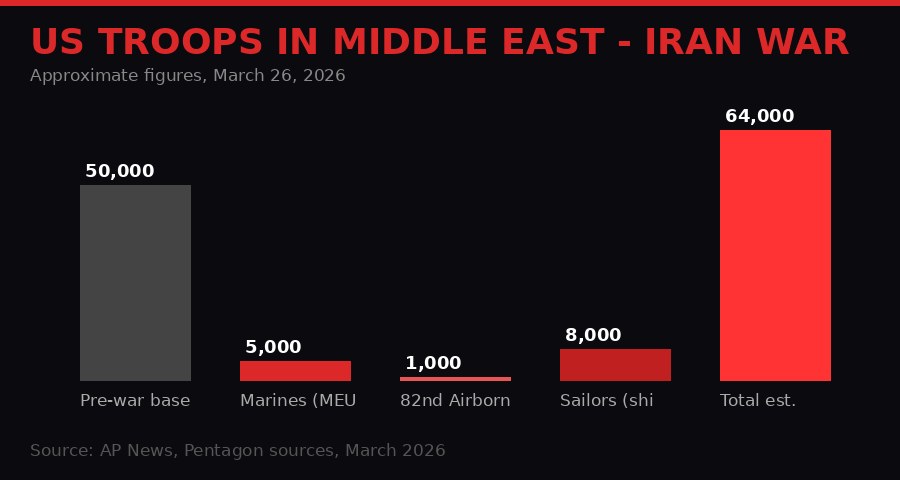
Approximate US forces in the Middle East by category, March 26, 2026. Source: AP News, Pentagon sources.
Congress: Where Is the Exit? Where Is the Vote?

Congress is constitutionally empowered to declare war - but Trump launched the Iran campaign without a vote. The War Powers Act gives him 60 days before a congressional mandate kicks in. (Pexels)
The War Powers Resolution - passed in 1973 in the shadow of Vietnam - gives a US president the authority to deploy military force for up to 60 days without congressional authorization. Day 26 of the Iran war arrived this week. That leaves 34 days before the constitutional clock runs out and Congress is legally obligated to vote on whether the war continues.
Trump launched the war without seeking that vote. Republicans in the House and Senate have so far killed every Democratic resolution designed to invoke the War Powers Act and force a withdrawal. But the political arithmetic is shifting.
"The real question is: What ultimately are we trying to accomplish?" - Sen. Thom Tillis (R-NC), Senate Armed Services Committee, to AP News
Tillis added that he generally supports actions that target Iran's leadership, "but at the end of the day, there has to be a kind of strategic articulation of the strategy, what our objectives are." That statement, from a Republican, carries weight. Tillis is not a critic of the administration on reflexive grounds. His skepticism reflects something real: nobody in the White House has clearly explained what winning looks like.
House Speaker Mike Johnson offered a version of optimism that collapsed under its own logic. He told reporters this week that "the original mission is virtually accomplished" - that US strikes had taken out Iran's ballistic missiles, its means of production, and its navy. But Johnson then immediately acknowledged that Iran's continued control of the Strait of Hormuz "is dragging it out a little bit." The Strait of Hormuz is, arguably, the entire remaining problem. Describing it as a minor complication is not a strategic framework.
The Pentagon has meanwhile submitted what officials describe as a $200 billion emergency war funding request to the White House. Senate Minority Leader Chuck Schumer called the figure "preposterous." Whatever its final form, that request will require congressional votes - and those votes will force a public reckoning with objectives that nobody in the administration has articulated clearly.
Trump's most widely quoted statement on the war's endpoint remains this: it will end "when I feel it in my bones." Virginia Sen. Mark Warner, ranking member of the Senate Intelligence Committee, offered a one-word response: "Crazy."
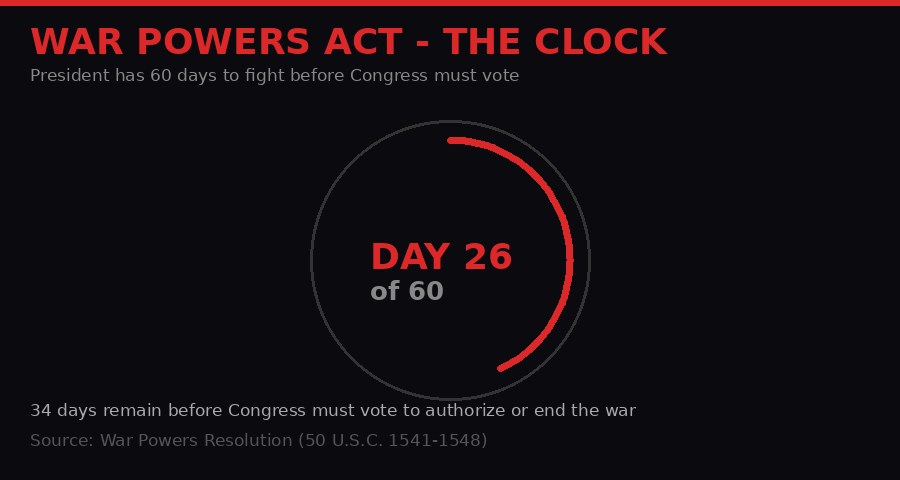
The War Powers Act 60-day clock: Day 26 of 60. Congress must vote by late April to authorize or end the war. Source: War Powers Resolution (50 U.S.C. 1541-1548).
The Ceasefire That Isn't: 15 Points, 5 Counter-Demands, Zero Progress

Mediators from Pakistan, Egypt and Gulf Arab states are trying to bridge an enormous gap between US and Iranian positions. Both sides are escalating militarily while talking of talks. (Pexels)
While the military escalation continues, a parallel - and deeply confused - diplomatic track is running alongside it. Late Tuesday, Pakistan transmitted a 15-point ceasefire proposal from the US to Iran. Two Pakistani officials described its broad outlines: sanctions relief, rollback of Iran's nuclear program, limits on ballistic missiles, reopening of the Strait of Hormuz, and restrictions on Iranian support for armed proxy groups across the region.
Iran's response was unambiguous. Foreign Minister Abbas Araghchi said on state television that his government has not engaged in negotiations "and we do not plan on any negotiations." Iranian state TV's English-language broadcaster, Press TV, reported that Tehran had rejected the plan outright and issued its own five-point counter-demand: halt the killing of Iranian officials, guarantee Iran against future strikes, pay reparations for the war, end all hostilities, and recognize Iranian sovereignty over the Strait of Hormuz.
Those counter-demands are not a negotiating position. They are a list of things no American administration could accept politically - reparations, in particular, would require Trump to admit that the war was unjust, and sovereignty over Hormuz would effectively concede Iran a permanent chokehold on global oil markets. Iran knows this. The counter-offer was designed to be rejected.
"They are negotiating, by the way, and they want to make a deal so badly, but they're afraid to say it because they figure they'll be killed by their own people. They're also afraid they'll be killed by us." - President Donald Trump, fundraiser speech, Washington DC, Wednesday March 25, 2026
Trump's reading of Iran's internal politics may be accurate - Tehran's domestic constraints are real - but the quote reveals a president negotiating through public confidence rather than private channel. Whatever Witkoff, Kushner, Rubio and Vance are doing behind closed doors, the public posture does not resemble a synchronized diplomatic push. It resembles improvisation.
Mediators from Egypt and Pakistan are pushing for face-to-face US-Iran talks in Islamabad, possibly as soon as Friday. But the Iranians have not confirmed attendance. And with new US troops flowing toward the region even as diplomats talk of trust-building, Tehran has little incentive to show up and every incentive to wait.
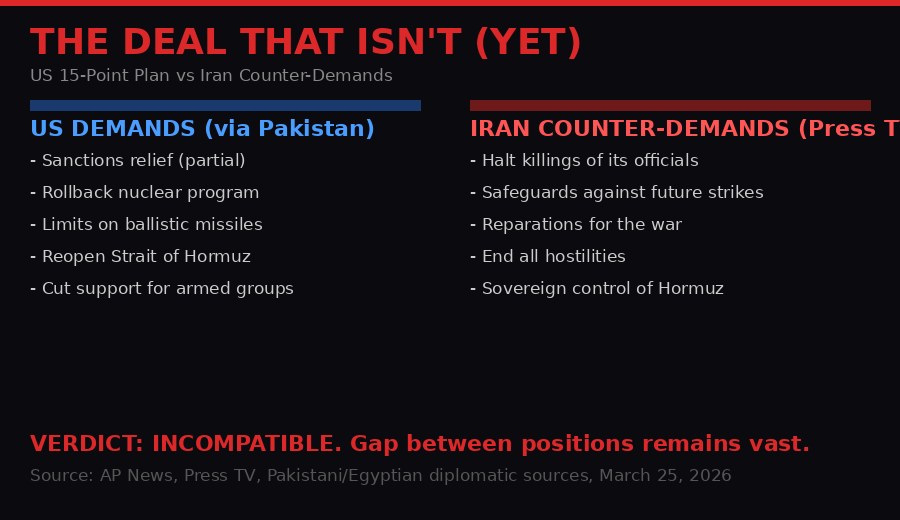
The gap between US and Iranian positions remains vast. Source: AP News, Press TV, Pakistani/Egyptian diplomatic sources, March 25-26, 2026.
The Battlefield: Kuwait Airport Burning, Hezbollah Cells in the Gulf

Iranian drone and missile attacks have struck energy infrastructure across the Gulf, including a fuel tank fire at Kuwait International Airport on Wednesday. (Pexels)
While diplomats circulated proposals and presidents gave fundraiser speeches, the war ground on. Wednesday's military picture was grim across every front.
Iran launched attacks on Israel, Saudi Arabia, Bahrain and Kuwait. Saudi Arabia's Defense Ministry reported destroying at least eight Iranian drones over its oil-rich Eastern Province. Missile alert sirens activated in Bahrain. In Kuwait, the military shot down multiple drones - but one got through, striking a fuel tank at Kuwait International Airport and igniting a fire that emergency crews worked to contain.
Israel launched new airstrikes on Tehran, the Israeli military said - follow-on strikes to the previous day's attack on an Iranian submarine development facility in Isfahan. Hezbollah continued its around-the-clock rocket fire into northern Israel, where communities have lived under constant alert since the war's opening day. Missile sirens sounded across Israel as Iranian and Hezbollah projectiles flew.
Then came the intelligence disclosure that reframed the Gulf's threat environment entirely: Kuwaiti authorities announced the arrest of six people allegedly linked to Hezbollah, accused of plotting to assassinate Gulf Arab leaders. Fourteen associates had fled the country, officials said. The operation suggests Iran's proxy network has been working inside Gulf states as an active fifth column - not just a contingency, but an ongoing covert campaign running parallel to the overt military one.
More than 1,500 people have been killed in Iran since the war began, according to the country's Health Ministry. Twenty have been killed in Israel. The figures for Iraq - where Iranian proxies have attacked US bases repeatedly - and for Gulf states remain fragmented. US military dead stand at 13; more than 230 have been wounded.
Iran's Fractured Command: Who Is Actually Deciding to Fight?

Iran's command structure has been severely disrupted by targeted assassinations of senior political and military leaders. The IRGC now functions with unprecedented autonomy. (Pexels)
The question of who is running Iran matters enormously to any prospect of a negotiated end to the war. The answer, three weeks in, remains dangerously unclear.
Supreme Leader Ayatollah Ali Khamenei was killed in the opening hours of the war on February 28, in an airstrike on his compound in downtown Tehran. His son, 56-year-old Mojtaba Khamenei, was quickly named as successor - but Israeli Prime Minister Benjamin Netanyahu said bluntly at a press conference: "I'm not sure who's running Iran right now. Mojtaba, the replacement ayatollah, has not shown his face. Have you seen him? We haven't." US and Israeli officials have suggested the younger Khamenei was wounded in the same strike that killed his father.
Ali Larijani, secretary of Iran's Supreme National Security Council, has also been killed. Along with a reported "raft" of other senior military and political figures, the systematic targeting of Iran's leadership tier has left its decision-making apparatus in what Netanyahu called "utter chaos."
"The Revolutionary Guard is the state now." - Ali Vaez, Iran Project Director, International Crisis Group
Vaez told AP that before the war, Iran's civilian leadership was "subservient entirely" to the supreme leader, while the Revolutionary Guard was the second power. Now, with the elder Khamenei gone and his son's authority unproven, "it is really the Revolutionary Guards who are running the country." The IRGC, an organization with its own economic interests, its own intelligence apparatus, and its own ideological commitments - has never been subject to the kind of civilian restraint that might incline it toward negotiation.
Burcu Ozcelik of the Royal United Services Institute in London offered a longer timeline: "Leadership matters, and the loss of key decision-makers spanning politics, intelligence, internal security and the army will have transformative consequences. But we need to be prepared for change that may take years, not weeks or months."
An organization that "will fight until complete victory" - the words of Iran's military spokesman - is not an organization making a diplomatic calculation. It is an organization that has been radicalized by the loss of its civilian restraints and may now be running a war not toward any achievable objective, but as a matter of institutional identity.
The Strait of Hormuz: What Everyone Is Actually Fighting Over

A fifth of the world's oil transited the Strait of Hormuz before the war. Near-closure has sent fuel prices soaring and is the primary economic lever driving US urgency. (Pexels)
Strip away the rhetoric about nuclear weapons, regime change, and Iranian proxies, and what remains at the core of the Iran war is a 21-mile-wide chokepoint between the Gulf of Oman and the Persian Gulf.
The Strait of Hormuz carries approximately a fifth of all global oil exports under normal conditions. That flow has been reduced to a trickle. Iran's military presence on islands within and adjacent to the strait - combined with drone and missile attacks on commercial shipping - has made the waterway functionally impassable for most tanker operators. The AP reported that dozens of vessels have still managed to cross, according to maritime data platforms, but the bulk of traffic has halted.
The consequences are not abstract. US gas prices have surged. About 45% of Americans are now "extremely" or "very" concerned about being able to afford gasoline in the coming months - up from 30% in a poll taken just after the November 2024 election, according to AP-NORC data. Three-quarters of Republicans and two-thirds of Democrats say keeping oil and gas prices down is highly important. That bipartisan consensus on a kitchen-table issue is the single most politically dangerous aspect of the war for the Trump administration.
Iran knows this. Its five-point counter-proposal included explicit retention of "sovereignty over the Strait of Hormuz" - the one demand guaranteed to be rejected, which tells you it was never intended as a serious negotiating position but as a public statement of what Iran is fighting to preserve. Control of that strait is Iran's ultimate deterrent: the ability to hold the global oil market hostage. It will not give that up for sanctions relief and diplomatic recognition.
House Speaker Johnson acknowledged the strait's centrality when he said Iran's ability to threaten shipping there was "dragging it out a little bit." That understatement - "a little bit" - underscores how completely the administration has failed to communicate the scale of what it is trying to accomplish. Reopening Hormuz against Iranian resistance would require the destruction of Iran's coastal missile batteries, its island fortifications, its submarine capability, and its fast-attack boat fleet. None of that happens from the air alone. All of it happens only with naval and possibly ground operations that Congress has not authorized and the American public, by 59%, says has already gone too far.
War Timeline - Key Escalation Moments
What Comes Next: Three Scenarios, All Bad

US military planners face three converging pressures: an adversary that won't negotiate, a Congress demanding an exit, and a public that says enough. The options are narrowing. (Pexels)
By late March, three scenarios are plausible. None of them is clean.
The first scenario is continued escalation. The 82nd Airborne secures an airfield. Marines execute amphibious operations against Iranian coastal missile sites. The Strait of Hormuz is cleared by force. Iran's IRGC fights on regardless, sustained by its institutional survival instinct and its willingness to absorb casualties that would be politically unacceptable in Washington. The war drags through the summer, through the War Powers Act deadline, toward a midterm election cycle that already, based on Florida's March special election result, is showing warning signs for Republicans.
The second scenario is a forced diplomatic pause. Pakistan's in-person talks materialize. Iran sends someone empowered to agree to a temporary ceasefire but not a permanent deal. Both sides halt active strikes - Iran keeps its grip on Hormuz partially loosened, the US keeps its troops in place. The conflict freezes into a standoff that resolves nothing and leaves all the underlying issues intact. Trump declares it a deal and moves on.
The third scenario is escalation beyond current parameters - either Iranian strikes that kill Americans in numbers that force a congressional vote, or the deployment of US ground forces into Iran itself, triggering a constitutional crisis over war powers that would consume the Republican Congress and potentially rupture Trump's political coalition.
None of these scenarios ends with a stable Middle East, a reopened Strait of Hormuz, and American troops home before the midterms. The realistic question is not how this ends well. It is which version of bad the administration can navigate without catastrophic political or military damage.
The 82nd Airborne's deployment order does not answer that question. It only sharpens it. When you send paratroopers, you are not closing doors. You are opening them - and somewhere down that corridor, a decision awaits that nobody in the White House has yet been willing to name out loud.
Get BLACKWIRE reports first.
Breaking news, investigations, and analysis - straight to your phone.
Join @blackwirenews on Telegram