Asia on Empty: How the Iran War's Hormuz Blockade Broke the World's Supply Chain
BLACKWIRE | Wednesday, March 25, 2026 | Dubai / Manila / Bangkok
The Philippines just declared a national energy emergency. 3,200 ships are stranded in the Persian Gulf. Drug supplies from India are running low. The Hormuz blockade - now in its 25th day - has moved beyond an oil story. It is gutting the entire architecture of global trade, and the hardest hit countries are the ones nobody in Washington was thinking about when the bombs fell on Tehran.
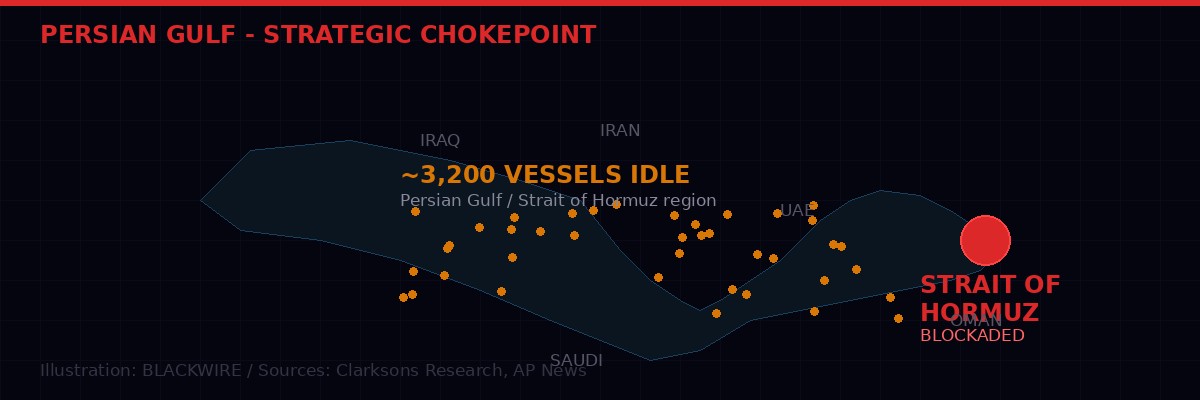
Roughly 3,200 vessels are idle inside or near the Persian Gulf. The Strait of Hormuz - the narrow passage between Iran and Oman - carries a fifth of global oil and one-third of the world's LNG. Graphic: BLACKWIRE
The Emergency Nobody Voted For
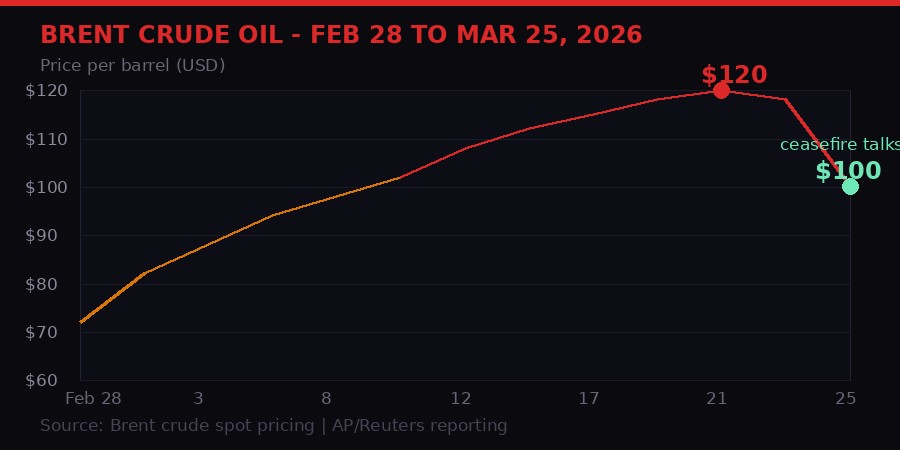
Brent crude surged nearly 40% after US-Israeli strikes opened the war on Feb 28. Ceasefire diplomacy on March 25 pushed prices back toward $100 - but analysts warn a deal is far from guaranteed. Source: AP/Reuters market reporting
Philippine President Ferdinand Marcos Jr. signed the declaration of a state of national energy emergency on Tuesday. The order will last at least a year. A new contingency committee under Marcos' direct command will control the distribution of fuel, food, medicines and agricultural goods. (AP News, March 25, 2026)
The government cited "an imminent danger of a critically low energy supply." It was not political theater. Gasoline prices in Manila have been tracking the war in real time since Feb 28, when the United States and Israel launched coordinated airstrikes on Iran, killed Supreme Leader Ayatollah Ali Khamenei, and triggered the longest sustained closure of the Strait of Hormuz in recorded history.
About 2.4 million Filipinos live and work in the Middle East - roughly 31,000 in Israel, 800 in Iran. The Department of Migrant Workers has been ordered to prepare evacuation contingency plans. The government has already begun issuing 5,000 pesos ($83) each to motorcycle taxi drivers and other transport workers across the country to offset rising diesel costs. Free bus rides have been rolled out in selected cities for students and workers.
One Filipino worker, a caregiver named Mary Ann de Vera, was killed in Tel Aviv on Feb 28 - hit by an Iranian missile while helping her elderly charge reach a bomb shelter, according to Philippine officials.
"The situation is common across the board. There is no easy decision for the short term." - Putra Adhiguna, Energy Shift Institute, Jakarta
The Strait of Hormuz: What's Actually Blocked
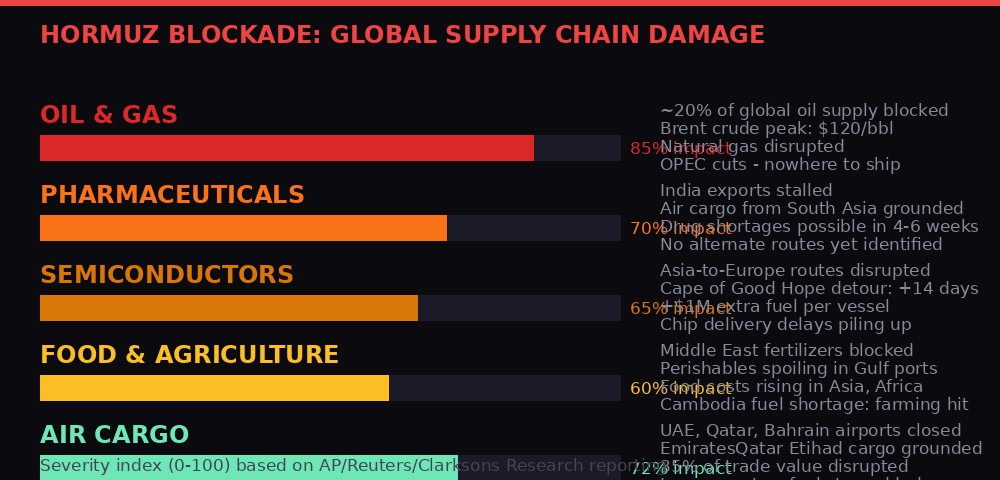
The Hormuz closure has cascaded far beyond oil. Pharmaceuticals, semiconductors, fertilizers, and air cargo are all facing severe disruption. Severity indices based on AP/Reuters/Clarksons Research reporting. Graphic: BLACKWIRE
The Strait of Hormuz is a 21-mile wide channel between Iran and Oman. Before the war, roughly a fifth of the world's oil passed through it every day. So did enormous volumes of liquefied natural gas, pharmaceuticals from India, semiconductors from Asia, nitrogen fertilizers from the Gulf, and general cargo moving between East and West.
Iran has not formally "closed" the strait in the legal sense. It has done something more effective. By threatening and attacking commercial ships, combined with the de facto collapse of the regional insurance market, it has achieved the same result: nearly all shipping has stopped. (AP News, March 2026)
Clarksons Research, which tracks global shipping data, estimates approximately 3,200 vessels are now idle inside the Persian Gulf, representing about 4% of global ship tonnage. A further 500 ships are "waiting" in ports off the UAE and Oman coasts, outside the Gulf entirely, unable or unwilling to proceed. (AP News, March 2026)
Iran has quietly allowed a small number of ships to transit - none from the US, Israel, or countries seen as aligned with them. Iranian Foreign Ministry spokesman Esmail Baghaei confirmed on Tuesday that Iran is charging ships for passage. He did not elaborate on the rate. (AP interview with India Today, March 25)
The domino effect is already being felt far from the Gulf. Shipping company Maersk had only recently resumed Suez Canal transit after years of Houthi disruption - it is now rerouting all traffic around the Cape of Good Hope again. That detour adds 10 to 14 days to each journey and roughly $1 million in extra fuel costs per ship. (AP News, March 2026)
"The supply chain is kind of like a long train with many cars and each car represents a port in the world. Well, if one car gets derailed, it can very often have a domino effect to many other cars behind it or in front of it." - Michael Goldman, General Manager North America, CARU Containers
Southeast Asia in Triage Mode
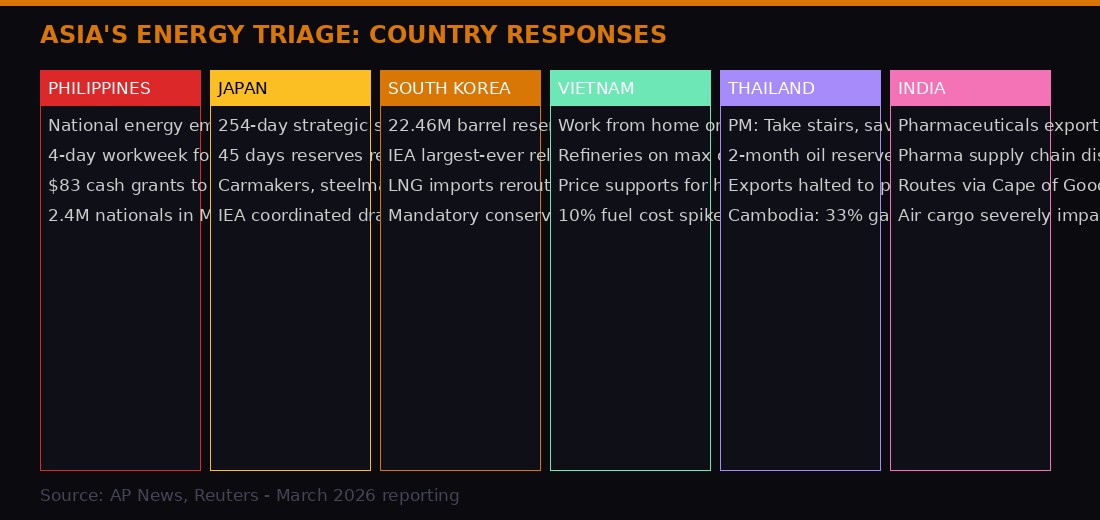
Six major Asian economies and their emergency energy responses to the Hormuz closure. Japan's 254-day strategic reserve is the region's strongest buffer. Graphic: BLACKWIRE / Source: AP News
Across Southeast Asia, governments are scrambling to stretch supplies they do not have enough of to last through a war that shows no sign of ending soon.
VIETNAM
Hanoi has urged citizens to work from home to cut fuel consumption. Refineries have been instructed to maximize output. The government is using price supports to shield households. For Dieu Linh, a vegetable seller in Hanoi, it is not enough. "If my costs go up by even a little, the profit is almost gone," she told AP reporters this week.
THAILAND
Thai Prime Minister Paetongtarn Shinawatra has asked government officials to take the stairs rather than elevators to conserve energy. The country is stretching its roughly two-month strategic oil reserve. It has halted fuel exports to protect domestic supplies - a move that has contributed to a shortage that has forced nearly a third of Cambodia's roughly 6,000 gas stations to close. (AP News, March 2026)
BANGLADESH
Scenes of motorists queuing for hours outside petrol stations have been reported since early March. The country imports almost all of its oil and has limited strategic reserves. With no domestic production to fall back on, Dhaka is competing on the spot market against much larger economies for whatever scarce supply remains available.
Patrick Penfield, professor of supply chain practice at Syracuse University, put the near-term outlook bluntly: "As this conflict keeps progressing, you'll start to see some shortages, you'll see some major price increases." (AP News, March 2026)
The Control Risks consultancy warned that even modest constraints on energy use will drag on industrial activity. "Vietnam's energy-intensive export industries could see higher production costs or slower factory output quickly," said analyst Linh Nguyen. Vietnam's manufacturing sector - heavily dependent on foreign orders - cannot easily absorb extended supply disruptions.
East Asia Draws Down Strategic Reserves
Japan, South Korea, and Taiwan import the vast majority of their energy. More than 80% of the LNG that passed through the Strait of Hormuz in 2024 went to Asia - much of it to these three countries. (US Energy Information Administration data via AP)
Japan is deploying the most powerful buffer in the region. Its strategic petroleum reserve amounts to approximately 254 days of supply - a system built precisely after the 1970s Arab oil crisis to prevent this kind of shock from becoming catastrophic. Japan began releasing about 45 days' worth of reserves this week. Last time Japan tapped its emergency stockpile at this scale was after Russia's invasion of Ukraine in 2022. (AP News, March 2026)
The release is designed to keep Japan's most energy-intensive industries running - Toyota's assembly lines, Mitsubishi's industrial facilities, Nippon Steel's blast furnaces. These companies sit at the center of Asian and global manufacturing supply chains. If they slow, the ripple effects spread far beyond Japan's borders.
South Korea is participating in the International Energy Agency's largest-ever coordinated strategic stock draw - contributing 22.46 million barrels to the collective release. The IEA activated the emergency release mechanism in mid-March after oil prices spiked past $115. (AP News, March 2026)
The reserve draw is buying time. Analysts are clear that it is not a solution. IEA emergency releases have historically been able to suppress prices temporarily but cannot substitute for actual supply. If the Hormuz blockade persists beyond weeks, the reserves become depleted without any underlying supply improvement.
Beyond Oil: Drugs, Chips, and Fertilizers
The energy story has dominated headlines. But the Hormuz closure is inflicting damage across every sector that flows through the Persian Gulf region. The war has effectively frozen a critical node in several global supply chains simultaneously.
Pharmaceuticals: India is one of the world's largest producers and exporters of generic drugs, supplying roughly 40% of US generic pharmaceutical demand and significant portions of markets across Africa, Southeast Asia, and Europe. India's main export routes to the West rely heavily on air cargo through Gulf hub airports - Dubai, Doha, Abu Dhabi - and sea routes through Hormuz. All of these are now severely disrupted. Air cargo through the UAE and Bahrain has been grounded by airport closures. Sea routes face the same insurance and attack risks as oil tankers. (AP News, March 2026)
Henry Harteveldt, an airline industry analyst with Atmosphere Research Group, laid out the specific risk: "Remember, there's a lot of pharmaceutical products that are made in India and then exported to different countries around the world. If those flights don't operate out of India, we may start to see drug shortages in certain markets." (AP News, March 2026)
Semiconductors and electronics: The Cape of Good Hope rerouting adds 10 to 14 days to Asia-Europe shipments. For just-in-time manufacturing supply chains - electronics, automotive, industrial machinery - that kind of delay cascades through the entire production schedule. Companies depending on specific components arriving on predictable schedules are now scrambling to rebuild buffer stocks they were never designed to hold.
Fertilizers: The Middle East produces significant volumes of nitrogen fertilizer derived from natural gas - Qatar, Saudi Arabia, and Iran are major producers. With those export routes choked, global fertilizer markets face shortages that, if prolonged, will affect planting seasons across Asia and Africa, potentially carrying food security consequences into 2026's harvest cycle.
Air cargo system: The three largest Middle Eastern carriers - Emirates, Qatar Airways, and Etihad - have had their operations severely disrupted. They normally transport goods in the bellies of their passenger aircraft as well as dedicated cargo fleets. Air freight represents less than 1% of freight by volume but roughly 35% of world trade value - precisely because it carries the high-value, time-sensitive goods: electronics, perishables, pharmaceuticals. That sector is now severely disrupted. (Boeing World Air Cargo Forecast data via AP)
The Ceasefire That Hasn't Happened
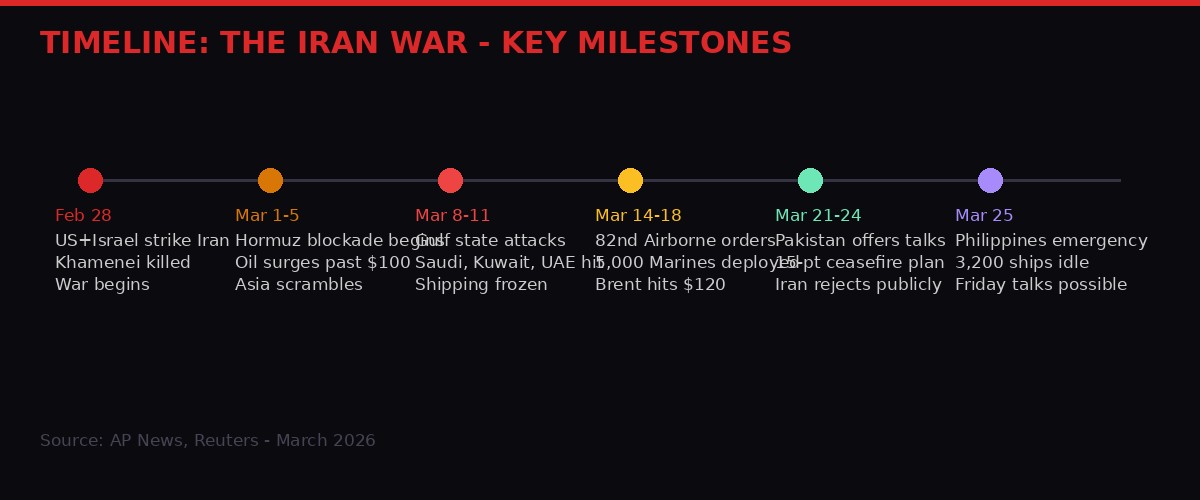
Key milestones of the Iran War - from the Feb 28 opening strikes to the March 25 ceasefire diplomacy. Source: AP News reporting. Graphic: BLACKWIRE
On Tuesday night, the Trump administration delivered a 15-point ceasefire plan to Iranian officials through Pakistani intermediaries. The plan covers sanctions relief, civilian nuclear cooperation, rollback of Iran's nuclear program, IAEA monitoring, missile limits, and a full reopening of the Strait of Hormuz. (AP News, March 24-25, 2026)
Iran's military rejected the premise of the conversation outright.
"Have your internal conflicts reached the point where you are negotiating with yourselves? Someone like us will never come to terms with someone like you. Not now, not ever." - Lt. Col. Ebrahim Zolfaghari, spokesman for Iran's Khatam Al-Anbiya Central Headquarters, state television, March 25, 2026
The civilian government is saying something slightly different. Iranian Foreign Minister Abbas Araghchi has been in contact with Pakistani and regional diplomats throughout the week. But Araghchi's own credibility is uncertain - earlier in the war, he told Al Jazeera that Iranian military units were "now in fact independent and somehow isolated and they are acting based on instructions given to them in advance." (AP News, March 2026)
The gap between who is talking and who is shooting is the central problem. Supreme Leader Khamenei was killed in the Feb 28 strikes. His son Mojtaba was quickly named as successor - but has not appeared in public since, reportedly injured in the same Israeli strike that killed his father. His wife, Zahra Haddad Adel, was also killed in that strike. (AP News, March 2026)
"I'm not sure who's running Iran right now," Israeli Prime Minister Benjamin Netanyahu said during a news conference. "Mojtaba, the replacement ayatollah, has not shown his face. Have you seen him? We haven't, and we can't vouch for what exactly is happening there." (AP News, March 2026)
The International Crisis Group's Iran project director Ali Vaez concluded: "The Revolutionary Guard is the state now." Before the war, the civilian leadership was subordinate to the supreme leader. Now, with Khamenei dead and his son in hiding, the IRGC is making operational decisions. That is precisely the entity that issued the defiant statement on Tuesday - and the one whose commanders have been systematically targeted and killed by Israeli airstrikes throughout the war. (AP News, March 2026)
Pakistan has offered to host in-person talks as soon as Friday. US officials have agreed in principle. Iran has not agreed. Mediators from Egypt and Gulf states are still working to bring Tehran to the table. The Soufan Center think tank notes that Trump's decision to hold off on threatening Iran's power stations while talks proceed "could be aimed at buying time for the Marines to arrive" - or could reflect a genuine search for an exit. Both could simultaneously be true. (The Soufan Center analysis, March 2026)
The American Public is Turning
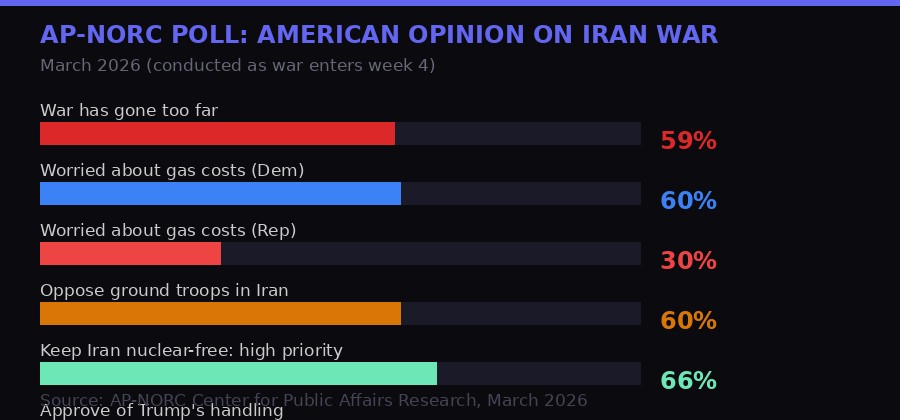
A majority of Americans now believe the war has gone too far. Gas costs are a top concern. Trump's approval on foreign policy remains slightly below his overall approval rating. Source: AP-NORC, March 2026. Graphic: BLACKWIRE
A new AP-NORC poll conducted as the war entered its fourth week found that 59% of Americans believe US military action in Iran has gone too far. That number tracks closely with the public's response to other Trump administration overreaches - about 60% have said he has "gone too far" on tariffs and other issues. (AP-NORC Center for Public Affairs Research, March 2026)
The energy price dimension is cutting across party lines in an unusual way. About 75% of Republicans and roughly 67% of Democrats say it is highly important to keep US oil and gas prices from rising. That bipartisan consensus on pump prices is rare. But it puts the administration in a bind: the war it launched is generating the very economic pain its own voters say they care most about.
About 45% of Americans say they are "extremely" or "very" concerned about being able to afford gas in the next few months - up from 30% in December 2024, right after Trump won reelection on promises to improve the economy and lower living costs. (AP-NORC, March 2026)
Opposition to ground troops in Iran is strong: roughly 60% overall oppose deploying forces on the ground, including about 80% of Democrats and half of Republicans. About 50% oppose airstrikes targeting Iranian leaders. Trump's overall approval remains at about 40% - unchanged since last month - but the political space for escalation is clearly contracting.
Trump said on social media that he ordered the US International Development Finance Corp. to provide political risk insurance for tankers carrying goods through the Persian Gulf at "a very reasonable price." He added that the US Navy would escort oil tankers through the Strait if necessary. The eight destroyers and three littoral combat ships in the region have escorted commercial shipping before - during the Tanker War of the 1980s and the Houthi crisis of the Red Sea. Whether that framework can function while Iran continues to actively attack regional infrastructure is unresolved. (AP News, March 2026)
Historical Echo: The Tanker War, Reloaded
The world has been here before - or somewhere close to it. During the 1980-1988 Iran-Iraq War, both sides attacked tankers in and around the Strait of Hormuz, using naval mines at critical points. The US eventually got involved directly: the Navy fought a one-day battle against Iran in 1988, and later shot down Iranian commercial flight IR655 after mistaking it for a fighter jet, killing 290 people. The strait did not fully close, but shipping became deeply dangerous and disrupted. (AP News archive)
In 2011-2012, Iran threatened closure during Western nuclear sanctions, sending Brent crude past $126/barrel in March 2012. In 2018, when Trump withdrew from the JCPOA nuclear accord, Iran repeated closure threats. Neither time did it follow through on a complete blockade. The difference now is that the war started with the deaths of Iran's supreme leader and a raft of top military commanders. There is no Rouhani figure to walk back the threats. The IRGC, as Vaez noted, is running the state.
The current disruption is already materially worse than any of the historical precedents. Brent crude hitting $120 per barrel represents a sharper shock than the 2012 peak in comparable terms. The breadth of supply chain impact - oil, gas, pharma, chips, fertilizer, air cargo - reflects a global trade system that is far more interconnected now than it was during the Tanker War. The pain reaches Dhaka and Manila and Hanoi in ways that 1988 never reached them.
KEY EVENTS: IRAN WAR - ENERGY AND SUPPLY CHAIN TIMELINE
What Happens Next
The energy triage now underway across Asia is buying weeks, not months. Japan's strategic reserves are substantial - 254 days is an extraordinary buffer - but that calculation assumes no access to normal supply. Countries without Japan's reserve depth are already feeling the pinch acutely.
The critical variable is whether the Hormuz closure continues. A genuine ceasefire that includes Iranian agreement to fully reopen the strait would relieve significant pressure quickly - oil markets already pushed Brent back toward $100 on Wednesday on ceasefire diplomacy news alone. But Iran's military publicly rejected the entire framework within hours of the 15-point plan becoming public knowledge. That rejection came from the IRGC command structure, which, as the ICG has assessed, is now the actual decision-making authority.
The possible Friday talks in Pakistan - if they happen - would represent a genuine escalation of diplomatic engagement. But the same fears that have paralyzed previous talks are still present. Iran was twice attacked by the Trump administration during diplomatic engagement: once in 2020 when the assassination of IRGC commander Qasem Soleimani came during a period of back-channel contact, and once on Feb 28, which US and Israeli strikes launched while talks were technically ongoing. The Iranian Foreign Minister did not mince words: "We have a very catastrophic experience with US diplomacy." (AP News, March 25, 2026)
For the 2.4 million Filipinos working in the Middle East, for the vegetable sellers of Hanoi with paper-thin margins, for the factories in Vietnam and South Korea that need the parts stuck on ships in the Persian Gulf - the question of whether two hostile powers can find their way to a negotiating table in Islamabad is not abstract. It is immediate and material.
The bombs made the war. The blockade made it everybody's problem.
Get BLACKWIRE reports first.
Breaking news, investigations, and analysis - straight to your phone.
Join @blackwirenews on Telegram