Regional Wildfire: How the Iran War Is Pulling in Yemen, Saudi Arabia, and Syria
Day 22 brings a new escalation geometry. The war that started as a US-Israeli operation against Iran has now drawn in a Saudi expulsion of Iranian diplomats, a Houthi declaration that all options are on the table, Israeli strikes on Syria, and a Trump ultimatum threatening to obliterate Iranian power plants. The fire is spreading.

Week four of the US-Israeli campaign has seen the conflict's perimeter expand dramatically. Photo: Pexels
The 22nd day of the US-Israeli war on Iran opened with competing ultimatums, each more dangerous than the last. At 23:44 GMT on March 21, US President Donald Trump posted a threat on Truth Social: Iran had 48 hours to fully reopen the Strait of Hormuz or the United States would "hit and obliterate their various POWER PLANTS, STARTING WITH THE BIGGEST ONE FIRST." [Al Jazeera, March 22]
Within hours, Iran's army responded that all US energy infrastructure in the region would be targeted if Iran's own fuel and power facilities were struck. Two nuclear facilities - Natanz in Iran and Dimona in Israel - had already been exchanged as targets in the preceding 24 hours. A Patriot air defense system in Bahrain had covered up a civilian hit. Saudi Arabia had expelled Iran's military attache. And in Yemen, the Houthi movement was telling the press that every option was under consideration. [Al Jazeera, BBC, March 21-22]
The geometry of the conflict has shifted. What began on February 28 as a bilateral US-Israeli strike on Iran has become a multi-front crisis touching six countries and threatening to engulf the entire Gulf region in a war whose parameters no one has clearly defined - or seems prepared to control.

The strategic picture on Day 22 shows escalation pressures building simultaneously across multiple fronts. Photo: Pexels
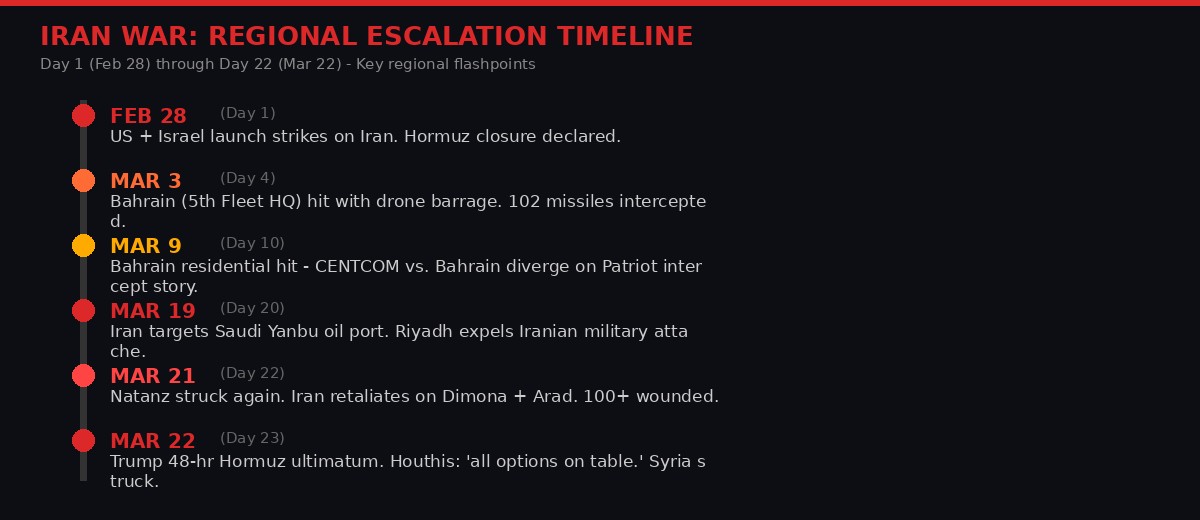
Key regional flashpoints from Day 1 through Day 22. Infographic: BLACKWIRE
The Trump Ultimatum and Its Trap

The Strait of Hormuz - where roughly 20 percent of global oil transits - has been effectively closed to US-allied shipping since early March. Photo: Pexels
Trump's 48-hour deadline, issued from his Mar-a-Lago estate on Saturday night, carries a fundamental contradiction. Just 24 hours before issuing it, the president had posted that the US was "getting very close to meeting our objectives as we consider winding down our great Military efforts in the Middle East." The pivot from wind-down to escalation came inside a single news cycle. [Al Jazeera, March 22]
The Strait of Hormuz - where a fifth of the world's oil and gas transits during peacetime - has been functionally sealed since the war's early days. Iran declared the waterway closed to US-allied "enemy ships" while indicating other nations could negotiate passage. Iranian Foreign Minister Abbas Araghchi told CBS that a group of ships from unnamed countries had been permitted through, but the commercial shipping traffic that normally flows through the 33-kilometre chokepoint has ground to a near-halt. [Al Jazeera, March 22]
Admiral Brad Cooper, commanding US Central Command, reported on Saturday that American fighter jets had dropped 5,000-pound bombs on an underground Iranian coastal facility storing anti-ship cruise missiles and mobile launchers, also destroying "intelligence support sites and missile radar relays" used to track ship movements. Cooper assessed that Iran's ability to attack vessels in the strait had been "degraded." [Al Jazeera, March 22]
But the gap between what Cooper said and what Trump threatened was immediately visible. Al Jazeera's correspondent in Washington noted "a gap between what the White House appears to want in the Strait of Hormuz and what the US military says they have already accomplished." The military was describing mission success. The president was threatening a new escalation. The two accounts do not reconcile.
Targeting Iran's power plants would be a significant escalation beyond military-to-military strikes. Power infrastructure feeds hospitals, water treatment plants, civilian heating and cooling. The International Committee of the Red Cross has documented that attacks on civilian power grids are subject to international humanitarian law constraints requiring proportionality assessments. Trump has not disclosed which plant he considers "the biggest." Iran's largest generating capacity sits at the Bandar Abbas and Isfahan plants, each serving millions of civilians. [Reuters, background]
"If Iran doesn't FULLY OPEN, WITHOUT THREAT, the Strait of Hormuz, within 48 HOURS from this exact point in time, the United States of America will hit and obliterate their various POWER PLANTS, STARTING WITH THE BIGGEST ONE FIRST." - President Donald Trump, Truth Social post, 23:44 GMT March 21, 2026
Iran's counter-threat came quickly and specifically: all US energy infrastructure in the region would be targeted if Iran's own fuel and power systems were struck. That language directly implicates Saudi Arabian, Emirati, Qatari, and Bahraini facilities where US military and economic interests are deeply embedded. The threat is not abstract - Iranian drones have already struck the Saudi port of Yanbu.
Yemen on the Edge: The Houthi Decision

The Houthis, who control western Yemen and its Red Sea coastline, have the capability to re-ignite Red Sea shipping disruptions at scale. Photo: Pexels
The Houthis - the Iran-aligned Yemeni armed movement that controls Sanaa and the Red Sea coastline - have not yet formally entered the war. But on March 22, Al Jazeera reported that the group stated "all options are on the table." That phrasing, in the context of a war involving their patron state, is not idle. [Al Jazeera, March 22]
The Houthis spent 2024 and early 2025 conducting one of the most sustained drone and missile campaigns against commercial shipping in the Red Sea's modern history. Their attacks on vessels linked to Israel, the US, and the UK forced major rerouting of global container traffic around the Cape of Good Hope, adding weeks to transit times and billions to logistics costs. The US and UK conducted extensive counter-strikes on Houthi launch sites throughout that period.
A formal Houthi entry into the current war would open a second front the US military would struggle to ignore. The group demonstrated in 2024-25 that they could sustain strikes for months despite heavy bombardment of their facilities. They hold stocks of Iranian-supplied ballistic missiles and one-way attack drones. Their coastal position gives them effective range over the Bab el-Mandeb strait - a second chokepoint for global shipping that connects the Red Sea to the Gulf of Aden.
If both Hormuz and Bab el-Mandeb were simultaneously restricted, the effect on global energy markets would be severe. Together, these two straits handle approximately 30 percent of globally traded oil and significant portions of liquefied natural gas. The EU is already warning its members to accelerate winter gas storage amid Hormuz-driven price surges. Adding a Bab el-Mandeb disruption on top would send energy markets into genuinely uncharted territory. [Al Jazeera, March 22]
The critical variable is Tehran's direct request. The Houthis do not operate as a pure Iranian proxy - they have their own strategic calculus and leadership structures. In 2024 they continued attacks even as Iran signaled restraint on certain targets. If Iranian leadership formally requests Houthi entry as a diversionary pressure valve, the group has the motivation, the means, and the political framing to comply. Their domestic audience - and the broader Muslim world watching Eid al-Fitr prayers amid war footage - represents a powerful mobilization driver.
ANALYST NOTE: Houthi entry would not change the military outcome of the Iran war. It would, however, substantially increase the cost to the US Navy, extend the conflict timeline, and create a third front (Red Sea / Bab el-Mandeb) that complicates any negotiated exit for Washington. The strategic value to Iran is buying time. The cost to the Houthis would be renewed US airstrikes on Yemen - which they have absorbed before.
Saudi Arabia Expels Iran's Military Attache

Saudi Arabia's expulsion of Iran's military attache and four embassy staff marks a significant rupture in the cautious detente the two countries had been maintaining since their 2023 Beijing rapprochement. Photo: Pexels
In 2023, under Chinese mediation in Beijing, Saudi Arabia and Iran normalized diplomatic relations after years of rupture. The deal was considered one of the more significant diplomatic achievements of the previous decade - a signal that even bitter regional rivals could be pulled back from the edge of open confrontation.
That deal is now effectively dead. [Al Jazeera, March 21]
Saudi Arabia has expelled Iran's military attache and four Iranian embassy staff, citing the Iranian attack on the Red Sea port of Yanbu. The Yanbu strike was significant: Yanbu is Saudi Arabia's main oil export outlet on the western coast, the Red Sea terminal through which Saudi crude reaches European and American markets. Iran struck it after Saudi Arabia failed to prevent US military assets from operating from Saudi territory - or at least that appears to be the logic from Tehran.
The Yanbu attack puts the Gulf Arab states in an impossible position. They never requested this war. Many of them maintained careful diplomatic balance between Washington and Tehran precisely because they live inside the blast radius of any conflict between the two. The Saudi-Iran rapprochement was a hedge against exactly this scenario - a US military campaign that drags Gulf states into the crossfire whether they want to be there or not.
The expulsion of the military attache is not yet a full diplomatic break. Saudi Arabia still formally maintains an Iranian embassy. But removing the military-to-military liaison - the person whose entire job is to prevent miscalculation between armed forces - removes a critical backroom channel. In a conflict environment where Iranian missiles are landing in Saudi territory, the absence of that channel increases the risk of escalation spiraling beyond anyone's control.
The UAE, Qatar, and Kuwait are watching this closely. Qatar in particular hosts the massive Al Udeid Air Base, the forward headquarters of US Central Command, which is actively directing strikes on Iran. Tehran has targeted Qatari energy infrastructure before as a political warning. Qatar's government has been walking a remarkable tightrope - hosting the US military command while maintaining Iranian diplomatic channels and attempting to serve as a message conduit. How long that tightrope holds is an open question.
Natanz Struck Again: Nuclear Dimensions

Iran's Natanz enrichment complex, 220km southeast of Tehran, has been struck multiple times since the war began. The IAEA has confirmed no radiation leakage to date. Photo: Pexels
On March 21, Iran's Atomic Energy Organization confirmed that the US and Israel had struck the Shahid Ahmadi Roshan enrichment facility at Natanz - one of the country's most strategically significant uranium enrichment sites. The organization stated there was "no leakage of radioactive materials" in the area. [Al Jazeera/Tasnim, March 21]
This was not the first Natanz strike. The facility was targeted in the first week of the war, with satellite imagery confirming building damage. The UN nuclear watchdog, the IAEA, confirmed "recent damage" on March 3 - a day after Iran acknowledged the initial attack on the underground plant. IAEA Director-General Rafael Grossi has repeatedly called for "military restraint to avoid any risk of a nuclear accident." [IAEA, Al Jazeera, March 2026]
Iran's retaliation came within hours. Ballistic missiles struck near Dimona in southern Israel - home to Israel's nuclear research center and, by widely held assessment, the site of its undeclared nuclear weapons program - and also struck the town of Arad. Israel's air defense systems were partially overwhelmed. Israeli defense authorities reported more than 100 wounded. Al Jazeera reporting from the scene described it as a "very difficult evening." Netanyahu has vowed further strikes. [Al Jazeera, BBC, March 21-22]
The nuclear dimension of this war has never been acknowledged openly but has been present since the first day. The White House stated from the outset that a "key objective" was to prevent Iran from acquiring nuclear weapons. Iran holds approximately 400kg of highly enriched uranium - enough, by Western intelligence estimates, for several devices if weaponized. US and Israeli strikes have repeatedly targeted enrichment infrastructure. Iran has repeatedly struck back at the one Israeli facility that represents the same capability on the other side. [Al Jazeera, March 21]
Russia condemned the Natanz strike as "a blatant violation of international law," with Foreign Ministry spokeswoman Maria Zakharova issuing a formal statement. Russia's intervention in the information space is consistent with its broader positioning - opposing the US-Israeli operation while stopping well short of any material support for Iran. Moscow's condemnations carry rhetorical weight and zero operational consequence for the US military campaign. [Al Jazeera, March 21]
Bahrain's Patriot Coverup and the Information War

The diverging accounts from Bahrain and CENTCOM over the March 9 drone incident illustrate how information control has become an active battlefield in the Gulf war. Photo: Pexels
On March 9, a drone struck a residential neighborhood in Manama, Bahrain - the small island kingdom that hosts the US Navy's Fifth Fleet. A 29-year-old Bahraini woman was killed. Eight people were injured. Bahrain's Ministry of Interior blamed "Iranian aggression." CENTCOM blamed Iran directly and explicitly denied that any Patriot missile had missed its target. [CENTCOM, Bahrain MOI, March 9]
On March 21 - twelve days later - Bahrain's government spokesperson told a different story. A Patriot air defense system had intercepted an Iranian drone over a residential neighborhood. The interception had saved lives. [Al Jazeera, March 21]
These two accounts cannot both be true. Either an Iranian drone struck a neighborhood (CENTCOM's account on March 9) or a Patriot intercepted a drone over a neighborhood (Bahrain's account on March 21). The discrepancy matters because Patriot missile debris, when an interception occurs over populated areas, causes exactly the kind of damage and casualties described on March 9. It is a documented phenomenon from the Gaza and Lebanon conflicts - interceptor fragments kill and wound civilians on the ground.
Bahrain's government did not explain the discrepancy. Its Ministry of Interior had on March 9 confirmed the woman's death as the result of Iranian aggression. CENTCOM posted "LIE" in capital letters to dismiss claims that a Patriot had missed. Now, twelve days later, Bahrain is describing a Patriot interception over a residential area. Al Jazeera contacted CENTCOM for comment; no response had been received at time of publication. [Al Jazeera, March 21]
The Bahrain episode reflects a wider pattern in the information environment of this conflict. All parties - the US, Israel, Iran, and Gulf states - are managing narratives under conditions of genuine operational confusion and political pressure. Iranian state media has been documented inflating enemy casualties and digitally manipulating imagery. US military statements have, at minimum, omitted inconvenient details. The civilian casualty picture across Iran, Lebanon, Yemen, and the Gulf is almost certainly underreported by every official source.
"According to reports, there is no radiation and there are no leaks." - Al Jazeera correspondent Ali Hashem, reporting from Tehran after Natanz strike, March 21
Israel Strikes Syria: A Third-Country Dimension

Israeli strikes on Syrian territory represent a fresh expansion of the conflict into a country already devastated by 14 years of civil war. Photo: Pexels
While the Gulf burns, Israel has opened a separate front in Syria. Following Druze community clashes in Syrian territory, Israeli forces struck weapons sites and government infrastructure in Syria. Damascus condemned the strikes as an "outrageous assault on Syria's sovereignty." Israeli Prime Minister Benjamin Netanyahu stated Israel had "acted alone" in attacking an Iranian gas field and that Trump had "requested that there be no further such attacks." [BBC, March 22]
The Syria strikes are ostensibly separate from the Iran war - framed by Israel as a counter to weapons transfers and Druze tensions. But the operational logic is entangled. Syria's new government, which emerged from the collapse of Assad's regime, has been attempting to consolidate control over a fractured country. Israeli strikes on Syrian government infrastructure undermine that consolidation. And Iranian influence networks in Syria - weakened but not eliminated by the war - remain a target for Israeli preemption.
The practical risk of the Syria dimension is miscalculation. Syrian government forces, Israeli forces, Turkish-backed factions, Kurdish-aligned units, and remnant Iranian-backed militias all operate in overlapping areas of Syria. A strike that hits the wrong target, or is misattributed, can spiral into a direct confrontation that nobody specifically chose. The history of the Syrian conflict - 14 years of proxy involvement by at least nine external powers - demonstrates exactly how fast that kind of miscalculation spreads.
European governments are watching the Syria strikes with particular concern. The EU has been cautiously re-engaging with Damascus in the post-Assad period, hoping to create conditions for refugee return and reduce the political pressure that migration creates domestically. Israeli military strikes on Syrian government infrastructure directly undercut that European diplomatic project.
The British Basing Decision and Allied Fractures

UK approval for US use of British bases to strike Strait of Hormuz targets represents a significant commitment of British military facilities to an operation Parliament has not formally debated. Photo: Pexels
On March 21, Downing Street confirmed that British ministers had approved the expansion of US use of UK military bases for strikes against Strait of Hormuz targets - specifically citing Iran's "reckless strikes" as justification. [BBC, March 21]
The basing decision places the UK formally inside the operational loop of the US-Israeli war on Iran. British bases in Cyprus (RAF Akrotiri) and Diego Garcia are critical strategic assets for US air and naval operations across the Middle East and Indian Ocean. The UK had previously been in a holding pattern - supporting the US politically but avoiding direct operational entanglement. That position has now changed.
The domestic political implications in Britain are significant. Prime Minister Starmer has committed UK facilities to a war that was launched without consultation of NATO allies, without a UN Security Council resolution, and without a formal declaration of war by the United States. British MPs have not been given a parliamentary vote on the matter. The comparison to the 2003 Iraq War - where parliamentary authorization became a defining political crisis - is not lost on British commentators.
Japan offers a contrasting case. Trump's invocation of Pearl Harbor to justify the Iran war has caused genuine diplomatic discomfort in Tokyo. Japanese Prime Minister Takaichi's silence on the Pearl Harbor reference has generated mixed reactions domestically - some viewing it as appropriate diplomatic caution, others as a failure to defend Japan's historical narrative. Two Iranian football players who received humanitarian visas during the war chose to stay in Australia after their team's tour, illustrating the human dimensions of a conflict that extends well beyond its declared military objectives. [Al Jazeera, BBC, March 21-22]
European leaders remain hesitant to directly help Trump secure the Strait of Hormuz while simultaneously knowing that inaction carries real economic consequences. The EU's warning to member states to accelerate gas storage ahead of winter signals that Brussels has internalized that this war is not ending quickly. [Al Jazeera, March 22]
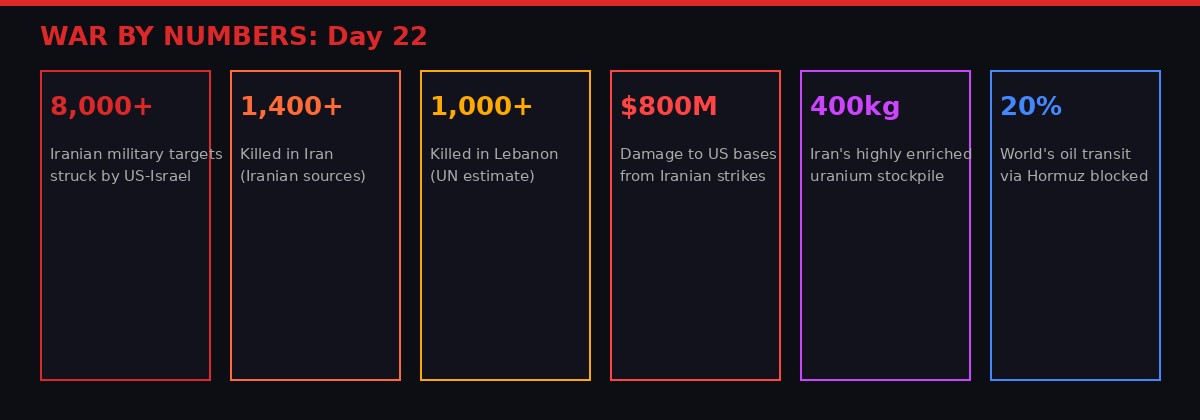
War by numbers through Day 22. Infographic: BLACKWIRE
The Casualty Picture and the Civilian Cost

Lebanon's estimated one million displaced people represent one of the war's most acute humanitarian consequences. Photo: Pexels
The confirmed death toll through Day 22 sits at approximately 1,400 killed in Iran and just over 1,000 killed in Lebanon, where the Lebanese civilian population has been caught in the crossfire of Iranian proxy operations and Israeli counter-strikes. At least a million people have been displaced in Lebanon. [Al Jazeera, March 21]
These numbers carry the caveat that all parties are managing information environments in their favor. Iranian state media has inflated enemy casualties and used digitally manipulated imagery. US military statements have been carefully framed to emphasize degraded Iranian capability rather than civilian impact. The actual toll of 8,000 strikes across Iranian territory over 22 days - including strikes on nuclear enrichment sites, missile storage facilities, coastal defense infrastructure, and intelligence support networks - cannot result in purely military casualties. The infrastructure of a country and its civilian population are not neatly separable.
Iranian analysts quoted in Western media have noted that the population is experiencing the war differently from what state media portrays. A BBC correspondent who spoke with Iranians preparing for Nowruz - the Persian New Year that coincided with the conflict's third week - found people describing a city under psychological siege. "You can't smell Nowruz in the air," one Tehran resident told the BBC. Eid al-Fitr prayers were held in Tehran as funerals were being conducted for an IRGC spokesman killed in a strike. [BBC, Al Jazeera, March 21]
In Lebanon, over a million displaced people represent a humanitarian emergency that has received comparatively little coverage given the scale of Iranian and Gulf headlines. Lebanese health infrastructure, already fragile before the conflict, is functioning under severe pressure. The overlap between Iranian proxy military activity and Lebanese civilian geography has made evacuation patterns chaotic and aid delivery difficult.
Three Palestinian women were killed in a beauty salon in the southern West Bank during an Iranian missile attack. A Thai worker was killed by falling shrapnel in Israel. These details - brief items in rolling live updates - are the texture of what "collateral damage" means in practice when missile exchanges happen over populated areas. [BBC, March 22]
Day 23 Forward: What Happens Next

The 48-hour window opened by Trump's Hormuz ultimatum makes the coming day the most consequential decision point of the war so far. Photo: Pexels
Israeli Defense Minister Israel Katz announced on March 21 that the intensity of strikes "to be carried out by the IDF and the US military against the Iranian terror regime" would "rise significantly" in the week starting Sunday. That statement came hours after the Natanz strike and the Dimona retaliation - and one day before Trump's power plant ultimatum. The signals point in one direction: both Washington and Jerusalem are planning more, not less. [Al Jazeera, March 21]
The 48-hour clock on Trump's Hormuz ultimatum expires in the early hours of Monday, March 23. Iran has shown no indication it intends to comply. Its foreign minister has stated repeatedly that the Strait's status is "up to our military to decide." The Iranian army's counter-threat - striking all US energy infrastructure in the region if Iranian power plants are hit - suggests Tehran is preparing a response, not a concession.
The range of outcomes that open as the clock runs down are all bad. If Trump follows through and strikes Iranian power plants, Iran has credibly promised to hit US energy infrastructure across the Gulf. That means Saudi Aramco facilities, UAE oil terminals, Qatari LNG export infrastructure - the economic backbone of the entire Gulf Arab order. If Trump does not follow through, his credibility on the Hormuz ultimatum collapses and Iran has demonstrated that it can call his bluff.
The Houthi decision, likely made in coordination with whatever Iranian leadership can exercise command-and-control authority after 22 days of decapitation strikes, will be the clearest indicator of whether Iran intends to absorb this war or expand it. A Houthi entry into the conflict would not save Iran militarily. It would, however, dramatically increase the political cost to Washington of continuing operations and make any negotiated exit considerably harder to construct.
Saudi Arabia's rupture with Tehran removes one of the last backstage channels that had been available for de-escalation messaging. Qatar's ongoing role as message conduit between the two sides depends entirely on Iran's willingness to keep that channel open and Doha's willingness to absorb the political risk of hosting it. The EU's call for gas storage reflects a baseline assumption in Brussels that this conflict has no near-term exit. The US lifts on some Iranian oil sanctions - announced concurrently with the Hormuz ultimatum - signals that Washington is also trying to manage the economic blowback of a war it launched but may not know how to end.
The fire is no longer contained in Tehran. It is burning across the region, and every actor with a stake in the outcome is making decisions that make the next 48 hours more dangerous than the last 22 days combined.
Day 22 Event Timeline
Get BLACKWIRE reports first.
Breaking news, investigations, and analysis - straight to your phone.
Join @blackwirenews on Telegram