The most dangerous moment in a war is when one side claims it is over. On the 25th day of the US-Israel war against Iran, President Donald Trump told the world that Iran "means business" and "wants peace." He said discussions were ongoing. He said a deal was close.
Iran's response came in two forms. The first was verbal: Iran's Revolutionary Guard Corps called Trump a "deceitful American president" whose "contradictory behaviour will not make us lose sight of the battlefront." Iran's parliament speaker Mohammad Bagher Qalibaf called the claims "fake news." Iran's Foreign Ministry said it was "a big lie."
The second response was ballistic. Multiple waves of Iranian missiles hit Israel early on Tuesday. One 100-kilogram warhead - a concrete-penetrating munition - evaded Israel's David's Sling air defense system and detonated in the center of Tel Aviv, blowing out windows across an apartment block. Four people were wounded. (AP News, March 24 2026)
Both things are simultaneously true: Trump says peace, and the missiles keep falling. The Strait of Hormuz stays closed. Oil holds above $108 a barrel. And somewhere in the Persian Gulf, a convoy of US amphibious assault ships is carrying the next 2,500 Marines toward a war that its commander-in-chief just said was nearly over.
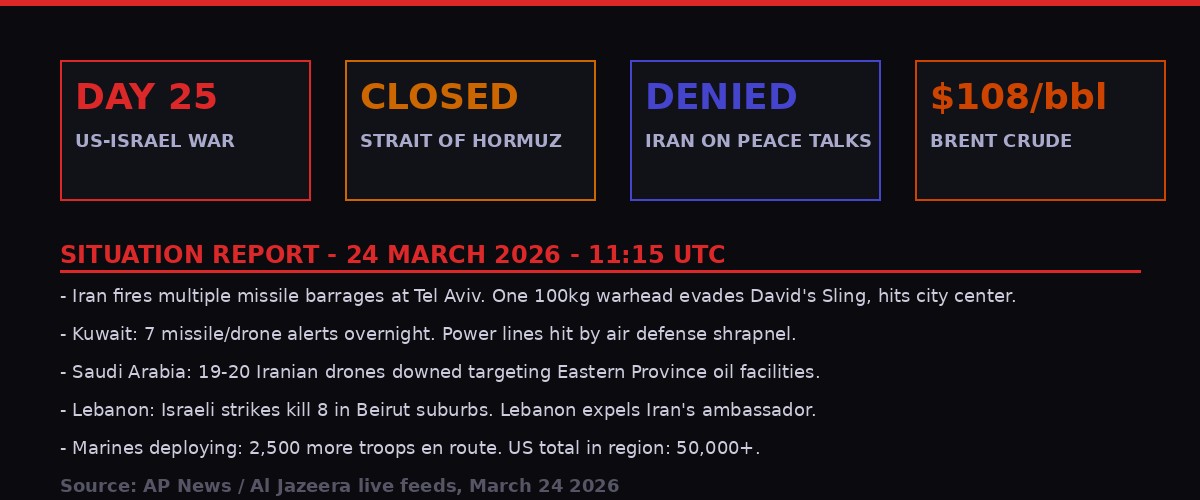
Day 25 situation snapshot: key conflict metrics as of March 24, 2026. Source: AP News, Al Jazeera live feeds.
The Peace Talks That Aren't
Trump's claim that peace talks are underway with Iran is not entirely without foundation - and not entirely credible either. Iranian Foreign Minister Abbas Araghchi's office confirmed he has been in contact with counterparts in Azerbaijan, Egypt, Oman, Pakistan, Russia, South Korea, Turkey and Turkmenistan. Those are intermediaries. That is not a negotiation - it is message-passing through neutral channels.
What Trump called "productive discussions" is, by all Iranian accounts, Tehran responding through third parties while simultaneously refusing to acknowledge any direct channel to Washington. The distinction matters. Iran was in talks with the United States before the February 28 surprise attack that started this war. They were also in talks last year when US and Israeli forces struck its nuclear facilities. (AP News)
The memory is not abstract. It is institutional. Iran's security apparatus has twice experienced the pattern of "negotiations as cover for incoming strikes." Trusting a third iteration requires either amnesia or coercion. Iran has neither.
"This time, Iran means business; they want to settle. They want peace." - US President Donald Trump, social media post, March 24 2026
"Trump's contradictory behaviour will not make us lose sight of the battlefront." - Iran's Islamic Revolutionary Guard Corps, statement March 24 2026
Niall Stanage, White House columnist for The Hill, offered the most plausible explanation for the gap between Trump's rhetoric and ground reality: the president may be looking for an "exit ramp" because the war has become domestically unpopular and is causing severe economic damage through rising fuel prices. That is a coherent political reading. It does not require Iran's participation to be useful - the announcement alone briefly drove down oil prices and boosted stock markets before Brent crude climbed back above $100. (AP News)
White House Press Secretary Karoline Leavitt subsequently walked back any suggestion of a deal, cautioning that the situation is "fluid" and that "speculation about meetings should not be deemed as final." That caveat came after financial markets had already moved.
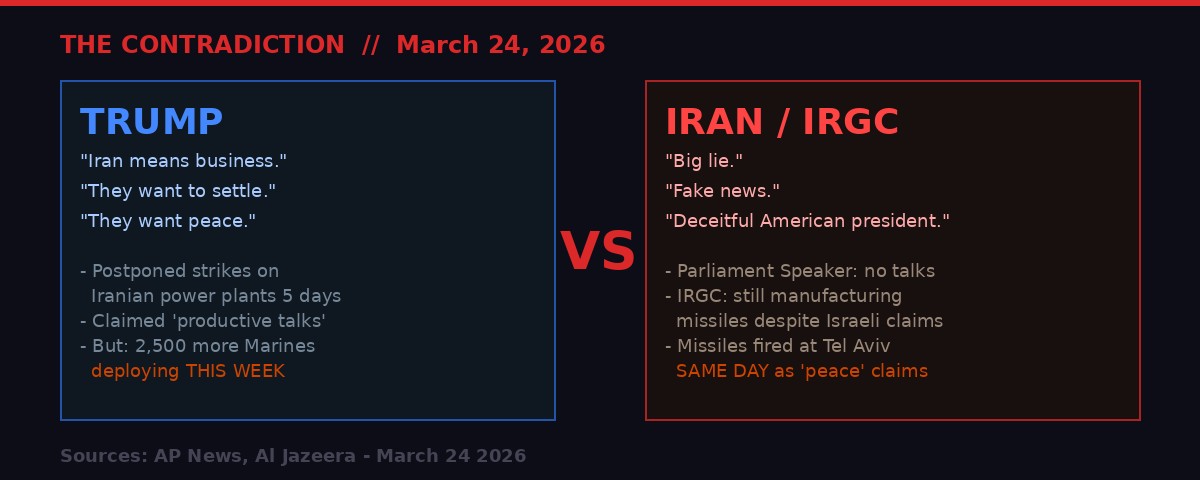
The simultaneous positions: Trump claims Iran wants peace. Iran's IRGC fires missiles at Tel Aviv the same morning. Source: AP News, Al Jazeera, March 24 2026.
What Is Actually Happening on the Ground
The operational tempo on Tuesday told a different story from the diplomatic messaging. It told the story of a war in its third week with no indication that either side has reached a breaking point.
In Tehran: US and Israeli airstrikes continued to batter the capital. Infrastructure across the city was reporting damage. Iran's new Supreme National Security Council secretary - a former IRGC brigadier general named Mohammad Bagher Zolghadr - was named Tuesday, replacing Ali Larijani who was killed in a prior airstrike. The appointment of a military commander to that role is not a peace gesture. (AP News, March 24 2026)
In Tel Aviv: The missile that hit the city center carried a 100-kilogram warhead. It evaded the David's Sling interceptor system - the same system that suffered a malfunction over the weekend allowing two ballistic missiles to strike southern Israel, wounding dozens. An Israeli rescue worker named Yoel Moshe confirmed four minor casualties in Tuesday's strike. A resident named Amir Hasid, emerging from a shelter, said: "It feels like you're a sitting duck, waiting for the missiles to hit you, or someone next to you." (AP News)
In Kuwait: Air defense sirens sounded at least seven times in a single night. Air defense shrapnel from intercepted projectiles knocked out power lines, causing partial electricity outages across several hours. Civilians are cycling between shelters and darkness.
In Saudi Arabia: The Defense Ministry confirmed it downed 19 Iranian drones targeting the kingdom's Eastern Province - the region containing the bulk of Saudi oil infrastructure. No damage or casualties were reported. The Eastern Province has been under near-continuous threat since Israel bombed Iran's South Pars natural gas field in mid-March, triggering escalated Iranian retaliation against Gulf states. (AP News, March 24 2026)
In Lebanon: Israel continued pounding Beirut's southern suburbs. An airstrike on a residential apartment southeast of the capital killed at least three people including a three-year-old girl, according to Lebanon's Health Ministry. Five more were killed in the south. Al Jazeera correspondent Obaida Hitto reported from Beirut that Israel is destroying bridges - deliberately trapping civilians and making it "extremely difficult" for Lebanese armed forces to deliver humanitarian aid to the more than one million people displaced by the conflict. (Al Jazeera, March 24 2026)
Lebanon also declared Iran's ambassador persona non grata, ordering him to leave by Sunday. A country that shares a border with Israel and has hosted Iran-backed Hezbollah for decades is expelling Tehran's diplomat. That is a measure of how far the regional calculus has shifted.
In Iraq: The US military launched a strike in Anbar province targeting the headquarters of an Iran-backed armed group, aimed specifically at its senior commander, Saad Dawai. A Syrian base in the northeast was separately hit by a missile from Iraqi territory, with an Iraqi official attributing it to a local armed group. Al Jazeera's Nicolas Haque, reporting from Baghdad, described Iraq as a "secondary battleground" where the US and Iran-backed groups are in active confrontation. (Al Jazeera, March 24 2026)
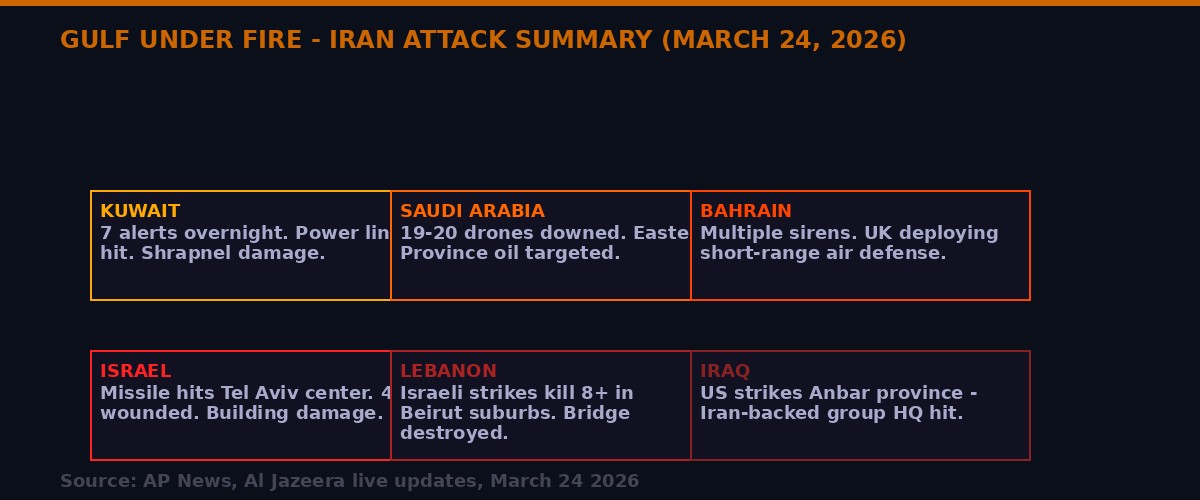
Multi-theater attack summary for the 24-hour period ending March 24, 2026. Source: AP News, Al Jazeera.
Israel's Air Defense Problem
The malfunction in Israel's David's Sling system is one of the most significant military developments of the past 72 hours, and it is being underreported relative to its strategic implications.
David's Sling handles the mid-range threat band - roughly 100 to 300 kilometers. It sits between Iron Dome (short range, rocket-focused) and Arrow 3 (designed for ballistic missiles above the atmosphere). Developed jointly by Israel's Rafael Advanced Defense Systems and the US defense contractor Raytheon, each intercept costs approximately one million dollars. The system is the backbone of Israel's defense against the specific class of Iranian ballistic missiles that have been the primary threat throughout this conflict.
When it failed over the weekend - the IDF confirmed the malfunction - two Iranian ballistic missiles struck southern Israel and wounded dozens of people. That is the first significant confirmed air defense failure of the war. (AP News, March 22-23 2026)
This matters for a specific reason: Iran's strategy throughout this conflict has not been to overwhelm Israeli defenses with a single massive barrage - a tactic that would be expensive and require weapons stockpiles Iran is depleting. The strategy is volume and persistence. Fire enough salvos, probe enough directions, and eventually find the gap. The David's Sling failure suggests Iran may be closing in on one.
IRGC Gen. Ali Mohammad Naeini was quoted by an Iranian state newspaper on Friday claiming Iran "continues to manufacture missiles despite Israel's claim that it destroyed Iran's production capabilities." Iranian state television later said Naeini was killed in an airstrike. The statement stands, regardless. (AP News)
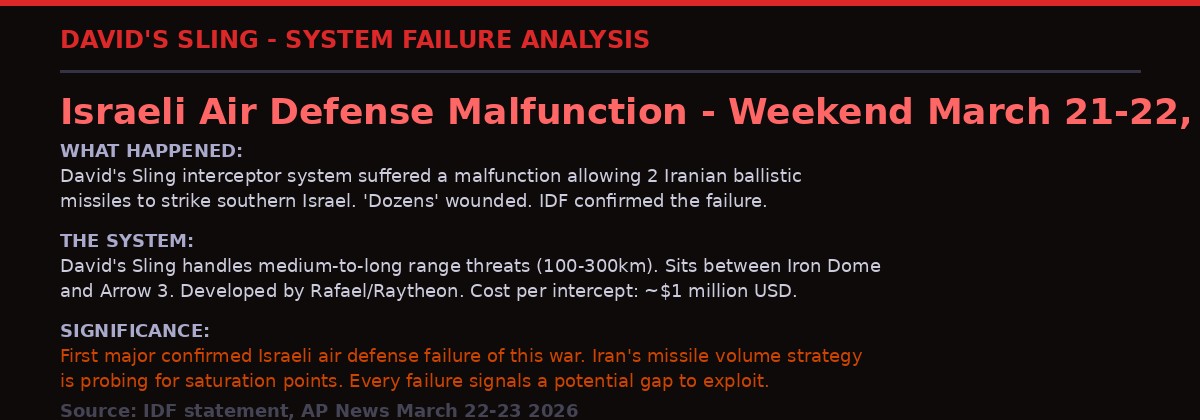
Analysis of the David's Sling malfunction that allowed two Iranian ballistic missiles to strike southern Israel on March 21-22. Source: IDF statement, AP News.
The Marines and the Kharg Island Question
Officially, the United States has no plans to send ground forces into Iran. Trump has said this repeatedly. The US military, however, continues to deploy the specific assets required to do exactly that.
The latest tranche: three more amphibious assault ships carrying approximately 2,500 Marines, en route to the Persian Gulf. They join a prior contingent of another 2,500 redirected from the Pacific, and more than 50,000 US troops already in the region. The US has also requested an additional $200 billion from Congress to fund the war - a figure that implies an operational horizon well beyond any five-day pause in power plant strikes. (AP News, March 24 2026)
The Soufan Center, a New York-based security think tank, published an analysis noting that Trump's delay in power plant strikes "could be timed to coincide with the arrival of US Marines in the region, expected Friday." The analysis offered two readings: "Trump could be moving military assets into place, in this case to prepare for an invasion and seizure of Kharg Island, while using negotiations as a cover until those assets are fully combat-ready. However, Trump could also be actively seeking an offramp. Whether Iran reciprocates is yet to be seen." (Soufan Center, March 23-24 2026)
Kharg Island is Iran's primary oil export terminal, located in the Persian Gulf roughly 25 kilometers off the Iranian coast. The US bombed it more than a week ago, targeting its defenses while leaving oil infrastructure intact - an unusual restraint that has generated significant military analysis. An island whose defenses you destroy but whose pipelines you preserve is an island you may intend to capture and operate.
Iran's response to this logic has been stated clearly: Tehran has threatened to mine the Persian Gulf if the United States appears on the verge of landing troops. Mining the Gulf would complicate any amphibious operation while simultaneously threatening every ship in the waterway - including civilian tankers, military vessels, and the Gulf states' own commerce. It is a threat with real force behind it.
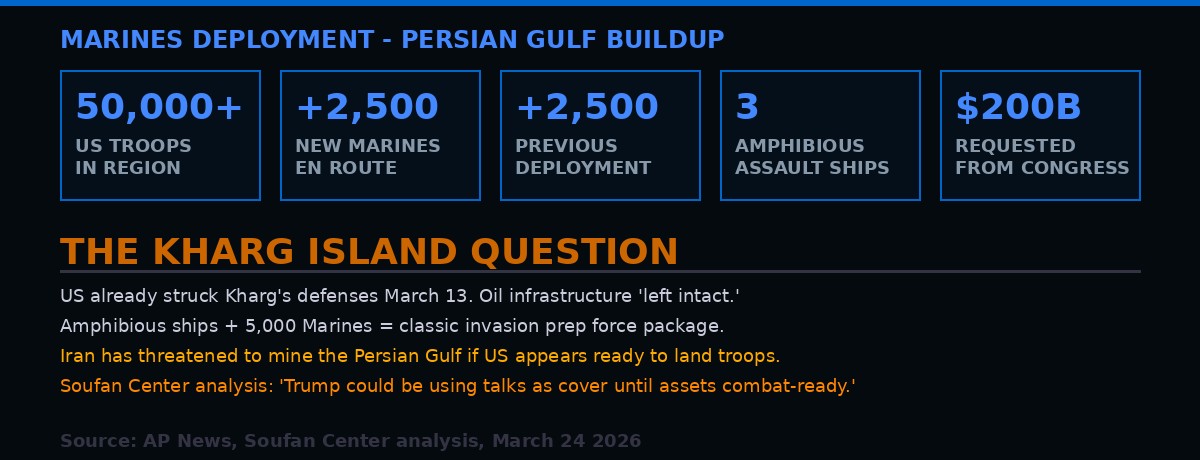
US force buildup and the Kharg Island strategic question. Source: AP News, Soufan Center, March 24 2026.
Israel's War Within the War
For Israel, the Trump peace claims arrived as a shock. Israeli analysts have described the domestic mood as one of "disappointment and confusion." The war was sold to the Israeli public as one that would overthrow the Iranian government. Twenty-five days in, the Islamic Republic still stands, its missiles are still hitting Tel Aviv, and the US president is talking about a deal.
"Is it a defeat for Netanyahu? Hell, yes! It's Trump essentially ditching Israel. Any idea that we're a serious player that the US or any state would want to talk with has gone. Nobody wants to talk to us." - Ori Goldberg, Israeli political scientist, speaking to Al Jazeera from outside Tel Aviv, March 24 2026
Former Israeli ambassador Alon Pinkas was more measured, but his analysis was equally blunt: Trump may be aware that "Netanyahu may have duped him on how quick and resounding a victory would be, and how viable regime change is." (Al Jazeera, March 24 2026)
Israeli political analyst Nimrod Flashenberg offered a counterpoint: the war was never really about regime change. If you assume the goal was to degrade Iran's military capabilities, then Israel has achieved that, and has done so "in such a way that's going to ensure the US's long-term commitment to making sure it remains downgraded." That is a more cynical reading of the entire operation - and possibly the most accurate.
Netanyahu's own statement on Tuesday tried to thread both narratives at once. He said Trump believed military gains could be "converted into a negotiated agreement" protecting Israeli interests, and added: "In parallel, we continue to attack, both in Iran and Lebanon. We are methodically dismantling the missile programme and the nuclear programme, and continue to hit Hezbollah hard. There's more to come."
The phrase "there's more to come" is not the language of a leader preparing to accept a ceasefire. It is the language of a leader preparing to continue a war while someone else talks about stopping it.
The Economics of Prolonged Conflict
Brent crude oil is trading at approximately $108 per barrel as of Tuesday - up roughly 54 percent from pre-war levels around $70. That single data point translates into cascading costs across the global economy: fuel, fertilizer, plastics, shipping, food. Economies that depend on Gulf exports are absorbing the most concentrated damage. Asia - particularly China, India, Japan and South Korea - imports heavily through the now-closed Strait of Hormuz.
The Trump administration announced a temporary lifting of sanctions on Iranian oil loaded on ships as of Friday, set to expire April 19. Treasury Secretary Scott Bessent framed it as a mechanism to prevent China from being the sole beneficiary of Iranian oil. The Soufan Center and several economists have noted that the measure does nothing to increase production flow - Iran is not pumping more oil, and the Strait is still closed. The price relief, such as it is, has been minimal. (AP News)
The International Energy Agency and Australia have both issued separate warnings about global energy security during the conflict. The IEA estimates that the Strait of Hormuz closure, if sustained, represents the largest disruption to global oil supply since the 1970s. A fifth of the world's oil transits that waterway on normal days. None of it does right now.
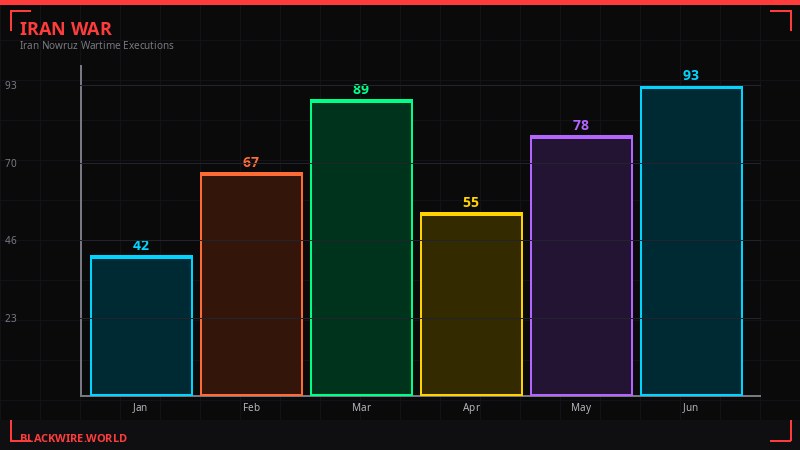
Brent crude oil price trajectory since the start of the US-Israel war against Iran. Up 54% from pre-war levels. Source: AP/Reuters data.
Iran's Command Structure and the Invisible Supreme Leader
One of the most underexamined aspects of this conflict is the question of who, exactly, is running Iran's military response. Mojtaba Khamenei was named Supreme Leader following the killing of his father on February 28. He has not been seen publicly since. He is reportedly wounded.
Iran's Foreign Minister Abbas Araghchi stated early in the war that military strikes were being conducted "on the orders of local commanders, rather than from the political leadership." It remains unclear whether Mojtaba Khamenei is issuing orders to the regular military or to the IRGC, which historically answered only to his father. The IRGC and the conventional military are distinct chains of command, and the overlap between them depends entirely on the Supreme Leader's active engagement. (AP News)
Several senior Iranian officials have been killed in airstrikes since the war began. The Supreme National Security Council's previous secretary, Ali Larijani, was killed in an airstrike. The military spokesperson was apparently killed on Friday. The pattern of targeting Iranian leadership has been consistent and deliberate - Israel has made no secret of the strategy.
The result is a government that is operationally functioning at the local military commander level while its political apex remains either incapacitated or deliberately hiding for survivability reasons. That creates a negotiation problem even if both sides wanted to talk: who in Iran has the authority to make commitments that would hold across the entire security apparatus?
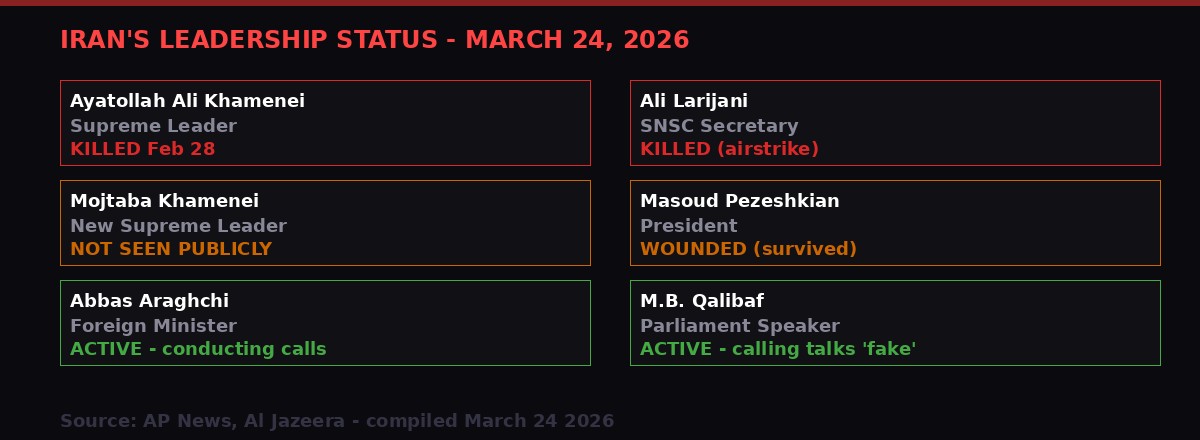
Current status of Iran's senior leadership as of March 24, 2026. Multiple positions vacant or uncertain following Israeli targeting campaigns. Source: AP News, Al Jazeera.
Timeline: How We Got Here
What Comes Next
The next 72 hours contain three separate tripwires, any one of which could escalate or de-escalate the conflict sharply.
The first is the arrival of US Marines in the Persian Gulf, expected Friday. Their presence transforms the Kharg Island question from theoretical to operational. If Trump has been sincere about peace talks, the Marines' arrival creates enormous pressure to either announce a deal before they arrive or explain why a diplomatic president is landing an amphibious assault force. If Trump has been using diplomacy as cover, the Marines' arrival is the drop of the other shoe.
The second is the extended deadline on Iranian power plant strikes, set to expire in five days. Trump framed the extension as a gesture of good faith toward talks. If those talks produce nothing tangible by late March, the political logic of the threat requires either follow-through or another embarrassing extension. Each extension weakens deterrence; every follow-through widens the war.
The third is Iran's air campaign against Gulf infrastructure. Saudi Arabia and Kuwait are absorbing nightly attacks. Bahrain - where the US Fifth Fleet is headquartered - is under regular alarm. The Gulf Cooperation Council states are under sustained pressure to either publicly support the US-Israel operation or begin negotiating independently with Tehran. Qatar's statement Tuesday - that "no attacks merited alerts in recent days but that doesn't mean the country is not attacked" - suggests at least one Gulf state is managing information as carefully as it is managing its defenses. (Al Jazeera live feed, March 24 2026)
Pakistani Prime Minister Shehbaz Sharif said Tuesday that he had spoken with Iranian President Pezeshkian about "the grave situation in the Gulf region" and pledged a "constructive role in advancing peace." Pakistan borders Iran, has a significant Shia population, and has nuclear weapons. Its involvement in any diplomatic process is potentially significant - and potentially stabilizing - if Washington is willing to use it.
The UK is sending short-range air defense systems to the Middle East, Prime Minister Keir Starmer confirmed. Britain is providing military capability to help defend Gulf states against Iranian attacks without formally joining the US-Israel coalition. That is a meaningful line to be drawing - and drawing it out loud.
Day 25 ended with the same contradictions it started with. A president claiming peace while deploying Marines. A country claiming to be negotiating while firing missiles. An ally claiming solidarity while being sidelined from talks. And somewhere below all the rhetoric, a 100-kilogram warhead cooling in a Tel Aviv street, next to an apartment building whose windows no longer exist.
The missiles are the most honest communication either side has made today.
The pattern of this war has been consistent: diplomatic noise at the political level, operational continuity at the military level. Every announced ceasefire possibility, every extended deadline, every claimed negotiation has been accompanied by uninterrupted fighting. Until one of those tracks actually produces a concrete pause in kinetic operations - not a press release, not a social media post, but an actual cessation of strikes on both sides - the war's baseline assumption must remain that it continues. The rhetoric is not the war. The missiles are the war.
Get BLACKWIRE reports first.
Breaking news, investigations, and analysis - straight to your phone.
Join @blackwirenews on Telegram