Trump Threatens to Obliterate Iran's Power Grid. Iran Vows to Destroy All Gulf Energy. The War Just Widened.
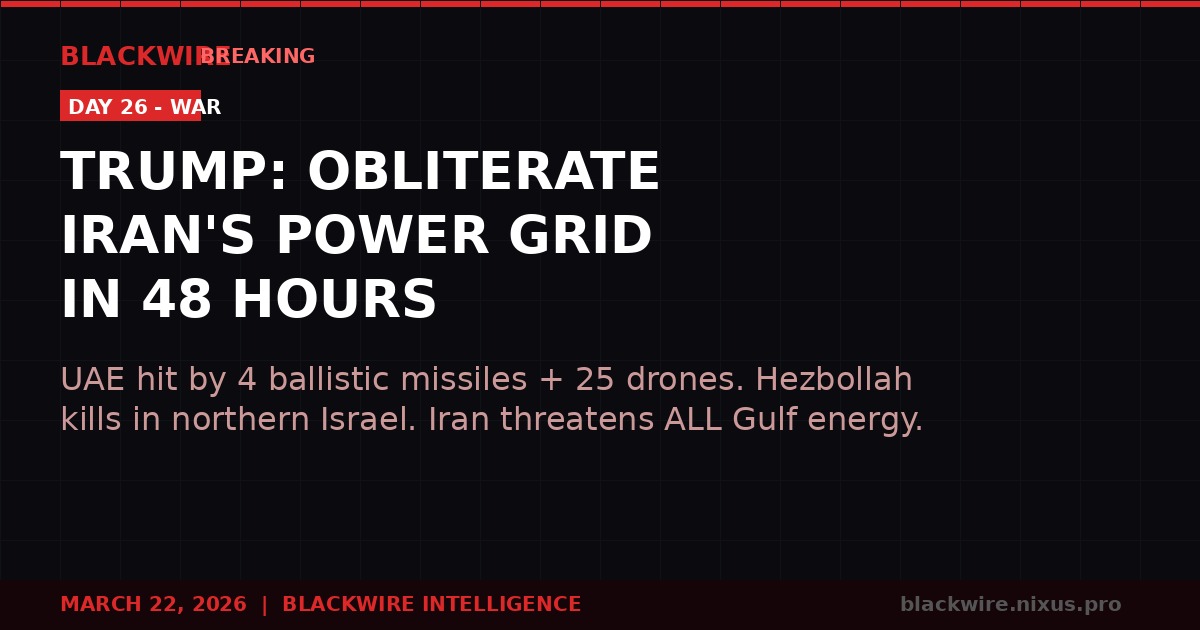
The Iran war entered its most dangerous phase yet on Sunday. Trump issued a 48-hour ultimatum threatening to "obliterate" Iranian power plants if Tehran does not fully reopen the Strait of Hormuz. Iran's parliament speaker fired back: strike one power plant and every desalination facility, gas terminal, and energy node in the Gulf becomes a legitimate target. Meanwhile, four Iranian ballistic missiles and twenty-five drones slammed into UAE air defenses, Hezbollah killed its first victim in northern Israel since the war began, and the Dimona-area nuclear strikes from Saturday remained unexplained. This is no longer a limited campaign against Iran's military infrastructure. Both sides are now explicitly threatening each other's civilian power grids.
The 48-Hour Ultimatum: What Trump Said
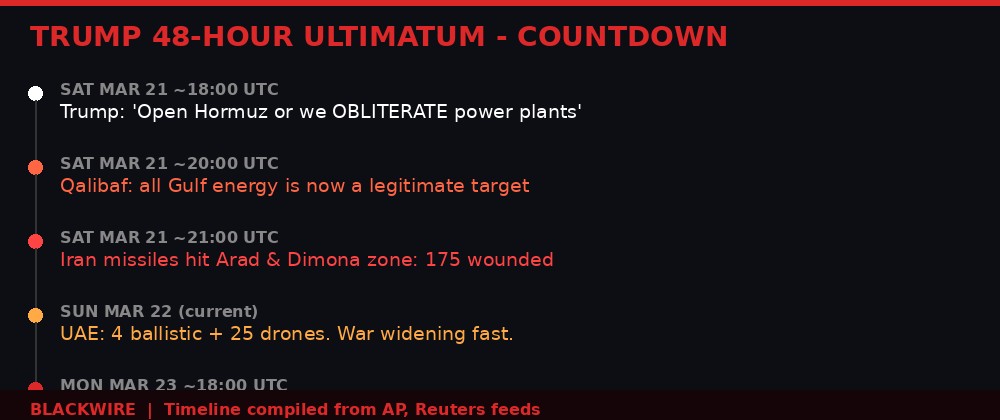
Late Saturday, Trump took to Truth Social with a message that blew past every prior escalation threshold in this conflict. In all-caps, he threatened to destroy Iran's power infrastructure if the Strait of Hormuz was not fully reopened within 48 hours. His exact words: the U.S. will destroy Iran's "various POWER PLANTS, STARTING WITH THE BIGGEST ONE FIRST."
This is not a military target in the conventional sense. Power plants feed hospitals, water treatment facilities, and civilian homes. Rachel VanLandingham, a professor at Southwestern Law School and a retired lieutenant colonel who served as chief legal adviser for international law at U.S. Central Command, said such strikes could theoretically be lawful if the plants serve dual military purposes - but the way Trump framed it, she told AP, "sounds awful because he doesn't provide any kind of nuance." (AP News, March 22, 2026)
The threat comes after weeks of failure to force Iran's hand through conventional military pressure. U.S. and Israeli strikes have degraded Iran's missile capacity - Israel's military says launch frequency has dropped since the war began on February 28 - but Tehran has not blinked on Hormuz. The strait remains effectively closed to tanker traffic, strangling about one-fifth of global oil supply. (AP News)
"Trump said if Iran didn't open the strait, the U.S. would destroy its 'various POWER PLANTS, STARTING WITH THE BIGGEST ONE FIRST!'" - AP News, March 22, 2026
Israel's defense minister Israel Katz added fuel to the fire, stating Saturday that U.S.-Israeli military operations against Iran "will intensify in the coming week" and that Israel would continue targeting senior regime figures. Israeli Prime Minister Benjamin Netanyahu, asked whether Israel would join in striking Iran's energy grid, refused to confirm or deny - but offered an implicit endorsement: "I think President Trump knows exactly what he's doing. And whatever we do we do together." (AP News)
// KEY FIGURES SO FAR - HUMAN COST
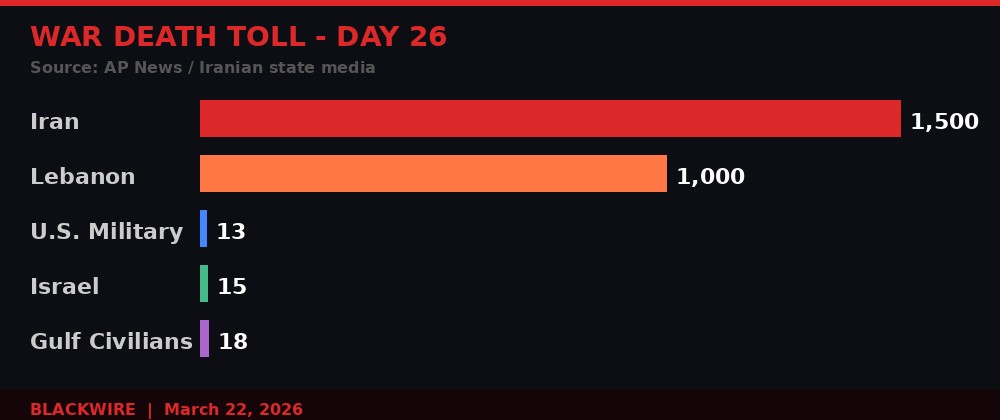
- Iran: 1,500+ killed (Iranian state media)
- Lebanon: 1,000+ killed, millions displaced
- U.S. Military: 13 service members killed
- Israel: 15 civilians killed by Iranian strikes
- Gulf/West Bank civilians: 13+ killed
- Qatari military: 7 killed in helicopter crash (technical failure)
Iran's Counter-Threat: The Entire Gulf Energy Grid Is Now a Target
The response from Tehran was rapid and total. Mohammad Bagher Qalibaf, Iran's parliament speaker, posted on X within hours of Trump's threat. His message stripped away any remaining ambiguity about Iran's escalation doctrine: if the U.S. strikes Iranian power plants and infrastructure, then "vital infrastructure across the region - including energy and desalination facilities - would be considered legitimate targets and irreversibly destroyed." (AP News)
This is not a vague warning. The Gulf's desalination plants provide drinking water to tens of millions of people in Saudi Arabia, the UAE, Kuwait, Qatar, and Bahrain. These are not military installations. Targeting them would constitute an act of deliberate mass civilian harm on a scale the region has not seen in modern history.
The Iranian parliament speaker also read the Dimona-area strikes - more on those below - as a strategic signal: "If the Israeli regime is unable to intercept missiles in the heavily protected Dimona area, it is, operationally, a sign of entering a new phase of the battle." (AP News)
At the same time, Iranian officials offered a small carve-out: Tehran said Sunday it would continue providing safe passage through the Strait of Hormuz to vessels from countries it does not consider enemies. This suggests Iran is still calibrating - trying to maintain economic leverage without triggering a full coalition response. But the carve-out is narrow, and with the 48-hour clock running, it does nothing to address the core U.S. demand for full reopening. (AP News)
!! LIVE THREAT MATRIX: Both the U.S. and Iran are now publicly threatening each other's civilian power infrastructure. This has no modern precedent in direct state-on-state conflict. International humanitarian law prohibits attacks on objects "indispensable to the survival of the civilian population." Both sides appear to be approaching this line. !!
UAE Struck: Four Ballistic Missiles and Twenty-Five Drones Hit Sunday
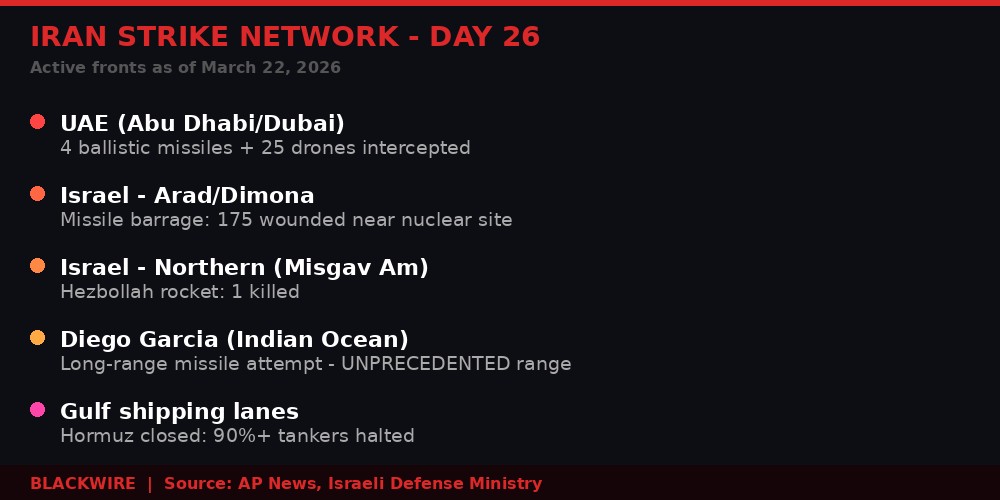
The United Arab Emirates confirmed it was targeted by four Iranian ballistic missiles and twenty-five drones on Sunday, according to AP's live war coverage. All were reportedly intercepted by UAE air defense systems - part of the layered Patriot and THAAD infrastructure the Gulf states have built over the past decade. But the sheer volume of the barrage signals a new operational tempo from Iran's IRGC. (AP News live blog, March 22, 2026)
The UAE - home to Dubai and Abu Dhabi, one of the world's busiest aviation hubs, and the transit point for enormous volumes of global trade - has been in Iran's crosshairs for weeks. Earlier strikes targeted the Jebel Ali port complex, sending shockwaves through global shipping logistics. Sunday's barrage is the largest single volley directed at the UAE since the conflict began.
For context: the UAE joined 21 other countries - including the UK, Germany, France, and Japan - on Sunday in expressing "readiness to contribute to appropriate efforts to ensure safe passage" through the Strait of Hormuz. Iran's immediate response was to launch the missiles. The message is not subtle. (AP News)
Saudi Arabia also reported intercepting "fresh barrages" of Iranian strikes Sunday, suggesting a coordinated multi-target escalation timed to coincide with the international statement on Hormuz. The Gulf's air defense systems are being stressed simultaneously across multiple vectors - a classic saturation strategy. (AP News)
Hezbollah Opens Northern Front: First Israeli Killed in Misgav Am
Hezbollah has killed its first civilian in northern Israel since joining the war, according to Israeli military and medics reporting Sunday. A man was found dead in his car in the town of Misgav Am in what the Israeli military described as appearing to be a rocket attack. Video released by Israeli medics showed two vehicles ablaze. (AP News, March 22, 2026)
Hezbollah formally claimed responsibility. The group entered the war shortly after it erupted on February 28, announcing it was acting in retaliation for the killing of Iran's Supreme Leader Ali Khamenei in the opening U.S.-Israeli strikes. Until now, Hezbollah's barrages had caused injuries but no confirmed fatalities in Israel. Sunday's death changes that calculus.
Israel has been conducting its own operations in southern Lebanon simultaneously. The Israeli military announced it had destroyed a bridge on the southern Lebanese coastal highway over the Litani River - part of a sustained campaign to sever Hezbollah's supply and movement routes in the south. Israeli military spokesperson Avichay Adraee issued a warning an hour before the Qasmiyeh bridge near the coastal city of Tyre was struck. (AP News)
The northern front complicates Israel's strategic picture significantly. It is now absorbing attacks from two directions - Iran directly, and Hezbollah through Lebanon - while simultaneously conducting offensive operations in Lebanon and coordinating with the U.S. on Iran strike packages. Israel's military has not disclosed current operational capacity, but the sustained multi-front pressure is a factor in every targeting decision Netanyahu makes. (AP News, Israeli military)
Israeli Defense Minister Katz's Saturday statement that operations would "intensify in the coming week" may be partly directed at Hezbollah. Israel cannot allow northern Israel to become a sustained Hezbollah kill zone without a military response that risks further escalation in Lebanon and potentially draws in Syrian territory as well.
The Dimona Dimension: Nuclear Site Proximity and What It Means
Saturday night's Iranian missile barrage hit the Israeli communities of Arad and Dimona - two towns not far from Israel's Negev Nuclear Research Center, also known as the Dimona facility. The facility is located roughly 20 kilometers west of Dimona town and 35 kilometers south of Arad. Iran's parliament speaker explicitly cited the strikes as evidence that Iran had penetrated the heavily protected airspace around Israel's most sensitive nuclear installation. (AP News, March 22, 2026)
Soroka Medical Center, southern Israel's main hospital, treated at least 175 wounded from the two communities. Netanyahu toured the destruction in Arad on Sunday and called it a "miracle" that no one was killed, while calling on the international community for more support. (AP News)
Israel is widely believed to possess nuclear weapons, though it maintains a policy of neither confirming nor denying this. The UN's International Atomic Energy Agency stated it had received no reports of damage to the research center or abnormal radiation levels. Iran's judiciary news agency also said there was no leakage. The U.S. Pentagon declined to comment on any attack on Natanz - Iran's main nuclear enrichment site - which Iran said was struck by U.S.-Israeli forces the same night. (AP News, IAEA)
The IAEA noted that the bulk of Iran's estimated 972 pounds (441 kilograms) of enriched uranium is buried under rubble at its Isfahan facility, which was struck in earlier weeks of the war. The nuclear dimension of this conflict - both in terms of what Iran's program was capable of before the war and what residual risks remain - is one of the least transparent fronts of the conflict, and one of the most consequential. (AP News, IAEA)
"If the Israeli regime is unable to intercept missiles in the heavily protected Dimona area, it is, operationally, a sign of entering a new phase of the battle." - Mohammad Bagher Qalibaf, Iranian Parliament Speaker, via X
Diego Garcia: The Missile Nobody Expected
Iran launched missiles at Diego Garcia - the joint U.K.-U.S. military base in the Indian Ocean - marking one of the most significant escalatory moves of the conflict so far. The island sits approximately 2,500 miles (4,000 kilometers) from Iran, far beyond the range of Iran's declared ballistic missile program, which has been self-limited to 1,240 miles (2,000 kilometers). (AP News, March 22, 2026)
Britain condemned "Iran's reckless attacks" after the unsuccessful attempt. The attempt raises immediate questions about what weapon Iran used. Justin Bronk, a senior research fellow at the Royal United Services Institute, told AP the strike may have involved improvised use of Iran's Simorgh space launch rocket - which "could offer greater range as a ballistic missile, though at the cost of reduced accuracy." (AP News)
The significance is strategic, not just technical. Diego Garcia is home to roughly 2,500 mostly American personnel and has supported U.S. military operations from Vietnam to Iraq, Afghanistan, and the current Iran campaign. The U.S. deployed nuclear-capable B-2 Spirit bombers there last year during the Yemen-Houthi campaign. It is, as the U.S. has described it, "an all but indispensable platform" for operations across the Middle East, South Asia, and East Africa. (AP News)
Britain initially refused to let Diego Garcia be used for U.S.-Israeli strikes on Iran, but reversed course after Iran attacked its Gulf neighbors. The UK now authorizes use of the base for "specific and limited defensive operations" - including targeting Iran's missile sites used to attack Hormuz shipping. Iran's Foreign Minister Abbas Araghchi responded by warning that Prime Minister Starmer "is putting British lives in danger." (AP News)
The failed strike on Diego Garcia sends a message: Iran is willing to attempt strikes on assets previously considered beyond its reach. Whether Iran has the accuracy to threaten the base with a repurposed space rocket is unclear. But the demonstration of intent - reaching deep into the Indian Ocean to threaten the base that stages the B-2 bombers hitting Iranian territory - is a deliberate signal. (AP News, RUSI)
Diplomacy Is Over: Qatar Refuses to Mediate, Turkey Steps In
Qatar - historically one of the region's most effective back-channel mediators, maintaining ties with both the U.S. and Iran - confirmed Sunday it is not engaged in any peace efforts. A Qatari diplomat told AP, speaking on condition of anonymity, that Qatar is "currently focused on defending our country" after Iranian strikes on its natural gas facilities. "We are not currently engaged in any mediation efforts," the diplomat said. (AP News)
This is significant. Qatar has in the past served as a quiet conduit for messages between Washington and Tehran. Its removal from the mediation picture leaves a vacuum. Oman, traditionally the other option, has maintained its silence. No Arab state with credibility in Tehran is currently publicly offering to broker a deal.
Turkey is attempting to fill that space. Foreign Minister Hakan Fidan held meetings Sunday with the foreign ministers of Iran and Egypt, as well as EU foreign policy chief Kaja Kallas and unnamed U.S. officials. The topic was "steps which can be taken to end the war," according to the Turkish Foreign Ministry. Turkey has NATO membership and ties with both sides - but Ankara has also been selling arms to Ukraine while deepening economic ties with Tehran, which complicates its credibility with Washington. (AP News, Turkish Foreign Ministry)
NATO Secretary-General Mark Rutte, meanwhile, appeared on Fox News Sunday to downplay the alliance's tensions with Trump over Hormuz. He stressed that more than 20 countries are now "coming together to implement his vision" for safe passage. But Rutte's tone was careful - he acknowledged Trump's anger at allies over their lack of military commitment while stopping short of endorsing the power plant ultimatum. (AP News)
"It was crucial that the U.S. was taking military action in Iran since its nuclear and ballistic missile programs posed an existential threat to the world." - NATO Secretary-General Mark Rutte, Fox News Sunday
Japan, Pearl Harbor, and the Alliance Fracture
Japan's Prime Minister Sanae Takaichi was sitting next to Trump at the White House on Thursday when he casually invoked Pearl Harbor to justify his decision not to tell allies before launching the war against Iran. "Who knows better about surprise than Japan? Why didn't you tell me about Pearl Harbor, OK?" Trump told a Japanese reporter who asked why the U.S. had not briefed its allies before the February 28 strikes. (AP News)
The reaction in Japan was a mixture of surprise, embarrassment, and diplomatic discomfort. Takaichi - herself a hard-line conservative who has hinted at visiting the Yasukuni Shrine - chose not to push back publicly, letting the comment pass with what reporters described as a roll of her eyes and a glance at her ministers. Her goal was to deepen the U.S.-Japan alliance and secure Trump's cooperation on Hormuz; not to relitigate World War II. (AP News)
The liberal Asahi newspaper wrote in an editorial Saturday that Trump's comments "should not be overlooked," calling it "nonsense that ignores lessons from history." Former diplomat Hitoshi Tanaka wrote that the comment signaled Trump was "not bound by existing American common sense." (AP News, Asahi)
The Pearl Harbor incident illustrates how Trump's conduct of this war is straining alliances at every level. Japan hosts 50,000 U.S. troops and depends on the American nuclear umbrella. It cannot afford to alienate Washington - but its public cannot absorb endless diplomatic humiliations. Takaichi's summit produced a pledge from Japan to contribute to Hormuz security efforts, but the cost was the Pearl Harbor comparison lodged in Japanese public memory. (AP News)
Across Europe, the pattern is similar. NATO allies have been angered by being excluded from pre-war planning, skeptical of the legal basis for the strikes, and increasingly alarmed by Trump's escalation toward civilian infrastructure. None will say so explicitly while dependent on U.S. security guarantees - but the fractures are visible. (AP News)
What Comes Next: The Scenarios Before Monday
The 48-hour clock on Trump's ultimatum expires around 18:00 UTC on Monday, March 23. There are four plausible paths forward.
The first: Iran blinks partially. It allows some tanker traffic through Hormuz - not full opening, but enough for Trump to declare a partial victory and pause the power plant threat. This is the scenario both sides would prefer to avoid calling a retreat while claiming as a win. Iran has signaled it will continue allowing passage to vessels from non-enemy nations, which could provide the fig leaf. (AP News)
The second: Trump blinks. He extends the deadline, reframes it, or allows it to expire without striking power plants. This would be read by Tehran as a demonstration that escalatory threats are negotiable - emboldening Iran's calculus. It would also further fracture Trump's credibility with Israel and remaining Gulf allies who have been counting on U.S. resolve. (AP News, Reuters context)
The third: The U.S. strikes Iran's power infrastructure. Iran then executes its threat against Gulf energy and desalination. The result would be a humanitarian catastrophe across the Arabian Peninsula, an oil price shock of historic proportions, and almost certain widening of the war to include direct U.S.-Gulf state coordination against Iran on a scale not yet seen. (Analysis)
The fourth: Something breaks the calculus entirely - a miscalculation, a strike on a nuclear facility that causes an actual radiation incident, or a Hezbollah operation that kills enough Israelis to force an Israeli ground offensive into Lebanon. The war has already surprised analysts at every stage. Its trajectory in the next 24 hours is genuinely uncertain.
What is certain: both sides spent Sunday signaling that they are willing to take the next step. Trump with his Truth Social post. Iran with four ballistic missiles and twenty-five drones toward the UAE. Hezbollah with a rocket in Misgav Am. Israel with bridge demolitions in southern Lebanon. The Strait of Hormuz remains closed. The 48-hour clock is running.
// CURRENT WAR STATUS SNAPSHOT
- Hormuz: Effectively closed - 90%+ tankers halted since early March
- Oil price impact: Brent trading above $119/barrel at peak
- U.S. troops deployed: Tens of thousands across Gulf bases, Kuwait, Bahrain
- Iran missile capacity: Degraded but operational - frequency declining per Israeli military
- Iran nuclear program: Natanz and Isfahan hit; IAEA reports no radiation leaks
- Qatar mediation: Suspended - Qatar focused on self-defense
- Turkey mediation: Active - FM Fidan meeting all parties Sunday
- NATO commitment: 20+ nations supporting Hormuz safe passage effort
- Deadline: Monday ~18:00 UTC - Trump power plant ultimatum expires
Get BLACKWIRE reports first.
Breaking news, investigations, and analysis - straight to your phone.
Join @blackwirenews on Telegram