The Phantom Peace: Trump's Five-Day Pause, Iran's Flat Denial, and the Information War Inside the War
Trump announced a five-day halt to strikes on Iranian power infrastructure. Iran's Parliament Speaker said no talks ever happened. Both statements cannot be true. One of them is lying, and in this war, figuring out which one is the only thing that matters.

Aerial view of strike aftermath in a dense urban zone. The Iran conflict has entered its second month with no clear off-ramp. (Pexels)
A Peace Announcement Nobody Could Verify

The back-channel diplomacy that Trump claimed took place on Sunday remains unverifiable. Iran's officials say it never happened. (Pexels)
On Monday morning, Donald Trump woke up and posted in all-caps to Truth Social. That alone signals something significant is happening - or is being manufactured. He announced that the US Department of Defense had been instructed "to postpone any and all military strikes against Iranian power plants and energy infrastructure for a five day period" pending what he called ongoing talks with Tehran.
He followed it with a statement to reporters that was casual, even cheerful. "They want very much to make a deal," Trump told journalists. "We'd like to make a deal, too. We're doing a five-day period, we'll see how that goes. And if it goes well, we're going to end up settling this. Otherwise, we'll just keep bombing our little hearts out."
Trump said talks had taken place on Sunday, conducted with "a top person" in Iran, whose identity he declined to reveal. He said the conversations had been "very good and productive." Markets reacted instantly. Oil futures slid as traders priced in a possible de-escalation. Shares in European shipping and insurance companies rebounded. The Strait of Hormuz, still shut to commercial traffic for 22 consecutive days, briefly seemed like it might reopen.
Then Tehran responded.
"No negotiations have been held with the US. Fakenews [sic] is used to manipulate the financial and oil markets and escape the quagmire in which the US and Israel are trapped." - Mohammad Bagher Ghalibaf, Speaker of the Iranian Parliament, via X, March 23, 2026 (Source: Al Jazeera)
Iranian Foreign Ministry spokesman Esmaeil Baghaei added a layer of nuance that did not contradict Ghalibaf but pointed toward something happening behind the scenes. Baghaei told IRNA - Iran's official state news agency - that "messages have been received from some friendly countries regarding the US's request for negotiations to end the war." That is not a denial of contact. It is a denial of direct talks, while acknowledging that third parties are carrying messages between Washington and Tehran.
So this is what we actually know on Day 29: the US says direct talks happened; Iran says they did not; regional actors appear to be acting as intermediaries; and nobody can confirm anything publicly. That is not a peace process. That is the fog of war applied to diplomacy.
The 48-Hour Ultimatum That Wasn't

Iranian power and oil infrastructure has been a central targeting consideration since Trump's 48-hour ultimatum last Saturday. The pause bought time - but for whom? (Pexels)
Two days before his peace announcement, Trump had been far less diplomatic. On Saturday, March 22, he threatened to "obliterate" Iran's power plants unless Tehran reopened the Strait of Hormuz within 48 hours. It was a hard line. It was also a deadline he then walked back without Iran doing anything he demanded.
The Strait remains closed. Hormuz - the 21-mile-wide chokepoint through which roughly one-fifth of the world's oil and liquefied natural gas passes every day - has been functionally blockaded by Iran's naval forces since March 1. Iranian fast-attack boats, mines, and anti-ship missile batteries have made commercial transit too dangerous for most insurers to cover. The International Energy Agency agreed to release 400 million barrels from strategic reserves as a buffer, but that cannot substitute for a waterway that moves approximately 21 million barrels per day.
Analysis from Iran specialist Hassan Ahmadian at the University of Tehran, shared with Al Jazeera, cuts to the core of what happened between Saturday's ultimatum and Monday's peace announcement. "It seems that there are mediation efforts that started regionally, by Pakistan, Egypt and Turkiye, trying to find a way out of this standoff," Ahmadian said. "But Trump going this heavy on this mediation effort speaks volumes to him trying to climb down from the deadline he issued and the Iranian threat of retaliation that would have been really significant."
That framing - Trump needing an exit ramp from his own ultimatum - is the interpretation that Iran's officials appear to be deliberately amplifying. Ghalibaf called the deal narrative "fake news used to escape the quagmire." Whether that is accurate or propaganda, it functions as a pressure tool: Iran denies the talks, which keeps it from appearing weak, while the pause in power plant strikes gives their civilian population a brief reprieve.
Netanyahu complicated everything further. The Israeli Prime Minister said he had spoken with Trump on Monday and that the US president believes "there is an opportunity to leverage" the war to reach an agreement. "In parallel, we continue to attack both in Iran and Lebanon," Netanyahu added. The Israeli Air Force conducted fresh strikes on Tehran on Monday. The bombing did not stop. The pause on power plant strikes apparently did. That distinction matters enormously to the 85 million people living in Iran, where rolling blackouts have already affected major cities.
The F-35 Question Nobody Will Answer Cleanly

The F-35 Lightning II is the most advanced stealth fighter jet in the world. Iran now claims it successfully struck one. The US has not confirmed or denied the damage. (Pexels)
Separate from the diplomacy theater, a harder military reality has been developing over the past week. An F-35 stealth fighter - the most advanced combat aircraft in the US arsenal - made an emergency landing at an undisclosed base in the region last Thursday. CENTCOM's initial statement confirmed only that the jet had landed safely and the pilot was in stable condition.
Then the details started leaking. Air and Space Forces Magazine, citing unnamed sources with direct knowledge of the incident, reported that the pilot suffered shrapnel wounds and that the aircraft had been struck by ground fire. Iran's Islamic Revolutionary Guard Corps issued a statement claiming it had successfully targeted a US aircraft. Iran's Tasnim news agency released what it called military footage showing Tehran's air defense systems engaging an F-35.
The US has denied that any F-35 was shot down. CENTCOM pushed back hard on Monday: "FALSE: Rumors claim the Iranian regime recently shot down a U.S. F-15 over Iran. TRUE: U.S. forces have flown more than 8,000 combat flights during Operation Epic Fury. No U.S. fighter aircraft have been shot down by Iran." That statement is careful. It says no aircraft were "shot down" - which is different from saying no aircraft were struck. An F-35 taking shrapnel hits and successfully returning to base is not a shootdown. It is still significant.
"This would be significant - not because it means stealth is becoming obsolete but because it would show that even an F-35 is not invulnerable in a dense, adaptive air-defence environment." - Ali Vaez, Director of the Iran Project, International Crisis Group (Source: Al Jazeera)
Defense analysts reached by Al Jazeera noted that while F-35s have been deployed in combat operations since 2018, there are no confirmed prior cases of one being struck by enemy fire. If Iran's air defense systems - which are a layered combination of Russian-supplied S-300 batteries, domestically developed Bavar-373 systems, and shorter-range interceptors - managed to put shrapnel through a fifth-generation stealth aircraft, the implications for US air power doctrine are significant.
John Phillips, a British safety and risk adviser and former military chief instructor, told Al Jazeera that the F-35's radar suites are what make it formidable, but they are not uniform across export variants. "There isn't a standard radar suite, and they vary by nation," Phillips explained. "Rumours are that certain countries were only given certain radars by the manufacturer. This I believe is to counter attempts at foreign adversaries like China or Russia reverse engineering the technology." Iran, in acquiring its air defense intelligence, may have exploited those variance gaps.
Separately, Iran claimed it fired long-range missiles at Diego Garcia - the British Indian Ocean Territory base that serves as the primary US strategic bomber hub for Operation Epic Fury. Iran's Foreign Ministry spokesman Baghaei called reports of the attack a "false flag." The US has not commented specifically on the Diego Garcia claim. Given that B-2 stealth bombers operate from Diego Garcia, any successful Iranian missile strike on the facility would represent a dramatic escalation in Iran's operational reach - over 4,000 kilometers from Iranian soil.
Lebanon: The Second Front Creeping Open

Infrastructure bridges have become strategic targets in Lebanon, as Israel's strikes expand beyond traditional Hezbollah strongholds. (Pexels)
While global attention is fixed on Tehran and the Strait of Hormuz, the Lebanon front has been accelerating quietly. Israeli forces struck the Qasmiyeh Bridge over the Litani River on Monday, March 23. Lebanese authorities described it as a potential "prelude to a ground invasion."
The Qasmiyeh Bridge crossing sits on a key route in southern Lebanon. Destroying river crossings is a classic preparation for ground operations - it limits Hezbollah's ability to move forces and resupply lines while potentially allowing Israeli ground forces to exploit the gap. Blackwire has previously reported on the Israeli ground incursion threat, specifically the 517,000 internally displaced Lebanese civilians already displaced from southern towns and villages ahead of any potential Israeli push.
Hezbollah has been resurgent since the Iran war began on February 28. With Israel's Iron Dome and David's Sling systems increasingly occupied tracking Iranian missile and drone swarms, Hezbollah has reportedly reconstituted firing positions that had been degraded in the 2024-2025 ceasefire period. The group has been launching rockets into northern Israel with increasing frequency over the past two weeks.
Netanyahu's confirmation that Israel is "continuing to attack in Iran and Lebanon simultaneously" is significant strategic information. Israel is not treating these as separate conflicts. It is treating the Iran war, the Gaza campaign, and the Lebanon threat as one integrated theater of operations. That has resource and logistics implications - and it explains why the UK's HMS Prince of Wales was put on five-day readiness, why UK troops are stationed in Bahrain, and why CENTCOM has been rotating additional Marine and Army units through Kuwait.
The Pakistan dimension adds another layer. Al Jazeera's reporting cites Pakistan as one of the regional mediators carrying messages between Washington and Tehran. Pakistan borders both Iran and Afghanistan, has a complex military relationship with the US, and shares the Iran-China gas pipeline infrastructure that is now one of the few economic lifelines Tehran has left open. Islamabad's willingness to play intermediary suggests it believes this war has consequences for Pakistani energy security that go beyond the immediate conflict.
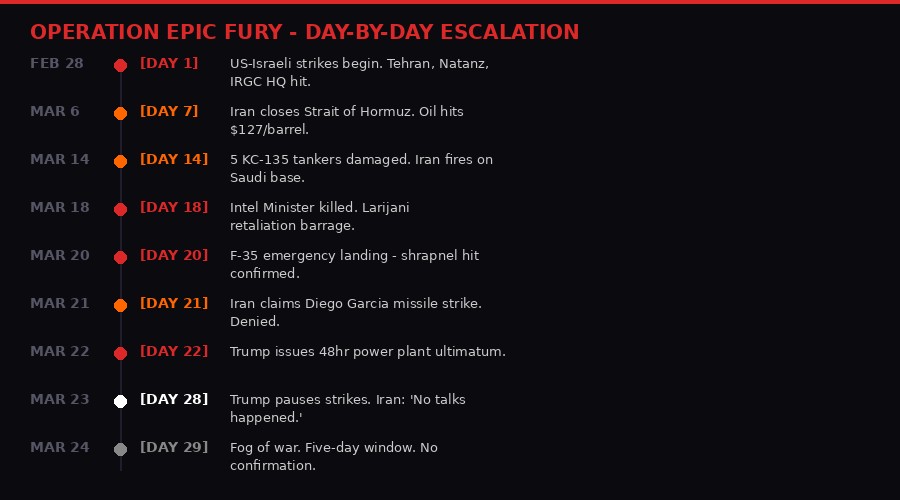
Timeline of Operation Epic Fury from Day 1 to Day 29. Each escalation has been followed by a counter-escalation with no stable equilibrium reached.
The Civilian Cost Inside Iran

Civilians in Iran's major cities are bearing the compounding costs of airstrikes, power grid failures, and an economy in freefall. (Pexels)
The BBC reported Monday on what it called "the alarming civilian cost of war in Iran," profiling a pharmacist and a lifestyle blogger - ordinary people caught inside a war they did not choose. Since February 28, at least 1,444 Iranians have been killed and 18,551 injured, according to local health authorities. Those numbers are almost certainly undercounts. CENTCOM controls the airspace over much of the western portion of the country during strike windows, and access for independent journalists is severely restricted.
The power grid situation is deteriorating. Trump's pause on infrastructure strikes covers power plants specifically, but Iranian energy infrastructure has already taken significant hits over 28 days of sustained operations. Hospitals in Tehran have reported operating on backup generators. Fuel rationing has begun in several provincial cities. The Iranian government has blamed the US for what it calls "economic warfare against civilians."
That framing carries weight internationally even if it is also self-serving. The International Energy Agency's decision to release 400 million barrels from strategic reserves was prompted in part by warnings about a global energy shock - not just for oil, but for liquefied natural gas, of which Iranian production accounts for a significant share of Gulf export capacity. Qatar and the UAE, both US partners, have been navigating an increasingly uncomfortable position as the war's economic spillover hits their own shipping and trade volumes.
The Strait of Hormuz closure is now in its 22nd day. International maritime law, the doctrine of freedom of navigation that the US Navy has enforced for 75 years, is effectively suspended in the Persian Gulf. Several major shipping companies have rerouted cargo around the Cape of Good Hope, adding 14 to 17 days to transit times and an estimated 25 to 30 percent to per-voyage costs. Consumer prices for goods dependent on Gulf energy supplies are rising in Europe, South Asia, and East Africa.
Day 29 War Readout: What We Know, What We Don't
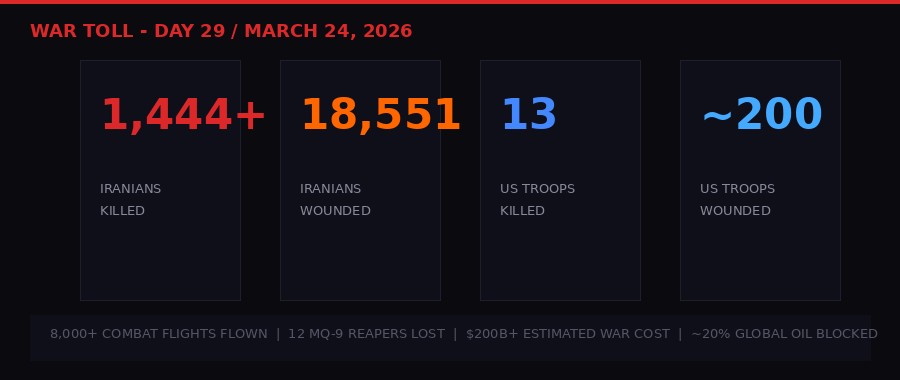
Verified war toll as of Day 29. Iranian casualty figures sourced from Iranian Health Ministry via Al Jazeera. US KIA sourced from CENTCOM public statements.
The information environment around this war has been aggressively managed by all parties since Day 1. The US releases carefully worded CENTCOM statements that confirm air superiority claims without providing location-specific strike data. Iran's IRGC releases footage and claims that are difficult to verify without on-the-ground access. Netanyahu's office coordinates carefully with Washington on what is disclosed and when.
What the open-source record confirms as of March 24, 2026:
US combat losses: 13 troops killed in combat. Approximately 200 wounded. 12 MQ-9 Reaper drones lost. At least one F-35 suffered shrapnel damage from ground fire. Three F-15E Strike Eagles lost in a friendly fire incident on March 1. Five KC-135 tanker aircraft damaged in an Iranian missile strike on a Saudi base March 14. Over 8,000 combat sorties flown.
Iranian losses: Minimum 1,444 civilians killed, 18,551 wounded per Iranian Health Ministry. Multiple IRGC command nodes struck. Intelligence Minister killed March 18. Natanz and other nuclear infrastructure struck repeatedly. Air defense systems partially degraded but operational.
The Hormuz blockade: Entering day 22. No commercial tanker transit has been verified since March 1. Iran maintains fast-attack boat patrols, mine threat, and anti-ship missile coverage.
The diplomatic picture: Pakistan, Egypt, and Turkey acting as intermediaries. Iran denying direct US talks. Trump claiming talks happened. Five-day window on power plant strikes announced but unconfirmed by Iran. Israel striking Iran and Lebanon regardless.
What is not confirmed: whether the five-day window represents a genuine diplomatic channel, a face-saving exit for Trump after his ultimatum, an Iranian stall tactic to protect their remaining power grid, or some combination of all three. The war is in its most dangerous phase not because strikes are escalating, but because neither side has defined what victory looks like or what they will accept as a stopping point.
BLACKWIRE Assessment: The diplomatic fog is thickening, not clearing. Trump's paused-strike window expires in five days. Iran's denial of direct talks removes any accountability mechanism for what those five days are supposed to produce. The Hormuz strait remains closed. Israeli strikes on both Tehran and Beirut continue. The scenario that resolves this is not visible yet.
Timeline: Operation Epic Fury - Key Escalation Moments
What the Five-Day Window Actually Buys

The five-day pause gives both sides room to breathe - but the structural impasse remains: Iran will not reopen Hormuz without guarantees; the US will not provide guarantees before Hormuz reopens. (Pexels)
Strip away the political theater and the five-day window buys several things regardless of whether talks are real or fabricated.
For Iran, it buys time to assess damage to their power grid and potentially restore partial capacity before another strike wave. It gives the civilian population a psychological break. It gives the IRGC leadership time to prepare their next-wave missile retaliation if the window closes without an agreement. And it allows Iranian diplomats to present themselves internationally as the rational party - the ones who did not confirm talks they never agreed to.
For Trump, the five-day window solves an immediate problem: he issued a 48-hour ultimatum that was about to expire with nothing to show for it. The Hormuz strait was still closed. Iran had not blinked. Striking power plants serving 85 million civilians would have intensified international pressure - from Europe, from India (which had been importing Iranian oil through workarounds), from China, and from the UN. The pause gives him a narrative exit: talks are happening, be patient.
For the regional mediators - Pakistan, Egypt, Turkey - the five-day window is an opportunity to establish themselves as indispensable brokers. Any of those three governments that successfully facilitates a framework for talks would gain significant diplomatic capital. Turkey's Erdogan, facing his own economic pressures, has been positioning Ankara as a neutral venue. Egypt's back channel access to Tehran goes back decades. Pakistan's shared border with Iran and its energy dependency on the Gulf makes it a natural intermediary.
What the window does not buy: a structural resolution to the core dispute. Iran wants the US and Israel to stop bombing. The US wants Iran to reopen Hormuz and abandon its nuclear program. Those are not negotiating positions that have an obvious middle ground. Every day the Strait stays closed, Iran's leverage as an energy choke point grows - but every day the strikes continue, Iran's industrial and military infrastructure erodes. This is an attrition game now. And in attrition games, the side that cannot absorb losses loses eventually.
The question is what "losing" looks like when one side has nuclear enrichment capability, dispersed military forces, and a population of 85 million willing to absorb pain, and the other side has the most powerful air force in human history but no stomach for a ground campaign, no allied consensus, and a president who needs this to be "a deal" rather than "a war."
Five days. That is what both sides bought themselves. What happens on Day 34 depends entirely on what neither side will publicly admit right now.
Get BLACKWIRE reports first.
Breaking news, investigations, and analysis - straight to your phone.
Join @blackwirenews on Telegram