Day 31: 82nd Airborne Deploys as Pakistan Offers Talks - Iran Keeps Firing and Says No Deal
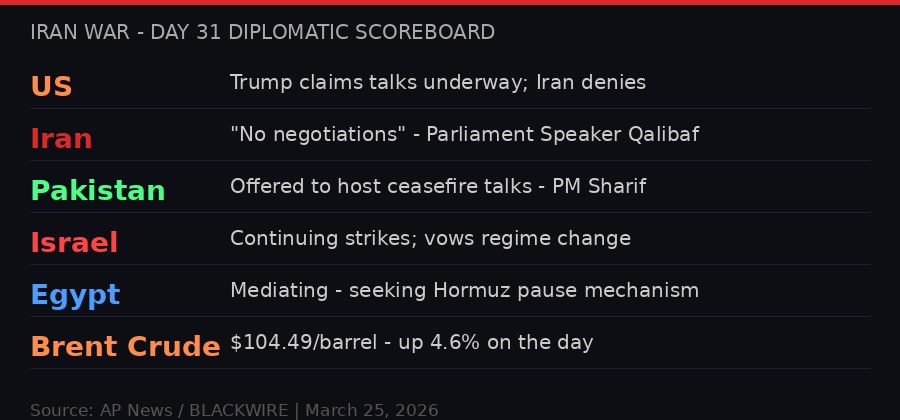
The United States is sending roughly 1,000 soldiers from its elite 82nd Airborne Division to the Middle East even as Pakistan steps forward to host peace negotiations - a diplomatic lifeline that Iran is refusing to grab. Missiles and airstrikes continued through Tuesday night. Brent crude climbed back above $104 a barrel. The war has now lasted 31 days with no end in sight.

Iran's parliament speaker Mohammad Bagher Qalibaf posted on X Tuesday: "No negotiations have been held with the US. Fakenews is used to manipulate the financial and oil markets and escape the quagmire." Iran's military spokesman followed with: "This path will continue until complete victory."
The 82nd Airborne - America's 911 Force Goes to the Gulf

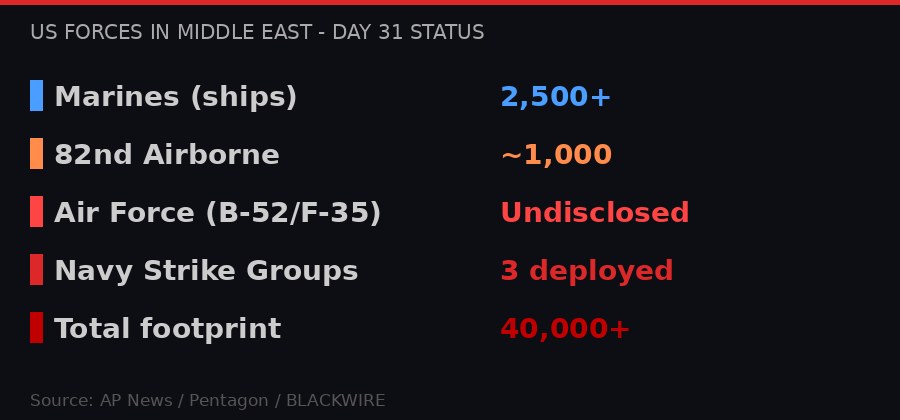
The deployment is not subtle. Around 1,000 soldiers from the 82nd Airborne Division - the US Army's on-call emergency force - are heading to the Middle East in the coming days, a person with direct knowledge of the plans told the Associated Press. The source spoke on condition of anonymity because the deployment had not been officially announced at time of reporting.
The 82nd Airborne is explicitly different from the Marines who were already announced. Marine units aboard Navy ships are trained for embassy support, civilian evacuation, and disaster response. The 82nd Airborne is trained for one thing above all others: to parachute into hostile or contested territory and seize key terrain, including airfields. That distinction carries operational weight.
The deployment comes on top of thousands of Marines already heading to the Gulf aboard several Navy ships, as Pentagon officials announced last week. The total American military footprint in the region has expanded rapidly during the conflict's 31-day arc - from pre-war positioning to a force now estimated at more than 40,000 personnel across multiple countries, aircraft carriers, and land bases stretching from the Red Sea to the Arabian Peninsula.
Pentagon officials declined to specify where the 82nd Airborne troops would be stationed, which countries had agreed to host them, or what their precise mission would be. The New York Times first reported that the deployment was under consideration. The AP confirmed it was now proceeding.
The 82nd is headquartered at Fort Liberty, North Carolina. It maintains a Division Ready Brigade that can deploy within 18 hours of an execute order. Sending a brigade-sized element - roughly 1,000 troops represents a task force drawn from that ready force - to an active war zone signals that planners in Washington are preparing for scenarios that go beyond the current air-and-missile exchange.
Those scenarios could include: securing airfields for follow-on forces, providing a rapid reaction capability if US bases or embassies come under direct ground assault, or supporting potential special operations raids. None of those missions have been confirmed. But the doctrine of the unit speaks for itself.
Pakistan Steps Up - Can Islamabad Pull Off a Ceasefire?

Pakistani Prime Minister Shehbaz Sharif posted publicly on X on Tuesday that Pakistan is ready to "facilitate meaningful and conclusive talks" to bring the Iran war to a close. The announcement was not purely symbolic. According to three Pakistani officials, one Egyptian official, and a Gulf diplomat who spoke to the AP on condition of anonymity, the United States has agreed "in principle" to join talks in Pakistan.
The framework being discussed would have US special envoy Steve Witkoff and Jared Kushner - Trump's son-in-law and a key back-channel diplomat - representing Washington at the table. Pakistan's position as a geographic and diplomatic bridge is notable: it shares a long border with Iran, maintains Islamic solidarity with Tehran, and has historically served as a conduit between the Gulf states and harder-to-reach actors in regional diplomacy.
One regional diplomat told the AP that talks could materialize by early next week if Iran agrees to participate. That is the problem. Iran has not agreed to participate.
Egyptian mediators, who are also engaged in parallel efforts, described their priority as "trust-building" between Washington and Tehran before any formal ceasefire can be structured. The Egyptian official said negotiators were working on a "mechanism" specifically aimed at getting Iran to reopen the Strait of Hormuz - the 21-mile-wide chokepoint that handles roughly 20 percent of the world's crude oil supply and has been functionally closed since the war began on February 28.
The Hormuz question is central to everything. Trump has listed reopening the strait as a core war objective alongside degrading Iran's missile program, eliminating its navy, destroying its defense industrial base, and ensuring Tehran can never acquire a nuclear weapon. Any deal that does not visibly address Hormuz would be politically unsellable to markets and to the American public - which has watched gas prices soar nearly 40 percent since the conflict began.
Trump spoke at the White House on Tuesday and confirmed the talks framework: "We have a number of people doing it," he told reporters. "And the other side, I can tell you, they'd like to make a deal." Iran's foreign ministry responded within hours by calling his statement an effort "to reduce energy prices and to buy time for implementing his military plans." The pattern of Trump claiming progress, Iran denying it, and markets whipsawing has now repeated for three consecutive days.
Iran's Response - Defiance, Denial, and More Missiles

While diplomats in Islamabad and Cairo worked their phones, Iran's armed forces were firing. At least a dozen waves of missiles targeted Israel on Tuesday. First responders in Israel reported three people wounded in southern Israel, four others with minor wounds in Tel Aviv. Iranian strikes also hit Bahrain, where a Moroccan civilian contractor working with the UAE's armed forces was killed. Kuwait saw power line strikes from air defense shrapnel, causing partial electricity outages lasting several hours. Saudi Arabia said it destroyed Iranian drones targeting its oil-rich Eastern Province.
Iran's military spokesman Maj. Gen. Ali Abdollahi Aliabadi issued a statement through Iranian state television that left no room for diplomatic ambiguity. "Iran's powerful armed forces are proud, victorious and steadfast in defending Iran's integrity," he said. "This path will continue until complete victory." He declined to define what victory would mean - a deliberate vagueness that analysts say is intended to give Iran's political leadership maximum flexibility while keeping the military hard line firm.
The leadership picture in Tehran remains murky. Mojtaba Khamenei - son of the late Supreme Leader Ayatollah Ali Khamenei and the man who has formally assumed the supreme leadership role - has maintained a posture of outward defiance. His portraits now line Tehran's major highways alongside those of his father. Internally, according to diplomatic sources, there are factions within Iran's government who recognize the economic toll of the Hormuz closure and the ongoing bombardment. But those factions have no public voice, and the IRGC - the Islamic Revolutionary Guard Corps - has so far shown no signs of breaking from the war posture.
Parliament speaker Qalibaf's flat denial of any negotiations happening was particularly pointed. Reports had focused on Qalibaf himself as a potential interlocutor with Witkoff and Kushner - the very idea that he was being positioned as a backchannel was apparently enough to push him into a public denial on X. Trump had said Witkoff and Kushner held "very good" talks over the weekend with unspecified "respected" Iranian officials. The gap between what Washington says is happening and what Tehran acknowledges is happening has become its own front in the information war.
Oil, Markets, and the Economic Bleed

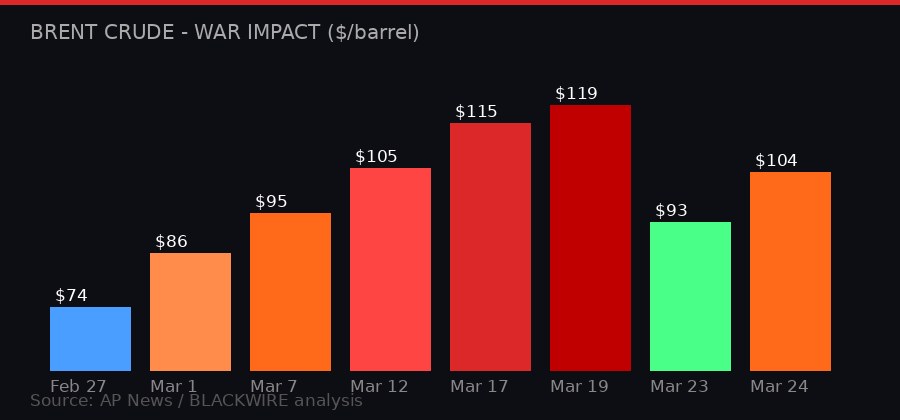
Tuesday's market moves told the real story. When Trump announced Monday that negotiations were underway, Brent crude fell 9.7 percent to $101.26. Stocks rallied. Optimism briefly spiked globally. Then Iran denied everything, missiles continued flying, and oil clawed back 4.6 percent to settle at $104.49 per barrel by Tuesday's close. US benchmark crude rose 4.8 percent to $92.35. Gold fell slightly to $4,402 per ounce. The S&P 500 lost 0.4 percent. The market has now learned to discount Trump's peace claims until there is a material change on the ground - specifically, movement on Hormuz.
The Strait of Hormuz remains the economic nerve of this conflict. Roughly 20 percent of the world's crude oil and about 20 percent of global liquefied natural gas passes through the strait annually. Since Iran effectively closed the strait on February 28, the disruption has sent Brent crude up nearly 40 percent from its pre-war level of around $74. Every week that passes with Hormuz closed adds tens of billions of dollars in direct and indirect economic damage to the global economy.
The human cost is landing across the planet in very ordinary ways. In Buenos Aires, taxi driver Luis Catalano told the AP he is "just barely getting by" as fuel costs shred his margins. In Cologne, Germany, 35-year-old janitor Kevin Plucken can only afford to put 20 euros of gas in his car at a time and has stopped taking his children on weekend drives. In Manila, Filipino jeepney drivers dependent on diesel face cascading costs on top of stagnant wages that have not moved in years.
The Philippines declared a national energy emergency on Tuesday - the first country to do so directly attributing the crisis to the Iran war. Philippine President Ferdinand Marcos Jr. invoked emergency powers that will allow authorities to act against fuel hoarding and manipulation, and ordered the Department of Migrant Workers to prepare evacuation plans for the 2.4 million Filipinos living in the Middle East, including 31,000 in Israel and 800 in Iran.
Israel Keeps Striking - Beirut, Lebanon Fractures

Israel continued its operations with no sign of pulling back. The Israeli military conducted what it described as an extensive series of strikes on Iranian "production sites" - without specifying locations or what was targeted. In Tehran, large blasts were heard in northern neighborhoods and in the city center.
Israel also pounded Beirut's southern suburbs, stating the strikes targeted infrastructure used by Hezbollah. A strike on a residential apartment building southeast of the Lebanese capital killed at least three people, including a three-year-old girl, according to the Lebanese Health Ministry. Five more people were killed in southern Lebanon. In northern Israel, one woman was killed by shrapnel during an attack originating from Lebanon.
Lebanon's response to the ongoing bombardment took a sharp diplomatic turn. The Lebanese government declared Iran's ambassador persona non grata and ordered him to leave the country. The move reflects the extraordinary rupture that the war has created across the region - Hezbollah is Iran's most significant external proxy, the two are deeply intertwined, and yet the Lebanese state is now expelling Tehran's top diplomat. The Lebanese political establishment has watched the country absorb Israeli strikes ostensibly aimed at Hezbollah and has reached a breaking point with Tehran's role in pulling Lebanon into a conflict it did not choose to enter.
Israeli Prime Minister Benjamin Netanyahu has been explicit about one goal that creates a direct problem for any US-Iran deal: he says the war aims to help Iranians overthrow the theocratic government in Tehran. Trump has notably backed away from regime change language in recent days - the two leaders' objectives are drifting visibly apart. Trump wants a negotiated outcome. Netanyahu wants the Islamic Republic to fall. Those are not compatible endpoints, and the gap between them will need to be resolved before any serious ceasefire framework can be constructed.
What Would a Deal Actually Look Like - and Can Trump Claim Victory?
The hardest political problem Trump faces is not brokering a deal - it is brokering a deal that he can actually claim as a win. When he launched the war alongside Israel on February 28, Trump stated a list of objectives that have become harder to walk away from the longer the conflict runs:
Degrading Iran's ballistic missile capability: partial progress, according to US military assessments, but Iran has continued firing missiles in volume throughout the conflict. Its production capacity is damaged but not eliminated.
Destroying Iran's defense industrial base: significant strikes have been carried out on manufacturing and logistics nodes. But Iran's distributed production model - learned over decades of sanctions - means the industrial base is not a single target that can be "destroyed" in any binary sense.
Eliminating the Iranian navy: the IRGC Navy's fast-attack capability has been degraded. Iran's conventional naval assets have absorbed significant losses. But maritime drones and underwater capabilities remain active, and Iran has demonstrated the ability to threaten Gulf shipping asymmetrically even without a conventional fleet.
Preventing Iran from ever acquiring nuclear weapons: this is the hardest goal by a very wide margin. US and international nuclear watchdog assessments believe that approximately 970 pounds of highly enriched uranium remains buried beneath rubble at three key Iranian nuclear sites that were damaged in earlier strikes. The uranium did not disappear. It is harder to access, but it exists. Any deal that does not include full IAEA verification and an Iran commitment to permanently forgo enrichment above low levels would leave this goal unresolved.
Reopening the Strait of Hormuz: not achieved. This is the goal that the global economy is most immediately focused on, and it remains the clearest metric for measuring whether the war is actually being wound down or merely paused.
If Trump were to announce a ceasefire today, he would be leaving the table without definitive progress on nuclear weapons or Hormuz. Regional analysts cited by the AP have noted that this creates a significant credibility problem. The administration would argue that degrading Iran's military - stripping it of battlefield effectiveness, eliminating key leadership, and demonstrating American willingness to act - represents strategic victory even if individual checkboxes remain incomplete. That argument will face fierce scrutiny in Washington.
Timeline - How This War Reached Day 31
Key Events - February 28 to March 25, 2026
The Bigger Question - How Does This End?

The fundamental problem with the current diplomatic moment is that neither side has reached the threshold of pain that forces a deal. Iran is absorbing strikes and losing commanders, but its government has not collapsed and its missile force continues to function, if at reduced capacity. The US has not suffered the kind of battlefield losses that create domestic political pressure to exit - no aircraft carrier sunk, no mass casualty event, no congressional revolt yet sufficient to invoke the War Powers Act successfully.
That equilibrium can shift. The 82nd Airborne deployment is a signal that Washington is preparing for escalation, not de-escalation. The Pakistan talks offer is a real diplomatic opening, but Iran would need to choose to engage - and Tehran's public posture is that there is nothing to negotiate until strikes stop. Washington's position is that strikes will stop when Iran agrees to discuss Hormuz and nuclear guarantees. The circular logic has so far produced 31 days of war.
What changes the calculus most quickly is either a dramatic military event - a US strike that Tehran cannot absorb, or an Iranian strike that Washington cannot ignore - or an economic crisis severe enough that one side blinks. Oil at $104 is painful but not catastrophic for the United States, which remains an oil producer. For Iran, an economy already under years of sanctions pressure, the combination of ongoing military destruction and complete economic isolation is doing compounding damage that may not be visible yet in public statements but is almost certainly being felt in private discussions.
The Hormuz closure is the pressure point. Every tanker that cannot pass through the strait is costing Iran revenue it cannot recover. Every day the blockade continues is a day the international coalition against Tehran's isolation grows marginally stronger. The question is whether that pressure accumulates fast enough to produce Iranian flexibility before the US decides to escalate toward targets - power plants, water infrastructure, economic nodes - that would dramatically expand civilian suffering and global outrage.
Pakistan's offer is the first serious multilateral diplomatic framework to emerge from the conflict. Egypt's mediation efforts, the Gulf states' behind-the-scenes work, and now Islamabad's direct invitation create the outline of an off-ramp. Whether Iran takes it depends on decisions being made right now in Tehran by a leadership that is publicly committed to "complete victory" and privately watching its country absorb the 31st consecutive day of airstrikes.
The 82nd Airborne is packing its parachutes. The diplomats are making calls. The missiles are still flying. Day 32 will tell us whether any of it changes.
"No negotiations have been held with the US. Fakenews is used to manipulate the financial and oil markets and escape the quagmire in which the US and Israel are trapped." - Mohammad Bagher Qalibaf, Speaker of Iran's Parliament, posting on X, March 24, 2026 (AP News)
"All I'm saying is we are in the throes of a real possibility of making a deal. And I think, if I were a betting man I'd bet for it. But again, I'm not guaranteeing anything." - US President Donald Trump, speaking to reporters before boarding Air Force One, March 23, 2026 (AP News)
"Pakistan is ready to facilitate meaningful and conclusive talks to end the Iran war." - Prime Minister Shehbaz Sharif of Pakistan, posting on X, March 24, 2026 (AP News)
Get BLACKWIRE reports first.
Breaking news, investigations, and analysis - straight to your phone.
Join @blackwirenews on Telegram