Day 32: Trump Sends 15-Point Ceasefire Plan to Iran. Oil Crashes 9%. Hormuz Cracks Open.
The Trump administration has sent Iran a 15-point framework to end the war, delivered by Pakistan. Oil dropped 9% in minutes. Tehran announced a partial Hormuz opening. And then the bombs kept falling anyway.
Twenty-six days of bombing. Fifty thousand US troops in the region. Oil pinned above $100 per barrel for two weeks. Now, on Day 32, three separate things happened simultaneously that nobody fully expected: a 15-point American peace proposal surfaced in the international press, Iran made its most significant concession yet by declaring the Strait of Hormuz open to non-hostile ships, and Brent crude fell off a cliff - dropping more than 9% in a single session on hopes the war could end.
None of it means peace. Strikes continued through the night. Iranian missiles wounded seven people in Israel, including an infant. A US-Israeli strike killed at least 12 people in Tehran. The 82nd Airborne is reportedly still en route to the theater. Israel's military spokesman said the war plan was "unchanged."
What it does mean is that something shifted - or at least appeared to shift. Markets decided the noise was worth pricing. Analysts are calling it the most significant diplomatic signal of the war. And Tehran's own foreign ministry quietly acknowledged that messages had been "relayed by friendly countries indicating a US request for negotiations," according to AFP.
The question every intelligence analyst, diplomat and oil trader is sitting with this morning: is this the beginning of the end, or a market manipulation operation dressed as diplomacy?
The 15-Point Plan: What America Is Asking For
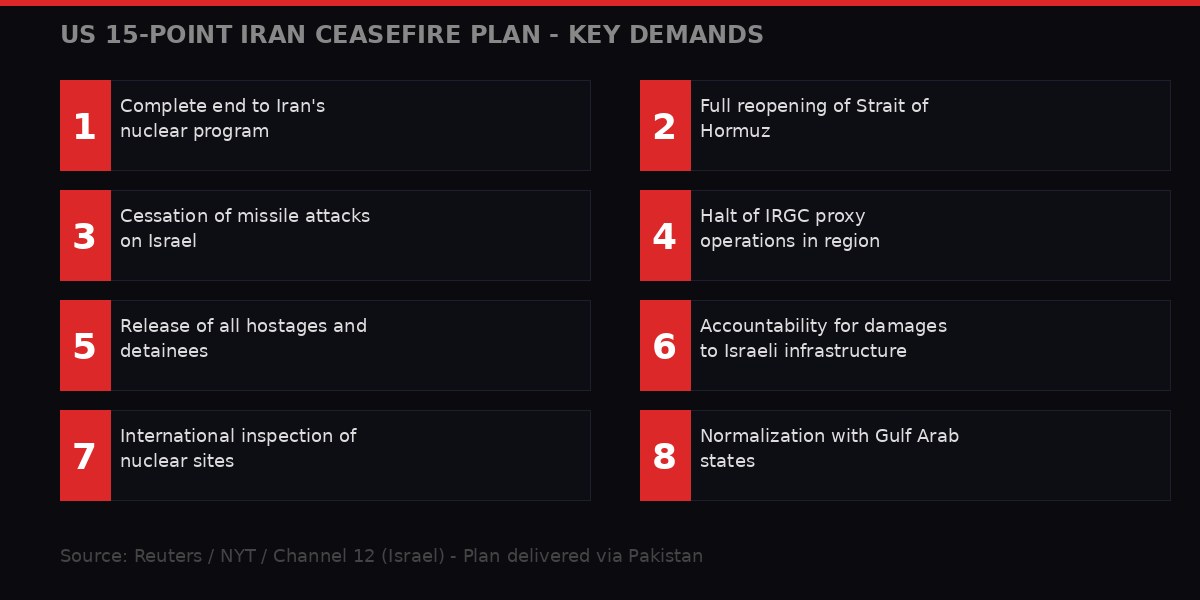
The plan was reported simultaneously by Reuters, The New York Times, and Israel's Channel 12 - a trifecta of sourcing that suggests a coordinated leak from within the US government or its intermediaries. The timing was precise: Asian markets were opening, and Brent crude was hovering near $120.
According to those reports, the 15-point framework includes demands for the complete end of Iran's nuclear program, the full reopening of the Strait of Hormuz, a cessation of all missile and drone attacks on Israel, the halting of IRGC proxy operations across the region, and international inspection access to Iranian nuclear facilities. It also reportedly seeks normalization between Iran and Gulf Arab states, the release of all hostages and detainees, and some form of accountability for damages inflicted on Israeli civilian and military infrastructure.
The document was delivered through Pakistan - a choice that is itself diplomatically significant. Pakistan maintains formal diplomatic relations with Iran, has no military stake in the conflict, and has credibility in Tehran that neither the US nor any Western European power currently holds. Al Jazeera's Teresa Bo, reporting from Washington, confirmed that the plan had "apparently been handed over to Iran by Pakistan."
In the days prior, Trump had already been telegraphing some form of diplomatic movement, telling reporters the US was talking to "the right people" and that Tehran wanted a deal "so badly." He also alluded cryptically to a "very big present" related to "oil and gas" having been received from Iran - a statement that remains unexplained but which analysts interpreted as possibly referencing the Hormuz concession.
"No negotiations have been held with the US, and fakenews is used to manipulate the financial and oil markets and escape the quagmire in which the US and Israel are trapped." - Mohammad Bagher Ghalibaf, Speaker, Iranian Parliament, via social media (March 23, 2026)
Iran's public denials have been consistent and emphatic. The parliamentary speaker called the talk of negotiations "fake news." Foreign Ministry officials have repeatedly said no direct contact has occurred. Yet the foreign ministry's own private acknowledgment - that messages had been relayed through third parties - tells a different story. In diplomatic language, that is a channel. A channel is a negotiation.
Oil Markets React: The Biggest Single-Day Drop in Months
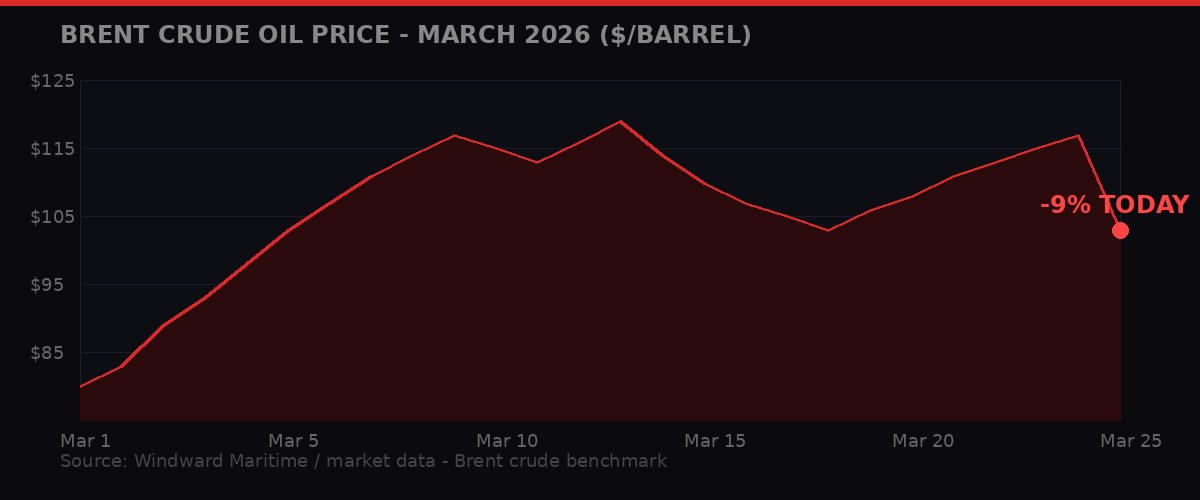
Brent crude fell more than 9% on Wednesday after the peace plan reports broke - from just above $118 to below $108 in the space of a trading session. For a commodity that has been the defining economic variable of this war, that move is seismic.
Asian equity markets opened sharply higher. Japan's Nikkei 225 was up approximately 2.3% as of 02:30 GMT. South Korea's KOSPI gained 2.6%. Hong Kong's Hang Seng climbed 0.7%. The relief trade was instantaneous and global.
The broader backdrop helps explain the scale of the reaction. Oil had been trading above $100 since early March, when Iran effectively throttled the Strait of Hormuz - the world's most critical oil chokepoint, through which roughly one-fifth of global oil and liquified natural gas normally transits. At its worst point, shipping through the strait had dropped from 120 daily vessel transits to just five, according to data from maritime intelligence firm Windward.
The economic damage has been cascading. Energy analysts at BlackRock - the world's largest asset manager - warned publicly that oil reaching $150 per barrel would trigger a global recession. South Korea has already issued emergency energy advisories. India has been scrambling for alternative supply routes. Several Asian refineries have begun rationing allocations to industrial customers.
The Trump administration had already taken one quiet extraordinary step to ease the pressure: issuing temporary sanctions waivers on certain Iranian oil purchases. It was the first time any Iranian oil had been effectively de-sanctioned since 2019, a concession that did not generate big headlines but was not lost on the markets - or on Tehran.
"Oil at $150 will trigger global recession." - Larry Fink, CEO, BlackRock - March 2026
The question now is whether Wednesday's price drop holds. If Iranian officials publicly confirm even indirect talks - or if the Hormuz opening translates into actual increased vessel traffic - the next move down could be significant. Conversely, a sharp Iranian military escalation or a definitive denial of any negotiating channel could send prices right back above $115.
The Strait of Hormuz: Iran's Most Significant Concession Yet
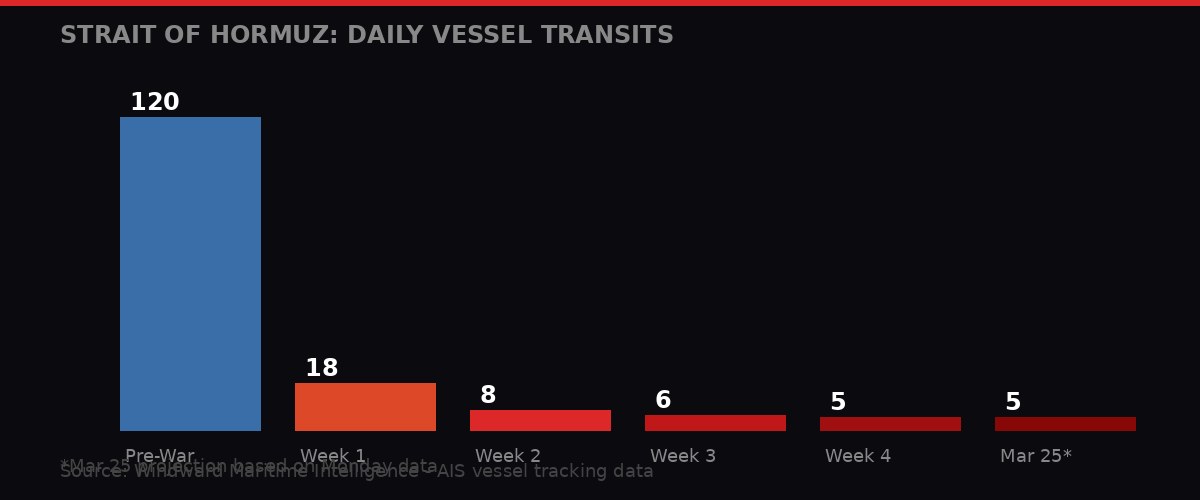
Iran's UN mission published a statement on Tuesday declaring that vessels may transit the Strait of Hormuz - provided they "neither participate in nor support acts of aggression against Iran and fully comply with the declared safety and security regulations."
The language is deliberately vague. What counts as "supporting acts of aggression"? Which vessels qualify as "non-hostile"? Tehran did not elaborate on the specific conditions or provide a contact process for vessels seeking assurance. A similar statement was filed with the International Maritime Organization, the UN body overseeing international shipping safety.
For shipping operators, the practical question is whether insurers will accept the statement as sufficient cover. Since the war began, war-risk premiums on vessels passing through the strait have increased by anywhere from 300% to 600% depending on the insurer, effectively pricing most commercial traffic out of the route. No declaration from Iran's UN mission changes that calculus immediately - what insurers need is actual, sustained, uneventful passage of commercial vessels before they revise their models.
Still, the statement matters symbolically. It is the first time since the war began that Iran has signaled any intent to reduce pressure on global shipping. Combined with the leaked 15-point plan, it creates a picture of an Iran that is sending - however indirectly and deniably - signals of potential off-ramp availability.
Negar Mortazavi, a senior non-resident fellow at the Center for International Policy, told Al Jazeera that Iran would want to end the war on "its own terms," with two core requirements: establishing enough deterrence to prevent a future attack, and securing tangible economic gains. The Hormuz leverage, she noted, has given Tehran ideas about structural changes to the waterway's governance - including potential passage fees, a concept that would represent a permanent shift in the geopolitics of global energy.
"This chokehold on the Strait of Hormuz is now giving them ideas. 'Maybe we can charge passage fees like some other places in the world' - there are those discussions in Iran." - Negar Mortazavi, Center for International Policy, to Al Jazeera
Israel's Position: War Plan Unchanged, Lebanon Next?
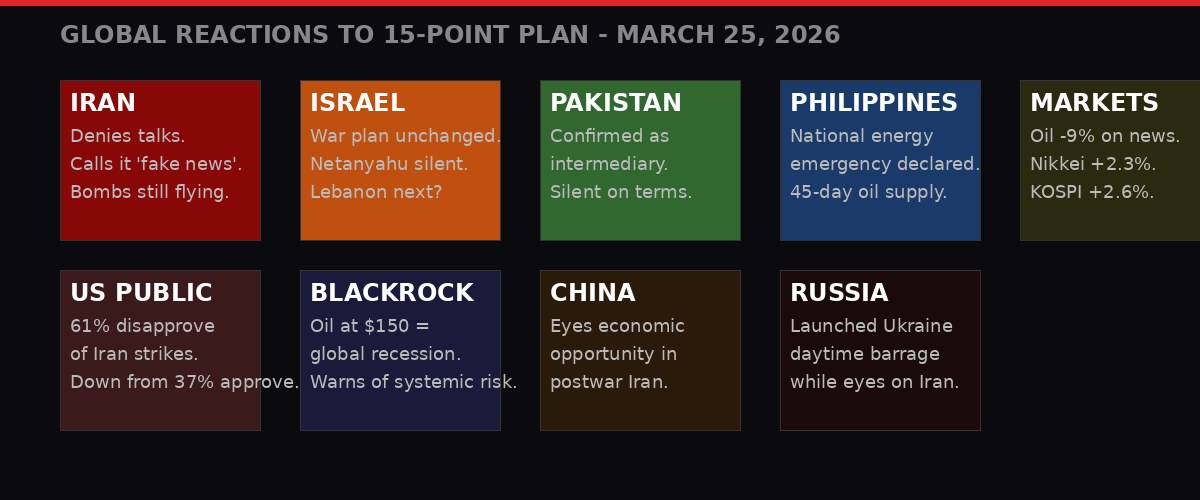
While Trump floats peace signals and markets cheer, Israel's military is sending a different message entirely. Spokesman Effie Defrin stated plainly on Tuesday that Israel's war plan was "unchanged" and that it would continue "to deepen the damage and remove existential threats."
That statement is more than a press line. It signals a fundamental tension at the heart of any potential deal: the US and Israel are not operating from the same strategic agenda, and any ceasefire that satisfies Trump's domestic political needs may not satisfy Netanyahu's war objectives.
Netanyahu came into this conflict with a clear strategic aim: the permanent degradation of Iran's military capacity - particularly its missile arsenal and nuclear program. A 15-point plan that ends the nuclear program on paper but leaves the Iranian state intact is not necessarily what Israel signed up for. Especially not with the 2026 congressional elections on the horizon in the US, which limits Trump's ability to sustain an unpopular war, and with Iranian missile attacks continuing to put millions of Israelis in bomb shelters multiple times a day.
Canada and France took the opportunity on Wednesday to call on Israel to halt preparations for what appears to be an imminent invasion of southern Lebanon, issuing a joint statement that Lebanon's "sovereignty must not be violated." The warning suggests Western allies believe Israel may use the diplomatic cover of Iran peace talks to simultaneously move on Hezbollah's remaining infrastructure in Lebanon - a two-front escalation that would upend any ceasefire framework.
For those tracking the military picture on the ground: US forces have been continuously building up in the region. Reports from CBS News, confirmed by the BBC, indicate the Pentagon is expected to deploy thousands of additional soldiers from the 82nd Airborne Division to the Middle East - adding to the 50,000 US troops already positioned there. That is not the troop movement profile of an administration preparing to wind down a war.
The Domestic Pressure: Trump's Political Calculus
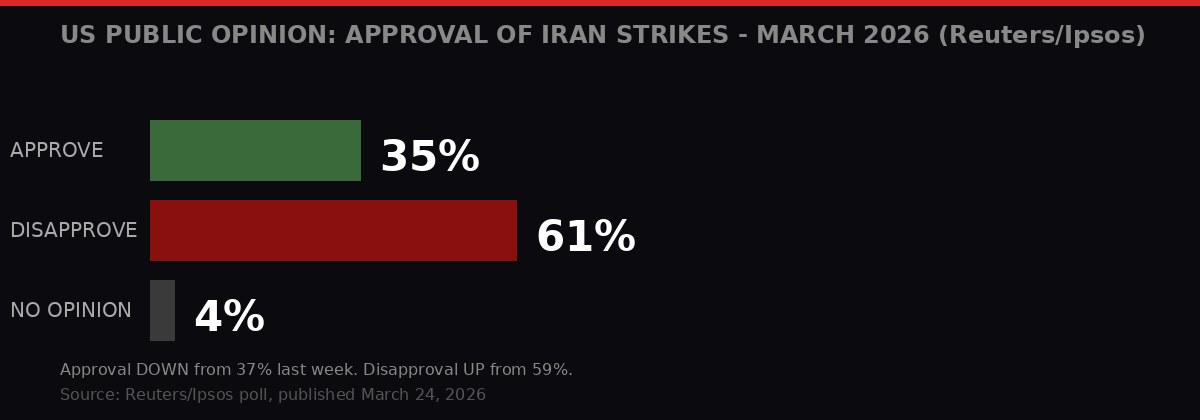
A Reuters/Ipsos poll published Tuesday contained the kind of numbers that concentrate minds in Washington. Sixty-one percent of Americans disapprove of the US strikes on Iran - up from 59% the week before. Only 35% approve, down from 37%. The trajectory is moving in one direction only.
Trump launched this war with Benjamin Netanyahu on February 28 with the stated goal of eliminating Iran's nuclear program and "cleaning up" the Middle East. The phrase "short-term excursion" - his own words - is now haunting him. More than a month later, Iran has not collapsed. The Iranian state has proven resilient. Oil is above $100. The US is burning through interceptor stocks, burning through political capital, and burning through public goodwill at a rate that makes the 2026 congressional midterms look increasingly dangerous for Republicans.
Trump himself acknowledged last week that Iran's ability to expand the conflict had surprised even him - and, apparently, even the experts. "They weren't supposed to go after all these other countries in the Middle East," he said. "Nobody expected that." The statement was remarkable for its candor - and for what it reveals about the pre-war intelligence assessment failures, or alternatively, the willful ignoring of warnings that were, in fact, widely circulated by US intelligence officials before February 28.
The 15-point plan, in this reading, is not a war-ending document. It is a negotiating floor - a way for Trump to say publicly that the US is pursuing peace while maintaining maximum military pressure. The timing of its leak, as noted by multiple analysts, was precisely calibrated: Asian markets were opening, oil was elevated, and the White House needed a circuit-breaker on energy price anxiety without appearing to blink.
"Trump's talk of negotiations may also give time for more US troops to arrive in the Middle East, if Washington decides to conduct some form of ground invasion of Iranian territory." - Al Jazeera analysis, March 24, 2026
Iran's Strategic Calculus: Hold, Deter, Negotiate From Strength
Tehran's position is more complex than the public defiance suggests. Iran has absorbed more than 1,500 civilian deaths, according to government figures. Infrastructure has been heavily damaged. Relations with Gulf Arab neighbors have deteriorated sharply and will not recover quickly. The power grid is under persistent pressure from US-Israeli strikes targeting electrical infrastructure. Economic pain is acute.
And yet Iran has also achieved something it failed to achieve in any previous confrontation with US and Israeli power: it demonstrated that its missile arsenal is real, capable, and not easily saturated. Multiple Israeli defense officials have privately acknowledged that Iron Dome and Arrow system interceptors are being depleted faster than anticipated. The April resupply timeline from US arsenals is now a defining variable in whether Israel can sustain the current operational tempo.
For Iranian hardliners - who appear to be in the ascendancy following the killing of several senior security officials including the former chief of the Supreme National Security Council - this is precisely the wrong moment to stop. Their argument internally is that stopping now, before interceptors are fully depleted, would be a strategic error. The time to negotiate is when the other side has run out of missiles to shoot your missiles down with.
More moderate voices in Tehran frame it differently. Some form of deterrence has been established, they argue. The US has already quietly issued sanctions waivers on Iranian oil. The Hormuz leverage has been demonstrated beyond any doubt. A deal that locks in sanctions relief, provides reparations for infrastructure damage, and includes enforceable guarantees against future attacks could be presented to the Iranian public as a victory - not a surrender.
The succession question also matters. Iran has named Mohammad Bagher Zolghadr, a former IRGC commander, as the replacement for the late Ali Larijani as chief of the Supreme National Security Council. Zolghadr is a hardliner. His appointment signals that the institutional power center in Tehran remains firmly with those who see the war as an opportunity to establish permanent deterrence - not as a crisis to be ended quickly on Washington's terms.
The Global Ripple: Philippines Emergency, Asia Crisis, Russia's Move
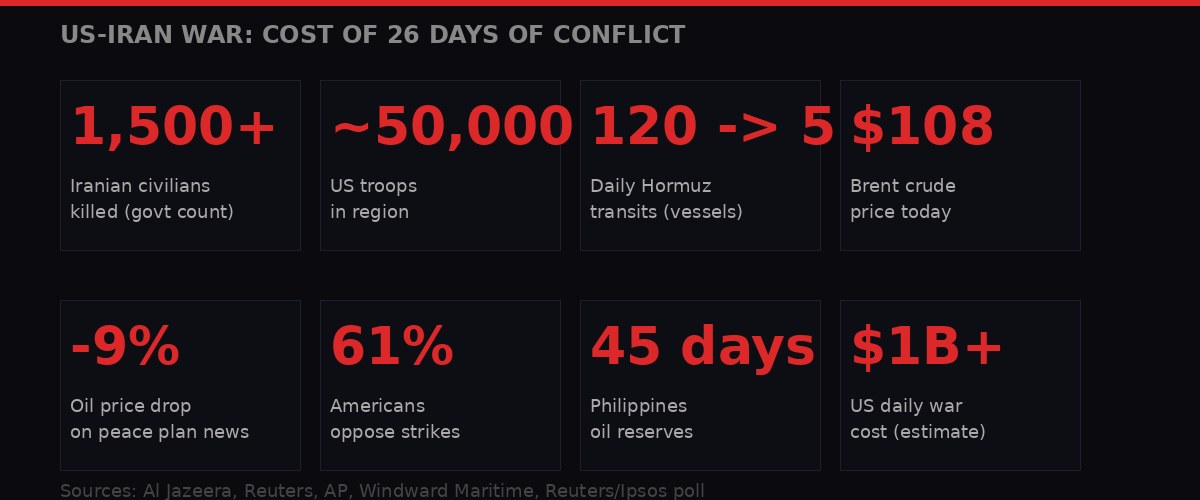
The war's consequences are no longer containable within the Middle East theater. They are becoming the defining geopolitical event of 2026 - reshaping energy supply chains, political calculations, and military postures across three continents.
Philippine President Ferdinand Marcos Jr declared a national energy emergency on Tuesday, citing "imminent danger" to the country's energy supply from the Iran conflict. The Philippines has approximately 45 days of fuel reserves at current consumption levels, according to Energy Secretary Sharon Garin. The government is scrambling to procure 1 million barrels of oil from alternative sources and is working with Washington to secure sanctions exemptions that might allow purchases from Iran or Venezuela.
Transport unions in Manila have announced a two-day strike beginning Thursday. Progressive coalitions are demanding suspension of fuel excise taxes and VAT. The Marcos administration's emergency declaration has been called a "superficial band-aid" by transport federation Piston, which argues that without price controls or tax suspensions, the emergency declaration changes nothing for the millions of Filipinos dependent on affordable fuel for daily transport.
Across Asia, the story is similar. Japan, South Korea, Taiwan, and India all rely heavily on Gulf oil and LNG transiting through the Strait of Hormuz. The BBC reported that "everyday life in Asia is being upended by the Iran war fuel crisis," with shortages and price surges beginning to bite at consumer and industrial levels. Several major Asian petrochemical facilities have begun operating at reduced capacity due to feedstock supply uncertainty.
Russia has not been idle. On Tuesday, Ukrainian President Zelenskyy warned that Kyiv faces a missile deficit - with Washington's attention and military stockpile allocations focused heavily on the Middle East theater. Russia launched a rare daytime barrage against Ukraine, apparently calculating that the Iran war has distracted Western decision-making and stretched US military logistics thin enough to create an operational window. Zelenskyy's warning about missile shortages was pointed: the same US interceptor supply chains that support Ukraine also supply Israel, and both are simultaneously depleting their stocks at elevated rates.
China, for its part, has been watching with characteristic patience - making no public statements of consequence, but positioning for the postwar reconstruction market in Iran and monitoring whether the conflict creates the kind of extended US military commitment in the Middle East that leaves the Indo-Pacific with reduced American bandwidth.
The Fog of War: Propaganda, Market Manipulation, and Ground Truth
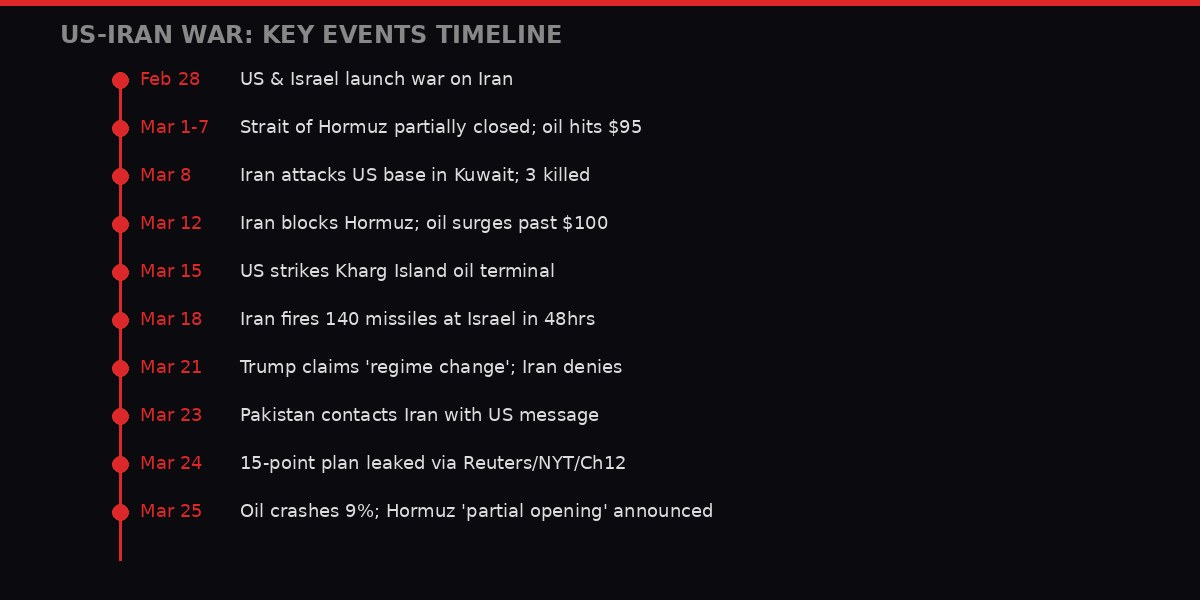
The hardest thing to assess in any war is what is real. The US has incentives to leak the 15-point plan to calm markets. Iran has incentives to deny talks to keep oil elevated and maintain economic pressure on the US. Israel has incentives to dismiss any peace signal to preserve its freedom of military action. Every statement from every actor is shaped by those incentives.
What we know with confidence: Iran's foreign ministry did not deny that messages were relayed through third parties. It acknowledged exactly that - framing them as informal rather than formal talks. The distinction is legally and diplomatically meaningful in Tehran, where anything that looks like official negotiations with the US requires supreme leader approval and creates enormous domestic political exposure. "Friendly countries relayed a US request" is how you describe early-stage backchannel contact when you're not yet ready to call it talks.
What we also know: the 15-point plan as reported contains maximalist US demands. A complete end to Iran's nuclear program is not a starting position for Iran - it is, arguably, a war aim. Iran will not enter any negotiation from a position of unconditional surrender, particularly when it believes it is not losing the current conflict militarily. The plan, if it represents Washington's actual opening position, leaves almost no room for Iran to say yes without appearing to capitulate.
That suggests the 15-point plan may be less a genuine negotiating document and more a diplomatic IED - designed to create a paper trail of US "good faith," to calm markets, and to buy time for either a military escalation or a more private negotiating channel to develop. The analysts who noted that Trump's five-day deadline for an Iranian response "happens to coincide with the end of the trading week" were not being cynical without reason.
Negar Mortazavi's framing is probably the most precise: both sides have reasons to claim they are or aren't talking. Neither public statement tells you what is actually happening in backchannels. The real negotiation, if it exists, will not be announced. It will show up first in what doesn't happen - in strikes that are suddenly delayed, in missile launches that are held back, in oil prices that keep falling without anyone confirming why.
What Happens Next: The Variables That Will Define Week 5
The next 72-120 hours will answer several critical questions. Does Iran formally respond to the 15-point plan - even with a counter-proposal? Does the Hormuz "opening" translate into actual increased shipping traffic, with actual vessels risking the passage? Do strikes escalate, de-escalate, or hold steady?
If the backchannel is real and gaining traction, the most likely signal will be a deliberate pause in Iranian missile launches against Israel - a signal to Washington that Tehran is in active communication, without the domestic political cost of an official announcement. Watch the 48-hour strike cadence coming out of Iran more closely than any diplomatic statement.
If the 15-point plan was primarily a market operation, expect a rebound in oil prices within the week, as the reality of continued fighting reasserts itself over the hope of imminent peace. The floor that Iran's partial Hormuz statement created may hold, but a full recovery in shipping traffic requires more than a UN mission tweet - it requires vessels actually transiting, insurers actually covering them, and Iran actually not shooting at them.
Israel remains the most unpredictable actor. Netanyahu's silence on Trump's peace overtures is conspicuous. A government that declared its war plan "unchanged" twenty-four hours ago is not a government preparing to accept a ceasefire. The Lebanon invasion preparations being condemned by Canada and France may represent Israel's own parallel agenda - a plan to use the diplomatic window created by US-Iran backchannel activity to simultaneously clear Hezbollah's remaining northern infrastructure while the world's attention is focused on the Hormuz diplomacy.
And the 82nd Airborne is still moving toward the theater. You don't deploy elite airborne forces as a peace signal.
Key Timeline: US-Iran War - Diplomatic Track
One month ago, the world was watching what most analysts assumed would be a sharp, decisive, and brief US-Israeli military operation to neutralize Iran's nuclear and military infrastructure. What unfolded instead was a war that Iran chose to broaden from Day 1 - targeting US bases in Kuwait and Iraq, activating regional proxies, and weaponizing the world's most critical oil chokepoint with a precision and deliberateness that confounded American strategists.
The 15-point plan is Washington's most concrete public move toward the exit. But exits from wars rarely happen on the timeline of the party that wants to leave. They happen on the timeline of the party that has least to lose by staying. And right now, that party is not the United States.
Get BLACKWIRE reports first.
Breaking news, investigations, and analysis - straight to your phone.
Join @blackwirenews on Telegram