Day 32: Trump Declares Victory and Plans National Address While the Strait of Hormuz Stays Shut and 2,000 Ships Sit Stranded

The skies over the Middle East haven't been clear in 32 days. The question is whether a presidential address changes that. (Pexels)
Thirty-two days into Operation Epic Fury, President Donald Trump stood in the Oval Office on Tuesday and told reporters the United States would leave Iran "within two weeks, maybe three." Hours later, White House Press Secretary Karoline Leavitt announced the president would address the nation Wednesday evening at 9:00 PM ET to deliver "an important update on Iran."
The framing was unmistakable: mission accomplished. Trump claimed the US has "totally unchecked" dominance over Iranian skies, described the Iranian military as "totally decimated," and said Tehran's new leadership is "begging to make a deal." He told the press pool that a deal was now "irrelevant" to the timeline of American withdrawal.
There is one problem with the victory narrative. The Strait of Hormuz - the 21-mile chokepoint through which roughly 20% of the world's oil supply transits - remains under effective Iranian blockade. Two thousand ships are stranded in the region. Brent crude is trading near $120 a barrel. American consumers are paying over $4 per gallon at the pump for the first time since 2022. And 1,937 people are confirmed dead in Iran alone, with independent monitors placing the total regional death toll above 4,500.
The war Trump says he is winning has cost more than bombs. It has redrawn the energy map of the world, destabilized NATO alliances, and produced a humanitarian crisis that international observers are still struggling to quantify. Wednesday's address may signal the beginning of the end. Or it may be the latest chapter in a conflict that keeps redefining its own goalposts.
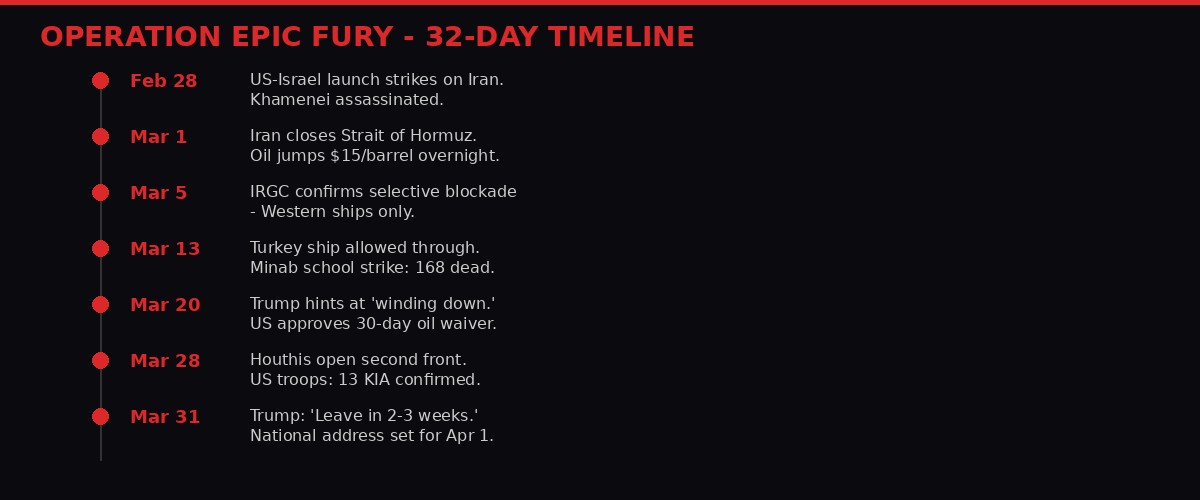
32 days of escalation, from the first strikes to the declaration of victory. (BLACKWIRE)
The Oval Office Declaration: "We'll Be Leaving Very Soon"

Trump will address the nation Wednesday night from the White House. The last time he did so was to announce the strikes on February 28. (Pexels)
Trump's remarks on Tuesday afternoon represented the most definitive exit timeline he has offered since Operation Epic Fury began on February 28. Speaking to reporters in the Oval Office, the president was categorical in his assessment of the campaign's results.
"We leave because there's no reason for us to do this. We'll be leaving very soon. Within maybe two weeks, maybe a couple days longer to do the job. We want to knock out every single thing they have." - President Donald Trump, March 31, 2026 (BBC)
The statement marked a sharp pivot from the administration's earlier posture. Just eleven days ago, on March 20, Trump first floated the idea of "winding down" military operations - but that statement was coupled with the deployment of 2,500 additional Marines to the region, a contradiction BLACKWIRE reported at the time. This time, the language was unambiguous. The president said the US had achieved its "one goal" of ensuring Iran cannot develop a nuclear weapon, and declared the country had been put "into the Stone Ages."
More striking was Trump's dismissal of any need for a negotiated agreement. When asked whether a deal with Tehran was required to end hostilities, Trump replied flatly: "Iran doesn't have to make a deal, no. No, they don't have to make a deal with me." He described the current Iranian leadership - installed after weeks of strikes killed numerous senior political and military figures, including Supreme Leader Ali Khamenei on February 28 - as "much less radicalized" and "more rational."
Secretary of State Marco Rubio, in an exclusive interview with Al Jazeera, reinforced the timeline. He told the network that US war objectives would be achieved "in weeks, not months," claiming the operation was "on track" after destroying Iran's air force and much of its navy. Rubio confirmed that communication between Washington and Tehran continues through intermediaries, though he offered no details on the substance of those exchanges.
Pentagon chief Pete Hegseth, however, introduced a note of ambiguity. Speaking on Tuesday, Hegseth said the next days would be "decisive" - and pointedly refused to rule out US ground forces playing a role in the conflict's final phase. The Wall Street Journal, citing top officials, reported that Trump has told aides he is willing to end the operation even if the Strait of Hormuz remains largely closed. Defense Secretary Hegseth separately told reporters that reopening the strait is "not just a US problem set."
That distinction matters enormously. The stated objective of the war was to neutralize Iran's nuclear capability and reopen global oil transit. If the US declares victory on the first count while abandoning the second, it redefines what "winning" looks like. And it leaves the economic consequences of the conflict squarely on the shoulders of allied nations scrambling for energy supplies.
The Hormuz Question: 2,000 Ships and No Clear Path Forward
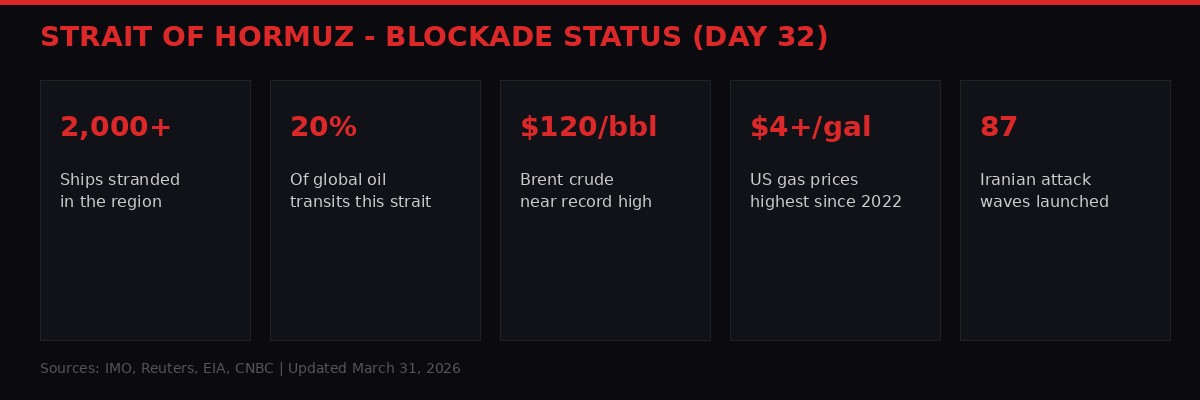
The strait remains under effective blockade. Iran allows selective passage, but Western-flagged vessels stay out. (BLACKWIRE)
The single most consequential fact of this war is not the bombs falling on Tehran or the strikes on IRGC installations. It is the closure of the Strait of Hormuz - and it remains unresolved as Trump prepares to declare mission accomplished.
Iran's Revolutionary Guard closed the strait to Western-allied shipping on March 1, the day after the first strikes hit. On March 5, the IRGC formalized the blockade, announcing that the strait would remain closed only to ships from the US, Israel, and their Western allies. The result has been the most severe disruption to global oil transit since the 1973 Arab oil embargo.
According to the International Maritime Organization, approximately 2,000 ships are currently stranded in the region. Some are anchored in the Gulf of Oman. Others are rerouting around the Cape of Good Hope, adding weeks and millions in fuel costs to every voyage. Iran has selectively allowed passage to Turkish, Chinese, and Indian vessels, turning the strait into a tool of geopolitical leverage rather than a simple military blockade.
The economic damage has been immediate and severe. Brent crude surged from roughly $72 per barrel before the war to above $120 in early trading this week - the highest since the 2022 energy crisis following Russia's invasion of Ukraine. Reuters reported that US pump prices have crossed $4 per gallon, the first time since mid-2022. West Texas Intermediate breached $100 a barrel. The global Brent benchmark recorded its biggest one-month price increase on record.
The impact extends beyond fuel. Morgan Stanley projects that a sustained 10% increase in oil prices could boost US headline consumer prices by roughly 0.35% over three months. Goldman Sachs warned that if the strait remains closed, gasoline could climb well beyond $4, and inflation would become embedded in the US economy for the remainder of 2026. The International Monetary Fund announced it is providing emergency policy advice and financial assistance to affected member states, with a fuller assessment expected at the IMF-World Bank spring meetings in mid-April.
The Trump administration's response has been to shift responsibility. In a Truth Social post on Tuesday, Trump told European allies that countries "like the United Kingdom" who cannot get jet fuel because of the Hormuz restrictions should "build up some delayed courage, go to the Strait, and just TAKE IT." That message landed in European capitals with the subtlety of a cruise missile. French President Emmanuel Macron's office called itself "surprised" by Trump's criticism of France as "very unhelpful" - Paris had refused to allow planes carrying military supplies to fly over its territory. Secretary Rubio went further, saying the US would "reexamine" its relationship with NATO.
Al Jazeera reported that Iran's parliament approved tolls on vessels transiting the strait - a move that signals Tehran views the waterway as a long-term negotiating chip, not a temporary measure. The message from Iran is clear: the strait opens on Iranian terms, or it does not open at all.
What 32 Days of Bombing Has Actually Destroyed

Thirty-two days of sustained air operations have reduced significant portions of Iran's military infrastructure to rubble. The civilian cost keeps climbing. (Pexels)
The operational tempo of Operation Epic Fury has been staggering. According to White House Press Secretary Karoline Leavitt, US and allied forces have struck more than 9,000 Iranian targets since February 28. The campaign has reduced Iranian ballistic missile and drone launch capability by an estimated 90%, according to CENTCOM assessments. Global Defense Corp reported that nuclear and ballistic missile capability has been degraded by approximately 70%, though Iran's stockpile of intermediate-range ballistic missiles reportedly remains intact in a hardened bunker.
The institutional destruction has been systematic. The IDF confirmed on March 30 that it struck Imam Hossein University in Tehran - the IRGC's primary military academic institution and weapons research facility. The Institute for the Study of War reported strikes on HESA, Iran's drone manufacturing plant responsible for the Ababil and Shahed series. A long-range anti-aircraft missile assembly site in Qazvin Province was hit. Amir ol Momenin University of Military Sciences in Isfahan was struck on March 29. Mehrabad Airport in Tehran was destroyed to prevent regime officials from fleeing.
The IRGC confirmed the death of its naval commander, Admiral Alireza Tangsiri, killed in an Israeli strike. The confirmed kills of senior leadership extend across Iran's political and military establishment, beginning with Supreme Leader Khamenei on day one and continuing through intelligence minister Esmail Khatib, killed on March 18 according to Israeli claims.
Trump's assertion that Iran's military is "not putting up a fight" is, by the president's own metrics, an overstatement. Iran has launched 87 waves of retaliatory attacks across the region in 32 days. Al Jazeera reported that the 87th wave, launched by Iran's navy, served as what correspondent Mohamed Vall called "a very strong message to the US" - proving that Washington's claims of obliterating Iranian naval forces were premature. Iran struck a US air base in Saudi Arabia - Prince Sultan Air Base - wounding over a dozen American personnel and damaging valuable jets, according to NPR. Iranian missiles have entered Turkish airspace four times since the war began, each intercepted by NATO air defense systems.
The human toll defies clean categorization. Al Jazeera's live tracker shows 1,937 dead in Iran as of March 31. The US-based Human Rights Activists News Agency (HRANA) places the total at 3,291, with 1,455 confirmed civilians - including the children of Minab. That school attack on February 28 killed an estimated 168 people, around 110 of them children, according to Iranian authorities. BBC Verify confirmed through satellite analysis that the school was hit with multiple missiles in what appears to have been a triple-tap strike. Thirteen American service members are dead. Twenty-seven people have been killed across Gulf states. Over 1,000 have died in Lebanon. At least 20 are dead in Israel.
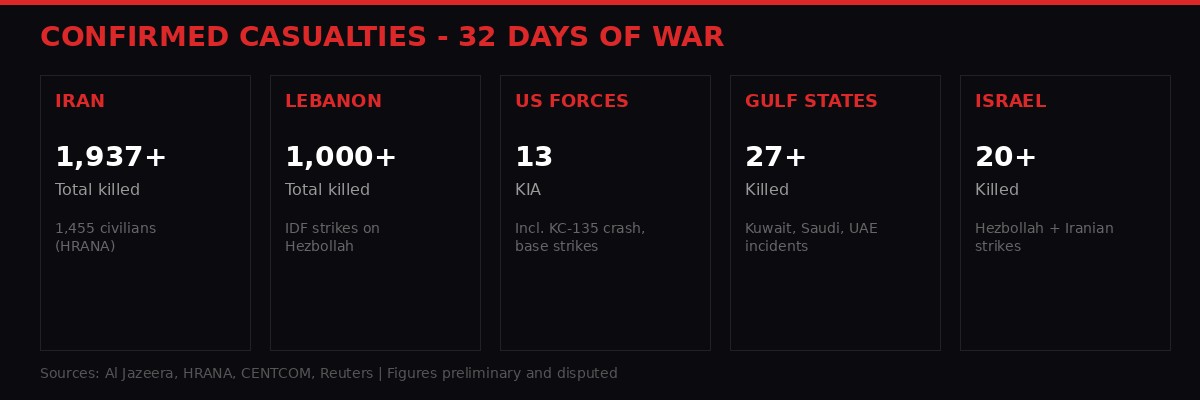
Casualty figures remain preliminary and disputed. Independent monitors consistently report higher numbers than official sources. (BLACKWIRE)
The Multi-Front War: Lebanon, Iraq, the Gulf, and the Houthis

The war has spilled across every border that Iran's proxy network touches. Beirut, Baghdad, Riyadh, and the Red Sea are all active theaters. (Pexels)
What the White House frames as a bilateral campaign against Iran's nuclear program has metastasized into the broadest Middle Eastern conflict since 2003. The war is not contained within Iranian borders. It has active fronts in Lebanon, Iraq, Yemen, and the Gulf states - each with its own dynamics and escalation trajectory.
In Lebanon, the situation deteriorated sharply on the night of March 31 into April 1. Israeli strikes hit southern Beirut and the Jnah neighborhood on its outskirts, targeting what the IDF described as "a Hezbollah commander and another senior figure." Lebanon's Health Ministry confirmed seven dead and 24 injured in two separate strikes. A car traveling south of Beirut was hit by multiple missiles launched by an Israeli drone, according to Lebanese state media. Hezbollah, which declared war on Israel after the February 28 strikes, has maintained a steady rocket barrage into northern Israel - three people were lightly injured in the latest salvo.
The human cost of the Lebanon theater has exceeded 1,000 dead, according to compiled figures from Reuters and The Economist. The Lebanese government has banned Hezbollah's military activities, but enforcement is nominal at best. Israel has launched operations across southern Lebanon, the Bekaa Valley, and Beirut. Two Indonesian UN peacekeepers from UNIFIL were killed in a roadside blast near Bani Haiyyan on March 31, bringing the total peacekeeper deaths to three this week. Israel denied responsibility, saying no IDF troops were present in the area, and urged UNIFIL to "avoid presence in combat zones" where it has issued evacuation orders.
In Iraq, a drone attack targeted the US Embassy in Baghdad late on Monday. The drone was intercepted, but shrapnel fell into a nearby neighborhood, wounding one civilian. The Institute for the Study of War reported that Popular Mobilization Forces (PMF) fighters - Iraqi Shia militia members aligned with Iran - have deployed to western Iran, marking an unprecedented cross-border militia deployment that complicates the already tangled battlefield.
The Gulf states are under sustained pressure. Iran launched what Kuwait called a "direct and criminal" attack on the Al-Salmi, a fully loaded Kuwaiti oil tanker stationed at Dubai port. Saudi Arabia intercepted at least eight ballistic missiles targeting Riyadh and the energy-rich Eastern Province. Bahrain activated civil defense sirens and ordered residents to shelters. Iran hit a water desalination plant in Kuwait on March 29, killing one worker. A summit in Jeddah saw the leaders of Saudi Arabia, Qatar, and Jordan jointly condemn Iranian escalation, but offered no military response beyond continued reliance on US and NATO air defense systems.
Yemen's Houthi movement opened a second naval front around Bab al-Mandeb on March 28, threatening shipping in the Red Sea as a complement to the Hormuz blockade. This dual-strait strategy effectively puts a chokehold on oil transit at both ends of the Arabian Peninsula. Western navies, already stretched thin from the 2024-2025 Red Sea crisis, have no credible force to secure both waterways simultaneously. As Reuters noted, the West failed to secure the Red Sea against Houthi attacks. Hormuz, against a state military, will be harder.
Iran's Foreign Minister Abbas Araghchi said on Tuesday that it is "high time" for US troops to leave their bases in Gulf states. The message was directed at governments in Riyadh, Doha, Manama, and Abu Dhabi - a reminder that hosting American forces makes them targets, and that Iran has demonstrated the willingness and capability to hit them.
The Oil Shock: $120 Crude, $4 Gas, and the Inflation Spiral
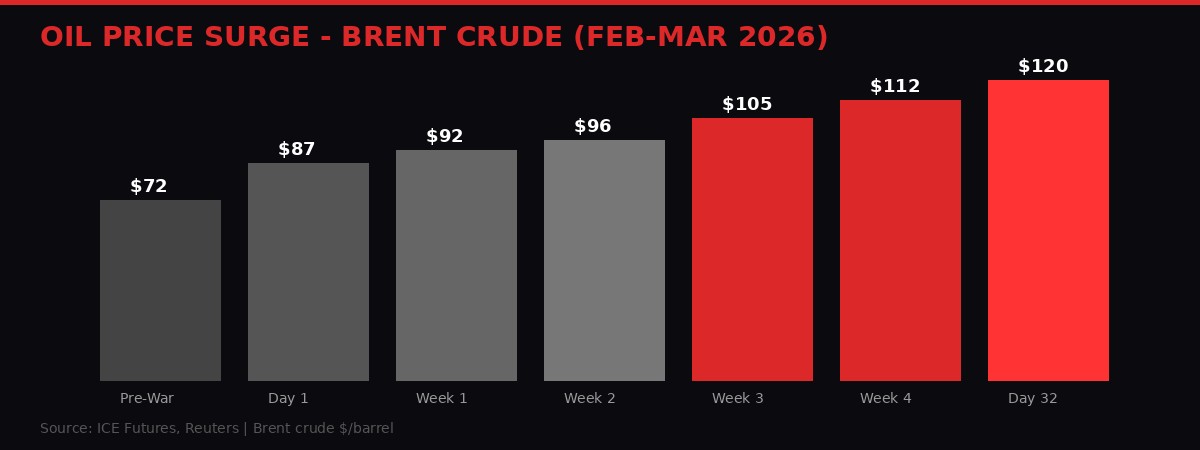
The war has produced the largest one-month oil price surge on record. The Strait of Hormuz closure is the primary driver. (BLACKWIRE)
The economic shockwave from Operation Epic Fury has arrived at American kitchen tables. US gasoline prices surged above $4 per gallon for the first time in more than three years, according to CNBC and Reuters, driven by the oil supply disruption caused by the Hormuz blockade. Brent crude futures settled above $100 a barrel and have continued climbing to near $120 - up roughly $33 per barrel since the first strikes on February 28.
The numbers tell a story that no presidential address can spin away. West Texas Intermediate breached $100, marking the first time since the summer of 2022 that both major crude benchmarks are in triple digits. Oil prices are on track for the biggest one-month rise ever recorded. The G7 economy and finance ministers issued a joint statement saying they were ready to take "all necessary measures" to stabilize the energy market, but offered no specifics beyond the phrase itself.
Time Magazine reported that US gas prices have climbed above the $4 threshold, "squeezing household budgets and raising fears of further increases as global oil markets remain volatile." The Center for American Progress warned that a sustained oil price of $100 per barrel would keep US inflation elevated for months. Bloomberg Economics modeled the impact at around $110 per barrel and projected "a marked but manageable boost to prices and blow to growth" - language that will age poorly if Brent holds above $120 into April.
California, as usual, is absorbing the worst of it. State gasoline prices have surged above any other state, with some stations reporting prices above $5.50 per gallon. The fertilizer market - heavily dependent on Gulf-sourced natural gas and ammonia - is facing its own crisis. CNBC reported that Iran war-induced fertilizer shortages threaten to become a political liability for farm-state Republicans in the 2026 midterms.
Trump told reporters on Tuesday that fuel prices "will come down as soon as the US ends its military actions." That claim assumes the Hormuz blockade lifts when the bombs stop. Iran's parliamentary commission has approved Hormuz transit tolls, suggesting Tehran plans to weaponize the waterway well beyond any ceasefire. Al Jazeera's analysis found that even after the strait reopens, turmoil would still last months as the backlog of 2,000 stranded vessels clogs global shipping lanes. The pre-war energy equilibrium is not coming back quickly, if it comes back at all.
Trump's decision to waive Jones Act shipping rules for 60 days and issue a 30-day sanctions waiver for the sale of Iranian oil already at sea are emergency measures that acknowledge the severity of the crisis. They are also insufficient. The waiver covers oil that was already loaded before the blockade. New supply is not flowing. The world's energy infrastructure was designed around the assumption that the Strait of Hormuz would always be open. That assumption died on March 1, and no one has built a credible replacement.
The Diplomatic Wreckage: NATO Fractures, Regional Chaos, and No Off-Ramp

The war has fractured alliances that took decades to build. NATO cohesion is under unprecedented strain. (Pexels)
The diplomatic architecture that sustained the US-led global order for seven decades is cracking under the weight of this conflict. Trump's public attack on European allies, Rubio's threat to "reexamine" NATO relations, and France's refusal to grant military overflight rights represent a level of trans-Atlantic hostility not seen since the Iraq War - and arguably worse, because the stakes are higher and the fracture lines run deeper.
France's position is straightforward: Paris did not support the strikes, was not consulted before they began, and will not facilitate a military campaign it considers illegitimate under international law. Trump called France "very unhelpful." Macron's office responded that it was "surprised" by the characterization. The diplomatic language is polite. The substance is a rupture.
NATO's role has been limited to defensive interception. The alliance has shot down four Iranian missiles that entered Turkish airspace - a member state that did not ask for this war but is absorbing its consequences. Turkey's foreign policy has been characteristically hedged: Ankara allowed a Turkish ship through the Hormuz blockade on March 13, maintaining commercial relations with Tehran while remaining technically within NATO's defensive framework.
Regional diplomacy is moving without Washington. Pakistan's Deputy Prime Minister Ishaq Dar visited Beijing on Tuesday for talks with Chinese Foreign Minister Wang Yi, following weekend meetings in Islamabad with top diplomats from Saudi Arabia, Turkey, and Egypt. The format is telling: a Pakistan-China axis mediating between Gulf states and Turkey, with the US notably absent from the table. Egypt's President Abdel Fattah el-Sisi made a direct public appeal to Trump: "No one will be able to stop the war in our region, in the Gulf. Please, help us to stop the war, you are capable of it."
The UN Human Rights chief condemned Israel's parliament for approving a "deeply discriminatory" death penalty bill targeting Palestinians convicted of deadly attacks, warning that applying the law on occupied Palestinian territory "would constitute a war crime." The US State Department publicly supported the Israeli law. FIFA chief Gianni Infantino announced that Iran "will be at the World Cup" and will play its group matches in the US as scheduled, a surreal footnote to a conflict that has killed thousands.
A Reuters/Ipsos poll released on March 31 found that 60% of Americans disapprove of US military strikes on Iran, while 35% approve. More than 200 US soldiers have filed formal complaints regarding superior officers using religious rhetoric to justify the war. These are not the numbers of a united country behind its commander-in-chief. They are the numbers of a nation being asked to accept victory in a war that most of its citizens did not want.
Iran's negotiating posture, despite Trump's claims of "begging," appears more calculated than desperate. Tehran continues launching attacks - 87 waves and counting. Its navy, reportedly destroyed, just launched the latest wave. Its diplomatic channels remain open through intermediaries in Pakistan, China, and Oman. And it holds the single most powerful card in the deck: a 21-mile strip of water through which the world's economy flows, currently under Iranian control.
What Wednesday's Address Could Mean - and What It Cannot Fix

The president will speak at 9 PM ET on Wednesday. What he says will shape the next phase of the conflict - and the next phase of US credibility. (Pexels)
The White House has announced that Trump will deliver a national address on Wednesday, April 1, at 9:00 PM ET. Press Secretary Leavitt said the president will provide "an important update on Iran." The last time Trump addressed the nation in a formal setting regarding this conflict was to announce the strikes on February 28. That address lasted eleven minutes and drew 48 million viewers.
Several scenarios are on the table. The most likely, based on Tuesday's comments, is a declaration that Operation Epic Fury's military objectives have been met and that US forces will begin withdrawal within the stated two-to-three-week window. Trump may announce a unilateral ceasefire, conditional or unconditional. He may frame the campaign as a decisive strategic victory - the destruction of Iran's nuclear program, the degradation of its military, and the elimination of its senior leadership.
What the address cannot do is solve the structural problems the war created. The Strait of Hormuz remains closed. Oil prices remain at crisis levels. US gas prices are climbing. Allied nations are furious. NATO cohesion is damaged. Nearly 2,000 people are dead in Iran. Regional proxy networks are inflamed and active. Lebanon is being bombed. Iraq's militia forces have crossed into Iran. The Houthis control the Red Sea approaches.
The core contradiction of Day 32 is this: Trump claims total military dominance over a country that is still launching attacks on US allies, still blockading the world's most important oil chokepoint, and still demonstrating that its proxy network spans the entire Middle East. The fact that Iran's conventional air force and navy are degraded is real. The fact that this degradation has not translated into strategic capitulation is also real.
The administration appears to be calculating that declaring victory and leaving is better than an open-ended occupation of Iranian airspace. They may be right. The alternative - escalation to ground forces, seizure of Kharg Island, or strikes on power plants - carries risks that make the current oil crisis look manageable by comparison. Hegseth's refusal to rule out ground forces suggests these options remain on the table, even as the president signals their opposite.
There is a historical echo here that no one in the White House will welcome. On May 1, 2003, George W. Bush stood on the deck of the USS Abraham Lincoln beneath a "Mission Accomplished" banner and declared major combat operations in Iraq complete. The Iraq War continued for eight more years and cost 4,431 American lives. The comparison is imperfect - the Iran war has not involved ground forces, and the operational scope is different. But the pattern of declaring victory before the consequences have played out is disturbingly familiar.
Wednesday's address will be watched by tens of millions of Americans paying record gas prices, by allied governments wondering whether Washington can be trusted, by Iranian leaders calculating their next move, and by 2,000 ship crews anchored in the Gulf of Oman waiting for permission to move. Trump's words will matter less than what happens in the Strait of Hormuz on Thursday morning.
Key Developments to Watch
- Wednesday April 1, 9 PM ET: Trump's national address on Iran. Content and tone will signal whether this is a declaration of withdrawal, a conditional offer, or a demand for Iranian capitulation.
- Strait of Hormuz: Any change in Iranian enforcement policy would be the most concrete signal of de-escalation. So far, no change has been announced.
- Oil markets: Asian and European trading sessions on Thursday will react to the address. If markets interpret it as a genuine endgame, Brent could pull back toward $100. If not, $130 is within reach.
- Lebanon: IDF operations in Beirut are intensifying, not winding down. A US withdrawal from the Iran theater does not automatically end Israeli operations in Lebanon.
- Ground forces: Hegseth's refusal to rule them out means the 82nd Airborne and Marine expeditionary forces positioned in the region remain a live option.
- Iran's 88th wave: Tehran has launched attacks consistently, at a rate of nearly three per day. A pause would signal willingness to negotiate. Continuation signals defiance.
By the Numbers: Day 32
- 1,937+ confirmed dead in Iran (Al Jazeera tracker)
- 3,291 total dead per HRANA, including 1,455 civilians
- 4,500+ total regional fatalities across all fronts (IranWarLive OSINT)
- 13 US service members killed
- 9,000+ Iranian targets struck (White House)
- 87 Iranian retaliatory attack waves
- 2,000 ships stranded near Hormuz (IMO)
- $120/barrel Brent crude price
- $4+/gallon US average gas price
- 60% of Americans disapprove of the strikes (Reuters/Ipsos)
- 4 Iranian missiles intercepted in Turkish airspace by NATO
- 3 UN peacekeepers killed in Lebanon this week
Get BLACKWIRE reports first.
Breaking news, investigations, and analysis - straight to your phone.
Join @blackwirenews on Telegram