
The Persian Gulf has become the most dangerous body of water on Earth. Photo: Pexels
The Gulf Burns: Iran Strikes Kuwait, Qatar, Bahrain, UAE in Single-Day Blitz
Day 33 of the US-Israel war on Iran. Tehran launches its most aggressive retaliatory barrage yet - hitting four Gulf states in a single morning while coordinating strikes on Israel with Houthi and Hezbollah proxies.
April 1, 2026. The thirty-third day of this war opened with fire across the entire Persian Gulf.
Between midnight and noon local time on Wednesday, Iranian cruise missiles struck an oil tanker in Qatari territorial waters. Iranian drones set fuel tanks at Kuwait International Airport ablaze. Industrial facilities in Bahrain took hits. Intercepted drone debris injured a person in the UAE. And in a declared joint operation, Yemen's Houthi rebels and Lebanon's Hezbollah fired ballistic missiles and rockets at Israel, wounding at least 14 people in Tel Aviv and the country's center.
This was not random retaliation. This was a coordinated, multi-vector escalation across six fronts in a single morning. Iran, battered by five weeks of US-Israeli airstrikes that have killed an estimated 3,492 people, is making a statement: if they burn, the Gulf burns with them.
And the diplomatic response? Fractured. China and Pakistan are pushing a five-point peace plan. The UK is convening 35 nations to discuss Hormuz shipping. Iran's foreign minister says there are no negotiations. Trump says the war ends in "two to three weeks." Australia's prime minister is warning his citizens of months of economic pain.
Nobody is in control of this situation.
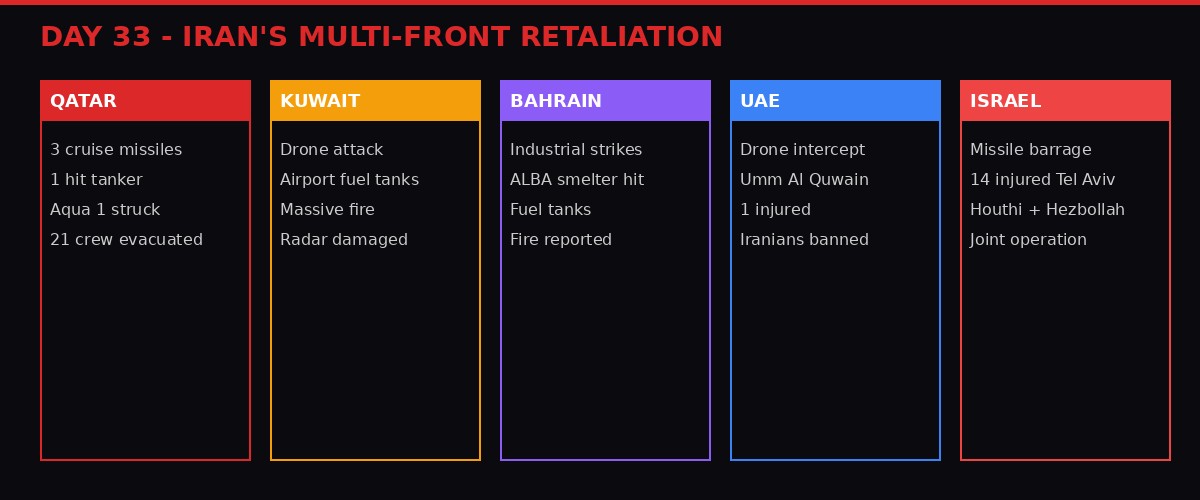
BLACKWIRE infographic: Iran's simultaneous strikes across the Gulf on Day 33.
The Qatar Strike: Cruise Missiles in Friendly Waters

A fuel oil tanker was struck by an Iranian cruise missile in Qatari territorial waters. Photo: Pexels
In the early hours of Wednesday morning, Qatar's Defence Ministry confirmed what had been rumored since dawn: three cruise missiles launched from Iranian territory targeted the small Gulf state. Qatar's armed forces intercepted two of them. The third struck the Aqua 1, a fuel oil tanker operating under charter to QatarEnergy, in Qatar's northern territorial waters.
QatarEnergy confirmed the hit in a separate statement, noting that the vessel had been carrying fuel oil when struck. Twenty-one crew members were aboard. All were evacuated without casualties, the defence ministry said. The tanker sustained hull damage but did not sink.
The UK Maritime Trade Operations (UKMTO) had earlier reported that a tanker was hit by "two projectiles" off the coast of Doha, with one described as unexploded. Qatar's official account - three cruise missiles, two intercepted, one impact - provided the fuller picture.
This strike crosses a line that previous Iranian retaliatory attacks had skirted. Qatar is not hosting major US military operations in the way that Bahrain (home to the US Fifth Fleet) or Kuwait (staging ground for Operation Epic Fury) are. Qatar has historically maintained diplomatic channels with Tehran. It mediated between Washington and Tehran during the 2024 prisoner exchange negotiations. Doha's Al Udeid Air Base hosts CENTCOM's forward headquarters, but Qatar has positioned itself as a neutral broker in Gulf disputes for over a decade.
Hitting a QatarEnergy-chartered tanker in Qatari territorial waters is a message: neutrality no longer exists. If your waters touch the Gulf, your infrastructure is a target. The IRGC has framed these strikes as retaliation against Gulf states that permit US military basing, but the Qatar strike suggests the targeting calculus has expanded beyond military-adjacent infrastructure to pure economic warfare.
Crude oil futures surged on the news. Brent crude had already been trading above $110 per barrel since the Strait of Hormuz crisis began in early March. The Qatar strike pushed it higher. Gas futures moved in sympathy, given Qatar's position as the world's largest LNG exporter. If Iran is willing to strike tankers in Qatari waters, the entire Gulf shipping corridor - not just Hormuz - is now a conflict zone.
Kuwait Airport: Fuel Tanks Ablaze, Radar Destroyed

Iranian drones struck fuel storage tanks at Kuwait International Airport, sparking a massive fire. Photo: Pexels
Kuwait's Public Authority for Civil Aviation (PACA) confirmed on Wednesday that Kuwait International Airport had been targeted by an Iranian drone attack. The drones struck fuel storage tanks adjacent to the airport's main terminal, sparking what KUNA (Kuwait News Agency) described as "a massive fire" that sent black smoke columns visible across Kuwait City.
Kuwait's state media reported no casualties. Emergency crews moved quickly to contain the blaze and prevent it from spreading to other critical airport facilities, including the passenger terminals. But the damage was not limited to fuel infrastructure. The National, citing Kuwaiti officials, reported "significant" radar damage from the drone strike - meaning Kuwait's air traffic control capabilities may be degraded at a time when the country needs them most.
This is the second time Kuwait International Airport has been hit since the war began. On March 25, an earlier Iranian drone attack struck the airport complex, an incident that BLACKWIRE covered at the time. That the airport was hit again suggests either Iran considers Kuwait's air defenses insufficient to deter repeat attacks, or the IRGC views Kuwait's aviation infrastructure as a legitimate ongoing target in its campaign against US basing in the Gulf.
Kuwait hosts several US military installations, including Camp Arifjan and Ali Al Salem Air Base, which have served as primary staging areas for US operations in the region. The American military presence in Kuwait dates to the 1991 Gulf War and has been a fixture ever since. Iran's repeated targeting of Kuwait's civilian airport - rather than direct strikes on US military bases - suggests a deliberate strategy of indirect pressure: attack the civilian infrastructure of host nations to raise the political cost of allowing American forces to operate from their soil.
Kuwait has not publicly escalated its rhetoric against Iran beyond factual statements about the attacks. But the pattern is clear. The diplomatic space for Gulf states to remain nominally neutral while hosting US military assets has collapsed. Iran is forcing a binary choice: expel the Americans or absorb the hits.
Commercial flights in and out of Kuwait International were disrupted. Several airlines diverted inbound flights to Bahrain and Saudi Arabia, though both of those countries face their own security situations.
Bahrain and UAE: The Full Perimeter Under Fire

Iran's strikes expanded to industrial targets in Bahrain and the UAE. Photo: Pexels
The strikes extended further. Bahrain reported attacks on fuel tanks and industrial infrastructure, with fires breaking out at targeted facilities. The IRGC specifically named Aluminium Bahrain (ALBA), one of the world's largest aluminium smelters, as a target - claiming it had connections to American defense production. Whether that claim holds any material truth is secondary to the message: economic infrastructure across the Gulf is now in the crosshairs.
Bahrain's position is uniquely vulnerable. The island kingdom hosts the US Navy's Fifth Fleet headquarters at Naval Support Activity Bahrain. Since the war began, Bahrain has been struck multiple times by Iranian missiles and drones. The country's small geographic size - just 780 square kilometers - means any strike on military targets risks civilian collateral. Bahrain has limited strategic depth. Everything is close to everything else.
In the UAE, the situation played out differently. UAE air defense systems intercepted a drone targeting the emirate of Umm Al Quwain, but debris from the intercept fell near an industrial facility in the Umm Al Thaoub area. One person, identified as an Indian national, was injured by the falling debris, according to the Umm Al Quwain Government Media Office.
The UAE has taken the most aggressive diplomatic step of any Gulf state in response to the escalating attacks. On Wednesday, Emirates airline updated its visa advisory to state that "Nationals of Iran are not allowed to enter and transit" the United Arab Emirates. Flydubai and Etihad Airways posted similar restrictions. Only Iranian nationals holding UAE Golden Visas were exempted.
This is an extraordinary measure. The UAE has one of the largest Iranian diaspora populations in the Gulf - estimated at 400,000 to 500,000 people, concentrated primarily in Dubai and Sharjah. Many Iranian-origin business families have been in the Emirates for generations. The travel ban, while aimed at new arrivals and transit passengers, signals a fundamental shift in the UAE's relationship with Iran. Dubai's historic role as a commercial bridge between Iran and the world is being severed in real time.
The IRGC also named Emirates Global Aluminium (EGA) as a target alongside ALBA in Bahrain, alleging connections to US defense supply chains. EGA is one of the world's top five aluminium producers and a cornerstone of the UAE's non-oil economy. Whether Iran follows through on targeting EGA facilities directly remains to be seen, but the naming alone has sent shockwaves through Gulf markets and insurance underwriters.
The Resistance Axis Strikes: Houthis and Hezbollah Join the Fight

Iran's proxy network activated across multiple fronts on Day 33. Photo: Pexels
While Iran hammered the Gulf states, its proxy network executed coordinated strikes against Israel from two directions.
Yemen's Houthi rebels claimed responsibility for "a barrage of ballistic missiles" targeting "sensitive Israeli enemy targets" in southern Israel. The Houthis explicitly stated this was a "joint operation" conducted in coordination with Iran and Hezbollah. The Israeli military confirmed detecting a missile launched from Yemen toward its territory. This was not the first Houthi strike on Israel since the war began - the Houthis fired their first missile at Israel on March 28, formally entering the conflict - but Wednesday's attack represented an escalation in volume and stated coordination.
Simultaneously, Hezbollah maintained its rocket barrage against northern Israel. The Lebanese militia has been firing into Israel since March 1, when it launched missiles and drones targeting northern and central Israel in retaliation for the killing of Ayatollah Khamenei. On the days leading up to April 1, Hezbollah rockets killed a woman in northern Israel and injured others. Israel responded with strikes around Beirut targeting senior Hezbollah commanders.
The combined effect of these attacks was significant. Israel's Magen David Adom emergency service reported that Iranian missile fire toward central Israel and Tel Aviv wounded at least 14 people on Wednesday. An 11-year-old girl was in serious condition. A 36-year-old woman and a 13-year-old boy were in moderate condition. The IDF reported "impact sites in the center of the country" - meaning Israeli missile defense systems, including Iron Dome, David's Sling, and the Arrow system, did not achieve complete interception of the incoming barrage.
The strategic implication is stark. Iran has activated its full "resistance axis" - the network of aligned militias stretching from Yemen through Iraq and Syria to Lebanon - in a coordinated multi-front campaign. Israel is now absorbing fire from the south (Houthis), the north (Hezbollah), and directly from Iran. The Israeli military, already stretched by its expanded ground operations in southern Lebanon and ongoing strikes across Iran, faces a multi-axis threat that tests the limits of its layered defense architecture.
Israel had announced plans to expand its buffer zone in southern Lebanon, with officials stating they would occupy "large parts" of the south. Hezbollah's sustained rocket fire is the price of that expansion. Ten Israeli soldiers have been killed by Hezbollah in southern Lebanon, while at least two Israeli civilians have died from rocket fire in the north.
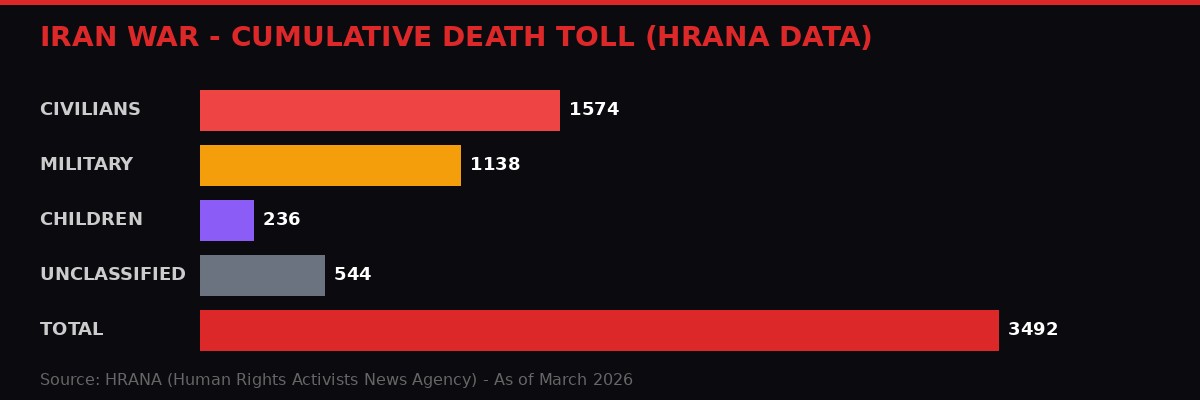
BLACKWIRE infographic: Cumulative death toll from the Iran war as tracked by HRANA.
The Infrastructure War: Steel Plants, Pharmaceutical Factories, and the Former US Embassy

US-Israeli strikes targeted Iran's largest steel production complex in Isfahan. Photo: Pexels
While Iran struck outward, US-Israeli airstrikes continued to systematically dismantle Iranian industrial and economic infrastructure. On Wednesday, strikes hit the Mobarakeh Steel Company in Isfahan - Iran's largest steel production facility and one of the largest in the Middle East. This was the second time the Isfahan steel complex was hit in less than a week. The previous strike, on March 27, targeted the facility alongside Khuzestan Steel Company factories in Ahvaz.
Iran's Red Crescent Society confirmed additional strikes on Tuesday night and Wednesday morning, listing targets that paint a picture of deliberate economic warfare: the Shahid Haqqani Port in the southern port city of Bandar Abbas, a steel production complex in Bandar Abbas, a meteorological facility in Bushehr, a residential complex in the western Tehran suburb of Malard, and pharmaceutical companies in Isfahan and Farokhshar.
The targeting of pharmaceutical companies is particularly notable. Medical supplies in Iran have been under strain since the war began, with hospitals in Tehran and other major cities reporting shortages of surgical materials, antibiotics, and emergency medications. Striking pharmaceutical production facilities pushes the humanitarian crisis deeper into civilian life, beyond the immediate violence of airstrikes and missile barrages.
Perhaps the most symbolically charged strike on Wednesday hit the area near the former US Embassy in Tehran. An AFP journalist on the ground reported damage to walls of the building, which was transformed into a museum known as the "Den of Spies" after the 1979 hostage crisis. Footage from Mehr news agency showed blown-out shop windows, debris scattered across streets, and structural damage in central Tehran. The embassy-museum has been a centerpiece of Iranian revolutionary mythology for 47 years. Striking near it - whether intentionally or as collateral from nearby targets - carries symbolic weight that will resonate through Iranian political culture for decades.
The Russian consulate in Isfahan was also previously damaged by US-Israeli airstrikes - a fact that has complicated Moscow's already delicate balancing act between its nominal partnership with Tehran and its desire to avoid direct confrontation with Washington. Russia has condemned the strikes publicly but has not provided Iran with meaningful military assistance. The destruction of its consular property underscores Moscow's limited leverage in a conflict that is reshaping the Middle East without Russian involvement.
According to HRANA (Human Rights Activists News Agency), the cumulative death toll in Iran from airstrikes has reached 3,492 people as of late March. That figure includes 1,574 confirmed civilians and at least 236 children. HRANA acknowledges that military casualties are "significantly higher than the figures reported" due to the difficulty of confirming deaths in active conflict zones where the Iranian government controls information flow.
The Diplomatic Scramble: Everyone Has a Plan, Nobody Has Leverage
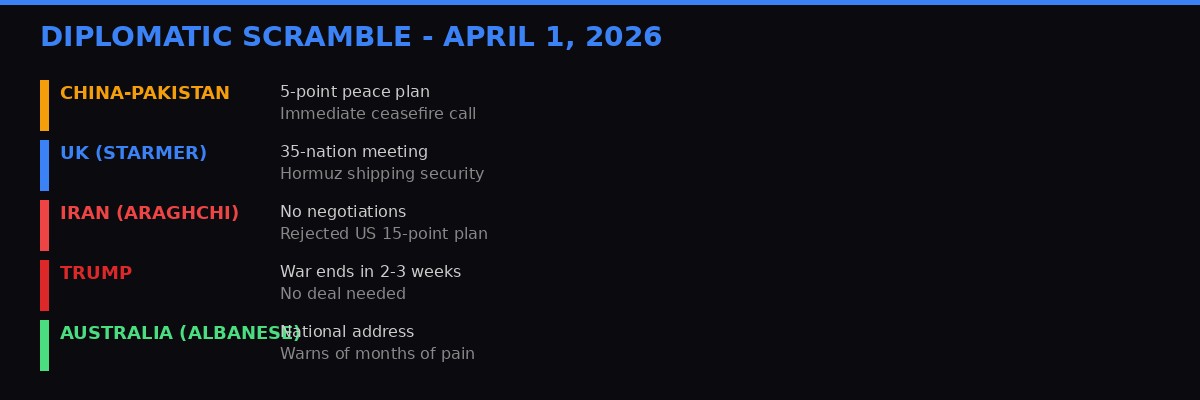
BLACKWIRE infographic: Competing diplomatic efforts as of Day 33.
Against the backdrop of expanding violence, the diplomatic landscape on April 1 resembled a multi-car pileup - everyone involved, nobody moving forward.
China and Pakistan released a joint five-point peace plan for the conflict, the most structured diplomatic proposal to emerge since the war began. The plan calls for: (1) an immediate cessation of hostilities, (2) the early commencement of peace talks, (3) protection of civilians and non-military infrastructure - including energy facilities, desalination plants, and power stations, (4) restoration of normal passage through the Strait of Hormuz and protection of shipping lanes, and (5) adherence to the primacy of the United Nations Charter.
Chinese Foreign Ministry spokesperson Mao Ning told a briefing that Beijing was working with Islamabad to "raise a voice for reason and justice" and that "the immediate priority is to initiate peace talks." Pakistan hosted a meeting of foreign ministers from Egypt, Saudi Arabia, and Turkey in Islamabad on March 29 to discuss regional de-escalation, indicating a broader coalition of Middle Eastern and Asian states seeking diplomatic channels.
The China-Pakistan plan is notable for what it does not say. It does not assign blame. It does not mention regime change - the stated US-Israeli objective. It does not address Iran's nuclear program, which Washington has cited as a core justification for military action. The plan is deliberately agnostic on the war's causes and focused entirely on stopping the shooting. Whether the United States or Israel would accept a framework that does not address their stated war aims is, at best, doubtful.
Separately, UK Prime Minister Keir Starmer announced that Britain would host a meeting of approximately 35 nations this week to discuss reopening the Strait of Hormuz. "We will assess all viable diplomatic and political measures that we can take to restore freedom of navigation, guarantee the safety of trapped ships and seafarers, and resume the movement of vital commodities," Starmer told reporters. The UK has deployed HMS Dragon to Cyprus, four additional jets to Qatar, and air defenses to Bahrain, Kuwait, and Saudi Arabia. London has authorized US forces to use British military bases for "specific and limited defensive purposes," later expanded to include "US defensive operations to degrade the missile sites and capabilities being used to attack ships" in Hormuz.
Iran's Foreign Minister Abbas Araghchi threw cold water on the idea that negotiations were underway. In an interview with Al Jazeera aired Wednesday, Araghchi said there were "no negotiations" with the United States and that Tehran had not responded to a reported 15-point proposal from Washington. "We receive messages from the American side, some direct and some through our friends in the region, and whenever necessary we respond to these messages," he said - a statement that acknowledges back-channel communication while denying formal diplomatic engagement.
Trump, for his part, told reporters on Tuesday that the war could end in "two to three weeks" and that Iran did not need to make a deal for him to end hostilities. He simultaneously threatened to bombard Iranian power plants if Iran does not reopen the Strait of Hormuz by April 6 - a threat that experts have warned could constitute a war crime given the impact on civilian populations. Trump also suggested that NATO allies who refuse to allow US military operations from European bases are making the alliance "a one-way street" - a remark that reignited tensions with European partners already uncomfortable with the scope of American military action.
Australian Prime Minister Anthony Albanese made a rare national television address, warning citizens that "the months ahead may not be easy" due to the economic fallout from the war. Australia faces historic spikes in petrol prices driven by the Hormuz blockade. Albanese urged Australians to switch to public transport to preserve fuel for rural communities and essential services. "Australia is not an active participant in this war," he said. "But all Australians are paying higher prices because of it."
The Emerging Pattern: Attrition Without Negotiation

Thirty-three days in, the war has no diplomatic off-ramp in sight. Photo: Pexels
Five weeks into this war, a pattern has crystallized. The United States and Israel are systematically destroying Iran's military and economic infrastructure - steel plants, ports, energy facilities, military installations, government buildings. Iran cannot match this firepower conventionally. Its air force was effectively neutralized in the opening hours of the conflict. Its air defenses, while capable of sporadic intercepts, cannot stop the volume of precision-guided munitions being delivered by American B-2 bombers, Israeli F-35s, and naval-launched cruise missiles.
But Iran is not powerless. Its asymmetric response - cruise missiles against Gulf shipping, drones against civilian airports, ballistic missiles against Israeli cities, proxy attacks from Yemen and Lebanon - is designed to make the war politically unsustainable for the coalition prosecuting it. Every tanker hit in Qatari waters raises insurance premiums across the global shipping industry. Every airport fire in Kuwait strains the already-fraying relationship between Gulf monarchies and their American security patron. Every missile that lands in Tel Aviv tests Israeli public tolerance for a conflict that was supposed to be a surgical strike campaign.
The human toll is mounting on all sides, though distributed unevenly. Iran has absorbed the overwhelming majority of deaths - over 3,400 by conservative estimates - compared to dozens of casualties in Gulf states and Israel. But the economic toll is distributed more broadly. Oil prices above $110 per barrel are already causing inflationary pressure across Asia, Europe, and the Americas. The Hormuz blockade has disrupted roughly 20% of global oil supply. LNG shipments from Qatar - the world's largest exporter - face new risk after Wednesday's tanker strike. Countries as distant as Australia and Japan are implementing emergency fuel conservation measures.
The fundamental problem is structural: the US-Israeli war aims (regime change, nuclear disarmament) require Iran to capitulate completely. Iran's war aims (survival, deterrence of further strikes, maintenance of its regional influence network) require the conflict to become expensive enough for Washington to walk away. These objectives are mutually exclusive. There is no overlap zone where both sides can claim victory. And until one side's calculus changes - through military exhaustion, economic pressure, or domestic political upheaval - the war will continue.
Trump's claim that the conflict will end in "two to three weeks" is difficult to square with the evidence on the ground. Iran's proxy network is expanding its involvement, not contracting it. The Houthis entered the war four days ago and are already conducting "joint operations" with Iranian forces. Hezbollah has been firing into Israel for a month. The IRGC's Gulf strikes are increasing in frequency and geographic scope. Nothing about this trajectory suggests a conflict winding down.
What Day 33 demonstrates is that the war has moved beyond the initial US-Israeli air campaign against Iran and into a broader regional conflict where Iran is systematically targeting the economic infrastructure of every state in the Gulf that permits American military presence. The Gulf states - Kuwait, Qatar, Bahrain, the UAE, Saudi Arabia - are being forced into a choice none of them wanted: absorb the damage, or break with Washington. So far, none have broken. But the pressure is building with every drone that gets through, every tanker that takes a hit, and every airport that catches fire.
The war is thirty-three days old. It feels much older.
Timeline: Day 33 - April 1, 2026
Sources: Qatar Defence Ministry, QatarEnergy, KUNA (Kuwait News Agency), Kuwait PACA, Al Jazeera, ABC News, Gulf News, Reuters, AFP, The National, Xinhua, Iran Red Crescent Society, Israel MDA, HRANA, Times of Israel, UK Government (GOV.UK), Middle East Eye, SCMP, India Today.
Get BLACKWIRE reports first.
Breaking news, investigations, and analysis - straight to your phone.
Join @blackwirenews on Telegram