Day 33: Trump Blinks Again. Iran Digs In. Lebanon Burns.
Trump extended his power plant strike deadline by ten days. Iran denied there were any negotiations. Israel deployed a third division into Lebanon. Wall Street posted its worst single-session loss since the war started. Twenty-seven days of attrition have produced no ceasefire, no open strait, and no discernible off-ramp. Day 33 looked a lot like Day 32 - but harder.

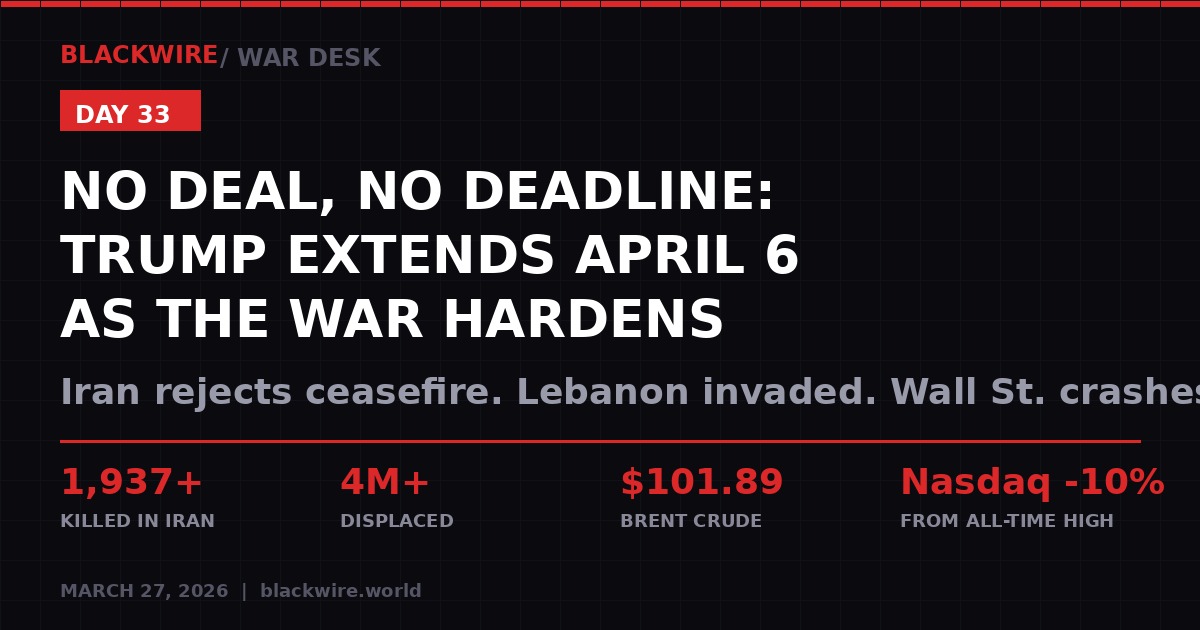
BLACKWIRE War Desk infographic - Day 33 summary. Trump's April 6 deadline, 1,937+ killed in Iran, 4 million displaced, Brent crude above $101. (BLACKWIRE / March 27, 2026)
The Deadline That Keeps Moving
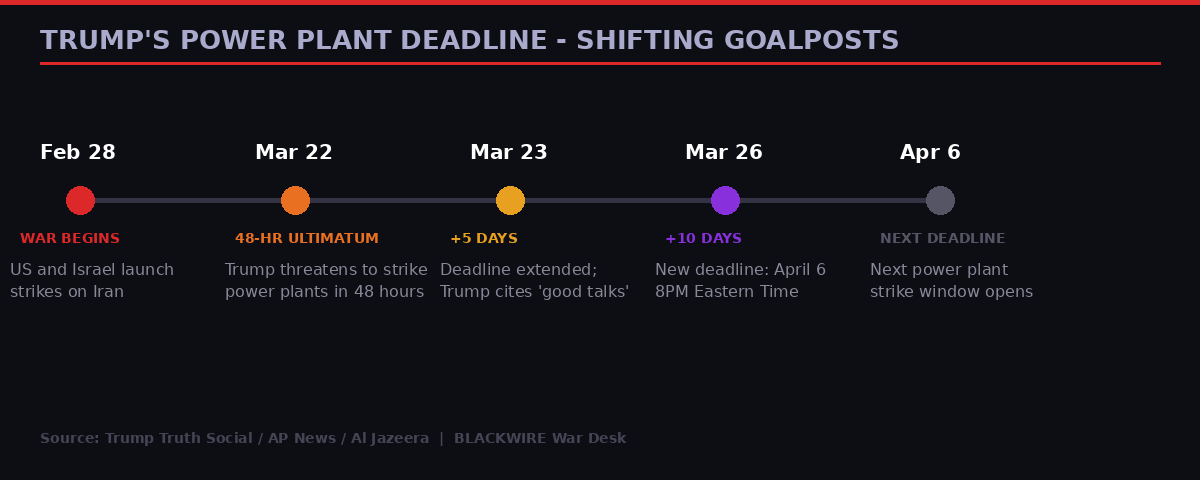
Trump's power plant threat has been issued and retracted three times in five days. Each extension has been followed by market relief, then market collapse when Iran dismissed the talks. (BLACKWIRE infographic - sources: AP News, Al Jazeera, Truth Social)
The pattern is now familiar. Trump issues a threat. Markets stabilize. Iran denies negotiations are happening. Markets crater. Trump backs off the threat. Markets stabilize again. Repeat.
On Sunday, March 22, Trump threatened to strike Iran's power grid if the Strait of Hormuz was not reopened within 48 hours, writing on Truth Social that he would target energy plants "STARTING WITH THE BIGGEST ONE FIRST." On Monday, he extended the deadline by five days, citing "good and productive conversations" that Iran's government denied took place. On Thursday, March 26 - the thirty-second day of the war - he pushed the window back again, this time by ten days, to Monday April 6 at 8 PM Eastern.
"As per Iranian Government request, please let this statement serve to represent that I am pausing the period of Energy Plant destruction by 10 Days to Monday, April 6, 2026, at 8 PM, Eastern Time. Talks are ongoing and, despite erroneous statements to the contrary by the Fake News Media, and others, they are going very well." - President Donald Trump, Truth Social, March 26, 2026
Iran's Foreign Minister Abbas Araghchi responded directly and flatly. In an interview on Iranian state television, Araghchi said his government had not engaged in talks to end the war and does not plan to. "The U.S. had tried to send messages to Iran through other nations," he said, "but that is not a conversation nor a negotiation." Tehran's official position: there are no talks. Washington's official position: talks are going very well. Both cannot be right, and the market responded accordingly to the contradiction.
Trump's envoy Steve Witkoff confirmed Thursday that Washington had delivered to Tehran - using Pakistan as an intermediary - a 15-point "action list," calling it a framework for a possible peace deal. He said there were "strong signs" the U.S. could "convince Iran that this is the inflection point, with no good alternatives for them other than more death and destruction." Iran's Press TV, meanwhile, said Tehran had put forward its own five-point counter-proposal, which includes reparations for the war damage and formal recognition of Iranian sovereignty over the Strait of Hormuz.
Demanding that Washington legally recognize Iranian ownership of the most strategically important waterway on Earth is not the posture of a government that believes it is losing. Whether Iran is stalling for time, genuinely believes it can outlast the bombardment, or is operating under completely different assumptions about what "winning" looks like - the practical effect is the same: the war continues.
The Markets Speak First
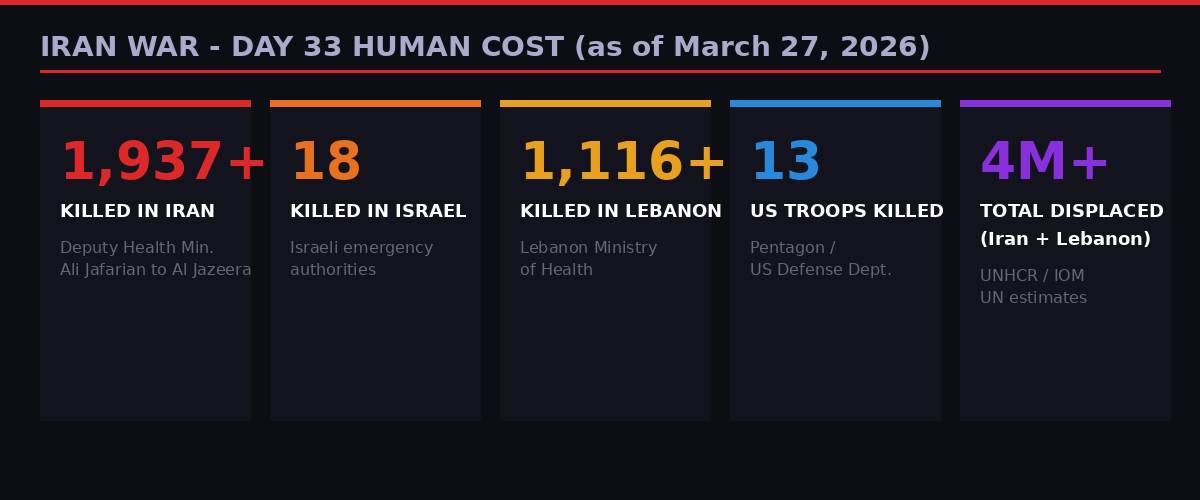
War's human ledger as of Day 33. The 1,937+ figure for Iran is described by Iranian Deputy Health Minister Ali Jafarian as conservative. Al Jazeera and UNHCR data for Lebanon and Iran respectively. (BLACKWIRE infographic)
Before Trump announced the extension Thursday evening, Wall Street had already rendered its verdict on the state of the war. The S&P 500 fell 1.7%, its worst single session since January and well clear of its worst day since the war started. The Nasdaq sank 2.4% and slipped more than 10% below its all-time high set earlier this year - the formal threshold for what professional investors call a "correction."
Brent crude, the international benchmark, climbed 4.8% to settle at $101.89 per barrel, up from roughly $70 before the war started - a 45% surge in thirty-three days. U.S. benchmark crude rose 4.6% to $94.48. Even after Trump's evening announcement trimmed some of oil's gains, Brent remained close to $100.
Yields on 10-year U.S. Treasury bonds jumped to 4.43% from 4.33% the day before, and up from 3.97% before the war. That matters: higher Treasury yields translate directly into higher mortgage rates, higher business borrowing costs, and slower economic growth. The Federal Reserve, which entered 2026 with traders expecting several rate cuts this year, now faces a paralysis scenario - oil-driven inflation on one side, a war-slowed economy on the other.
Germany's DAX lost 1.5% Thursday. Hong Kong's Hang Seng sank 1.9%. South Korea's Kospi dropped 3.2%. Japan's Nikkei held to a 0.3% loss - one of the milder declines globally. The war has been a wrecking ball through Asian markets in particular, given that region's dependence on Gulf oil transported through the Strait of Hormuz. Traffic through the strait has fallen by 90% since March 1, according to Lloyd's List Intelligence. About 150 vessels have transited in the entire month - roughly one day's normal pre-war traffic.
Critics of Trump's on-again-off-again approach to the war have latched onto an acronym from last year's tariff reversals: "TACO," meaning Trump Always Chickens Out. The pattern is similar - Trump makes a maximalist threat, markets crash, Trump backs off with an explanation that talks are going well, markets recover slightly, the cycle repeats. Whether that read is unfair or accurate, the structural effect is real: each iteration of the cycle erodes U.S. credibility as a negotiating counterpart and gives Iran more time to cement its control of the strait.
Iran's Toll Booth and the Grip on Hormuz
While diplomatic signals bounced between Washington, Tehran, Islamabad, and Cairo, Iran continued its consolidation of the Strait of Hormuz into a tool of economic leverage. Lloyd's List Intelligence formalized the description Thursday: Iran's Islamic Revolutionary Guards Corps has imposed a de facto "toll booth" regime at the strait.
The mechanics are straightforward and alarming. Ships that want to transit must divert from the standard two-lane shipping channel to a northern route around Larak Island, placing them inside Iranian territorial waters. There, they must submit their details - cargo manifest, ownership information, destination, and a complete crew list - to approved intermediaries of the IRGC. Approved vessels receive a code and receive an IRGC escort through the passage. The cargo is described as "geopolitically vetted."
At least two vessels have paid a direct toll. Payment, according to Lloyd's List, is settled in yuan - China's currency. Iranian oil continues to flow largely uninterrupted: Iran's Kharg Island terminal loaded 1.6 million barrels in March, nearly identical to pre-war monthly totals, according to data firm Kpler. Most of those customers are small, private Chinese refineries that operate outside the reach of U.S. sanctions.
"Weaponizing the Strait of Hormuz is not an act of aggression against one nation. It is economic terrorism against every consumer, every family that depends on affordable energy and food. When Iran holds Hormuz hostage, every nation pays the ransom - at the gas pump, at the grocery store and at the pharmacy." - Sultan al-Jaber, CEO of Abu Dhabi National Oil Company (ADNOC), March 26, 2026
The Gulf Cooperation Council's secretary-general, Jasem Mohamed al-Budaiwi, said Iran's toll collection is "an aggression and a violation of the United Nations agreement on the law of the sea." Legal experts have pointed to Article 19 of the UN's Law of the Sea Treaty, which requires nations to allow "innocent passage" of peaceful vessels through their territorial waters. Maritime historian Sal Mercogliano of Campbell University was blunt: "There's no provision in international law anywhere to set up a toll booth and shake down shipping."
Iran's parliament is reportedly working to formalize the arrangement through legislation. The Fars and Tasnim news agencies - both tied to the IRGC - quoted lawmaker Mohammadreza Rezaei Kouchi saying parliament was pursuing a plan to "formally codify Iran's sovereignty, control and oversight over the Strait of Hormuz, while also creating a source of revenue." At least 18 ships have been hit since the war began; at least seven crew members have been killed, according to the UN's International Maritime Organization.
The IRGC has also killed the US-led war coalition's ability to rely on standard maritime passage in any operational sense. About half of vessels transiting the strait have turned off their AIS radio identification transponders before entering - appearing blind on tracking systems - and re-emerging on the other side in the Gulf of Oman. The war is being fought with layered opacity: diplomatic back-channels no one admits to, ships that vanish from tracking systems, tolls paid in a currency designed to route around US sanctions.
Israel's Third Division Enters Lebanon
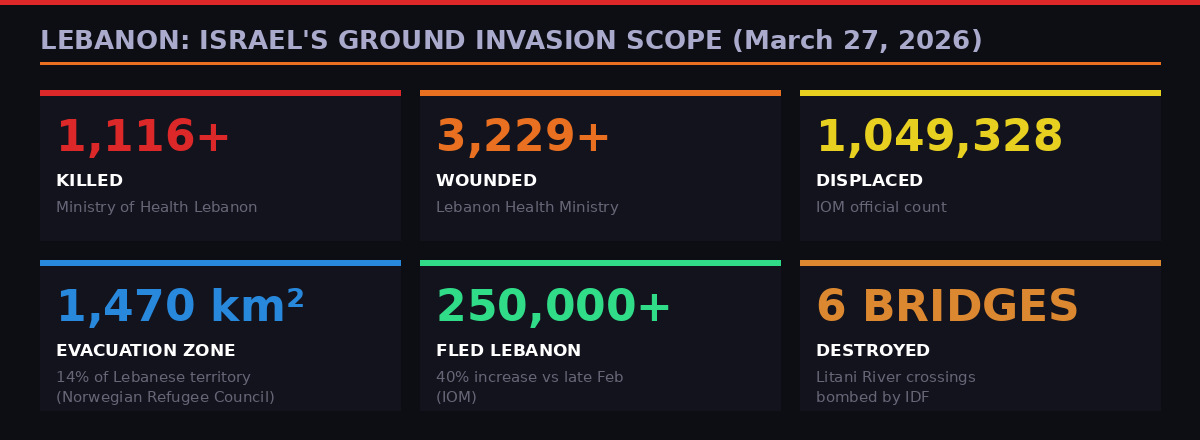
Lebanon's war numbers as of Day 33. Over 1 million displaced inside Lebanon; 250,000 have fled the country. Six Litani River bridges destroyed by the IDF. (BLACKWIRE infographic - sources: IOM, Lebanese Ministry of Health, Norwegian Refugee Council)
Israel announced Thursday that troops from Division 162 would begin operating in southern Lebanon - the third Israeli division deployed there since the ground invasion escalated in early March. The 162nd joined two divisions already operating below the Litani River, according to an Israeli Defense Forces social media post confirming the deployment. The stated objective: expanding the "buffer zone" in southern Lebanese territory.
Israeli Defense Minister Israel Katz confirmed separately that the IDF requires an additional 15,000 soldiers - roughly half of them combat troops - to reach full operational strength across its multiple simultaneous missions. Israel can draw from tens of thousands of reservists, but successive deployments have generated domestic friction: reservist and regular soldiers have cited exhaustion, financial strain, and family disruption. The IDF is now fighting Hezbollah in Lebanon, conducting air operations against Iranian infrastructure, and maintaining active deployments in the West Bank.
Hezbollah's chief Naim Qassem said this week the group would continue fighting "without limits." On Thursday alone, Hezbollah announced more than 45 military operations against Israel, including rocket and drone attacks and the targeting of Israeli armored vehicles - including two Merkava tanks in the border town of Deir Siryan, hit with guided missiles. A Hezbollah rocket strike on the Israeli coastal city of Nahariya killed one person and wounded eleven others. One Israeli soldier was killed in what the IDF described as an "incident" in southern Lebanon.
Sirens over Israel warned repeatedly of barrages of incoming Iranian missiles through the day. Two people were killed in the United Arab Emirates by shrapnel from a missile interception over Abu Dhabi - demonstrating again that Gulf civilian populations are inside the kill radius of this conflict even when intercept systems function correctly.
Lebanese Prime Minister Nawaf Salam warned Thursday that Israel's push to deepen its ground invasion "constitutes a matter of utmost gravity that threatens Lebanon's sovereignty" and violates international law and the UN Charter. He said the Lebanese government would file a complaint with the UN Security Council. France, the United Kingdom, Germany, Italy, and Canada had already warned last week that an expanded Israeli offensive "would have devastating humanitarian consequences." The deployment of a third division is the answer to those warnings.
The Displacement Crisis Nobody Is Watching
Four million people displaced. That number - assembled from UNHCR data for Iran and IOM data for Lebanon - sits in the background of every diplomatic communique and every market update, largely unexamined.
Inside Iran, the UNHCR estimates 3.2 million people have been displaced since strikes began on February 28. More than 85,176 civilian sites have been damaged, including 282 healthcare facilities, 600 schools, and 64,583 homes. In Tehran alone, nearly 14,000 residential units have been damaged, and at least 6,000 people have been housed in municipal hotels. In Iran's major cities - Isfahan, Shiraz, Bandar Abbas - the combination of infrastructure strikes and internal displacement has created overlapping crises that international aid agencies are struggling to even document, let alone address.
Cross-border flows out of Iran have been limited and largely controlled. Afghanistan reports primarily Afghan returnees - nationals previously living in Iran who are now heading home due to insecurity. Pakistan reports only authorized entries. Turkey, Turkmenistan, and Azerbaijan report stable borders with limited authorized crossings. Iraq has seen approximately 325 Iranian nationals enter. The borders are holding - for now. But inside Iran, the displacement is already generating the kind of secondary pressure on infrastructure - water systems, power distribution, food supply chains - that outlasts the strikes themselves.
Lebanon's numbers are sharper and faster-moving. The IOM counts 1,049,328 officially registered displaced people. More than 250,000 people have left Lebanon entirely in the past two weeks, a 40% increase compared to the previous two weeks. Most are crossing into Syria - itself a country with no infrastructure left to absorb them. As of March 17, more than 125,000 people had crossed into Syria; nearly half are children. About 7,000 are Lebanese nationals. The rest are Syrian nationals who had been living as refugees in Lebanon - now doubly displaced, back in the country they originally fled.
Israel's destruction of six bridges crossing the Litani River - the Qasmiyeh, Coastal Highway, al-Qantara, Khardali, al-Dalafa, and Zaraiya-Tirseflay bridges, all verified by Al Jazeera - has severed the physical connections between southern Lebanon and the rest of the country. Lebanese President Joseph Aoun described the attacks as "an attempt to sever the geographical connection between the southern Litani region and the rest of Lebanese territory." The bridges are gone. The million-plus people displaced from below the Litani have nowhere to easily return to even if the fighting stopped tomorrow.
The War's Logic: Attrition Without Exit
The United States has offered shifting objectives since the war began. Ensuring Iran's missile and nuclear programs are neutralized. Ending Tehran's support for armed groups in the region. At one point, regime change - the overthrow of Iran's theocracy. None of these objectives have been met. None appear close to being met.
What the US-Israeli campaign has accomplished: killing senior Iranian military and government leaders, including most recently IRGC Navy Commander Commodore Alireza Tangsiri and naval intelligence chief Behnam Rezaei, confirmed by Israeli Defense Minister Israel Katz on Thursday. Striking scores of military sites, air defense systems, and infrastructure targets. Degrading Iran's conventional military capacity on paper.
What has not been accomplished: stopping Iranian missile launches. Iran continues firing missiles at Israel and Gulf Arab states daily. Preventing the IRGC from controlling Hormuz. Iran's grip on the strait is tighter today than when the war started. Creating any internal political crisis. There is no sign of an uprising against the Iranian government. No senior defections. No collapse of institutional cohesion.
Iran's strategic calculation, as read by regional analysts, is not to win in the conventional sense. It is to outlast. If Tehran can simply remain functional - missiles still firing, oil still flowing to China, strait still under effective IRGC control, leadership still intact - and force the U.S. to keep escalating, each escalation costs America more in economic pain, in allied patience, in domestic political capital. The 10-day extension Trump granted Thursday is, from Iran's perspective, more time and another data point confirming that the escalation threats are not automatic.
Egypt's Foreign Minister Badr Abdelatty said Thursday that his country sees "a desire from both sides for calm, for the exploration of negotiations." That may be true at the level of individual diplomat signals. At the level of operational military reality on March 27, 2026, both sides are moving more forces forward, not fewer. Strikes on Thursday included heavy reported impacts around Isfahan - home to a major Iranian air base, other military sites, and one of Iran's nuclear facilities. Power was reported out in parts of Tehran. Iranian missiles continued to target Israel and Gulf partners. The 82nd Airborne paratroopers continue their approach to the region. The USS Tripoli and approximately 2,500 Marines continue their approach to the Gulf.
Thirty-three days in, the war has killed at least 1,937 people in Iran, 18 in Israel, more than 1,116 in Lebanon, at least 13 American service members, 80 members of Iraqi security forces, and an unknown number of civilians across the Gulf. The Nasdaq is in correction. Brent crude is above $100. Four million people are displaced. The next hard deadline is April 6.
Timeline - Day 33 Key Events
Who Watches the Strait
The IRGC Navy is now without its top commander. Commodore Alireza Tangsiri, who Israel says was killed Thursday, was the officer responsible for the operational architecture that transformed the Strait of Hormuz from a transit route into a choke point with a toll. His killing removes an experienced commander from a complex, ongoing naval operation - but it does not remove the operation itself.
The IRGC's institutional depth is one of the persistent surprises of this war for US defense planners who assumed leadership kills would create paralysis. Iran's military-political structure is designed around distributed authority and ideological resilience rather than hierarchical command dependency. Tangsiri's death was announced by Israel, not confirmed by Iran. Tehran's silence on command-level losses - consistent throughout the war - prevents accurate public assessment of the damage to operational capacity.
What is publicly documented: 150 vessel transits in the entire month of March, against a normal daily rate roughly 30 times higher. Iran-affiliated ships account for approximately 60-90% of recent transits - their own oil moving freely while everyone else queues, pays, or turns back. Iran is not simply blocking the strait. It is running the strait as a geopolitical filtering mechanism, letting through what serves Iranian interests and stopping what does not. The yuan-denominated toll system is a direct thumb in the eye of U.S. dollar dominance in global trade.
At least 18 ships have been hit. Seven crew members have been killed. The IMO has condemned the attacks. The GCC has condemned the tolls. International law scholars have said there is no legal basis for Iran's toll regime. None of that matters in the absence of a force capable of compelling Iran to stop. The U.S. Seventh Fleet is in the region. The USS Tripoli group is inbound. But no U.S. or allied vessel has yet attempted to physically break Iran's control of the strait - because doing so could trigger the escalation that the diplomatic track is supposedly trying to prevent.
The strait is, for now, Iran's. The April 6 deadline is the next test of whether anything changes.
What Comes Next
The ten days between now and April 6 will determine whether the war enters a new phase or continues its current pattern of grinding attrition. The variables are specific and knowable:
On the US side: the 82nd Airborne paratroopers and the USS Tripoli Marine group will complete their transit to the Gulf. Trump's domestic political environment - already strained by a government shutdown, airport delays, and rising gas prices - will continue to press against escalation. The No Kings protests scheduled for Saturday, March 28 in cities across the United States represent a different pressure vector: domestic opposition that Trump cannot bomb into submission.
On the Iranian side: Tehran's fundamental posture has not changed in 33 days. It continues to fire missiles. It continues to collect tolls in the strait. It continues to officially deny negotiations while reportedly maintaining back-channel contact through intermediaries. Iran's Deputy Health Minister stated the 1,937 death toll is conservative. The actual number of killed may be higher. Yet the government has not collapsed, the leadership has not sought asylum, and no credible internal opposition has emerged.
On the Lebanese front: the deployment of Division 162 signals that Israel intends to expand, not consolidate, its buffer zone south of the Litani. Hezbollah has maintained operational capacity through 33 days of war, announcing 45+ operations on a single day. Lebanon's civilian displacement has reached 18% of the national population. The humanitarian situation south of the Litani - with bridges destroyed and over a million people gone - will deteriorate further as Israel deepens its presence.
Thirty-three days in, the core question of this war has not changed: who runs out of tolerance first. Iran is betting it outlasts the American appetite for economic pain and domestic dissent. The United States is betting that Iran's capacity - military, economic, political - will eventually crack under the weight of strikes and isolation. On April 6, Trump will have to decide whether the third deadline extension is the last one, or whether there is a fourth.
Get BLACKWIRE reports first.
Breaking news, investigations, and analysis - straight to your phone.
Join @blackwirenews on Telegram