April 2, 2026 • Day 34 of the Iran War • 16:00 CET
Day 34: Stone Ages - The Systematic Dismantling of Iranian Civilian Infrastructure

The pattern of destruction across Iranian cities now extends far beyond military targets. Photo: Pexels
The Pasteur Institute of Iran is gone. A century of vaccine research, disease surveillance, and public health capacity - reduced to concrete dust and twisted rebar sometime before dawn on Thursday. Iran's health ministry spokesman Hossein Kermanpour posted images on X showing the facility "extensively damaged," then called the strike "a direct assault on international health security." He was not exaggerating. The Pasteur Institute was a member of the International Pasteur Network, a pillar of infectious disease research across the Middle East, and one of Iran's oldest scientific institutions. It produced vaccines. It monitored epidemics. It is now rubble.
This is Day 34 of the US-Israel war on Iran. What began on February 28 as strikes on missile infrastructure and military command sites has expanded into something different - a sustained campaign against the civilian foundations of Iranian society. Pharmaceutical plants, steel works, desalination facilities, highway bridges, civilian ports, airports. The target list on April 2 reads less like a military operation and less like counterproliferation. It reads like an effort to dismantle a country's capacity to function as a modern state.
President Trump, in a 19-minute primetime address Wednesday evening, made the quiet part loud. "We are going to hit them extremely hard over the next two to three weeks," he told the nation. "We're going to bring them back to the Stone Ages where they belong." He threatened to strike Iran's electrical grid if no deal materialized. He offered no ceasefire timeline. He said the war was almost over while simultaneously promising to escalate it.
The markets heard the contradiction. Oil surged past $105 per barrel Thursday morning. US gas prices crossed $4 per gallon for the first time since 2022. And the Western alliance - already fractured beyond recognition - cracked wider, with France's Emmanuel Macron delivering the most direct rebuke of Trump by any allied leader since the war began.
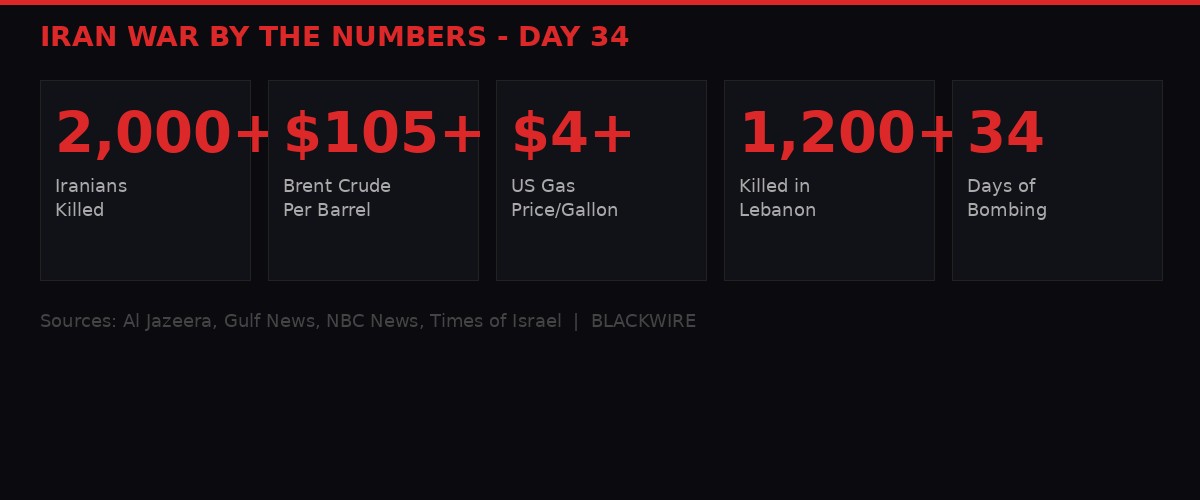
The war in numbers after 34 days of sustained aerial bombardment. Infographic: BLACKWIRE
The Pasteur Institute and the Logic of Civilizational Destruction

The Pasteur Institute produced vaccines and conducted epidemiological research for over a century. Photo: Pexels
Founded in 1920, the Pasteur Institute of Iran was modeled on its Parisian counterpart. It was not a dual-use facility. It was not connected to Iran's nuclear program. It was not producing chemical or biological weapons. It was producing vaccines, conducting disease surveillance, and training the next generation of Iranian epidemiologists. Its destruction was confirmed by Iran's Health Ministry on Thursday morning, with images showing catastrophic structural damage across the campus.
The strike came less than 24 hours after another pharmaceutical target was hit. On Wednesday, US-Israeli forces bombed the Tofigh Daru pharmaceutical raw material units in Tehran, destroying the facility's research and development department. An Iranian official said the strike dealt "a blow to the national medical supply chain" - language that understates the reality. Tofigh Daru produced active pharmaceutical ingredients. Without domestic production, Iran becomes dependent on imports for medications its population requires daily. With the Strait of Hormuz effectively closed and sanctions already limiting access to global markets, that dependency translates into shortages. Shortages translate into deaths that will never be counted as war casualties.
This is the architecture of what international humanitarian law experts call "civilian harm through infrastructure degradation." You do not need to bomb a hospital to destroy a healthcare system. You bomb the pharmaceutical plants that supply it. You bomb the research institutes that develop its diagnostics. You bomb the desalination plants that provide clean water - as happened on Qeshm Island in the Strait of Hormuz, where a facility was knocked offline Thursday, cutting water supply to the island's population. You bomb the steel plants that produce the materials to rebuild anything.
"The aggression against Pasteur Institute of Iran - a century-old pillar of global health and member of International Pasteur Network - is a direct assault on international health security." - Hossein Kermanpour, Iran Health Ministry spokesman, via X (April 2, 2026)
The Geneva Conventions prohibit attacks on objects indispensable to the survival of the civilian population. Article 54 of Additional Protocol I specifically protects drinking water installations and irrigation works. Article 56 protects works and installations containing dangerous forces. The systematic targeting of pharmaceutical production, water infrastructure, and medical research facilities raises questions that no primetime address can answer.
Steel, Bridges, and the Arithmetic of Reconstruction

The pattern of destruction extends across industrial and civilian infrastructure. Photo: Pexels
Iran's two largest steel plants are offline. That sentence requires unpacking, because steel is not just an industrial commodity. Steel is the material that rebuilds everything else - bridges, hospitals, housing, water treatment plants, power stations. Without domestic steel production, reconstruction becomes dependent on imports through supply chains that are currently severed by the Hormuz blockade and international sanctions.
Mehran Pakbin, deputy head of operations at Khuzestan Steel Company, told Iranian state media Thursday that "our initial estimate is that restarting these units will take at least six months and up to one year." Mobarakeh Steel Company in Isfahan - Iran's largest flat steel producer - reported that "production lines have completely shut down following the high volume of attacks." Between them, these two facilities accounted for a significant share of Iran's steel output, which stood at approximately 30 million tonnes annually before the war began. That production is now zero.
The B1 highway bridge connecting Tehran to the western city of Karaj was struck on Thursday morning. Iran's Fars news agency reported it as the highest bridge in the Middle East, inaugurated earlier this year. Early assessments indicated multiple injuries. The bridge was a civilian arterial route. The Tehran-Karaj corridor handles some of the heaviest traffic in the country. Its destruction does not degrade Iran's military capacity. It degrades the ability of millions of people to move, to commute, to access services.
Add to this the Shahid Haqqani passenger pier in Bandar Abbas, struck Wednesday by fighter jets. Ahmad Nafisi, a senior official in Hormozgan province, condemned the "criminal" attack on what he described as pure civilian port infrastructure. No military casualties were reported because there was nothing military about the target. The pier served passenger ferries.
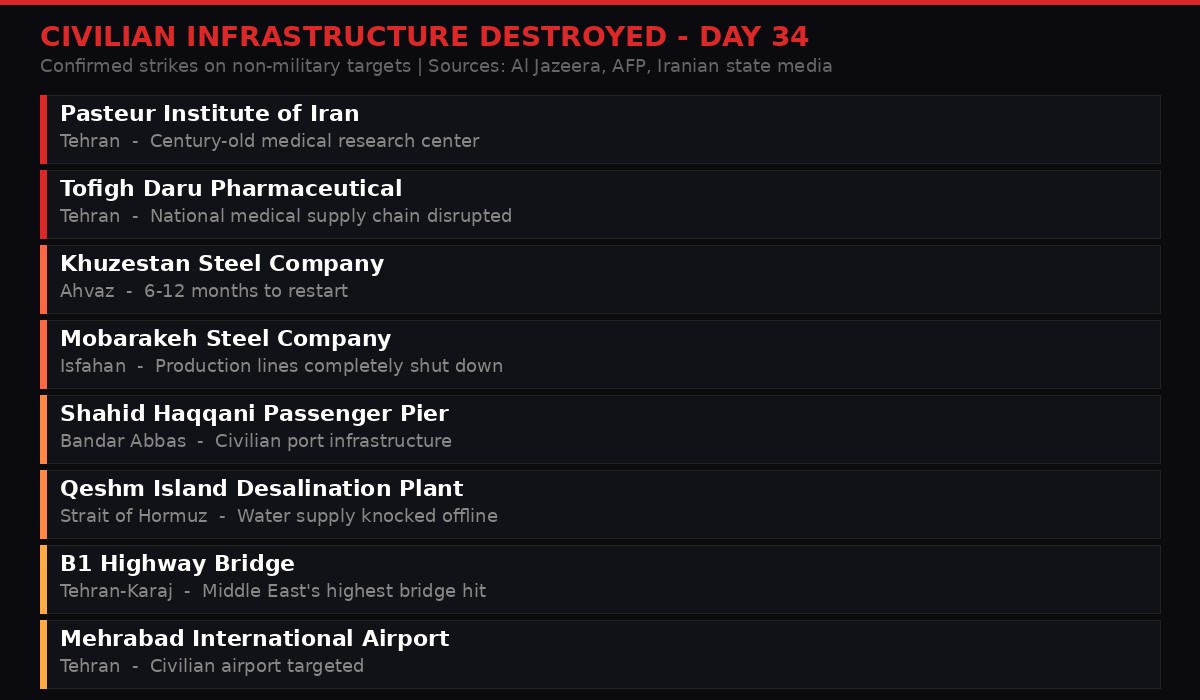
Confirmed civilian infrastructure targets struck in the 48 hours preceding April 2. Infographic: BLACKWIRE
The Alma Research and Education Center, an Israeli defense think tank, reported that "approximately 20 weapons production sites and research and development centers across Tehran were targeted" on April 1, along with Mehrabad International Airport. The framing - "weapons production sites" - covers an increasingly elastic category. When pharmaceutical plants and century-old medical research centers fall under the same targeting rubric as missile factories, the distinction between military and civilian targets has been effectively dissolved.
Trump's Address: Victory Without End

The gap between "mission accomplished" rhetoric and escalating bombardment has become the defining contradiction of Day 34. Photo: Pexels
Trump's 19-minute primetime address from the White House on Wednesday evening was intended to reassure a war-weary public. It accomplished the opposite. The speech contained two messages that cannot coexist: the war is almost over, and the bombing is about to get worse.
"We are going to hit them extremely hard over the next two to three weeks," the President said. "We're going to bring them back to the Stone Ages where they belong." In the same address, he said Iran's missiles and drone systems had been "dramatically curtailed" and that their "weapons factories and rocket launches are being blown to pieces." He claimed the US military's performance was "unstoppable." He asked Americans to "keep this conflict in perspective," comparing it favorably to the wars in Iraq and Vietnam.
Then came the escalation threat. Trump said that "if no deal is made," the United States would strike Iran's electrical grid - the last piece of critical civilian infrastructure that has remained largely intact. In a country where summer temperatures routinely exceed 45 degrees Celsius, electrical grid destruction is not an abstract military concept. It is an existential threat to millions of people who depend on air conditioning, refrigeration, and powered medical equipment to survive.
"We're going to bring them back to the Stone Ages where they belong." - President Donald Trump, primetime address, April 1, 2026
The contradictions were not lost on investors. Brent crude surged past $105 per barrel Thursday as markets digested the reality that the speech offered no exit ramp. The average US gasoline price crossed $4 per gallon - a symbolic threshold not breached since 2022. Stocks slid. The dollar gained against currencies tied to energy-importing economies. Anyone hoping for de-escalation signals found none.
Defense Secretary Pete Hegseth, speaking separately, said the US was "negotiating with bombs" and that the coming days would be "decisive." Secretary of State Marco Rubio warned that relations with NATO would need to be "re-examined" after the war. "Without the United States, there is no NATO," Rubio said. "An alliance has to be mutually beneficial." These statements collectively telegraph an administration that sees the war not as a discrete military operation but as a lever for restructuring the entire Western alliance system.
Macron's Rebuke and the NATO Collapse
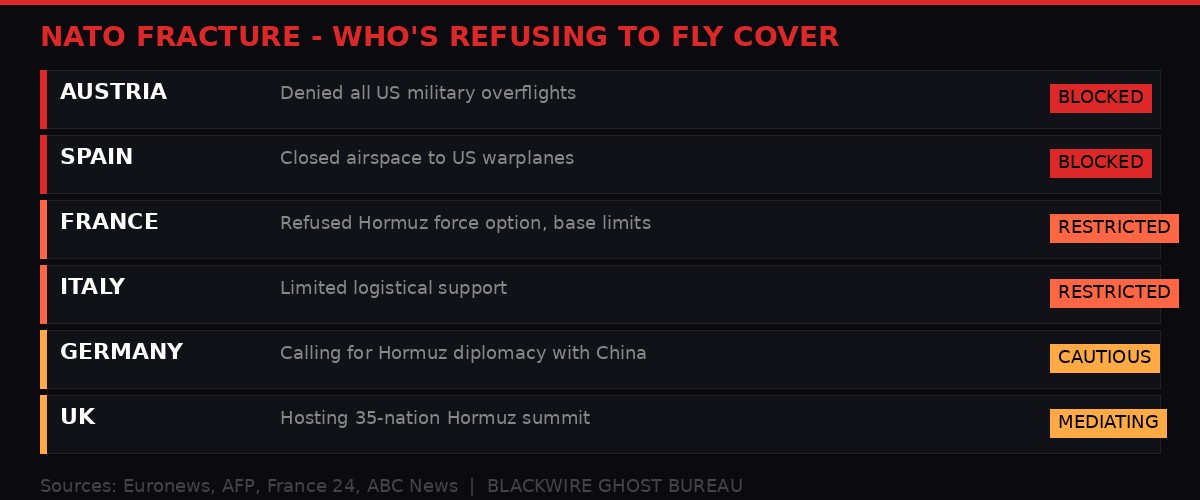
The alliance is fracturing along clean lines: those who deny access entirely, those who restrict it, and those trying to mediate. Infographic: BLACKWIRE
Emmanuel Macron did not use diplomatic language on Thursday. Speaking from Seoul during a state visit to South Korea, the French President delivered what amounts to the sharpest public rebuke of a sitting US president by an allied leader since the invasion of Iraq in 2003.
"You have to be serious," Macron said. "When you want to be serious, you don't say the opposite every day of what you said the day before. And perhaps you shouldn't talk every day." He was responding to Trump's shifting statements on the war, his threats to pull the US out of NATO, and his demands that European allies assemble a naval force to reopen the Strait of Hormuz.
On the Hormuz question specifically, Macron was categorical. "There are those who advocate for the liberation of the Strait of Hormuz by force through a military operation, a position sometimes expressed by the United States," he said. "It is unrealistic because it would take an inordinate amount of time and would expose anyone crossing the strait to coastal threats from the Revolutionary Guards, who possess significant resources, as well as ballistic missiles, and a host of other risks." He concluded: "This can only be done in concert with Iran. So, first and foremost, there must be a ceasefire and a resumption of negotiations."
Macron also addressed Trump's NATO threats directly, saying the US president was undermining the alliance by creating "daily doubt about his commitment." He added: "I don't want to provide a running commentary of an operation the Americans have decided on their own with Israel. They can deplore the fact they're not being helped, but that's not our operation. We want peace as soon as possible."
The French president also had to address Trump's personal attacks. On Wednesday, Trump claimed Macron's wife Brigitte "treats him extremely badly," referencing a disputed 2025 news video. Macron called the comments "neither elegant nor up to standard." Yaël Braun-Pivet, president of France's lower house of parliament, went further: "We are currently discussing the future of the world. People are dying on the battlefield and we have a president who is laughing, who is mocking others."
The Macron statement did not arrive in isolation. Hours before the French president spoke, Austria's defense ministry confirmed what had been suspected for weeks: Vienna has denied every US request for military overflights since the war began, citing its constitutional neutrality policy. Colonel Michael Bauer told AFP: "There have indeed been requests and they were refused from the outset. Every time a similar request involves a country at war, it is refused." Austria is not a NATO member, but the denial forces US aircraft into longer routing patterns across European airspace that is becoming increasingly restricted.
Spain, France, and Italy have all imposed varying degrees of restriction on US military operations - closing airspace, denying base access, or limiting logistical support. The cumulative effect is a war in which the United States and Israel are operating with virtually no allied participation beyond intelligence sharing. Trump's response - threatening to leave NATO entirely, calling the alliance "a paper tiger" in a Telegraph interview on Wednesday - has accelerated the fracture rather than healing it.
The Hormuz Summit and the Oil Crisis

The economic destruction extends far beyond Iran's borders, with global energy markets in sustained crisis. Photo: Pexels
As Macron spoke in Seoul, representatives from approximately 35 countries convened for a summit hosted by the United Kingdom to discuss reopening the Strait of Hormuz. The strait - through which roughly 20% of global oil supply transits in normal times - has been effectively paralyzed since the war began on February 28. Iran's IRGC Navy controls the chokepoint with mines, fast attack boats, coastal anti-ship missiles, and the persistent threat of ballistic strikes on any vessel attempting transit.
The summit's participants face an impossible problem. The strait cannot be reopened by force - Macron said as much publicly, and private assessments from multiple European defense ministries have reached the same conclusion. The IRGC's coastal defense capabilities are designed precisely for this scenario: a narrow waterway bristling with weapons, where any minesweeping or escort operation would suffer devastating attrition. A French defense official, speaking at the War + Peace conference in Paris earlier this week, stated plainly that a forced opening of the strait "would be a breach of international law."
The alternative - negotiating the strait's reopening with Iran - requires a ceasefire that neither the United States nor Israel appears willing to accept. Trump's Wednesday address explicitly linked the Hormuz question to continued military operations: he would not consider a ceasefire until the strait was open, while simultaneously bombing the country that controls it. The circularity is obvious. You cannot negotiate passage with a nation you are threatening to bomb into the Stone Ages.
Germany and China issued a joint statement Thursday calling for "freedom and security of shipping" in the strait, an unusual alignment that reflects the severity of the energy crisis. Australian Prime Minister Anthony Albanese warned in a national address that "the months ahead may not be easy" and that "no government can promise to eliminate the pressures that this war is causing." These are the statements of leaders who see no resolution on the horizon.
Analyst Trita Parsi told Al Jazeera that it is "not as easy for Trump to just walk out" of the conflict, noting that Iran will likely continue to control and attack the waterway regardless of what happens on the battlefield. The strait, in other words, is not a military objective that can be captured. It is a geographic reality that Iran will dominate for as long as the IRGC exists - and nothing in the current campaign is designed to occupy Iranian territory.
The Multi-Front War Intensifies

The war now spans Iran, Lebanon, Israel, and multiple Gulf states simultaneously. Photo: Pexels
The war is not confined to Iran. It has not been since Day 1. On Thursday, Iran fired four separate missile salvos at Israel since midnight, some carrying cluster warheads - a weapon designed to scatter submunitions across a wide area, maximizing civilian casualties. Four people were wounded in Bnei Brak, a densely populated city near Tel Aviv, including two babies. Fourteen people were wounded by a separate missile strike on central Israel that the military attributed to Iranian forces. Hezbollah fired over 50 rockets at northern Israel, lightly wounding two people, while a drone infiltrated Israeli airspace over Kiryat Shmona, triggering alarms in the Safad area.
In Lebanon, the situation has deteriorated beyond the already catastrophic baseline. Israeli Defense Minister Israel Katz announced that homes in southern Lebanon would be demolished and that hundreds of thousands of displaced Lebanese would not be allowed to return. Since March 2, Israeli operations in Lebanon have killed more than 1,200 people and displaced 1.2 million - figures that continue to climb daily. The Israeli military's 91st "Galilee" Regional Division is operating in southern Lebanon, according to a handout published Thursday.
Across the Gulf, Iranian drone attacks have repeatedly targeted Kuwait's airport, forcing its closure since February 28. Saudi Arabia provided buses to airports in Dammam and Qaisumah as alternatives. Air raid sirens sounded in Bahrain. Saudi Arabia's Ministry of Defence reported destroying two more Iranian drones. An "unknown projectile" struck a tanker north of Doha, Qatar, though no environmental damage was reported.
The Iraqi dimension is darkening. Kata'ib Sayyid al-Shuhada, an Iranian-backed armed group, warned Thursday that if US troops use Kuwaiti territory to launch a ground invasion into Iran, it would trigger "all-out war." Members of Iraq's Popular Mobilization Forces attended a funeral in Baghdad on Thursday - a signal of the proxy dimension that is already active and could rapidly expand. The US Embassy in Baghdad told American citizens to leave Iraq, citing "terror threats."
Iran's military, for its part, issued defiant statements. After Trump's address, the Iranian armed forces said the war would continue "until the enemies surrender" and claimed hidden stockpiles to sustain the fight. Iran's army chief was ordered to prepare for "any attack" - language that suggests Tehran is preparing for the possibility of a ground invasion, however unlikely that may be given the logistical realities.
The Death Toll Nobody Wants to Count
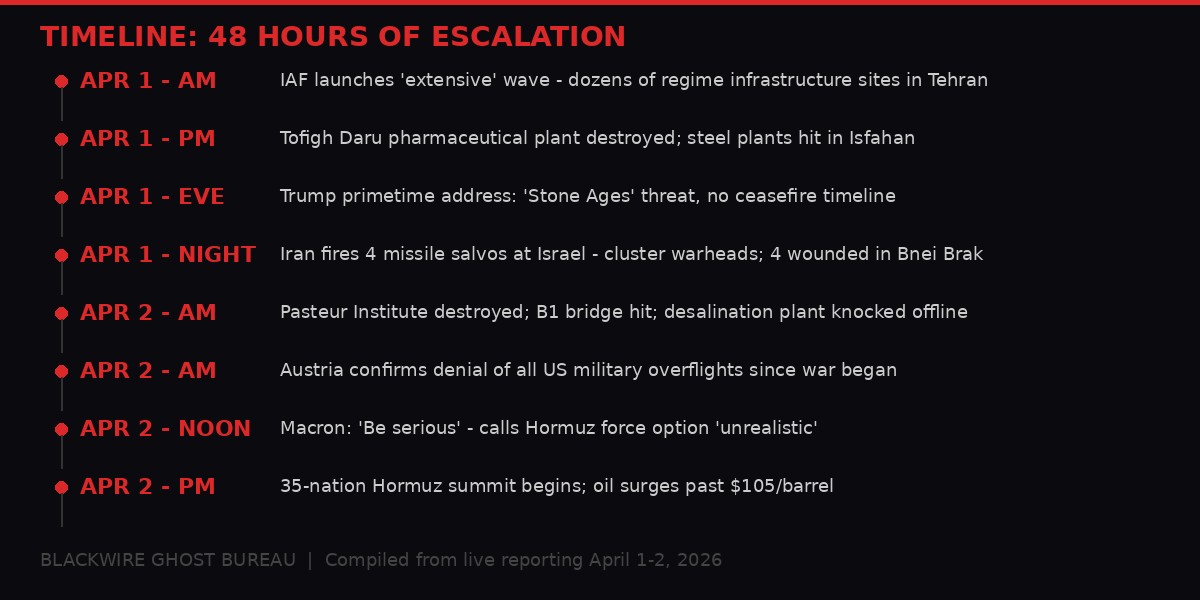
48 hours of escalation: from expanded airstrikes to the Pasteur Institute's destruction. Infographic: BLACKWIRE
More than 2,000 Iranians have been killed in 34 days. That number comes from Al Jazeera's tracking, and it almost certainly undercounts. Thousands more are wounded. Thousands of civilian sites have been struck - "including hospitals, schools, universities and pharmaceutical factories," as Al Jazeera cataloged in its Day 33 summary. The targeting of civilian sites is considered a war crime under international humanitarian law. No investigation has been announced. No accountability mechanism exists.
In Lebanon, the death toll from Israeli operations since March 2 exceeds 1,200, with 1.2 million displaced. In Israel, Iranian and Hezbollah attacks have wounded hundreds and killed dozens over the same period, though the Israeli government has not released a comprehensive casualty figure. In the Gulf states - Kuwait, Bahrain, Saudi Arabia, Qatar, the UAE - Iranian missile and drone attacks have caused an unknown number of casualties, infrastructure damage, and mass disruption to civilian life.
The secondary deaths - those caused by disrupted medical supply chains, water shortages from destroyed desalination plants, economic collapse, and the psychological toll of sustained bombardment - are not being counted at all. They won't be for months or years. When the Tofigh Daru pharmaceutical plant's research and development wing was destroyed, the immediate casualty count was low. The long-term casualty count - people who will die because medications they needed are no longer produced domestically, and cannot be imported through a blockaded strait - is unknowable but real.
This is what "Stone Ages" means in practice. Not the absence of military capability. The absence of the civilian systems that prevent mass suffering - clean water, medicines, electricity, functional roads, working hospitals. The destruction of the Pasteur Institute does not degrade Iran's ability to fire ballistic missiles at Israel. It degrades Iran's ability to track infectious disease outbreaks, produce vaccines, and protect the health of 88 million people. That is the calculation. That is the war being waged on Day 34.
What Comes Next
Trump promised two to three more weeks of "extremely hard" strikes. Iran's military promised to fight until the "enemies surrender." Macron said a forced opening of Hormuz was unrealistic. Oil is above $105. Gas in America is above $4. NATO is fractured along clean lines - those who refuse access entirely (Austria, Spain), those who restrict it (France, Italy), and those trying to mediate (the UK, hosting its 35-nation summit). Germany is coordinating with China on freedom of navigation. Australia is warning its citizens to prepare for hard months ahead.
The 35-nation Hormuz summit will produce statements. It will not produce a solution, because no solution exists that does not require Iran's cooperation, and Iran is currently being bombed. The contradiction at the heart of this war - demanding Iranian concessions while systematically destroying Iranian society - has not been resolved in 34 days and will not be resolved in the next 14-21 days that Trump has promised.
The Pasteur Institute took 106 years to build. It took one strike to destroy. Khuzestan Steel will take six months to a year to restart - if reconstruction begins the day bombing stops, which it won't. The B1 bridge, the desalination plant on Qeshm, the Tofigh Daru pharmaceutical complex, the Shahid Haqqani passenger pier - each represents years of construction, billions in investment, and irreplaceable capacity that will not return on any timeline Trump has mentioned.
"Stone Ages" was a threat. On Day 34, it is becoming a description.
Timeline: 48 Hours of Escalation (April 1-2, 2026)
Israeli Air Force launches "extensive" wave of strikes across Tehran. Dozens of regime infrastructure sites targeted. Mehrabad International Airport hit.
Tofigh Daru pharmaceutical plant destroyed in Tehran. Steel plants hit in Isfahan and Ahvaz. Passenger pier bombed in Bandar Abbas.
Trump delivers 19-minute primetime address. Threatens "Stone Ages." Promises 2-3 weeks of intensified bombing. No ceasefire timeline offered.
Iran fires four missile salvos at Israel, some with cluster warheads. Four wounded in Bnei Brak including two babies. Hezbollah launches 50+ rockets at northern Israel.
Pasteur Institute of Iran destroyed. Health Ministry calls it "assault on international health security." Desalination plant on Qeshm Island knocked offline.
B1 highway bridge (Tehran-Karaj) struck. Fars news reports casualties. Austria confirms it has denied all US military overflights since war began.
Macron delivers "be serious" rebuke from Seoul. Calls Hormuz force option "unrealistic." Says Trump is hollowing out NATO with daily doubt.
35-nation Hormuz summit convenes. Oil surges past $105/barrel. Germany and China issue joint call for freedom of navigation. Iran's army chief ordered to prepare for "any attack."
Get BLACKWIRE reports first.
Breaking news, investigations, and analysis - straight to your phone.
Join @blackwirenews on Telegram