25 Days Left: The War Powers Clock, the $200 Billion Bill, and America's Unfinished Iran War
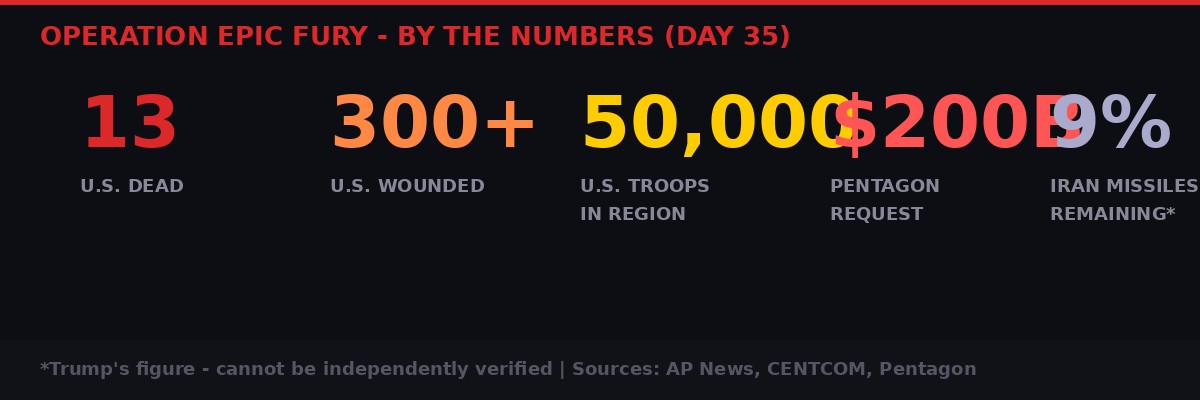
One month in. Thirteen dead. Three hundred wounded. A $200 billion bill nobody wants to pay. Pakistan brokering peace talks Iran says don't exist. A constitutional clock ticking down 25 days before Trump either needs Congress or must stop. And today - the Houthis opened a second front. This is not a war winding down.

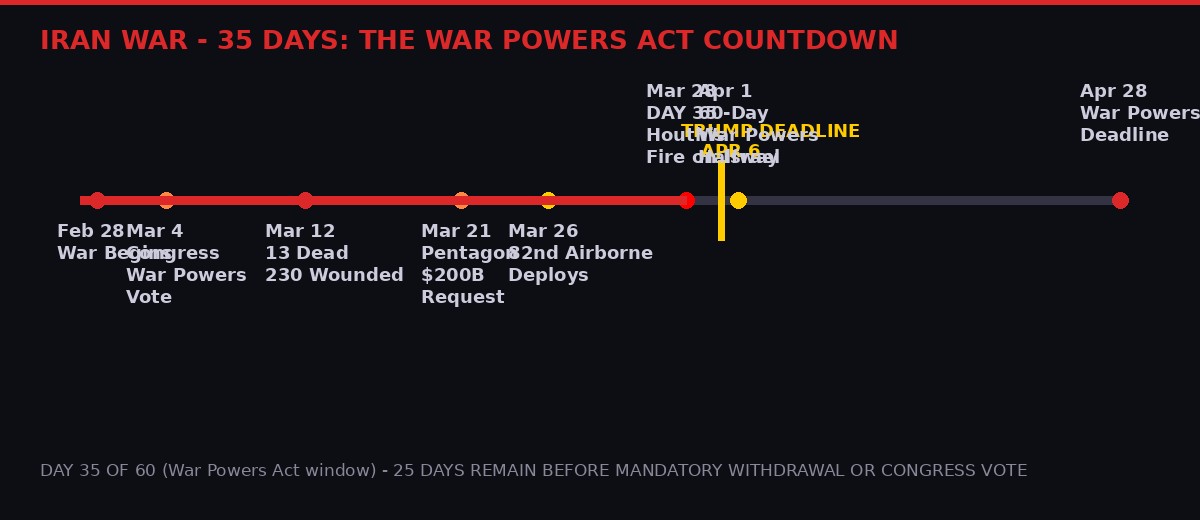
The Iran war turned one month old on Saturday. The administration celebrated the milestone by not celebrating it at all - the White House put out no statement marking the anniversary, no press conference, no updated casualty figures. What it did put out was a second extension of Trump's deadline for Iran to reopen the Strait of Hormuz, now set for April 6. The first deadline came and went on March 23. The second slipped to March 28. Now it's April 6.
Meanwhile, at a Saudi air base 96 kilometers from Riyadh, Iranian missiles and drones struck three times in one week. At least 15 Americans were wounded in Friday's attack alone. Five were serious. The Pentagon did not respond to requests for comment on the latest figures when contacted by AP.
The war that Trump said would be over quickly - the one House Speaker Mike Johnson said was "all but done" - is entering its fifth week with no exit in sight, no congressional authorization, and a constitutional clock that started ticking on February 28 and will run out on April 28.
The Clock: What the War Powers Act Actually Says

The War Powers Resolution of 1973 gives the president 60 days to conduct military operations without congressional authorization. The clock started the day the first bombs fell - February 28, 2026. That puts the hard legal deadline at April 28.
Today is Day 35. Twenty-five days remain.
Under the law, if Congress does not authorize the war within that window, the president must begin withdrawing forces within 30 days. No president has ever been forced to comply with this provision - courts have consistently declined to referee the standoff between branches. But the political damage of running out the clock without a plan is real, and Republicans on Capitol Hill are beginning to say so out loud.
"When you get into the 45-day mark, you've got to start articulating one of two things - an authorization for the use of military force to sustain it beyond that or a very clear path on exit." - Sen. Thom Tillis (R-NC), quoted by Associated Press, March 20, 2026
The 45-day mark arrives April 13 - two weeks away. The administration has not submitted a formal request for an Authorization for Use of Military Force (AUMF). It has not publicly acknowledged the War Powers clock at all.
What it has done is request $200 billion from Congress to keep fighting.
The Pentagon sent that request to the White House earlier this month. Defense Secretary Pete Hegseth confirmed the administration was "going back to Congress" for funds when pressed at a press briefing, though he declined to confirm the $200 billion figure directly. "It takes money to kill bad guys," he said.
That number represents roughly one-quarter of the entire Pentagon annual budget, on top of $150 billion already allocated through Trump's tax cuts bill. The nation's debt has surpassed $39 trillion. Democrats called the request "outrageous." Some Republicans called it necessary. Nobody has a timeline for when it might pass - or whether it can.
What Congress Actually Knows - Which Isn't Much
Rep. Chip Roy (R-TX), a House Budget Committee member and Freedom Caucus member who says he supports "blowing some crap up," described the administration's congressional briefings to AP reporters as revealing only information "you read in the papers."
He is not alone in that frustration. Multiple Republicans and Democrats have described classified briefings on the Iran war as thin on strategic substance. The operating objectives have shifted at least four times in 35 days: topple the Islamic Republic, eliminate the nuclear program, degrade missile capabilities, reopen the strait. Now the stated goal appears to be simply getting Iran to the table before April 6.
"The real question is: What ultimately are we trying to accomplish?" - Sen. Thom Tillis (R-NC), AP interview, March 20, 2026
House Speaker Mike Johnson, despite claiming the mission was "all but done," acknowledged that Iran's ability to threaten Hormuz shipping was "dragging it out a little bit." He said the operation would be over "as soon as we bring some calm to the situation" - a statement that could describe weeks, months, or years of conflict depending on how "calm" is defined.
Sen. Mark Warner (D-VA), the top Democrat on the Senate Intelligence Committee, was blunter: "Regime change? Not likely. Get rid of the enriched uranium? Not without boots on the ground."
Warner's assessment reflects a quiet consensus among defense and intelligence analysts: the military campaign has achieved some objectives - Iran's navy is largely destroyed, many senior IRGC commanders are dead, nuclear facilities have been struck - but the strategic goal of reopening the Strait of Hormuz without occupying Iran is proving elusive. Iran doesn't need its navy to keep the strait closed. It needs only missiles, drones, and the threat of using them.
The Insurgent Strategy: How Iran Is Winning By Not Losing

The AP's analysis published Saturday, the product of reporting from across the Gulf region by correspondent Jon Gambrell, frames Iran's approach with clinical precision: Tehran is fighting like an insurgency, not a nation-state. The goal is not to defeat America militarily. The goal is to survive long enough to claim victory.
"The Islamic Republic understands that it cannot defeat the United States militarily," wrote Shukriya Bradost, a Mideast security analyst, in a widely cited paper this week. "Instead, its objective is both simpler and more strategic: Survive the war long enough to claim victory."
The tactics are familiar from two decades of asymmetric warfare in the region. Mobile missile launchers - disguised as commercial trucks - move continuously to evade targeting. Underground bases, built over decades and hardened against all but the largest bunker-busters, shelter remaining capabilities. Shoot-and-scoot tactics, borrowed from the Houthi playbook Iran itself helped write, keep launch windows short and targeting windows tight.
Trump said Thursday that approximately 9% of Iran's original missile arsenal remains. No independent verification of that figure is possible. What is independently verifiable: Iran struck a Saudi air base hosting U.S. troops three times in one week using that supposedly depleted arsenal. Six ballistic missiles and 29 drones in Friday's attack alone.
The geography compounds the problem. Iran is roughly the size of Alaska, mountainous, and features terrain that provides natural concealment for exactly the kind of dispersed, mobile force Iran has been building since the 1980s. Every analyst who predicted the air campaign would rapidly degrade Iran's strike capability was measuring a conventional military, not the one Iran actually built.
Iran's economy - long sanctioned and therefore long insulated from global market interdependence - is largely unaffected by the economic warfare inflicted on the rest of the world through Hormuz. The country that suffers most from high oil prices is not Iran. It is the United States, whose president is simultaneously fighting a war and promising voters he will lower the cost of living before November midterms.
Pakistan, Talks, and the Art of the Non-Deal

Pakistan's top diplomat, Foreign Minister Ishaq Dar, publicly confirmed this week that indirect talks between the United States and Iran are ongoing, with Islamabad serving as the go-between. It was the first time Pakistan acknowledged its mediating role publicly, after weeks of diplomatic back-channeling that had been reported but never officially confirmed.
Iran denies any such negotiations are happening. Iranian state television's English-language broadcaster Press TV has published Tehran's counter-proposal: a five-point plan that includes reparations and formal recognition of Iranian sovereignty over the Strait of Hormuz. That last demand - sovereignty recognition - is categorically unacceptable to Washington and effectively kills any short-term deal before it starts.
Trump, meanwhile, says Iran is "begging" for a deal. "They better get serious soon, before it is too late," he wrote on Truth Social Thursday, "because once that happens, there is NO TURNING BACK, and it won't be pretty!"
The same day, the Eurasia Group risk advisory noted that Trump "continues to prefer 'escalate to de-escalate'" and that additional U.S. forces deploying to the region suggest preparation for mid-April military escalation rather than imminent negotiations.
Pakistan's interest in mediation is straightforward: the country shares a border with Iran, is acutely vulnerable to regional energy disruption, and sees an opportunity to position itself as a useful American partner at a moment when traditional U.S. allies - France, Germany, most of NATO - have refused to participate in the war. Pakistan also sits on Trump's "Board of Peace," an advisory initiative that grew from the Gaza ceasefire framework.
The Soufan Center, a New York-based security think tank, published a blunt assessment Friday: "Washington seems to believe that an overwhelming display of military power will force the Iranians to the negotiating table. But the U.S. can't expect to gain in peace what it was not able to take in war."
The core problem: any ceasefire deal requires someone with authority to sign it. Iran's new supreme leader, Mojtaba Khamenei - appointed after his father Ali Khamenei was killed in the early days of the war - has not been seen publicly since being named. U.S. officials say he has been wounded. The Revolutionary Guard appears to be operating without centralized command. A deal requires a counterpart. Right now, the counterpart is unclear.
The Houthis Open the Second Front

For exactly one month, the Houthis watched. They were Iran's most durable proxy - the group that successfully disrupted global Red Sea shipping for more than a year before Trump struck a deal to halt their attacks in early 2025. When the U.S. and Israel launched Operation Epic Fury on February 28, the Houthis did not immediately respond. They waited.
On Saturday, they stopped waiting.
Houthi military spokesman Brig. Gen. Yahya Saree announced that Yemen's Houthi forces had fired a "barrage of missiles" at "sensitive Israeli military sites" in southern Israel. The Israeli military confirmed it intercepted a missile fired from Yemen. Israeli military spokesperson Brig. Gen. Effie Defrin's response was terse: "We are preparing for a multifront war."
The strategic implications are severe. Since Iran sealed the Strait of Hormuz in the opening days of the conflict, Saudi Arabia has been routing oil exports through Bab al-Mandeb - the 32-kilometer-wide passage at the southern tip of the Arabian Peninsula. That strait sits squarely in Houthi firing range. If the Houthis resume their Red Sea shipping campaign as a full second front, Saudi Arabia loses its backup export route. The world's last major oil escape valve closes.
Bab al-Mandeb is the gateway to the Suez Canal. Approximately 12% of global trade flows through Suez, including oil, LNG, grain, electronics, and consumer goods. The Houthis already demonstrated in 2023-2025 that they can make ships afraid to use this corridor without the resources of a nation-state. Armed with Iran's sustained backing and likely freshly supplied before the war began, their capability in 2026 is significantly greater than it was then.
"If we see more pressure on the Iranians, or there's any escalation, the Houthis will jump in harshly." - Ahmed Nagi, senior Yemen analyst, International Crisis Group, quoted by AP
For Europe, the implications are particularly acute. European nations depend on LNG tankers transiting Suez for roughly 40% of their natural gas supply. The continent has spent three years restructuring its energy systems after Russia cut gas flows in 2022-2023. A sustained Houthi Red Sea campaign, combined with the existing Hormuz blockade, would cut off both the Atlantic and Pacific routes through the Indian Ocean, creating a dual-chokepoint energy siege with no short-term solution.
The U.S. military has been here before. From late 2023 through early 2025, Operation Prosperity Guardian attempted to protect Red Sea shipping from Houthi attack. It required a sustained carrier presence and near-daily strike missions against Yemen. The Houthis absorbed it all and kept shooting. After 18 months, Trump negotiated a ceasefire - not a military defeat of the Houthis. The group's infrastructure is intact. Its will is unchanged.
Who Is Actually in Charge: The Leadership Vacuum in Tehran
Mojtaba Khamenei was named Iran's supreme leader after his father was killed on approximately Day 8 of the war. He has not been seen or heard from publicly since. U.S. officials, speaking on background to AP and other outlets, say he has been wounded - though the specifics remain classified. Iran's state media has issued statements attributed to him, but their authenticity cannot be independently verified.
The political vacuum this creates complicates everything. Any ceasefire deal that doesn't have the blessing of both Mojtaba Khamenei and the Revolutionary Guard's hard-liner faction is a deal that could fracture Iran's political structure. The Guard, which controls Iran's missile arsenal, its proxy networks, and its economic interests in the strait toll system, has its own institutional interests that may not align with any deal Trump would accept.
According to Lloyd's List Intelligence, the IRGC has established a systematic "geopolitical vetting" process for ships seeking to transit Hormuz - checking cargo, origin, ownership, and in some cases charging fees. This is not a wartime improvisation. This is a revenue system. The Guard is earning money from the blockade. That creates an institutional interest in maintaining it.
IRGC official Rahim Nade-Ali confirmed this week that Iran has begun recruiting children as young as 12 for the Basij paramilitary force - framed publicly as "responding to popular demand," acknowledged privately as filling depleted ranks. The Basij, which carried out the bloody crackdown on protesters in January that killed thousands, remains active despite repeated targeting. Social media footage shows armed Basij fighters roaming Tehran streets, playing propaganda from loudspeakers.
The combination - a wounded or absent supreme leader, a Revolutionary Guard with financial interests in the blockade, a Basij using children to fill its ranks - is not a picture of a government ready to negotiate. It is a picture of a government that has decided the costs of continuing are lower than the costs of capitulation.
The Domestic Reckoning: What This Is Costing Americans

The political pressure Trump faces is economic before it is strategic. He campaigned on lower prices. He is delivering higher ones.
The Strait of Hormuz once carried roughly one-fifth of all globally traded oil. Its closure - effective since approximately Day 5 of the war - has pushed oil prices to levels not seen since the 2022 Russian invasion of Ukraine. The price of oil is embedded in the cost of nearly everything: fertilizer, manufacturing inputs, transport, plastics, food packaging. The oil shock is inflating a broad basket of consumer goods at a time when Trump had promised to cut costs.
An AP-NORC poll released this week found that 63% of Republicans support the air campaign against Iranian military targets. But only 20% support deploying American ground troops. That 43-point gap is the political minefield Trump is now navigating. He has said there will be no ground troops in Iran. He has also said he will not rule anything out. Both statements are simultaneously true to Trump. They are not simultaneously reassuring to voters.
Sen. John Kennedy (R-LA) articulated the tension plainly: "Most of my people are also equally or even more so concerned about cost of living."
U.S. stocks closed out their worst week since the war began on Friday. Markets are not reassured by Trump's "escalate to de-escalate" posture - they are priced for a war that lasts months, not weeks. If the April 6 deadline passes without a deal and the U.S. begins bombing Iranian power plants as threatened, analysts project another significant oil price jump and a further equity selloff.
Iran's strategy is working because it doesn't require Iran to win - only to not lose. The Strait of Hormuz and the Houthi threat to Bab al-Mandeb are economic weapons that function independently of military defeat. As long as both chokepoints remain under threat, the war's cost flows to every economy on earth - which is precisely the political pressure Iran wants to apply to Trump's domestic base. The 25-day War Powers clock is a secondary pressure point: Congress can't force Trump to stop, but the optics of a constitutionally unauthorized war entering its third month with 300+ casualties and a $200B price tag create space for Republican defections that didn't exist three weeks ago.
Timeline: 35 Days of Operation Epic Fury
The Math That Doesn't Work

The Eurasia Group published a concise summary of America's strategic position Thursday: the U.S. has achieved most of its initial military objectives - Iran's navy is destroyed, its air defenses are at their weakest point in decades, its missile manufacturing has been heavily degraded. And none of it has opened the Strait of Hormuz.
The reason comes back to insurgent math. Iran doesn't need a navy to close the strait. It needs missiles and drones, which it has in dispersed, mobile form across a country the size of Alaska. To actually force the strait open would require either a ceasefire - which Iran is denying it is negotiating - or a ground operation to physically clear Iran's missile infrastructure, which Trump has said he won't do and which Republicans say would be a red line not to cross.
The $200 billion request reflects the Pentagon's assessment that the war will last significantly longer than publicly stated. The Defense Department's current annual budget is over $800 billion. A $200 billion supplemental - equivalent to 25% of the entire defense budget - is not a request premised on a war ending in weeks. It is a request premised on a war lasting through the year, possibly longer.
Rep. Betty McCollum (D-MN), the ranking Democrat on the House Appropriations defense subcommittee, has explicitly refused to authorize funds without full transparency on objectives. "I'm not writing blank checks to the Department of Defense," she said. Senate Democratic leader Chuck Schumer called the $200 billion request "preposterous." Conservative fiscal hawks within the Republican caucus are quietly unenthusiastic.
The bipartisan math on the supplemental is difficult. Without Democratic votes, Republicans would need to use budget reconciliation - a slow, painful process that risks other legislative priorities. With Democratic votes, the price of cooperation is likely to be conditions on war conduct that the administration doesn't want to accept.
Trump said the $200 billion request was partly for "other reasons beyond Iran" - an acknowledgment that the Pentagon is using the war supplemental to fund broader military modernization that can't get through normal appropriations. Congress has noted this. Nobody is happy about it.
What Happens If April 6 Passes Without a Deal
Trump's April 6 deadline carries the most concrete threat he has issued since the war began: if Iran does not reopen the Strait of Hormuz, the U.S. will begin targeting Iranian power plants and electrical grid infrastructure. This is a fundamentally different category of strike from attacks on military facilities. Civilian electrical infrastructure - hospitals, water treatment, heating systems - would go dark.
Iran has publicly stated that any attack on its power grid would trigger retaliatory strikes against Gulf energy infrastructure - specifically oil production and export facilities in Saudi Arabia, the UAE, and Kuwait. Saudi Arabia's Aramco facilities produce approximately 10% of global oil supply. The UAE's export terminals handle another 3-4%. A sustained Iranian campaign against Gulf infrastructure, using the same dispersed missile and drone tactics that have already kept Hormuz closed and struck Saudi bases three times in a week, would push oil prices into territory not seen since the 1970s oil shocks.
This is the escalation trap. Every step upward by the U.S. carries a cost that falls primarily on the global economy, not on Iran. Iran's economy - already sanctioned, already adapted to isolation - can absorb domestic economic pain at a scale its adversaries cannot politically absorb for their own populations.
The Soufan Center analysis put it plainly: "The U.S. can't expect to gain in peace what it was not able to take in war." The military campaign has been punishing. It has not been decisive. And there are 25 days left on the constitutional clock before the political costs inside Washington begin to compound on top of the economic costs outside it.
One month in. This is not a war winding down. This is a war searching for an exit that nobody has drawn on a map yet.
Get BLACKWIRE reports first.
Breaking news, investigations, and analysis - straight to your phone.
Join @blackwirenews on Telegram