No Fertilizer, No Harvest: How the Iran War Is Breaking the World's Food Supply
Oil prices get the headlines. But the deeper catastrophe from Iran's Strait of Hormuz chokehold is arriving quietly, in empty warehouse bays and delayed shipments of urea, phosphate, and ammonia. The planting season is now. The fertilizer is not here. And the harvest clock is already ticking.
It has been 27 days since the United States and Israel struck Iran and the first missiles fell on Persian Gulf infrastructure. Since then, global energy markets have absorbed the headline shock - oil above $100 per barrel, gasoline at record highs in Australia, Germany, and the United States. But a quieter, slower catastrophe is now accelerating in fields across six continents.
The world's most critical fertilizer shipping lane has been cut off at exactly the wrong moment: Northern Hemisphere planting season, which runs March through May. Farmers who have not pre-ordered and already paid for their fertilizer may simply not be able to obtain it at any price, according to the American Farm Bureau Federation. Some won't plant at full capacity. Others won't plant at all.
The consequences - lower yields, crop failures, food price inflation - will not show up immediately. They will appear in late summer and fall, when harvests come in short. By then, the war may still be ongoing. The food crisis will be real regardless of whether a ceasefire is reached.
The Toll Booth That Choked Global Trade
The numbers from Lloyd's List Intelligence are unambiguous. Traffic through the Strait of Hormuz - normally the passage for about 150 to 200 vessels per day - has fallen by 90% since the war began on February 28. (AP News, March 27)
Iran's Islamic Revolutionary Guard Corps has formalized what shipping analysts are now calling a "toll booth" regime. Vessels wishing to transit must submit cargo details, crew lists, ownership information, and destination data to IRGC-approved intermediaries. Approved ships receive a code and are escorted by IRGC vessels. At least two ships have paid direct passage fees, settled in Chinese yuan. Iran's parliament is working on legislation to codify the system permanently.
"Iran's IRGC has imposed a de facto 'toll booth' regime in the Strait of Hormuz. While not all ships are paying a direct toll, at least two vessels have and the payment is settled in yuan." - Lloyd's List Intelligence, March 2026
The implications extend far beyond oil. The Persian Gulf region accounts for approximately one-third of global fertilizer trade, according to the United Nations Conference on Trade and Development. That one-third is now largely blocked. Countries including Saudi Arabia, Qatar, and the UAE - all of which route exports through or near the Hormuz corridor - have seen their fertilizer export capacity dramatically curtailed.
About 18 ships have been hit since the war began, and at least seven crew members have been killed, according to the International Maritime Organization. Even vessels not directly attacked are deterred: approximately half of ships that attempt transit now turn off their radio identification systems before entry, reappearing on the other side in the Gulf of Oman as if they vanished and materialized.
Planting Season Without Nitrogen
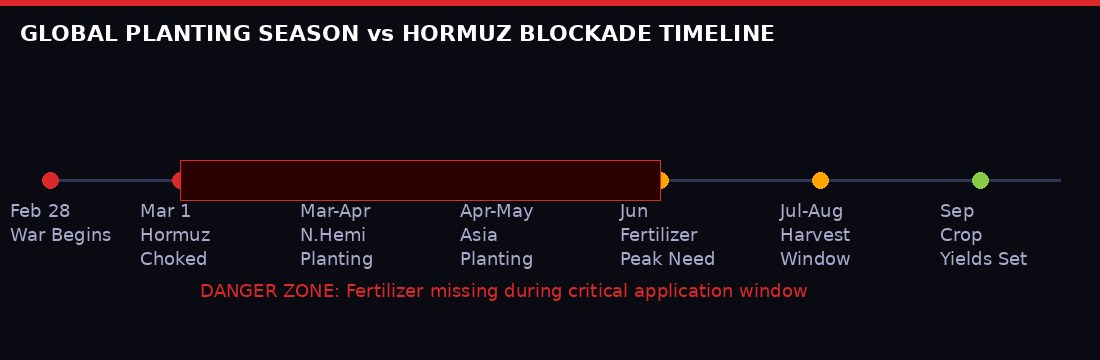
March and April are when Northern Hemisphere farmers apply nitrogen fertilizer to fields. The chemistry is non-negotiable: nitrogen-based compounds, primarily urea, must reach plant root zones before and during early growth stages. A delay of even two to three weeks can reduce corn and wheat yields by 10 to 20 percent. A complete miss of the application window means the yield loss is locked in for the entire growing season.
This is not a problem that can be fixed later. "Our crops out in the field need nitrogen now - the sooner the better - so they can get off to a good start," said Dirk Peters, an agricultural engineer farming outside Berlin, in an interview with AP. "Helping them establish themselves and build up reserves for the harvest later this summer." (AP News)
The United Nations World Food Program has confirmed the severity. "In the worst case, this means lower yields and crop failures next season. In the best case, higher input costs will be included in food prices next year," said Carl Skau, WFP Deputy Executive Director. (AP News)
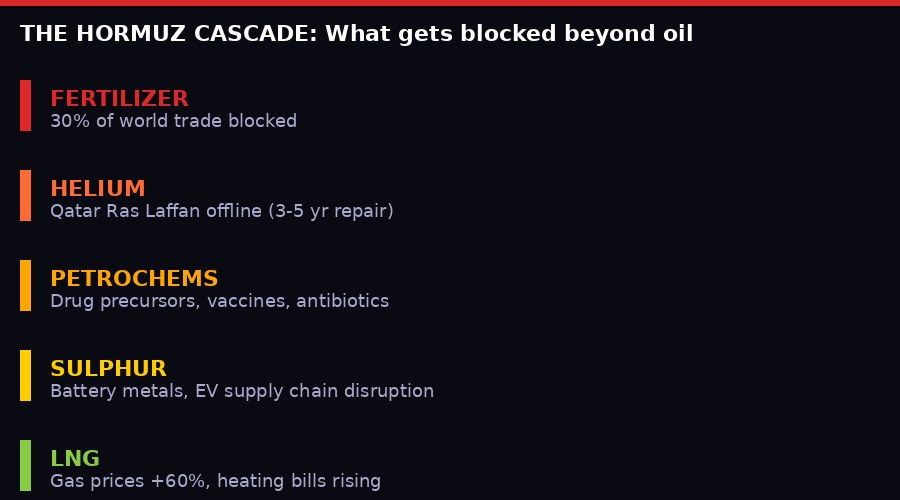
The blockade has specifically throttled nitrogen-based fertilizers - urea and ammonia - which are produced in enormous quantities in the Gulf using locally produced liquefied natural gas as a feedstock. With LNG production disrupted and exports blocked, Chris Lawson of CRU Group, a London-based commodities consultancy, estimates the conflict has restricted approximately 30% of global urea trade.
Phosphate fertilizer, which supports root development, is also under pressure. Saudi Arabia produces roughly one-fifth of the world's phosphate fertilizer. The region also exports more than 40% of global sulfur, a key phosphate ingredient. Both streams have been largely cut off.
American Farmers: $100,000 More and No Guarantee
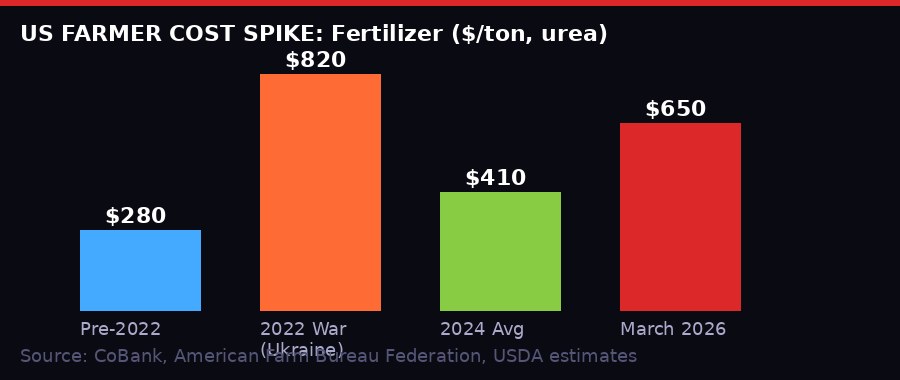
Todd Littleton, a third-generation farmer in Gibson County, Tennessee, expects to pay $100,000 more for fertilizer this season compared to last year - a 40% spike. He grows corn, soybeans, and wheat. He has had two consecutive record-loss years. He is now "grabbing at straws."
"The problem is, is we're so strained financially coming into this issue. We have had a couple of record losses the last couple years, so everyone's kind of grabbing at straws anyway, and then to have input prices increase yet again, it just really couldn't happen at a worse time." - Todd Littleton, Tennessee farmer, via AP News
About 15% of fertilizer imports to the United States come from the Middle East, according to the American Farm Bureau Federation. Roughly half the global supply of urea originates in the region, along with 30% of ammonia. The supply chain disruption is already cascading: domestic distributors that buy on spot markets are competing with farmers who locked in contracts months ago, driving prices up further for those without pre-arranged supply.
The situation is more dire than the 2022 Ukraine war fertilizer shock, according to Jacqui Fatka, farm supply economist for creditor CoBank. In 2022, grain prices were simultaneously high, helping farmers absorb elevated input costs. This time, grain prices were not elevated coming in. Farmers are absorbing cost increases without a corresponding revenue cushion.
"We're being told that many of our farmers that haven't preordered their fertilizer and paid for it may not even obtain the fertilizer that they're going to need during the season," said Zippy Duvall, president of the American Farm Bureau Federation. "That's why this situation is so serious." (AP News)
Harry Ott, a South Carolina cotton, corn, and peanut farmer who leads the South Carolina Farm Bureau, confirmed that warehouse stockpiles are not sufficient to cover demand. "It is a really dire situation that our farmers are facing," Ott said.
Even if the war ended today, the structural lag is built in: shipping times from the Middle East to the US port system average 30 to 45 days. Pre-planting application windows close long before those deliveries could arrive. The 2026 harvest in corn and soybean country is already materially compromised.
The Developing World Cannot Wait
For farmers in developing economies, the calculation is existential. Ethiopia gets over 90% of its nitrogen fertilizer from Gulf producers through Djibouti - a supply route that was already fragile before the war began. Raj Patel, food systems economist at the University of Texas, put it plainly: "The planting season is now. The fertilizer isn't there." (AP News)
In India, smallholder farmers - the backbone of a country feeding 1.4 billion people - are waiting and hoping. The government has prioritized urea supplies for domestic use and subsidizes roughly 70% of fertilizer manufacturers' gas needs, but some plants are still running below capacity. Baldev Singh, a 55-year-old rice farmer in Punjab, said the government needs to subsidize fertilizer when demand peaks in June. "Right now, we are waiting and hoping," Singh told AP.
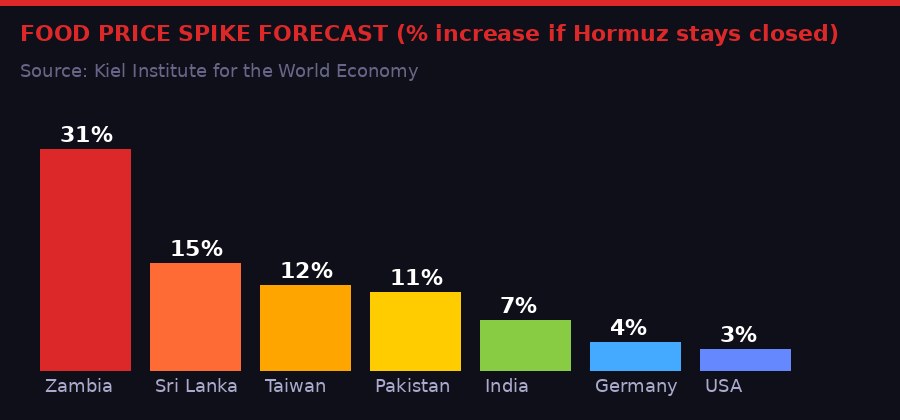
The Kiel Institute for the World Economy has modeled what a full Hormuz closure means for food prices globally. The findings are grim and specific: wheat prices up 4.2%, fruit and vegetable prices up 5.2%. But the most affected nations face far larger increases. Zambia faces a 31% food price spike. Sri Lanka, already economically devastated from a 2022 sovereign debt default, faces 15%. Taiwan, deeply dependent on Gulf imports, faces 12%. Pakistan faces 11%.
These are not abstract percentages. In countries where food already consumes 40 to 60% of household income, a 15 to 31% spike in food prices is a humanitarian catastrophe. The Kiel Institute researchers noted that "a relatively brief closure could disrupt an entire growing season, with food security consequences that persist long after the strait reopens." (BBC Verify)
Vladimir Putin's special envoy, Kirill Dmitriev, has already signaled Russia's awareness of its position in this chaos. Moscow, a major fertilizer and grain exporter, is "well positioned," Dmitriev said. Russia benefits from every day the Hormuz corridor remains disrupted. Its competitors - Saudi Arabia, Qatar, UAE - are blocked. Its goods can still reach markets. Putin does not need to fire a single shot in this particular food war.
Africa Rationing Power, Diluting Fuel
The war's first-order effect on Africa is energy, not food - but the two are inseparable. Without fuel, there is no irrigation, no mechanized planting, no cold chain for perishables, and no transport for whatever fertilizer does exist.
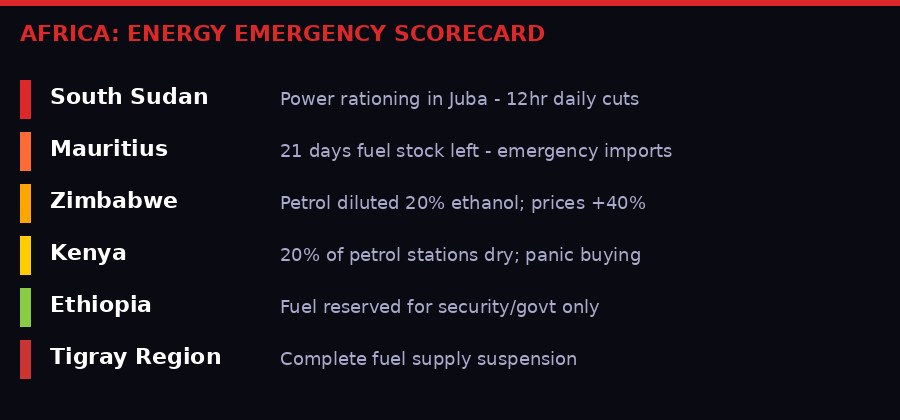
South Sudan has begun rationing electricity in Juba, with 12-hour daily power cuts on a rotational schedule. The country generates 96% of its electricity from oil, and nearly all the refined product it uses is imported. "This paralyses most businesses," said Ereneo Mogga, an electrical engineer in Juba, to BBC. "Power often goes off at 16:00 and doesn't come back until 04:00 the next day." (BBC)
Mauritius is in a more acute position. A scheduled oil shipment failed to arrive over the weekend. The island nation now has 21 days of fuel stock remaining. The government secured emergency supplies from Singapore due to arrive April 1, but at significantly higher cost. Energy Minister Patrick Assirvaden said on Monday that the island had no margin for error in subsequent shipments.
Zimbabwe has chosen a different strategy: chemistry. The government raised the ethanol content in petrol from 5% to 20% to stretch existing fuel supplies further. It also announced plans to eliminate some fuel import taxes after domestic petrol prices climbed 40% in under a month. In Harare, street vendor Nicole Mazarura sells soft drinks from a push cart. Her transport costs have doubled. She cannot raise her prices to compensate. "If transport costs go back to where they were, I can survive," she told BBC.
Kenya's energy ministry denies a fuel shortage exists, while simultaneously acknowledging that 20% of the country's petrol stations are running dry. Vivo Energy Kenya, which distributes Shell products, confirmed "temporary stock-outs" due to elevated demand. Ethiopia has formally ordered fuel companies to prioritize security forces, major government infrastructure projects, and essential goods manufacturing. Tigray - already one of the world's most food-insecure regions following years of civil war - has had fuel supplies suspended entirely.
Australia's crisis is further advanced. Prime Minister Anthony Albanese held an emergency press conference Friday morning, seeking to reassure Australians that supply remains "secure." The average retail petrol price reached 238 Australian cents per litre as of Sunday, up from 171 cents four weeks ago - a 39% spike. Diesel in Sydney hit 314.5 Australian cents per litre Thursday, a record high. Hundreds of petrol stations across the country have run out of at least one fuel type. Emergency national cabinet is set for Monday.
The Australian crisis was compounded Thursday when a cyclone in Western Australia knocked out two of the world's largest LNG facilities - Gorgon and Wheatstone, operated by Chevron, together supplying roughly 5% of global LNG. The timing could not be worse. (BBC)
The Hidden Crises: Helium, Chips, and Medicines
Most coverage of the Hormuz crisis focuses on oil. But BBC Verify's analysis identifies four additional critical supply chains that are simultaneously disrupted, each with severe downstream consequences.
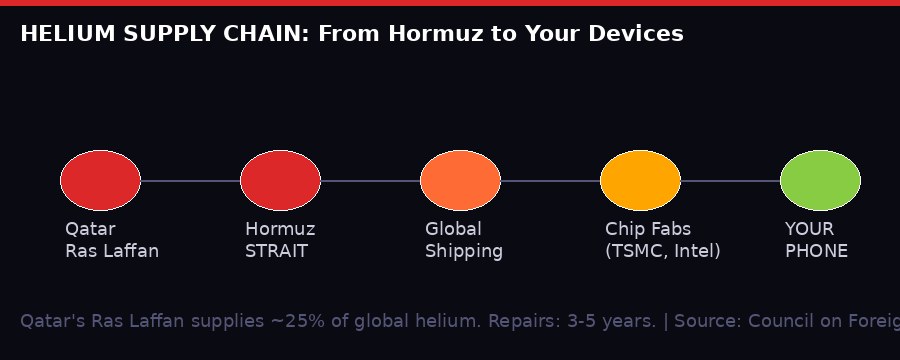
Helium is the quietest catastrophe. Qatar's Ras Laffan facility - which produces approximately 25% of global helium supply as a byproduct of natural gas processing - was struck by Iranian missiles early in the conflict. The Qatari government has warned that repairs will take three to five years. Helium is not merely a party balloon gas. It is the cooling medium for superconducting magnets in MRI machines. It is essential for semiconductor wafer manufacturing. TSMC, Intel, Samsung Foundry, and virtually every other major chip fab rely on helium in their processes.
"MRI machines require somewhere between 1,500 to 2,000 liters of helium to cool the magnets. People like to think helium's predominant use is in data centers, semiconductors and cooling for the AI and data industry. But we can't forget that helium is quite important for MRIs and for other medical users." - Prashant Yadav, Council on Foreign Relations, via BBC Verify
Bloomberg analysis has warned of knock-on impacts for a host of cutting-edge technologies, from smartphones to data centers, as helium supplies tighten over the next 6 to 18 months. The semiconductor industry cannot easily substitute alternatives. Helium's physical properties - non-reactive, extremely low boiling point, the second-lightest element - are not replicable with any other gas. Some chip production processes would have to be redesigned from scratch to operate without it.
Petrochemicals are the second invisible crisis. Methanol and ethylene, derived from oil and gas and produced in large quantities by Gulf nations, are vital precursors to pharmaceuticals. Painkillers, antibiotics, vaccines - many require petrochemical-derived inputs in their manufacturing processes. Gulf nations route approximately half of these exports to Asian markets through Hormuz. Those shipments have largely stopped.
Sulfur - the third disrupted commodity - is a byproduct of oil and gas refining, and the Gulf produces more than 40% of global sulfur supply. Sulfur is used to make sulfuric acid, which processes copper, cobalt, nickel, and lithium. Every battery in the world - from laptop batteries to the giant cells in electric vehicles to military drone power packs - requires these metals in quantities that sulfuric acid helps extract. Supply constraints on sulfur will cascade into battery metal prices, battery manufacturing costs, and ultimately the price of every device that runs on stored electricity.
After the War: No Quick Recovery
Assume a ceasefire is announced tomorrow. The food and fertilizer crisis does not end.
Before Gulf producers resume full fertilizer exports, they will require security guarantees - formal or informal assurances that IRGC vessels will not target their tankers. Negotiating those guarantees takes time. Rebuilding insurance frameworks for Gulf shipping routes, which have been upended by active attacks on commercial vessels, takes longer. Even after trade resumes, global warehouse stocks will need to be rebuilt from depleted levels.
Owen Gooch, an analyst with Argus Consulting Services in London, said: "Even after the war ends, producers in the Gulf would need clear security guarantees before resuming shipments through the strait, and insurance costs would almost certainly rise." The price signals from this disruption will persist in food markets well into 2027.
The structural lag in shipping compounds the problem. A fertilizer shipment leaving a Gulf port today would take 30 to 45 days to reach US ports. It would take 20 to 35 days to reach Southeast Asia. For a crop that needs nitrogen applied in late March, a shipment that departs after a March 27 ceasefire still arrives too late for the 2026 harvest. The yield damage is already locked in.
Jacqui Fatka of CoBank, who has tracked fertilizer markets through multiple disruption cycles, offered little comfort to farmers hoping for a rapid rebound: "There's going to be a tail to this that's going to take time to get everything turned back on, sent back out." Previous supply shocks - the 2022 Ukraine war, the 2021 COVID-era disruptions - showed that fertilizer market normalizations typically take 12 to 18 months even in the best scenarios.
The Kiel Institute's research was blunt about the asymmetry between the shock's origin and its victims. The countries that contributed nothing to the Iran war, that have no stake in the outcome, and that have no leverage over any of the parties - Zambia, Sri Lanka, Pakistan, small island nations across the Pacific and Indian Ocean - face the largest food price spikes as a percentage of household income. The war's authors face small increases. The bystanders face crises.
WHAT HAPPENS NEXT
- Late summer 2026: Northern Hemisphere harvests come in below estimates. Corn and wheat shortfalls become measurable.
- Q3-Q4 2026: Global food price indices climb. UN food security warnings escalate in sub-Saharan Africa and South Asia.
- 2026-2027: Helium shortage begins biting semiconductor fab capacity. Chip prices firm. Electronics production timelines lengthen.
- 2027: Battery metal prices spike as sulfur supply constraints work through the mining and processing pipeline.
- Regardless of ceasefire timing: Fertilizer prices stay elevated 12-18 months post-conflict due to insurance, stockpile rebuilds, and infrastructure repair.
Trump administration officials have described the Iran war as targeting Iranian nuclear and military capacity. They have not publicly addressed the fertilizer crisis, the food supply chain disruption, or the cascading impact on African and Asian economies. The White House press shop has fielded more questions about gas prices at the American pump than about crop yields in Ethiopia or fertilizer costs in Pakistan.
That framing - the war as a contained military operation with limited economic spillover - is colliding with reality in fields from Tennessee to Punjab. Todd Littleton in Gibson County, Tennessee, is not thinking about Iranian centrifuges. He is thinking about a $100,000 bill and whether his third-generation farm survives another record loss. His calculation is shared by tens of thousands of farmers across six continents, none of whom voted on whether the war should start.
The Strait of Hormuz runs 33 kilometers at its narrowest point. Through it flows 20% of the world's oil, one-third of its fertilizer trade, and a list of chemicals and gases that underpin the entire industrial food supply, the global semiconductor industry, and the pharmaceutical manufacturing chain. Iran is charging ships to pass. The world is paying - not at the toll booth, but at the grocery store, in the field, and in the harvest that will come up short when autumn arrives.
Get BLACKWIRE reports first.
Breaking news, investigations, and analysis - straight to your phone.
Join @blackwirenews on TelegramSources: AP News (Iran war fertilizer exports, March 27, 2026); AP News (US farmers fertilizer crisis, March 27, 2026); BBC Verify (Beyond oil: crucial Hormuz exports, March 27, 2026); BBC (Australia fuel crisis, March 27, 2026); BBC (Africa energy emergency scorecard, March 27, 2026); Lloyd's List Intelligence (Hormuz toll booth analysis, March 2026); Kiel Institute for the World Economy (Hormuz food price modeling); UN World Food Program (Carl Skau statement); Council on Foreign Relations (Prashant Yadav, helium/MRI analysis); American Farm Bureau Federation (Zippy Duvall statement); CoBank (Jacqui Fatka, fertilizer market analysis); CRU Group (Chris Lawson, urea trade estimates); Argus Consulting Services (Owen Gooch, Gulf shipping insurance analysis).