The Gulf Burns: Iran's Drone War Expands to Kuwait, Saudi Arabia and Bahrain as US Pilot Rescued from Enemy Terrain
Two US warplanes are down. A pilot was hunted through Iranian mountains for 36 hours before a rescue involving dozens of aircraft. Kuwait's power grid is cracked. Bahrain is on fire. Oracle's Dubai office has a hole in its wall. And in less than 18 hours, a Trump-imposed deadline expires - at which point, he says, "all Hell will reign down."

This is what the sixth week of the U.S.-Iran war looks like on the ground. Not the clean, decisive air supremacy the White House advertised. Not the "completely decimated" adversary Trump described from the podium on Wednesday. A degraded but operational Iranian military that is still shooting down American jets, still launching ballistic missile salvos at allied bases, still feeding drone swarms into a Gulf region that is now, unmistakably, a war zone.
The 48-hour clock Trump set ticking on Saturday is now down to hours. By Monday morning, April 6, Iran must reopen the Strait of Hormuz - the 33-kilometer chokepoint through which 20 percent of the world's oil supply normally flows - or face what the president called consequences that would open "the doors of hell." Iran's response, delivered by Gen. Ali Abdollahi Aliabadi of the joint military command: "The doors of hell will be opened to you" if Iranian infrastructure is struck. Neither side is blinking.
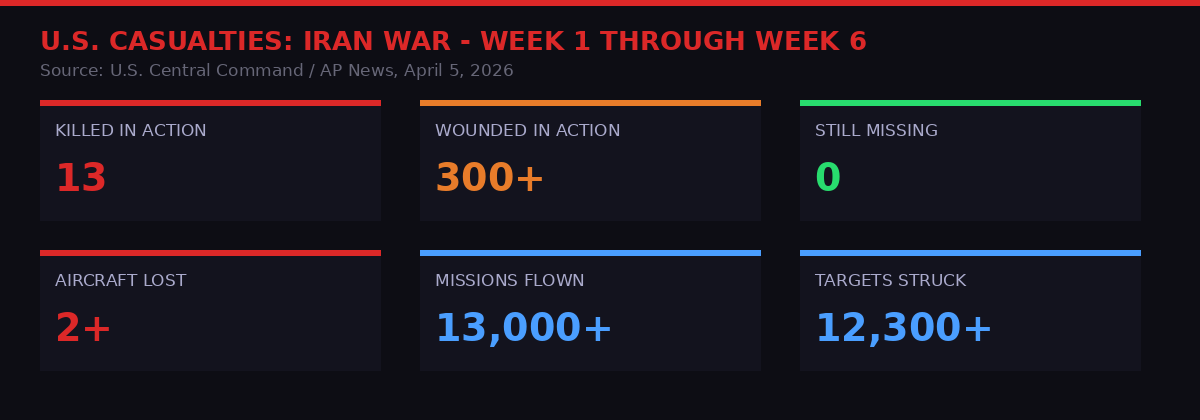
Source: U.S. Central Command / AP News, April 5, 2026
A Pilot Behind Enemy Lines: The 36-Hour Hunt

The F-15E Strike Eagle went down on Friday. One crew member was pulled out immediately. The second - rank and identity withheld by the Pentagon - vanished into the mountains of Kohgiluyeh and Boyer-Ahmad, a remote, heavily rugged province in southwestern Iran.
For the next 36 hours, two operations ran simultaneously in the same piece of terrain. American forces tracked the aviator's position around the clock, feeding coordinates to a rescue chain that, Trump said Sunday morning, ultimately involved "dozens of aircraft." Iranian forces fanned out through the same mountains following calls by state television for residents to report any "enemy pilot" to police, with a reward offered for turning over the downed American.
"This brave Warrior was behind enemy lines in the treacherous mountains of Iran, being hunted down by our enemies, who were getting closer and closer by the hour." - President Donald Trump, Truth Social post, April 5, 2026 (AP News)
Trump announced early Sunday that the pilot had been rescued. The aviator was described as injured but expected to recover. The second F-15E crew member had been pulled out earlier. The statement provided no operational details - no callsign, no unit, no specifics of the extraction that would give Iranian forces any intelligence value.
The rescue is genuine good news. But it does not change the underlying reality that surfaced the moment that jet went down: after 13,000 American combat missions and 12,300 targets struck since February 28, Iran's air defenses still work. (Source: U.S. Central Command via AP News)
The F-15E is one of the most sophisticated strike platforms in US inventory. Flying at low altitude to improve targeting precision - an operational adaptation to the environment - it became vulnerable to shoulder-fired or surface-to-air missiles, the latter far easier to conceal and nearly impossible to suppress completely in a country the size of Iran. "A disabled air defense system is not a destroyed air defense system," Behnam Ben Taleblu, Iran program senior director at the Foundation for Defense of Democracies, told AP. "We shouldn't be shocked that they're still fighting."
The other aircraft lost on Friday - a US A-10 Thunderbolt II attack aircraft - went down in the Persian Gulf after Iranian state media reported it was struck by Iranian defense forces. The status of its crew was not immediately confirmed. According to retired Air Force Brig. Gen. Houston Cantwell, a former F-16 fighter pilot and now senior resident fellow at the Mitchell Institute for Aerospace Studies, the last time a US warplane was brought down by enemy fire in combat was an A-10 over Baghdad on April 8, 2003. (Source: AP News)
"The fact that this hasn't happened until now is an absolute miracle. We're flying combat missions here, they are being shot at every day." - Retired Air Force Brig. Gen. Houston Cantwell, Mitchell Institute for Aerospace Studies (AP News)
The Gulf States Are Now a War Zone

The most significant tactical development of the past 48 hours is not the downed jets over Iran. It is the expanding geographic footprint of Iranian strikes - moving beyond Israel, beyond Lebanon, beyond the Saudi bases targeted repeatedly since week one. Iran is now hitting civilian and energy infrastructure across the Gulf with what appears to be coordinated multi-vector drone operations.
In Kuwait, the Ministry of Electricity confirmed that an Iranian drone attack caused "significant damage" to two power plants and took a water desalination station out of service. No injuries were reported, but the implications are not minor. Kuwait's freshwater supply depends heavily on desalination. A sustained campaign targeting desalination and power infrastructure is a different category of warfare - it threatens civilian survival, not just military operations. (Source: Kuwait Ministry of Electricity via AP News, April 5, 2026)
In Bahrain, the national oil company confirmed that a drone strike caused a fire at one of its storage facilities. The fire was extinguished. Damage was still being assessed at time of publication. No casualties were reported. But the message is clear: Bahrain, home to the US Navy's Fifth Fleet, is no longer outside the strike envelope. (Source: Bahrain National Oil Company via AP News, April 5, 2026)
In the UAE - specifically Dubai - the offices of Oracle Corporation were struck. The Dubai Media Office described a "minor incident caused by debris from an aerial interception that fell on the facade." AP-verified footage showed a large hole in the building's southwestern corner. Oracle did not respond to comment requests. This comes after Amazon Web Services facilities in the UAE and Bahrain were hit in earlier drone strikes. Iran's Islamic Revolutionary Guard Corps had publicly accused several large US tech companies of "terrorist espionage" and declared them legitimate targets. (Source: AP News, April 4-5, 2026)
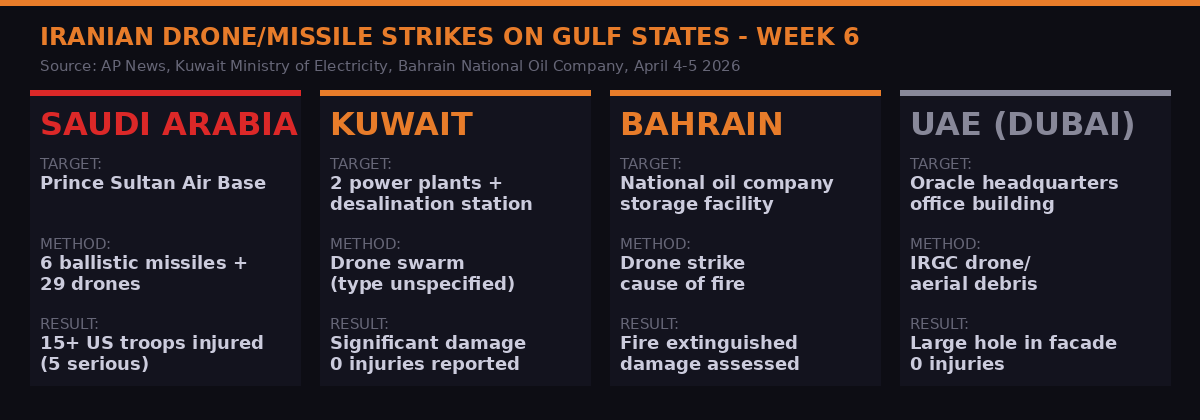
Saudi Arabia took the heaviest blow. Iran fired six ballistic missiles and 29 drones at Prince Sultan Air Base - located approximately 96 kilometers from Riyadh and shared by US forces and the Royal Saudi Air Force. At least 15 troops were injured, including five seriously. US officials initially reported at least 10 US personnel hit, including two seriously wounded. The base has been targeted repeatedly. The total American wounded toll in the Iran war now stands above 300, according to US Central Command. Thirty remain out of action. Ten are considered seriously wounded. (Source: US Central Command / AP News, April 4, 2026)
The pattern is significant. Iran is not simply defending itself from air strikes. It is conducting an expanding regional campaign designed to pressure the Gulf Arab states - many of which are quietly hosting US forces - into pushing Washington toward a ceasefire. Kuwait, Bahrain, the UAE: these are not Iran's enemies in any ideological sense. They are pressure points. The message is that no sovereign territory in the Gulf is safe from drone reach as long as the war continues.
The Hormuz Ultimatum and What Monday Means

Trump issued an ultimatum: Iran opens the Strait of Hormuz by Monday, April 6, or faces devastating consequences. He has been amplifying this message repeatedly on social media, most recently Saturday: "Remember when I gave Iran ten days to MAKE A DEAL or OPEN UP THE HORMUZ STRAIT. Time is running out - 48 hours before all Hell will reign down on them."
The Strait of Hormuz is not just strategically important. It is existential to the global economy in its current form. Roughly 20 percent of the world's oil - including the majority of exports from Saudi Arabia, Iraq, Kuwait, UAE, and Qatar - passes through a channel barely 33 kilometers wide. Iran has effectively shut it. Oil prices have spiked. Fuel prices in the United States have surged. Global shipping has been disrupted. European allies are calling for profit caps on energy companies. (Source: AP News, European Ministers statement, April 4, 2026)
Iran's position, at least publicly, is defiance. Gen. Aliabadi said: "The doors of hell will be opened to you" if US forces strike Iranian infrastructure. Iran's parliamentary speaker, Mohammad Bagher Qalibaf, issued an additional veiled threat on Friday - this time aimed at a second strategic chokepoint. He posted online: "Which countries and companies account for the highest transit volumes through the strait?" The strait he referenced: the Bab el-Mandeb. (Source: AP News / Iranian state media, April 4, 2026)
The Bab el-Mandeb is 32 kilometers wide. It links the Red Sea with the Gulf of Aden and the Indian Ocean. More than one-tenth of global seaborne oil and one-quarter of all container ships use it. If Iran activates any ability to disrupt Bab el-Mandeb traffic - through Houthi remnants in Yemen, naval mining, or direct strike capability - it would extend the economic siege from the Persian Gulf into the Red Sea and effectively cut Europe's primary Asian shipping lane.
This threat has not been operationalized yet. But the fact that it was made publicly by the parliament speaker suggests it is being considered at serious levels. The Red Sea was already disrupted by Houthi operations in 2024 and 2025. The infrastructure for that kind of campaign - proxy networks, drone supply chains, targeting intelligence - does not need to be built from scratch.
Trump's ultimatum creates a problem he cannot resolve with language. If Iran does not open Hormuz by Monday and he does not strike, his future ultimatums are worthless. If he does strike to enforce the deadline, he risks triggering the exact Bab el-Mandeb activation he most wants to avoid. The ceasefire diplomacy running in the background - Pakistan, Turkey, Egypt - may be the only off-ramp that lets both sides claim something.
American Military Buildup and the Ground Troop Question

The US military presence in the Middle East is the largest it has been in more than two decades. Two aircraft carriers, several warships, and roughly 50,000 troops were already in theater before this week's reinforcements began arriving. The USS Tripoli, an amphibious assault ship based in Japan, has now reached the region carrying approximately 2,500 Marines from the 31st Marine Expeditionary Unit. They had been conducting exercises near Taiwan when the deployment order came. (Source: US Central Command via AP News, April 5, 2026)
The Tripoli brings transport and strike fighter aircraft, plus amphibious assault assets. The USS Boxer and two additional ships carrying another Marine Expeditionary Unit are en route from San Diego. Secretary of State Marco Rubio said Friday that the United States can meet its objectives "without any ground troops" - but immediately added that Trump "has to be prepared for multiple contingencies" and that American forces are available "to give the president maximum optionality."
That is the diplomatic language of a ground option that remains on the table. The Marine Expeditionary Units being moved into theater are specifically designed for amphibious assault and land operations. Their arrival is not coincidental to a war where Trump has promised not to use ground troops. Whether or not ground forces are deployed, their presence is a signal to Tehran - and possibly to Gulf allies watching the American commitment level with considerable anxiety.
The USS Gerald R. Ford, the newest and largest American aircraft carrier, recently left the region for repairs and resupply in Europe after a fire in a laundry room affected sleeping quarters. Its absence created a temporary gap in carrier strike group coverage. The Ford's return timeline is unknown. US Central Command said American forces have flown more than 13,000 missions and struck more than 12,300 targets since the war began on February 28. (Source: AP News, April 5, 2026)
The Isolation of Trump's War: Allies Speak Out

Trump declared on Wednesday that the United States had "beaten and completely decimated Iran." Two days later, Iran shot down two American warplanes and struck a Saudi base with ballistic missiles. The pattern is becoming consistent: presidential declarations of decisive victory followed by Iranian actions that directly contradict them.
The international reaction to week six has moved beyond quiet concern into open dissent. French President Emmanuel Macron said the United States "can hardly complain afterward that they are not being supported in an operation they chose to undertake alone." British Prime Minister Keir Starmer has refused, despite sustained US pressure, to join the war. France and Britain are leading a separate diplomatic effort to reopen the Strait of Hormuz - but only after the fighting ends. They will not participate in enforcement during hostilities. (Source: AP News, April 5, 2026)
"You can be the most assertive, aggressive president in the world but you don't control what happens overseas." - Julian Zelizer, history professor, Princeton University (AP News)
Within Republican ranks, cracks are showing over Trump's threat to exit NATO, made this week in the context of allies' refusal to support the Iran operation. Senate Majority Leader John Thune said bluntly that there were not enough votes to support NATO withdrawal: "We got an awful lot of people who think that NATO is a very critical, incredibly successful post-World War II alliance." Trump made no mention of NATO exit in his White House address - suggesting the threat was a pressure tactic rather than firm policy.
John Bolton, Trump's first-term national security adviser, offered what amounted to a harsh operational verdict: the administration made a "serious mistake" by not consulting allies before launching the war. "If you don't build your coalition before the war, it's pretty tough to do it while you're in it." The assessment reflects operational reality: the US is fighting a regional war with no meaningful allied military participation. The broader coalition that made the Gulf War of 1991 diplomatically sustainable does not exist here. (Source: AP News, April 5, 2026)
The go-it-alone posture has practical consequences beyond the diplomatic ledger. Without allied participation in strike packages, the US bears the entire risk. Without allied intelligence sharing on Iranian air defense networks, US aircraft fly with incomplete pictures. Without allied political cover, every American casualty lands in a domestic political environment where, according to Princeton's Zelizer, a large part of the country does not support the war and where any loss is treated as unacceptable. The cost of isolation is paid in blood by the aviators flying the missions.
Ukraine Watches From Istanbul - and Worries

The Iran war is generating second-order effects that stretch far beyond the Middle East. In Istanbul on Saturday, Ukrainian President Volodymyr Zelenskyy gave the AP an exclusive interview. His assessment was direct and alarmed.
"We have to recognize that we are not the priority for today," he said. "That's why I am afraid a long (Iran) war will give us less support." The specific concern is Patriot air defense missiles - the US-made systems Ukraine depends on to intercept Russian ballistic missiles targeting Ukrainian cities. Ukraine never received enough of them to begin with. Now, as the Iran war drives demand from a different theater, Zelenskyy says the delivery packages are getting smaller. (Source: AP News exclusive interview, Istanbul, April 4-5, 2026)
The economic dimension makes this worse for Kyiv. Iran's closure of the Strait of Hormuz has spiked global oil prices. Russia sells oil. Higher oil prices mean more revenue for the Kremlin. More Kremlin revenue means more capacity to sustain Russia's invasion of Ukraine. Zelenskyy said explicitly: "Russia gets additional money because of this, so yes, they have benefits."
Ukraine is not a passive observer. Zelenskyy offered to share Ukrainian battlefield expertise - particularly in countering Iranian-made Shahed drones, which Ukraine has been fighting against for years since Russia began using them - with US and allied forces as a card to keep Kyiv relevant in the current strategic conversation. Ukraine has more practical experience countering Iranian drone systems than any other military in the world. Whether Washington treats this as valuable intelligence or as distraction from the Iran campaign is unclear. (Source: AP News, April 5, 2026)
The interplay between the two wars is a strategic windfall for Moscow that was either not modeled or not weighted seriously before the February 28 strikes began. Russia does not need to do anything active to benefit from the Iran war. The oil revenues flow automatically when Hormuz is blocked. The US attention is divided automatically when carrier strike groups move south. The Patriot stocks thin automatically when consumption outpaces production. War in one theater can hollow out another without a single Russian soldier crossing a new line of advance.
The Ceasefire Track: Pakistan, Turkey, Egypt

Parallel to the escalation, a ceasefire track is running - and, according to multiple sources, it is closer to producing results than the public posturing suggests.
Pakistan's Foreign Ministry spokesperson Tahir Andrabi told AP that Islamabad's ceasefire efforts are "right on track." Iran's foreign minister Abbas Araghchi confirmed that Iranian officials "have never refused to go to Islamabad" for talks. Three regional mediators - Pakistan, Turkey, and Egypt - are actively working to broker direct US-Iran negotiations. The proposed framework: a cessation of hostilities to enable a diplomatic settlement. (Source: AP News, April 4-5, 2026)
This intelligence comes from two sources: a regional official directly involved in the mediation efforts and a Gulf diplomat briefed on the discussions - both speaking anonymously given the sensitivity of closed-door diplomacy. Neither side has formally agreed to sit down. But neither side has formally walked away either.
Trump complicated his own diplomacy by setting the Monday deadline. If Iran opens Hormuz before Monday, he can declare a win. If Iran does not open Hormuz by Monday, Trump faces a choice: strike and potentially trigger massive Iranian retaliation against Gulf infrastructure, or allow the deadline to pass without consequences - which would eviscerate any future ultimatum credibility. Neither option is clean.
Iran's stated position remains unchanged. Tehran says the Strait will reopen when US and Israeli strikes stop - not as a gesture of goodwill ahead of negotiations, but as a result of negotiations. This is a sequencing problem that no amount of ultimatum language resolves. The Hormuz closure is Iran's primary leverage. Surrendering it before negotiations begin would leave Tehran with nothing to negotiate with. (Source: AP News, April 4-5, 2026)
Trump told NBC News that the shootdown of American jets "would not affect negotiations." That statement is either genuine confidence or a deliberate signal to Tehran that the pilot incident will not harden US negotiating positions. Either interpretation suggests the back-channel pressure toward Islamabad talks is real and ongoing. The ceasefire track and the escalatory track are running in parallel, and which one prevails in the next 24 hours is genuinely unknown.
What Week Seven Looks Like
The variables entering Monday April 6 are stacked against a peaceful resolution of the immediate crisis. The Hormuz deadline expires at a time when Iran is demonstrating - not claiming, demonstrating - that it retains meaningful offensive capability. Two American planes down. Saudi bases hit repeatedly. Gulf energy infrastructure burning. A tech company's Dubai office with a hole in its wall. A pilot hunted through Iranian mountains for a day and a half.
The worst-case scenario visible from where we stand: Trump strikes additional Iranian infrastructure to enforce the deadline. Iran activates threats against Bab el-Mandeb. The Red Sea shipping corridor - already disrupted by Houthi operations in 2024-2025 - goes dark again. Global oil supply is squeezed from both ends simultaneously. European energy prices spike further. Asian manufacturing takes another hit. The global recession risk that has been hovering since week one materializes.
The best-case scenario: the Pakistan-Turkey-Egypt mediation track produces enough of a signal from Iran - even an ambiguous, partial gesture toward Hormuz - that Trump can claim momentum and delay the hardest escalatory choices for another week while talks develop. The pilot rescue gives Trump a genuine piece of good news to point to. The ceasefire overture gives Iran a way out that does not look like capitulation. Face-saving is what keeps wars from becoming worse.
Mark Cancian, retired Marine colonel and senior defense adviser with the Center for Strategic and International Studies, put the current American air campaign in historical context. "The loss rate for American warplanes flying over Germany during World War II was 3% at one point, which would equal about 350 warplanes in the US war against Iran. But then there's the political side - you have an American public that is accustomed to fighting bloodless wars. Then a large part of the country doesn't support the war. So to them, any loss is unacceptable." (Source: AP News, April 4, 2026)
Two aircraft over six weeks against roughly 13,000 missions is a statistical success rate that military planners would accept without hesitation. The political economy of American war-making does not run on statistics. It runs on images - on the footage that does not yet fully exist of a pilot being hunted in Iranian mountains, on the families of the 13 Americans killed, on fuel prices at gas stations in Ohio and Georgia. Those images are accumulating. The political weight of the war is increasing faster than the military campaign is resolving it.
In the mountains of southwestern Iran on Saturday night, a man in a flight suit hid from a search party and waited for rescue. He made it out. Thousands of others across this theater - Iranian civilians, Lebanese civilians, US service members in Saudi bases, Kuwaiti workers near shattered power plants - are still waiting to see how this ends. The Hormuz clock is running. And Monday is coming.
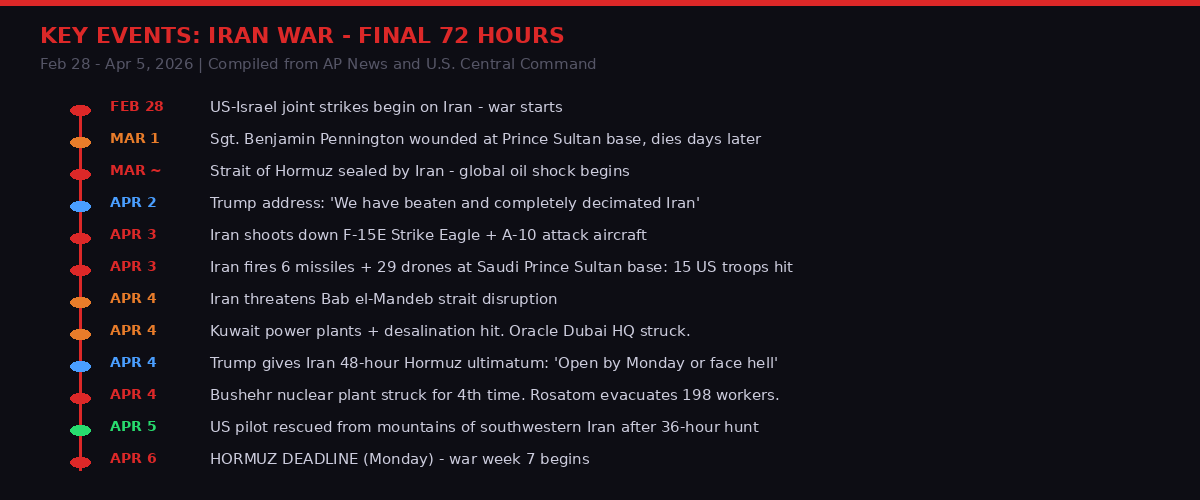
KEY EVENTS: WEEK SIX OF THE IRAN WAR
Get BLACKWIRE reports first.
Breaking news, investigations, and analysis - straight to your phone.
Join @blackwirenews on TelegramSources: Associated Press (AP News) reporting April 3-5, 2026; U.S. Central Command statements; Kuwait Ministry of Electricity; Bahrain National Oil Company; Iranian state media IRNA; Pakistan Foreign Ministry; Foundation for Defense of Democracies; Mitchell Institute for Aerospace Studies; Center for Strategic and International Studies.