No Exit: Trump Said "Winding Down" Friday. By Saturday He Was Threatening to Obliterate Iran.
Twenty-five days into a war that was supposed to be short, decisive, and justified, Trump's contradictions are now the story. Congress is demanding a plan. Japan is furious. Saudi Arabia just expelled Iranian diplomats. And the Strait of Hormuz clock is ticking.

Ships burning in the Persian Gulf region - the Strait of Hormuz has remained closed to US-aligned vessels for 25 days. (Illustrative / Pexels)
- 06:00 Trump 48-hour Hormuz ultimatum: clock expires Monday 23:44 GMT
- 05:30 Iran army: all US energy infrastructure in region will be targeted if attacked
- 03:00 Israel: 100+ wounded in Iranian strikes on Dimona and Arad (Mar 21)
- 02:00 Saudi Arabia expels Iranian military attache, four embassy staff after Yanbu attack
- 00:15 CENTCOM: Iran's anti-ship missile capacity "degraded" after 5,000-lb bomb strike on coastal facility
The president posted on Truth Social at 11:44 PM GMT Friday that the United States was "getting very close to meeting our objectives as we consider winding down our great Military efforts in the Middle East." Markets rallied briefly on the signal. Diplomats in three countries began drafting ceasefire framework language.
Eighteen hours later, he posted the opposite.
"If Iran doesn't FULLY OPEN, WITHOUT THREAT, the Strait of Hormuz, within 48 HOURS from this exact point in time, the United States of America will hit and obliterate their various POWER PLANTS, STARTING WITH THE BIGGEST ONE FIRST," Trump wrote at 23:44 GMT Saturday, according to Al Jazeera.
No other senior US official knew it was coming. No interagency review process. No congressional notification. A single post from Trump's Mar-a-Lago residence, written in all-caps, now sets the clock for a potential strike on Iran's civilian power grid - an act that international legal scholars say would constitute a war crime under the Geneva Conventions.
The 48-hour window expires Monday night. This is where the war stands on Day 25.
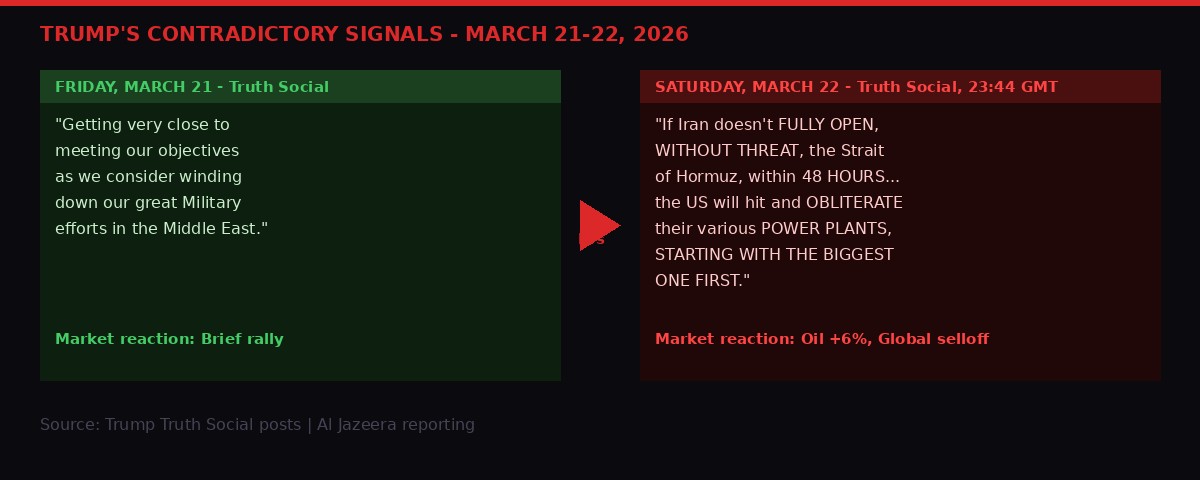
Trump's own posts, 18 hours apart, sent contradictory signals to allies, markets, and Iran. (BLACKWIRE / Pexels)
The Hormuz Ultimatum: What Trump Actually Said
The Strait of Hormuz carries roughly 20 percent of the world's oil and liquefied natural gas during peacetime. Since the early days of the war Iran launched February 28 alongside the US and Israel, shipping has "virtually ground to a halt," according to Al Jazeera's reporting. Iran has maintained a formal position that the strait remains open to all nations except the US and its allies - a position the Iranian foreign minister reinforced last week, telling CBS he had been "approached by a number of countries" seeking safe passage.
Trump's ultimatum does not appear to be coordinated with the military operation already underway. Admiral Brad Cooper, head of US Central Command, stated Saturday that US fighter jets had already dropped 5,000-pound bombs on an underground Iranian coastal facility that stored anti-ship cruise missiles and mobile launchers - a strike that also destroyed "intelligence support sites and missile radar relays" used to monitor ship movements.
"It is interesting, to say the very least, to hear Trump talking about a major escalation, given the fact that we've been hearing throughout the course of the day how much damage the US has done, supposedly, to Iran's ability to target oil tankers and vessels navigating through the strait."
- Al Jazeera's Manuel Rapalo, reporting from Washington, DC
The gap between the White House and the Pentagon is visible in real time. CENTCOM says Iran's capacity to block the strait has been degraded. Trump says the strait is still closed and threatens to escalate. Iran, for its part, responded within hours: the Iranian army announced that all US energy infrastructure in the region would be targeted if Iran's own fuel and power systems came under attack.
That counter-threat was not vague. Iran operates near US bases in Bahrain, Qatar, Kuwait, and the UAE. US energy infrastructure in the region includes pipelines, export terminals, and refinery partnerships. An exchange of strikes on power and energy infrastructure would push oil well past $130 per barrel and trigger financial market dislocations not seen since the 2008 crisis.
The ultimatum expires Monday night. No off-ramp has been offered by either side.

A fifth of the world's oil transits the Strait of Hormuz during peacetime. The strait has been effectively closed to US-aligned shipping for 25 days. (Pexels)
Congress Demands an Exit Plan Nobody Has
Behind closed doors in Washington, the questions from Congress are hardening. The war was launched without a formal congressional authorization - Trump and the White House have relied on executive authority and pre-existing authorizations that legal scholars across the political spectrum say do not apply to a new offensive war against Iran.
Now, four weeks in, members of both parties are asking the question that nobody in the administration can answer with confidence: what does victory actually look like, and when does the US get out?
According to AP News reporting, Congress is "looking for Trump's exit plan as the Iran war drags on." That is a remarkable sentence for Week 4 of a war the White House presented as a short, decisive military operation with clear objectives. The stated goal at launch was to eliminate Iran's nuclear weapons capability and force the opening of the Strait of Hormuz. Iran has not surrendered either point. It has expanded its targeting to include Israeli cities, Saudi oil infrastructure, and US bases across the Gulf region.
"We were told this would be limited and focused. We were told the Iranians would fold quickly. Neither of those things has happened, and now we're watching the president threaten to attack their power grid while simultaneously saying we're winding down. Someone needs to explain what the plan is."
- Senior congressional official, speaking to AP News on condition of anonymity
Trump's Friday "winding down" comment came without context, without a briefing, and without any accompanying diplomatic progress. Markets reacted because they desperately wanted it to be true. By Saturday the comment looked like either a tactical disinformation move aimed at calming nervous allies - or a simple reflection of how disconnected the president's public messaging has become from the military reality in the Gulf.
The contradiction is not new. Trump said similar things during the opening weeks of the war - broadcasting confidence about "objectives being met" while CENTCOM was reporting significant resistance and casualties. But the 48-hour power plant ultimatum represents a new level of escalation in a war that was supposedly about to wind down, and Congress has limited tools to stop it.
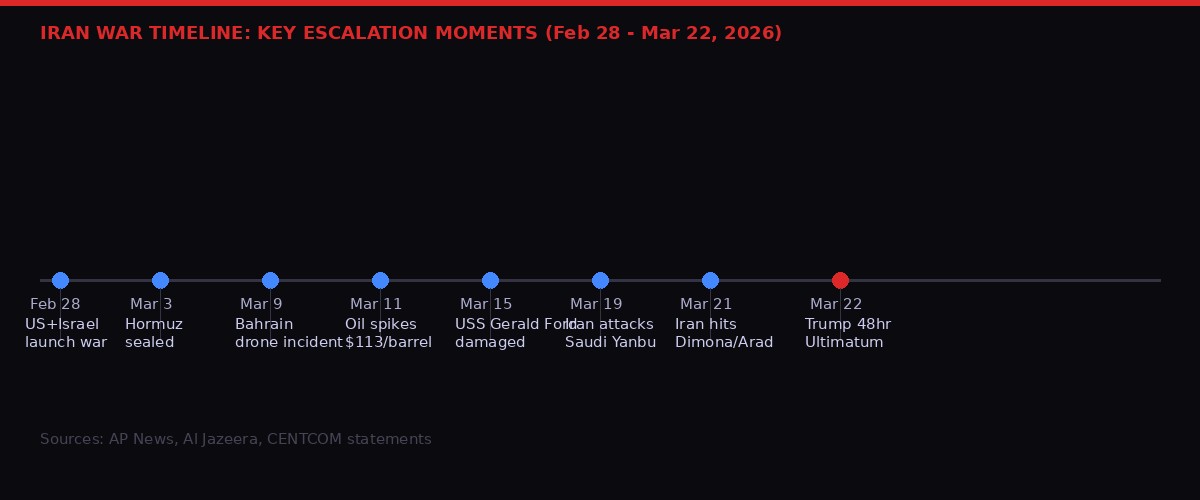
Twenty-five days of escalation: from the Hormuz closure to the Dimona strike and Saturday's power plant ultimatum. (BLACKWIRE)
Japan: The Pearl Harbor Comment That Broke Something
Among US allies, the most significant political rupture of the week may not be in Europe. It may be in Tokyo.
Trump invoked Pearl Harbor to justify US involvement in the Iran war - a rhetorical move that has produced what AP News describes as "surprise, embarrassment, unease" in Japan. The December 7, 1941 attack on Pearl Harbor was carried out by Japan. It killed more than 2,400 Americans. It brought the United States into World War II and ended with the atomic bombing of Hiroshima and Nagasaki, killing over 200,000 Japanese civilians.
Trump's use of Pearl Harbor as an analogy for why the US is right to attack Iran was not explained or elaborated. He did not specify which aspect of Pearl Harbor applied - the surprise attack element, the justification for military response, or simply the emotional weight of the reference. The comment landed in Japan like a detonation.
Prime Minister Sanae Takaichi has remained silent since the comment - a silence that is itself politically loaded. Japan is one of the world's largest importers of oil and liquefied natural gas. The Strait of Hormuz closure has been devastating for Japanese energy supply chains and the broader economy. Japan cannot publicly side with Iran. It cannot comfortably side with a US president who just used the memory of Japanese aggression to justify his own military offensive.
The silence of Takaichi is getting "mixed reaction" domestically, according to Al Jazeera's reporting. There are Japanese politicians and public figures who believe she should have responded forcefully to Trump's Pearl Harbor reference as both historically inappropriate and diplomatically irresponsible. There are others who believe any response risks a bilateral rupture with Washington at the worst possible moment.
Japan's dilemma encapsulates the broader problem the Trump administration has created for its Pacific alliances. The US-Japan security relationship is foundational to regional stability. Trump just handed China an argument that the US is historically reckless, diplomatically unserious, and willing to exploit the darkest chapters of its allies' histories for rhetorical convenience.

Congress is pushing the White House for a war exit strategy as Trump simultaneously signals de-escalation and threatens to obliterate Iranian power plants. (Pexels)
Saudi Arabia Expels Iranian Diplomats After Yanbu Attack
The regional diplomatic map shifted again on Friday, March 21, when Saudi Arabia expelled Iran's military attache and four additional embassy staff. The move followed Iran's attack on Yanbu - Saudi Arabia's primary oil export outlet on the Red Sea coast.
The Yanbu attack was significant for several reasons. It demonstrated that Iran's retaliatory capacity extends well beyond the Strait of Hormuz. Yanbu handles a substantial portion of Saudi Aramco's crude oil exports. Striking it sent a message not just to Riyadh but to every oil-importing nation watching the conflict: Iran can reach the arteries of Gulf oil production, not just the choke point at Hormuz.
Saudi Arabia's decision to expel Iranian diplomats formally aligns Riyadh with the US-Israeli coalition in a way that was not previously explicit. Saudi Arabia had maintained a studied ambiguity since the war began - its Abraham Accords relationship with Israel put it in proximity to the US coalition, but decades of Sunni-Shia geopolitics and economic interdependence with Iran's regional networks had kept Riyadh from making a clear choice.
The expulsion is that clear choice. Iran attacked Saudi infrastructure. Saudi Arabia responded by removing Iranian diplomatic presence from its territory. The Gulf Cooperation Council members are watching this closely - the UAE, Kuwait, Bahrain, and Qatar all host US military assets and have been carefully managing their exposure to Iranian retaliation. Saudi Arabia moving to the explicit US-aligned column changes the calculus for all of them.
The attack on Yanbu port - Saudi Arabia's main oil export outlet - followed Iran's decision to block the Hormuz Strait, according to Al Jazeera reporting.
- Al Jazeera, March 21, 2026
For Iran, the expulsion signals that the war is not contained. The strategy of keeping the Gulf states neutral - using the threat of escalation to prevent them from fully committing to the US side - appears to have backfired with Riyadh. Bombing Yanbu bought Tehran a short-term demonstration of reach. It may have cost them Saudi neutrality permanently.
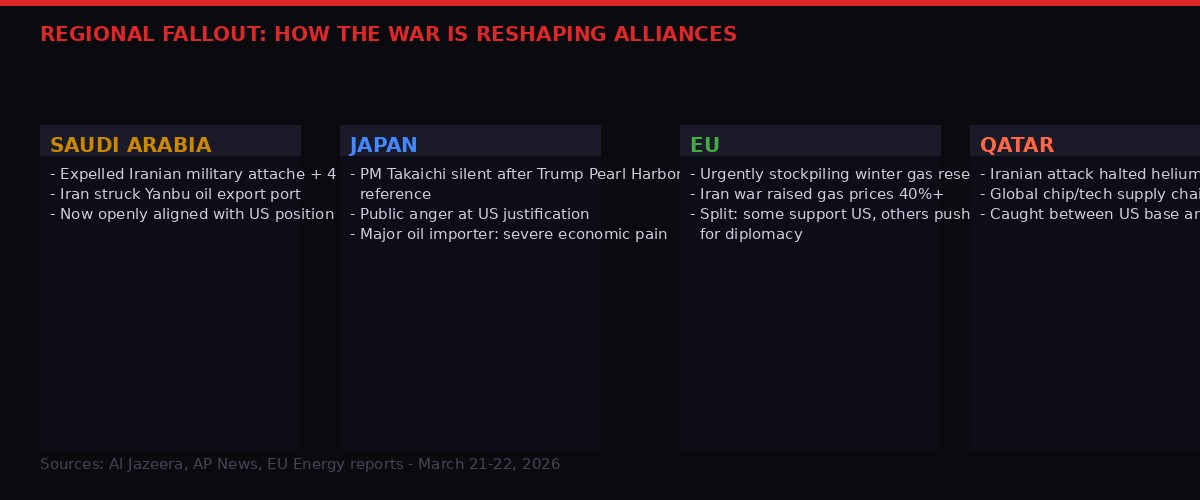
Four key countries caught in the geopolitical crossfire: Saudi Arabia, Japan, the EU, and Qatar each face distinct pressures. (BLACKWIRE)
The Eid al-Fitr Dimension: War on a Holy Day
The latest escalation is unfolding on Eid al-Fitr - the Islamic holiday marking the end of Ramadan, one of the most significant days in the Muslim calendar for more than 1.8 billion people worldwide.
Tehran held Eid prayers as funerals were simultaneously conducted for an IRGC spokesman killed in the preceding days of fighting, according to Al Jazeera reporting from March 21. The image is powerful: a city simultaneously celebrating a holy day and burying its military dead, with US and Israeli bombs still falling on Iranian territory.
In Gaza, the war's reverberations are felt differently. Eid "without toys" is how Al Jazeera described the situation in Gaza, where Israeli supply restrictions have driven up prices and left children without gifts - a direct consequence of the broader regional conflict that has tightened supply chains and elevated military priorities across the entire Middle East theater.
The timing of Trump's 48-hour ultimatum - issued Saturday, the first full day of Eid - carries its own diplomatic signal, whether intentional or not. Issuing a war ultimatum on the most important Muslim holiday of the year is a provocation that will resonate across the Muslim world far beyond Iran's borders. The framing debate inside the war will now include the question of whether the US is willing to escalate against a Muslim-majority nation specifically on its holiest celebration.
Pete Hegseth's Christian rhetoric is already drawing "renewed scrutiny" after the US went to war with Iran, according to AP News. The Defense Secretary has publicly framed US military action in religious terms. Combined with Trump's Pearl Harbor historical revisionism and the Eid timing of the power plant ultimatum, the optics of this war are creating long-term soft power damage to the United States that will outlast the military campaign by years.
The Helium Supply Chain Crisis Nobody Is Talking About
While the kinetic war dominates headlines, a slower-moving crisis is accelerating in the background. Iran's attack on Qatar - specifically on facilities at or near Ras Laffan industrial city, Qatar's primary LNG and industrial export hub - has halted Qatari helium production.
Qatar is the world's third-largest helium producer. Helium is not optional for the global technology industry. It is essential for manufacturing semiconductors, cooling MRI machines, and filling scientific research systems. There is no immediate substitute. The global helium market was already constrained before the war; the Qatari supply disruption has pushed it into crisis territory.
According to AP News, the "Iran war halts Qatar helium output, threatening global tech supply chains." This is the kind of second-order effect that rarely features in war coverage but will have consequences felt in every semiconductor fab and hospital on earth. Intel, TSMC, Samsung, and every major chipmaker rely on helium as a process gas. Extended supply disruptions will slow chip production at a moment when the global economy is already under severe energy price pressure from the Hormuz closure.
The EU is now urgently urging member states to begin storing winter gas reserves, as the Iran war has caused gas prices to spike and become "high, volatile," threatening EU storage projections, according to Al Jazeera's European reporting. Europe, which was still rebuilding energy reserves after the Russia-Ukraine shock, faces another year of emergency energy management - this time driven by a war in the Persian Gulf that no European government sanctioned or voted for.

Qatar's helium output - critical to global chip manufacturing - has been halted by the Iran war's industrial spillover. (Pexels)
What Comes Next: The 48 Hours That Matter
Trump's power plant ultimatum expires Monday night at 23:44 GMT. Three outcomes are plausible:
Iran partially opens Hormuz. This would allow Trump to claim a victory, step back from the power plant threat, and potentially stabilize the situation enough for diplomatic talks to begin. Iran would lose face but preserve its energy infrastructure. This is the outcome markets are pricing in a small probability premium for - oil remains elevated but has not yet surged to the $140+ territory that a strike on power plants would trigger.
Iran refuses and Trump backs down. The most historically damaging outcome for US credibility. A public all-caps ultimatum followed by no follow-through would signal to Iran, China, North Korea, and every other adversary that Trump's threats carry limited weight. Congress would likely escalate its pressure for a formal exit strategy. The war continues with Iran emboldened.
The US strikes Iranian power plants. This is the scenario that international legal experts, European governments, and most senior military professionals privately regard as catastrophic. Striking civilian power infrastructure is prohibited under international humanitarian law in most circumstances. Iran's counter-threat - to hit all US energy infrastructure in the region - would trigger a wider regional war. Oil would spike to levels not seen since the 1973 embargo. Global recession risk would become near-certainty. The scenarios for Israeli vulnerability, for regional state collapse, for a nuclear calculation in Tehran all become significantly more dangerous.
CENTCOM reported Saturday that Iran's anti-ship capacity has been "degraded" - which suggests the military assessment is that Hormuz can be reopened by force without necessarily requiring strikes on the Iranian mainland's power grid. The question is whether that military logic reaches the president at Mar-a-Lago before his self-imposed deadline expires.
"There seemed to be a 'gap between what the White House appears to want in the Strait of Hormuz and what the US military says they have already accomplished.'"
- Al Jazeera's Manuel Rapalo, Washington reporting, March 22, 2026
Robert Mueller died Saturday at 81. The former FBI director who investigated Russian interference in the 2016 election and Trump's conduct is gone. The irony - that the man who spent years examining one president's potential entanglement with an adversarial power died on the same weekend that president issued a 48-hour war ultimatum with no congressional authorization - was not lost on the Washington commentariat. AP News noted Mueller "investigated Russia-Trump campaign ties." The current war has no parallel investigation. There is no one checking the exit ramp.
Twenty-five days in, the Iran war is no longer short, decisive, or under clear strategic control. The Hormuz clock is running. Congress has no plan. Allies are either furious or frightened. And the president's last two posts on the subject said opposite things.
Something has to give. The question is what - and who pays for it.
Get BLACKWIRE reports first.
Breaking news, investigations, and analysis - straight to your phone.
Join @blackwirenews on Telegram