Three Missions, Zero Exit: The Ground War Trap Swallowing 7,000 Marines in the Persian Gulf
Trump promised two to three weeks. The Pentagon is planning for something much longer. As thousands of Marines stream into theater with no public objective, three ground operations are on the table - and every one of them is a potential quagmire.

US Army Blackhawk during insertion training. Similar rotary-wing assets are now staging across Gulf bases. Photo: Pexels
Thirty-three days into Operation Epic Fury, the air campaign that was supposed to be swift and decisive has produced something the White House never planned for: a ground war debate. President Trump told the nation on April 1 that US forces would "finish the job" within two to three weeks. Hours later, 3,500 additional Marines were confirmed en route to the Persian Gulf, joining roughly 3,500 who arrived over the weekend. That brings the total surge force to approximately 7,000 - on top of the 50,000-plus US personnel already in the region.
The question nobody in Washington can answer clearly: what are they there to do?
According to reporting from The Atlantic, ABC News, and multiple defense officials speaking on background, Trump has been briefed on three distinct ground operations. Each one targets a different strategic objective. Each one carries risks that Pentagon planners describe in private as "extreme." And each one, if it goes wrong, transforms a month-old air campaign into something that looks uncomfortably like the opening chapter of another forever war.
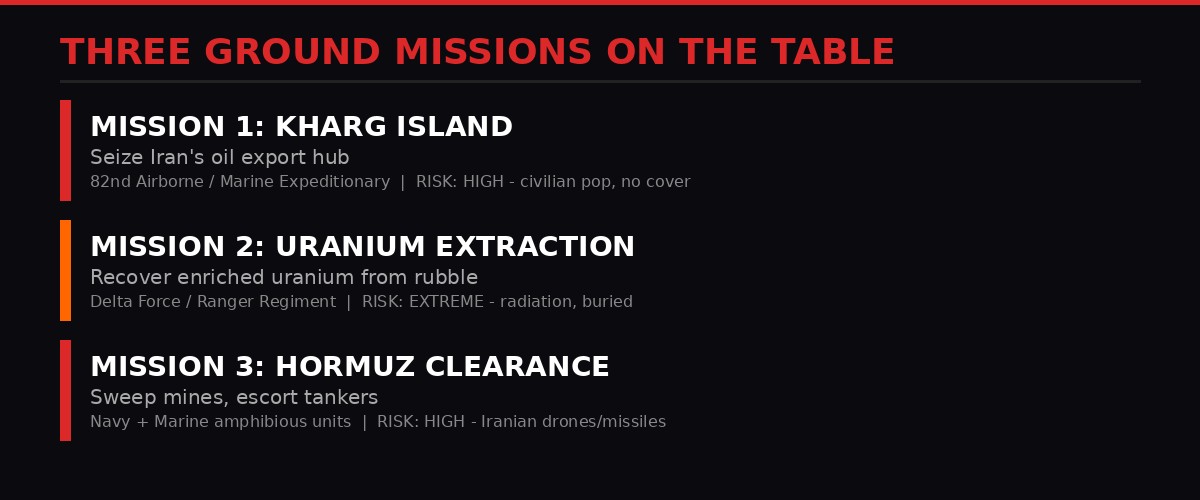
BLACKWIRE analysis: The three ground missions currently on Trump's desk. Each carries distinct force requirements and risk profiles.
The Prime-Time Address That Said Nothing New

Trump's April 1 national address lasted 19 minutes but introduced no new military announcements. Photo: Pexels
Trump's April 1 prime-time address was his first since Operation Epic Fury launched on February 28. The White House billed it as an "important update on Iran." What viewers got was a 19-minute speech that recycled talking points from the previous month, according to analysis from AP News and BBC.
"In these past four weeks our armed forces have delivered swift, decisive, overwhelming victories on the battlefield," Trump said from the Oval Office. He slammed previous presidents, saying they "made mistakes and I am correcting them." He promised to hit Iran "extremely hard over the next two to three weeks."
What he did not do: announce a ceasefire. Reveal a diplomatic breakthrough. Provide a timeline for withdrawal. Or explain why 7,000 Marines are heading into theater if the mission is nearly complete.
"We are on track to complete all of America's military objectives shortly, very shortly. We have all the cards, and they have none."
- President Trump, national address, April 1, 2026 (AP News)
Earlier that day, at an Easter lunch, Trump had been more candid. In remarks the White House uploaded then hastily deleted, the president said: "We could just take their oil. But you know, I'm not sure that the people in our country have the patience to do that." The White House did not respond to AP requests for comment on why the video was removed.
The mixed messaging is not new. Since the war began, Trump has demanded unconditional surrender, then suggested he might end the war without a deal. He threatened to bomb Iran "back to the Stone Ages," then said the US would leave "very soon." He claimed Iran's president requested a ceasefire; Tehran's foreign ministry called the assertion "false and baseless" within hours, according to Iranian state TV.
Iran's Foreign Minister Abbas Araghchi responded directly: "You cannot speak to the people of Iran in the language of threats and deadlines. We do not set any deadline for defending ourselves." That was on Al Jazeera, hours before Trump's address. The messaging gap between Washington and Tehran is not narrowing. It is widening.
Mission One: Seize Kharg Island

Kharg Island handles 90% of Iran's crude oil exports. Its seizure would cripple Tehran's war economy - but holding it is another matter. Photo: Pexels
Kharg Island sits 25 kilometers off Iran's southwestern coast in the Persian Gulf. It is the beating heart of Iran's oil export infrastructure - 90% of the country's crude flows through its terminals. When Trump threatened to "obliterate" it in late March, he was signaling the most aggressive economic warfare option available short of occupying Tehran itself.
The neoconservative case for taking Kharg is straightforward. Michael Rubin of the American Enterprise Institute - who has reportedly been advising Trump administration officials - called it a "no-brainer" in a recent analysis, arguing the operation would "protect its oil facilities for a post-war economy." In a textbook scenario, 82nd Airborne Division paratroopers would parachute onto the island from high-altitude aircraft, or Marines from expeditionary units would insert via helicopter.
The textbook scenario, military analysts say, is where reality ends and the problems begin.
Harrison Mann, a former Army major who specialized in Middle East analysis at the Defense Intelligence Agency, outlined the dangers in interviews with the Christian Science Monitor. Helicopters have to land. Paratroopers disperse on impact. Neither arrives with weapons up and ready.
"Especially if it's a combat jump where the aircraft is probably going to be going low and fast, it's a hard landing, like you're getting pushed out of a third-story window. Those soldiers are not hitting the ground with their weapons up."
- Harrison Mann, former DIA analyst, to CS Monitor, April 1, 2026
Kharg Island has a civilian population. The Iranian military has had a month to prepare defenses. Iran could let US forces land unopposed - then use the island as a trap to draw in logistics convoys, medical evacuations, and resupply missions that are even more vulnerable than the initial assault force.
"As dangerous as it is to bring troops onto the island, it's even more dangerous to get them off of it," Mann wrote in Responsible Statecraft. Troops on the ground need food, water, munitions, air cover, and medical support. Every one of those supply chains is a target for Iranian drones and cruise missiles that can be fired from hills many miles inland.
An analysis from NDTV's defense correspondents noted that Kharg's terrain offers "total lack of natural cover" and is within "close proximity to Iran's main defenses." The island is not Grenada. It is not even the first Gulf War. It is a target that Iran has been fortifying since the 1980s.
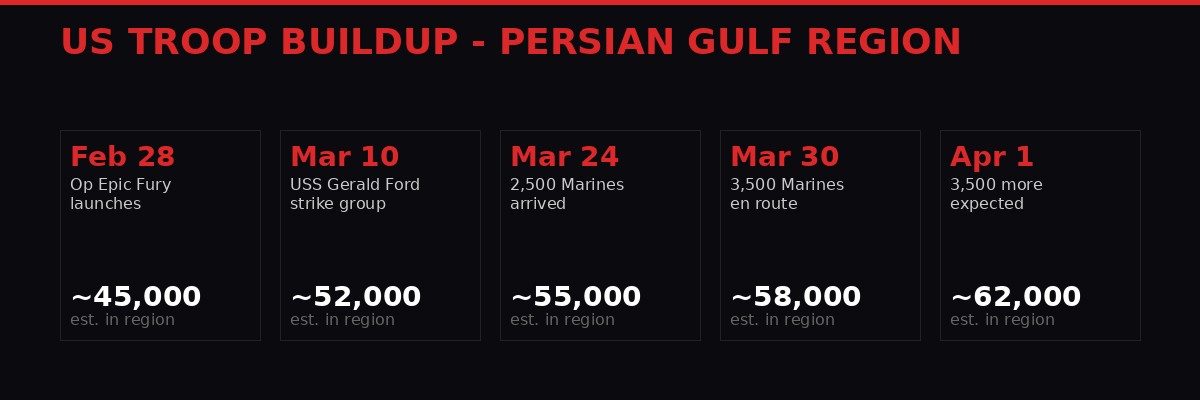
US force levels in the Gulf have climbed steadily since Operation Epic Fury launched. The latest Marine surge brings total estimated forces to over 60,000.
Mission Two: Extract the Uranium

Iran's enriched uranium is believed buried under rubble at multiple sites following US bunker-buster strikes. Extracting it requires ground teams in a radioactive environment. Photo: Pexels
The stated reason for Operation Epic Fury was preventing Iran from obtaining nuclear weapons. The US and Israel struck Iran's nuclear facilities with bunker-busting munitions in the opening hours of the campaign. Trump declared the sites "obliterated." Intelligence now suggests the picture is more complicated.
Iran is believed to retain approximately 450 kilograms of highly enriched uranium - enough for multiple nuclear devices. Some of it was moved before the strikes. The rest is buried under rubble at sites including Isfahan and Natanz, according to reporting from The Washington Post and Foreign Policy.
Securing that material is the most technically demanding mission on the table. According to CS Monitor, Pentagon officials have drawn up plans for sending US special operations units - likely Delta Force and Ranger Regiment elements - into Iran to locate, extract, and transport the uranium. Open-source intelligence reports show increased air traffic from US bases where these units are stationed.
The logistics are staggering. A US military option to seize the uranium would require flying in excavation equipment, setting up radiation containment protocols, building a runway for cargo planes to fly out with the radioactive material, and securing the perimeter against Iranian counterattacks for the duration of the operation - which analysts estimate could take days or weeks, not hours. Two people familiar with the matter told The Washington Post that the operation's complexity rivals anything attempted since the Iraq War.
Fred Kaplan, writing in Slate, noted the fundamental paradox: "Trump said U.S. bunker-busting bombs had 'obliterated' Iran's nuclear sites last June - but some of which, it now appears, was moved elsewhere before the attack." The uranium that was supposed to be destroyed now needs to be extracted from irradiated rubble by soldiers operating in chemical and radiological hazard conditions.
Retired Army Lt. Col. Brad Taylor, who served eight years as a Delta Force commander, told CS Monitor that the buildup itself creates momentum toward deployment. "You've done so much planning, it's almost like, 'Well, I guess we're going to use them.'" That observation carries weight. Forces positioned for contingency operations have a historical tendency to be deployed, not stood down.
Mission Three: Break the Hormuz Blockade

Over 2,000 vessels have been diverted from the Strait of Hormuz since Iran effectively closed the waterway. The economic damage is measured in trillions. Photo: Pexels
The Strait of Hormuz is 33 kilometers wide at its narrowest point. Before the war, roughly 21 million barrels of oil passed through it daily - about a quarter of global seaborne petroleum trade. Since Iran closed it in the opening days of the conflict, global oil markets have convulsed. Brent crude is up over 40% since February 28. US gas prices topped $4 per gallon for the first time since 2022, according to NBC News.
Trump demanded on April 1 that Iran reopen the strait or face attacks that would send the country "back to the Stone Ages." He set an April 6 deadline. In the same breath, he told allies to secure it themselves - calling on South Korea, Japan, and China to step up. "Let South Korea do it. Let Japan do it. They get 90% of their oil from the strait. Let China do it," he said at the Easter lunch.
The contradiction is obvious. If the US is prepared to send Iran to the Stone Age over the strait, why ask Japan to handle it? If the US "doesn't need" Hormuz oil, as Trump claimed, why is gas at $4 a gallon driving his poll numbers into the ground?
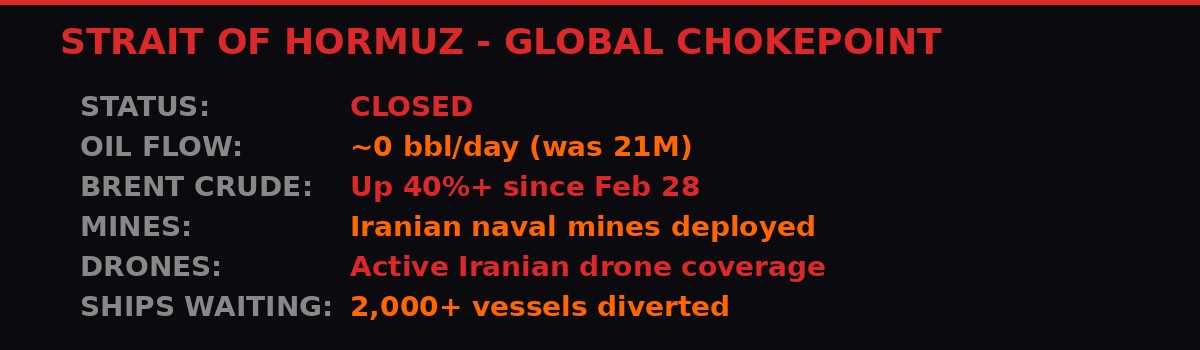
The Strait of Hormuz remains closed to commercial traffic. Iran has deployed naval mines and maintains active drone surveillance of the waterway.
A retired Navy officer who formerly planned strait-clearing operations and still works with classified think tanks told Slate that reopening Hormuz would require "many thousands" of troops to occupy the surrounding coastline - plus thousands more to sustain the occupation with munitions, food, water, shelter, and defensive weapons against Iranian drones and cruise missiles.
The critical problem: Iran's drones and missiles can be launched from positions deep inland, well beyond the range of troops sitting on the coast. Every ship attempting to escort a tanker through the strait becomes a target. Defense Secretary Pete Hegseth admitted at a March 31 Pentagon press conference that despite 11,000 targets struck, Iran still has significant missile and drone capabilities. "Yes, they will still shoot some missiles," he said. "But we will shoot them down."
Military analysts are less confident. If Iran sinks even one tanker in the strait, the deterrent effect would keep commercial vessels away for months. Insurance rates for Gulf transit have already become prohibitive. The economic damage from a failed clearance operation could exceed the damage from the blockade itself.
The Vietnam Parallel Nobody Wants to Hear

Thirteen US service members have been killed in the Iran war so far. Veterans' organizations warn that ground operations would dramatically increase that number. Photo: Pexels
Fred Kaplan's Slate analysis drew the comparison directly: "Trump is faced with a dramatic choice - either to escalate his war on Iran by sending in ground troops, or to pull out altogether." He invoked Senator George Aiken's famous advice to Lyndon Johnson during Vietnam: "Declare victory and go home."
The parallel is uncomfortable because it is precise. In Vietnam, the air campaign was supposed to break Hanoi's will. When it didn't, ground troops went in. When the ground troops didn't produce victory, more ground troops followed. The logic of escalation created its own momentum, independent of strategic objectives.
In Iran, the air campaign has struck over 11,000 targets in 33 days. It has killed Supreme Leader Khamenei and degraded Iran's military infrastructure. It has not reopened the Strait of Hormuz. It has not secured Iran's enriched uranium. It has not broken the regime - Mojtaba Khamenei, the new Supreme Leader, has vowed to keep Hormuz closed and warned regional nations to stop hosting US bases. Three million Iranians have been internally displaced, according to the UN High Commissioner for Refugees.
The human cost is climbing. Thirteen US service members are dead. Hundreds more are wounded. In Iran's retaliatory strikes across the Middle East, at least 50 people have been killed in Gulf nations. Seventeen Israelis are dead. Iranian civilian casualties remain difficult to verify but are estimated in the thousands by international observers.
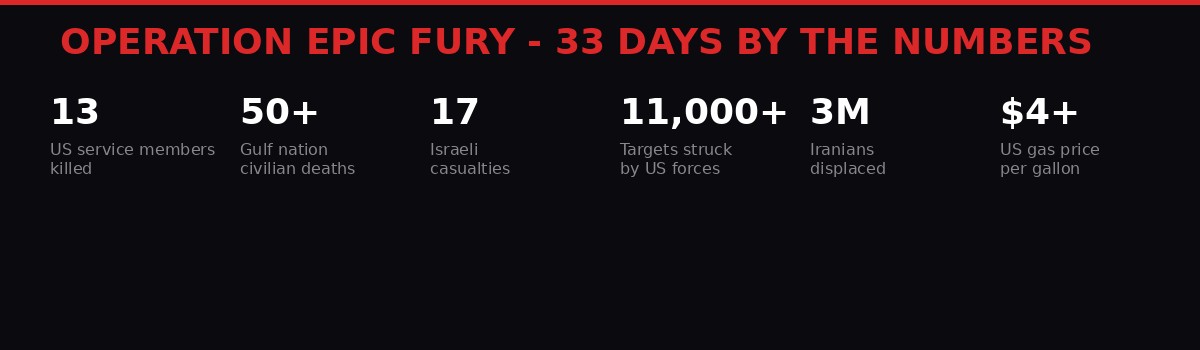
Operation Epic Fury's toll after 33 days: 13 US dead, 50+ Gulf civilian deaths, 11,000+ targets struck, 3 million Iranians displaced, gas at $4+ per gallon.
Polling shows many Americans believe the military has already gone too far. Yet more troops keep arriving. CS Monitor quoted Brad Taylor's observation about how buildup creates its own momentum: once the planning is done, once the forces are in position, the bureaucratic and institutional pressure to deploy them becomes enormous. "It's almost like, 'Well, I guess we're going to use them.'"
The Afghanistan and Iraq parallels are obvious. In both conflicts, initial air campaigns transitioned to ground operations that were described as limited and temporary. In both, those operations lasted years, then decades. The mechanisms were the same: shifting objectives, mission creep, and the discovery that breaking things from the air is fundamentally different from controlling territory on the ground.
Iran's Asymmetric Counterpunch

Iranian retaliatory strikes have hit targets across the Gulf - Dubai, Bahrain, Saudi Arabia, Kuwait. The regional escalation shows no sign of abating. Photo: Pexels
While Washington debates ground operations, Iran is fighting the war it prepared for - not the war Trump wanted. Tehran's strategy centers on making the cost of continued conflict unbearable, not on matching US firepower target for target.
On April 1 alone, Iranian missiles and drones struck across the region. Fuel tanks caught fire at Kuwait International Airport after drone hits. A tanker off Qatar's coast was struck by a missile. Bahrain's Batelco headquarters - which hosts Amazon Web Services infrastructure - was targeted. Saudi Arabia intercepted two drones. And new waves of projectiles were fired toward Israel, according to the Israeli military's real-time detection systems.
Iranian President Masoud Pezeshkian posted an English-language letter on X addressed to the American public: "Exactly which of the American people's interests are truly being served by this war?" It was a calculated information operation - an appeal over the head of the US government directly to voters already showing war fatigue in polls.
Iran's regional proxy network, though degraded, remains active. Israel launched strikes on Beirut targeting Hezbollah commanders who are supporting Iran's war effort. The Houthis in Yemen continue to threaten Red Sea shipping. The conflict's footprint extends from the Mediterranean to the Indian Ocean.
NDTV's defense analysis outlined the terrain problem facing any US ground force in Iran proper: "The Zagros mountains to the Dasht-e-Lut desert, Iran's geography could crush Trump's ground invasion plans." The country covers 1.6 million square kilometers - three times the size of Iraq. Its mountainous terrain, combined with what NDTV described as "close proximity to Iran's main defenses and total lack of natural cover" in coastal areas, makes sustained ground operations logistically nightmarish.
And Iran has not exhausted its escalation options. The Strait of Hormuz remains closed. Iranian-backed militias operate across Iraq, Syria, Lebanon, and Yemen. The regime has signaled willingness to absorb punishment indefinitely rather than capitulate to what it frames as American-Israeli aggression.
The NATO Fracture

Trump told The Telegraph he is "strongly considering" pulling the US out of NATO after allies refused to join the Iran campaign. Photo: Pexels
The Iran war has cracked open the deepest fissure in the Western alliance since the 2003 Iraq invasion - and possibly deeper. On April 1, Trump told the UK's Telegraph that he was "strongly considering" pulling the United States out of NATO after the alliance failed to join the war. He described NATO as a "paper tiger."
The threat is not entirely new. Trump has questioned NATO's value throughout his political career. But the context is different now. The US is actively at war, requesting allied support for operations including Hormuz mine-clearing, and being rebuffed. European nations, dealing with their own energy crises caused by the Hormuz closure, have calculated that joining the conflict would worsen their situation, not improve it.
The 35-nation Hormuz Summit - covered separately by BLACKWIRE - took place without a single American representative. Thirty-five nations gathered to discuss the waterway that the US went to war partly to reopen, and the US was not in the room. That absence speaks louder than any presidential address.
Australia's response is illustrative of allied discomfort. Prime Minister Anthony Albanese addressed the nation on April 1 about the war's impact on fuel supplies, urging citizens to "fill up like normal and think of others." He stopped well short of offering military support. Opposition Leader Angus Taylor criticized Albanese for not outlining a "clear plan."
The isolation is strategic. If the US sends ground troops into Iran - for any of the three missions - it will do so without meaningful allied participation. That means American logistics chains, American casualties, American responsibility. No coalition to share the burden. No multilateral legitimacy to frame the operation.
The Forgotten War Next Door

While the world watches Iran, Russia claims full control of Luhansk and Ukraine fights on with diminished international attention. Photo: Pexels
While the Iran war dominates every headline, the war that has been grinding for four years continues to chew through eastern Ukraine. On April 1 - the same day Trump addressed the nation about Iran - Russia's Defense Ministry announced it had "completed the liberation" of the Luhansk region, claiming full control of the territory for the first time since 2022.
Ukraine denied it. Viktor Trehubov, spokesperson for Ukraine's Joint Forces grouping, told AP that Ukrainian positions in Luhansk, though small, were still held. "Unfortunately, we only hold small patches there, but those positions have been held by 3rd brigade for a long time," he said. Russian battlefield claims have historically shown discrepancies - the Moscow-appointed head of Luhansk announced its full capture once before, in June 2025.
The timing is not coincidental. Russia benefits enormously from the Iran war consuming American diplomatic bandwidth. US peace talks between Russia and Ukraine, scheduled for late March, were postponed because of the Middle East conflict. Zelenskyy said he would hold a video call with envoys Witkoff and Kushner on April 1, but the meeting was overshadowed by Trump's Iran address.
The Institute for the Study of War reported that Russian forces had seized approximately 746 square miles between October 2025 and March 2026 - an average of 4.1 square miles per day, down from 5.7 the previous year. Ukrainian tactics are disrupting Russian advances, but the broader trajectory favors Moscow as long as Western attention and resources are split.
Russia launched a rare daytime drone attack on Ukraine on April 1, killing four people in the Cherkasy region and damaging energy infrastructure. Ukraine's air force reported shooting down 298 drones overnight. Zelenskyy noted the bitter irony: "We proposed a ceasefire for Easter. In response, we're getting Shaheds."
Ukrainian drones have struck Russia's Ust-Luga Baltic port five times in ten days, but the overall picture is one of a conflict grinding toward a resolution dictated by Russian territorial gains and Ukrainian exhaustion - accelerated by the Iran war pulling American resources and attention southward.
TIMELINE: 33 DAYS OF OPERATION EPIC FURY
What Happens Next

The Persian Gulf at dusk. Somewhere in these waters, 7,000 Marines are headed toward a mission that has not been publicly defined. Photo: Pexels
April 6 is the next inflection point. That is Trump's self-imposed deadline for Iran to reopen the Strait of Hormuz. If Tehran does not comply - and every signal from Iranian leadership suggests it will not - Trump faces the choice he has been deferring for 33 days: escalate with ground troops, or accept that the air campaign has reached the limits of what bombing can achieve.
The forces are in position. The plans exist. The institutional momentum is building. What is missing is the thing that should have come first: a strategy that connects military action to a political outcome. As Kaplan noted in Slate: "The combination of force without a clear end goal could be a recipe for the kind of mission creep that turned conflicts in Vietnam, Iraq, and Afghanistan into quagmires."
Trump could declare victory and leave. Senator Aiken's ghost haunts every war that lacks an off-ramp. But leaving means the Strait of Hormuz stays closed. Iran's uranium stays unaccounted for. Gas prices stay at $4 or climb higher. Midterm elections in November get harder for Republicans.
Or Trump could send in the Marines. All three missions. One at a time or simultaneously. Each one opens a new vector of risk. Each one creates new opportunities for escalation. Each one generates the kind of casualties that transform public opinion from "we've gone too far" to "bring them home now."
Seven thousand Marines are on their way to the Persian Gulf. They know how to fight. What nobody has told them - or the American public - is what victory looks like when you get there.
Get BLACKWIRE reports first.
Breaking news, investigations, and analysis - straight to your phone.
Join @blackwirenews on Telegram