Trump Says He's Winding Down the Iran War. His Pentagon Just Asked for $200 Billion.
On Friday, the president posted about ending the conflict. Within hours, three more warships were deploying, oil hit $112 a barrel, and Congress had no answers. Four weeks in, the war that started without them shows no signs of stopping.

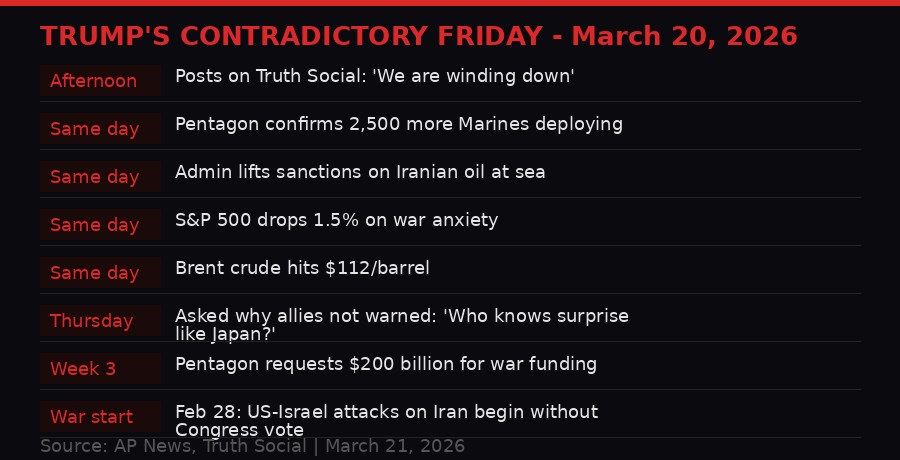
Friday afternoon, Donald Trump typed out what read like a victory announcement. "We are getting very close to meeting our objectives as we consider winding down our great Military efforts in the Middle East," the president posted to Truth Social, according to AP News. Oil markets initially bounced on the news. Then reality hit.
Within the same news cycle: the Pentagon confirmed it was sending three additional amphibious assault warships and 2,500 more Marines to the Middle East. A $200 billion supplemental budget request for the war was sitting unsigned at the White House. The S&P 500 dropped 1.5 percent. Brent crude closed above $112 per barrel. And Iran fired missiles at a joint US-UK base 4,000 kilometers away in the Indian Ocean.
That is not a war winding down. That is a war accelerating, wrapped in presidential language designed to calm markets while the military apparatus does the opposite.
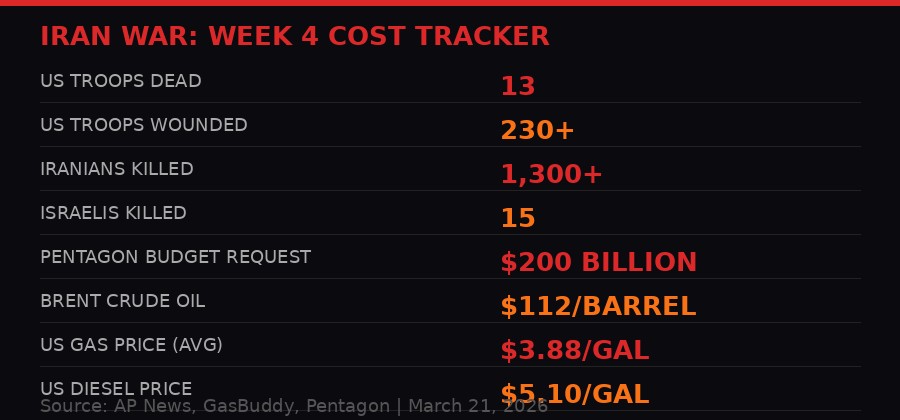
Iran War: Week 4 Scoreboard
The Contradiction at the Top

The gap between what Trump says and what his administration does has never been wider. In a 24-hour stretch Friday into Saturday, the president sent signals that pointed in at least three different directions simultaneously.
He said the US was close to its objectives and "considering" a pullback. He said the Strait of Hormuz would have to be policed by other nations - "The United States does not!" But then added the US would help if asked. He lifted sanctions on Iranian oil at sea for the first time in decades, providing financial relief to the exact government he is fighting. And his military kept deploying.
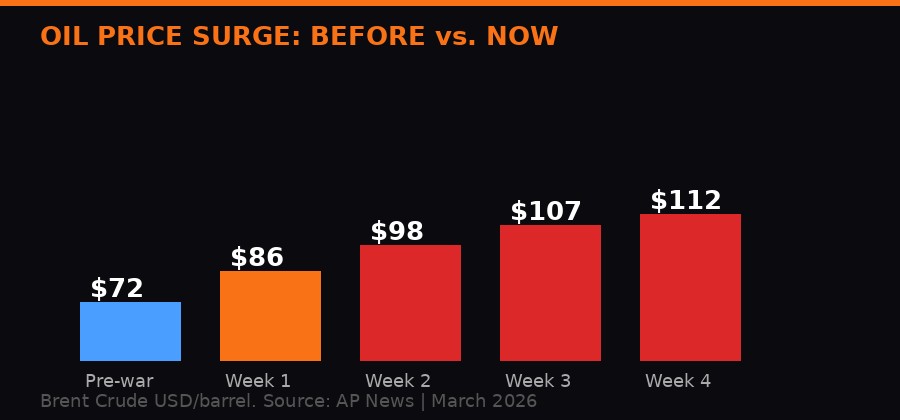
The sanctions move was explicitly an attempt to bring down soaring energy prices. Brent crude had already climbed from under $80 before the war started on February 28 to above $112. US gasoline prices hit an average of $3.88 per gallon nationally, up from $2.98 before the conflict - a roughly 30 percent increase in under four weeks. AP News reports that diesel - which drives the freight economy - had spiked 36 percent to $5.10 per gallon.
"Higher gasoline and diesel prices are now costing the US economy half a billion dollars more every single day (and rising) versus three weeks ago. A staggering rise and near record-setting." - Patrick De Haan, GasBuddy petroleum analyst, posted to X, March 17, 2026
The oil sanctions move was strange in another way: Iran replied that it "essentially has no crude oil left in floating storage." The relief valve Washington just opened may have already been empty.
The Oil Shock Is Real and Spreading

The economic consequences of the Iran war are no longer theoretical. They are arriving at checkout counters, fuel terminals, and airline booking systems across the world.
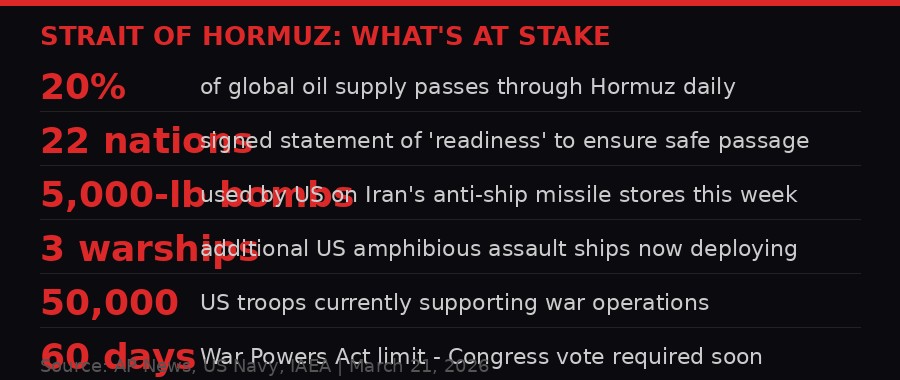
Approximately one-fifth of global oil supply passes through the Strait of Hormuz daily. Iran has turned that chokepoint into a weapon. The US Navy has attempted to degrade Iran's anti-ship missile capabilities - this week, 5,000-pound bombs struck an underground facility along Iran's coast used to store cruise missiles and mobile launchers, per CENTCOM chief Admiral Brad Cooper. Yet Iranian attacks on shipping continue.
The US, UK, Germany, France, Japan and 18 other nations issued a joint statement expressing "readiness to contribute to appropriate efforts to ensure safe passage." It is a statement of intent. Whether it means boots on ships or boots on ground remains undefined.
The economic damage does not stop at the pump. Diesel at $5.10 per gallon means trucking companies pass that cost to retailers. Retailers pass it to consumers. Food prices, Amazon delivery costs, construction materials - all of it flows downstream from the price of the fuel that moves the American economy.
California, which relies heavily on imported refined products from Asia, saw average gas prices near $5.62 per gallon Thursday. Patrick Penfield, professor of supply chain practice at Syracuse University, told AP that when gas hits $4 nationally, "that's usually the tipping point for consumers. They may not drive as much, or they may not go out." The national average is now $3.88. That tipping point is weeks, not months, away.
An Israeli strike on Iran's gas fields and an Iranian retaliation that crippled a major liquefied natural gas terminal in Qatar accelerated the damage Friday alone. The S&P 500 fell 1.5 percent. US equity markets have been volatile throughout the conflict, sensitive to every ceasefire rumor and every new military deployment announcement.
Congress Has No Plan Either

Trump launched the war against Iran without a vote of Congress. Under the War Powers Act, he can conduct military operations for 60 days before formal congressional approval is required. That clock is running.
Republicans have twice voted down Democratic resolutions to halt the campaign. They have given their president wide latitude. But the calculus is shifting. The Pentagon's $200 billion supplemental request for war funding - an "extraordinarily high number," per AP - landed on Capitol Hill this week. That number does not suggest confidence that the conflict is nearly over.
"The real question is: What ultimately are we trying to accomplish?" - Sen. Thom Tillis, R-NC, to AP News, March 2026
Tillis - a Republican, a supporter of the president - followed that up with: "I generally support anything that takes out the mullahs. But at the end of the day, there has to be a kind of strategic articulation of the strategy, what our objectives are."
That articulation has not come. The objectives keep shifting. The early rationale - prevent Iran from developing nuclear weapons - has been joined by: topple the Iranian government, degrade Iran's missile program, degrade its naval capacity, secure the Strait of Hormuz, eliminate support for armed proxies. Each new objective extends the mission.
House Speaker Mike Johnson told AP this week that "the original mission is virtually accomplished now." He said US forces had "neuter[ed] the navy" and taken out ballistic missile production. But then acknowledged Iran's continued threat to Hormuz is "dragging it out a little bit."
Trump's own framing on the endgame has been startling even to allies. When asked if there was a clear timeline, Trump said the war would end "when I feel it in my bones." Sen. Mark Warner, the top Democrat on the Senate Intelligence Committee, told AP: "When he feels it in his bones? That's crazy."
The constitutional question looms. Sixty days in means late April before Congress must formally authorize or curtail the conflict. That deadline is arriving as the war - and its costs - are still growing.
The Pearl Harbor Moment Nobody Wanted

On Thursday, a Japanese reporter asked Trump why he had not warned allies in Europe and Asia before launching the attack on Iran on February 28. The US and Israel struck Iranian territory without informing partners who would bear significant downstream consequences - oil dependency, base exposure, diplomatic fallout.
Trump's answer: "Who knows better about surprise than Japan? Why didn't you tell me about Pearl Harbor, OK?"
Japanese Prime Minister Sanae Takaichi was sitting at Trump's side as he said it, per AP News. The comment landed in Japan like a diplomatic grenade. By Saturday, it was on front pages, prompting editorials in major newspapers and debate about Japan's relationship with Washington.
"Making such a remark to justify a sneak attack and boast about its outcome is a piece of nonsense that ignores lessons from history." - Asahi Shimbun editorial, March 22, 2026
The liberal Asahi newspaper said the comment "should not be overlooked." Conservative analysts used the episode to argue that Trump sees Japan purely as a strategic asset, not as a partner. Tsuneo Watanabe of the Sasakawa Peace Foundation wrote in Nikkei that the comment signaled Trump was "not bound by existing American common sense" and appeared designed to make Takaichi "complicit" in justifying the surprise strike.
Japan's discomfort runs deeper than diplomatic embarrassment. The country hosts 50,000 US troops, relies on the American nuclear umbrella to deter China and North Korea, and is constitutionally prohibited from using military force except in self-defense. It is one of the world's most oil-dependent major economies. The Strait of Hormuz is not an abstraction in Tokyo.
The Pearl Harbor comment also arrived as Japan's own political debate about its wartime history is unresolved. PM Takaichi has hinted at visiting the Yasukuni Shrine, where Japanese war criminals are enshrined alongside the general war dead - a gesture that remains politically charged across Asia. For Trump to invoke 1941 casually, in front of her, at a White House summit, was not a gaffe so much as a signal that he simply does not operate within the usual diplomatic constraints.
Allies throughout Europe and Asia have been unsettled by the conflict from the start. Most refused Trump's request to join military operations. The UAE joined 21 other countries in a joint statement about Hormuz - but that statement is a far cry from boots on ships. The alliance architecture that characterized post-WWII American foreign policy is visibly strained.
What Natanz Means - and What the IAEA Is Not Saying

On Saturday, Iran's main nuclear enrichment site at Natanz was struck again. Iran's IAEA ambassador Reza Najafi alleged the strike was conducted by the United States and Israel. Israel's military said it was "not aware" of a strike there. The Pentagon declined to comment.
The IAEA's director-general Rafael Grossi said the agency had "no indication" that nuclear installations had been damaged. He confirmed no radiation elevation above background levels had been detected in bordering countries. Iran's judiciary news agency said there was no leakage after the strike.
But the situation at Natanz is more complicated than those reassurances suggest. According to AP, the facility had already been "functionally destroyed" by Israeli strikes in June 2025, during a previous 12-day conflict. A US follow-up attack in late June 2025 hit Natanz's underground facilities with bunker-busting bombs, "likely decimating what remained."
Before the current war, the IAEA estimated Iran had approximately 970 pounds (440 kilograms) of enriched uranium. The bulk was believed to be beneath rubble at Iran's Isfahan facility - also struck in earlier operations - with a lesser amount at Natanz. Both facilities were enriching uranium to 60 percent purity, a short technical step from the 90 percent weapons-grade threshold.
"Again they attacked Iran's peaceful safeguarded nuclear facilities yesterday. Their justification that Iran wants to develop nuclear weapons is simply a big lie." - Reza Najafi, Iran's IAEA Ambassador, Vienna, March 2026
Russia convened a special session of the IAEA Board of Governors to discuss the conflict. Russian Foreign Ministry spokesperson Maria Zakharova said the Natanz strikes posed a "real risk of catastrophic disaster throughout the Middle East." Iranian strikes on Israel's Dimona nuclear research center on Saturday - which sent shrapnel injuring several people near Tel Aviv - escalated the nuclear dimension of the conflict in a way that will be difficult to walk back.
Israel is widely believed to be the only Middle Eastern nation with nuclear weapons, though its leaders refuse to confirm or deny their existence. Iran targeting Dimona - even if it falls short of causing radiation release - is a direct message about what escalation could mean.
The Week Ahead: More Escalation, No Exit

Israeli Defense Minister Israel Katz said Saturday that Israeli attacks on Iran would "increase significantly" in the coming week. Israel's army chief Gen. Eyal Zamir told reporters: "The war is not close to ending." This is not the language of a wind-down. These are the words of commanders planning for continuation.
The divergence between Trump's Truth Social posts and the actual operational posture of his military is growing. Some 50,000 US troops are already supporting war operations. Three more amphibious assault ships and 2,500 Marines are en route. Iran has demonstrated it has missiles capable of reaching 4,000 kilometers - far beyond its previously acknowledged 2,000-kilometer range limit - by targeting Diego Garcia, the joint US-UK Indian Ocean base. Britain's Ministry of Defense described Iran as "lashing out across the region and holding hostage the Strait of Hormuz."
The Supreme Leader Ayatollah Mojtaba Khamenei, who was elevated to the role during the conflict, has not been seen publicly. No credible information has emerged about who is actually making decisions inside the Iranian state. Internet restrictions inside Iran are severe. The IAEA cannot reach Iranian nuclear authorities. The fog of war is thick on both sides of the conflict.
Saudi Arabia reported downing 20 Iranian drones in a few hours on Saturday over its eastern region, home to major oil installations. A missile alert sounded in Dubai. The Gulf states - which depend on stability for their own economic survival - are being drawn into a conflict they did not want, by a war they could not stop.
The War Powers Act clock is ticking toward late April. Congressional Republicans are increasingly asking for a strategy document, not just a tweet. The Pentagon's $200 billion request needs to be approved or rejected. And oil - the economic nerve running through all of it - is sitting at $112 a barrel with no credible path downward as long as Hormuz remains contested.
Trump's "winding down" post may have been aimed at markets, or at domestic polling, or at allies pressing for a timeline. What it was not was a military plan. The generals are still deploying. The missiles are still flying. The price at the pump is still climbing.
The war that started without a congressional vote, without warning allies, without a clear endgame, is now entering its fifth week with all three problems unresolved.
The Numbers Behind the War
The war's scale is staggering for a conflict now in its fourth week. Thirteen US military personnel dead. Over 230 wounded. More than 1,300 Iranians killed, 15 Israelis dead from Iranian missiles, four more killed in the occupied West Bank. The human cost is compounding alongside the financial one.
Brent crude at $112 per barrel - up from approximately $72 before the conflict began - represents a roughly 55 percent price increase in under a month. US diesel up 36 percent. US gas up 30 percent. Patrick De Haan of GasBuddy calculated the US economy is now paying half a billion dollars more per day in energy costs compared to three weeks ago.
The macroeconomic feedback loops are beginning. Airlines have started raising fares. Freight costs are climbing. Supply chain managers are reporting upstream pressure on nearly every product category that requires transportation. The consumer tipping point - historically around $4 per gallon - is weeks away at the current trajectory. When it arrives, spending pulls back. Retail suffers. The recession risk that economists have been hedging around becomes harder to dismiss.
None of that is in Trump's Truth Social post about winding down. The gap between the message and the reality is the defining feature of week four.
Get BLACKWIRE reports first.
Breaking news, investigations, and analysis - straight to your phone.
Join @blackwirenews on Telegram