Iraq's Impossible Neutrality: Day 30 of the Iran War and the Front No One's Watching
PMF bases hit near Kirkuk. The Kurdish region's president targeted in his own home. A US airbase in Saudi Arabia absorbs six ballistic missiles and 29 drones. Kuwait's airport radar knocked out. And somewhere in an Islamabad conference room, diplomats are shuffling papers that no missile respects. Thirty days into the war on Iran, the conflict has done what wars always do: it has spread.

The war on Iran has entered its second month with no diplomatic off-ramp in sight. Photo: Pexels
The headlines on Day 30 belong to the Houthis - their first missile salvos against Israel in this war, a dramatic entry that dominated Saturday's news cycle. But the more structurally important story is quieter and more dangerous: Iraq is disintegrating as a neutral party, and no one has a plan for what happens when Baghdad fully breaks.
The US and Israel want access to Iraqi airspace and, in some cases, Iraqi soil for staging operations. Tehran wants the 67,000-strong Popular Mobilisation Forces to keep attacking US assets and keep the pressure on. And Baghdad - a government that owes its political survival to both Washington and Tehran - is caught in a vice that tightens with every airstrike.
Al Jazeera's Nicolas Haque, reporting from Baghdad, described Iraq as an "expanding battleground." That is not a metaphor. It is a military fact.
The PMF: Iraq's Uncontrollable Variable

Pro-Iran armed factions within the PMF have been targeted repeatedly. Their response has been to escalate. Photo: Pexels
The Popular Mobilisation Forces were born in 2014 from a fatwa issued by Grand Ayatollah Ali Sistani in Najaf - a religious decree calling on Iraqis to take up arms against the advancing Islamic State. They worked. ISIS was beaten back. The PMF became war heroes.
Then they became a problem.
The organisation now numbers more than 67,000 fighters organised into dozens of distinct factions. Some factions, particularly those aligned with Muqtada al-Sadr's political movement, have sought to maintain at least nominal independence from Tehran. Others - the Badr Organisation, Kataib Hezbollah, Asaib Ahl al-Haq - are openly funded, trained, and directed by the Islamic Revolutionary Guard Corps. They were formally integrated into the Iraqi Army in 2016, which means their payroll runs through Baghdad. But their loyalties run through Tehran.
When the US and Israel launched their strikes on Iran on February 28, the pro-Iran PMF factions didn't wait for orders from Baghdad. They began attacking US interests within days - bases in Iraq, logistics chains, and what sources describe as coordination with Iranian planners on regional targeting priorities.
Washington responded the only way it knows how: with airstrikes.
On Saturday, two separate strikes hit PMF positions in northern Iraq. A double strike on the PMF's headquarters near Kirkuk Airport killed three fighters and wounded two others. Two Iraqi police officers died in a separate strike near Mosul, approximately 170 kilometres northwest of Kirkuk. An Iraqi security source told Al Jazeera that six Iraqi soldiers were also wounded in the Kirkuk attack.
The PMF's official statement called the dead "martyrs" who were "subjected to a treacherous Zionist-American" attack. That language is standard PMF rhetoric. What is not standard is that these men were formally integrated Iraqi security forces. The United States did not bomb a militia. It bombed a unit of the Iraqi Army.
"That makes it very difficult for Baghdad to hold all of this together. Up until the war, the government successfully brought everybody around the table and was able to manage the different factions." - Al Jazeera's Nicolas Haque, reporting from Baghdad, March 28, 2026
Iraq's foreign ministry has summoned the US envoy over previous strikes. This will likely produce another summons. What it will not produce is any change in US targeting policy. The strikes on PMF positions are not accidents or miscalculations. They are deliberate. Washington has decided that the cost of allowing pro-Iran forces to operate with impunity inside Iraq outweighs the diplomatic damage of bombing the Iraqi Army's own units.
Baghdad has so far absorbed each provocation without openly breaking with either side. That capacity for absorption is finite. Each strike narrows the government's room to manoeuvre.
The Kurdish Assassination Attempt

Drones have become the signature weapon of the expanded regional conflict. Photo: Pexels
Saturday produced a development that goes beyond routine targeting of military assets. A drone struck the private residence of Nechirvan Barzani, president of Iraq's semi-autonomous Kurdistan Regional Government, in the western town of Duhok.
Barzani was not killed. But the message was unmistakable.
Kurdistan has been broadly friendly to the United States for decades. The Erbil government hosts a US and coalition forces hub near Erbil airport. On Saturday, that base was targeted by two drones, which were intercepted by the US C-RAM air defence system. The attack on Barzani's home came hours later - a personal warning rather than a military strike.
Masrour Barzani, prime minister of the Kurdish Regional Government and Nechirvan's cousin, called the attack "outlaw criminal terrorism" and demanded federal Baghdad bring those responsible to justice. He said, pointedly, that he was "calling on the federal government to act on its responsibility" - a rhetorical move that underlines exactly how little Baghdad can do to restrain the pro-Iran factions responsible.
French President Emmanuel Macron spoke directly to Nechirvan Barzani after the attack, posting on X that increased attacks in Iraq were "a worrying development." That description - one of the great examples of diplomatic understatement - reflects how far French policy has drifted from doing anything substantive to stop what's happening.
The attack on the Kurdish president's residence is significant for what it signals about the war's logic. The pro-Iran factions are no longer confining themselves to military targets. They are sending messages to political leaders, regional governments, and anyone else perceived as tilting toward the US-Israel axis. The message is: nowhere in the region is safe from retaliation.
The Gulf States Under Fire

Gulf states that host US military bases have become targets. Kuwait's international airport radar was knocked out Saturday. Photo: Pexels
Kuwait's international airport was hit by multiple Iranian drone attacks early Saturday morning. The strikes caused significant damage to the airport's radar system, grounding flights and forcing the Civil Aviation Authority to issue an emergency operations statement. The attack produced no casualties, according to Kuwaiti state news agency Kuna. Kuwait's Civil Aviation Authority attributed the attack to "Iran, its proxies, and the armed factions it supports."
In Abu Dhabi, strikes caused debris to fall near the Khalifa Economic Zone adjacent to Khalifa Port. Six people were injured. Three fires broke out and were brought under control. Iran's military separately claimed it struck what it called a Ukrainian anti-drone system depot in Dubai, alleging the Ukrainian equipment was there to support US military operations. Ukraine's Foreign Ministry denied the claim.
Two drones hit Oman's port of Salalah in the southern Dhofar province, injuring one person and damaging a crane. Danish shipping giant Maersk suspended operations at Salalah for 48 hours.
Saudi Arabia reported intercepts of a ballistic missile and multiple drones on Saturday. This came a day after Iran launched what US officials described as a serious attack on Prince Sultan Air Base - at least six ballistic missiles and 29 drones. At least 15 American soldiers were wounded, with five reportedly in serious condition. The attack on a Saudi base hosting US forces is the most direct confrontation between US personnel and Iranian military power since the war began.
"To the countries of the region: If you want development and security, don't let our enemies run the war from your lands." - Iranian President Masoud Pezeshkian, posted on X, March 28, 2026
Pezeshkian's statement - addressed to the Gulf monarchies that host American bases - is both a warning and a statement of intent. Iran cannot dislodge those bases militarily. But it can make the cost of hosting them prohibitive enough that political pressure builds within the Gulf states themselves. Kuwait's airport radar is not a military target. It is a population centre demonstration - look what we can hit, and look what your citizens endure while your government keeps the Americans here.
Bahrain activated air raid sirens multiple times Saturday without reporting casualties. The psychological effect on a small, densely populated island nation is exactly the point.
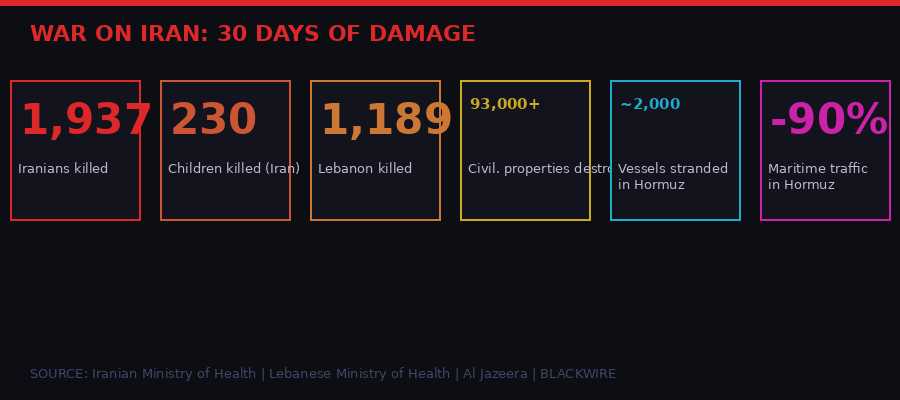
30 days of the US-Israel war on Iran: the human and economic toll. Source: Iranian Ministry of Health, Lebanese Ministry of Health, Al Jazeera.
Iran's Nuclear Response: The NPT Exit Gambit

US-Israeli strikes have hit the Yellowcake facility in Yazd, the Khondab Heavy Water Complex, and nuclear sites near the Bushehr power plant. Photo: Pexels
While the conventional war grinds on, a quieter but more consequential escalation is taking shape inside Iran's parliament.
Ebrahim Rezaei, spokesman for the national security commission of parliament, posted on X Friday night that it would be meaningless for Iran to remain a signatory to the Treaty on the Non-Proliferation of Nuclear Weapons. "It has had no benefit for us," he wrote. A member of parliament from Tehran, Malek Shariati, confirmed that a priority piece of legislation has been formally uploaded to the parliamentary portal for review.
The proposed legislation is sweeping. It would withdraw Iran from the NPT entirely, revoke the legal framework establishing nuclear restrictions tied to the now-collapsed 2015 JCPOA, and authorise Iran to develop new international nuclear agreements with aligned nations in the Shanghai Cooperation Organisation and BRICS bloc.
This is not an idle parliamentary gesture. The bill reflects months of mounting pressure from hardliners who have been demanding since at least September 2025 that Iran respond to external pressure by developing a nuclear deterrent. Now, with the Khondab Heavy Water Complex bombed, the Yellowcake facility in Yazd targeted, and projectiles landing near the Bushehr Nuclear Power Plant - raising fears of a Chernobyl-scale radiological incident, per IAEA warnings - the argument that treaty membership has protected Iranian nuclear infrastructure is impossible to make.
The IAEA has been caught in an impossible position. Director Rafael Grossi told CBS News earlier this month that no conventional war could completely destroy Iran's nuclear programme "unless it was nuclear war and you go for destruction unfathomable." Iranian officials have seized on that statement, accusing Grossi of providing tacit encouragement to the attackers. Senior adviser Mohammad Mohkber called Grossi "a partner in crime in blood spilled."
For the NPT exit bill to take effect, it would need to clear the Guardian Council - the 12-member constitutional body that reviews legislation for compatibility with Islamic principles and constitutional law. Hardliners control sufficient influence to push this through if the political will exists. That will is building.
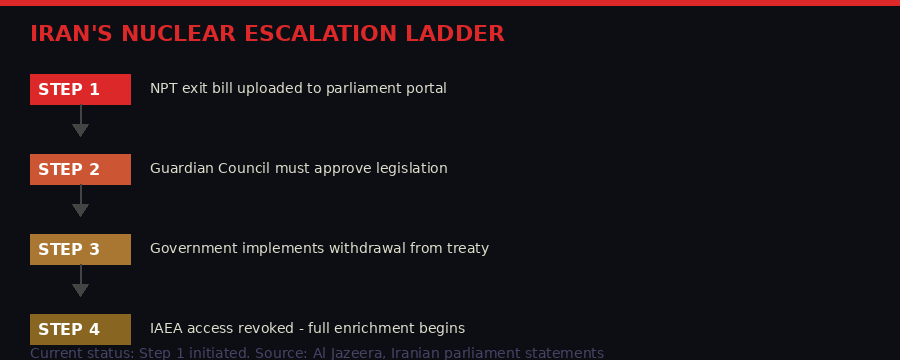
Iran's NPT exit process: where the legislation stands and what comes next. Source: Al Jazeera, Iranian parliamentary records.
The implications extend beyond Iran. If Tehran withdraws from the NPT and begins unrestricted enrichment, the already-shattered non-proliferation architecture collapses permanently. Saudi Arabia has previously stated it would pursue nuclear capability if Iran developed a weapon. Turkey has signalled similar intent in private diplomatic communications. The 30-year project of preventing nuclear spread in the Middle East would be over within a decade.
Lebanon: Advancing Boots, Dying Press

Three journalists were killed in a clearly marked press vehicle in southern Lebanon on Saturday. Photo: Pexels
The war's Lebanon front continues to produce casualties at a pace that has normalised the extraordinary. The Lebanese Ministry of Health confirmed Saturday that 1,189 people have been killed in Israeli attacks since March 2. More than 3,300 have been injured.
Saturday added three more names to the press dead. Fatima Ftouni and her brother Mohammed Ftouni, both correspondents for Al Mayadeen, and Ali Shuaib of Al-Manar were killed when four precision missiles struck their clearly marked press vehicle on the Jezzine Road in southern Lebanon. The Israeli military acknowledged the strike, claiming Shuaib was embedded with a Hezbollah intelligence unit tracking Israeli troop positions and distributing Hezbollah propaganda. Al-Manar described Shuaib as one of its most prominent war correspondents of three decades. Neither network accepted Israel's characterisation.
The Committee to Protect Journalists recorded 129 journalists killed globally in 2025 - a record since CPJ began keeping data. Israel was responsible for two-thirds of those deaths. It has now killed more journalists than any other nation in CPJ's recorded history.
Fatima Ftouni had been covering the war from the field in southern Lebanon. Earlier this month, her uncle and his family were killed in an Israeli strike. She reported their deaths live on air. Now she is among them.
On the same day, nine paramedics were killed in five separate attacks across southern Lebanon. The WHO's director-general Tedros Adhanom Ghebreyesus confirmed the toll. Attacks struck Zoutar al-Sharqiya, Kfar Tibnit, Ghandouriyeh, Jezzine, and Kfar Dajjal. Four hospitals and 51 primary healthcare centres in southern Lebanon are now closed entirely. Several others operate at reduced capacity.
"All the journalists that I'm speaking to here today say that they were just doing their job, and that the journalists that are still here are going to continue to carry out their work despite the obvious dangers." - Al Jazeera's Obaida Hitto, reporting from Tyre, southern Lebanon, March 28, 2026
Israeli troops have pushed further into southern Lebanon, advancing toward the Litani River in what Israeli military doctrine frames as the "Gaza model" - a systematic push to create a buffer zone by displacing the population and destroying the infrastructure that sustains it. Around 20 percent of southern Lebanon's population has refused to leave despite repeated Israeli displacement orders. Al Jazeera described their decision as "a very deadly gamble."
Hezbollah claimed dozens of operations against Israeli forces in the past 24 hours. An Israeli airstrike killed one Lebanese Army soldier in Deir al-Zahrani, raising the question of when Israeli ground advances will provoke a direct confrontation with Lebanese state forces rather than just Hezbollah.
The Hormuz Tightrope: Pakistan's Shipping Deal and What It Reveals

Maritime traffic through the Strait of Hormuz is down 90 percent. An estimated 2,000 vessels are stranded on either side. Photo: Pexels
Pakistani Foreign Minister Ishaq Dar announced Saturday that Iran has agreed to allow 20 Pakistani-flagged vessels to transit the Strait of Hormuz, two ships per day. He addressed his announcement directly on X to US Vice President JD Vance, Secretary of State Marco Rubio, US envoy Steve Witkoff, and Iranian Foreign Minister Abbas Araghchi - a signal that Islamabad views this as a diplomatic building block toward something larger.
The deal is tiny against the scale of the crisis. Maritime traffic through Hormuz is down 90 percent since the war began. An estimated 2,000 vessels remain stranded on either side. Oil sits above $100 a barrel, roughly 40 percent above pre-war levels. WTO head Ngozi Okonjo-Iweala said global trade is experiencing its "worst disruptions in the past 80 years."
What the Pakistani deal reveals is the mechanism Iran has constructed: a toll road. Ships seeking transit must submit cargo details, crew lists, and destinations to IRGC-approved intermediaries, receive a clearance code, and accept an IRGC escort through Iranian territorial waters. At least two vessels have paid passage fees reportedly running to $2 million per crossing, paid in Chinese yuan. Iran's parliament is now moving to formalise this arrangement as a permanent revenue source.
The IRGC has effectively turned one of the world's most critical waterways into a checkpoint. Malaysian ships have been permitted passage after Prime Minister Anwar Ibrahim thanked President Pezeshkian personally. Pakistani ships now have a deal. The pattern suggests Iran is willing to negotiate passage on a case-by-case basis with nations that are not directly hostile - while maintaining enough disruption to keep oil prices elevated and Western economies under pressure.
Trump has threatened to hit Iranian power stations if Tehran does not fully open Hormuz, then extended his own deadline twice. The current window closes Saturday. Israel has said its strikes will continue regardless of any US-Iran diplomatic timeline. That gap between American pressure and Israeli operations is itself a structural problem - Tehran cannot negotiate with two parties that are not negotiating with each other.
Meanwhile, in Islamabad, foreign ministers from Saudi Arabia, Turkey, and Egypt gathered Saturday for talks aimed at ending the war. Pakistan's foreign minister called Iranian counterpart Abbas Araghchi late Saturday, urging "an end to all attacks and hostilities." US envoy Steve Witkoff said he had "a 15-point plan on the table" and expected an Iranian response within days. Trump's approval ratings are deteriorating as the war's unpopularity grows ahead of November midterms.
The Iraq Problem No One Has Answered

Baghdad is trying to manage factions loyal to both Tehran and Washington. The space for that manoeuvre is disappearing. Photo: Pexels
Return to Iraq. Because the Iraq problem is not going away.
Baghdad's government holds together because it must - any collapse of central authority would benefit ISIS remnants, regional militias, and Iranian proxies equally. Prime Minister Mohammed Shia' Al-Sudani has spent two years carefully managing the competing demands of Washington and Tehran, extracting concessions from both while keeping Iraq out of direct confrontation with either.
That equilibrium has now been shattered.
When US aircraft bomb units of the Iraqi Army - even units whose true loyalty runs to Tehran - the Iraqi government's position becomes untenable. It cannot endorse the strikes without losing its nationalist credentials and its coalition with PMF-aligned parties. It cannot condemn the strikes without risking US support and the security guarantees that keep the government in power. Summoning ambassadors is the only tool left, and it is not a tool that changes anything on the ground.
The attack on Nechirvan Barzani's residence in Duhok made the situation worse. The Kurdish Regional Government has long been the most pro-American constituency in Iraq, offering the US its most reliable base infrastructure in the country. If the Kurds come under direct personal attack from pro-Iran forces, and Baghdad cannot stop those attacks, the KRG faces pressure to either further entrench its security relationship with the US - deepening the split with Baghdad - or to pull back from that relationship to reduce its targeting profile.
Neither option leaves Iraq more stable.
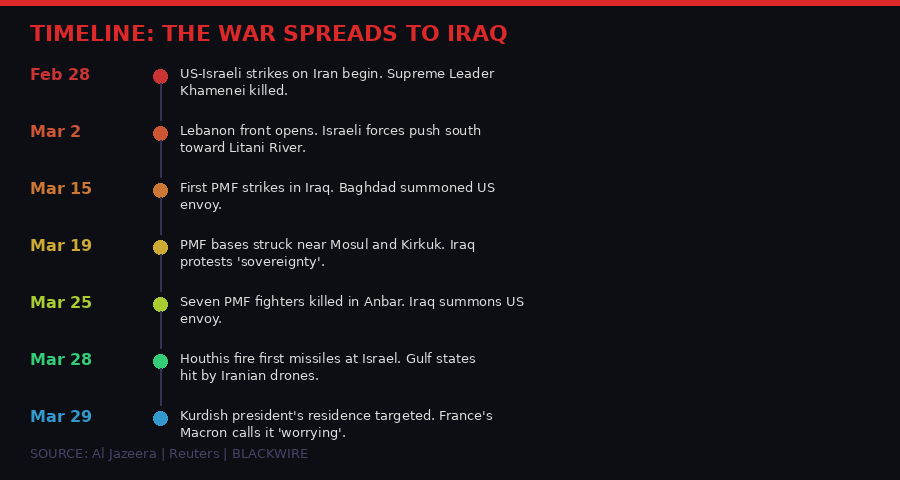
How the US-Israel war on Iran expanded into an Iraqi battleground. Source: Al Jazeera, Reuters, BLACKWIRE.
There are roughly 2,500 US military personnel in Iraq, down from a peak of 170,000 during the occupation. They occupy a legally ambiguous position - present under an agreement that the Iraqi parliament has repeatedly voted to revoke, but which the executive has never fully implemented. Every US strike on PMF forces provides fresh ammunition to Iraqi politicians who want that agreement terminated. If Washington pushes too hard, it risks losing its Iraqi basing entirely - which would significantly complicate any ground operations against Iran.
The US is threading a needle in Iraq that gets thinner with every strike. Hit the PMF too rarely, and they continue attacking US assets. Hit them too hard, and Baghdad breaks with Washington entirely. There is no comfortable middle ground when the targets are formally incorporated into the Iraqi state.
Day 30: What the Numbers Say
Iran's Ministry of Health confirmed 1,937 Iranians killed since February 28, including 230 children. Iran's Red Crescent Society said more than 93,000 civilian properties have been damaged. Iran's internet remains almost entirely blocked - only an intranet operates, limiting the flow of information to state-run channels. A total internet blackout ran for 20 days in January; the current information lockdown is now in its fifth week.
Iran's steel industry has been severely damaged. Both the Mobarakeh complex in Isfahan and the Khuzestan complex in Ahvaz - the country's two largest steel producers - were targeted Friday. The Ahvaz complex announced suspension of production. These facilities represent the backbone of Iran's non-oil export economy, worth billions in annual revenue. Thousands of workers face unemployment in a country already running 70 percent annual inflation.
The war has created what amounts to a humanitarian siege of 90 million people. No free internet. Steel production halted. Nuclear infrastructure bombed. Oil revenues choked by its own government's Hormuz blockade. Residential areas struck nightly in Tehran, Karaj, Tabriz, Yazd, Shiraz, and Shahr-e Rey.
And inside the country, armed state forces have occupied city streets since the protests of January - protests in which thousands were killed, according to regime accounts attributing the violence to "terrorists." No independent verification is possible because no independent verification is permitted.
Trump says negotiations "are going very well." Iran's parliament is drafting legislation to exit the nuclear non-proliferation treaty. These two positions are not compatible. One of them is wrong.
The Islamabad summit and Pakistan's Hormuz deal suggest that regional powers believe a diplomatic exit is still achievable. The pace of bombardment suggests the US-Israeli military campaign believes it can force a favourable outcome before diplomacy closes the window. Iraq's disintegrating neutrality, the targeting of a Kurdish president, the killing of Lebanese journalists, and Houthi missiles over Israel suggest the window is not closing - it is already gone.
Day 31 begins at midnight. The war will still be there.
Get BLACKWIRE reports first.
Breaking news, investigations, and analysis - straight to your phone.
Join @blackwirenews on Telegram