GHOST BUREAU - WAR & CONFLICT
The Launchpad: How Iraq Became Iran's Proxy War Staging Ground Against the Gulf
March 31, 2026 | 00:15 CET | Day 31 of the Iran War
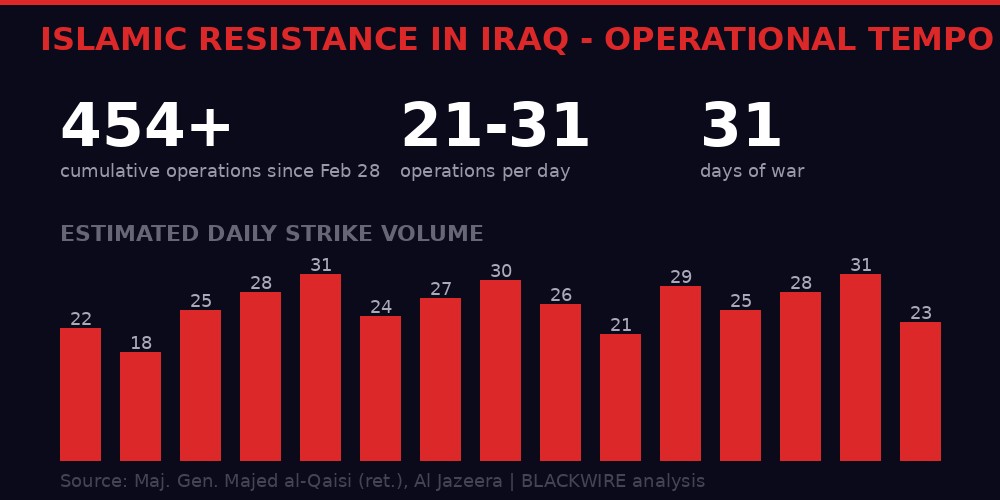
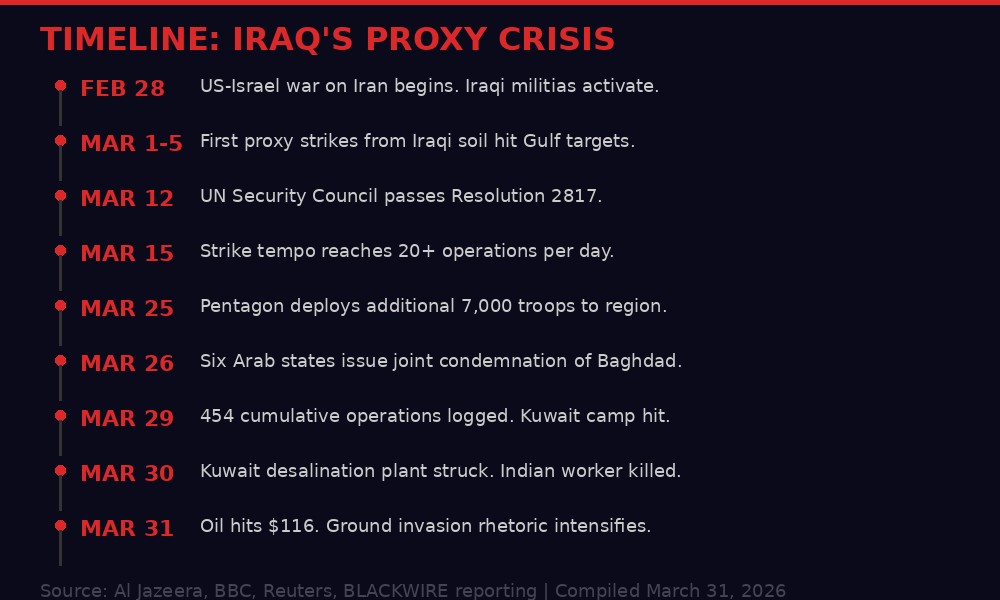
454 operations in 31 days. 21 to 31 strikes every 24 hours. Drones and missiles screaming out of the Iraqi desert toward Kuwait, Saudi Arabia, the UAE, Bahrain, Qatar, and Jordan. Six Arab nations now hold Baghdad responsible. And Iraq's government can do nothing to stop it.

The night sky over the Gulf has become a theater of drone and missile fire originating from Iraqi territory. Photo: Pexels
Somewhere in the western desert of Iraq's Anbar province, a launcher tilts skyward. The coordinates loaded into its guidance system point to a power plant in Kuwait City, 400 kilometers to the south. The men operating it do not wear Iraqi army uniforms. They answer to commanders in Tehran. And when the missile arcs into the Kuwaiti night, the Iraqi government in Baghdad will issue a statement condemning the violence while doing exactly nothing to prevent the next one.
This is the state of Iraq in the fifth week of the US-Israel war on Iran. A sovereign nation - at least on paper - whose territory has been transformed into the primary staging ground for Iranian proxy forces waging a parallel conflict against every Gulf state within range. The numbers are staggering. According to retired Iraqi Major General Majed al-Qaisi, groups operating under the umbrella of the Islamic Resistance in Iraq have carried out more than 454 cumulative operations since the war began on February 28, maintaining a daily tempo of 21 to 31 strikes against targets across the Arabian Peninsula and Jordan (Al Jazeera, March 30, 2026).
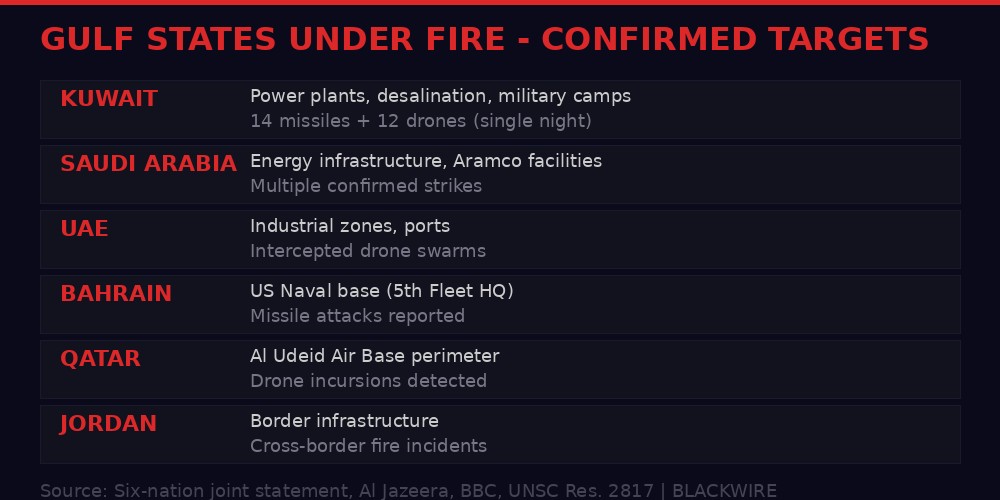
On Monday, the consequences arrived in lethal form. An Iranian strike hit a power and water desalination plant in Kuwait, killing an Indian worker and causing what Kuwait's Ministry of Electricity described as "significant material damage" to the facility. Hours earlier, Kuwait's Defense Ministry reported that 14 missiles and 12 drones were detected in its airspace in a single evening, with several targeting a military camp and injuring 10 Kuwaiti servicemen (Al Jazeera, March 30, 2026). These are not isolated incidents. They are the daily reality of a region under sustained bombardment from a country that claims to want nothing to do with the war.
I. The Architecture of Deniability

Iraq's western desert provides vast, ungovernable terrain for militia launch operations. Photo: Pexels
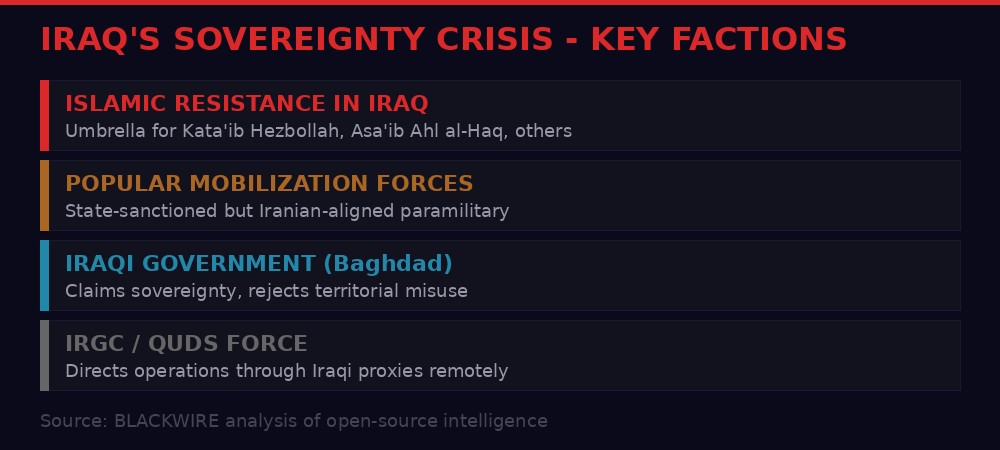
Tehran's use of Iraqi proxy forces is not improvisation. It is a doctrine refined over two decades, from the Mahdi Army's insurgency against US forces in the 2000s to the Islamic State campaign of 2014-2017, which gave Iran the pretext to embed its militia networks permanently into Iraq's security architecture through the Popular Mobilization Forces (PMF). The PMF was formally incorporated into Iraq's military structures after 2017, but the chain of command for its most powerful factions runs directly to Iran's Islamic Revolutionary Guard Corps (IRGC) and its Quds Force.
The groups currently firing missiles and launching drones toward the Gulf operate under the banner of the Islamic Resistance in Iraq, an umbrella designation that includes Kata'ib Hezbollah, Asa'ib Ahl al-Haq, Harakat Hezbollah al-Nujaba, and several smaller factions. Each maintains its own command structure, recruitment pipeline, weapons stockpiles, and communication channels with IRGC handlers. Each claims to act out of ideological solidarity with Iran. Each knows that Baghdad will not - cannot - stop them.
Khaled al-Jaber, director of the Middle East Council on Global Affairs in Doha, described the strategy in precise terms to Al Jazeera: "Iran is not withdrawing from the confrontation; rather, it is redistributing it through tools that are less politically costly." The logic is elegant in its brutality. Direct Iranian strikes against Gulf states carry immediate legal and diplomatic consequences under international law. Strikes launched from Iraqi soil by nominally independent armed groups create a fog of attribution that buys Tehran time and plausible deniability.
The system works like this: IRGC Quds Force officers provide targeting data, weapons systems, and operational guidance to Iraqi commanders. The Iraqi groups execute the strikes from positions deep inside Iraq's western and southern deserts - terrain so vast and ungovernable that even a fully functional Iraqi military would struggle to monitor it. When the missiles land in Kuwait or Saudi Arabia, Iran can claim ignorance, blame "independent resistance fighters," or - as happened on Monday - accuse Israel of false-flag operations. After the Kuwait desalination plant strike, Iran's military operational command Khatam al-Anbiya released a statement calling it "brutal aggression by the Israeli regime" carried out "under the pretext of accusing the Islamic Republic" (Al Jazeera, March 30, 2026).
Nobody in the Gulf buys it. The six-nation joint statement issued last Wednesday by Saudi Arabia, the UAE, Qatar, Kuwait, Bahrain, and Jordan made that clear. They cited UN Security Council Resolution 2817, which specifically mandates Iran halt all attacks on neighboring countries, and they held Baghdad - not just Tehran - directly responsible for what is being launched from Iraqi territory.
II. Baghdad's Impossible Position

Baghdad faces mounting international pressure while lacking the military capacity to confront Iran-aligned militias. Photo: Pexels
Iraq's government is trapped in a contradiction it cannot resolve. Prime Minister Mohammed Shia al-Sudani came to power in 2022 with the explicit backing of the Coordination Framework, a parliamentary alliance dominated by Iran-aligned Shia parties. His government depends on these factions for legislative support. Several of the militia leaders whose forces are currently firing missiles into Kuwait hold seats in Iraq's parliament or occupy senior positions within government ministries. Ordering the Iraqi army to confront them militarily would mean ordering the state to attack itself.
Baghdad's response to the six-nation condemnation was carefully calibrated to say everything and commit to nothing. The Ministry of Foreign Affairs stated that the security of Arab countries is "an integral part" of Iraq's national security. It "categorically rejected" the use of Iraqi territory to target Gulf states. It expressed "full readiness" to receive evidence regarding the attacks. And it promised to act "responsibly and swiftly" - phrasing that every diplomat in the region understood as a delaying tactic. Retired Major General al-Qaisi told Al Jazeera that Baghdad's response "appeared aimed more at addressing diplomatic embarrassment than as a proactive security measure."
The structural problem runs deeper than politics. Iraq's conventional military, rebuilt after the devastation of the ISIS war, remains smaller and less capable than the combined militia forces that theoretically fall under its command. The PMF fields an estimated 100,000 to 150,000 fighters, many of them battle-hardened veterans of both the ISIS campaign and earlier conflicts. The Iraqi army's effective strength is roughly equivalent, but its command structure is fragmented, its equipment aging, and its officers reluctant to engage in what would amount to a civil war against forces that many Iraqis consider patriotic defenders of the nation.
There is also the matter of geographic reality. Iraq shares a 1,458-kilometer border with Iran. The western and southern deserts where militia launch sites are concentrated span tens of thousands of square kilometers of flat, featureless terrain where a pickup truck mounted with a multiple rocket launcher can fire, relocate, and disappear within minutes. Even the US military, with its satellite surveillance and drone fleet, found it difficult to track mobile launch vehicles in this terrain during the 2003 war. Iraq's military has a fraction of those capabilities.
Ahmed Abdel Mohsen al-Mulaifi, a former Kuwaiti minister and member of parliament, drew the logical conclusion: a state hosting armed groups operating outside the law "cannot be considered fully sovereign." It is a blunt assessment, but it reflects the increasingly open frustration of Gulf capitals with Baghdad's inability to control what happens within its own borders.
III. The Gulf Under Bombardment

Gulf desalination plants and energy infrastructure have become primary targets. The region produces 40% of the world's desalinated water. Photo: Pexels
The scale of what Gulf states are absorbing deserves clear documentation. Since February 28, cross-border strikes from Iraqi territory and direct Iranian attacks have targeted energy infrastructure, military installations, industrial facilities, and civilian sites across six countries. The attacks have killed at least 25 people in GCC member states, according to Iranian Health Ministry figures cited by Al Jazeera, though Gulf governments have not released comprehensive casualty counts.
Kuwait has borne the heaviest burden. Monday's strike on the desalination plant killed one Indian worker and damaged the facility's service building. But this was merely the latest in a sustained campaign. Kuwait's Defense Ministry has documented dozens of drone and missile incursions since the war began, including the March 30 incident where 14 missiles and 12 drones entered Kuwaiti airspace in a single evening. Ten servicemen were injured in a separate attack on a military camp the previous night. The targeting of water desalination infrastructure is particularly alarming. Al Jazeera's Zein Basravi, reporting from Dubai, noted that the Gulf region produces 40 percent of global desalinated water, and that this water is where Gulf cities "get their potable drinking water from." A successful strike that knocked a major desalination plant offline would create a humanitarian crisis within days.
Saudi Arabia has intercepted multiple drone swarms and missile attacks targeting its eastern provinces, where the kingdom's oil infrastructure is concentrated. The six-nation statement specifically referenced attacks on "civilian infrastructure" - language that Gulf diplomats told Al Jazeera was directed at both Iranian strikes and Iraqi proxy operations that had hit non-military targets. Saudi foreign ministry statements have grown progressively more hostile toward Baghdad, with the most recent calling Iran's approach "an unjustifiable hostile approach" that constitutes "a clear violation of international laws and norms."
The UAE, Bahrain, Qatar, and Jordan have all reported drone incursions, attempted missile strikes, or near-misses that their air defense systems intercepted. Bahrain, which hosts the US Navy's Fifth Fleet headquarters, has faced particular pressure, as Iranian forces view it as both an American military asset and a strategic target. Qatar's Al Udeid Air Base, the largest US military facility in the Middle East, has seen increased security alerts, though neither the Qatari nor American governments have confirmed direct strikes on the base.
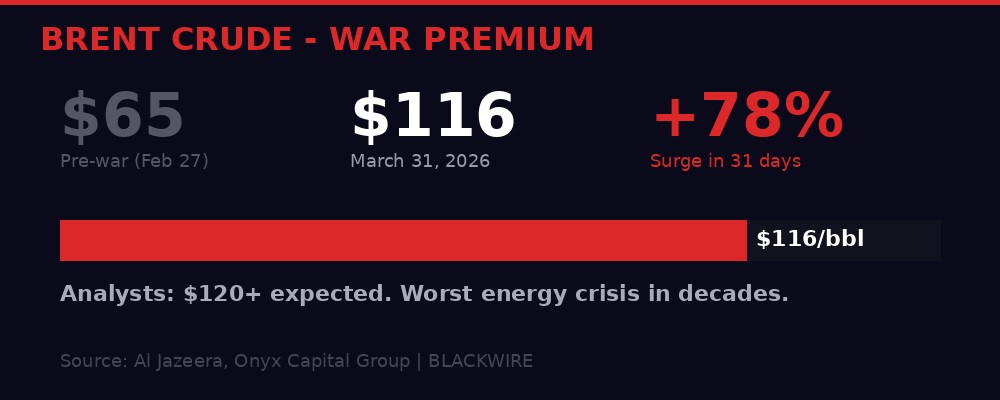
The economic damage extends beyond physical destruction. The ongoing attacks have compounded the energy crisis triggered by Iran's effective closure of the Strait of Hormuz. Brent crude surged above $116 per barrel on Monday - a nearly 78 percent increase from the pre-war price of roughly $65 per barrel. Greg Newman, CEO of Onyx Capital Group, told Al Jazeera that markets still had not fully priced in the disruption: "No one in the market has ever seen the outages we are now suffering from. Physical premiums are the highest ever. The reality will come out in the economic numbers over the coming months."
IV. The Legal Framework: Resolution 2817 and Article 51

UN Security Council Resolution 2817, passed on March 12, mandates Iran halt all attacks on neighboring countries. Enforcement remains the question. Photo: Pexels
The legal architecture surrounding Iraq's proxy crisis is unusually well-defined for a conflict this chaotic. UN Security Council Resolution 2817, adopted on March 12, 2026, specifically condemns Iranian attacks on neighboring states and mandates an immediate halt to all cross-border military operations. The resolution passed with the support of all five permanent members, including Russia and China, reflecting the severity of the threat to global energy infrastructure and maritime commerce.
The six Arab states invoked Resolution 2817 in their joint condemnation, alongside Article 51 of the UN Charter - the provision that affirms the right of self-defense when an armed attack occurs against a member state. The explicit citation of Article 51 is not diplomatic boilerplate. It is a legal predicate for military action. By invoking it publicly, the six nations were signaling that they consider themselves legally justified in striking back - not just at Iranian forces, but potentially at launch sites inside Iraq.
This is where the situation becomes existentially dangerous for Baghdad. If Gulf states exercise their Article 51 right of self-defense against Iraqi-based militia positions, Iraq would face the nightmare scenario of being bombed by its own Arab neighbors in response to attacks that its own government claims to oppose but cannot prevent. Saudi Arabia maintains the most capable air force in the Arab world. The UAE's military has demonstrated precision strike capabilities in Yemen, Libya, and elsewhere. Neither would hesitate to hit targets in Iraq's western desert if the political decision were made.
Iraq's legal exposure is compounded by the doctrine of state responsibility under international law. The International Law Commission's Articles on State Responsibility hold that a state is responsible for the actions of armed groups operating from its territory if the state is unable or unwilling to prevent those actions. Baghdad's public statements - acknowledging the attacks while expressing "full readiness" to investigate them - could be interpreted by international courts as evidence of unwillingness rather than inability, since the government has not taken any visible military action against the launch sites.
Former Kuwaiti minister al-Mulaifi warned that if Trump follows through on threats of a ground invasion of Iran, Tehran could "activate its Iraqi proxies to open dangerous new land fronts across the Kuwaiti and Saudi borders." This is not hypothetical. The militia forces currently firing missiles into the Gulf maintain ground combat capabilities, armored vehicles, and tens of thousands of fighters who could theoretically cross into Kuwait or Saudi Arabia's northern provinces. The distances involved are short - Kuwait City is less than 100 kilometers from Iraq's Basra province, where several major militia groups are based.
V. The Wider War: Spain, Allies, and the Fracturing Coalition

Spain's airspace closure to US military aircraft signals growing European fractures over the Iran war. Photo: Pexels
Iraq's proxy crisis is unfolding within a broader context of alliance fractures and escalation spirals that are reshaping the geopolitical landscape of the war. On Monday, Spain closed its airspace to all US aircraft involved in the war on Iran. Defense Minister Margarita Robles confirmed the measure, stating: "This was made perfectly clear to the American military and forces from the very beginning. Neither the bases are authorized, nor, of course, is the use of Spanish airspace authorized for any actions related to the war in Iran" (Al Jazeera, March 30, 2026).
Spain's move escalates its earlier decision to deny the US use of the jointly operated Rota and Moron military bases in southern Andalusia, which forced 15 US aircraft to relocate. Prime Minister Pedro Sanchez has called the war "profoundly illegal and profoundly unjust" and has positioned Spain as Europe's loudest opposing voice. The airspace closure effectively creates a no-fly zone over the Iberian Peninsula for American military logistics flights, complicating supply lines to the Gulf theater.
Trump responded with threats to cut trade with Madrid. But Spain's defiance signals something larger: the US-led coalition for the Iran war is smaller than Washington expected. The European Union has issued vague calls for "de-escalation and protecting civilians" without explicitly condemning the war, creating diplomatic cover for countries like Spain, Belgium, and Ireland that have broken ranks. NATO is functionally paralyzed on the issue, with member states split between those hosting US forces (UK, Italy, Germany) and those refusing to participate (Spain, Norway, Turkey).
The fracture extends to Trump's domestic position. His rhetoric has intensified as the war enters its second month. On Monday, he threatened to "blow up" all water desalination plants in Iran if a deal is not reached "shortly." He told the Financial Times he wants to "take the oil in Iran," potentially seizing Kharg Island, and dismissed domestic opponents as "stupid people." These statements prompted legal experts to warn that deliberate targeting of civilian water infrastructure constitutes collective punishment under international humanitarian law. Luis Moreno Ocampo, the founding chief prosecutor of the International Criminal Court, told the BBC that attacks on energy and water infrastructure amount to war crimes under the Rome Statute.
Back in Islamabad, top diplomats from Pakistan, Saudi Arabia, Egypt, and Turkey were meeting on Monday to prepare ground for de-escalation talks. Iran has rejected Trump's 15-point peace plan as "maximalist" and proposed its own terms: an end to US-Israeli attacks, reparations for war damage, and security guarantees against future strikes. Trump told the Financial Times that Iran had agreed to allow 20 ships through the Strait of Hormuz as "a sign of respect," but also stated: "We've got about 3,000 targets left - we've bombed 13,000 targets - and another couple of thousand targets to go."
The gap between diplomacy and reality is measured in missile flight times. While diplomats talk in Islamabad, drones continue to launch from Iraqi soil toward Gulf targets. While Trump dangles deals, he simultaneously threatens to obliterate civilian infrastructure. The war's internal contradictions are becoming its defining feature.
VI. The Human Cost: Workers, Refugees, and Regional Collapse

The human cost of the Iran war continues to mount across the region. More than 2,000 killed in Iran alone; 25 confirmed dead in GCC states. Photo: Pexels
The Indian worker killed at Kuwait's desalination plant on Monday was not a combatant. He was a migrant laborer - one of millions of South Asian workers who keep the Gulf's infrastructure running. His death illustrates a dimension of this conflict that receives far too little attention: the war is being waged across a region where a majority of the physical workforce consists of foreign nationals from India, Pakistan, Bangladesh, Nepal, and the Philippines. These workers have no embassies powerful enough to protect them, no evacuation plans tailored to their needs, and no voice in the decisions that placed them in a warzone.
India's Ministry of External Affairs has not yet issued a public statement on the death. But the Indian community in Kuwait - estimated at over 900,000 people, making it the largest expatriate group in the country - is watching with growing alarm. Similar communities across the GCC total more than 8 million Indian nationals, plus millions more from Pakistan, Bangladesh, and other South Asian countries. A sustained campaign of strikes against Gulf infrastructure puts this entire population at risk.
Inside Iran, the numbers are far worse. Iran's Ministry of Health reported 2,076 people killed since the start of the war, including 216 children (Al Jazeera, March 30, 2026). Critical infrastructure has been systematically destroyed. Trump's threat to target desalination plants would compound existing damage to power grids, refineries, and water treatment facilities. International legal experts have pointed out that Iran is already facing a civilian infrastructure crisis; deliberate attacks on water systems would push the country toward a humanitarian catastrophe.
In Lebanon, the war's southern front continues to extract its own toll. Two Indonesian UN peacekeepers were killed on Monday when an explosion destroyed their vehicle in southern Lebanon. A third peacekeeper was severely injured. The day before, another Indonesian peacekeeper died when a projectile of "unknown origin" struck a position in Adchit Al Qusayr. UNIFIL stated that "deliberate attacks on peacekeepers are grave violations of international humanitarian law." Since the November 2024 ceasefire between Israel and Hezbollah - which Israel claims Hezbollah has violated - 1,238 people have been killed in Lebanon, including 124 children, according to the Lebanese health ministry (BBC, March 30, 2026).
The refugee dimension is accelerating. Iran's borders with Turkey, Pakistan, and Afghanistan are seeing increased outflows of civilians fleeing the bombing campaign. Turkey, already hosting over 3 million Syrian refugees, has tightened its Iranian border. Pakistan, which secured the 20-ship transit deal through the Strait of Hormuz, is simultaneously managing its own border with Iran's Sistan-Baluchestan province, where the conflict has displaced communities on both sides. The UNHCR has not released updated displacement figures for the Iran war, but regional aid organizations estimate hundreds of thousands have been internally displaced since February 28.
Iraq itself faces an internal displacement crisis as well. The southern provinces of Basra, Maysan, and Dhi Qar, where militia activity is heaviest, are seeing residents flee northward to avoid becoming collateral in a potential Gulf retaliation strike. The irony is devastating: Iraqis displaced by a proxy war waged from their own soil, fleeing strikes that their own government cannot prevent.
VII. What Happens Next: Three Scenarios

The trajectory of Iraq's proxy crisis depends on decisions being made in Tehran, Washington, Riyadh, and Baghdad simultaneously. Photo: Pexels
The trajectory of Iraq's proxy crisis depends on variables being decided simultaneously in Tehran, Washington, Riyadh, and Baghdad. Three scenarios define the range of outcomes.
Scenario 1: Diplomatic De-escalation
The Islamabad talks produce a framework for ceasefire negotiations. Iran agrees to rein in proxy strikes from Iraqi soil as part of a broader de-escalation package. The Strait of Hormuz reopens partially. Oil prices stabilize below $100. Baghdad uses the diplomatic breathing room to reassert nominal control over militia launch sites, likely through backroom deals with PMF commanders rather than military confrontation. This is the most optimistic scenario and the least likely. It requires Iran to sacrifice its most effective asymmetric weapon - Iraqi proxy forces - in exchange for concessions from a US administration that has shown no inclination to compromise.
Scenario 2: Gulf Retaliation
The Article 51 invocation moves from diplomatic signaling to operational planning. Saudi Arabia and/or the UAE conduct precision strikes against identified militia launch sites in Iraq's Anbar and Basra provinces. Baghdad protests but cannot respond militarily. The militia groups retaliate with intensified strikes against Gulf targets, potentially including ground incursions into Kuwait's northern border region. Oil prices spike above $150. The conflict metastasizes from a US-Israel-Iran war into a multi-front regional conflagration with Iraq as its central battlefield. Former minister al-Mulaifi's warning about Tehran activating proxies for land operations becomes reality.
Scenario 3: Frozen Conflict
The most probable outcome in the near term. The current tempo of 21-31 daily proxy strikes continues. Gulf states absorb the damage through air defense systems, infrastructure redundancy, and economic reserves. Baghdad continues issuing condemnations while doing nothing. The diplomatic track produces periodic announcements about "progress" and "frameworks" that change nothing on the ground. The proxy war from Iraqi soil becomes a permanent feature of the regional security architecture, normalizing cross-border bombardment as the new baseline. This scenario benefits Iran most - it maintains pressure on Gulf states without the political cost of direct attribution, while gradually eroding Iraq's sovereignty to the point where the country becomes a de facto Iranian military province.
VIII. The Sovereignty Question
At the center of all three scenarios is a question that Iraq's political class cannot answer: Does Iraq control its own territory? The honest answer, based on 31 days of evidence, is no. Iraq's western and southern deserts function as Iranian military space, operated by Iranian-directed forces, servicing Iranian strategic objectives, with consequences borne by Iraqi civilians and Iraqi diplomacy. The Iraqi flag still flies over the Green Zone. The Iraqi parliament still convenes. The Iraqi prime minister still issues statements. But the missiles launching toward Kuwait every night do not consult any of these institutions before they fire.
A state that cannot control what crosses its borders in either direction - neither the weapons flowing in from Iran nor the missiles flying out toward the Gulf - exists in a legal and political gray zone that international law is poorly equipped to address. The Westphalian model of sovereign statehood assumes that governments exercise a monopoly on the use of force within their borders. Iraq has not met that standard since 2003, and the current crisis has stripped away the last pretense.
For the Gulf states, the calculation is increasingly simple. They will not accept indefinite bombardment from a neighbor that claims to be neutral. The six-nation statement, the Article 51 invocation, the progressive escalation of Saudi and Emirati rhetoric - these are not diplomatic formalities. They are the legal and political groundwork for military action. Whether that action takes the form of precision strikes, a naval blockade of Basra, or something more dramatic remains to be seen. But the window for Baghdad to resolve this crisis through diplomacy is closing with every missile that arcs out of the Iraqi desert toward a Gulf target.
Retired Major General al-Qaisi put it bluntly to Al Jazeera: the militia groups are conducting 21 to 31 operations per day. At that rate, by the time anyone negotiates a ceasefire, the cumulative damage - physical, economic, diplomatic, human - may be beyond repair. Iraq's neighbors are counting missiles. They will not count forever.
By the Numbers - Day 31
- 454+ operations launched from Iraqi soil since February 28
- 21-31 strikes per day by Islamic Resistance in Iraq
- 6 Arab nations jointly condemning Baghdad
- $116/barrel - Brent crude price, up 78% from pre-war levels
- 2,076 killed in Iran, including 216 children
- 25+ killed in GCC states from cross-border strikes
- 1,238 killed in Lebanon since November 2024 ceasefire
- 3 UN peacekeepers killed in Lebanon in 24 hours
- 7,000 additional US troops deployed to the region
- 13,000 targets struck by US-Israel coalition (Trump's count)
- 3,000 targets remaining (Trump's estimate)
- 20 ships Iran agreed to let through Hormuz (Pakistan-brokered)
Get BLACKWIRE reports first.
Breaking news, investigations, and analysis - straight to your phone.
Join @blackwirenews on Telegram