The Alumina Pipeline: How Ireland's Biggest Refinery Feeds Russian Rockets
Leaked transaction data traces a $650 million supply chain from Europe's largest alumina refinery - sitting on Irish soil, owned by a Putin-linked oligarch - directly to the Russian weapons factories building the missiles killing Ukrainian civilians. Every shipment is legal under EU rules. Every gram is compliant. And the rockets keep falling.

The facility sits on the Shannon Estuary in County Limerick, wind coming off the Atlantic, a cluster of silos and processing towers visible from miles away. Aughinish Alumina employs hundreds of Irish workers, pays Irish taxes, and operates under Irish and European Union law. It is, by every official measure, a legitimate industrial enterprise.
It is also, according to a bombshell investigation published March 24, 2026 by the Organized Crime and Corruption Reporting Project (OCCRP) and partners including iStories, KibOrg, De Tijd, and the Irish Times, the single most important source of alumina feeding into a supply chain that terminates at the Russian weapons factories constructing Iskander ballistic missiles, anti-aircraft systems, and long-range bombers currently deployed against Ukrainian cities.
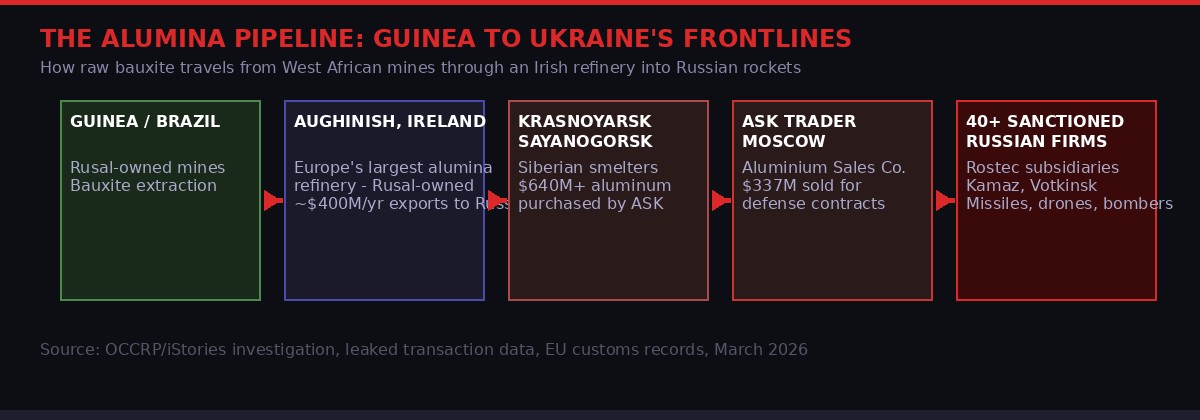
The investigation, built on leaked transaction data, EU customs records, and shipping manifests, traces the journey of bauxite - a reddish rock mined from Rusal-owned operations in Guinea and the Brazilian Amazon - through the Aughinish refinery and into alumina powder, then shipped east to Siberian smelters, converted into aluminum, sold to a single Moscow-based trader, and distributed to more than 40 EU-sanctioned Russian defense companies.
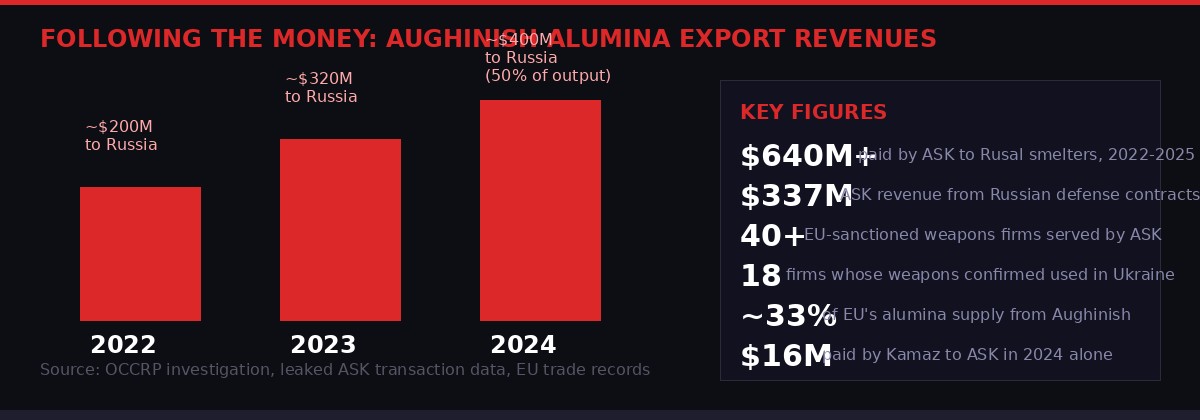
The total value of aluminum flowing through this pipeline from the smelters that received Aughinish material: more than $650 million between February 2022 and April 2025. The total paid by those smelters' trading arm to sanctioned Russian weapons manufacturers for defense contracts: approximately $337 million.
None of it violates a single EU sanction. The European Commission has been asked about this gap. It did not respond.
Europe's Largest Alumina Refinery, Russian-Owned

Aughinish Alumina is owned by United Company Rusal, one of the world's largest aluminum producers and, inside Russia, the dominant supplier of aluminum for the defense, transport, and construction industries. Rusal was founded by Oleg Deripaska, a billionaire oligarch with documented ties to President Vladimir Putin.
After Russia's 2022 full-scale invasion of Ukraine, the EU sanctioned Deripaska personally - citing his alleged involvement in companies working with the Russian defense sector. Rusal itself was left untouched. The reason, never fully explained publicly, appears to be economic self-protection: Aughinish produces roughly one-third of the EU's entire alumina supply. Sanctioning Rusal would mean sanctioning Europe's own industrial base.
The Irish parliament noticed. In April 2022, MP Thomas Pringle stood up in the Dail and said plainly: "We appear to be protecting the Aughinish Alumina plant from sanctions. That is hypocritical of us. If we need to protect that plant, the Government should be considering taking it over straight away and take it out of the hands of the oligarchs."
The government minister at the time, Patrick O'Donovan, responded by saying the plant was "not connected to any sort of Russian empire" and was a major employer. He did not address the ownership structure. He did not address who was receiving the alumina.
"EU policymakers have to draw a balance between potential impact of sanctions on Russia and potential impact of sanctions on their domestic economies. No further action was taken on alumina either because the EU didn't think that it would have sufficient impact, or because one or more member states decided that this ban was not in their national interests."
- Alex Prezanti, UK barrister and sanctions specialist, co-founder of the State Capture Accountability Project
The EU has imposed 16 packages of sanctions on Russia since the 2022 invasion. It has banned Russian aluminum imports since February 2025. But it has never restricted the export of alumina - the refined precursor to aluminum - to Russia. Latvia argued in 2023 that such a ban would "weaken Russia's war machine." The Commission did not act.
Ireland's Department of Foreign Affairs, when contacted by OCCRP, confirmed that alumina "is not a sanctioned good and therefore its export to other countries, including Russia, is not restricted." The statement did not explain how this position squares with Ireland's stated "unequivocal support for Ukraine."
From Guinea to Siberia: The Bauxite Trail

The investigation traces the supply chain from its origin. Rusal owns three bauxite mines in Guinea, West Africa. It also draws from a mine in the Brazilian Amazon - a facility whose largest external shareholder is the Swiss commodity trading giant Glencore, which holds a 10 percent stake in Rusal's parent company EN+ Group. When OCCRP asked Glencore about the arrangement, the company said it was "unable to comment on Aughinish's commercial decisions."
Bulk carriers load the raw bauxite and sail it to the Shannon Estuary, where it arrives at Aughinish's dock facilities. Inside the plant, a combination of heat, pressure, and caustic soda strips the bauxite down to its core: alumina, a white powder that serves as the primary input for aluminum smelting. The process is straightforward industrial chemistry. The destination of the resulting powder is where the story gets complicated.
EU customs and trade data show that since 2023, more than half of Aughinish's alumina exports have been shipped directly to Rusal smelters inside Russia. The primary destinations are the Krasnoyarsk and Sayanogorsk facilities, both located in Siberia. In 2024 alone, Aughinish sent approximately half of its entire refined alumina output - valued at around $400 million - to those two smelters. That material accounted for nearly 40 percent of the alumina imported by Krasnoyarsk and Sayanogorsk that year. Together, those two plants produced over a third of Rusal's entire aluminum output.
The public documentation ends there. Rusal's annual reports do not mention supplying Russian arms manufacturers. The smelters' published accounts do not track where the aluminum goes after it leaves the foundry floor. The paper trail, built from legitimate commercial documents filed with regulators and customs authorities, simply stops.
The leaked transaction data does not.
The Trader in the Middle: ASK and the Defense Pipeline

The leaked data, obtained by the Russian investigative outlet iStories and shared with OCCRP and its partners, centers on a single Moscow-based metals trader: Aluminium Sales Company, known by its Russian abbreviation ASK.
ASK is not a household name. It does not appear on sanctions lists. It has no prominent public profile. It is, as far as the outside world knows, a commodity trader buying aluminum from Russian smelters and selling it onward to manufacturers.
What the leaked transaction records reveal is the nature of those manufacturers. Between February 2022 and April 2025, ASK paid Rusal's trading arm more than $640 million for aluminum from the Krasnoyarsk and Sayanogorsk smelters - the same smelters fed by Aughinish alumina. During that same period, ASK generated approximately a third of its total revenue - around $337 million - selling aluminum specifically to fulfill Russian defense contracts.
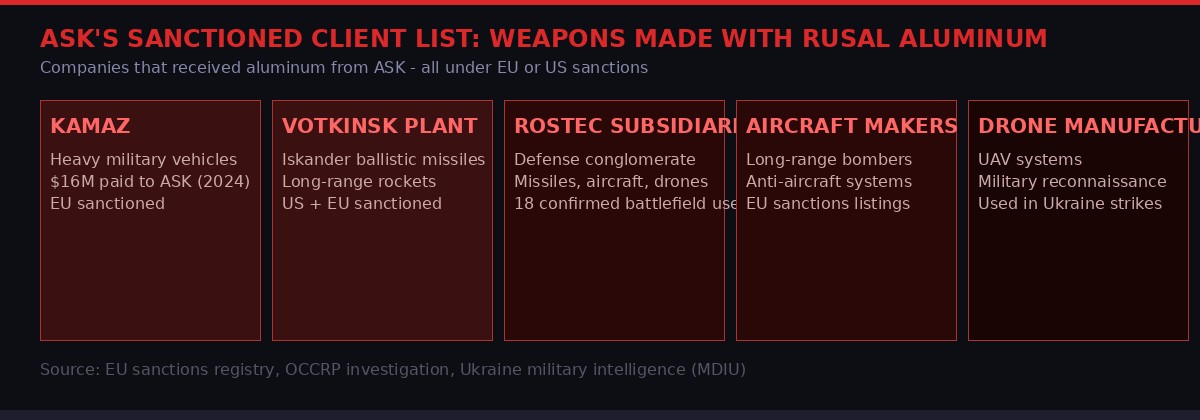
ASK's 2024 customer list, as captured in the leaked data, includes more than 40 companies that appear on EU sanctions registers. Many are subsidiaries of Rostec, Russia's state-owned defense conglomerate. Their products, according to EU sanctions listings, include anti-aircraft missiles, rocket systems, Iskander ballistic missiles, long-range bombers, and heavy-duty military vehicles.
Andriy Yusov, an official with Ukraine's Main Directorate of Intelligence who analyzes weapons debris recovered from Russian strikes, confirmed that 18 of these companies have built arms directly used in attacks on Ukrainian soil.
"Not only direct daily attacks on Ukrainian civilians, but also potential confrontation with Europe itself, as the development of Russian military industry suggests."
- Pavlo Shkurenko, Sanctions Research Fellow, Kyiv School of Economics Institute
The Named: Kamaz, Votkinsk, and the Weapons Built With Irish-Sourced Metal

Two ASK clients stand out above the rest for the specificity of the documented connection between their products and Ukrainian casualties.
The first is Kamaz, Russia's largest manufacturer of heavy-duty vehicles. Kamaz trucks move Russian troops, ammunition, and equipment along the frontlines in eastern Ukraine. The company is under EU sanctions. In 2024, according to the leaked transaction data, Kamaz paid ASK $16 million for aluminum. Kamaz did not respond to requests for comment.
The second is the Votkinsk Machine Building Plant, located in the Ural region and under both US and EU sanctions. Votkinsk's product line is not trucks - it is missiles. The plant manufactures a range of long-range weapons systems including the Iskander-M, a short-range ballistic missile system that has become one of the most destructive tools in Russia's arsenal. An Iskander strike on the city of Sumy in April 2025 killed 31 civilians. In 2024, the Votkinsk plant bought $101,200 worth of aluminum from ASK. That dollar figure is modest. The missiles it helped build are not.
OCCRP's investigation was unable to establish that a specific atom of aluminum refined from Aughinish alumina ended up in a specific missile. The industrial reality makes such precision impossible: alumina from different sources is blended together in the smelting process, and the resulting aluminum is itself mixed before being distributed to manufacturers. The supply chain is deliberately opaque. But the investigators could - and did - establish that the trader connecting Rusal's Siberian smelters to Russia's sanctioned weapons industry purchased aluminum specifically from the smelters that Aughinish supplies.
The mathematical logic is hard to escape. Aughinish supplies roughly 40 percent of the Krasnoyarsk and Sayanogorsk smelters' alumina inputs. Those smelters sell their aluminum output through ASK. ASK sells to weapons manufacturers. The probability that some fraction of the alumina processed at a facility on the shores of the Shannon Estuary has ended up in weapons deployed against Ukraine is, in the judgment of researchers at the Kyiv School of Economics, not negligible.
"Supplying Russia with EU-made alumina could undermine NATO's stated goals of supporting Ukraine and deterring Russia."
- Oleksandr V. Danylyuk, former Ukraine defense official, fellow at the Royal United Services Institute (RUSI)
The Sanctions Gap: How the EU Left the Door Open

The legal architecture here is precise and revealing. The EU banned Russian aluminum imports in February 2025 - recognizing that aluminum is a strategic military material and cutting off a revenue stream. What it did not ban is the export of alumina to Russia. These are two different regulatory decisions about two different points in the same supply chain. The result is a gap large enough to drive 700,000 tonnes of processed mineral through every year.
Latvia formally called for an alumina export ban, arguing in 2023 that such a measure would "weaken Russia's war machine" by restricting the feedstock for the smelters producing the metal. The argument was not adopted. The European Commission has never publicly explained why.
UK sanctions barrister Alex Prezanti, who advises governments on evasion risks, told OCCRP the inaction reflects the fundamental tension embedded in sanctions policy: "EU policymakers have to draw a balance between potential impact of sanctions on Russia and potential impact of sanctions on their domestic economies." Alumina from Aughinish feeds not only Russian smelters but also European manufacturers. A blanket export ban would hit both.
The political sensitivity is compounded by Aughinish's economic significance to Ireland. The plant employs around 350 workers directly and generates significant tax revenues for a relatively rural county. It was lobbied for energetically by Ireland's diplomatic establishment. Former Irish ambassador to the United States Daniel Mulhall told the Irish Times he advocated to keep the plant open because it was "one of the few European strategic assets that we had in Ireland."
That framing - Aughinish as a European strategic asset - runs directly against the reality exposed by the OCCRP investigation. A strategic asset that is controlled by a Russian oligarch connected to Putin, whose primary function is to supply input materials for the Russian weapons industry, is not obviously "European." It is a Russian strategic asset that happens to be located in Ireland and employ Irish workers.
The European Commission did not respond to OCCRP's request for comment on the alumina export gap. Ireland's foreign affairs ministry confirmed the legal position - exports are unrestricted - and offered no further analysis. Aughinish Alumina said it was "in strict compliance with all applicable European Union laws."
None of those statements are untrue. They are also entirely beside the point.
Timeline: The Sanctions Debate and What Was Ignored

- February 24, 2022 Russia launches full-scale invasion of Ukraine. EU begins sanctioning Russian officials, oligarchs, and companies.
- April 2022 EU sanctions Oleg Deripaska, Rusal's founder and major shareholder. Rusal itself is not sanctioned. Aughinish Alumina continues operating under Rusal ownership. Irish MP Thomas Pringle calls the arrangement "hypocritical."
- 2022-2023 Aughinish alumina exports to Russia increase. The plant fills the gap left when Rusal's Ukrainian refinery was nationalized following the invasion.
- 2023 Irish lawmaker Reada Cronin formally asks why Russia is buying so much alumina from Ireland, noting exports "are capable of assisting Russia in its invasion of Ukraine." Trade minister Simon Coveney confirms the exports comply with EU sanctions. No further action taken.
- 2023 Latvia calls on the EU to ban alumina exports to Russia. The European Commission does not act. No formal proposal is tabled.
- February 2025 EU finally bans Russian aluminum imports under its 16th sanctions package. Alumina exports to Russia remain completely unrestricted.
- 2024 Aughinish sends roughly half of its annual alumina output - approximately $400 million worth - to Russian smelters. The smelters' aluminum feeds ASK, which in turn supplies 40+ sanctioned defense companies.
- March 24, 2026 OCCRP and partners publish full investigation based on leaked transaction data, customs records, and trade statistics. The European Commission does not respond to request for comment.
The Players: Who Owns What and Who Knows What

The corporate structure at the top of this supply chain is worth laying out precisely.
Oleg Deripaska is a Russian billionaire with documented business ties to Putin's inner circle. He founded Rusal, built it into the world's second-largest aluminum producer, and was personally sanctioned by the EU in 2022. He has mounted unsuccessful legal challenges against US, EU, and Australian sanctions. His shareholding in Rusal has been restructured several times to keep the company itself off western sanctions lists - most notably in 2018-2019 when the US briefly sanctioned Rusal directly, then agreed to delist it after Deripaska nominally reduced his ownership stake.
EN+ Group is Rusal's parent company, listed in London until sanctions pressure forced it to delist. Glencore, the Swiss commodity trader and one of the world's largest companies, holds approximately 10 percent of EN+. Glencore also co-owns a bauxite mine in Brazil with Rusal that supplies Aughinish. Glencore declined to comment on Aughinish's commercial decisions.
United Company Rusal owns Aughinish Alumina directly. It also owns the Krasnoyarsk and Sayanogorsk smelters in Siberia that receive Aughinish's alumina exports. The company is Russia's primary aluminum supplier for the defense industry.
Aluminium Sales Company (ASK) is a Moscow-based aluminum trader. It bought more than $640 million worth of aluminum from Rusal's smelters between 2022 and 2025. It sold approximately $337 million of that material to companies fulfilling Russian defense contracts. ASK is not under EU or US sanctions. Its role as the critical intermediary between Russia's industrial base and its weapons industry has not previously been publicly reported.
Rostec subsidiaries are the end customers. Rostec is Russia's state defense and industrial conglomerate, directly controlled by the Kremlin. Its subsidiaries manufacture everything from small arms to strategic bombers. More than 40 Rostec-linked companies appear on ASK's client list. All are under EU sanctions. None can be sold to directly by a European company. But they can, apparently, be sold to by a Russian trader who bought materials that originated in Ireland.
What Aughinish Says vs. What the Data Shows
Aughinish position: "We operate in strict compliance with all applicable European Union laws, including sanctions, export control measures and trade regulations."
What this means in practice: Aughinish is correct. EU law does not restrict alumina exports to Russia. Compliance with the law is complete.
What the data shows: Material leaving Aughinish enters a supply chain that terminates at sanctioned Russian weapons factories. The gap between legal compliance and material consequence is the story.
What Aughinish did not answer: Whether its products "might be used to build Russian weapons." The company did not dispute the supply chain documented by OCCRP. It declined to engage with the substance of the investigation.
The Bigger Picture: Sanctions Architecture Built With Holes

The Aughinish case is not unique. It is, rather, a vivid example of a broader failure in the sanctions regime that the EU, UK, and US have constructed since 2022.
OCCRP's previous reporting documented how European electronic components - made by companies including Infineon, NXP, and u-blox - end up inside Russian Geran-2 kamikaze drones. Those components were not sanctioned for export to Russia when they were sold. BLACKWIRE covered that investigation earlier this year.
The pattern is consistent: a raw material or component is identified as having military utility. Expert bodies and allied governments call for restrictions. The economic cost of restrictions is assessed. The restrictions are not imposed, or are imposed too narrowly to close the identified gap. The weapons keep falling.
NATO Secretary General Mark Rutte acknowledged the acceleration of Russian weapons production last year, saying "Putin's war machine is speeding up - not slowing down." He warned that "the new generation of Russian missiles travel at many times the speed of sound." What he did not say - could not say, in that forum - is that those missiles are being built with materials that flow freely from EU member states because the economic and political cost of stopping the flow is deemed too high.
The Ukrainian government sees this clearly. Andriy Yusov from Ukrainian military intelligence confirmed that weapons built by ASK's clients have been used directly against Ukrainian soil. Pavlo Shkurenko at the Kyiv School of Economics called Europe's entanglement with Russia's metallurgical sector a risk not just to Ukraine but to Europe itself: the same industrial capacity building weapons for Ukraine is building weapons that, in a broader conflict, could be aimed at European cities.
Oleksandr Danylyuk, the former Ukrainian defense official now at RUSI, put the contradiction most starkly. Supplying Russia with EU-made alumina, he said, "could undermine NATO's stated goals of supporting Ukraine and deterring Russia." That is a diplomatic framing. The less diplomatic version is that Europe is arming both sides of a war it claims to be decisively on one side of.
The alumina exemption is not a secret. Latvia flagged it in 2023. The Irish parliament debated it in 2022. Experts cited by OCCRP have named it directly. The European Commission has declined to explain why it has not acted. Ireland has confirmed the legal position and offered nothing further.
In County Limerick, the refinery continues processing bauxite. The bulk carriers continue sailing east. The Siberian smelters continue running around the clock. And in Moscow, ASK continues taking orders from the companies building the weapons that fall on Kyiv, Sumy, Kharkiv, and the dozens of other Ukrainian cities whose names have become synonymous with what happens when sanctions have gaps.
Get BLACKWIRE reports first.
Breaking news, investigations, and analysis - straight to your phone.
Join @blackwirenews on Telegram