Made in Ireland, Fired in Ukraine: How Rusal's Refinery Feeds Russia's War Machine
An OCCRP investigation backed by leaked transaction data reveals a $400 million-per-year pipeline: Irish alumina, refined at Europe's largest plant, shipping to Russian smelters that supply over 40 EU-sanctioned weapons manufacturers - and the sanctions regime that makes it all perfectly legal.

Aughinish Alumina in County Limerick is Europe's largest alumina refinery - and, according to a new OCCRP investigation, a critical node in Russia's weapons supply chain. (Credit: Pexels / illustrative)
The refinery sits on a wind-swept estuary in County Limerick, Ireland, far from any battlefield. Its stacks push steam into the Atlantic air. Inside, the chemistry is unremarkable: bauxite rock from Guinea and the Brazilian Amazon is crushed, dissolved in caustic soda, and baked under pressure until it becomes a fine white powder called alumina - the precursor to aluminum.
What happens to that powder afterward is the story. According to a landmark investigation published this week by the Organized Crime and Corruption Reporting Project (OCCRP), iStories, De Tijd, the Irish Times, the Guardian, and Delfi, the majority of Aughinish Alumina's exports travel not to European industry but to two Siberian smelters owned by the Russian aluminum giant Rusal. Those smelters convert the powder into aluminum. That aluminum flows to a Moscow-based trading company called ASK. And ASK sells it to Russian weapons manufacturers - over 40 of them, most sanctioned by the European Union, some of whose products have killed Ukrainian civilians.
Every step of this chain is entirely legal under current EU trade rules. That is the scandal.
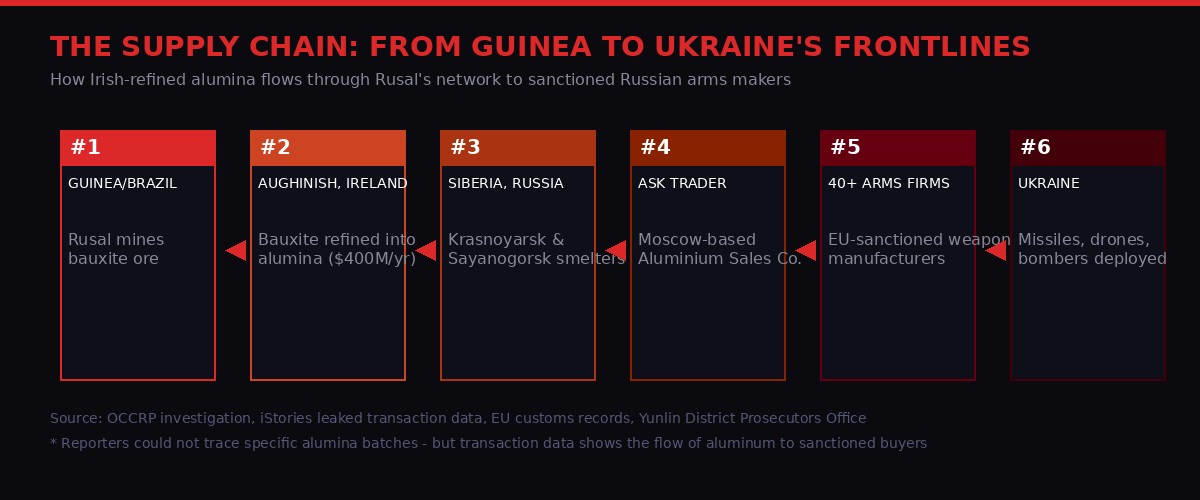
The full supply chain - from raw bauxite mines in Guinea and Brazil, through Ireland's refinery, to Siberian smelters, a Moscow trader, and finally to sanctioned Russian arms manufacturers. (BLACKWIRE / CIPHER)
The Loophole That Brussels Built

The European Parliament has repeatedly debated Russia sanctions - but alumina has fallen through a structural gap. (Pexels / illustrative)
The European Union's sanctions architecture against Russia is built on layers of bans targeting specific goods, specific people, and specific companies. Since Russia's full-scale invasion of Ukraine in February 2022, Brussels has imposed 16 successive packages of sanctions. The framework has targeted oil, steel, luxury goods, financial institutions, oligarchs, and eventually, in February 2025, Russian-produced aluminum.
That last step - banning the import of Russian aluminum - was widely seen as a significant escalation. Aluminum is one of the most militarily critical metals: light, strong, and resistant to corrosion, it is essential in the fabrication of missiles, drone airframes, aircraft fuselages, and armored vehicle components. By severing Russia's ability to sell its aluminum into Europe, the EU intended to cut off a key revenue stream for the Russian defense industry.
But there is a gap, and it is large enough to sail a bulk carrier through. While the EU banned Russian aluminum imports, it imposed no corresponding restriction on exporting alumina - the intermediate product, the white powder - to Russia. That means EU-based refineries can legally ship the raw feedstock that Russian smelters need to produce aluminum, even while those smelters feed into the weapons supply chain.
The Latvian government had already warned Brussels about exactly this structural vulnerability. In formal discussions preceding the aluminum import ban, Latvia explicitly argued that a ban on alumina exports to Russia was equally necessary - that restricting finished aluminum while allowing raw alumina to flow would simply perpetuate Russia's domestic production capacity. Brussels did not act on that argument. The alumina trade remained unrestricted.
"EU policymakers have to draw a balance between potential impact of sanctions on Russia and potential impact of sanctions on their domestic economies. No further action was taken on alumina either because the EU didn't think that it would have sufficient impact, or because one or more member states decided that this ban was not in their national interests." - Alex Prezanti, UK barrister and sanctions specialist, co-founder of the State Capture Accountability Project (quoted in OCCRP investigation)
The blunt reality: Aughinish Alumina's shipments to Russia have increased since the full-scale invasion, not decreased. As the OCCRP investigation notes, one of Rusal's refinery assets in Ukraine was nationalized after February 2022, making the Irish plant a more critical supplier for the company's Russian smelting operations. The invasion, paradoxically, made the Limerick plant more valuable to the Russian war effort - and it has been shipping accordingly.
Following the Money: From Limerick to the Missile Factory

Russian defense manufacturers, including Iskander missile maker Votkinsk and truck maker Kamaz, appear in leaked ASK transaction records. (Pexels / illustrative)
The evidentiary core of the OCCRP investigation rests on two distinct data sets. First: international trade and shipping records, which document the volume and destination of Aughinish's alumina exports to Russia. Second, and far more explosive: leaked transaction data obtained by iStories, the Russian investigative outlet, which traces the aluminum trade from Rusal's smelters through the Moscow-based trader ASK to its final customers.
The trade records establish that in 2024, Aughinish Alumina shipped approximately half of its total annual alumina production - worth roughly $400 million - to two Rusal-owned facilities in Siberia: the Krasnoyarsk Aluminum Smelter and the Sayanogorsk Aluminum Smelter. Together, these two plants accounted for nearly 40% of all alumina imported by those facilities that year, and produced over a third of Rusal's entire aluminum output.
The leaked transaction data, covering the period from Russia's invasion in February 2022 through April 2025, shows what happened next. The Aluminium Sales Company (ASK), a Moscow-based trader, paid Rusal's trading arm more than $640 million for aluminum from the company's smelters during that period. Approximately a third of ASK's revenue - some $337 million - derived from aluminum sold for the explicit purpose of Russian defense contracts.
The customer list is where the investigation becomes most damning. ASK supplied aluminum to over 40 companies currently under EU sanctions, many of them subsidiaries of Rostec, Russia's state-owned defense conglomerate. The buyers include:
ASK's Sanctioned Customers (Partial List)
- Kamaz - Heavy military truck manufacturer, sanctioned by both the EU and US. Paid ASK $16 million for aluminum in 2024 alone. Kamaz vehicles have been documented transporting Russian troops and equipment throughout the Ukraine war.
- Votkinsk Machine Building Plant - Sanctioned by the EU and US. Manufactures the Iskander short-range ballistic missile. An Iskander strike on the northeastern Ukrainian city of Sumy in April 2025 killed 31 civilians. Paid ASK $101,200 for aluminum in 2024.
- Numerous Rostec subsidiaries - The Russian defense conglomerate's member companies produce anti-aircraft missile systems, rocket artillery, and long-range strategic bombers. Eighteen of ASK's customers produce weapons that Ukrainian military intelligence has confirmed were used in specific attacks on Ukrainian territory, based on debris analysis.
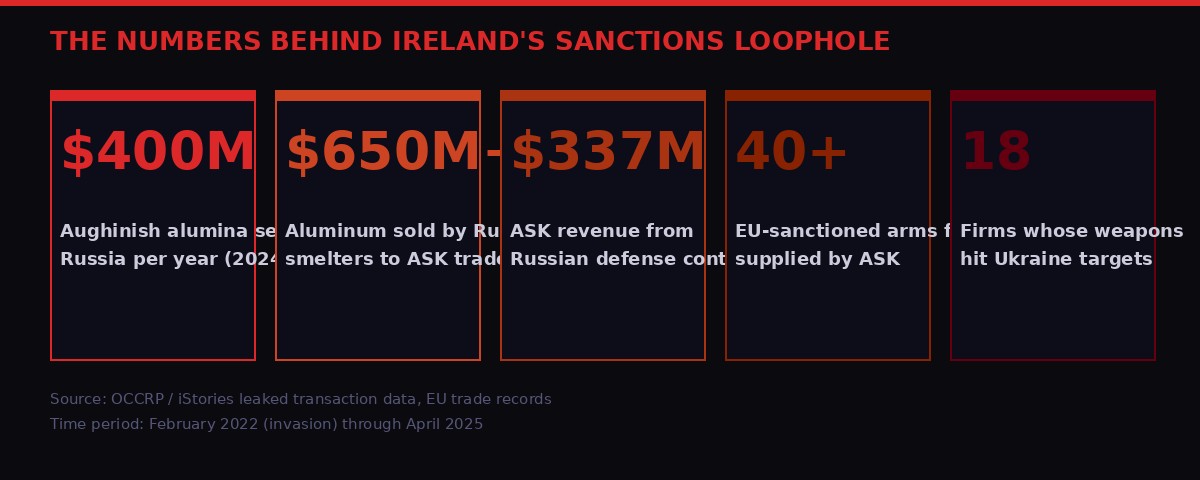
The financial scale of the supply chain, based on OCCRP's investigation and iStories' leaked transaction data. (BLACKWIRE / CIPHER)
OCCRP's reporters were careful to note the epistemological limits of their evidence. Because alumina is a commodity that mixes together in the smelting process, reporters could not definitively trace a specific tonne of Irish alumina to a specific missile component. But that caveat does not diminish the investigation's structural finding: the same smelters that receive Aughinish's alumina sell the resulting aluminum to an intermediary that, in documented transactions, supplies the makers of Iskander missiles, anti-aircraft systems, and armored military vehicles.
The Architect: Oleg Deripaska and the Rusal Empire

Oleg Deripaska, sanctioned by the EU, US, and Australia, remains the controlling force behind Rusal's parent company EN+. (Pexels / illustrative)
The company at the center of this story - United Company Rusal - is one of the world's two largest aluminum producers. It was built primarily by Oleg Deripaska, a billionaire who rose through the chaos of Russia's post-Soviet privatizations to assemble a metals empire spanning mines, refineries, and smelters across multiple continents.
Deripaska's relationship with the Kremlin has long been a matter of public record and legal controversy. In April 2018, the US Treasury Department sanctioned him under the Countering America's Adversaries Through Sanctions Act, citing his alleged involvement in companies working with the Russian defense sector, money laundering, extortion, and associations with organized crime - allegations Deripaska has consistently denied. The sanctions briefly sent shockwaves through the global aluminum market and pushed Rusal's stock price into freefall.
The situation resolved in a manner that critics still dispute. In January 2019, the US Treasury agreed to lift sanctions on Rusal and its parent company EN+ after Deripaska agreed to reduce his ownership stake in EN+ to below 50%, relinquishing majority control. Deripaska himself remained personally sanctioned. He has since mounted legal challenges against sanctions in the US, EU, and Australian courts - losing all of them.
The EU followed the American lead in sanctioning Deripaska personally in February 2022, citing "his alleged involvement in companies working with the Russian defense sector" and his status as a "key supporter and enabler of actions and policies which undermine the territorial integrity, sovereignty and independence of Ukraine." The EU's sanctions listing noted his "access to Vladimir Putin" and his role as a "pro-Kremlin oligarch."
Rusal itself, however, has never been sanctioned by the EU. The company's ownership structure - with Deripaska's stake officially reduced - and the refinery's economic importance to Ireland and to European aluminum supply chains have repeatedly provided cover for inaction. When Irish lawmakers raised the issue in April 2022, the then-minister of state Patrick O'Donovan dismissed concerns, saying the plant "is not connected to any sort of Russian empire" and was a major employer and supplier to European industries.
The OCCRP investigation suggests that characterization was, at minimum, incomplete.
Ireland's Political Reckoning

The Dail has debated Aughinish Alumina's Russian ties repeatedly since 2022 - but this week's revelations have raised the political temperature significantly. (Pexels / illustrative)
The publication of the OCCRP investigation triggered immediate political turbulence in Dublin. Prime Minister Micheal Martin addressed the Dail, acknowledging that the findings raise "concerns" and pledging that authorities would review the matter. He was careful to note the investigation described a supply chain routed "through intermediaries" rather than a direct link - but even this measured response represented a shift from the government's previous posture.
The opposition was less measured. Ivana Bacik, leader of the Labour Party, called the findings "horrific" if Irish alumina was being used to manufacture weapons killing Ukrainian children. Ged Nash, Labour's finance spokesman, accused the government of being "rather incurious" and called for an urgent reassessment of the EU sanctions framework. Paul Murphy of People Before Profit accused Dublin of protecting the interests of a Russian oligarch.
The Irish government's formal response has been to note, accurately, that alumina is "not a sanctioned good" and that its export to Russia "is not restricted." A spokesperson for the Department of Foreign Affairs stressed that Ireland "remains unequivocal in its continuing support for Ukraine." But critics note that legal compliance and moral accountability are not the same thing.
The economic stakes are real. Aughinish Alumina is one of the largest private employers in County Limerick. The refinery processes around a third of the EU's entire alumina supply. A ban on its exports to Russia would have cascading effects - potentially forcing Rusal to source alumina elsewhere, potentially triggering renegotiation of the plant's operating terms, and potentially jeopardizing hundreds of Irish jobs. These are not trivial considerations. They also do not change what the supply chain produces.
"We appear to be protecting the Aughinish Alumina plant from sanctions. That is hypocritical of us. If we need to protect that plant, the Government should be considering taking it over straight away and take it out of the hands of the oligarchs." - Former Irish MP Thomas Pringle, in the Dail, April 2022 (via OCCRP)
Former Irish ambassador to the US Daniel Mulhall offered a candid retrospective assessment to The Irish Times: he had lobbied in 2018 to keep Aughinish open, describing it as "one of the few European strategic assets that we had in Ireland" at the time. The framing is revealing - a refinery owned by a Russian oligarch's company, making material that flows to Russian smelters, was characterized as a European strategic asset worth protecting from sanctions. That logic has become significantly harder to defend in 2026.
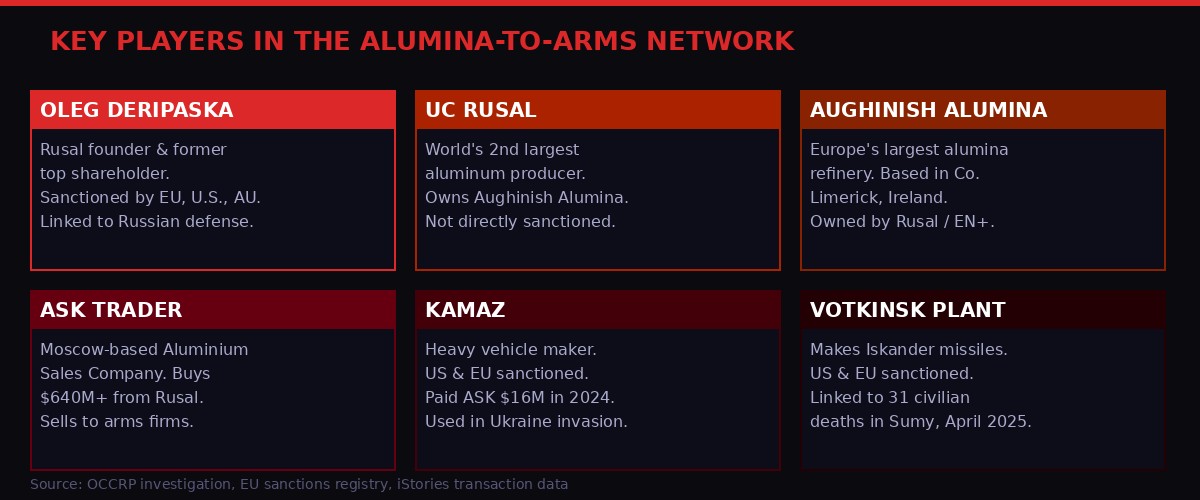
The core actors in the supply chain, from Deripaska's corporate empire through the Aughinish refinery to ASK's sanctioned weapons clients. (BLACKWIRE / CIPHER)
European Pressure: The Belgian Push and Brussels' Inertia

Belgium's foreign minister has launched a formal push to close the alumina sanctions gap at the EU level. Brussels has yet to commit to action. (Pexels / illustrative)
Belgium moved fastest. Foreign Minister Maxime Prevot, after being briefed on the OCCRP findings by the Belgian partner De Tijd, described the revelations as "extremely disturbing" and announced that Belgium would formally lobby the EU to expand its sanctions regime. Prevot wants Brussels to ensure that EU-produced raw materials cannot be repurposed for the Russian war effort - a formulation that, if implemented, would directly address the alumina loophole.
In the European Parliament, Dutch MEP Thijs Reuten cited the investigation as "glaring proof" that EU sanctions require urgent tightening and stricter enforcement. Reuten emphasized that companies bear a fundamental responsibility to vet their supply chain partners even when a specific trade technically complies with the letter of sanctions law. "The game of hide-and-seek by companies and member states must end," he said, warning that the weapons produced by ASK's customers "wreak death and destruction in Ukraine."
The EU's own sanctions envoy, David O'Sullivan, acknowledged the issue. He confirmed that the information, "if accurate, is worrying" and promised that the European Commission would "continue to act in order to undermine Russia's ability to wage its war." The carefully hedged language - "if accurate," "continue to act" - is the language of institutions that are aware of political constraints.
Those constraints are structural. Rusal-controlled facilities and supply chains touch multiple EU member states. European aluminum manufacturers depend on alumina supply chains that Rusal influences. Energy-intensive smelting operations have moved away from Europe in part because of energy costs, making the EU more dependent on Russian-linked aluminum production than policymakers publicly acknowledge. The alumina loophole is not a bureaucratic oversight. It is, at least in part, the result of deliberate choices by EU members who calculated that closing it would cost them more than keeping it open.
Experts have been blunt. John O'Brennan, professor of Irish politics, called the findings evidence of "significant gaps in EU sanctions" and urged the bloc to fully sanction the alumina sector. Alexander Pomazuev of Russia's Anti-Corruption Foundation described the current regulatory framework as "a glaring loophole." Oleksandr Merezhko, a Ukrainian lawmaker who addressed Ireland's foreign affairs committee, argued that it is unacceptable for Western companies to help Moscow circumvent restrictions. "Russia should be totally isolated, economically, politically," he said.
Ukraine's Military Intelligence: Weapons Identified

Ukrainian military intelligence has analyzed weapons debris from attack sites, identifying components traceable to ASK's sanctioned customers. (Pexels / illustrative)
For OCCRP's investigation, the operational confirmation came from Andriy Yusov, an official from Ukraine's Main Directorate of Intelligence. Yusov confirmed that 18 of ASK's documented customer companies have produced weapons that Ukrainian military intelligence has identified on Ukraine's battlefields, based on debris analysis following specific strikes.
The Votkinsk Machine Building Plant, which paid ASK $101,200 for aluminum in 2024, manufactures the Iskander ballistic missile. An Iskander strike on the city of Sumy in April 2025 killed 31 people. EU sanctions listings confirm that Votkinsk also produces longer-range systems including the RS-26 Rubezh missile.
Kamaz, which paid ASK $16 million for aluminum in 2024 - a far larger purchase than Votkinsk - manufactures heavy military trucks that have become a ubiquitous feature of Russian logistics throughout the invasion. Documented on social media, in drone footage, and in satellite imagery, Kamaz military trucks have transported troops, artillery ammunition, and supplies along virtually every front in the war.
Other ASK customers, unnamed in the investigation, include producers of anti-aircraft systems, multiple-launch rocket systems, and long-range strategic bombers. These weapons are at the heart of Russia's ability to project violence across Ukrainian territory. NATO Secretary General Mark Rutte addressed the underlying dynamic in a speech last summer: "Putin's war machine is speeding up - not slowing down." The supply chains identified by OCCRP's investigation are part of why.
"It is unacceptable for Western companies to help Moscow circumvent restrictions. Russia should be totally isolated, economically, politically." - Oleksandr Merezhko, Ukrainian lawmaker, addressing Ireland's foreign affairs committee
Pavlo Shkurenko, Sanctions Research Fellow at the Kyiv School of Economics Institute, has warned that Europe's "entanglement" with Russia's metallurgical sector carries risks beyond the immediate war. It enables "not only direct daily attacks on Ukrainian civilians, but also potential confrontation with Europe itself, as the development of Russian military industry suggests." The warning is not theoretical. Russia has explicitly cited its enhanced weapons production capacity - including systems targeting NATO infrastructure - in its own strategic communications.
How the Investigation Was Built: The Data Trail

The investigation combined public trade data, vessel tracking, and leaked transaction records obtained by iStories to trace the supply chain from refinery to arms factory. (Pexels / illustrative)
The OCCRP investigation involved a consortium of eight reporting partners across multiple countries. The methodology is detailed in their published report and warrants examination for what it reveals about the evidentiary standards and the limitations of the findings.
Public and private trade data, combined with vessel tracking, documented the flow of bauxite from Guinea and Brazil to Ireland and the subsequent export of alumina to Russia. This part of the chain is well-evidenced - customs filings, port records, and shipping databases leave comprehensive paper trails for commodity movements. The reporters confirmed that since 2023, more than half of Aughinish's alumina exports went to Rusal smelters in Russia.
The link between those smelters and ASK was established through leaked transaction data obtained by iStories. The data, covering February 2022 to April 2025, shows ASK's purchases from Rusal's trading arm and ASK's sales to defense contractors. The total volumes - $640 million in purchases from Rusal, $337 million in defense sales - are specific and documented.
The one gap in the chain, which the investigation acknowledges, is the inability to trace a specific batch of Aughinish alumina to a specific ASK sale or a specific weapon. Alumina is a commodity. It gets mixed in the smelting process. Once it enters a smelter alongside alumina from other sources, the provenance of any given kilogram of aluminum cannot be established. The investigation's finding is structural, not transactional: the same facilities receiving Aughinish's alumina are selling aluminum to weapons makers in documented transactions.
Aughinish Alumina, when contacted by OCCRP, stated that it operates "in strict compliance with all applicable European Union laws, including sanctions, export control measures and trade regulations" and had implemented "robust sanctions compliance and due diligence framework covering its entire supply chain." The company did not respond to specific questions about whether its products might be used in Russian weapons. Rusal, its parent company EN+, and the Russian Ministry of Defense did not respond to requests for comment. ASK, Kamaz, Votkinsk, and eleven other sanctioned customers also did not respond.
Timeline: The Road to Complicity
What Happens Next: The Politics of Closing the Gap

Belgium's diplomatic push at the EU level will face resistance from member states with economic interests in maintaining the alumina trade. (Pexels / illustrative)
The Belgian diplomatic push is now the proximate test of whether the OCCRP investigation changes anything. Prevot's lobbying campaign will move through the Council of the EU, where sanctions decisions require unanimity among member states. Ireland, given the economic sensitivity of any alumina restrictions for the Aughinish plant, is an obvious pressure point. Dublin's government has so far committed to reviewing the issues - not to supporting a ban.
The mathematical reality of EU sanctions unanimity means that even a single member state with strong economic interests in maintaining the alumina trade can block expanded restrictions. Other EU countries have commercial relationships with Rusal-linked aluminum supply chains. The economic argument will be made that alumina is a commodity, that the supply chain is too complex to police at the precursor level, and that jobs and European aluminum security should not be sacrificed for a ban that Russia would route around anyway.
These arguments are not entirely without merit. Rusal has global operations. If EU alumina exports to Russia were banned, Rusal would redirect supply chains - potentially drawing more heavily on its mines in Guinea and Brazil, shipping via other routes, or developing alternative refinery capacity. The actual impact on Russian aluminum production might be limited. On the other hand, the current arrangement allows a major EU-based facility to openly supply a Russian company's weapons-adjacent supply chain, which carries its own strategic and reputational costs for European institutions claiming to oppose Russia's war.
Oleksandr V. Danylyuk, the former Ukraine defense official now at RUSI, framed the contradiction starkly: supplying Russia with EU-made alumina "could undermine NATO's stated goals of supporting Ukraine and deterring Russia." He is right that the contradiction is structural. NATO members are simultaneously arming Ukraine and feeding the industrial capacity that makes Russia's weapons. That is not a sustainable posture.
What the investigation has done, irreversibly, is make the supply chain visible. The leaked transaction data naming Kamaz and Votkinsk as ASK customers, the trade records documenting Aughinish's exports, the EU sanctions listings connecting those customers to specific weapons used in specific attacks - this is now public record. European politicians can no longer claim not to know.
"Supplying Russia with EU-made alumina could undermine NATO's stated goals of supporting Ukraine and deterring Russia." - Oleksandr V. Danylyuk, former Ukraine defense official, RUSI Fellow (via OCCRP)
Whether knowing changes behavior is a different question. Sanctions regimes are political constructs, shaped by economic interests and diplomatic calculations as much as by moral clarity. The alumina loophole has been known to researchers and advocacy organizations for some time. What the OCCRP investigation has added is the transaction data - the names, the dollar amounts, the specific weapons firms - that transforms a theoretical concern into a documented supply chain.
The Iskander missile that killed 31 people in Sumy in April 2025 was made at Votkinsk. Votkinsk bought aluminum from ASK. ASK bought aluminum from Rusal smelters that received alumina from Aughinish in County Limerick. Each link in that chain is documented. The question is what Europe intends to do about it.
Get BLACKWIRE reports first.
Breaking news, investigations, and analysis - straight to your phone.
Join @blackwirenews on TelegramBLACKWIRE methodology note: This article is based on published investigative reporting and does not contain independent primary research. All figures and findings are attributed to the source investigation. BLACKWIRE has independently reviewed EU sanctions listings and parliamentary records cited herein.