Israel's Blame Game: How the Iran War Is Unraveling from the Inside
Netanyahu clashes with Mossad. The army chief warns the military could "collapse in on itself." Thirty-one days into a war that was supposed to shatter Iran, it is Israel that is fracturing.

US and Israeli forces are now five weeks into a campaign that has bombed 13,000 targets across Iran - with no clear political endgame. (Pexels)
One month ago, Israel was high on euphoria. The opening salvos of Operation - launched jointly with the United States on February 28 - had killed Supreme Leader Ayatollah Ali Khamenei, obliterated military command centers, and decimated Iran's air defense network. Senior Israeli officials spoke of "unprecedented" and "historic" coordination. Fifteen phone calls between Netanyahu and Trump in the weeks before the first bombs fell. Two face-to-face meetings. A partnership forged in mutual contempt for Tehran.
Today, on Day 31, that euphoria is rotting. In its place: finger-pointing between the prime minister's office and the Mossad. An army chief telling the security cabinet that the Israel Defense Forces could "collapse in on itself." Interceptor stocks running low. A second front in Lebanon spiraling out of control. And a growing whisper in Israeli media that this war - the war that was supposed to end Iran as a strategic threat forever - was a miscalculation of historic proportions.
The numbers are staggering. Over 13,000 targets bombed across Iran. More than 2,076 Iranians killed, including 216 children (per Iran's Ministry of Health). At least 25 dead in Gulf Cooperation Council states from Iranian retaliatory strikes. Brent crude at $116 a barrel - up 62 percent since February 27. And still, Iran fires missiles every single day. Still, the Strait of Hormuz remains effectively closed. Still, no regime change.
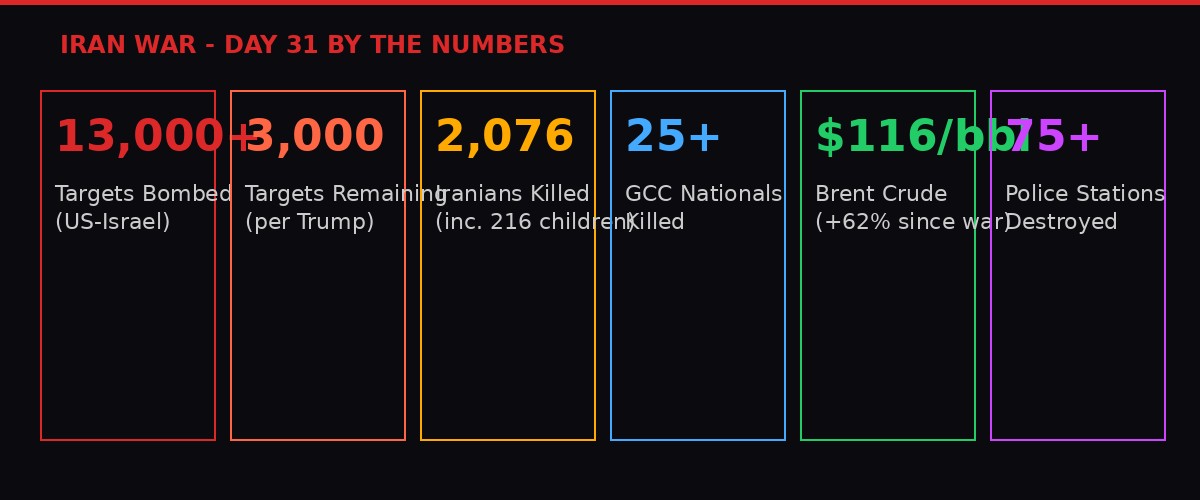
BLACKWIRE infographic: The war by the numbers on Day 31 - casualties, strikes, and economic fallout.
The Barnea-Netanyahu Fracture

Behind closed doors, the blame game between Netanyahu and Mossad chief Barnea has erupted into public view. (Pexels)
The crack appeared on March 22 when The New York Times reported that Mossad chief David Barnea had traveled to Washington in January with a plan. The pitch: after Israeli and American forces decapitated the Iranian regime, Barnea proposed engineering a successful insurrection inside Iran. The Mossad chief would not have taken such a proposal to US officials without Netanyahu's explicit approval. This was not a rogue intelligence operation. This was the plan.
Three days later, on March 25, Israeli journalist Yossi Yehoshua published a devastating account in Yedioth Ahronoth - one of Israel's most-read newspapers - detailing the tensions between Netanyahu and Barnea. The details were damning. The insurrection plan had failed. The regime-change strategy had failed. Iran's government, despite losing its Supreme Leader and several senior officials in the opening hours of the war, had not collapsed. The streets of Tehran were not filled with revolutionaries. They were filled with pro-government demonstrators marching nightly under the bombs.
According to the Yedioth report, Barnea had been warning Netanyahu privately that the Mossad's intelligence assessments overestimated the fragility of the Iranian state. The agency had believed - based partly on the economic protests that swept Iran in January 2026 - that the population was ready to revolt once the security apparatus was degraded. They were wrong.
What followed the assassination of Khamenei was not revolution. It was rallying. Mojtaba Khamenei, the former Supreme Leader's son, was elevated to power. Whether he was alive, injured, or dead remained disputed - Trump told the Financial Times on March 30 that "the son is either dead or in extremely bad shape" - but Tehran insisted the new Supreme Leader was safe and governing. The state apparatus held. The IRGC held. The Basij held. The police - even after 75 stations were bombed - still patrolled the streets.
"When the political and security echelons begin playing the blame game in the midst of a war, it is never a good sign." - Daniel Levy, former Israeli government adviser, writing for Al Jazeera, March 30, 2026
Army Chief Zamir's Warning

Israeli air assets are stretched across three simultaneous fronts - Iran, Lebanon, and Gaza. (Pexels)
The most alarming signal came from inside the Israeli military itself. Army chief Eyal Zamir warned the security cabinet in recent days that the IDF could "collapse in on itself" - particularly due to manpower shortages. This was not a retired general on a talk show. This was the sitting chief of staff telling the civilian leadership, in a classified briefing that was immediately leaked, that the military was approaching a breaking point.
Israel is now fighting on three simultaneous fronts. The air campaign against Iran requires continuous sortie generation, aerial refueling, and electronic warfare operations across thousands of kilometers. The Lebanon front - where Israel expanded its invasion of the southern suburbs of Beirut and continued ground operations south of the Litani River - demands infantry, armor, and artillery. And Gaza, where at least three Palestinians were killed in airstrikes on March 30 alone, never stopped burning.
The manpower crisis is structural, not temporary. Israel's reservist model was designed for short, decisive wars - not protracted multi-front campaigns lasting months. Reservists have been called up repeatedly since October 2023. Many have served multiple rotations. Businesses are hemorrhaging as their employees cycle through military service. Schools remain closed. The economy, already battered by the war's economic shockwaves, is contracting under the weight of indefinite mobilization.
Meanwhile, interceptor ammunition - the Iron Dome and David's Sling missiles that shield Israeli cities - is being consumed faster than it can be manufactured. Iran has been launching increasingly sophisticated munitions. Cluster munitions have penetrated Israeli defenses. Strategic targets have been hit, including the area around the Dimona nuclear reactor, the Haifa oil refinery, and Ben Gurion airport. The censorship is heavy, but the bomb shelters tell the story. Israelis are running to shelters more frequently on Day 31 than they were on Day 1.
Israeli Defence Minister Israel Katz inadvertently undermined the war's justification when he revealed in early March that Israel had been planning to strike Iran in mid-2026 - long before January's economic protests provided the pretext. The war was not a response to an imminent threat. It was a scheduled operation that used a popular uprising as cover.
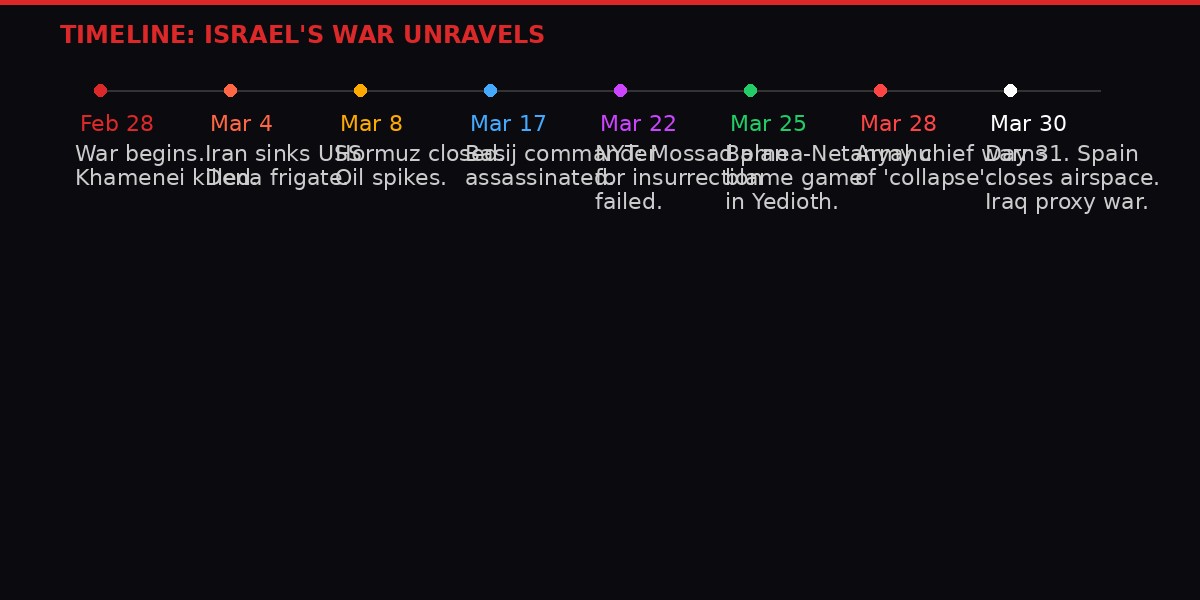
BLACKWIRE timeline: Key moments in the unraveling of Israel's Iran campaign.
The Regime Change That Wasn't

The US-Israeli campaign has destroyed police stations, civilian infrastructure, and government buildings - but Iran's state apparatus has not collapsed. (Pexels)
An Al Jazeera Digital Investigations unit analysis, published on March 30, confirmed what many analysts had suspected: the US-Israeli bombing campaign was not primarily about nuclear facilities or military infrastructure. It was about collapsing the Iranian state from the air.
At least 75 internal security sites were verified as destroyed or damaged between February 28 and March 10 alone. These were not missile batteries or nuclear centrifuge halls. They were local police stations. Criminal investigation headquarters. Public security offices. Basij checkpoints in residential neighborhoods. The 11th Criminal Investigation Base in southern Tehran - a building where detectives investigated fraud and petty theft - is now a crater.
The strategy had a clear logic, outlined explicitly by both Trump and Netanyahu. On February 28, Trump urged Iranians to "take over their government" once the bombing stopped. Netanyahu echoed the message in Farsi, calling on millions of Iranians to take to the streets, describing the military strategy as "breaking the Iranian government's bones." The bombs would destroy the security apparatus. The people would do the rest.
It was, in essence, the de-Baathification playbook from Iraq 2003 - applied from 30,000 feet instead of on the ground. And like de-Baathification, it created a security void without any mechanism to fill it. Except this time, unlike Iraq, there were no American troops on Iranian soil to manage the chaos they were trying to create.
The result one month later: FARAJA - Iran's Law Enforcement Command - deployed 24-hour patrols across Tehran during Ramadan. Riot police shut down potential protest gatherings before the Persian New Year holiday. After the March 17 assassination of Basij commander Gholamreza Soleimani, Israeli forces released footage of strikes on mobile Basij checkpoints - inadvertently confirming that the Basij was still operating, still moving, still controlling streets. The security apparatus adapted. It did not collapse.
The population, meanwhile, was too busy surviving bombardment to revolt. When your city is being bombed every night, political revolution is not the first thing on your mind. Shelter is. Food is. Water is. The United Nations special rapporteur on human rights in Iran warned that civilians faced a "simultaneous military and human rights crisis" - language that acknowledged the population was being crushed between its own government and the bombs falling from the sky.
The Coalition Cracks

Spain's airspace closure marks the most significant NATO-country dissent against the US war effort to date. (Pexels)
On Day 31, Spain closed its airspace to US military aircraft involved in the Iran war. Defence Minister Margarita Robles confirmed the closure to reporters after El Pais first reported it, calling the war "profoundly illegal and profoundly unjust." This came on top of Spain's earlier refusal to allow the US to use the Rota and Moron military bases in southern Spain - a decision that forced 15 US aircraft to relocate.
"This was made perfectly clear to the American military and forces from the very beginning. Therefore, neither the bases are authorised, nor, of course, is the use of Spanish airspace authorised for any actions related to the war in Iran." - Margarita Robles, Spanish Defence Minister, March 30, 2026
Spain is not a minor NATO member. Rota hosts four US Aegis destroyers as part of the European Ballistic Missile Defense system. Moron serves as a critical staging base for US Africa Command and special operations. Losing Spanish airspace and bases creates logistical headaches for US air operations that route through the Mediterranean. It forces longer flight paths, more aerial refueling, and increased operational complexity for missions heading toward the Persian Gulf.
Prime Minister Pedro Sanchez described the war as "unjustifiable" and "dangerous." His government had already pushed through a permanent arms embargo on Israel in October 2025, withdrawn from Israeli diplomatic coordination, and recognized Palestinian statehood. Spain under Sanchez has positioned itself as the loudest European voice against US-Israeli military operations in the Middle East - at a time when the European Union has limited itself to vague calls for "de-escalation and protecting civilians" without rejecting the assault on Iran.
Trump's response to Spain's base refusal was characteristically blunt: threats of a trade war with Madrid. But the threats rang hollow as the US found itself increasingly isolated. The Islamabad backchannel talks - involving Pakistan, Saudi Arabia, Turkey, and Egypt - were being organized without American participation in the room. The six Arab states (Saudi Arabia, UAE, Qatar, Kuwait, Bahrain, and Jordan) issued a joint condemnation of attacks on Gulf infrastructure that pointedly included both Iranian state strikes and proxy attacks. The coalition of the willing was becoming a coalition of the cornered.
Iraq: The Proxy Battlefield

Iran-aligned Iraqi militias have launched over 454 operations targeting Gulf states since February 28. Baghdad claims it cannot stop them. (Pexels)
Iraq has become the war's forgotten front and its most dangerous one. Iran-aligned armed groups operating under the umbrella of the Islamic Resistance in Iraq are launching between 21 and 31 operations daily against targets across the Gulf and Jordan. According to retired Iraqi Major-General Majed al-Qaisi, these groups have carried out more than 454 cumulative operations since February 28. The Iraqi desert has become a launchpad. Drones and missiles tear through the night sky toward the Arabian Peninsula. Baghdad watches and issues statements.
On March 30, six Arab nations - Saudi Arabia, the UAE, Qatar, Kuwait, Bahrain, and Jordan - issued a joint statement holding Baghdad directly responsible for the cross-border attacks. They cited UN Security Council Resolution 2817, which mandates that Iran halt all attacks on neighboring countries. They invoked Article 51 of the UN Charter - the right to self-defense. This was diplomatic language for: we reserve the right to strike back.
Baghdad's response was revealing in its impotence. The Iraqi Ministry of Foreign Affairs stated that the security of Arab countries was "an integral part" of Iraq's national security. It rejected the use of its territory to target Gulf states. It offered "full readiness" to receive evidence. In other words, it acknowledged the problem, denied responsibility, and asked for proof - the diplomatic equivalent of shrugging while your neighbor's house burns down from a fire that started in your yard.
The strategic logic behind Iran's use of Iraqi proxies is transparent. Tehran officially claims it is only targeting US bases in the region. The proxy attacks allow Iran to strike Gulf civilian infrastructure - energy facilities, industrial plants, desalination stations, hotels - while maintaining plausible deniability. As Khaled al-Jaber, director of the Middle East Council on Global Affairs in Doha, explained: "Iran is not withdrawing from the confrontation. It is redistributing it through tools that are less politically costly."
The consequences for Iraq are severe. Former Kuwaiti Minister Ahmed Abdel Mohsen al-Mulaifi warned that a state hosting armed groups operating outside the law "cannot be considered fully sovereign." He cautioned that if Trump follows through on threats of a ground invasion of Iran, Tehran could activate its Iraqi proxies to open new land fronts across the Kuwaiti and Saudi borders. Iraq would not just be a launchpad. It would become a war zone.
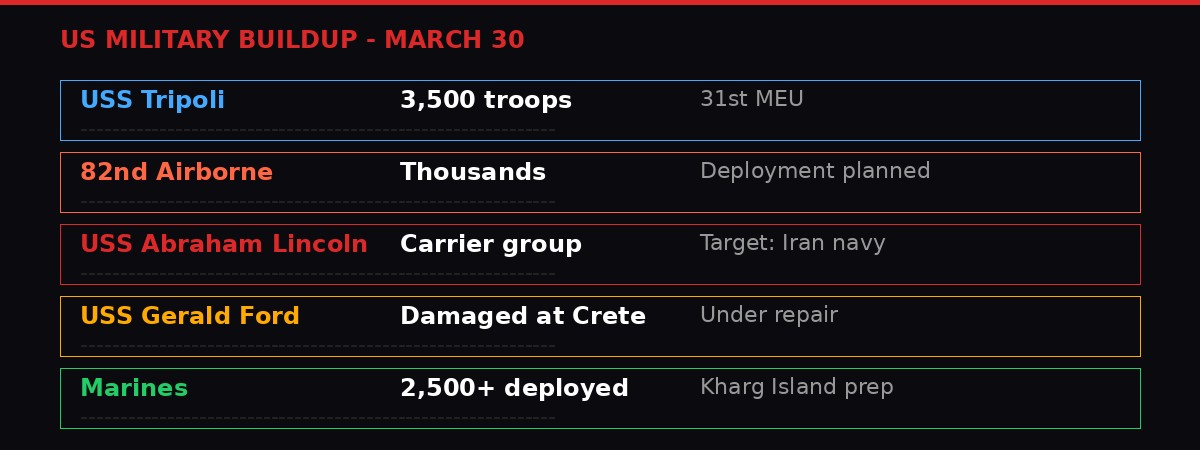
BLACKWIRE infographic: US military assets deployed to the Middle East as of Day 31.
The Ground Invasion Question

The USS Tripoli delivered 3,500 additional troops to the Middle East on March 27. The Pentagon says this does not mean a decision has been made. (Pexels)
Donald Trump told the Financial Times on March 30 that he wanted to "take the oil in Iran" by seizing Kharg Island - the nerve center of Iran's petroleum export infrastructure. Kharg handles crude from three major offshore oilfields (Aboozar, Forouzan, and Dorood) via subsea pipelines. Control Kharg and you control Iran's economic lifeline.
"To be honest with you, my favourite thing is to take the oil in Iran, but some stupid people back in the US say: 'Why are you doing that?' But they're stupid people. Maybe we take Kharg Island, maybe we don't. We have a lot of options." - Donald Trump, Financial Times interview, March 30, 2026
This was not idle speculation. The Washington Post reported on March 29 that the Pentagon was preparing for "weeks of limited ground operations in Iran" - potentially including raids on Kharg Island and coastal sites near the Strait of Hormuz. The plans could involve special operations forces and conventional infantry troops. One unnamed official described the timeline as "weeks, not months." Another said "a couple of months."
The military buildup supported the reporting. On March 27, 3,500 soldiers arrived in the Middle East aboard the USS Tripoli - the 31st Marine Expeditionary Unit, along with transport and strike fighter aircraft, amphibious assault assets, and tactical equipment. The 82nd Airborne Division was being readied for deployment. Marine forces already in the region numbered at least 2,500. The logistical footprint of a ground operation was being assembled in real time.
Iran's response was unambiguous. Parliament speaker Mohammad Bagher Ghalibaf said the "enemy openly sends messages of negotiation and dialogue and secretly plans a ground attack." He added: "Our men are waiting for the arrival of American soldiers on the ground to set them on fire and punish their regional partners forever." Iran's Navy Chief Shahram Irani warned that the USS Abraham Lincoln carrier strike group would be targeted with sea-to-sea missiles "to avenge the blood of the martyrs of the Dena warship" - the Iranian frigate sunk by the US on March 4.
The Iranians also played the escalation card. The semi-official Tasnim news agency quoted an unnamed military source saying Iran could open a new front at the mouth of the Red Sea if military action targeted Iranian islands. Yemen's Houthi rebels, backed by Iran, were "prepared to play a role" in controlling the Bab al-Mandeb Strait. This was a threat to choke two maritime chokepoints simultaneously - Hormuz and Bab al-Mandeb - cutting off both Persian Gulf and Red Sea shipping lanes.
White House press secretary Karoline Leavitt insisted that Pentagon preparations did not mean a presidential decision had been made. "It's the job of the Pentagon to make preparations in order to give the Commander in Chief maximum optionality," she said. But optionality and inevitability are separated by a thin membrane when 3,500 Marines are already bobbing in the Gulf.
The Oil Weapon

Brent crude has surged 62 percent since the war began. Energy analysts warn the worst is yet to come. (Pexels)
Brent crude topped $116 a barrel on March 30 - up more than 3 percent in a single session and 62 percent since the war began on February 27. That exceeds the price surge that followed Iraq's invasion of Kuwait in 1990. The world's energy markets have not seen disruption at this scale in modern history.
Iran's effective closure of the Strait of Hormuz - through which approximately 20 percent of global oil and LNG supplies flow - has created what analysts are calling the worst energy crisis in decades. Before February 28, the strait saw an average of 120 daily transits, according to maritime intelligence firm Windward. On March 27, seven non-Iranian vessels passed through. Seven, out of 120. That is a 94 percent reduction in maritime traffic through the world's most critical energy chokepoint.
The trickle of concessions - Pakistan brokered passage for 20 Pakistani-flagged vessels, Malaysia secured permission for its ships, and a handful of other non-aligned vessels have been cleared - does not come close to restoring normal flow. Greg Newman, CEO of Onyx Capital Group, told Al Jazeera that "physical oil moves around the world in loading cycles, and Europe has taken around three weeks to really start feeling the effects of the oil shortage." His assessment: "It is worse than anything that has come before it."
The crisis is rippling through global markets. Japan's Nikkei 225 and South Korea's KOSPI fell more than 4 percent on March 30. Indonesia's Jakarta Composite Index continued its decline. Southeast Asian countries, desperate for supply, are buying Russian oil under a 30-day US sanctions waiver. The irony is thick: the US launched a war partly to weaken Iran's oil leverage, and instead made the world more dependent on Russian crude.
Trump's April 6 deadline - the date by which he demanded Iran reopen the Strait or face strikes on civilian energy infrastructure including power plants and oil wells - was extended by 10 days. But the threat remains. "We've got about 3,000 targets left - we've bombed 13,000 targets - and another couple of thousand targets to go," Trump told the Financial Times. "A deal could be made fairly quickly." He also added: "We negotiate with them and then we always have to blow them up."
Tehran rejected Trump's 15-point peace plan as "maximalist" and "unreasonable." Iran's counter-demands include: the end of US-Israeli attacks, reparations for war damage, recognition of Iran's right to control the Strait, and security guarantees against future attacks. These positions are so far apart that diplomacy, at this stage, feels like theater.
The Kuwait Strike and Gulf Vulnerability
On Day 31, an Iranian attack damaged a power and water desalination plant in Kuwait, killing an Indian worker. Kuwait's Ministry of Electricity described it as "sinful Iranian aggression." The Kuwait National Guard reported downing five drones. The previous evening, 14 missiles and 12 drones had been detected in Kuwaiti airspace, with several targeting a military camp and injuring 10 servicemen.
Iran denied responsibility. The military's Khatam al-Anbiya operational command blamed Israel, claiming the Zionist regime had carried out the attack "under the pretext of accusing the Islamic Republic of Iran." This denial-by-deflection has become standard practice - Tehran attributes Gulf infrastructure hits to Israeli false flags while claiming its own strikes only target US military assets.
The attack exposed a vulnerability that Gulf states have been quietly dreading. The region produces 40 percent of global desalinated water. In countries like Kuwait, Qatar, the UAE, and Bahrain, desalination plants are not luxuries - they are the primary source of potable drinking water. A sustained campaign against desalination infrastructure would create a humanitarian crisis within days. As Al Jazeera's Zein Basravi reported from Dubai: "These cities get their potable drinking water from these plants."
Saudi Arabia reported intercepting five ballistic missiles heading toward its Eastern Province on the same day. Bahrain activated alarm sirens three times in four hours. The Gulf states have been living under a blanket of incoming fire since February 28, and their patience with Baghdad's inability to control Iraqi launch sites is running out.
What Comes Next

Thirty-one days in, with no ceasefire in sight, the question is no longer whether this war was a mistake - but how many more countries it will consume. (Pexels)
Daniel Levy, writing in Al Jazeera on March 30, identified the core problem with surgical precision: Israel takes an exclusively military approach to every conflict, devoid of any realistic political plan. Gaza did not produce regime change - Hamas still stands. Lebanon did not produce a decisive victory - Hezbollah is fighting back harder than expected. And Iran has not produced the revolution that Barnea pitched to the Americans in January.
The common denominator is unmistakable. Israel destroys. Israel does not build. It bombs police stations but cannot create a new security order. It kills leaders but cannot install replacements. It breaks infrastructure but cannot provide alternatives. Each campaign - Gaza, Lebanon, now Iran - follows the same pattern: overwhelming military force, no political vision, no exit strategy, and eventual descent into the blame game when the initial euphoria fades.
This time, the blame game started faster. One month. That is all it took for the army chief to warn of collapse, for the Mossad chief's failed insurrection plan to leak, for Netanyahu to start distancing himself from intelligence assessments he personally approved. The "unprecedented coordination" with Washington is beginning to look like a shared delusion - two governments that convinced each other they could reshape the Middle East with bombs and ended up reshaping it in ways neither intended.
The Islamabad talks, convened by Pakistan with Saudi Arabia, Turkey, and Egypt, represent the region's attempt to contain the damage. Trump said he was "pretty sure" of a deal. Rubio told Al Jazeera that Trump "prefers diplomacy." But the 82nd Airborne is being deployed. The Marines are staging near Kharg. Spain is closing its airspace. Oil is at $116. And Iran is threatening to set American soldiers on fire.
Day 31 is not a day of resolution. It is a day of divergence - between what leaders say and what they prepare for, between the stories they tell their publics and the intelligence assessments gathering dust on their desks. The war that was supposed to end Iran as a strategic threat has instead created the worst energy crisis in modern history, fractured NATO solidarity, turned Iraq into a proxy launchpad, pushed global markets into freefall, and exposed Israel's internal fractures for the world to see.
The question on Day 32 is not whether this war was a miscalculation. It is whether anyone involved has the political will to admit it before the next front opens.
Get BLACKWIRE reports first.
Breaking news, investigations, and analysis - straight to your phone.
Join @blackwirenews on Telegram