Israel Formalizes a Permanent Buffer Zone in Southern Lebanon: Five Bridges Destroyed, One Million Displaced
Israeli Defence Minister Israel Katz has formally announced the creation of a large security buffer zone across southern Lebanon, stretching to and beyond the Litani River - a 30-kilometre belt of territory that Israel intends to control indefinitely. Five bridges over the Litani have been destroyed. Displaced Lebanese civilians, now numbering over one million, will not be permitted to return. Hezbollah calls it an existential threat. The last time Israel tried this, they spent 15 years bleeding out of Lebanon before retreating in failure.

Southern Lebanon under Israeli bombardment, March 2026. (Pexels / illustrative)
The Katz Declaration: What Was Actually Said

Military press briefings have framed the buffer zone as defensive. Critics call it the beginning of a second occupation. (Pexels)
Israeli Defence Minister Israel Katz briefed defence chiefs on Tuesday and delivered the clearest articulation yet of Israel's territorial ambitions in southern Lebanon. The IDF was now "manoeuvring into Lebanese territory to seize a front line of defence, eliminating Hezbollah terrorists and destroying the terrorist infrastructures," he said, along with homes he claimed were used by Hezbollah near the border.
The strategic model Katz cited should alarm anyone paying attention to Gaza. He compared the planned zone explicitly to the approaches taken in Rafah and Beit Hanoun - major population centres in the Gaza Strip that have been largely levelled and remain under permanent IDF control. In other words: what was done there will be done here.
Katz confirmed five bridges over the Litani River have been blown. He described them as structures "used by Hezbollah for the passage of terrorists and weapons." The Lebanese government and civilians living across Shia, Christian, and Druze communities in the south see it differently: those bridges are how people move, how goods flow, how families reach hospitals. Destroy the infrastructure, and you destroy the possibility of return even if the shooting eventually stops.
The zone's stated purpose is to prevent Hezbollah from reconstituting combat positions in the south. Its practical effect is to permanently expel the civilian population from the heartland of Lebanon's Shia community - a community that does not uniformly support Hezbollah but has no say in this calculation.
"Thousands of Lebanese people in the south who have been displaced will not return south of the Litani River until security is guaranteed for the residents of the north." - Israeli Defence Minister Israel Katz, Tuesday briefing
Lebanese President Joseph Aoun responded immediately, calling the Israeli plans "collective punishment against civilians." That phrase has specific meaning under international humanitarian law, and its deployment by a sitting head of state in direct reference to Israeli military actions marks a sharp deterioration in any legal or diplomatic framing of the conflict.
The Ghost of 1985: Israel Has Tried This Before

Southern Lebanon has been contested territory for four decades. Israel's first buffer zone lasted 15 years. (Pexels)
Israel established its first buffer zone in southern Lebanon in 1985 - also described at the time as a "security belt" designed to protect northern Israeli communities from cross-border attacks. It extended roughly 15-20 kilometres into Lebanese territory. The IDF and its proxy militia, the South Lebanon Army (SLA), administered the zone for 15 years.
What followed was not peace. It was a slow-motion catastrophe. Hezbollah, which had only recently been founded in 1982, used the occupation itself as its primary recruitment tool and ideological justification. The group refined its guerrilla tactics against a conventional military force occupying unfamiliar terrain, bleeding the IDF in ways that the high command initially struggled to explain to the Israeli public.
By the late 1990s, footage of dead and wounded Israeli soldiers being regularly helicoptered out of the zone had turned Israeli public opinion decisively against the policy. Prime Minister Ehud Barak campaigned on withdrawal, won, and delivered. In May 2000, Israeli forces pulled out in what was widely seen - including by Israel's own generals - as a strategic defeat.
Hezbollah paraded through the vacated positions and declared victory. That victory narrative is what fueled the group's transformation from a Lebanese militia into a regional power - armed, funded, and politically entrenched in ways that have taken 25 more years of conflict to begin to reverse. The buffer zone policy, in other words, created the problem it was supposed to solve.
Now Israel is doing it again. Katz and the current IDF leadership believe the situation is different: Hezbollah has been significantly degraded in the months of fighting since late 2023, its command structure disrupted, its experienced fighters killed. But the same logic applies. A permanent occupation of Shia heartland generates the conditions for resistance. It does not eliminate them.
How This War Restarted

Infrastructure destruction - bridges, roads, power lines - has cut off entire villages from humanitarian access. (Pexels)
The November 2024 ceasefire was supposed to be the endgame for this round of fighting. Under the agreement brokered with US involvement, Hezbollah committed to withdrawing from positions south of the Litani and disarming. The Lebanese government and army were to supervise the process. Israeli forces were to withdraw from positions they had taken inside Lebanon.
Progress was made, but it was partial and fragile. Hezbollah never fully disarmed. Israel never fully withdrew, maintaining several military posts inside Lebanon and continuing regular strikes on what it described as Hezbollah targets. The Lebanese government - battered by years of financial collapse, multiple political crises, and the shadow of civil conflict - had the will to enforce the agreement but lacked the capacity.
The trigger came in late February 2026, when US and Israeli strikes against Iran began. Iran-backed Hezbollah responded by firing rockets into northern Israel - retaliation for the killing of Iran's supreme leader in the opening strikes of the war and in solidarity with a patron under sustained military attack. Israel responded to those rockets not with measured counter-fire but with a full campaign: air strikes, then ground forces, then the systematic destruction of infrastructure.
Israeli residents who had carefully, tentatively returned to towns in northern Israel after the 2024 ceasefire found themselves evacuating again. For the Israeli government and military, permitting a second displacement of northern Israeli communities by Hezbollah was politically intolerable. Hence the buffer zone policy: if Hezbollah cannot be trusted to stay north of the Litani, Israel will occupy the south of that line itself, permanently.
The logic is coherent. The history suggests it will not work.
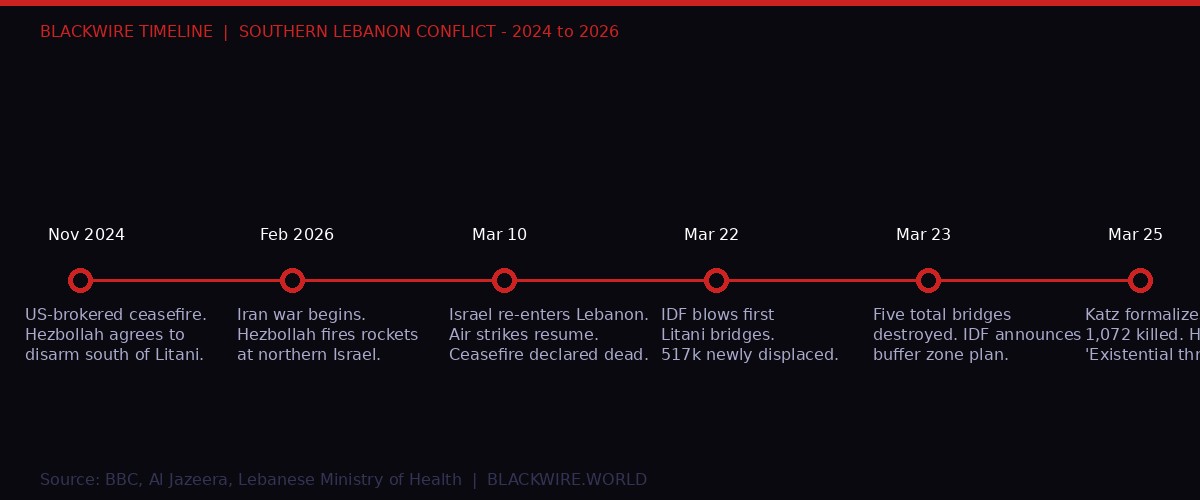
BLACKWIRE timeline: Key events in southern Lebanon, from the 2024 ceasefire to Israel's formal buffer zone declaration. March 25, 2026.
The Human Numbers: 1,072 Dead, One Million Displaced

More than one million people have been displaced from southern Lebanon, most with no access route back. (Pexels)
The Lebanese Ministry of Health puts the death toll in Lebanon since the current conflict escalated at 1,072 people. Those are the confirmed dead. The figure includes at least 121 children and 42 health workers - numbers that strip out any abstraction and situate the statistics in the bodies of people who were not combatants.
More than one million people have been displaced from southern Lebanon. That number comes from a country that was already hosting nearly 800,000 Syrian refugees, struggling with a currency collapse that has made Lebanese pounds nearly worthless, and dealing with the cascading effects of the 2020 Beirut port explosion on its physical and institutional infrastructure. There is no quiet part of Lebanon into which a million displaced people can be absorbed.
The destruction of five bridges over the Litani compounds this crisis in ways that go beyond the symbolic. The Litani is not just a military line - it is a geographic and logistical fact of life in southern Lebanon. Destroy the crossings, and you cut the south off from northern Lebanon's markets, hospitals, distribution networks, and population centres. Humanitarian organizations cannot operate effectively. Supply chains for food and medicine collapse. Communities that were not directly in the fighting zone are now isolated by the destruction of infrastructure.
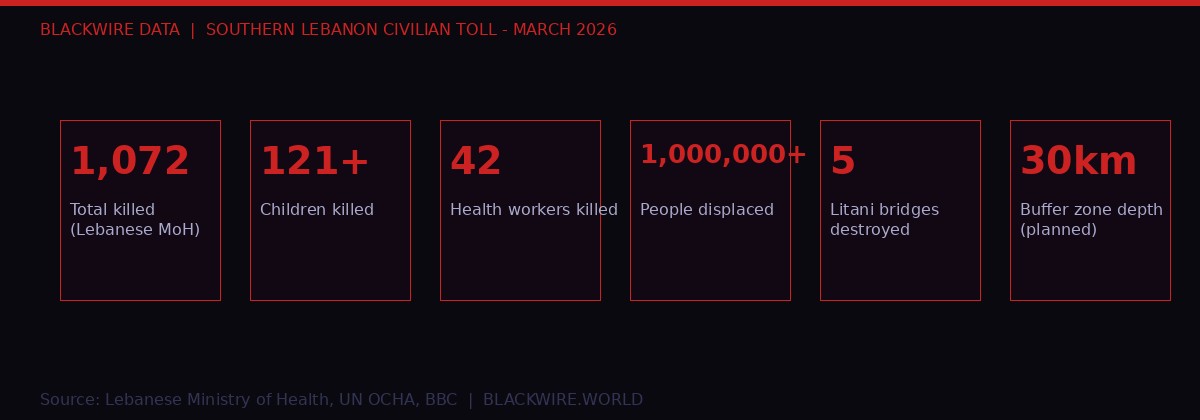
BLACKWIRE data: The human cost of Israel's Lebanon campaign as of March 25, 2026. Sources: Lebanese Ministry of Health, UN OCHA.
Human Rights Watch had already documented the use of white phosphorus in southern Lebanon in earlier stages of this conflict - a use that is prohibited under international humanitarian law when deployed in civilian-populated areas. The organization reported 517,000 people displaced in waves preceding the current formal buffer zone announcement. The total now exceeds one million.
Hezbollah's Response: "Existential Threat"

Hezbollah has vowed to resist what it calls an existential threat to its presence in southern Lebanon. (Pexels)
Hezbollah's official response was delivered by senior official Hassan Fadlallah. The language was stark: this was an "existential threat." His conclusion was equally direct: "We have no choice but to confront this aggression and cling to this land."
That framing - existential, no choice, cling - is not rhetoric designed to calm a situation. It is the language of a movement that has decided it cannot accept the terms being imposed and is communicating that to its constituency and its adversary simultaneously. Hezbollah is saying it will fight. The open question is how effectively.
The group has been significantly degraded. Senior commanders were killed in the strikes that opened this round of escalation, including figures central to Hezbollah's military planning and logistics. The Iranian support network has been disrupted - Iran itself is under sustained US-Israeli military attack as of late February 2026, its military infrastructure under systematic assault. The supply lines from Tehran through Syria to Hezbollah's depots in Lebanon are intermittent at best.
But degraded is not destroyed. Hezbollah retains fighters, it retains weapons stocks, and it retains what proved to be its most durable asset in the first occupation era: the ability to sustain losses, learn, adapt, and impose a cost on occupying forces over time. The IDF will take the territory south of the Litani. Whether it can hold it at acceptable cost is the question that 1985-2000 already answered once.
Lebanon's caretaker government is in an impossible position. President Aoun condemned the buffer zone as collective punishment - a condemnation that carries moral weight but no military leverage. The Lebanese Armed Forces lack the equipment, training, and political mandate to confront Israeli ground troops. The state can protest. It cannot stop.
The Wider War: Context the Buffer Zone Cannot Be Separated From

Israel's Lebanon strategy is inseparable from the broader US-Israeli war on Iran now in its 31st day. (Pexels)
The southern Lebanon buffer zone cannot be understood in isolation from the Iran war now in its 31st day. What Israel is doing in Lebanon is an extension of the same strategic logic it is applying everywhere: use the window created by the US military campaign against Iran to resolve, by force, security problems that diplomatic processes have failed to address for decades.
In Gaza, that meant ground invasion, sustained bombardment, and the destruction of Hamas's military and governmental infrastructure. In Lebanon, it meant - in this round - the resumption of airstrikes, ground incursions, and now the formal assertion of a buffer zone. These are not separate decisions; they reflect a single strategic assessment by the Israeli government that this is a historically unique window in which the regional balance of power is tilted sharply in Israel's favour.
Iran, which funds, arms, and directs Hezbollah, is fighting for its own survival against direct US-Israeli military strikes. The flow of weapons through Syria to Lebanon is disrupted. Iranian advisors who would normally coordinate with Hezbollah command are either dead, in hiding, or occupied with domestic crisis management. Hezbollah has been told, in effect, that its patron is not available to help right now.
This is the opening Israel's government decided to exploit. Whether that exploitation produces durable security for northern Israeli communities, or produces the same cycle of occupation and resistance that defined 1985-2000, depends entirely on what happens next - and history does not offer encouraging precedents.
Lebanon itself expelled the Iranian ambassador earlier this week, a rupture that reflects how the Hezbollah-Iran relationship has destabilized Lebanese domestic politics. Iran's ambassador was accused of attempting to use Lebanese territory to coordinate war efforts in ways that have drawn Lebanon into a conflict the Lebanese state did not choose and cannot control. The expulsion signals that whatever leverage Hezbollah retains inside Lebanese politics, it is not unlimited.
Timeline: Southern Lebanon - From Ceasefire to Buffer Zone
International Law and the ICC Problem

The International Criminal Court has no jurisdiction over Israel or the United States - but legal scholars are building the record. (Pexels)
Luis Moreno Ocampo, founding chief prosecutor of the International Criminal Court, told the BBC this week that the broader US-Israeli war on Iran amounts to a crime of aggression under international law. He applied the same analysis to Iranian strikes on Gulf neighbours. His legal framework: under the Rome Statute, the use of armed force against the sovereignty and territorial integrity of another state, outside of self-defence or UN Security Council authorization, constitutes a crime of aggression.
Moreno Ocampo also made a specific point about attacks on energy and civilian infrastructure. Striking power plants, water systems, and bridges - deliberately, as a strategy - does not constitute targeting of legitimate military objectives. He drew the comparison to Russian strikes on Ukrainian power infrastructure, which led to ICC indictments of Russian officials.
The legal analysis applies clearly to the destruction of Litani bridges. Those bridges served civilian populations. Their military use by Hezbollah does not automatically transform them into legitimate military targets under international humanitarian law - any attack must still adhere to principles of distinction (between combatants and civilians) and proportionality. The bridges are gone. A million people cannot cross. The legal record is being built, even if enforcement is absent.
Neither Israel nor the United States is a member of the International Criminal Court. The Trump administration has sanctioned several ICC judges in retaliation for previous investigations - a move that itself signals awareness that the legal exposure is real even if the practical consequences are currently limited. Lebanon, which is an ICC member, could in theory request an investigation. Whether it will, and whether that matters, is another question.
What matters on the ground is that the legal architecture designed after World War II to prevent exactly these kinds of actions - permanent occupation of territory by force, collective punishment of civilian populations, destruction of civilian infrastructure - is visibly failing in real time. The rules exist. The enforcement mechanism does not.
What Happens Next: The Three Scenarios

Three scenarios define what comes next in southern Lebanon - and none of them is easy. (Pexels)
The immediate military picture is clear enough: Israeli ground forces are pushing into the south, destroying infrastructure, and asserting control of a wide belt of Lebanese territory. What is less clear is what comes after the shooting stops, if it does.
Scenario one is the Israeli government's stated objective: a buffer zone that holds indefinitely, that is thin enough for the IDF to control, that Hezbollah cannot reconstitute south of the Litani, and that eventually allows northern Israeli communities to live without rocket threat. For this to work, Hezbollah would need to accept permanent exclusion from its heartland - something it has explicitly said it will not do, and something it proved it would not accept in the 2000 withdrawal. This scenario requires either the destruction of Hezbollah as an organization or a political agreement that gives Hezbollah enough of what it wants that fighting in the south becomes unprofitable. Neither condition is currently in sight.
Scenario two is the historical precedent: Israel holds the zone for years, takes regular casualties, loses domestic support, and eventually withdraws under conditions that Hezbollah again presents as a victory. Hezbollah uses the occupation to rebuild, recruit, and re-arm. The cycle resumes. This is what happened between 1985 and 2000, and the conditions that made it possible - a motivated resistance movement, terrain favourable to guerrilla operations, a civilian population that experiences occupation as oppression - remain present.
Scenario three is the wildcard: a broader political settlement that emerges from the Iran war negotiations now reportedly ongoing, in which Hezbollah's status and weaponry are addressed as part of a regional framework. Trump has claimed talks with Iran are happening. Iran has denied it. If a deal does emerge that ends the Iran war, the shape of that deal will determine whether Hezbollah is part of the settlement or is left to fight on independently. No such deal exists yet, and given the pace of current military operations, it may not come in time to prevent the buffer zone from becoming a permanent feature of the landscape.
The Lebanese state, the UN Security Council, and every regional actor with leverage is, for now, watching rather than acting. That inaction is its own kind of answer about how the international community rates the prospects for stopping what is underway.
Get BLACKWIRE reports first.
Breaking news, investigations, and analysis - straight to your phone.
Join @blackwirenews on TelegramBBC News, "Iran war shows norms of international conflicts have been upended," March 25, 2026 | Tom Bateman.
Al Jazeera, live updates on US-Israeli strikes on Iran and Lebanon operations, March 24-25, 2026.
Lebanese Ministry of Health, official casualty figures, March 2026.
Human Rights Watch, documented use of white phosphorus in southern Lebanon, March 2026 (previously reported in BLACKWIRE: 517,000 displaced).
Luis Moreno Ocampo, founding ICC chief prosecutor, interview with BBC, March 2026.
Israeli Defence Minister Israel Katz, official defence briefing statements, Tuesday March 24, 2026.
Lebanese President Joseph Aoun, public response to IDF buffer zone announcement, March 25, 2026.
Hezbollah senior official Hassan Fadlallah, public statement on buffer zone, March 25, 2026.
BLACKWIRE WAR BUREAU | GHOST CORRESPONDENT | Report filed March 25, 2026 | © BLACKWIRE