Israel Orders Litani Bridges Destroyed. Lebanon Braces for Ground Invasion.
Israeli Defense Minister Israel Katz has ordered the military to destroy every crossing over the Litani River. The Qasmiyeh Bridge - a vital artery linking southern Lebanon to the rest of the country - was blown apart Sunday. Lebanese President Joseph Aoun called it a "prelude to ground invasion." The IDF's own army chief confirmed it: the operation "has only begun."

Three weeks into Israel's expanded Lebanese campaign - itself a cascade effect of the US-Israel war on Iran - the death toll has cleared 1,029. More than one million people have been forced from their homes. And now, with the systematic demolition of river crossings ordered from the defense ministry, military analysts are reading the same pattern that preceded Gaza's prolonged siege: cut the territory off first, then move in.
The Israeli military struck the Qasmiyeh Bridge on Sunday. Video verified by Al Jazeera showed the explosion consuming the span over the Litani River in southern Lebanon. The bridge had served as a key route between the country's south and its interior - for supplies, for medical access, for displaced families trying to reach shelters in Beirut and beyond. It is now rubble.
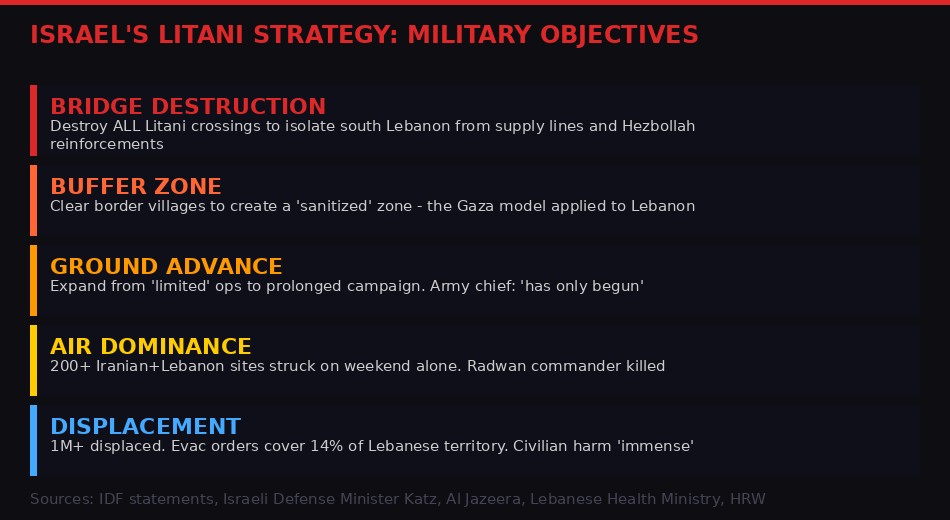
Katz's order wasn't just about one bridge. He told the IDF to destroy all Litani crossings "used for terrorist activity" - a designation broad enough to encompass any movement Hezbollah might exploit. Simultaneously, he ordered the demolition of homes in southern Lebanon's "front-line villages." The Israeli Defense Minister cited the operational model used in Beit Hanoun and Rafah in Gaza, where Israel created buffer zones by clearing structures near the border. That model involved roughly 2.3 million people trapped in a shrinking enclave. Lebanon has 5.9 million.
The Litani River: Why It Matters

The Litani River runs roughly east to west across southern Lebanon, flowing approximately 170 kilometers before turning south toward the sea near Tyre. It has been a strategic boundary in Lebanese-Israeli relations for decades - UN Security Council Resolution 1701, which ended the 2006 war, called for Hezbollah to withdraw its heavy weapons north of the river. That withdrawal never fully materialized.
For Israel, controlling the area south of the Litani has been a stated security objective since at least the 1978 invasion. The concept: eliminate Hezbollah's ability to fire rockets into northern Israel by physically occupying or isolating the territory. Destroying the bridges is the first step in that isolation. Without functioning crossings, the south becomes an island - cut off from resupply, from medical evacuation, from civilian flight.
Human Rights Watch's Lebanon researcher Ramzi Kaiss told Reuters on Sunday that destroying Lebanon's bridges wholesale would constitute wanton destruction, which is a war crime under international humanitarian law. Even if the bridges were being used for military purposes, international law requires weighing the military advantage against civilian harm.
"If all these bridges are struck, and the region that is south of the Litani becomes isolated from the rest of the country, then the civilian harm is going to be so immense that you have a humanitarian catastrophe - people still living in the south won't be able to access food, medicine and other basic needs." - Ramzi Kaiss, Lebanon researcher, Human Rights Watch, quoted by Reuters, March 22, 2026
The Lebanese government has already issued mass displacement orders covering 1,470 square kilometers - roughly 14 percent of the country's total territory. The Norwegian Refugee Council documented those orders this week. Nearly one in five Lebanese citizens has been displaced since March 2. Many of them have nowhere to go: collective shelters reached capacity weeks ago.
The Numbers Behind the Offensive
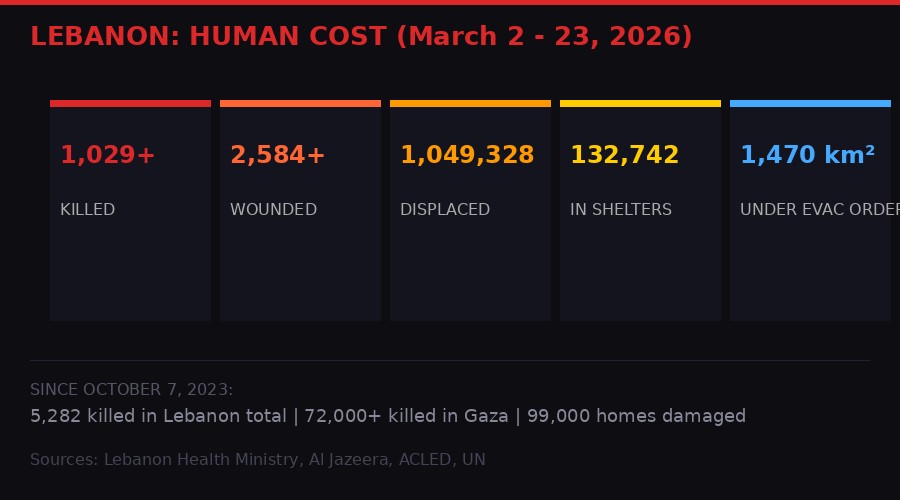
The Lebanese Health Ministry's count through March 22 includes 79 women, 118 children, and 40 healthcare workers killed. Those figures cover only the March 2 resumption of hostilities - since October 7, 2023, Israeli attacks in Lebanon have killed at least 5,282 people in total, according to historical data compiled by the Armed Conflict Location and Event Data project (ACLED).
Israel's military says it has struck over 200 targets in Iran and Lebanon over the past weekend alone - missile launchers, air defense systems, military bases, and what it describes as Hezbollah infrastructure. The IDF's stated logic: each destroyed bridge, each flattened building near the border, reduces Hezbollah's operational capacity. The observable reality: over a million civilians are now living the consequences of that doctrine.
Army Chief: "Has Only Begun"

Lieutenant General Eyal Zamir, the Israeli army chief, issued a statement Sunday afternoon that left no room for ambiguity. The operation against Hezbollah, he said, "has only begun" and would be "prolonged." He added: "We are now preparing to advance the targeted ground operations and strikes according to an organised plan."
That statement matters. Israel launched what it initially characterized as "limited and targeted ground operations" in southern Lebanon on March 16. Six days later, the army chief is publicly signaling expansion. The framing has shifted from surgical anti-Hezbollah action to a long-duration campaign with an unspecified end state.
Lebanese President Joseph Aoun read the bridge strikes the same way. The Qasmiyeh crossing destruction, he said, was "an attempt to sever the geographical connection between the southern Litani region and the rest of Lebanese territory." He called the attacks part of "suspicious schemes to establish a buffer zone along the Israeli border" and to "solidify the reality of the occupation and seek Israeli expansion within Lebanese territory."
"These attacks fall within suspicious schemes to establish a buffer zone along the Israeli border, solidify the reality of the occupation and seek Israeli expansion within Lebanese territory." - Lebanese President Joseph Aoun, statement issued March 23, 2026
The Lebanese government's position is notably complex. Beirut has outlawed Hezbollah's military activity and said it wants direct talks with Israel. Earlier this month, Katz warned Lebanon it would face infrastructure damage and territorial losses unless Hezbollah was disarmed - as agreed in the November 2024 ceasefire that Israel itself repeatedly violated before this month's escalation. That ceasefire ended, by most accounts, when the US and Israel killed Iranian Supreme Leader Khamenei on February 28. Hezbollah fired rockets two days later. Israel's military response has not stopped since.
The Gaza Model - Applied to Lebanon

Katz's explicit reference to Gaza's Beit Hanoun and Rafah as operational models for the Lebanon campaign is significant. It tells you exactly what Israel is planning to do with southern Lebanon south of the Litani: clear it.
The Gaza model, stripped of euphemism, worked like this: systematic air bombardment to destroy infrastructure, followed by mass displacement orders covering entire population centers, followed by ground operations into largely depopulated zones, followed by the construction of buffer zones along the border. The World Bank estimated damage to residential buildings in Lebanon from October 2023 to November 2024 alone at approximately $2.8 billion, with roughly 99,000 homes damaged or destroyed. Most families who fled in that period returned after the November 2024 ceasefire - only to be driven out again this month.
If the same operational arc plays out in Lebanon as in Gaza, southern Lebanon faces a prolonged occupation and the permanent displacement of hundreds of thousands of people. Zamir's "prolonged" language and the systematic bridge destruction suggest that timeline is already in motion.
The UN human rights office's spokesperson said this week that Israeli attacks on Lebanon "may amount to war crimes" - citing the failure to distinguish between military targets and civilian objects, and the deliberate targeting of healthcare workers and facilities. Amnesty International echoed that assessment, specifically calling out strikes on ambulances and hospitals as potential violations of international humanitarian law.
Hezbollah's Response - And Its Limits

Hezbollah fired a rocket at the northern Israeli community of Misgav Am on Sunday, killing one person in their vehicle. It was the first Israeli civilian death from fire originating in Lebanon since the US-Israel war on Iran began over three weeks ago. Hezbollah claimed the attack, saying it targeted "a gathering of Israeli enemy soldiers" - Israel's emergency services described a man burned in a car after a direct hit.
The death marks a threshold. Hezbollah has been drawing fire across the northern border intermittently since March 2, but civilian fatalities on the Israeli side from Lebanon had been avoided. That buffer is gone. Israel's military response will be calibrated accordingly.
Hezbollah also claimed multiple attacks on Israeli soldiers and vehicles in and near the border town of Taybeh, and in Khiam - a strategic southern town that has been the site of regular engagements during the ground operation. The IDF, meanwhile, announced the killing of Abu Khalil Barji, identified as a commander of Hezbollah's Radwan Force - the unit's elite ground fighters - along with two others in an air strike in the Majdal Selem area. The Radwan Force is Hezbollah's most capable conventional infantry unit, trained for cross-border operations. Targeting its commanders systematically degrades coordination capacity but rarely stops the fire.
Israel's military also said it killed a Hamas operative in Lebanon named Walid Muhammad Dib, described as responsible for transferring funds to Hamas networks. The IDF credited Shin Bet intelligence for that strike. The combination - Radwan commanders and Hamas financial operatives targeted simultaneously - reflects Israel's broader objective: dismantle every axis-of-resistance operational node inside Lebanese territory regardless of which group it belongs to.
Timeline: Three Weeks of Escalation
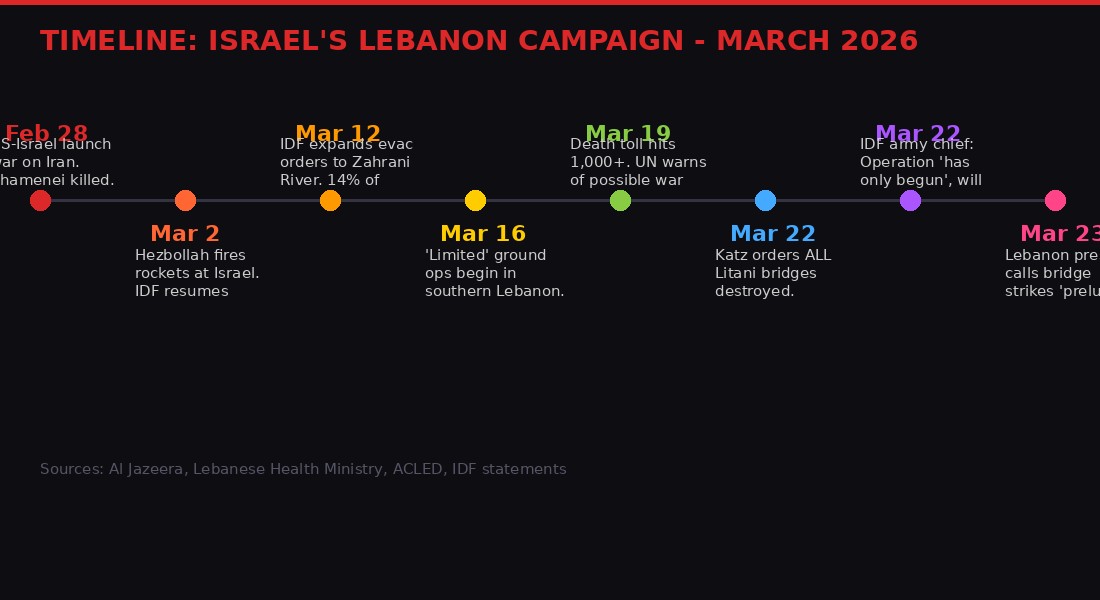
Conflict Timeline
The International Reaction - And Its Inadequacy

France, Germany, the UK, Canada, and Italy issued a joint statement earlier this month condemning attacks on civilians and civilian infrastructure in Lebanon and calling for de-escalation. French Foreign Minister Jean-Noel Barrot flew to Jerusalem on Friday and met with Israeli Foreign Minister Gideon Saar, telling reporters he expressed France's reservations about "a ground operation of significant scale and duration."
Saar has not indicated those reservations changed anything. Zamir's Sunday announcement came after Barrot's meeting.
The gap between international rhetoric and operational reality in Lebanon has been a defining feature of the conflict since October 2023. The November 2024 ceasefire was supposed to be the mechanism for pulling Israel's forces out of Lebanese territory and getting Hezbollah's heavy weapons north of the Litani. Israel didn't comply with its own withdrawal commitments under that deal, continued strikes in violation of the agreement, and now - with the Iran war providing strategic cover - is moving openly toward the buffer-zone scenario the ceasefire was meant to prevent.
The UN Security Council is in a familiar position: divided, with the US backing Israeli operations as part of the broader Iran campaign, Russia condemning attacks on nuclear facilities in Iran but doing little for Lebanon, and the European members caught between condemnation and the reality that sanctions on Israel have never materialized. Calls for restraint land differently when the entity being restrained is also receiving intelligence, weapons, and diplomatic cover from the world's most powerful military alliance.
What Comes Next

Zamir said Sunday that Israel is "preparing to advance the targeted ground operations and strikes according to an organised plan." That phrase - "organised plan" - suggests the current phase is preparation for something larger. The bridge demolitions are force-multipliers for ground movement: they prevent Hezbollah from maneuvering, resupplying, or receiving reinforcements across the Litani while IDF forces advance from the south.
The civilian consequences of that plan are already being calculated. Kaiss of Human Rights Watch warned that an isolated south Lebanon - cut off by destroyed bridges - produces a humanitarian catastrophe. People without road access cannot reach hospitals. Aid convoys cannot get food and medicine in. Wounded fighters and civilians alike cannot be evacuated. The Lebanese Red Cross and UN agencies have been working in an increasingly constrained environment as the bombing intensifies and roads are cut.
Lebanon's fragile state capacity complicates every part of the response. The Lebanese Armed Forces (LAF) - constitutionally obligated to defend Lebanese sovereignty - are in an impossible position. They lack the hardware to contest Israeli air superiority. They are nominally committed to disarming Hezbollah per the 2024 ceasefire, but cannot enforce that against an armed group that commands significant domestic political support and has been fighting the war independently. And they face an Israeli military that is explicitly operating inside Lebanese territory regardless of what Beirut says.
What Zamir's "prolonged" campaign looks like on the ground is a siege: bridges down, villages cleared, a creeping buffer zone being institutionalized through destruction. If the Gaza comparison holds, the international community will continue to issue statements, humanitarian organizations will struggle to access what's left, and the death toll will climb past numbers that were previously unimaginable.
Lebanon has been here before - 1978, 1982, 2006, 2024. Each time the war ended without resolving the underlying dynamic. This time, the context is different: Israel is simultaneously prosecuting a war against Iran, the US is fully engaged in that conflict, and no diplomatic framework exists to interrupt the escalation cycle. The Qasmiyeh Bridge is gone. The others are likely next. And the army chief has already told you the end state isn't close.
Get BLACKWIRE reports first.
Breaking news, investigations, and analysis - straight to your phone.
Join @blackwirenews on Telegram