Israel Bombs the Litani Bridges. Lebanon's President Says a Ground Invasion Is Coming.
On Day 26 of the Iran War, Israel struck Lebanese bridges over the Litani River, killed its first Hezbollah-confirmed Israeli civilian, and ordered the demolition of homes near the border. Beirut's president is calling it the opening move of a land war nobody can afford - but that everyone can see forming.
Smoke over southern Lebanon after Israeli airstrikes on Litani River crossings, March 22, 2026. BLACKWIRE graphic.
Israel struck the Qasmiyeh bridge near Tyre, southern Lebanon, with one hour warning on Sunday. Lebanese President Joseph Aoun called bridge strikes "a prelude to a ground invasion." Hezbollah confirmed its first confirmed kill in northern Israeli territory - farmer Ofer Moskovitz, 61, shot dead in Misgav Am. Trump's 48-hour ultimatum to Iran over the Strait of Hormuz is now running. The war is opening new fronts.
The Iran War has always carried a Lebanon problem inside it. Since the moment the U.S. and Israel launched Operation Epic Fury against Iran on February 28, Hezbollah has been firing rockets into northern Israel from Lebanese soil while Israeli aircraft have been hammering southern Lebanon with strikes that have killed more than 1,000 Lebanese civilians and displaced more than a million more. For 25 days, the two sides maintained a grim equilibrium: cross-border exchanges, casualties on both sides, mass displacement, but no confirmed Israeli combat deaths on Lebanese soil and no Israeli tanks rolling north across the Blue Line.
That changed on Sunday, March 22. Two connected events transformed the Lebanon front from a secondary theater into an imminent ground war. Israel bombed bridges across the Litani River - the waterway that has served as the notional boundary between Lebanese state authority and Hezbollah's armed zone for two decades. And a 61-year-old farmer named Ofer Moskovitz became the first Israeli civilian confirmed killed by Hezbollah since the war began.
Lebanese President Joseph Aoun, who has no love for Hezbollah and no desire for this war, looked at the bridge strikes and said publicly what military analysts have been whispering for weeks. This is the prelude to a ground invasion.
He may be right. And if he is, Lebanon is about to enter its worst chapter since 1982.
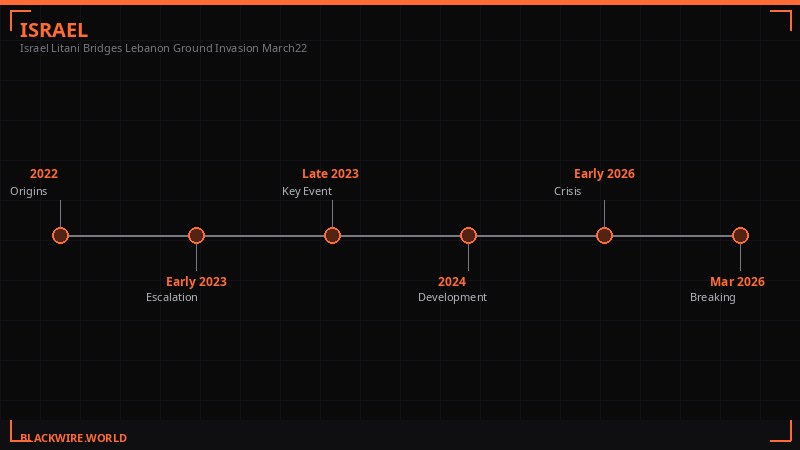
Hezbollah's role in the Iran War escalation - from Day 1 to the first confirmed kill in northern Israel. BLACKWIRE analysis.
The Bridge That Broke the Equilibrium
The Litani River has been a political red line in Israeli-Lebanese conflict since 1978, when Israel first invaded and the United Nations deployed UNIFIL - the United Nations Interim Force in Lebanon - to monitor a buffer zone. When the 2006 Lebanon War ended with UN Security Council Resolution 1701, the Litani became the official boundary: Hezbollah was required to withdraw all armed personnel and infrastructure north of the river. The Lebanese Armed Forces were supposed to deploy south of it. The zone between the river and the Blue Line was to be militia-free.
None of this happened. Hezbollah never withdrew. UNIFIL acknowledged it could not stop re-armament. The Lebanese Armed Forces, underfunded and politically constrained, deployed symbolically in the south without genuinely asserting sovereignty. For 20 years, the Litani line existed on paper and in UN resolutions while Hezbollah built one of the most militarily sophisticated non-state armed organizations in history in the territory it was supposed to vacate.
By 2026, independent military analysts estimated Hezbollah held close to 100,000 rockets and missiles, ranging from short-range Katyushas to precision-guided munitions that could hit Tel Aviv with accuracy. The International Institute for Strategic Studies, in its Military Balance assessment, described Hezbollah as better armed than most European national armies. The group's tunnels, command bunkers, and weapons caches in southern Lebanon were built specifically to survive Israeli airstrikes and sustain a prolonged ground fight.
The bridges over the Litani are the logistics lifeline connecting Hezbollah's southern forces to its deeper reserves in the Bekaa Valley and the organization's broader support infrastructure in central and northern Lebanon. Reinforcements, ammunition, fuel, food, medical supplies - all of it crosses the river. Destroy the crossings and you don't eliminate Hezbollah's fighting power in the south, but you dramatically extend the time and complexity required to resupply it.
On Sunday afternoon, Israel struck the Qasmiyeh bridge near Tyre, the historic coastal city in southern Lebanon. The military gave roughly one hour's warning for civilians to clear. Defense Minister Israel Katz described the bridge as part of Hezbollah's active logistics network - used to move fighters and weapons southward toward the border in preparation for operations against Israel. He ordered the military to accelerate what he called "the destruction of Lebanese homes near the border." Both announcements together signal the same thing: land clearing for an advance.
"This is a prelude to a ground invasion." - Lebanese President Joseph Aoun, March 22, 2026 (AP News)
Aoun's statement carries weight precisely because he is not Hezbollah's defender. He is a former Lebanese Armed Forces commander elected on a platform of state authority, political reform, and eventual Hezbollah disarmament through a negotiated political process. He has been trying to use the Iran War to reassert Lebanese sovereignty in the south. His warning is not a threat - it is a statement of analysis from a man who knows the military situation on the ground and has every reason to want a ground war not to happen.
Ofer Moskovitz: The Name That Changes the Politics
For 25 days, Hezbollah's rockets had killed livestock, destroyed buildings, ignited fields, triggered mass evacuations from northern Galilee, and made the communities within range functionally uninhabitable for a large share of their residents. Israeli civil defense authorities had been reporting near-daily incidents. Iron Dome intercepted many launches. Some got through. Craters in fields, smashed rooftops, damaged cars.
But no confirmed Israeli civilian fatality from Hezbollah in 25 days of war.
That statistical record was a political shield for Netanyahu. As long as Hezbollah's rockets were destroying property rather than killing people, it was possible to maintain the framing that the Lebanon front was a manageable harassment - serious, requiring response, but not existential in the way the Iran nuclear and Hormuz crises were. The Israeli right flank, which has been pushing since October 2023 for exactly this kind of ground operation in Lebanon, could be held off as long as the casualty count was zero.
On Sunday, Hezbollah shot Ofer "Poshko" Moskovitz in his car in the northern Israeli town of Misgav Am. He was 61 years old, a farmer, a man who had lived his whole life in the shadow of the Lebanese border and had chosen to stay. Two days before his death, he told an Israeli radio station that living where he did felt like "Russian roulette." He knew the odds. He stayed anyway.
Hezbollah confirmed responsibility within hours. Israeli authorities identified Moskovitz publicly. His face, his name, his age, his quote about Russian roulette - all of it will circulate through Israeli media through the night and into Monday morning. By the time the Israeli cabinet meets, he will be a symbol.
Symbols change political equations. Netanyahu, who is managing a coalition that includes far-right partners who have been demanding ground action in Lebanon since the war began, now faces a different set of political pressures. The argument for continued restraint on the Lebanon front - that Israeli civilians were not dying - is gone. The argument for action just got a face and a name.

Confirmed casualties across all fronts on Day 26 of the Iran War. Source: AP News, Iranian state media, IDF, Lebanese authorities.
What a Lebanon Ground Operation Actually Looks Like
Israeli military analysts who have spoken to international outlets over the past week have confirmed that significant ground forces - estimates range from 50,000 to 80,000 troops - have been positioned within range of the Lebanese border since roughly Day 10 of the Iran War. Expeditionary equipment has been pre-positioned. The Marines being sent to the region as part of Trump's latest reinforcement package are amphibious units designed for exactly the kind of coastal landings that southern Lebanon's geography accommodates.
The planning exists. The forces are there. The question has always been order, timing, and political will.
The military objective for a ground operation would be what Israel has framed publicly for two decades: push Hezbollah north of the Litani, destroy its tunnel networks and weapons caches in the south, and create a buffer zone that cannot be used to shell northern Israel. In theory, this is what Resolution 1701 required without armed enforcement. A ground operation would attempt to impose by force what a UN resolution failed to achieve through diplomacy.
In practice, ground operations in Lebanon have a specific historical outcome. Israel invaded in 1982 to push the PLO north of the Litani. The invasion lasted 18 years. It cost thousands of Israeli and Lebanese lives. It created the conditions in which Hezbollah was founded, grew, and became far more powerful than the PLO it replaced. Israel withdrew in 2000, and Hezbollah declared victory. In 2006, Israel launched a 34-day ground and air campaign in the south. Hezbollah survived, fired rockets throughout, and again declared victory when the fighting stopped. Its arsenal and prestige emerged from 2006 larger than before.
Military planners in Jerusalem know this history. The question is whether the political pressure building after Moskovitz's death, combined with Hezbollah's bridge-crossing logistics that a ground operation could interdict, outweighs the historical pattern of failed Israeli ground campaigns in Lebanese territory.
If Israel Invades Lebanon - The Numbers
- Estimated IDF ground force required: 50,000-80,000 troops
- Hezbollah remaining rocket inventory: Estimated 80,000-100,000 (IISS)
- Lebanese displaced by war so far: More than 1 million
- Lebanese killed by Israeli strikes (war to date): More than 1,000
- Precedent - 1982 Lebanon War duration: 18 years
- Precedent - 2006 Lebanon War duration: 34 days; Hezbollah emerged stronger
- UNIFIL personnel currently in Lebanon: ~10,500 from 50 countries

Key facts about a potential Israeli ground invasion of Lebanon. BLACKWIRE intelligence brief.
Lebanon's 1 Million Displaced and the Humanitarian Abyss
Before any ground operation begins, Lebanon is already experiencing a humanitarian catastrophe. Lebanese authorities report more than 1,000 people killed by Israeli airstrikes since the Iran War began, and more than 1 million people displaced from their homes in the south and in other areas affected by the fighting. That is roughly one-fifth of Lebanon's entire population forced out of their residences in less than four weeks.
The country's infrastructure was already shattered before the Iran War. Lebanon experienced the August 2020 Beirut port explosion, one of the largest non-nuclear explosions in history, which killed over 200 people and caused an estimated $15 billion in damage. The country then entered a prolonged economic crisis, with the Lebanese pound losing over 90 percent of its value, banks imposing capital controls, and the government defaulting on its sovereign debt. By the time the Iran War began in February 2026, the Lebanese state had been functioning on minimal reserves and international aid handouts for years.
An Israeli ground invasion into this context would not just be a military operation. It would land on top of a population that is already displaced, traumatized, and utterly dependent on international humanitarian access that a ground war would sever or severely restrict. Beirut's hospitals, understaffed and undersupplied before Day 1, would face a surge in casualties from active ground combat on top of the existing caseload from air strikes.
Southern Lebanon's main hospital facilities have already been receiving mass casualty transfers. If Israeli tanks move north and Hezbollah engages in the kind of urban and tunnel warfare it has been training for in exactly the terrain they would be fighting over, the medical system collapses.

Lebanon's humanitarian crisis on Day 26 - 1 million displaced, over 1,000 killed. BLACKWIRE data visualization.
Iran Strikes Near Dimona - The Nuclear Shadow
The Lebanon escalation is unfolding against the most alarming nuclear-adjacent development of the entire war. Late Saturday night, Day 25, Iran launched missiles targeting two Israeli communities in the Negev Desert - Arad and Dimona - near the site of Israel's Negev Nuclear Research Centre, the facility where Israel is widely believed to have developed and maintains its nuclear arsenal.
At least 175 people were wounded and treated at the main hospital in southern Israel, according to the hospital's deputy director Roy Kessous, who spoke to the Associated Press. Netanyahu visited one of the affected communities and called it a "miracle" that no one was killed. The IAEA said it had received no reports of damage to the research centre and that radiation monitoring showed nothing abnormal.
Iran's parliament speaker Qalibaf explicitly framed the Dimona penetration as a strategic proof of concept - that Iranian missiles could reach one of Israel's most heavily defended airspace zones.
"If the Israeli regime is unable to intercept missiles in the heavily protected Dimona area, it is, operationally, a sign of entering a new phase of the battle." - Mohammad Bagher Qalibaf, Iranian Parliament Speaker, March 22, 2026 (AP News)
Israel denied any role in the strike on Iran's Natanz enrichment facility on Saturday, which Iran cited as its justification for targeting Dimona. The Pentagon declined to comment. The IAEA noted that most of Iran's estimated 441 kilograms of enriched uranium is stored beneath the rubble of Isfahan, struck in an earlier phase of the war.
The Dimona exchange introduced something into the conflict that had been tactically absent but strategically ever-present: the explicit targeting, however symbolic, of sites associated with nuclear weapons infrastructure. Israel's nuclear ambiguity - its deliberate neither-confirm-nor-deny posture - means there is no clear red line communicated to Tehran about what would trigger a nuclear response. That ambiguity is precisely the deterrent. But it also means Iran cannot know exactly where the line is, and Israel cannot calibrate a warning precisely because doing so would require confirming what it has never officially acknowledged.
Trump's 48-Hour Clock and the Power Plant Threat
Lebanon is burning and the nuclear shadow is lengthening, but Washington's attention on Sunday is fixed on the Strait of Hormuz and Trump's most extreme public threat of the war. On Saturday night, Trump posted on Truth Social that Iran had 48 hours to open the strait or the United States would destroy its power plants, adding in capitals: "STARTING WITH THE BIGGEST ONE FIRST."
The Strait of Hormuz is effectively closed. Iranian attacks on shipping, mine-laying, and the threat of further strikes have halted nearly all tanker traffic through the channel that carries roughly one-fifth of global oil supply. Major oil producers in the Gulf have been forced to cut output because their crude cannot reach customers. Oil above $110 per barrel and spiking U.S. gasoline prices are eating into the economic narrative Trump has been trying to sustain as a political win.
Iran's response to the power plant ultimatum was delivered by Qalibaf on Sunday: if Iranian power infrastructure is struck, then energy infrastructure and desalination facilities across the entire region will be "irreversibly destroyed." Iran's national power grid serves approximately 90 million people. Destroying it would not primarily hurt the IRGC - it would plunge Iranian civilians into an immediate humanitarian collapse, halting water pumping systems, refrigeration, hospital equipment, heating, and the entire economic activity that depends on electricity. International law scholars quoted by AP News note that attacking civilian-benefit power infrastructure is only lawful if military advantage demonstrably outweighs civilian harm - a standard the U.S. case for this strike would struggle to satisfy in front of any international tribunal.
Iran separately signaled a partial diplomatic off-ramp: Iranian officials said they would maintain safe passage through the strait for vessels from countries that are not enemies. This was a quiet signal to China, Japan, South Korea, and India - which all depend heavily on Gulf energy - that Iran is not trying to choke them, only the U.S. and Israel. It also subtly complicates the U.S. effort to build a coalition for Hormuz enforcement: if China and India's ships can pass, they have less incentive to pressure Tehran.

The Litani River - why it matters and why Israel is destroying its crossings. BLACKWIRE strategic analysis.
Lebanon's President and the Impossible Position
Joseph Aoun arrived at the Lebanese presidency just months ago, elected after years of deadlock that had left the office vacant since 2022. He came in backed by reformist political blocs, the military establishment, and international donors who had made his election a condition for continued financial support. His platform was state sovereignty, anti-corruption, rebuilding the Lebanese Armed Forces, and a negotiated process - not a military one - for eventually disarming Hezbollah and incorporating its fighters into the national army.
The Iran War has methodically destroyed every element of that plan. Hezbollah entered the conflict on Day 1 without a conversation with the Lebanese state. The Lebanese Armed Forces are constitutionally and practically unable to fight either Hezbollah or Israel - they lack the weaponry, the political mandate, and the institutional culture for it. Aoun is effectively presiding over a country where two armed forces outside his control are fighting each other on Lebanese territory while his government watches and issues statements.
His warning that bridge strikes signal a coming ground invasion is a piece of active diplomacy, not just military commentary. He is attempting to put the international community - the UN, the European Union, the United States, Arab states - on formal notice that this is happening and it is predictable. The political and legal consequences of a ground invasion, Aoun is signaling, will fall on those who had the ability to stop it and chose not to act.
Whether that notice matters depends entirely on whether anyone in a position of power is listening. Washington is consumed by the Hormuz crisis and the 48-hour ultimatum. The UN Security Council has been deadlocked on Iran War resolutions since Day 1, with China and Russia blocking Western-backed texts and the U.S. blocking counterproposals. Europe is alarmed but militarily absent. Arab states are trying to protect their own infrastructure from Iranian retaliatory strikes.
Lebanon, in this war as in every previous round, is the country that gets crushed in the space between actors with more power and less to lose.
What Monday Looks Like
Three separate crisis lines converge as Sunday ends. Trump's 48-hour clock on Iranian power plants runs toward Monday night. The Israeli military is positioned for a Lebanon ground operation and the political pressure to order it just got a civilian fatality to justify it. And Iran's missiles have demonstrated they can reach the defensive perimeter around Dimona.
None of these crises has a clear resolution pathway. Iran has not indicated any intention to open the strait. Israel has not committed to a ground operation but its physical preparations are complete and its political trigger has just been pulled. The nuclear dimension of the Dimona exchange has not been seriously addressed by any of the parties.
Netanyahu, speaking Sunday, claimed Israel and the United States were "well on their way to achieving their war goals" and called for more international support. The stated goals have shifted throughout the war - from preventing Iranian nuclear capability, to eliminating IRGC missile capacity, to enabling Iranians to overthrow the theocracy, to any number of formulations that change based on the day's events. Not one of them requires a ground invasion of Lebanon. But Israeli domestic politics, specifically the coalition partners whose political base demands it, operate on a logic that is not synchronized with the strategic objectives.
The Lebanon ground invasion that Joseph Aoun is warning about is not inevitable. Military readiness is not the same as a political decision. Netanyahu would need to weigh the historical failure rate of Israeli ground operations in Lebanon, the global diplomatic isolation that a major escalation would deepen, and the risk that a Lebanon war opens a new casualty front just as the Iran operation is - according to Netanyahu himself - approaching its objectives.
But Ofer Moskovitz is dead. The bridges over the Litani are falling. The bulldozers are clearing homes near the border. And Lebanon's president is not the kind of man who warns about things that are not about to happen.
Get BLACKWIRE reports first.
Breaking news, investigations, and analysis - straight to your phone.
Join @blackwirenews on TelegramSources: AP News (March 22, 2026 wire), Lebanese Presidential Office, Israeli Ministry of Defense statements, Iranian state media (IRNA, Mizan), IAEA official statements, UN Security Council Resolution 1701 (2006), IISS Military Balance 2025, UNHCR Lebanon situation reports.