The Siege of Tyre: How Israel Is Turning South Lebanon Into a Permanent Occupation Zone
APRIL 5, 2026 | BEIRUT DESK

A street destroyed by repeated aerial bombardment. South Lebanon has suffered systematic infrastructure destruction since March 2. (File/Unsplash)
Twenty thousand people are still in Tyre. The rest fled when Israel issued mass evacuation orders and then systematically destroyed what they would have returned to. Roads cut. Bridges blown. Eleven-storey buildings reduced to rubble covering gas stations. One month into Israel's ground invasion of Lebanon, this is not a military campaign with an exit plan - it is the architecture of annexation.
The numbers accumulate with mechanical precision. At least 1,368 people killed in Lebanon as of April 5, 2026. More than 1.2 million displaced. Five hospitals forced to close operations. Fifty-three medical workers dead. Eighty-seven ambulances and medical vehicles destroyed. Three UN peacekeepers killed in four days. (Source: Lebanese Ministry of Public Health; UNIFIL statements, April 2026)
The math tells a specific story: this is not the fog of war. It is what happens when an army with air superiority, unlimited ammunition, and a stated goal of permanent occupation goes to work on a country the size of Connecticut.
On April 4, Israeli strikes hit Habbush and killed two girls and wounded 22 people. A separate strike near Tyre wounded 18 more, including a child, three women, and three paramedics who arrived to help. Overnight, Israeli aircraft struck three more buildings in and around the city - one 11-storey structure northeast of Tyre destroyed completely, another five-storey building partially levelled, a third strike landing on the Burj al-Shamali Palestinian refugee camp. (Source: Al Jazeera, April 4, 2026)
That same night, a mosque in Baraashit was destroyed. Israeli forces abducted a man in Shebaa. And the Lebanese Italian Hospital - one of the last facilities still operating in the Tyre district - had its windows shattered by a nearby strike, its suspended ceilings collapsed, two adjacent buildings flattened. The hospital director told Lebanon's National News Agency the facility would remain open. He did not explain how.
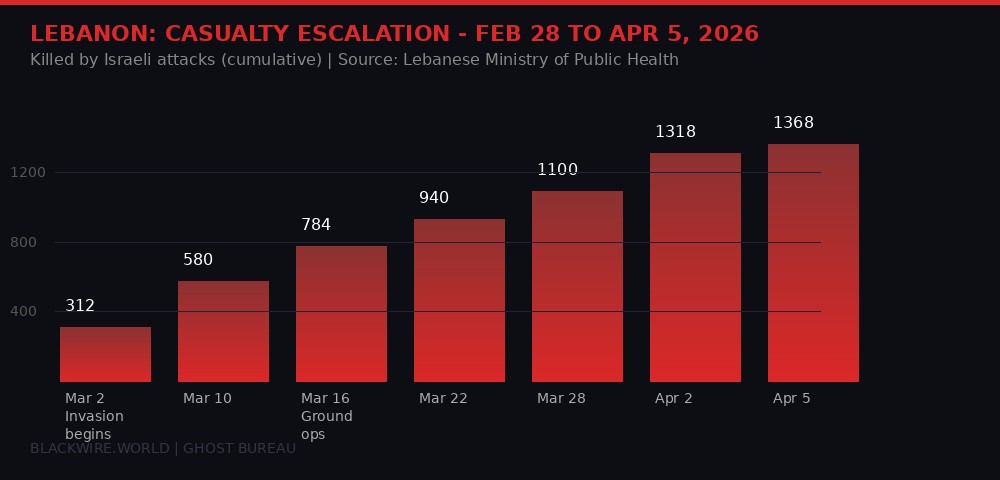
Cumulative killed in Lebanon from start of US-Israel war on Iran through April 5, 2026. Source: Lebanese Ministry of Public Health via Al Jazeera.
The Ground Invasion Timeline: How It Started and Where It Went

Israeli ground forces crossed into Lebanon after weeks of aerial preparation targeting key infrastructure and population centres. (File/Unsplash)
To understand where Tyre sits now, you have to go back to February 28. That is when the United States and Israel launched the first joint strikes against Iran. Two days later, on March 2, Hezbollah launched attacks on northern Israel - the group's first military action in more than a year, which it described as retaliation for the US-Israeli assassination of Iranian Supreme Leader Ayatollah Ali Khamenei. (Source: Al Jazeera, March-April 2026 reporting)
Israel used the Hezbollah response to justify what followed. Mass forced evacuation orders went out across southern Lebanon and Beirut's southern suburbs. The airstrikes that had been occurring sporadically since the ceasefire agreement in November 2024 - the UN had already recorded more than 10,000 Israeli ceasefire violations - intensified into something qualitatively different.
On March 16, Israeli ground forces crossed into southern Lebanon. They did not stop at a line or limit their operations to stated military targets. They began to move, methodically, through village after village.
Tyre: A City Squeezed From Every Side

The coastal city of Tyre sits under Israeli evacuation orders while 20,000 people remain trapped inside. Israeli forces have struck buildings on its outskirts repeatedly. (File/Unsplash)
Tyre is a UNESCO World Heritage site on Lebanon's southern coast. It has been inhabited for roughly 4,000 years. It is now under active military siege.
Tens of thousands of people have fled since Israel renewed attacks on Lebanon and launched its ground invasion. Some 20,000 remain in the city, according to Al Jazeera - including 15,000 who are internally displaced from surrounding villages, people who fled to Tyre because they had nowhere else to go, and who now find that Tyre itself is inside the strike zone. (Source: Al Jazeera, April 4, 2026)
Israel has issued forced evacuation orders covering most of Tyre and a wide swath of the south. But evacuation requires roads. Israel has been destroying roads.
Bridges over the Litani River have been struck. Roads linking Samar with Mashghara have been bombed. Routes from the Bekaa Valley to southern Lebanon have been targeted. Al Jazeera's Zeina Khodr, reporting from Beirut, described what she observed clearly: "In the past weeks, they hit bridges over the Litani - now they are trying to isolate the west Bekaa from southern Lebanon." (Source: Al Jazeera, March 31, 2026)
Rights groups have used a specific word for this: isolation. Human Rights Watch has documented what it calls a deliberate effort by Israel to cut the south off from the rest of the country. When you destroy bridges, hospitals, roads, mosques, and apartment buildings while also ordering civilians to leave - but have destroyed the means by which they would leave - the pattern has a name. It is not a military tactic. It is collective punishment.
Lebanon's Health Ministry counted 1,368 people killed and 4,138 wounded before the April 4 strikes were fully tallied. At least 24 people have been killed in Israel since the beginning of the war on Iran. Thirteen US soldiers have been killed in the broader region. The asymmetry is not subtle.
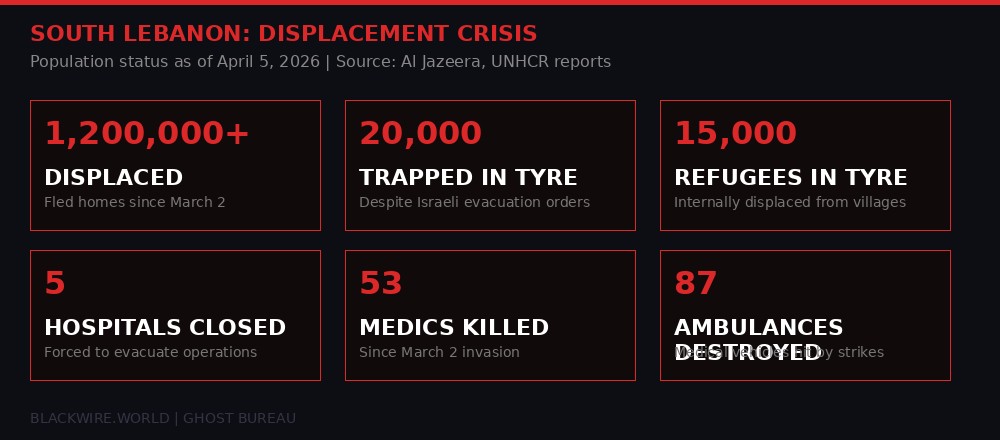
Key displacement and humanitarian data from Lebanon's south as of April 5, 2026. Sources: Lebanese Ministry of Public Health, MSF, WHO, Al Jazeera.
The Order of Battle: What Hezbollah Can and Cannot Do

Hezbollah has maintained rocket fire into northern Israel while Israel presses its ground invasion south. The group cannot stop the advance but continues to inflict costs. (File/Unsplash)
Hezbollah is fighting. That much is clear. What is also clear - and what both Hezbollah's own leadership and outside analysts acknowledge - is that the group cannot stop Israel's advance with conventional means.
Hezbollah Secretary-General Naim Qassem has been explicit about the power imbalance. The group is not going to drive Israeli forces out of southern Lebanon in a straightforward military confrontation. That is not what it is trying to do. What it is trying to do is make the occupation expensive. (Source: Al Jazeera, reporting from Beirut)
"What Hezbollah is trying to do is make this a costly war for Israel." - Al Jazeera's Zeina Khodr, reporting from Beirut, March 31, 2026
On the Kiryat Ata front, east of Haifa, Hezbollah fired more than 30 rockets in a matter of minutes - the second such barrage on the area in a single hour. Israel's Channel 12 reported smoke rising over the Galilee region. Attacks continued on Metula and other northern Israeli towns. On April 2, Hezbollah was engaging Israeli ground forces near the town of Antara in active fighting.
Heiko Wimmen, a Lebanon project director at the International Crisis Group, offered a cold-eyed assessment of what the fighting means and does not mean:
"We know that disarming Hezbollah is not on the cards, and so we're seeing an open-ended occupation evolving before our eyes." - Heiko Wimmen, International Crisis Group, Al Jazeera interview, April 4, 2026
Wimmen's analysis cuts through the Israeli government's stated objectives. Israel says the goal is to create a buffer zone, disarm Hezbollah, and secure northern communities against rocket fire. Wimmen says that goal is unachievable. Hezbollah maintains depth in the Bekaa Valley. Even if Israeli forces push the group out of the south entirely - which has not happened - it would not eliminate Hezbollah.
The group has survived Israeli occupation before. It grew stronger during the 1982-2000 occupation. Historical pattern is not favourable to the theory of victory. What does look increasingly likely is an open-ended military presence in southern Lebanon - a reality the Israeli government has now publicly embraced.
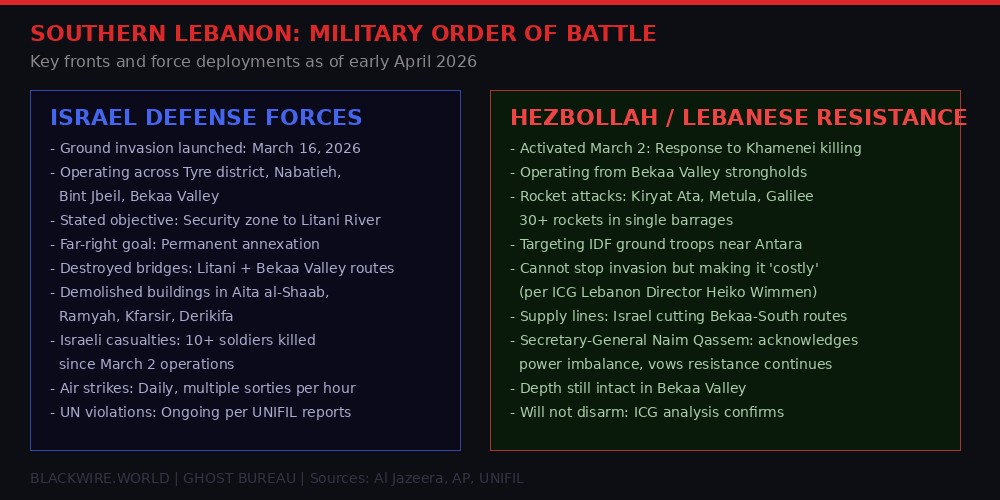
Military force deployments and objectives in southern Lebanon as of early April 2026. Sources: Al Jazeera, AP, UNIFIL field reports.
The Annexation Signal: What Israeli Officials Are Actually Saying

Israeli Defence Minister Katz has publicly stated that Israeli forces will maintain a permanent security zone inside Lebanese territory after the current war ends. (File/Unsplash)
Israeli Defence Minister Israel Katz has removed any ambiguity about the endgame. On March 31, he stated that Israel's military would "occupy a swath of southern Lebanon even after the end of the current war, establishing a 'security zone.'" (Source: Al Jazeera, March 31, 2026)
This is not a military objective stated in operational terms. It is a territorial claim articulated by a sitting defence minister. The difference matters legally, diplomatically, and in terms of what it signals about Israeli intentions.
Israel Hayom reported that Prime Minister Netanyahu told senior US officials that any future agreement between Washington and Tehran would not stop Israel's war in Lebanon. That is Netanyahu explicitly telling Washington that American diplomacy does not govern what Israel does in Lebanon. (Source: Israel Hayom, reported by Al Jazeera, March 30, 2026)
Far-right ministers in the Israeli government have gone further. Multiple ministers have urged Netanyahu to formally annex southern Lebanon. The political pressure on Netanyahu is not toward de-escalation - it is toward permanent seizure of territory that Israel's military is now physically occupying.
Political analyst Abed Abou Shhadeh, speaking to Al Jazeera from Jaffa, read the logic clearly. With Israeli elections expected by year-end and Netanyahu needing to deliver his promised "absolute victory," the absence of a clear endgame in Iran creates pressure to manufacture one in Lebanon:
"What we're seeing is they don't have any clear objectives in Iran, and the Americans want to finish the war. Amid a lack of a clear exit plan in Iran, Israeli leaders were preparing to continue waging war in Lebanon even if a ceasefire is reached in Iran to deliver what can be presented as a victory over Hezbollah." - Abed Abou Shhadeh, political analyst, Al Jazeera, April 2, 2026
The political arithmetic is brutal and it is not hidden. Lebanon's destruction serves multiple Israeli domestic political purposes simultaneously - it provides a front where military force produces visible results, it creates facts on the ground that will be difficult to reverse, and it supplies nationalist imagery for an election that Netanyahu needs to survive.
UNIFIL: The UN Peacekeeping Force Being Killed in the Crossfire

UNIFIL peacekeepers have operated in southern Lebanon since 1978. Three have been killed in four days as Israeli ground forces push through their operational area. (File/Unsplash)
The United Nations Interim Force in Lebanon - UNIFIL - has been deployed in southern Lebanon since 1978. Its mandate is to confirm Israeli withdrawal from Lebanese territory, restore international peace and security, and assist Lebanon in maintaining authority. All three mandates are currently being violated simultaneously.
Three UNIFIL peacekeepers were killed in four days between March 29 and April 1. The first died when a projectile hit a UNIFIL position near Aadchit el-Qusayr on Sunday, March 29. Indonesia's Ministry of Foreign Affairs confirmed the dead peacekeeper was Indonesian and said three other Indonesian peacekeepers were also wounded in what it described as "indirect artillery fire." (Source: UNIFIL statement; Indonesia Ministry of Foreign Affairs, March 30, 2026)
Hours later, two more peacekeepers were killed Monday, March 30, when an explosion of unknown origin destroyed their vehicle near Bani Haiyyan. A third peacekeeper was severely injured. A fourth was also wounded.
UNIFIL's statement cut through diplomatic language: "We reiterate that no one should ever have to die serving the cause of peace." Indonesia's Foreign Ministry did not match that restraint. It "strongly condemns the incident" and called on all parties to "respect Lebanon's sovereignty and territorial integrity, cease attacks against civilian populations and infrastructure, and return to dialogue and diplomacy." (Source: Indonesia Ministry of Foreign Affairs statement)
The killings represent a direct challenge to the entire framework of international peacekeeping. UNIFIL personnel are operating under UN mandate with specific protections under international humanitarian law. Their deaths are not collateral. They are either deliberate targeting or the result of operations conducted with such recklessness toward international law that the distinction barely matters.
Israel has not faced meaningful international accountability for the deaths. The Security Council remains deadlocked on any substantive response as long as the US shields Israeli operations from resolutions with binding effect.
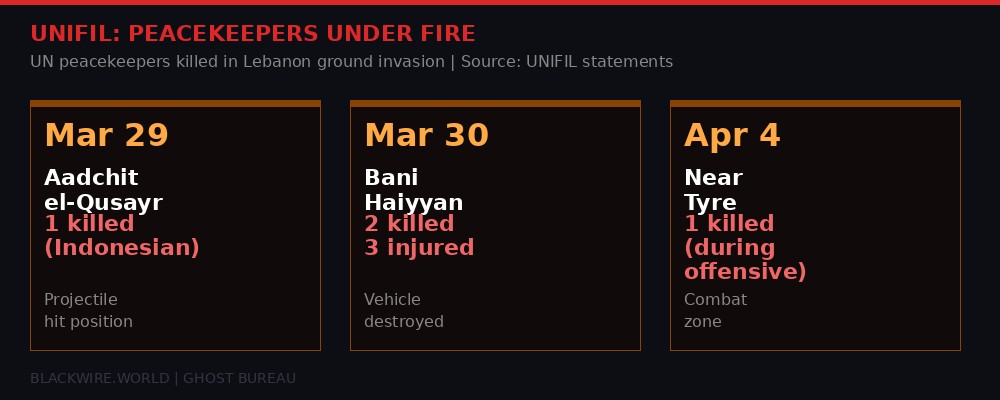
Three UN peacekeepers killed in four days as Israel's ground operation expanded through their deployment areas. Sources: UNIFIL, Indonesia MFA, Al Jazeera.
The Healthcare System: Systematically Destroyed

Lebanon's healthcare infrastructure has been targeted with a consistency that medical organisations describe as a deliberate pattern, not incidental damage. (File/Unsplash)
One month into the latest intensification of Israeli strikes on Lebanon, the country's Ministry of Public Health has counted 53 medical workers killed, 87 ambulances or medical centres destroyed, and five hospitals forced to close. Jabal Amel University Hospital in Tyre was struck a fifth time on March 31. (Source: Lebanon Ministry of Public Health; Al Jazeera, April 3, 2026)
This is not a healthcare system under strain from a nearby war. This is a healthcare system under direct attack.
Doctors Without Borders - MSF - Lebanon Medical Coordinator Luna Hammad was direct about what the organisation has documented: "Israeli strikes and blanket evacuation orders are cutting people off from care and shrinking the space for health services to function." MSF has seen "a documented pattern of attacks affecting healthcare." (Source: MSF statement, Al Jazeera, April 3, 2026)
Dr Abdinasir Abubakar, the World Health Organisation representative in Lebanon, confirmed direct attacks on health facilities. He also cited the displacement of healthcare workers as a secondary mechanism of erosion - when doctors and nurses flee along with the civilian population, hospitals cannot function even if the buildings remain standing.
The attacks have included what first responders describe as double-tap strikes: an initial explosion followed by a second strike after paramedics arrive. On March 28 alone, WHO Director-General Tedros Adhanom Ghebreyesus counted nine paramedics killed and seven wounded in five separate attacks. The double-tap pattern is not random. It is a specific tactic designed to deter emergency response - the same method documented and condemned in other conflicts.
"You can't live somewhere that doesn't have basic medical care. And of course it's now created a strain on healthcare facilities where people are displaced, because you now have over a million extra people who are going to need the health system here." - Beirut physician treating the displaced, speaking on condition of anonymity to Al Jazeera, April 3, 2026
Human Rights Watch has documented what it describes as "repeated, apparently deliberate, attacks on medical workers in Lebanon." HRW Lebanon researcher Ramzi Kaiss noted that the pattern has precedent: Israel killed more than 107 first responders in Lebanon between late 2023 and 2024.
Before this war, Lebanon's healthcare system was already damaged by the 2019 financial collapse and the 2023-2024 conflict. There are now more than a million displaced people requiring care, a shortage of staff who have fled, direct hits on facilities, destroyed supply routes, and Iranian strikes on Gulf states affecting shipping lanes for medicines and medical equipment. Every layer of the system is failing simultaneously.
Russia-Ukraine: Two Wars, Zero Diplomatic Off-Ramps

Russia launched 286 drones toward Ukraine in a single overnight attack, killing at least 15 people across four regions. Diplomatic talks have stalled with no resolution in sight. (File/Unsplash)
While southern Lebanon burns, Ukraine is fighting its fourth year of full-scale Russian invasion - and the diplomatic framework designed to end it has collapsed.
Russian attacks across Ukraine killed at least 15 people and injured dozens in the 24 hours of April 4 alone. Four people were killed and 11 injured in Kharkiv and surrounding northeastern Ukraine. Eleven people including a child were injured in a drone strike on Sumy. Five people were killed and 25 wounded when a Russian drone hit a covered market in Nikopol. Six more were killed and 10 injured across Donetsk. (Source: Al Jazeera, April 4, 2026)
The Ukrainian air force said it shot down or neutralised 260 of 286 Russian drones launched in a single overnight attack - a figure that reflects the extraordinary scale of Russia's aerial campaign. Twenty-six drones got through. Eleven struck ten locations.
The diplomatic situation is worse than the battlefield. Three rounds of US-Russia-Ukraine talks in Abu Dhabi and Geneva have produced nothing on the core question: territorial concessions in eastern Ukraine. A fourth round scheduled last month was postponed because of the US-Israel war on Iran. The war in the Middle East is consuming the diplomatic bandwidth that might have produced movement on Ukraine.
Ukrainian President Volodymyr Zelenskyy was in Istanbul on April 4, meeting with Turkish President Recep Tayyip Erdogan. Erdogan pledged continued support for negotiations and raised the importance of maritime safety in the Black Sea. None of those commitments constitute movement toward a ceasefire. (Source: Al Jazeera, April 4, 2026)
In Russia, a Ukrainian attack on Taganrog in the Rostov region killed one person and injured four. Drone debris hit a foreign-flagged cargo vessel in the Sea of Azov, causing a fire. The Sea of Azov is a key shipping route for industrial cargo. Attacks on it are economic warfare targeting supply chains that affect European commodity prices already stressed by the disruption of Gulf shipping routes from the Iran war.
Two major wars are now running simultaneously with no diplomatic off-ramp visible on either front. The Iran conflict has absorbed US attention, military resources, and political capital. Russia is treating the moment as an opportunity to press in Ukraine without the counterweight of American focus. The connection is not incidental. It is strategic.
The Humanitarian Accounting: What the Numbers Conceal

More than 1.2 million people have been displaced in Lebanon since March 2. Tyre's population includes 15,000 who fled surrounding villages and now find themselves trapped in a city under its own evacuation order. (File/Unsplash)
There is a tendency in war coverage to let the numbers stand without examination. Fifteen killed in Kharkiv. Seven killed in Tyre district. Two girls killed in Habbush. The numbers accumulate into something that starts to sound like statistics rather than lives.
The family killed in Nabatieh district on April 2 - a man, his wife, and their two daughters - was not a statistic before it became one. The two girls killed in Habbush on April 4 were not data points. The Indonesian peacekeeper killed near Aadchit el-Qusayr serving under a UN mandate to keep peace was a person from Indonesia who went to Lebanon to serve in a peacekeeping mission and was killed by a projectile of still-undetermined origin.
Lebanon's displaced population - 1.2 million people - represents roughly 20 percent of Lebanon's entire pre-war population. This is not a refugee crisis at the margins of a country. It is the displacement of one in five Lebanese people in a single month.
The 20,000 people remaining in Tyre are there for different reasons. Some cannot afford to leave. Some have nowhere to go - every available relative's home is already hosting displaced family. Some are caring for elderly or sick who cannot travel. Some refused to leave their homes and lives. Some arrived as displaced from surrounding villages and have already fled once. All of them now live under a city skyline where three buildings were destroyed in a single night.
Tyre's southern suburbs, traditionally home to lower-income Lebanese and Palestinian refugees from the Burj al-Shamali camp, have been particularly affected. The April 4 strike on Burj al-Shamali targeted a Palestinian refugee camp that has existed since 1948 - people who have already been displaced for 78 years, now displaced again or killed inside the camp they were displaced to.
Lebanese Prime Minister Nawaf Salam's statement on April 2 was measured but unmistakably desperate: "Lebanon has become a victim of a war whose outcome and end date no one can predict." He pledged continued diplomatic efforts to stop violations of Lebanese sovereignty. He did not claim those efforts were working. (Source: Al Jazeera, April 2, 2026)
What Comes Next: The Occupation Scenario

Israel has explicitly stated its intention to maintain a permanent military presence in southern Lebanon after the current conflict ends. Far-right ministers are pushing for formal annexation. (File/Unsplash)
The International Crisis Group's Heiko Wimmen used the phrase "open-ended occupation evolving before our eyes." That is the most precise description of where this is going.
Israel occupied southern Lebanon from 1982 to 2000. During those 18 years, Hezbollah did not exist when the occupation began and had become one of the most capable non-state military forces in the world by the time Israel withdrew. The 2000 withdrawal came because the occupation had become militarily unsustainable and politically untenable in Israel. The same dynamics are already visible less than two months into the current invasion.
Israeli politicians pushing for formal annexation are reading a specific moment: the international community is focused on Iran, the US is focused on the Strait of Hormuz, and Russia is capitalising on the distraction in Ukraine. In a global environment of compounding crises, the window for annexing Lebanese territory without meaningful international pushback may look shorter than it actually is.
But the structural problem with annexing Lebanon's south is the same one that made the 1982 occupation unsustainable: you cannot annex a population that does not accept occupation. Southern Lebanon's Shia population - Hezbollah's base - has never accepted Israeli authority and never will. Every Israeli soldier who dies in an occupied southern Lebanon becomes a political cost that Israeli governments eventually cannot bear.
The bridges being destroyed, the hospitals being hit, the villages being demolished - these are not preparations for an occupation that expects to be welcomed. They are preparations for a long, brutal, expensive military presence in a territory that will resist it at every point. Israel has been here before. It knows how it ends.
Pakistan, Turkey, and Egypt are working to bring the US and Iran to the negotiating table in Islamabad. Pakistan's Foreign Ministry said ceasefire talks are "right on track." Iran's Foreign Minister Abbas Araghchi said Iran has "never refused to go to Islamabad." A proposed compromise includes a cessation of hostilities to allow diplomatic settlement. (Source: AP, April 4, 2026)
Even if that ceasefire materialises - and it has not yet - it applies to the US-Iran war. Netanyahu has already told Washington that whatever deal the US reaches with Iran will not stop Israel's operations in Lebanon. The war on Lebanon is, at this point, Israel's war to prosecute on its own terms.
Twenty thousand people are still in Tyre. The Lebanese Italian Hospital is still open - its director said so, though his windows are gone and his ceiling is on the floor. The Burj al-Shamali camp is still home to Palestinians who fled 78 years ago. Hezbollah is still firing rockets into northern Israel. And Israel's far-right ministers are drafting annexation plans for land their army is currently standing on.
The siege of Tyre is not a battle with an end date. It is the ground floor of an occupation being built one demolished building at a time.
Get BLACKWIRE reports first.
Breaking news, investigations, and analysis - straight to your phone.
Join @blackwirenews on Telegram