Escalate and Expand: Israel Hits Tehran's Weapons Factories, US Paratroopers Move In

The Strikes: Weapons Factories in the Heart of Tehran

Israel's military said Friday that its overnight strikes targeted sites "in the heart of Tehran" where ballistic missiles and other weapons are produced. Additional targets included missile launchers and storage depots in western Iran, according to the Israel Defense Forces. The strikes followed a pattern now running for over a month - systematic degradation of Iran's production capacity rather than one-off symbolic hits.
Air raid sirens sounded in Israel throughout the day as the IDF reported intercepting Iranian missiles on a near-daily basis. Defense Minister Israel Katz issued a public warning that reached unusual bluntness even by his standards.
"Despite the warnings, the firing continues. And therefore attacks in Iran will escalate and expand to additional targets and areas that assist the regime in building and operating weapons against Israeli citizens." - Israel Defense Minister Israel Katz, March 27, 2026 (AP News)
Katz's phrasing - "escalate and expand" - was not accidental. It tracks with what Israeli military doctrine calls "progressive coercion": each response proportionally larger than the provocation that triggered it, applied continuously until the adversary's calculus changes. After a month of daily exchanges, that calculus has not visibly shifted on the Iranian side.
The Tehran strikes carry particular symbolic weight. Iran's capital had previously been mostly a planning and command hub rather than a primary target zone. Hitting weapons factories inside the city boundary signals that Israel is either willing or compelled to expand its targeting envelope further into Iranian sovereign territory - raising the prospect of responses calibrated at an entirely different level.
Lebanese capital Beirut also took a pre-dawn hit Friday. Smoke rose over the city and Lebanon's Health Ministry reported two people killed. Beirut was largely understood to be a staging and logistics zone for Iranian materiel moving toward Israeli territory via Hezbollah remnants - the strike suggests Israel is continuing to degrade that supply chain even as the main front burns further east.
Iran Fires Back: Riyadh, Kuwait City, the Gulf

Iran's counterpunches came quickly and ranged across the Gulf. Saudi Arabia's Defense Ministry reported intercepting missiles and drones targeting Riyadh. Kuwait disclosed that two of its ports - Shuwaikh Port in Kuwait City and the under-construction Mubarak Al Kabeer Port - sustained what officials called "material damage" in the attacks.
The Kuwait strikes carry an embedded geopolitical signal. The Mubarak Al Kabeer Port is being developed under China's Belt and Road Initiative. It appears to be among the first Chinese-affiliated infrastructure projects in the Gulf Arab states to come under direct fire in this conflict. China has continued purchasing Iranian crude throughout the war, and Tehran appears to have calculated it can still inflict damage on Chinese-linked assets without permanently rupturing that economic relationship.
The strikes on Gulf Arab cities are central to Iran's strategic logic. Tehran cannot win a conventional air war against the combined aerial assets of the United States and Israel. What it can do - and has been doing consistently - is make the war so expensive for everyone else that outside pressure builds on Washington and Tel Aviv to accept terms short of Iran's defeat.
As AP's analysis noted Friday, Iran is "fighting more like an insurgency than a nation" - using increasingly constrained resources to inflict maximum political and economic pain. A rocket that costs a fraction of a Patriot intercept missile can trigger a global oil price movement. The arithmetic favors the attacker when the defender's calculus is market-sensitive.
The Hormuz Chokepoint: Iran's Strongest Card

The Strait of Hormuz is twenty-one miles wide at its narrowest point. On a normal day before February 28, roughly 20 percent of the world's oil and a significant share of its liquefied natural gas passed through it. Since the war began, that waterway has become something closer to an Iranian toll booth - open on Tehran's terms, to buyers it approves of, at prices it sets.
A Gulf Arab bloc confirmed Thursday that Iran has been extracting fees from tankers as a condition of safe passage. The IRGC's naval arm - most of its surface fleet destroyed by US and Israeli strikes in the opening weeks of the conflict - retains extensive capacity to threaten shipping with shore-based anti-ship missiles, mines, and drone swarms launched from coastal positions. Destroying the fleet did not eliminate the threat. It eliminated one vector for it.
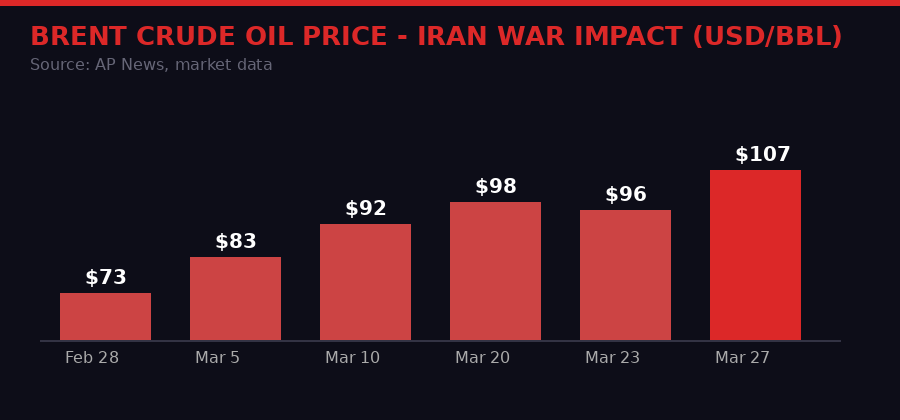
Oil prices tell the story with brutal clarity. Brent crude sat at roughly $73 per barrel before the war started. By Friday morning it was trading at $107 - a 45% increase in just over four weeks. That price is embedded in the cost of manufacturing, transport, and nearly every consumer good. It is the invisible tax the war is levying on every economy that runs on petroleum, which is to say every economy.
For Trump, who won his second term partly on the promise of reducing the cost of living, a war that has added roughly $30 to every barrel of oil consumed by American industry and households is a political liability that compounds daily. The S&P 500 closed down 1.7% Thursday, its fifth consecutive losing week - the longest such streak in nearly four years. Wall Street is pricing in the probability that the strait stays closed longer than Trump's deadlines suggest.
Iran understands this dynamic better than any party in the conflict. Its economy was already largely insulated from Western financial markets by decades of sanctions. It cannot be hit with the economic weapons that forced it to the table in 2015. What it can do is use the world's dependence on Gulf oil as a lever - and that lever is currently fully engaged.
Trump's Third Deadline: April 6, and the Pattern Behind It

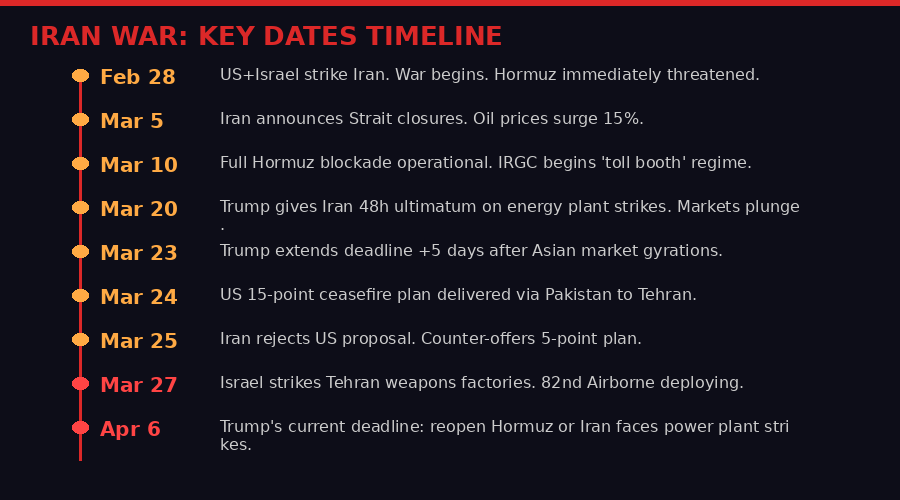
Trump set what is now his third deadline for Iran to reopen the Strait of Hormuz on Thursday evening. He said he would give Tehran until 8 PM Eastern time on April 6 - otherwise, he has threatened to begin bombing Iranian power plants and energy infrastructure. He announced the extension after Wall Street closed, which itself suggested the market pressure on him to avoid further escalation was a factor in the decision.
The pattern is by now clear enough that analysts have named it. On March 20, Trump gave Iran 48 hours. Markets gyrated and he backed off, citing diplomatic progress. On March 23, he gave an additional five days after Asian markets convulsed. On March 26, he gave ten more days - Iran asked for seven, he offered ten, he said. Each extension buys time for talks he says are happening and Iran says are not.
Trump told Fox News: "They asked for seven. And I said, 'I'm going to give you 10.'"
The same morning, at a Cabinet meeting, Trump insisted the war was going well.
"We have very substantial talks going on with respect to Iran - with the right people. Iran has already been decisively defeated." - President Donald Trump, Cabinet meeting, March 27, 2026 (AP News)
"Decisively defeated" is a characterization that sits uncomfortably alongside Iranian missiles hitting the Saudi capital the same morning. It tracks with a broader White House communications posture that claims victory in the political frame while the military and economic situation remains unresolved. The Eurasia Group risk advisory put it more precisely: "Trump's preference remains 'escalate to de-escalate.'"
The real question is whether the April 6 deadline is any more credible than the previous two. The consequences of following through are severe - striking Iranian power plants would escalate the conflict to a level that Iran has warned would trigger retaliatory strikes on desalination facilities across the Gulf, potentially cutting off drinking water for tens of millions of people. The consequences of backing down again are also severe - each extension signals to Tehran that time is on its side.
The 82nd Airborne Deploys: What the Paratroopers Signal

The clearest indicator that the April 6 deadline carries more military weight than its predecessors is the concurrent deployment of the 82nd Airborne Division. According to AP News, citing three people with direct knowledge, at least 1,000 soldiers from the 1st Brigade Combat Team plus the division commander, Maj. Gen. Brandon Tegtmeier, and division staff are preparing to deploy to the region within days.
This matters because the 82nd is not a logistics or headquarters unit. It is the US Army's designated emergency response force - trained specifically to parachute into hostile or contested territory to seize airfields and key terrain. Its deployment is designed for situations where you need to insert combat power into a denied environment without ground access or controlled airfields. That is a description of offensive entry, not defensive posturing.
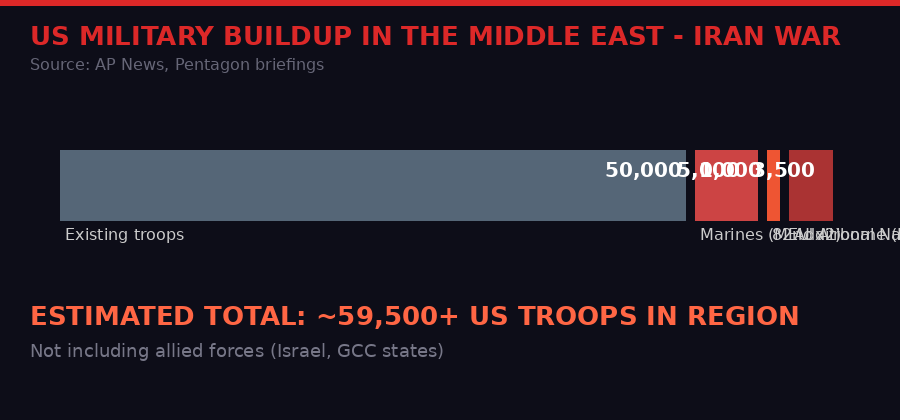
The 82nd's deployment joins a substantial Marine buildup already underway. The Japan-based USS Tripoli and the 31st Marine Expeditionary Unit were redirected from Taiwan exercises to the Middle East. Two Marine Expeditionary Units - roughly 5,000 Marines apiece - are in transit from San Diego. Combined with the existing approximately 50,000 US troops already in the region, total American force presence is approaching 60,000 and climbing.
White House spokeswoman Anna Kelly, when asked about the 82nd deployment, said the president "always has all military options at his disposal." That is technically true. The more operationally relevant truth is that you do not send the 82nd Airborne to a region where you're just waiting for diplomacy to succeed. You send it when you want to be able to act within 18 hours if the diplomacy fails.
The Senate Armed Services Committee received a classified Pentagon briefing on the deployment Wednesday - a notification requirement that signals the administration is treating this as a significant escalatory step that requires congressional awareness even if not formal authorization.
Pakistan as Intermediary: The Unlikely Peace Broker

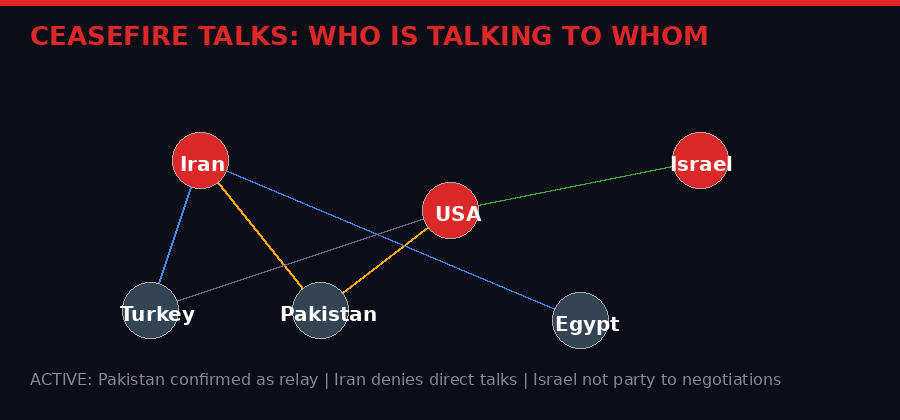
The normal facilitators for US-Iran indirect communication - Oman and Qatar - are themselves under Iranian missile threat for the first time in decades. That created an opening for Pakistan, which holds a peculiar diplomatic position: it has working relationships with Washington, Tehran, Riyadh, and Beijing simultaneously, has no diplomatic ties with Israel (therefore no reason for Iran to see it as a proxy for Israeli interests), and has enormous economic skin in the game.
Pakistan's Foreign Minister Ishaq Dar confirmed this week that Islamabad is actively relaying messages between the two sides, and that Turkey and Egypt are working parallel back-channels. Pakistani officials say US proposals are passed to Iran and Iranian responses relayed to Washington - a classic shuttle diplomacy format.
The specific proposal Pakistan delivered was a US 15-point "action list" that included restrictions on Iran's nuclear program and the full reopening of the Strait of Hormuz. Iran rejected it and submitted its own counter-proposal: a five-point plan that included reparations for war damage and formal US-Israeli recognition of Iranian sovereignty over the strait. The gap between those positions is not narrow.
Trump's envoys - Steve Witkoff, Jared Kushner, and Vice President JD Vance - are reportedly involved in the discussions. Iran has publicly maintained that no negotiations are taking place. Iranian parliament speaker Mohammad Bagher Qalibaf denied any direct talks. An Iranian military spokesman issued a statement vowing to fight "until complete victory."
Pakistan's economic stake in a resolution is substantial and not abstract. Five million Pakistani workers in Gulf Arab states send home remittances roughly equal to the country's total annual export earnings. Pakistan imports most of its oil from the region. Fuel prices in Pakistan have already risen about 20% since the war began, adding pressure to a government that was already navigating a fragile economy. Islamabad is not mediating out of regional principle - it is mediating because its economy needs this war to end.
Pakistan's army chief Field Marshal Asim Munir had a direct phone conversation with Trump over the weekend. Trump has publicly called him "my favorite Field Marshal" - an unusual degree of warmth that analysts read as Washington's acknowledgment of Islamabad's indispensable role in the current diplomatic architecture.
The Attrition Problem: Iran's Insurgent Strategy

A month into the conflict, the central problem for the US-Israeli side is that Iran is not behaving like a country that has been "decisively defeated." Its air defense network has been largely neutralized. Most of its surface navy is gone. Significant portions of its oil export infrastructure have been struck. Its regional proxy networks - Hezbollah in Lebanon, the Houthis in Yemen, Iraqi militia factions - have been degraded to varying degrees.
And yet, Brent crude is at $107. Riyadh took incoming fire this morning. The Strait of Hormuz remains a selective toll booth. Iranian ballistic missiles are still landing on Israeli territory at a rate that requires daily interception operations. The basic conclusion of the first month: military pressure has imposed real costs on Iran, but it has not broken Iran's capacity to impose costs on its adversaries.
The AP's regional analysis framed it in stark terms: Iran is pursuing a strategy with a straightforward logic - survive long enough to claim victory. "The Islamic Republic understands that it cannot defeat the United States militarily," wrote Mideast security analyst Shukriya Bradost. "Instead, its objective is both simpler and more strategic: Survive the war long enough to claim victory."
This creates a fundamental asymmetry. The US and Israel need Iran to capitulate on terms - reopening the strait, accepting nuclear restrictions - that require a decision by the Iranian leadership. Iran needs only to persist. Time is not neutral in this conflict. Every week the war continues at current intensity adds roughly $2-3 to the global oil price, compounds the stock market's five-week losing streak, and consumes political capital Trump needs for his domestic agenda and midterm positioning.
Iran's own domestic vulnerabilities are not zero. Sanctions have compressed the economy for years, and the war has added to that pressure. But the theocracy has survived decades of economic warfare. Its tolerance for civilian hardship, however brutal that sounds, is genuinely higher than that of an elected government facing a market-sensitive electorate in six months.
What April 6 Actually Means: Three Scenarios

The April 6 deadline is ten days out. The 82nd Airborne is deploying. Market pressure is intense. Iran is firing back. What actually happens on April 7 will determine the character of this war for months to come.
Three Scenarios for April 6
- Scenario A - Partial opening, face-saving deal: Iran allows commercial tankers through under nominal conditions that allow both sides to claim something. Trump declares partial victory. Diplomacy continues. Oil prices ease. This is the market's hoped-for outcome and, at current trajectory, the least likely without a concrete diplomatic breakthrough.
- Scenario B - Fourth extension: Trump finds a reason to delay again - diplomatic progress claimed, markets wobbling, a new intermediary. Iran stays the course, the strait stays restricted, and the negotiating position shifts further in Tehran's favor as each delay normalizes American non-action.
- Scenario C - US and Israeli strikes on Iranian power plants: The conflict escalates to a new magnitude. Iran retaliates against Gulf desalination facilities, potentially cutting water supplies to tens of millions. The war enters a phase that neither set of markets nor regional governments has fully priced. Oil moves past $130, possibly higher. The human cost compounds rapidly.
Eurasia Group's Thursday analysis said the US is "moving more ships and ground troops into the region and will be better prepared to escalate in mid-April." That framing - better prepared to escalate - is distinct from prepared to de-escalate. It suggests Washington is actively building the military option to be credible if deployed, while keeping diplomatic channels open until the last moment.
The 82nd Airborne's deployment is the clearest signal of that preparation. Paratroopers seize airfields and territory. They do not guard embassies. Whatever April 6 brings, the US is positioning itself to act - not just to threaten.
For Iran's leadership, the calculation is whether holding the strait for ten more days - and forcing another deadline extension or absorbing another round of strikes - is worth the escalation risk. For Trump, the calculation is whether his domestic political standing can absorb another visible climb-down, or whether the credibility cost of a fourth extension exceeds the conflict cost of going in.
Neither side has resolved that calculation yet. Both are running out of time to do it quietly.
On the Ground: Beirut, the Gulf, the Civilian Cost

Two people died in Beirut before dawn Friday. That number will be updated before this article goes to press, and probably again before the day ends. The Lebanese capital has been a periodic target throughout the conflict - Israel hitting Iranian logistics routes, Iranian-aligned remnants of Hezbollah occasionally firing back - but the civilian casualty rate in Lebanon has not reached the scale of the more direct US-Israeli-Iranian exchanges.
The broader humanitarian picture is darker and less visible. UNICEF and UN food agency reporting, cited in AP coverage this week, document spreading child hunger in Somalia directly linked to the war's disruption of food supply chains - specifically the fertilizer and grain shipments that pass through or are priced relative to Gulf shipping lanes. Somalia was already one of the most food-insecure nations in the world. The war is not responsible for that vulnerability, but it is actively making it worse.
The food-war connection runs through fertilizer pricing. Iranian natural gas feeds a significant portion of Gulf fertilizer production. Disruptions to that flow ripple into agricultural input costs globally, with the heaviest impacts in nations least equipped to absorb them. The mechanism is diffuse and invisible compared to a missile strike, but its body count, denominated in child mortality statistics across the Horn of Africa and South Asia, is not.
In Kuwait, port workers and logistics personnel were displaced from two harbor facilities after the Iranian strikes Friday. Kuwait City's Shuwaikh Port handles a significant portion of the country's commercial imports. The damage assessment is ongoing, but even temporary port disruption adds to the regional economic pressure that is already straining Gulf state budgets and accelerating inflation in countries that cannot afford to run it.
The war's blast radius is not defined by where the missiles land. It is defined by what the missiles do to the prices of things people need to survive, and by how long that condition persists. On day 34, there is no credible timeline for it ending.
What to Watch Before April 6
- Any signal from Tehran that indirect talks via Pakistan are making progress - or collapse entirely
- 82nd Airborne arrival in theater - the deployment timeline signals the operational window
- Oil price movement - if Brent breaks $115, market pressure on Trump intensifies sharply
- Israeli strike frequency - escalation or restraint in the next 72 hours will indicate whether Tel Aviv is coordinating with Washington or running its own timeline
- Iranian parliamentary statements - Qalibaf and the IRGC hardline faction have consistently sabotaged any hint of negotiating flexibility from Khamenei's office
- Chinese response to the Belt and Road port strikes in Kuwait - Beijing's reaction matters for whether Iran's economic lifeline remains intact
Get BLACKWIRE reports first.
Breaking news, investigations, and analysis - straight to your phone.
Join @blackwirenews on Telegram