Three Divisions, No Exit: Israel Escalates Lebanon Ground War to New Phase
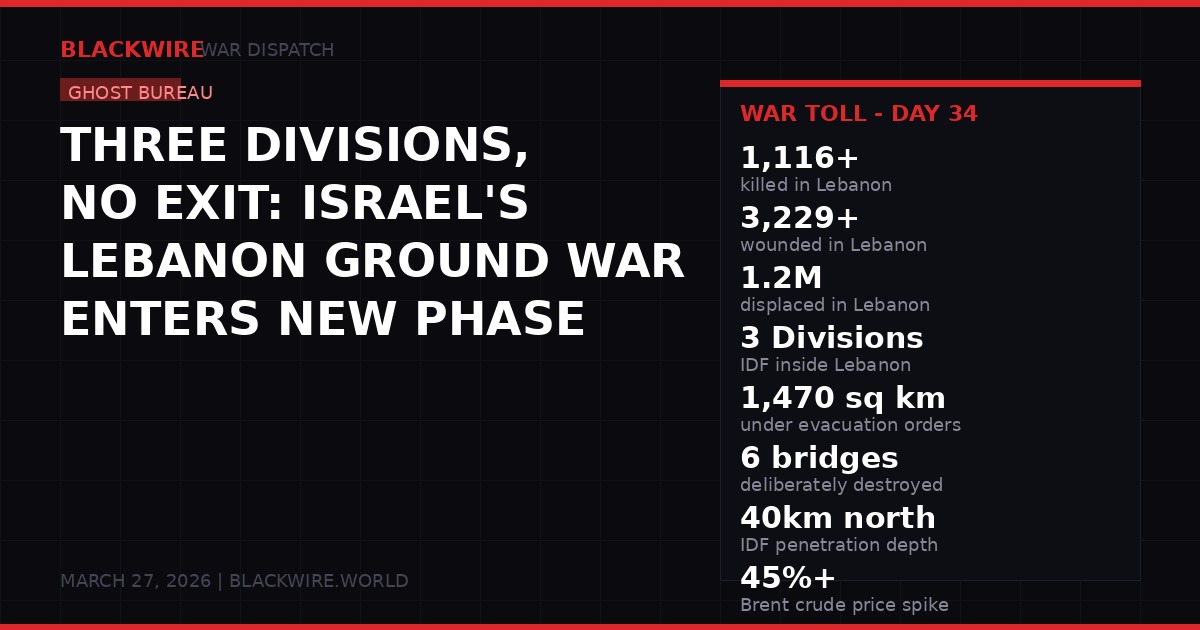
Israel has committed a third army division to its southern Lebanon campaign, transforming what began as a reactive border incursion into the largest ground operation Lebanon has seen in two decades. Bridges burned, towns emptied, 1.2 million people on the move - and Hezbollah promising no surrender.
The Third Division Arrives
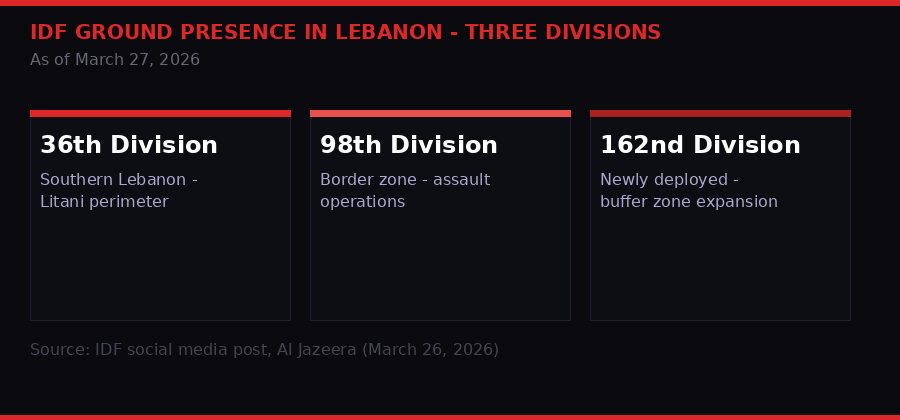
On Thursday, the Israeli military announced that Division 162 would begin operating inside southern Lebanon, joining two formations already conducting ground operations there. The IDF posted the order on social media - a terse statement saying the division would operate "with the aim of expanding" the buffer zone concept that Israeli officials have been promoting since the offensive began in early March.
Division 162 is not a light force. It is one of the Israeli army's main armored divisions, experienced in complex combined-arms warfare. Its deployment means Israel now has three full divisions committed to Lebanese territory simultaneously - the 36th, the 98th, and now the 162nd. That is a substantial fraction of the IDF's active ground combat power, committed to a front that was supposed to be a limited "buffer zone" operation.
The framing from Israeli Prime Minister Benjamin Netanyahu, speaking Wednesday, was that the military plans to create "a larger buffer zone" in southern Lebanon. But the operational scale - three divisions, a forced displacement area covering 1,470 square kilometers according to the Norwegian Refugee Council, and the systematic destruction of bridges connecting the south to the rest of the country - suggests objectives that reach beyond a simple security cordon along the border.
Lebanese President Joseph Aoun, in a public statement responding to the bridge demolitions, called the attacks "an attempt to sever the geographical connection between the southern Litani region and the rest of Lebanese territory." He said they fell "within suspicious schemes to establish a buffer zone along the Israeli border, solidify the reality of the occupation and seek Israeli expansion within Lebanese territory." That is diplomatic language for what field observers describe more directly: the methodical isolation of a large piece of a sovereign country.
The deployment of Division 162 also follows Israeli Defence Minister Israel Katz's declaration last week that Lebanese citizens would not be allowed to return to their homes in the south until the safety of northern Israel is secured. No timeline was given. No conditions were specified other than general security. For the 1.2 million people who have been forced out of their homes since early March, that means no return date in sight.
The Bridge Campaign: Cutting the South Off
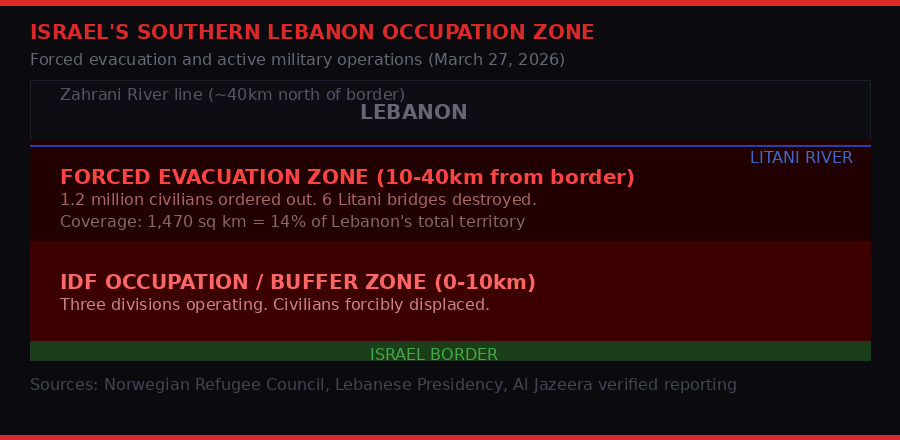
Six bridges over the Litani River have been destroyed by Israeli strikes. This is not incidental battle damage. Israeli Defence Minister Katz explicitly ordered the military to destroy all crossings over the Litani River and homes close to the border. The order was followed.
The six confirmed destroyed crossings, as verified by Al Jazeera through footage and photographs, are the Qasmiyeh Bridge, the Coastal Highway Bridge, the al-Qantara Bridge, the Khardali Bridge, the al-Dalafa Bridge, and the Zaraiya-Tirseflay Bridge. These were not military installations. They were the primary links between Lebanon's agricultural south and the rest of the country - the roads farmers use to move produce, families use to visit relatives, and, critically, the routes that aid convoys would need to reach a population under siege.
The Litani River runs roughly parallel to the Israeli border, between 20 and 40 kilometers north of it. In practical terms, destroying the crossings means the area between the Israeli border and the river - Lebanon's historic south - is now physically cut off from the Lebanese state by a line of rubble in the water. Aid can still enter from the north, but logistics become exponentially harder. Reconstruction cannot begin while the bridges are gone.
Amnesty International described the pattern as reflecting Israel's "record of atrocity crimes." In a statement published Thursday, the rights group wrote that the Israeli military "has already extensively destroyed and devastated civilian life in southern Lebanon" and called on world leaders to "uphold their international legal obligations to halt Israel's unlawful destruction of civilian property." The statement referenced Israel's conduct in Gaza as a point of comparison - an argument that carries weight given the observable operational pattern: systematic displacement, infrastructure denial, and the creation of conditions that make civilian return physically impossible.
The Norwegian Refugee Council, one of the primary aid organizations operating in Lebanon, confirmed that Israel's sweeping evacuation orders now cover more than 1,470 square kilometers - approximately 14 percent of the country's total territory. That is not a border strip. It is a substantial southern province of a Mediterranean country, emptied by military decree.
1.2 Million People Moving: The Humanitarian Collapse
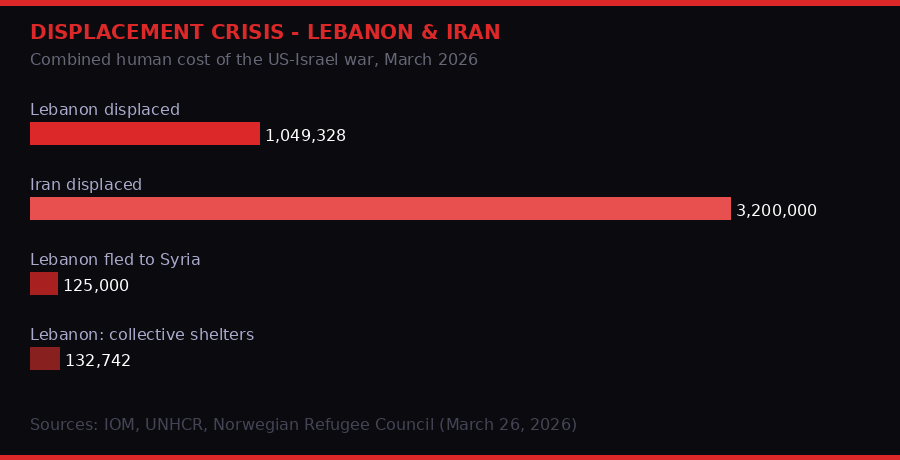
The International Organization for Migration puts the number of registered displaced people in Lebanon at 1,049,328. That number moves daily - the IOM's figures lag reality by 48 to 72 hours, meaning the actual count is likely higher. Nearly one in five Lebanese - 18 percent of the population - has been displaced in under four weeks. For context: the 2006 Lebanon War produced roughly 1 million displaced over 34 days of fighting. Israel's current campaign is running at a comparable pace, with no ceasefire negotiation on the Lebanese front visible from any angle.
Inside Lebanon's collective shelter network, 132,742 people are housed as of the latest IOM count. The pace of displacement has outstripped shelter capacity. Multiple organizations working in Lebanon have reported families sleeping in vehicles, in streets, and in public spaces after shelters reached capacity. Many of those displaced have been through this before: Lebanon's south has been subjected to Israeli military operations in 1978, 1982, 1993, 1996, 2006, and now 2026. The generational trauma accumulates.
More than 250,000 people have left Lebanon entirely over the past two weeks alone - a 40 percent increase compared with the final two weeks of February. The primary exit route is into neighboring Syria. As of March 17, more than 125,000 people had crossed that border, and the number has grown since. Nearly half of those crossings are children. Most are Syrian nationals who were living in Lebanon; approximately 7,000 are Lebanese nationals making the grim choice to seek refuge in a country still recovering from its own decade of civil war.
Lebanon's government is attempting to respond but is structurally limited. Prime Minister Nawaf Salam, speaking Thursday on a call with UN Secretary-General Antonio Guterres, warned that Israel's actions "constitute a matter of utmost gravity that threatens Lebanon's sovereignty" and announced that Lebanon would submit a formal complaint to the UN Security Council. The language is measured and procedurally correct. It will not bring a single displaced family home, or rebuild a single bridge, by itself.
Hezbollah's Counter-Offensive: "Without Limits"
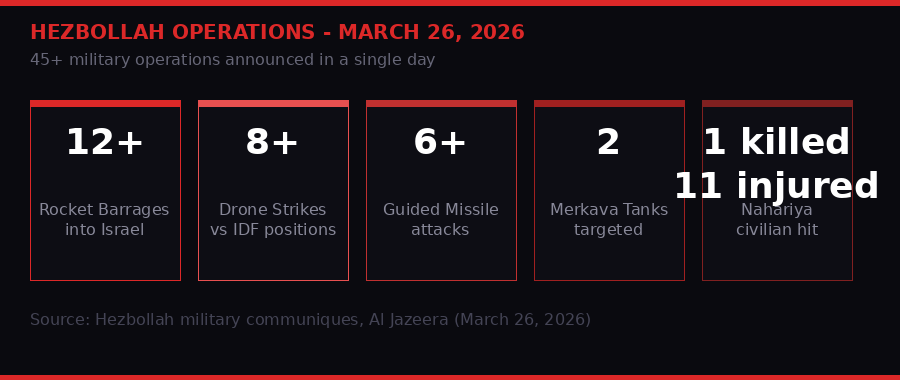
Hezbollah chief Naim Qassem stated this week that the group would continue fighting "without limits" against what he described as "an enemy that occupies land and continues daily aggression." The declaration was not delivered in desperation - it came as Hezbollah announced more than 45 separate military operations against Israel in a single day on Thursday.
The operations included rocket barrages, drone strikes against IDF positions inside Lebanon, and guided missile attacks on Israeli armored vehicles. Hezbollah specifically reported targeting two Merkava tanks in the border town of Deir Siryan with guided missiles. The Merkava is Israel's primary main battle tank and a symbol of Israeli armored power; hitting two in a single day is not incidental fire - it is precision anti-armor warfare, the kind that imposes attrition on mechanized advances.
A Hezbollah rocket attack on Nahariya, a coastal Israeli city well north of the immediate border zone, killed one person and injured 11 others, according to Israeli authorities. Nahariya has a civilian population of roughly 60,000. The strike demonstrates that Hezbollah retains the range and willingness to hit urban Israeli population centers even as the IDF grinds deeper into Lebanese territory.
The Israeli military also acknowledged that one soldier was killed and four were wounded in an "incident" in southern Lebanon on Thursday. The military did not specify what kind of incident - a term that typically indicates an ambush, improvised explosive device, or direct engagement that the IDF prefers not to detail. In a war where Israeli casualty figures are carefully managed, even that laconic acknowledgment signals ongoing attritional combat inside Lebanon.
Israel said it killed Commodore Alireza Tangsiri, the head of the Iranian Revolutionary Guard's navy, and Behnam Rezaei, Iran's naval intelligence chief, in recent strikes. Israeli Defence Minister Katz said Tangsiri was responsible for the bombing operations blocking ships from crossing the Strait of Hormuz. Iran had not immediately confirmed or denied the killings. High-value targeting like this is designed to degrade command capacity rather than halt operations - Hezbollah has replaced commanders before and continued fighting.
France, the United Kingdom, Germany, Italy, and Canada issued a joint warning the previous week that an expanded Israeli ground offensive "would have devastating humanitarian consequences" and "must be averted." That warning has now been overtaken by events: a third division is inside Lebanon, bridges are destroyed, and Hezbollah says it will fight without limits. The statement from five allied governments produced no operational change on the ground.
The Wider War Context: Iran, Diplomacy, and April 6
The Lebanon escalation is happening simultaneously with a diplomatic impasse at the strategic level. Israel launched a wave of strikes on targets "in the heart of Tehran" early Friday morning, local time, ahead of a scheduled UN Security Council meeting on Iranian civilian infrastructure. Iran fired back - air raid sirens sounded across Israel as the military intercepted incoming Iranian missiles. Smoke was reported over Beirut, though Israel did not immediately acknowledge hitting the Lebanese capital. Iranian drones and missiles were reported incoming in both Kuwait and the United Arab Emirates.
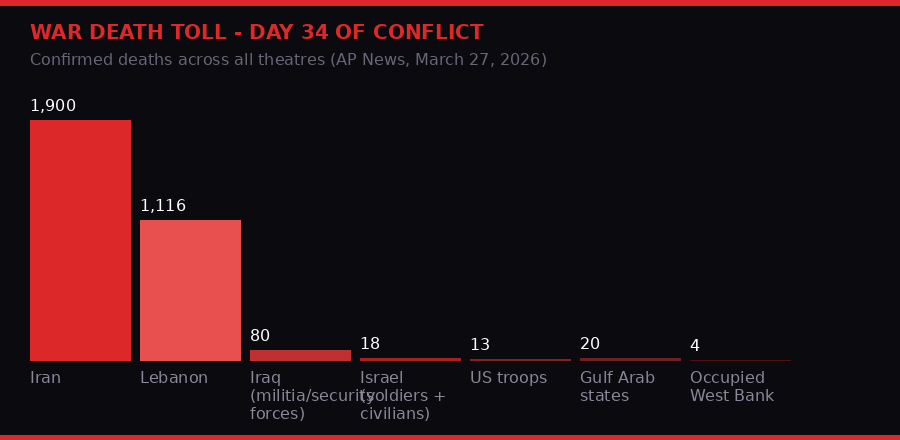
The death toll from the broader US-Israel war on Iran has now passed 1,900 in Iran itself, according to the Iranian Health Ministry - a conservative figure by the ministry's own acknowledgment, since formal casualty tallying remains incomplete in areas repeatedly struck. Lebanon's toll stands at 1,116 killed and 3,229 wounded since the offensive began in early March. Iraq, where Iranian-supported militia groups have drawn US and Israeli fire, has lost 80 security force members. Thirteen American troops have been killed. Eighteen people have died in Israel. Twenty in Gulf Arab states. Four in the occupied West Bank.
Trump, speaking at a Cabinet meeting Thursday before digressing into a discussion about Sharpie markers, said Iran is allowing some oil tankers through the Strait of Hormuz as "a sign of good faith for talks." At the same time, his administration delivered a 15-point "action list" to Tehran using Pakistan as an intermediary - a framework that Trump envoy Steve Witkoff called a potential path to a deal, saying there were "strong signs" the US could "convince Iran that this is the inflection point." Iran's Foreign Minister Abbas Araghchi said on state television that his government has not engaged in talks and does not plan to. Egypt is also acting as a go-between. The signals are contradictory.
Trump's deadline for Iran to reopen the Strait of Hormuz has been pushed to April 6. A Gulf Arab bloc confirmed Thursday that Iran is now exacting tolls from ships transiting the waterway - yuan-denominated payments for safe passage, according to Lloyd's List Intelligence. Brent crude was trading at $107 a barrel early Friday, up more than 45 percent since the war started. The financial pressure on the global economy is one of Iran's few remaining leverage points, and Tehran appears to be using it deliberately.
Meanwhile, the US has ordered at least 1,000 paratroopers from the 82nd Airborne Division to the region, joining 2,500 Marines already heading there aboard the USS Tripoli and accompanying vessels. The 82nd Airborne is trained to parachute into hostile or contested territory to secure key infrastructure and airfields. Its deployment, confirmed by three people with knowledge of the plans and reported by AP, is not a defensive posture. It is a capability that would only be used for a major offensive operation - specifically, a potential military attempt to force the Strait of Hormuz open.
Lebanon's Sovereign Crisis and International Law
Lebanon's Prime Minister Salam framed Thursday's phone call with the UN Secretary-General in explicitly legal terms: Israel's actions "violate international law and the UN Charter." He announced a formal complaint to the Security Council. Lebanese President Aoun has made the same argument about the bridge demolitions - that destroying infrastructure linking the occupied south to the rest of the country constitutes an attempt to formalize a territorial division.
The legal argument is not merely rhetorical. The Fourth Geneva Convention prohibits the destruction of property not made "absolutely necessary by military necessity." Demolishing six civilian bridges that connect a southern Lebanese region to its national government - after ordering the forced displacement of the population in that region - maps closely onto the prohibition against "extensive destruction and appropriation of property, not justified by military necessity and carried out unlawfully and wantonly." Whether any international body will enforce that distinction is a different question. The UN Security Council meeting called for Friday by Russia is unlikely to produce a binding resolution: the United States holds the Council presidency and has protected Israel's military operations throughout the conflict.
What Israel is building in southern Lebanon - physically and militarily - looks less like a temporary buffer and more like a holding operation. Three divisions require substantial logistics and command infrastructure to sustain. You do not deploy a third armored division into a foreign country to hold territory for a few weeks. The bridgeheads across the Litani have been destroyed from below - the crossing points that would allow a rapid military withdrawal have been eliminated alongside those that would allow a civilian return.
International human rights organizations have been consistent in their language. Amnesty International invoked Israel's "record of atrocity crimes," explicitly connecting the Lebanon operation to Gaza. Human Rights Watch has reported on the forced displacement. The Norwegian Refugee Council is documenting the scale of territory rendered uninhabitable. None of these organizations have the power to stop what is happening. They are building the evidentiary record for what comes after - however long after that proves to be.
The Lebanese State: Sovereignty Without Control
Lebanon went into this conflict in a state of institutional fragility it has never fully exited since the 2019 financial collapse. The country elected a new president, Joseph Aoun, in January 2026 after more than two years of vacancy. Nawaf Salam was named prime minister and had barely begun to form a functioning government when the war reached Lebanon's southern border in early March. The state that is now trying to respond to the displacement of 1.2 million people is not a stable, well-funded actor. It is a government that was, until six weeks ago, still debating whether it could pay state salaries.
The Lebanese army has not engaged Israeli forces. It cannot, realistically - the IDF's operational scale far exceeds what the Lebanese Armed Forces could contest in open battle. Salam's government has chosen the path of diplomatic complaint and legal protest: UN Security Council filings, public denunciations, appeals to international law. These are not ineffective in every context. In this one, with the US shielding Israel at the Council and the region consumed by a much larger war with Iran, they face long odds.
Hezbollah, which operates as a state within the state in Lebanon's south, has not been weakened into irrelevance by the IDF's offensive. It has adapted. The 45-plus operations announced on Thursday - guided missiles, drones, rockets reaching Nahariya - demonstrate an organization that is absorbing the ground pressure and continuing to fight. The group is taking casualties; the IDF's advance is real. But Hezbollah's model of resistance does not require holding territory. It requires imposing costs. On Thursday, the cost was a killed Israeli soldier, two Merkava tanks struck, and one Israeli coastal city hit hard enough to kill a civilian and injure eleven more.
Hezbollah Secretary-General Naim Qassem's "without limits" declaration echoes the language used by the organization during previous conflicts with Israel - 2006, specifically, when Israel also launched a ground campaign expecting a swift resolution and found instead a grinding attritional war that ended in a ceasefire rather than a military decision. The question of whether 2026 follows the same arc depends on variables that no field reporter can resolve from current information: whether the Iran-US diplomatic track produces anything before April 6, whether the UN Security Council meeting creates any political pressure, and whether Israel's objectives in Lebanon are genuinely limited to security or have expanded to include something harder to define and harder to end.
What Happens Next: April 6 and the Narrowing Window
The next major inflection point in the broader conflict is April 6, when Trump's extended deadline for Iran to reopen the Strait of Hormuz expires. If that deadline produces nothing - if Iran maintains the toll-booth regime and continues blocking US-linked shipping - Trump has threatened to strike Iran's power plants. Iran has threatened to retaliate against desalination infrastructure in Gulf states. A thousand paratroopers from the 82nd Airborne are closing on the region with the capability to seize airfields and chokepoints.
The Lebanon front does not operate in isolation from that clock. Every day that passes with three Israeli divisions inside Lebanon and Hezbollah fighting back is a day that deepens the commitment, extends the logistics tail, and raises the political cost of withdrawal. Netanyahu's public statements have moved from "buffer zone" to "larger buffer zone" with no indication of an end state. The populations of southern Lebanon - the ones sleeping in shelters or their cars or Syrian cities - are learning that there is no specific condition under which they will be allowed to go home. There is only "when it's safe," defined by the occupying military.
The UN Security Council meeting on Friday, called by Russia and focused on US-Israeli attacks on Iranian civilian infrastructure, is unlikely to address Lebanon directly. It was called on a specific mandate - the strikes on Iranian power grids and water systems - and will be conducted in closed session. Lebanon's complaint will be formally submitted but will enter the queue behind the larger crisis consuming the international system's attention.
For the people of southern Lebanon - the ones who are too old to leave, too poor to leave, or simply too stubborn - the view from what remains of their towns is a foreign army, three divisions deep, destroying the bridges behind it as it advances. Hezbollah fires back. Israel calls it a buffer zone. The world watches the strait.
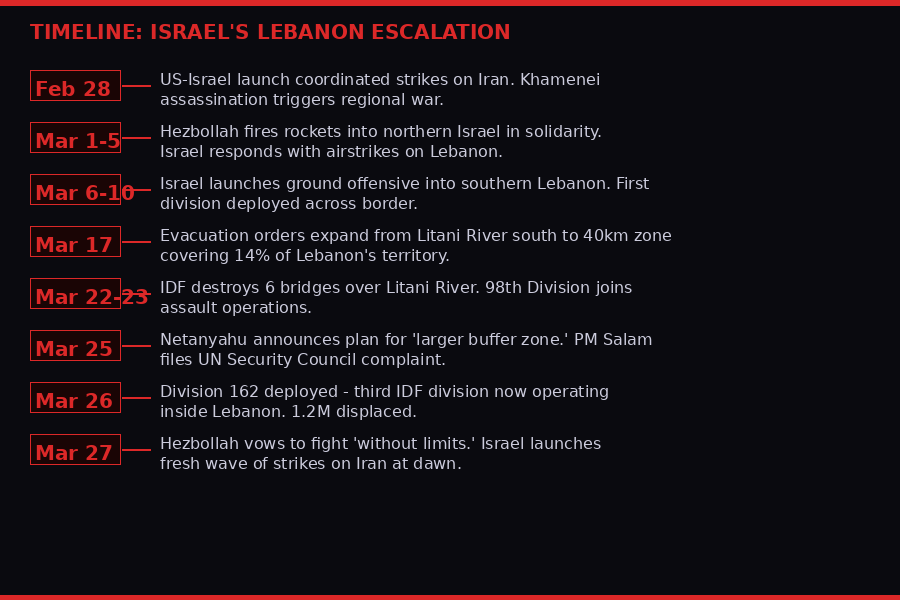
Timeline: Israel's Lebanon Escalation - Feb 28 to March 27, 2026
Key Figures
Benjamin Netanyahu - Israeli Prime Minister. Has publicly committed to a "larger buffer zone" in Lebanon, providing political cover for the three-division deployment without specifying limits or end conditions.
Israel Katz - Israeli Defence Minister. Issued the explicit order to destroy all Litani River crossings and declared that Lebanese civilians will not be allowed to return to the south until Israel deems it safe. His orders are being executed on the ground.
Naim Qassem - Hezbollah Secretary-General. Operating in the shadow of his predecessor's death and the broader Iranian war, he has committed publicly to fighting "without limits" and is directing an operational tempo of 45+ military actions per day against Israeli forces.
Nawaf Salam - Lebanese Prime Minister. Elected to lead a fragile state into its first real governance challenge: a foreign military occupation of 14% of national territory with 1.2 million people displaced. He has chosen diplomacy and legal channels. His toolkit is limited.
Joseph Aoun - Lebanese President, former army commander. Has described the bridge demolitions as an attempt to formalize Israeli annexation of southern Lebanon. His analysis of Israeli intent matches what independent observers see in the operational pattern.
Antonio Guterres - UN Secretary-General, on the receiving end of Lebanese PM Salam's warning call Thursday. Has no enforcement mechanism. Can document, appeal, and report.
Get BLACKWIRE reports first.
Breaking news, investigations, and analysis - straight to your phone.
Join @blackwirenews on Telegram