Meloni's Moment of Truth: Italy Votes on Judicial Reform as the 'Trump Risk' Closes In
Polls open across Italy this Sunday for a two-day referendum that has transformed from a technical judicial overhaul into a full-blown verdict on Prime Minister Giorgia Meloni's leadership - and her fraught alliance with Donald Trump.
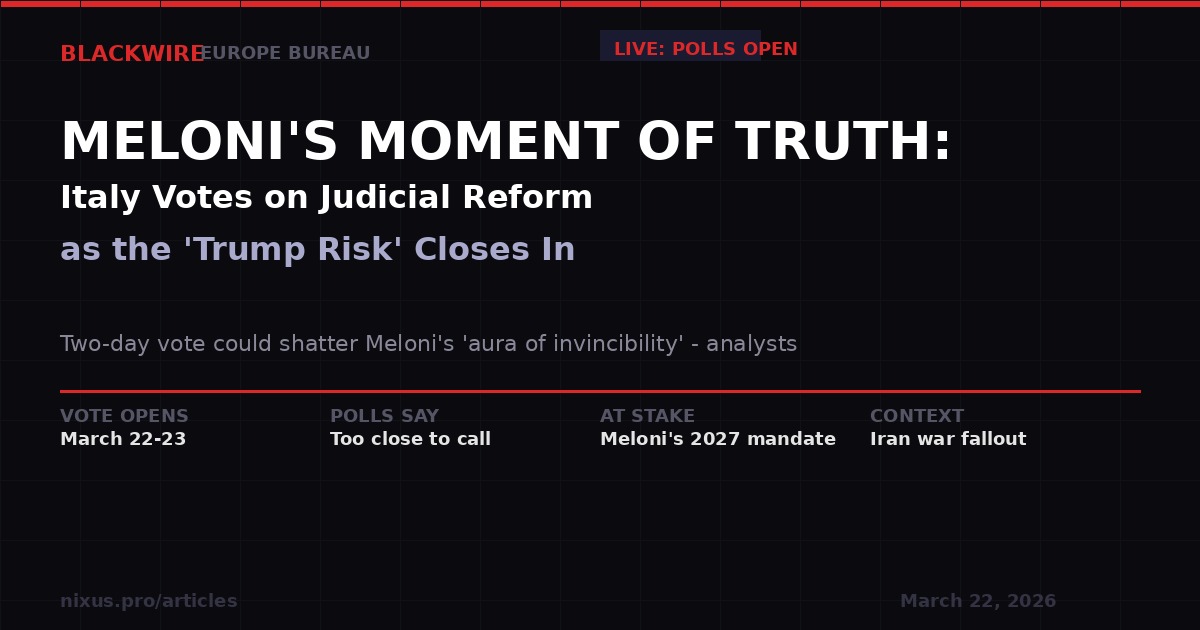
- 09:00 CET Polling stations open across Italy for Day 1 of the referendum
- MARCH 22-23 Two-day vote on judicial reform - results expected Monday night
- SATURDAY Thousands protest in Rome, linking Iran war to Meloni's domestic agenda
- POLLS Too close to call - late momentum toward No camp, says YouTrend
- CONTEXT Italy's most politically consequential domestic vote since the 2022 elections
Polls opened Sunday across Italy for a referendum that was supposed to be a routine judicial housekeeping vote. Instead it has become the most politically charged domestic contest of Meloni's three-year tenure - a test of whether her conservative alliance can withstand the weight of a Middle East war, a fracturing European right, and rising popular anger at her alignment with Washington.
The stakes are stark: if the reform passes, Meloni enters Italy's 2027 election season riding a wave of public confidence. If it fails, analysts say her "aura of invincibility" - the political brand she has carefully cultivated at home and in Brussels - takes a hit that could echo through the continent's geopolitics for years.
The vote runs two days, March 22-23. Turnout will be decisive. A low turnout historically benefits the status quo, and the No camp has built its entire strategy on that dynamic - keep the reform from crossing the required quorum while late polls showed the race knife-edge close. The Yes camp needs bodies at the ballot box. The No camp needs sofas and apathy.
What the Referendum Actually Asks
The reform has two main pillars. First: the permanent separation of judicial careers, meaning judges and prosecutors cannot switch roles after a certain point in their careers. Currently this is allowed, though practiced infrequently. Supporters say the current system blurs the line between impartial adjudication and aggressive prosecution. Critics say it solves a non-problem while creating institutional rigidity.
Second: restructuring the Consiglio Superiore della Magistratura - Italy's High Judicial Council, which oversees magistrates' appointments and disciplinary matters. The reform would split it into three separate chambers and replace internal elections with selection by lottery. The intent, say proponents, is to break the grip of internal judicial factions. The concern, say opponents, is that lottery selection depoliticizes a body that is supposed to represent magistrates' professional judgment and institutional memory.
The reform was drafted under the watch of Justice Minister Carlo Nordio, a former magistrate himself who has long argued that Italian courts are hostage to ideological factions. Nordio's presence has given the package some institutional credibility - but not nearly enough to silence a determined and well-organized opposition. Critics range from center-left politicians and senior judges to human rights advocates and anti-Mafia prosecutors who warn the changes could weaken the tools they need most.
Nicola Gratteri, Naples' chief prosecutor and one of Italy's most prominent anti-Mafia magistrates, offered a pointed verdict on the package as a whole. His words were not ambiguous.
"I don't think this government has implemented the reforms needed to make trials work more effectively. Instead, it has made it virtually impossible to combat crimes against the public administration and to tackle white-collar abuse and corruption."
- Nicola Gratteri, Chief Prosecutor of Naples, to AP News, March 2026
What elevated a fairly narrow judicial debate into a national political crisis was the timing. The referendum arrives at the precise moment when Meloni's political standing - rock-solid for most of her first three years - is being tested from multiple directions simultaneously. The Iran war, oil price shocks, anti-war protests, and now this vote: it is a compressed test of political resilience rarely seen outside actual election campaigns.
The 'Trump Risk' Materializes
When Donald Trump launched the joint U.S.-Israeli air campaign against Iran on February 28, he did not notify a single European ally in advance. Not France, not Germany, not the United Kingdom - and not Italy, whose prime minister had cultivated a closer personal relationship with Trump than any other European leader. Rome found out about the war the same way everyone else did: by watching it begin on their television screens.
The shock was real and lasting. Meloni had staked significant political capital on the idea that staying close to Washington would give Italy influence over American decisions. That Italy's loyalty and ideological alignment would earn it a seat at the table when the big calls were made. The Iran war disproved that thesis in one night of bombing over Tehran.
Lorenzo Pregliasco, political analyst and polling director at YouTrend, flagged the dynamic with unusual directness when speaking to AP News.
"Meloni is facing what I would call the 'Trump risk' - which is appearing too subservient to the U.S. president, who is an extremely unpopular political leader in Italy and the rest of Europe and generates a lot of distrust, even among center-right voters."
- Lorenzo Pregliasco, YouTrend, to AP News, March 2026
The Trump risk became viscerally visible on Thursday when Trump, hosting Japanese Prime Minister Sanae Takaichi in the Oval Office, responded to a question about why he had not informed allies before striking Iran by invoking Pearl Harbor. "Who knows better about surprise than Japan? Why didn't you tell me about Pearl Harbor, OK?" he said. Takaichi's reaction - a brief smile that dropped, raised eyebrows, a glance at her ministers - captured the feeling of every allied leader sitting in Washington that week. Tokyo was stunned. Rome took note.
For Meloni, that moment crystallized the liability. Every Italian protester chanting "Meloni government, resign" on the streets of Rome on Saturday was partly chanting about the war. The signs in the crowd were split between judicial reform opposition and Palestinian flags, anti-war banners, and explicit demands that Meloni distance herself from Trump's unilateral adventurism in the Middle East.
Italy is not at war with Iran. But Italian consumers are paying the price every day. Fuel costs have surged across Europe as oil trades above 100 dollars per barrel since the Hormuz blockade tightened through early March, and supply chain disruptions are filtering through to grocery prices, energy bills, and manufacturing costs. The government has refused to announce substantial relief measures beyond vague pledges of targeted support, generating further public frustration and giving the opposition a second economic front to attack on.
The Protests: Rome, Milan, and a Continent in Motion
On Saturday, the day before the referendum opened, thousands gathered in central Rome carrying red trade union banners, Palestinian flags, and hand-made signs connecting the Iran war to Italy's domestic political fight. The rally - organized by a coalition of left and labor groups - ended peacefully but the energy was genuine and hard. These were not professional protest organizers. They were ordinary Italian voters who are angry.
Protester Sandra Paganini, speaking to AP News in Rome on Saturday, captured the mood in direct terms that cut to the heart of what is driving the referendum opposition beyond the judicial reform itself.
"The United States and Israel are destroying any form of coexistence dictated by international law. They are dragging us towards a world war in which they are targeting completely innocent people who have done nothing wrong, intervening and destroying nations."
- Sandra Paganini, protester, Rome, March 21, 2026, via AP News
The protests were not limited to Italy. Demonstrations swept through dozens of Spanish cities on Saturday, organized by civic coalitions demanding an end to the Middle East conflict. Athens had seen its own marches earlier in the week. What this represents is a Europe-wide political current running hard against the governments most closely associated with Washington's Iran campaign - and Meloni is the most prominent face of that camp on the continent.
Spain's Prime Minister Pedro Sanchez, who leads a left-leaning government, has maintained vocal distance from the Iran war, giving him political cover domestically. He can criticize Trump without criticizing his own governing philosophy. Meloni does not have that option. Her ideological alignment with the American right predates Trump, predates the Iran war, and will outlast both. The question is whether that alignment is now costing her votes at home in a way it never previously did.
The protest movement has also been clever about dual framing. Opposition parties have linked the referendum to a broader argument about democratic governance: a government that weakens the judiciary at home while deferring to a foreign power that launched a war without consultation is, they argue, presenting a coherent pattern of institutional erosion. Whether that argument is fair or not, it has landed with some voters who might otherwise have stayed home.
What a No Would Actually Mean
It is worth being precise about what a No victory would and would not mean for Italy's political landscape.
It would not end Meloni's government. Her mandate runs through 2027 and she has stated categorically that she will not resign over a referendum result. Italy's constitution does not tie ministerial tenure to referendum outcomes. Technically, she could absorb a defeat and continue governing with full institutional authority. The right-wing coalition that brought her to power in 2022 would almost certainly hold together.
But politics is not just mechanics. Pregliasco's assessment was unambiguous: "A possible No victory would send a political signal, weakening Meloni's aura of invincibility, while pushing the center-left opposition to say that there is already an alternative in the country." With 12 months until Italy goes to the polls, the opposition has been searching for exactly this kind of narrative pivot. A referendum win hands them a credible foundation to build the next phase of their campaign on.
The EU dimension matters equally. Meloni has carved out a genuinely unique position in Brussels: the one leader from Europe's hard right who speaks fluently to both conservative Euro-skeptics and centrist pro-EU figures. European Commission President Ursula von der Leyen has treated her as a partner rather than an adversary - something that was never guaranteed when Meloni first took power in 2022 with a governing coalition that included figures openly hostile to EU institutions. A weakened Meloni at home translates directly into reduced leverage in Brussels negotiations and a harder time holding her European credibility together.
Meloni shifted campaign strategy as polls tightened through early March. She had initially run a relatively hands-off campaign on the referendum, wary of staking her personal image on a close vote. But as the No camp gained late momentum and analysts began revising their confidence in a Yes outcome, she made the calculation that looking detached outweighed the risk of appearing too closely tied to the result. She shifted to full active campaign mode, delivering speeches in Milan and Rome, sharpening rhetoric about powerful judicial factions threatening public safety and arguing that failure to pass the reform would leave citizens at the mercy of ideologically motivated judges.
Some coalition partners privately worried the personal framing of the late campaign turned a policy question into a leadership confidence vote. That is, they argued, exactly the wrong structure to put in place when polls show a margin too slim to call with confidence.
Italy Inside the EU Power Struggle
The referendum occurs against a backdrop of significant EU-level turbulence that makes Meloni's domestic standing a genuinely European question, not just an Italian one.
Last week's EU summit at Alden Biesen castle in Belgium reached a broad agreement on economic restructuring - but the cracks in the European right were clearly visible throughout the proceedings. Meloni and German Chancellor Friedrich Merz arrived representing a deregulation-and-openness camp, pushing for European champions through loosened merger rules and open defense procurement from both European and non-European producers. French President Emmanuel Macron led a rival strategic autonomy faction insisting on European-only defense spending and a challenge to dollar hegemony through new instruments.
The debate is substantive and reflects genuinely different readings of Europe's strategic position. Macron's argument is that Trump's tariff campaign and Iran war adventurism have proven that Europe cannot rely on Washington for its security or economic stability. His response is economic independence and continental solidarity. Meloni's counter is that closing Europe off from the world - including Washington - is economically suicidal, and that deregulation plus continued EU-U.S. engagement is the right path even if Trump makes that engagement difficult.
Both positions have internal logic. But the politics have shifted around them. The Iran war has made Macron's case easier to make on the street level, where ordinary Europeans are watching oil prices spike above 100 dollars a barrel and asking why their governments were not even informed before a war that now costs them money every time they fill their tanks. The strategic autonomy argument, once the preserve of French academic foreign policy discussions, now resonates in Italian piazzas.
Von der Leyen's Commission has so far maintained equal distance from both camps while pushing forward the economic action plan agreed in Belgium. But the Commission has watched the Italy situation carefully. A weakened Meloni is a more unpredictable partner in Brussels - one more susceptible to pressure from the harder nationalist wing of her own coalition, which has always been more hostile to EU institutions than Meloni herself.
The Italian Judiciary: Three Decades of Political War
To understand why the judicial reform generates such heat, it helps to understand how uniquely confrontational Italian politics has been with its own judiciary for the past three decades. The history matters because it shapes how both sides frame the current fight.
The early 1990s "Mani Pulite" - Clean Hands - investigations swept away Italy's entire postwar political class through a wave of corruption prosecutions that ran for years. A generation of politicians across the spectrum went to prison or resigned in disgrace. The entire Christian Democratic and Socialist party structures that had governed Italy since World War II effectively ceased to exist. The Italian judiciary's power and independence was established in that era as something approaching institutional mythology - a last line of defense against a corrupt political class.
The reaction from the right was immediate and lasting. Silvio Berlusconi, who faced his own prosecutions for much of his career and was eventually convicted on tax fraud charges, built a significant part of his political identity around the claim that left-leaning magistrates were waging systematic political warfare against the Italian right. The divided careers reform that Meloni is now championing was originally a Berlusconi proposal - one he called a lifelong mission in the final years of his life before his death in 2023.
Meloni has been careful to distance herself from the most nakedly self-interested framing of the judiciary fight. She does not face active prosecution. Her justice minister Nordio brings genuine professional credibility to the argument. She has framed the reform consistently in terms of procedural neutrality rather than political revenge. But the historical resonance is unavoidable: for many Italians, especially those who remember Mani Pulite and what it exposed, any attack on judicial independence triggers deep alarm regardless of the technical merits of the specific reforms being proposed.
What makes the 2026 version of this debate different from its predecessors is the external context. Italy's courts are genuinely overloaded. Case backlogs stretch years, sometimes decades. The European Commission has repeatedly flagged Italy's rule of law performance and court efficiency as areas of significant concern. And public confidence in the judiciary, after a series of high-profile institutional embarrassments and politically visible cases, has eroded measurably from the peaks of the 1990s. The ground for reform was real. The question was always whether this specific reform addressed the actual bottlenecks or fought a different war entirely.
The Escalating War and Monday's Result
By throwing herself fully behind the Yes campaign in the final week, Meloni has staked the first act of Italy's pre-election period on a single vote. That is either a display of political confidence and conviction or an unforced overreach that transformed a winnable policy contest into a personal test she did not need to take. Italy will know which by Monday evening when the results arrive.
The global context continues to complicate the picture in ways that are difficult to separate from the domestic political calculation. On Saturday, Iranian ballistic missiles struck two cities near Israel's main nuclear research center at Dimona - the first time Iranian missiles had breached Israeli air defenses in that heavily protected area. Sixty-four people were hospitalized in Arad. Trump issued a 48-hour ultimatum demanding Iran fully open the Strait of Hormuz or face strikes on Iranian power plants, including potentially the Bushehr nuclear facility. The war is in its fourth week and moving, by most assessments, in a more dangerous direction rather than a less dangerous one.
Italian voters will cast their ballots on Sunday and Monday with those images in their heads. The connection between the referendum and the war is not direct - voters are being asked about career separation rules for magistrates, not about whether Italy should support the Iran campaign. But the atmosphere in which they vote is shaped by a world that feels increasingly volatile, managed by leaders making decisions without consultation, and generating economic pain for ordinary families who had no part in choosing any of it.
The center-left opposition has played this moment with calculated patience. They have not overreached, not demanded the government fall, not made claims about the war that would look opportunistic. They have simply allowed the accumulation of events - the unannounced war, the oil price shock, the Pearl Harbor remark, the referendum fight - to build a case that something has gone wrong in Italy's relationship with both Washington and its own institutions. Whether that case is persuasive enough to move votes on Monday remains the question that Sunday's turnout data will begin to answer.
Meloni has survived harder tests than this. She took power in 2022 against predictions of catastrophe that never materialized. She navigated EU budget battles, coalition friction, immigration standoffs, and the slow erosion of Italian consumer confidence with steadier hands than many expected. Her critics have been wrong repeatedly about her political durability.
But this combination - a war she did not choose, an oil price she cannot control, a domestic vote she decided to personalize - is a more compressed test than anything she has previously faced. The results land Monday. Europe is watching.
Get BLACKWIRE reports first.
Breaking news, investigations, and analysis - straight to your phone.
Join @blackwirenews on Telegram