The $220 Queen: Inside Africa's Secret Ant Trafficking Network
From the anthills of Kenya's Rift Valley to living-room terrariums in Belgium and Beijing, a global black market has turned one of Africa's most important insects into a luxury commodity. The queen ants that hold entire ecosystems together now fetch more per gram than cocaine. And nobody made it illegal.
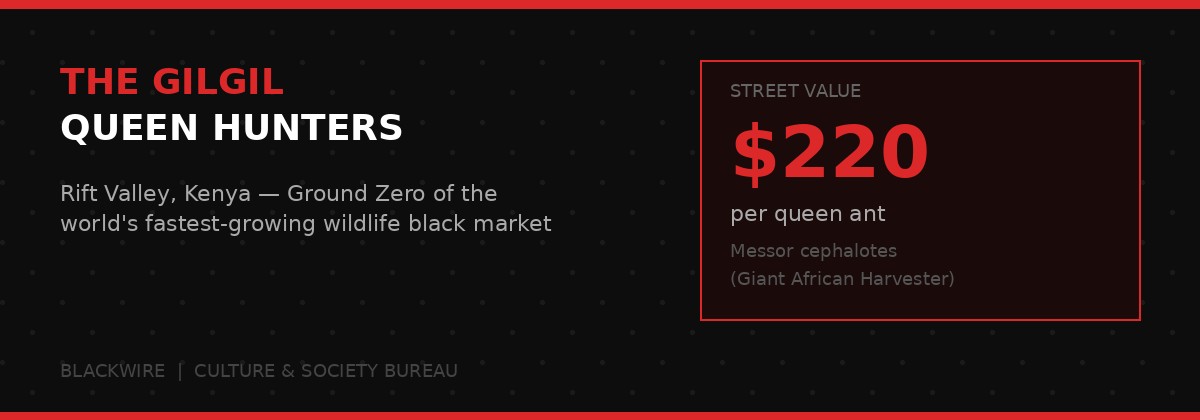
Gilgil, Kenya's Rift Valley. During the rainy season, thousands of giant harvester ant queens swarm from ancient mounds - straight into the hands of traffickers. (BLACKWIRE illustration)
The man asked not to be named. He's not a criminal, he said. Not really. He was just a guy who knew where the big red ants were.
"A friend told me a foreigner was paying good money for queen ants - the big red ones which are easily seen around here," he told the BBC this week. "You look for the mounds near open fields, usually early morning before the heat. The foreigners never came to the fields themselves - they would wait in town, in a guest house or a car, and we would bring the ants to them packed in small tubes or syringes they supplied us with."
He thought he was just making some extra money. He had no idea he was part of one of the fastest-growing wildlife trafficking networks in the world - one that moves not rhino horns or elephant tusks, but tiny creatures weighing less than a gram each, smuggled in cotton-lined syringes past airport scanners that simply cannot detect organic material.
One fertilized queen ant from the Rift Valley of Kenya sells for up to $220 on European and Asian black markets. A single person can carry thousands of them in their luggage. The total trade is worth millions annually. And there is currently no international law that makes any of it illegal.
The Town Nobody Was Watching
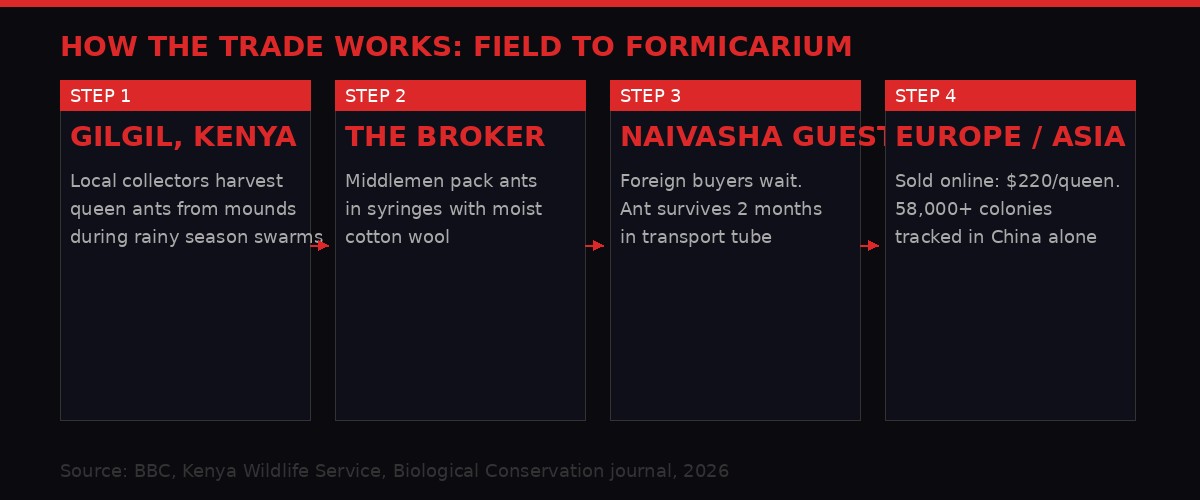
The full supply chain: from Rift Valley mounds to European collectors, via syringe-packed couriers. (BLACKWIRE infographic)
Gilgil is a quiet agricultural town about 90 kilometers north of Nairobi in Kenya's Rift Valley. It sits at high altitude, surrounded by sweeping grasslands. Cattle graze where there should be wildebeest. Wheat fields stretch where savanna once ran. But beneath it all, the land still belongs to something much older.
Giant African harvester ants - Messor cephalotes - have built their empires here for centuries. Their mounds rise from the red soil like terracotta spires. Some of those mounds are more than 40 years old. The scientist Dino Martins has been visiting certain nests near Nairobi for four decades and has watched them outlast governments, droughts, and land reforms.
During Kenya's rainy season, the ants do something spectacular. They swarm. Winged queens and males pour out of the mounds in their thousands, rising into humid air to mate in flight. The males die shortly after - their biological function complete, they become food for birds and lizards. The fertilized queens, each one carrying enough genetic material to build an entire new civilization, flutter back to earth and begin digging.
For local traffickers, this is harvest season.
The queens are easy to spot - large, reddish-brown, and briefly disoriented after their mating flights. A practiced collector can gather dozens in an hour. They are packed into small tubes or syringes with moist cotton wool, which keeps them alive and passive for up to two months. They don't require food. They don't make noise. X-ray machines at airports are calibrated for metal and explosives, not soft organic tissue.
"It was only when I saw the arrests on the news that I realized what I had been part of - and I immediately quit." - Anonymous former ant broker, Gilgil, speaking to the BBC, March 2026
The scale of the operation became visible to Kenyan authorities only when things went wrong. In 2025, a guesthouse in Naivasha - a lakeside tourist town near Gilgil - was raided by Kenya Wildlife Service officers. Inside, they found 5,000 live queen ants packed and ready for export. Three suspects were arrested: a man from Belgium, a man from Vietnam, and a Kenyan national.
Law enforcement officials described the find as unprecedented. It wasn't the value of the haul that shocked them. It was the realization that this had apparently been happening for years without detection. (Source: BBC News, March 29, 2026)
Who's Buying - and Why They'll Pay $220 for an Insect
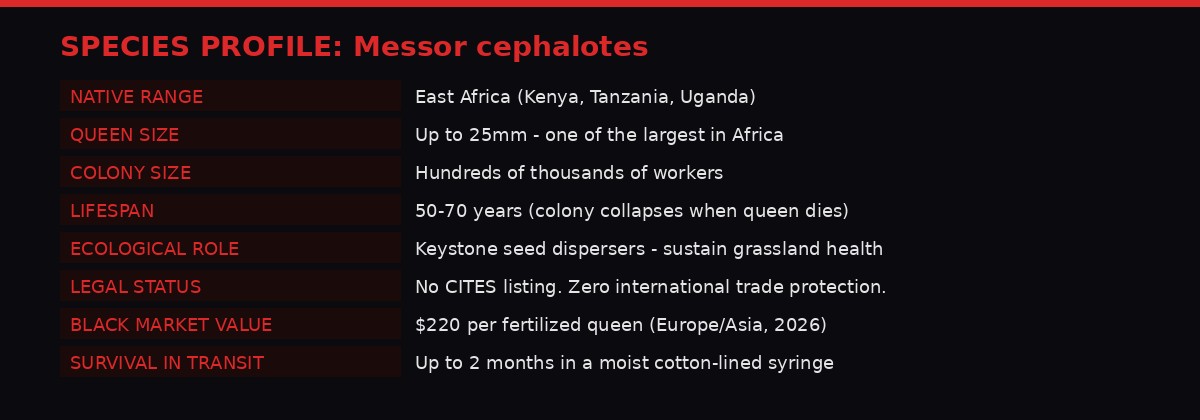
Messor cephalotes: the giant African harvester ant, now the most trafficked insect on earth. (BLACKWIRE species profile)
To understand why someone in Belgium would pay $220 for an ant, you have to understand what ant-keeping has become.
The hobby is global, and it is obsessive. Ant-keepers house their colonies in formicaria - transparent enclosures, sometimes made of acrylic, sometimes cast in gel, sometimes artfully sculpted from stone. Through clear walls, keepers watch workers excavate tunnels, soldiers patrol corridors, and nurse ants tend eggs no bigger than a grain of sand. It has the aesthetics of an aquarium and the intellectual engagement of a strategy game. Communities on Reddit, YouTube, and dedicated forums number in the millions.
For most hobbyists, a domestic ant species costs a few dollars. A queen of a common European species might sell for $15. But serious collectors want something different. They want size, behavior, and rarity. The giant African harvester delivers on all three.
Messor cephalotes is, by ant standards, enormous - queens grow to 25 millimeters, nearly an inch. Their workers are among Africa's most impressive seed gatherers, running foraging columns visible to the naked eye. Their colonies grow into the hundreds of thousands. And their behavior is complex enough to hold a hobbyist's attention for years.
Most crucially: a single fertilized queen can produce an entire colony from nothing. Buy one queen, and you are buying the foundation of a living civilization. She will lay eggs for the rest of her life - which could be 50 to 70 years. When she dies, the colony dies with her. She is irreplaceable.
That is why collectors pay $220. They are not buying an ant. They are buying a dynasty.
Zhengyang Wang, an assistant professor at Sichuan University in China who led a landmark 2023 study on the global ant trade, described monitoring over 58,000 ant colonies sold online in China over just six months. More than a quarter of the species being sold were not native to China - despite their import being illegal. Messor cephalotes featured among the most frequently traded non-native species.
"Initially, we were very excited when we learnt that many people have taken up keeping ants. A colony of pet ants are often kept in a formicarium... I'd say it's quite charming and can be a good way of educating people about insects and their behaviour. But then we realised, wait, isn't keeping invasive species incredibly dangerous?" - Zhengyang Wang, assistant professor, Sichuan University, 2026
The answer to his question is: yes. Extraordinarily so. But that concern came too late for thousands of queens already making their way across borders in carry-on luggage. (Source: Biological Conservation, 2023, Wang et al.)
The Ecosystem Beneath Your Feet
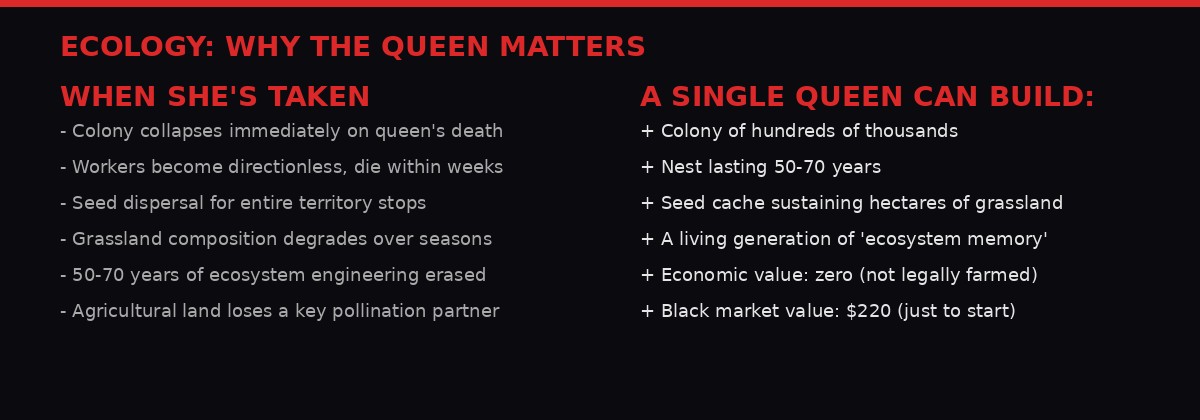
Remove the queen, and you don't just lose an ant. You lose decades of ecosystem work. (BLACKWIRE illustration)
Dino Martins has a way of talking about ants that makes you feel like you've been missing something important your entire life.
The Kenyan biologist has spent decades studying insect life in East Africa. He knows nests near Nairobi that have been continuously inhabited for at least 40 years - longer than most marriages, longer than most careers, longer than most governments. To him, these are not just bugs. They are infrastructure.
"Harvester ants are both keystone species and ecosystem engineers," Martins told the BBC this week. "They harvest seeds of grasses, and other plants and in so doing also help to disperse the seeds." Without them, the grasslands around Gilgil would be different places - thinner, less diverse, more prone to erosion. The ants' tunnels aerate soil. Their seed hoards feed birds and small mammals. Their sheer numbers make them a foundation species - remove them, and the structure above begins to shift.
The giant African harvester is not a cute quirk of the Rift Valley landscape. It is load-bearing.
Mukonyi Watai, a senior scientist at Kenya's Wildlife Research and Training Institute, chose careful language when he described the risk: "Unsustainable harvesting - particularly the removal of queen ants - can lead to colony collapse, disrupting ecosystems and threatening biodiversity."
Colony collapse, in this case, is total and immediate. Unlike bee colonies, which can potentially raise a new queen from existing larvae, an ant colony without a living queen has no mechanism for renewal. The workers - all female, all sterile - will continue their routines for days or weeks. They will tend eggs that will never hatch. They will patrol corridors of a nest that is already dying. Then they stop. The nest goes dark. Forty years of geological work falls silent.
The ecological damage from removing queens is not abstract or theoretical. It is measurable, irreversible, and cumulative. One nest lost is a localized impact. A hundred nests harvested from the same district across a decade is a landscape-scale event.
And with thousands of queens leaving Kenya every year - likely far more than have ever been detected - nobody can calculate what is already gone.
The Legal Vacuum
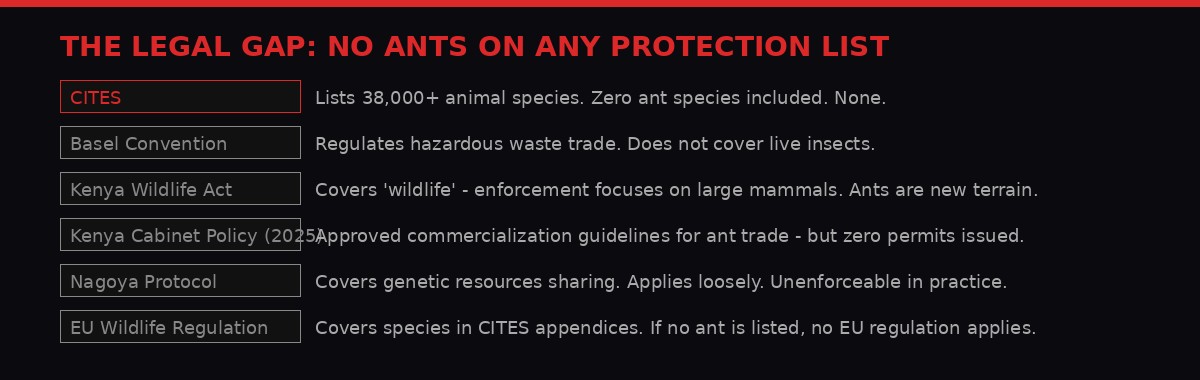
Not one ant species is listed under CITES or any equivalent international protection mechanism. The gap is not an oversight - it is a structural failure. (BLACKWIRE)
Here is the central absurdity of the ant trafficking crisis: most of it is not technically illegal at the international level.
The Convention on International Trade in Endangered Species of Wild Fauna and Flora - CITES - lists more than 38,000 animal species under various tiers of trade protection. Elephants are listed. Pangolins are listed. Even certain sea horses are listed. But no ant species appears anywhere in its appendices. Not one.
Sérgio Henriques, a researcher who specializes in the global ant trade, laid out the consequences plainly: "Without international treaties monitoring these movements, the scale of the trade remains largely invisible to policy makers and the global community."
Kenya itself does have national wildlife law that technically applies to ants - it is possible, in principle, to apply for a permit to legally collect and export them. The process would require an application to the Kenya Wildlife Service detailing the quantity, the destination, and a signed benefit-sharing agreement with the local community. But according to KWS, as of early 2026, zero such permits have ever been applied for. The legal pathway exists. Nobody uses it. Because the illegal pathway is faster, cheaper, and comes with a markup that makes $220-per-queen pricing look conservative.
The Belgian, Vietnamese, and Kenyan nationals arrested in Naivasha in 2025 were held under Kenyan domestic law. But their intended buyers in Europe faced no such exposure. Importing insects not listed under CITES into the European Union triggers no automatic legal scrutiny.
Airport scanner technology also works against enforcement. Live organic material - a queen ant packed in moist cotton wool in a plastic syringe - presents as essentially nothing on an X-ray. Kenya Wildlife Service has been explicit about the problem: they need better surveillance equipment at ports and airports. They do not yet have it. (Source: BBC News, March 2026)
What Would CITES Listing Actually Change?
A CITES Appendix II listing for Messor cephalotes would require that any international trade be permitted and documented, with exporting countries certifying that collection is "not detrimental to the survival of the species." It would not ban the trade - but it would make every queen a paperwork trail, dramatically raising costs and scrutiny for smugglers. Conservationists including Sérgio Henriques have been pushing for exactly this. Progress has been slow. CITES amendments require signatory agreement, and insects have historically struggled to attract political urgency.
A Timeline of the Trade That Surprised Everyone
The Global Demand Problem
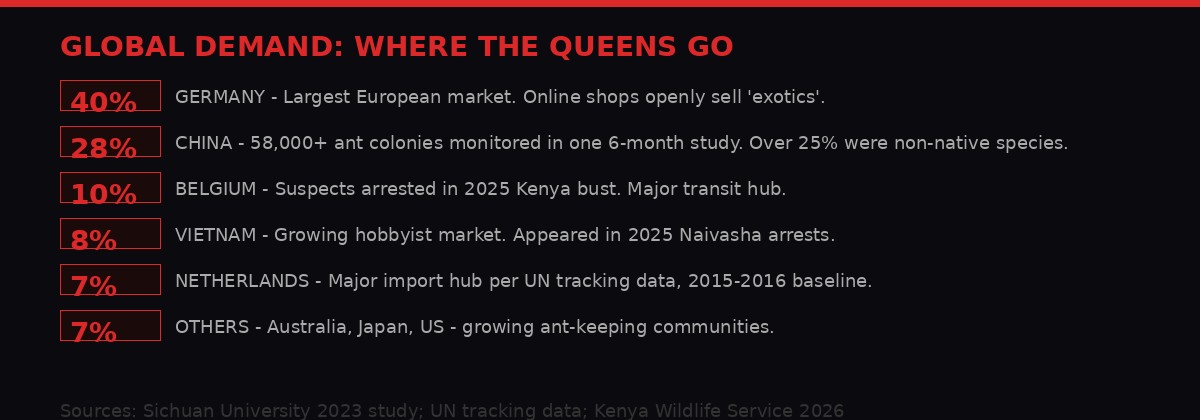
Europe and China lead demand. But the market is growing across Southeast Asia, Australia, and the United States. (BLACKWIRE)
The 2025 Naivasha arrests revealed a supply chain with reach. Belgium and Vietnam together represented two of the three most active ant-hobby markets in the world. Online communities in both countries feature thriving trade in exotic species, with dedicated shops selling formicaria, feeding cultures, and - via less visible channels - queens.
China is where the demand truly scales. Zhengyang Wang's research caught more than 58,000 colonies in active trade across a single half-year period in just one country. The ant-keeping community in China has grown explosively over the past decade, fueled by social media videos of colony construction that can attract millions of views. Sellers advertise openly on platforms including Taobao and Xianyu - China's eBay equivalent - with prices for exotic foreign queens starting at $100 and climbing sharply for African species.
The environmental hazard is not trivial. If even a fraction of those queens escape captivity and establish colonies in a new climate, the consequences could be severe. Wang's 2023 study specifically modeled what Messor cephalotes could do to agriculture in southeastern China: as one of the world's largest seed harvesters, an established population could "potentially disrupt predominantly grain-based agriculture." The word "disrupt" is doing heavy work there. In an agricultural context, "disrupt" means failed harvests, soil damage, and a cascade of downstream consequences for farming communities.
The European market is different in character. Hobbyists in Germany, Belgium, and the Netherlands tend to be more aware of the regulatory environment and more likely to keep species in genuine containment. But "genuine containment" and "perfect containment" are not the same thing. Ant escapes from formicaria are a documented phenomenon. And in the warming climate of southern Europe, what was once too cold to survive is becoming viable habitat.
Journalist Charles Onyango-Obbo, writing in Kenya's Daily Nation, identified something important: Kenya is treating a potential revenue stream like contraband. "The ants are not finite items like gold or diamonds," he wrote. "They are biological assets that can be bred and farmed, and their production can be scaled up to thousands a day. Yet we treat them like stolen artefacts." (Source: Daily Nation, Kenya, 2026)
Could Gilgil Become an Ant Farm?
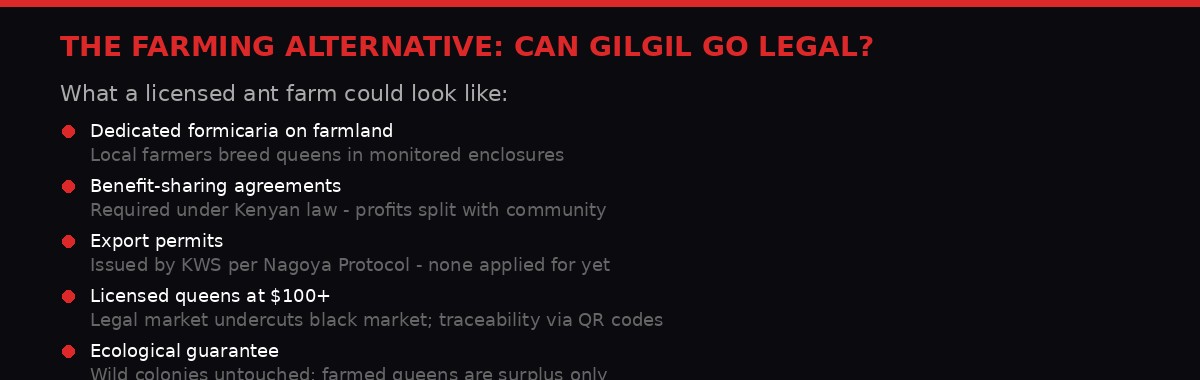
The legal route exists - barely. Kenya's 2024 cabinet guidelines opened the door to licensed ant farming with community dividends. Nobody has walked through yet. (BLACKWIRE)
The man who used to broker queens in Gilgil had a point, even if he didn't fully articulate it. He wasn't motivated by malice. He was motivated by money in a region where cash is scarce and the ants seemed, frankly, infinite. That's not a justification. But it is a fact that any serious response to wildlife trafficking has to reckon with.
Watai, the KWS scientist, outlined what a legal alternative could look like. Under Kenya's existing policy framework - approved by cabinet in 2024 but still without a single active permit - a licensed operator could establish a dedicated ant farming facility. Queens would be sourced under KWS supervision during swarm season. A portion of surplus queens - those that would otherwise mate, fail to establish, and die - could be legally collected and bred in controlled formicaria. The resulting colonies could be exported under permit, with documentation, to licensed buyers.
The benefit-sharing requirement would mean that farming communities in Gilgil or Naivasha would receive a percentage of the profits. For the first time, the people living closest to the ants would have a financial stake in their preservation rather than their depletion.
The legal queens would likely sell at lower prices than black-market queens - but the traceability and legal protection they offer buyers would be a genuine selling point in regulated markets. European customers who are nervous about importing species of uncertain provenance would have a legitimate channel. Chinese importers who want to operate legally could do so.
The catch: this system does not exist yet. Not one permit has been issued. Kenya Wildlife Service is focused on enforcement, which is where the immediate crisis is. The scientists who understand the ecology best - Martins, Watai - are warning about the damage, but policy infrastructure moves at geological pace compared to the speed of a syringe in a carry-on bag.
Meanwhile, the rainy season brings the queens out of the mounds, and someone in Gilgil is watching.
What Gets Lost - and What It Means
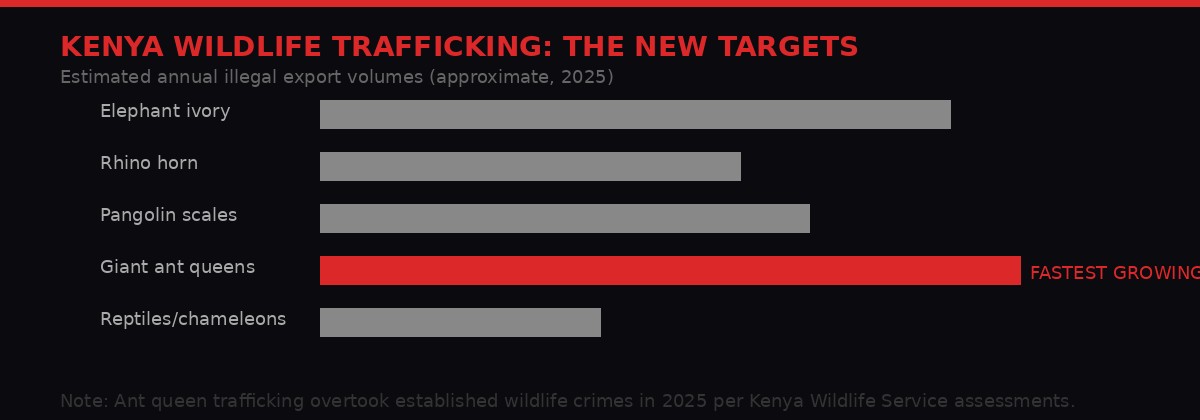
Ant queens have surpassed established trafficking categories as the fastest-growing wildlife crime in Kenya, per KWS assessments. (BLACKWIRE)
There is a story here that is easy to make funny. Ants! $220! A man in Belgium with a terrarium! It has the texture of a quirky news item, a water-cooler curiosity for a slow news day.
But the story underneath it is one of the oldest and most consistent patterns in the global relationship between the Global North and the Global South. Wealthy hobbyists in Europe and Asia develop a fascination. That fascination creates demand. The demand is met by a supply chain that reaches into communities where economic alternatives are limited, and where the natural resources being extracted have no price tag in the formal economy. The extraction damages an ecosystem whose value is distributed across the whole region and not captured by anyone who lives there. And the legal frameworks - designed for the last century of wildlife crime, for elephants and tigers and parrots - simply don't cover this new thing yet.
Kenya has been through this before, many times, with many species. The ant trade is new in form but ancient in structure.
Dino Martins - the man who has spent 40 years visiting the same ant nests, who knows their chambers better than some people know their own neighborhoods - framed it without sentiment. The trade is "likely only a fraction" of what's actually moving, he said. We are seeing the detectable edge of something much larger. The actual scale of what's been lost from Kenyan grasslands over the past decade of informal trafficking - the years before anyone was watching - cannot be known.
The queens that were taken didn't just die in a formicarium in Berlin or a terrarium in Chengdu. They left behind empty mounds. Silent tunnels. Workers that kept moving for a few more weeks before they too stopped. Grassland patches that lost their seed dispensers. Soil that dried differently without the network of tunnels beneath it.
Multiply that by thousands, across years, across the Rift Valley's grasslands, and the thing that was lost is not just insects. It is infrastructure that took half a century to build and can't be replaced by a policy paper or a permit system that doesn't exist yet.
The former broker from Gilgil stopped after the arrests. He got out. Good for him. But the network that recruited him - the foreign buyers with their syringes and their guesthouses - those people were not stopped by his departure. They found someone else. They are probably out there right now, in this year's rainy season, watching the queens swarm above the red soil of the Rift Valley.
At $220 a head, there is no shortage of reason to keep watching.
What Would Change the Situation
CITES Appendix II listing for Messor cephalotes - and other heavily traded ant species - would require documentation and export permits for any international trade, creating a paper trail that smugglers cannot avoid. Scientists and conservationists have called for this. It requires political will from signatory nations.
Airport scanner upgrades at Nairobi's Jomo Kenyatta International Airport and other East African transit hubs. KWS has formally requested better organic-material detection technology. Funding and deployment remain unclear.
Licensing and legal farming infrastructure - Kenya's 2024 cabinet guidelines exist but no permits have been issued. Activating this pathway would create economic alternatives for communities in the Rift Valley while taking some pressure off wild populations.
Platform enforcement in China and Europe. Online marketplaces where the bulk of trade takes place face minimal pressure to police ant sales. Until platforms treat ant trafficking with the same seriousness as other wildlife crime, the market will remain effectively open.
Get BLACKWIRE reports first.
Breaking news, investigations, and analysis - straight to your phone.
Join @blackwirenews on TelegramSources: BBC News (Wycliffe Muia, Nairobi, March 29 2026); Kenya Wildlife Service statements; Zhengyang Wang et al., "Global online trade of pet ants," Biological Conservation, 2023; Dino Martins, Kenyan biologist, quoted via BBC; Mukonyi Watai, Kenya Wildlife Research and Training Institute; Sergio Henriques, ant trade researcher; Charles Onyango-Obbo, Daily Nation Kenya; United Nations Environment Programme, e-waste Africa data; Nagoya Protocol documentation; CITES appendix data.